Home Blog Page 1047

Future climate sustainability must begin with education

0

Because climate change is a fairly recent issue, it has been difficult to arouse the public’s interest enough to reverse the trend. During my high school years in Hong Kong, students would occassionally be exposed to discussions on this issue. An article from Rabble suggests that “education about climate change must become front and center in our curriculum at all levels of schooling and across disciplines” — a statement with which I agree immensely.

As unpleasant as it is to admit, climate change is one of the most serious crises we face on this planet. It is no longer an issue that troubles only a few countries; the issue has now quickly come to affect almost every part of the world. If we do not act quickly, future generations will suffer.

Climate change issues cannot be solved in a short period of time, therefore, the education of future generations is an essential element in building a sustainable future.

One of the problems with current climate change education is that it’s introduced too late in the school curriculum. In elementary school, these issues are barely touched upon, and only in high school is the subject really introduced. It is best to start educating students when they are young, in order to successfully encourage them to change their attitudes and behaviours.

Educators must show understanding and be passionate when teaching.

Unfortunately, I find that some teachers do not have adequate knowledge on the issue, and are therefore unable to enlighten students fully. Furthermore, educators must be passionate about what they teach their students. A real interest in a certain situation would do wonders in influencing students’ perceptions.

Sadly, during my high school days, climate change talks could be dull. Teachers tended to bombard students with scientific research — statistics, graphs, charts, and quantitative facts — that did little to arouse student interest.

An interactive learning approach may be a useful alternative in educating students on climate change. Innovative, hands-on activities would be a decent method to use on children.

Point blank, while we may have yet to come up with some truly effective methods that will motivate people to participate in a viable climate change solution, education and awareness for our future generations is where it starts.

Carbon dioxide levels have almost doubled in the past 60 years, global sea levels have risen about 17 centimetres in the last century, and extreme weather is occurring all over the world. As everyone is responsible for the environment, we must invest our time, money, and interest in raising our future generations to be globally empathetic, innovative individuals who will build our sustainable future.


SFU Community Summit explores the future of innovation

0
The sea level along Vancouver's coastline is projected to rise by 1 metre by 2100.

Experts, innovators, and artists gathered at venues throughout the city last week to discuss the implications of innovation at SFU’s third annual Community Summit.

Hosted by SFU Public Square, this year’s summit, titled, “Innovation: The Shock of the Possible,” explored the impact of new ways of thinking on the most important social, environmental and economic issues in British Columbia, Canada, and beyond.

In an editorial published in the Vancouver Sun, SFU president Andrew Petter explained, “Innovation is not just about technological developments, although there are groundbreaking examples of technological advances to celebrate. Innovation also refers to new ways of imagining our society, of reconfiguring our democracies, and of reinvigorating our social contract.”

The week kicked off on October 19 with the Young Innovators Crawl, which invited community members to explore studios and open houses of local innovators under 30.

“We didn’t want to have just another youth conference where young people are just discussing what innovation is,” Shauna Sylvester, the executive director of SFU Public Square told the Vancouver Sun. “We wanted to look at how they’re innovating.”

Later that evening, opportunities for innovation were explored at RISE, a competition addressing sea level rise in Metro Vancouver. Teams were invited to pitch their ideas for how people in the area can “adapt and thrive — faster than the waters that surround us.”

Teams competed for a $35,000 grand prize, pitching their ideas to a panel of experts from the government, the media, and academia.

On a similar topic regarding an uncertain future, Ray Kurzweil, director of engineering at Google, and Richard Florida, a world-renowned urban theorist, joined forces at the Queen Elizabeth Theatre on Wednesday night for a talk titled, “Will Innovation Save Us?”

One of the talks that was most relevant to SFU students concerned the production, adoption, and use of open textbooks at post-secondary institutions. The province has already invested $2 million dollars to date in the BC Open Textbook project, which creates free open source textbooks for the most popular courses in the province.

Simon Fraser Student Society (SFSS) president Chardaye Bueckert, who was on the discussion panel for the event, spoke to its value: “It’s good to hear about the various developments that are going on in open source and what [students] can do to advocate for the use of them in their own classrooms, and how to engage in conversations with their professors in a way that’s productive and encourages them to get involved in the movement.”

Other events included a discussion on how to make Metro Vancouver a zero waste city, and a presentation on the viability of values-based businesses.

Overall, the week provided an opportunity to connect SFU students with faculty members as well as with innovators in the greater community and beyond, an effort that mirrors SFU’s commitment to being an engaged university.

Bueckert commented on the significance of that effort: “Instead of having our university as a bit of an ivory tower, it’s more out there and engaging with the public.”

Why Canadians need to stop freaking out over the Ebola outbreak

0
Extensive media coverage has left Westerners in a state of paranoia.

The rapid spread of the Ebola virus has undoubtedly become one of the worst epidemics in recent history, claiming the lives of thousands in West Africa. Ironically though, as victims fall prey to the outbreak thousands of kilometres from our borders, Westerners over here in ‘prosperity-land’ are left shaking in their boots. After all, it could be any day now that a weary traveller fresh from disease-ridden Sierra Leone steps foot on Canadian soil, thus sounding the alarms for terrified public health officials to race over and quarantine the hell out of that poor individual.

Extensive media coverage has left frightened Canadians in a state of paranoia. But what we Westerners must realize is that the only outbreak we’ll be falling prey to is that of anxiety bordering on hysteria.

In many respects, it’s become the media’s duty to shroud foreign epidemics in a certain melodrama. This isn’t to belittle the fact that, since March, over 4,700 people have been killed by the virus, it’s to say that our nation’s perception of this issue, through the corporate lens of the news, has been vastly misinformed.

Yes, Canadians should be worried about the possible introduction of the disease to the country — after all, it only makes sense — but what we should be even more worried about is how our news coverage is currently skewing the issue through too much speculation and too few facts.

Currently, our nation’s precautionary measures regarding a Canadian Ebola outbreak are sturdy. Apart from sending out 800 vials of experimental vaccines to the World Health Organization last Monday, the Public Health Agency of Canada has placed two large groups of epidemiologists and other experts ‘on call’ in Winnipeg and Ottawa.

Harper has needlessly ingrained a bloated issue into our Canadian psyche.

In addition, quarantine officers have been stationed at six major airports across the country, while Prime Minister Stephen Harper recently announced an intensive Ebola-preparedness plan with Nova Scotia Health.

Needless to say, the only people at risk of contracting the virus would be those health officials in direct contact with a patient. Similar to the swine flu pandemic in 2009, our nation’s extensive security measures would ensure that such a patient is under quarantine within minutes, and everyone outside the quarantine zone would be kept safe.

It’s a shame that the media has spewed out so much editorial commentary on how Ebola has the potential to wipe out our nation — a commentary further amplified by activists and politicians. It’s ironic that, while Obama cautions his American herd to “not give in to hysteria or fear,” Harper proclaims to the True North that a great threat is upon us, stating that due to globalized travel, foreign issues “could arrive at our shores very quickly.” Apart from playing Mr. Obvious, Harper has needlessly ingrained a bloated issue into our collective Canadian psyche.

Statements such as these have even influenced us to consider unnecessary measures to prevent the spread of the virus. Some officials have suggested that Canada close borders to people traveling from anywhere in Africa — an enormous continent where those living on the Eastern side have even less a chance of contracting the virus than Europeans. These irrational notions could cause us to turn away almost an entire continent of comparatively healthy people.

While it’s human nature to fear what we do not understand, our fears are simply a product of misinformed speculation. I hope I’m not the only individual who’d like a little more light shed on the realities of the issue, rather than some Hollywood drama concocted by corporate conjurors to make a dime.

University Briefs

0

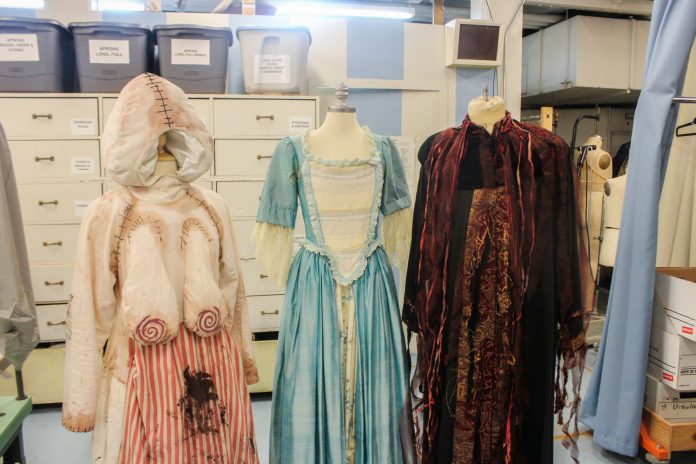
UBC Theatre and Film sells old costumes for Halloween

Students looking for unique disguises to wear this October 31 were invited to Freddy Wood Theatre last Wednesday for priced-to-clear costumes, courtesy of UBC’s Film and Theatre program.

From vintage bling to corseted Shakespearian dresses, all items were under $10; the sale helped to reduce the department’s inventory as well as raise funds for upgrades to their costume shop.

Some of the more outlandish costumes — such as a ghost getup from their production of Ubu Roi that is supposed to evoke the sense of a “loutish royal glutton on the prowl” — were up for a separate silent auction during the sale.

With files from The Ubyssey


Student residences hotbed for unsolicited form of trick or treating known as ‘break-and-enters’

Fanshawe College students are in danger of losing more than just miniature versions of candies this Halloween. According to London Police, there has been a 60.8 per cent increase in residential break-and-enters in the neighbourhood containing the school’s student residences in the past year.

The main items that have been targeted by thieves have not been little Snickers or Starburst, but electronics such as mobile phones and laptops.

Police have recommended that students keep their doors locked and windows closed, as those are the main points of entry for thieves, as well as humans in general.

With files from The Interrobang


Being a video game ‘zombie’ could be healthy

A new study conducted at Ryerson University suggests that playing video games before meals contributes to lower calorie intake for teenage boys.

According to nutrition professor Nick Bellissimo, when the subjects, who ranged from nine to 14 years old, played Angry Birds, they consumed, on average, 50 fewer calories than when they didn’t have any screen time.

The study concluded that after 30 minutes of gaming, the kids both ate less and were in a happier mood, which further contributed to their desire to eat less.

With files from Ryerson University

Crunching the numbers on the worth of university

0

Almost every undergraduate, at one point, asks the following question: is university worth it? I myself have spent more than a few hours over the last several years pondering this. But what does it mean for something to be worth it? Monetary return? Experiential value? Or is it merely another check we all feel must be crossed off before entering adulthood?

The answer to this question is all of the above. We’d all like a higher salary and to experience all of the joys of university life. Most commonly, we want to cross this task off our list, and move on. The question then is, does university actually get you any of these things?

From a monetary perspective, let’s assume you graduate at the age of 25 and you work for at least another 40 years. Having gone through post-secondary education, how much more money would you need to make in order to break even?

Simply combine the cost of your tuition, the opportunity cost you incur by attending school, and the interest on your student loan repayment. By my estimate, if you’re an undergraduate, your total cost will never be over $75,000. Now you may find this number rather staggering. You may question what job you could possibly get upon graduation that could justify such an expenditure. The answer, surprisingly, is just about any.      

University only needs to make you better off than you would have been otherwise.

Assuming you have the next 40 years of work to break even, and assuming that you will work full-time each year, you would need to make an average of 97 cents more per hour — than what you would have made without your degree — post-university for your degree to have been worth it. Some might argue that you won’t even be able to make that much more, being perpetually underqualified due to your lack of work experience.

My answer would be to wait. Take that BA designation off of your resume, get a ‘basic job,’ then apply for a proper one every week. Even if it takes you years to build up the work experience needed, it will still have been worth it. Remember, post-secondary education doesn’t need to make you a millionaire to have been worth it. It simply needs to make you better off than you would have been otherwise.

These ideas do not even consider the fact that university is amazing on its own merits, regardless of any payback. It is a time for you to be part of a community of thinkers, to become politically active, and socially mobile. To use a tired cliché, it is a place for you to discover yourself and find your academic muse. This muse, whether English or statistics, geology or acting, will inform and enrich the rest of your life. What is more, the experiences you share with your peers, professors, lovers, and friends will stay with you forever.

When you take all of these benefits into consideration, in conjunction with the fact that the monetary payoff is almost certain, surely your answer to my question is obvious: university is worth it.

Calgary feminist group takes back Halloween

0
The event encourages party-goers to don costumes that are empowering, clever, and diverse.

A feminist theatre company in Calgary is taking back Halloween from what they consider to be an oversexualized costume industry.

The group, Urban Curvz, is holding an event on October 31 called Take Back Halloween, which “promotes the opportunity for all genders to make and wear costumes that are empowering, clever and diverse.”

The organizers were inspired to launch the campaign after they spotted a sexy leopard costume geared towards three-year-olds in a costume shop window.

“When we saw that [. . .], the artistic director of Urban Curvz and I thought, ‘You know what, this is a problem for all ages,’” said Pam Rocker in an interview with the Calgary Eyeopener. “And this is something that we want to take back by having something like a feminist costume contest where you actually have to be creative and think about things that don’t gender stereotype and that maybe actually empower women.”

Some of the plans for the event include a feminist costume contest and a patriarchy haunted house, which will illustrate the spooky side of gender issues.

In the description for their Halloween event, the organizers defined feminist costumes as costumes that do not appropriate cultures, are not racist, and are not misogynistic, while at the same time are not slut-shaming.

“We are not saying that if you want to be a sexy nurse that’s bad, but we want to provide an alternative to something that isn’t gender stereotyping,” said Rocker.

The group also acknowledged that it is not only women and girls, but people of all genders who are victims of this oversexualized holiday.

“There is also a ‘mac pimp daddy’ costume for eight-year-old boys [. . .] I also saw a sexy Bert and Ernie and a sexy pizza slice,” explained Rocker.

Gals and ghouls looking to don feminist costumes this Halloween can reference Suzanne Scoggins’ costume guide, Take Back Halloween, which markets itself as “a costume guide for women with imagination.”

Created in 2011, the guide is divided into four categories: Glamour Grrls, Goddesses and Legends, Notable Women, and Queens. Costume ideas include Athena, Josephine Baker, Audrey Hepburn, and Jane Austen.

In addition to providing viewers with ideas from diverse backgrounds, the guide offers tips for creating these costumes at a reduced cost.

The guide, as well as the event, aim to deconstruct and dispose of the harmful gender stereotypes surrounding this holiday and to make it more friendly and accessible to the whole gender spectrum.

Rocker concluded with her hopes for the event: “Awareness doesn’t have to be a drag and that’s really important to us, so we want it to be an exciting night for people.”

Polar bears ruin Halloween for Nunavut children

0
The mayor of Churchill reported that trick or treaters do not dress up as seals or polar bears.

This year, Halloween night is going to look a little different for children in the Nunavut village of Arviat.

The Hamlet of Arviat has issued a public notice advising against trick or treating, as there have been more than the average number of polar bears spotted in and around the village in recent years.

As an alternative to the night’s door-to-door festivities, there will be an indoor event for children held at the community hall with activities such as face painting and a haunted house. They also hope to provide a shuttle bus to and from the event as a further safety precaution.

The public notice read, “It was clear that the majority of people liked the idea of providing a safer environment for kids to celebrate Halloween.”

The village is located about 250 kilometres north of Churchill, Manitoba — another city that deals with the dangers of bear activity in late fall, when the bears are waiting to start the seal hunting season once Hudson Bay is frozen over.

“Picture 1,200 kids going door-to-door in Arviat in the middle of polar bear season,” said Steve England, Arviat’s senior administrative officer.

“It’s a pretty obvious conclusion of what tragedies could come out of that. We’re just trying to safeguard the younger population by offering an alternative.”

Some have attributed the rise in bear activity near Arviat this year to the reduction of the polar bear harvest number — this winter, Cree and Inuit hunters are limited to 45 instead of 60 bears in Nunavut, Ontario, and Quebec.

In the past, Churchill has managed to keep trick or treaters safe with a helicopter warning to scare the polar bears off, as well as with consistent bear patrols, equipped with noisemakers, cracker shells, and rubber bullets.

These safety measures were even reflected in the costume choices in Churchill; mayor Mike Spence explained: “Nobody dresses up as seals. Nobody dresses up as polar bears here.”

Sesame Street for adults

0

Did you watch Sesame Street as a kid? The hilarious Broadway musical Avenue Q is the perfect grown up version, complete with full puppet nudity. The show won Best Musical, Best Book, and Best Original Score at the 2004 Tony Awards, and the music and lyrics are catchy, irreverent, and universal. Having seen the Broadway Across Canada production a couple of years ago, I was eager to see what Arts Club’s version would be like.

There are many parallels to be seen between Avenue Q and Sesame Street. Bert and Ernie are roommates Rod and Nicky, the Cookie Monster is Trekkie Monster, a grumpy, porn-obsessed bachelor. Some of the show’s familiar devices are also used, such as sounding out words one syllable at a time to introduce a new concept.

The other puppets in the show include Princeton, who is trying to find his purpose in life. He delivers the opening line: “What can you do with a BA in English?” His love interest, Kate Monster is also trying to find her purpose while spending her days as a teaching assistant for Mrs. Thistletwat. Things seems to be going well for Princeton until he decides he needs some time alone to find his purpose and he gets involved with performer Lucy T. Slut.

The non-puppet characters include Gary Coleman, the superintendent of the apartment block on Avenue Q, the aspiring comedian Brian and his Chinese wife, Christmas Eve, who is a therapist with no clients. Christmas Eve’s strong Chinese accent seemed a bit difficult to sustain throughout the show, but she is very funny as she imparts her wisdom and provides therapy to a few of the Avenue Q residents.

It can be a bit hard to get used to watching the puppets instead of the people manipulating them, but once you get into the story, this becomes less distracting. The songs are what really carry this show. With titles like “Everyone’s a Little Bit Racist,” “I’m Not Wearing Underwear Today,” and “The Internet is for Porn,” how can you go wrong? “Schadenfreude” also stands out as the cast sings about taking pleasure in the misfortune of others.

I also loved the Bad Idea Bears, who coax Princeton into buying a case of beer when he has no money, and convince Kate Monster that she should chug a few long island iced teas on a work night. Each character starts out thinking that their life sucks, spends some time looking for their purpose, and ends up accepting themselves and taking control of their life.

Arts Club Theatre Company presents Avenue Q on tour from October 4 to November 15, and on the Granville Island Stage from November 20 to January 3 2015. For more information, visit artsclub.com.


SFU experts question whether Ottawa shooting linked to terrorism

0

Canadians were left distraught last Wednesday, October 22, 2014 after an attack was made against Canada’s political leadership, resulting in the death of a Canadian war soldier.

At 7:00 a.m., Cpl. Nathan Cirillo, 24, lost his life while guarding the National War Memorial in Ottawa.

The incident has caused multiple media outlets to speculate as to the reasons behind the attack, with some labelling it as an isolated incident while others point to links with terrorism.

Rob Gordon, an SFU professor of criminology, says that his initial reaction to the attack was to believe that this “may have been linked to the hit-and-run that occurred in Quebec two days prior, and that it might be connected with the intention to bring terrorism to Canada.”

However due to recent reports, Gordon now believes that this “deranged individual” was probably not connected to an extremist group, as evidence suggests that he was a loner, appearing from nowhere, and who, within minutes of shooting a war soldier, tried to force his way into Parliament.

His choice of weaponry also suggests that he was poorly equipped for a potential terrorist attack.

“Had he not been shot and killed, we might have more answers to this individual’s actual motives for taking fire Wednesday morning,” said Gordon. “I doubt this man is linked to any extremist groups, and he is likely just a copycat killer; attempting to repeat Monday’s incident, which resulted in the death and injury of two other Canadian soldiers.”

He continued, “Terrorist attacks usually harbour subsequent threats and, at this point, we have not witnessed any.”

New intelligence reports also indicate that the shooter in Ontario, Michael Zehaf-Bibeau, and Martin Couture-Rouleau, the driver in the fatal hit-and-run in Quebec, might have possessed similar character traits, but that there is no direct link between the two individuals or either incident.

“I doubt this man is linked to any extremist groups.”

Rob Gordon, SFU professor of criminology

Contrary to Gordon’s view, Andre Gerolymatos, an SFU professor of history and international security expert, believes that Zehaf-Bibeau was following directions from ISIS, and that this might be the first of many terrorist-like attacks against Canada.

“It is a mechanism to cause fear,” said Gerolymatos of the shooting. “Whether you kill one individual or hundreds, it causes the same effect — fear has been instilled upon the country and its government.”

Gordon noted that there were certain government actions that took place on Wednesday morning that would make the incident extremely well-timed if it was connected to terrorism.

For one, Stephen Harper was in the process of passing a security bill that would grant the Canadian Security Intelligence System (CSIS) more power to track and investigate potential terrorists. This bill was scheduled to be tabled Wednesday, but has been deferred for the time being, with government house leader, Peter Van Loan refusing to acknowledge when this bill will come to light.

Secondly, Malala Yousafzai, a Pakistani woman, was being awarded honorary Canadian citizenship in Toronto, due her courageous efforts in trying to establish activism for young girls in her region of Pakistan and her resilience in the face of brutalization from the Taliban.

Whether or not Wednesday’s events symbolize a terrorist attack, both SFU experts agree that more security precautions and surveillance will be increased across the country.

Gordon said, “RCMP enforcement will be expected to be hyper-vigilant, in the off chance that something does happen again.”

“Fear has been instilled upon the country and its government.”

Andre Gerolymatos, SFU professor of history

Gerolymatos echoed these thoughts: “Politicians and legal enforcement will have tremendous pressure to make sure a tragedy like this doesn’t happen again — whether that be to increase levels of electronic security or take preventative detention measures; although this could prove difficult and upsetting to Canada’s legal system.”

Despite this, if Harper’s new security bill is passed, it might include measures to allow preventative detention — as long as these remain within the scope of the law.

Gordon added, “Although an abundance of caution is needed, police and government officials must strike a balance between conducting activities in a normal manner, while constructing a surveillance mechanism that will allow them to take dangerous perpetrators down.”

Happy Halloween from The Peak!

0

The Peak’s carved pumpkin! Hope you have a spooky Halloween SFU!