
SFU rejoins U SPORTS’ Canada West in 2027

By: Jonah Lazar, Staff Writer
Following SFU’s decision last September to leave the National Collegiate Athletic Association (NCAA), the US’ premier collegiate sports governing body, the university is set to begin competing in Canada’s collegiate sports governing body, U SPORTS, starting in the fall of 2027.
On May 7, SFU was accepted into Canada West, U SPORTS’ western division, as a probationary member. SFU received probationary membership from U SPORTS at the U SPORTS annual meeting at the beginning of June.
In U SPORTS, SFU will compete in the Canada West conference against 17 other universities in Western Canada, including UBC, UVIC, and other universities in BC, Manitoba, Alberta, and Saskatchewan.
SFU’s decision to leave the NCAA championships last September was largely due to budgetary concerns. The university estimates they will save over a million dollars annually in fees and wages from the change in competitions. This is mostly due to softball, golf, and outdoor track and field being cut, as U SPORTS does not offer these sports. These teams will begin to gear up for what will be their last season in action.
After this announcement, SFU’s Student-Athlete Advisory Committee published an open letter opposing SFU’s decision to leave the NCAA. They stated that leaving the NCAA championships will “affect students, alumni, staff, recruitment, institutional reputation, global partnerships, and the student experience at SFU.” They continued, “SFU has created a rare environment where Canadians and international students can access elite sports competition while obtaining a Canadian degree. That is something worth preserving.” This change will also affect scholarships for some, as SFU will determine their athlete scholarship budget on a departmental basis.
Some users on r/simonfraser echoed the letter’s sentiment. u/BeffBezos shared, “NCAA inclusion was one of the only things SFU had going for it.” Others had more mixed opinions. u/canadahuntsYOU shared, “Makes sense, unfortunately. Definitely shit news for the NCAA students but constant cross-border travel and fees associated with that is an obvious choice for slashing. At least now we’ll see SFU regularly play UBC again?”
SFU will continue to compete in the NCAA championships for the 2026/27 academic year before leaving the competition. Prior to this withdrawal, SFU was Canada’s only NCAA university in an otherwise American program.
According to SFU’s media release, SFU believes that their admission into Canada West will “ensure long-term sustainability of varsity sport.” The university also believes that “competing against local Canadian universities will enhance natural rivalries and the fan experience on campus for all SFU students, leading to a deeper sense of SFU community.”
The move to U SPORTS means policy for trans athletes will change. As of 2025, the NCAA banned trans women from competing in women’s sports. Under U SPORTS, trans athletes may practice and compete on the team that aligns with their gender. However, this doesn’t guarantee trans inclusivity for athletes. The Student-Athlete Advisory Committee’s letter stated, “Transgender women are barred from participating in female competitions in Alberta. Teams in Canada West routinely compete against institutions located in Alberta.” Overall, the change means that trans athletes will lose the option to compete in the widely acclaimed NCAA.
As reported by SFU News, Canada West president Ben Matchett stated:
“We are pleased to welcome SFU back into the fold”
— Ben Matchett, Canada West president
“We were impressed by the commitment of SFU’s institutional and athletic leadership to this process, and we look forward to working with them on the transition process as we prepare for the Red Leafs to join competition in the fall of 2027.”
The Peak reached out to the Student-Athlete Advisory Committee, however did not get a response by the publication deadline.
Low income transit pass moved by councillor Sean Orr

By: Maya Barillas Mohan, Staff Writer
On June 3, councillor Sean Orr of the Coalition of Progressive Electors introduced a motion to create a low income transit pass to assist “those earning less than $40,000 a year” in Metro Vancouver, as stated in the motion. As a result, the City will engage in conversation with TransLink to figure out the feasibility of the pass. Additionally, the City and TransLink will lobby for funding from the provincial government. The Peak reached out to Orr to learn more.
Orr shared that the $40,000 figure came up repeatedly in his research. In Vancouver, “the median individual income is $46,000. So that’s why I choose it, because it’s the median: not the average, but the median,” said Orr. The median figure means half Vancouverites earn less than $46,000, while the other half earn more. In Vancouver, full-time hours at minimum wage comes in at less than $38,000 a year.
Orr said, although “a lot of people take transit already in Vancouver,” reducing transit prices forms a positive dual impact: it gives people more choice in how they commute, and it has environmental benefits. “Anytime we can get people out of cars and onto transit, it’s good for the climate,” he said.
Posters organized by Movement YVR around the city advertise petitions for the low income transit pass. According to their website, they are an advocacy group focused on unifying transit riders’ voices to “advocate for better, more equitable transit across Metro Vancouver.” The group is petitioning for the low income transit pass to be implemented before TransLink’s next fare increase. They state, “No one should be denied transit because they can’t afford it.”
Transit fare increased 4% in 2025, and will experience another increase as of July 1. The Peak reached out to TransLink directly for a statement. They shared, “Transit fares will increase [ . . . ] on July 1 to help expand transit services throughout Metro Vancouver,” like bus service, new routes, and infrastructure. The increase will “help our revenues catch up, after fare increases were capped under the rate of inflation for five years.”
The company has faced financial challenges in previous years, due to issues in their financial structure. The company announced a $72 million deficit in their 2025 budget. As reported by Vancouver Sun, they warned that bus services would experience a “50% reduction in bus service and 30% cut in SkyTrain and West Coast Express service” without emergency government funding. Ultimately, in May 2026, the federal government gave TransLink $1.5 billion for 10 years of operations and developments.
Despite these challenges, Orr’s motion states, “Affordable transportation is linked to better social well-being and health outcomes.” Currently, transportation costs are rising and reduced fares are only available for some: people with disabilities or seniors aged 65 and older.
“The fact we don’t have a low-income transit pass, but cities like Calgary, Edmonton, Halifax, New York, LA, Denver, the list goes on. It’s really frustrating. It’s something we absolutely need to be on par with those cities about.”
— Sean Orr, COPE City Councillor
“We can have it so that people aren’t choosing groceries over taking transit or they’re not missing job interviews or missing hospital visits with loved ones because they can’t afford transit. So, I really think it’s just a matter of political will and really committing to affordability across this province.”
Canucks orchestrate hierarchy overhaul

By: Jonah Lazar, Staff Writer
After finishing rock bottom in the NHL Western Conference, the Vancouver Canucks are set to reshape their managerial team. The 2025/26 campaign saw the Canucks pick up 25 wins across 82 games, finishing 19 points behind the next worst-performing team in the NHL. This is following their 2024/25 season, when the team picked up 38 wins, and finished fifth place in the Pacific Division — out of eight teams. Their 2025/26 season is regarded by many as the worst season in Canucks history: star player and captain, Quinn Hughes, was traded away, and the team then picked up their lowest points tally in a full season since 1998/99.
In the aftermath of these many setbacks, the Canucks team owner Francesco Aquilini has changed the personnel running the side. General manager Patrik Allvin was fired from the helm of the franchise after four years in charge, and long-time president of hockey operations, Jim Rutherford, stepped down from his position.
The dissolved hierarchy will leave room for new leadership to take charge, with some familiar faces returning to Rogers Arena, where the team plays. Franchise legends Henrik and Daniel Sedin, who played together for the Canucks from 2000 to 2018, will take over as co-presidents of Canucks hockey operations, in place of the departing Rutherford. Ryan Johnson will take over as general manager. Johnson has been working for the Canucks since the 2013/14 season, primarily in player development with the Vancouver Canucks. He was also general manager of the Abbotsford Canucks, a franchise operated by the Vancouver Canucks who compete in the American Hockey League.
Soon after taking charge, Johnson dismissed head coach Adam Foote and assistant coaches Scott Young, Kevin Dean, and Brett McLean. Foote was fired after just one season coaching the team. Speaking to the press, Johnson thanked the coaching staff for their commitment during “a very tough and tumultuous year of so many variables.” He shared that their dismissal was “less about change in the past and more about implementing something for the future.”
Filling Foote’s shoes as head coach will be Manny Malhotra, who worked with Johnson at the Abbotsford Canucks, and was a player in the Canucks’ run to the Stanley Cup finals in 2011. In a statement sent out to Canucks season ticketholders, the Canucks stated,
“What stands out most about Manny isn’t simply his experience; it’s his ability to bring people together, establish accountability, and create an environment where players can thrive.” — The Canucks
Today marks an important milestone in our journey forward.”
The Peak reached out to the Abbotsford and Vancouver Canucks for a statement, but did not receive a response by the publication deadline.
Expanding public safety to include gender-based violence during FIFA
By: Lucaiah Smith-Miodownik, News Writer
Across Turtle Island (North America), the FIFA World Cup is well underway. While host cities have prepared for this major event by increasing police presence, two local groups are leading the effort to expand community-based safety services during Vancouver’s football fever. Battered Women’s Support Services (BWSS) “provides support and advocacy for women who have experienced abuse, as well as community education and training about violence against women” and Good Night Out Vancouver focuses on “building community capacity to prevent and respond to sexual harassment and sexual assault in all sectors, with a focus on hospitality, music, arts, and nightlife.” Together, the organizations are working to prevent gender-based violence during the FIFA World Cup in Vancouver.
In a public service announcement released on June 8, both organizations asked: “What would it look like if safer streets, safer nightlife, and safer homes were all part of the same public safety conversation?” While the City of Vancouver directs focus towards a myriad of safety issues ranging from riots to terrorism threats, BWSS and Good Night Out are taking action to prevent vulnerable populations from falling through the cracks.
In an effort to support, the City informed The Peak, the Vancouver host committee has allocated funding to Good Night Out, as well as other organizations working to end gender-based violence.
As part of its increased service, the BWSS shared they “will temporarily expand its specialized crisis-line services to 24 hours a day, seven days a week throughout the six-week tournament period” to support those in need, at home or elsewhere. The crisis line will provide reliable “access to information, emotional support, safety planning, risk assessment, crisis intervention, and referrals” for survivors.
Additionally, the BWSS will hand out “FIFA Safety [Cards], a practical resource designed to increase awareness of available supports and provide accessible safety information to individuals who may be experiencing violence, coercive control, stalking, harassment, or other forms of abuse.”
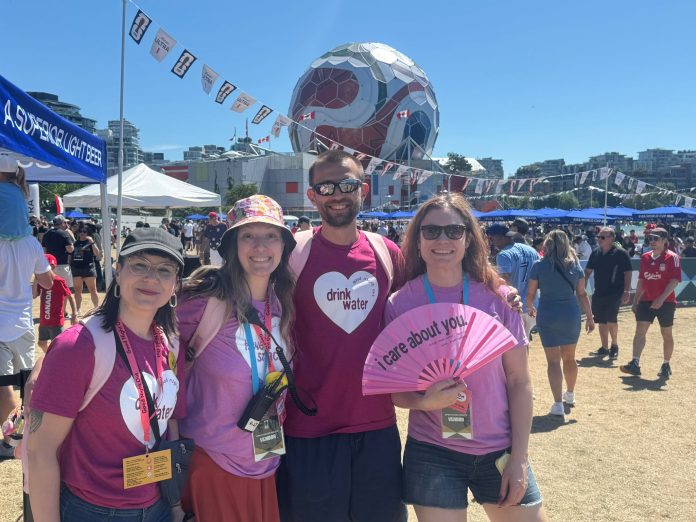
To strengthen public-facing support, Good Night Out, “will have extra outreach teams in the downtown core” throughout June and July. These teams, dressed in peach shirts, are designed to create safer environments for “women, marginalized genders, and anyone feeling like they need support.” The announcement shared that Good Night Out teams will be working “directly within nightlife and hospitality settings” to help create atmospheres of safety. Good Night Out is explicit in that their services will be for “anyone in the public realm, including patrons, workers and people sheltering in the street.”
Regardless of whether it’s the heart of downtown or behind closed doors, the two groups are striving to help create a safe environment for all.
The groups note that “for many survivors, the risks associated with major sporting events are not experienced in stadiums. They are experienced at home.” Studies suggest that there is “a strong correlation between major sporting events and domestic violence.” Both organizations noted that while “sport does not cause violence against women [ . . . ]
“Periods associated with heightened emotional intensity, alcohol consumption, gambling stress, nightlife activity, and social gatherings can intensify existing patterns of coercive control and abuse.”
— Battered Women’s Support Services and Good Night Out Vancouver
A look into Vancouver’s past sporting events illuminates such risks. As reported by City News, BWSS executive director Angela Marie MacDougall explained that during the 2010 Olympic games, the organization received more calls for support.
BWSS and Good Night Out are collectively pushing “for gender safety and violence prevention to be recognized as essential components of public safety planning during major international events.”
As part of this initiative, BWSS also released a short film titled The Space Between, which chronicles the “coercive control and the realities many survivors experience” hidden from the public eye. In the video, they share, “Not all abuse is visible. Too often it is downplayed. Coercive control is abuse. Safety changes everything.”
To access the BWSS crisis support line during the FIFA World Cup, call 1-855-687-1868, open 24/7 until July 19
FIFA’s corruption makes World Cup viewership ethically problematic
By: Jonah Lazar, Staff Writer
Content warning: brief mention of genocide.
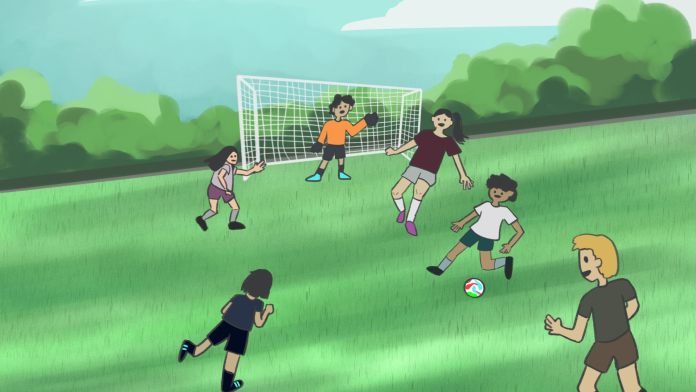
One of my earliest memories is my dad standing a foot away from the TV, yelling at Arjen Robben for having missed an open net in the 2010 World Cup Final. In 2014, I watched nearly every game of the tournament in the basement with my older brother, watching in horror as England crashed out in the group stage, and then going to the park and trying to recreate some of the iconic goals from the tournament. As I grew older, I became more aware of FIFA’s unethical apathy in selecting who hosts the World Cup. The 2018 World Cup in Russia was marred by the 21 preventable worker deaths and the nation’s anti-LGBTQIA+ policies. In 2022, Qatar admitted that 400–500 migrant workers died while working on World Cup related construction. Russia’s anti-LGBTQIA+ policies were echoed in Qatar which criminalizes homosexuality with fines, prison time, and even execution. Many queer fans skipped the tournament, fearing prison or abuse if they were to attend. The history of human rights abuses had been present long before these countries were selected as hosts for the games.
FIFA’s history of corruption and sportswashing, by using fan’s love of the game to wash over host country’s human rights abuses, is a tragedy for the sport of soccer. It has a monopoly on the world’s most popular sport, funding the national federations and setting codes of conduct for leagues all the way down to players. FIFA has taken the love of soccer that so many people share, and turned it into complicity for its harmful political agenda.
This year, FIFA has yet again been under scrutiny; the US’ attacks on Iran have been central to the backlash, especially considering that the newly-minted FIFA Peace Prize was awarded to Donald Trump last year.
The Palestinian Football Association demanded that Israel’s football association be banned from competing over the genocide in Gaza, for the murder of athletes. However, FIFA’s toothless sanctions on Israel amounted to just 150,000 Swiss francs (around $260,000 CAD) and permitted them to play in the qualifying process, which they lost.
Once every four years, this tournament feels like the centre of the universe for some, drawing attention to some incredible human stories of achievement. World Cup debutants Cape Verde held Spain to a 0-0 draw and Curaçao scored their first-ever World Cup goal against Germany, prompting celebrations across the nation. These moments have been orchestrated by players who have worked tirelessly to achieve their dreams of playing on the biggest stage, and have been watched by, quite literally, billions of people around the world. Yet, the enjoyment of watching our countries take on one another in a global celebration, invariably results in support for FIFA due to its monopoly. Whether it’s via streaming through a platform paying FIFA for television rights, buying stadium tickets, or even by consuming advertising at the free fan festivals, our turnout funds their politics.
For those of us who have grown up with soccer balls at our feet and jerseys on our backs, FIFA’s continual decision to turn our collective love for soccer to sportswash the host country’s history and actions is deeply saddening. Soccer fans deserve to be able to enjoy watching our beloved sport without having to wrestle with the morality behind our passion. Maybe it’s time for a new organization.
Workers should have the right to strike
By: Maya Barillas Mohan, Staff Writer
Striking is an important part of negotiating fairer labour conditions. But for essential workers, striking is not an option as they provide a service that’s required by the public to keep those services accessible to the public. Canada’s labour code covers a wide range of areas including collective bargaining and some private workplaces that are federally regulated, like postal workers and flight attendants for airlines. Yet, recent consultations could reconfigure what an essential worker is thereby removing the right to strike for more workers. For others, the minister of labour can invoke section 107 of the code to end strikes, forcing people back to work. The right to strike is crucial for a democratic and just society.
The labour program underwent a month-long consultation starting April 17. These consultations were with labour unions, employers, First Nations, Inuit, and Métis governments, and others. This code affects people in a union working in federally regulated private-sector companies like airlines and crown corporations: as of 2024, this was 1,060,000 employees, according to the federal government. The goal was to “strengthen labour relations” to protect and support workers. However, many of the agenda items open for feedback like who is an essential worker and when can the government stop a strike, make me question this goal. Strikes are a key negotiation tactic for unions as they disrupt an employer’s ability to extract profit from their employees’ labour. If the government expands on who an essential worker is, especially around trade infrastructure like port and airline workers, then those people lose their right to strike. Governments should not be in the business of removing workers’ rights.
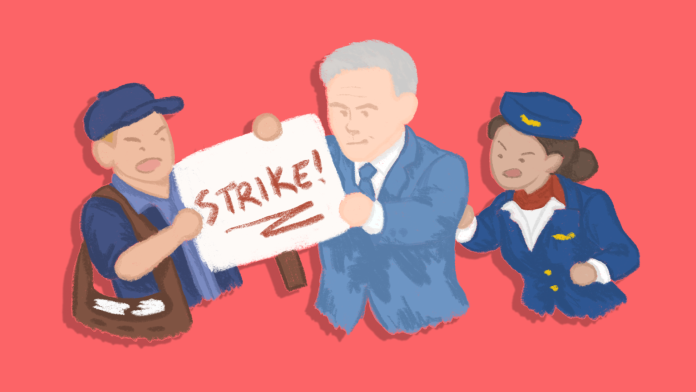
Section 107 of the Canada Labour Code is also up for review. This section has been used by the minister of labour to interject in labour disputes by directing the Canada Industrial Relations Board to order strikers to go back to work. Since 2024, the Liberal party has used it at least eight times. It’s undemocratic as it overrides the voice of union members; without the ability to withhold labour, the employer still sets all the terms. Last August, Air Canada employees went on strike to demand ground pay surrounding flights, and percentage increases in pay correlating to years of loyalty with the company. But less than 12 hours later, the minister used section 107 to try and force them back to work. The flight attendants defied it and secured an agreement a few days later. After this, the Canadian Union of Public Employees filed a court challenge about the constitutionality of the minister’s power, as they argued it violates their right to strike. Additionally, the New Democratic Party introduced a bill to remove the section from the labour code, which will be debated this fall. If successful, the government cannot force workers back to work and strikes will remain a powerful bargaining tool.
Students should care about changes to labour legislation. We all have the right to assemble, make decisions democratically, and collectively bargain to improve our working conditions. These changes could impact our friends, family, community members, and even ourselves so we should still advocate for fairness.
When the government changes who is an essential worker, preventing them from striking, whose rights are being protected?
When governments interfere in collective bargaining to force you back to work, then your right to strike is not real.
SFYou: Dr. Amyn Sajoo

By: Zainab Salam, Editor-in-Chief with contributions from Petra Chase, Features Editor
If you’re studying political science, international studies, or history at SFU, you’re likely to have had the pleasure of encountering this remarkable professor. Having taken a course previously instructed by him (IS 302: Humanitarian Intervention), I conducted a video interview with Dr. Amyn Sajoo last fall.
“It’s certainly been a very long journey,” Sajoo recounted during our chat, smiling. “I’ve been very fortunate.” The SFU lecturer and scholar-in-residence was referencing his over four decades of contributions to diverse disciplines.
With a focus on human rights, he’s helped facilitate countless dialogues on an array of topics, including diversity and belonging.
He’s also written and edited volumes of literary works, imprinting a mark on the academic memory.
Sajoo received his doctorate in international human rights at McGill University in 1986. Then, one winter in the early ‘90s, a turning point in his scholarly journey happened. He had been acting as a policy advisor in applied human rights at the Canadian Human Rights Commission in Ottawa. “Out of the blue, I won this competition to accept a fellowship in Southeast Asia,” he recalled, with gratitude. It was through this opportunity at the Institute of Southeast Asian Studies in Singapore that he was sent to do two years of field work in Indonesia, Malaysia, Thailand, and the Philippines. The result was his foundational book, Pluralism in “Old Societies and New States:” Emerging ASEAN Contexts, published in 1994.
Continuing his research focus on civil society — how people govern themselves and approach society, from non-government organizations to grassroots organizers to individual people — Sajoo was called to London. As a visiting scholar at the Institute of Ismaili Studies in London, he refined his focus, melding thoughts with other scholars on Muslim ethics and traditions.
These experiences helped him realize that “the secular approach to human rights in the West is not the only approach,” he explained. “It required me to take all my human rights background, and now apply it specifically to how Muslims were governed, and how they had their everyday existence — when you took Islamic thought, Islamic practice, and then the politics in its interplay.”
At SFU, Sajoo continues to bridge worlds. Between ethics and law, his lectures are committed to connecting scholarship with public discourse. In making complex ideas accessible to wider audiences, he demonstrates that research is not confined to academic spaces, but is deeply intertwined with lived experiences.
Interdisciplinary imperative
Islamic studies involves theology, history, philosophy, literature, and political social sciences — all through the lens of Islam and its influences. For Sajoo, it is not a single academic discipline. “There’s no other way of looking at Islamic studies,” he said. “It is intersectional, interdisciplinary, and can’t be reduced to a single department where it’s put into a warehouse.” The key, he explained, is context: the issues being addressed shape which disciplines are brought together.
Islamic studies faces structural challenges in universities. Sajoo pointed to the rigid departmental division that defines academic life. Through the declaration of a major, people are “put into a particular disciplinary area. And this narrows the approach,” he said. Because of this, multifaceted topics in universities like refugee crises or climate change, issues that are very important to what is referred to as the Muslim world, have “very weak means of pulling in Islamic studies at large and bringing that into play.”
He continued, “We haven’t got the intellectual courage or the imagination to say, ‘Interfaith dialogue is a very exciting field to get into, even for universities. And it’s not just some pious thing that should happen in a church, or a mosque, or a temple.’” Sajoo believes it’s important to separate religion from state, but that doesn’t mean we should ignore the influence of religion on politics and identity.
The importance of dialogue
For Sajoo, the idea is clear: dialogue is not just a moral imperative, but an intellectual one. Engaging multiple perspectives — sectarian, national, and disciplinary — enriches all approaches to Islamic knowledge. After speaking fondly about intercultural exchange, he expressed excitement about how the digital age helps facilitate global dialogues.
At SFU, the Centre for Comparative Muslim Studies promotes scholarship in Islamic studies. Sajoo has been “hosting a conversation series to do with citizenship and identity” with them since 2018. One conversation he highlighted was with Dr. Wenona Hall, last year. Hall is Stó:lō from the Sq’ewqeyl First Nation and SFU’s chair of Indigenous studies. Sajoo spoke of the new terrain Muslims face as settlers on unceded land, as they “now have a relationship with Indigenous Peoples who feel very deeply connected to us on matters like Palestine, minority rights, gender equity.” He noted, “I think our dialogue with Indigenous Peoples [ . . . ] is another thrilling thing to get into as a diaspora citizen.”
For Sajoo, Islamic studies must engage with lived experience. Turath (an Arabic word that means tradition) is dynamic, not static, and human beings navigate religion, ethics, politics, and all other facets of daily life in an intertwined reality. The idea of stewardship, which is present in many religions including Islam, is also crucial to the approach to human rights. It is the idea that “you are accountable, in a very deep way, for leaving the earth a better place than when you came,” he said.
Rethinking historical narratives
History provides remarkable feats of humanity, according to Sajoo. Upon insistence from me, (“It’s like asking a dad to choose his favourite child!” he protested) I had been successful at extracting some of Sajoo’s notable pages of history.
“To me, perhaps the most exciting era would be the 10th and 11th centuries in Cairo. When the Fatimids came from the Western part of North Africa [now Tunisia], they founded the city of Cairo,” he said. Cairo and Baghdad during this period became hubs for Islamic intercultural exchange and dialogue, where academics, artists, and even mental health doctors (the first psychiatric ward in the world) flourished.
Perhaps my favourite reference is to the Islamic Translation Movement which occurred in the 8th and 9th centuries. The movement set out to translate works from all the regions that Muslims, and those living in what was referred to as the Islamic world, had interacted with at that point. This initiative had proved to be incredibly valuable both within its temporal context, and to later generations; it led to preservation of various ancient texts and even helped activate the Renaissance period.
Sajoo is a careful communicator and he places an emphasis on the use of terminology. In our conversation, he expands on his critique of Samuel Huntington’s 1996 book The Clash of Civilizations and Remaking of World Order, emphasizing the dangers of reductionism — oversimplifying complex concepts — and determinism — the assumption of the existence of a causal relationship between one phenomena and another. He communicates that Huntington’s framework, which predicts inevitable clashes between a limited number of civilizations, oversimplifies complex histories and denies human agency.
He stressed that societies should be understood in a plural and dynamic manner — as collections of interacting cultures rather than isolated, static entities. This perspective is essential in contemporary discussions of identity and citizenship.
Literature as a lens to truth
Sajoo also highlighted fiction as a vehicle for understanding human experience. While teaching in SFU’s liberal arts outreach program, he helped explore works ranging from South African apartheid, with André Brink’s A Dry White Season, to Kazuo Ishiguro’s Klara and the Sun.
“Fiction contains a lot more truth sometimes than non-fiction does,” he explained. “It may not be about facts, but it’s about truth.”
He posits the importance of diaspora literature to hold particular significance, offering insights into identity, belonging, and historical memory. Through literature, ethical and cultural questions come to life in ways traditional scholarship, alone, cannot achieve. The way Islamic history is often viewed through the lens of battles and sultans, or empires and elites, he highlighted, can be “reductive” as it overlooks the lives of everyday people.
Personal passions
Beyond scholarship, Sajoo maintains deep personal interests, notably in literature and chess. Despite the rare spare time, he finds solace and intellectual stimulation in these activities. Chess, in particular, is a meaningful practice. He notes the Persian and Indian roots of the game. He argues that the game mirrors broader patterns of human ingenuity and creativity that was preserved through time.
Sajoo also remarked on the “role of art” in our human existence. “Art is a very powerful place. People let down their guard a little bit and are willing to dialogue a lot more when you share with them the beauty of art.” He includes various mediums of art, such as the visual mediums and poetics. “It breaks the barriers between people. There is a shared appreciation of the aesthetics.” He encourages exploring the Gibson Art Museum at SFU on The Mountain of Lhuḵw’lhuḵw’áyten (Burnaby Mountain) campus.
A subject of interest for Sajoo is the intersection of environmental ethics and Islamic heritage. “Climate change is such a big issue,” he noted. Sajoo hosted professor Peter Dauvergne from UBC for an interview, in 2018, where they discussed Dauvergne’s book: Environmentalism of the Rich.
Sajoo is an encyclopedia. You can browse his extensive catalogue in the SFU library. If you haven’t yet had the opportunity to witness him as a lecturer you can do so by watching his highly informative lecture, Populism, Citizenship, and Religion, on Vimeo.
Mi’gmaq dancer Cheyenne Seary explores her artistic vision
By: Nejdana Houshyar, Peak Associate
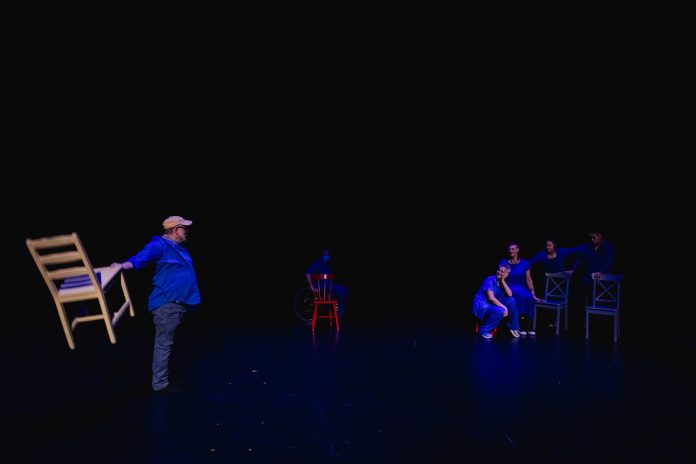
On June 5 and 7, Mi’gmaq dance artist Cheyenne Seary debuted her latest piece, “Casseiopia,” with the All Bodies Dance Project at the Goldcorp Centre for the Arts at the SFU School for Contemporary Arts. The piece explores themes of love, aging, and grief. It follows a young mother navigating the trials of motherhood while following a community mourning two lost children. “Casseiopia” speaks from experience — a harrowing yet beautiful work that encapsulates Seary’s personal life. The Peak reached out to Seary to learn more about her life, her work, and the symbolism behind “Casseiopia.”
This interview has been edited for clarity and concision.
What made you want to become an artist and choreographer?
I have always enjoyed the arts, but for many years I never considered myself an artist. I believed that artists were people with exceptional talent, while I simply enjoyed being creative. Over time, I have come to realize that art is about expression, connection, and community.
My journey as an artist began 11 years ago when I joined my first All Bodies Dance Project class. Being part of a community of engaged dancers has helped me embrace my identity as an artist. I saw that being an artist is less about performing perfectly and more about being open, authentic, and willing to create with others. Through movement, collaborative choreography, and celebrating our differences, I also discovered that dance can look many ways and that every person’s story has value.
As an early childhood educator, I am inspired by the quote, “Every child is an artist. The problem is how to remain an artist once we grow up.” Children creating, exploring, and expressing themselves without fear has influenced the way I approach my own creative practice.
Why did you choose to call the piece “Casseiopia,” and how does the symbolism of a strong mother figure reflect your art?
In December 2024, All Bodies Dance Project presented Constellations at the Roundhouse. For this production, I created a piece called “Casseiopia,” inspired by the constellation of the same name. I was drawn to her image because it reflected both the strength and vulnerability I associate with motherhood.
“Casseiopia” explores the struggles, resilience, and joy of being a mother. The choreography began to take shape during 2020, when I was a new mom navigating the uncertainty, isolation, and grief of the pandemic, while also discovering the deep love and connection that comes with caring for a new baby.
For me, the piece is not only about motherhood, but also about the power of community, creativity, and collective care. It reflects my belief that dance can create spaces where our stories are witnessed, our challenges are honoured, and our shared humanity is celebrated.
Your piece also touches on a community’s mourning of two lost children. How does the contrast between birth and loss shape the meaning of your work?
The big, child-sized red chairs at the beginning of “Casseiopia” symbolize a connection I had with a young boy who lived where I grew up. One day, he saw me outside holding and rocking my baby. He found a small chair and a toy baby, sat beside me, and mirrored what I was doing. That memory stayed with me deeply, especially because he passed away only a few months later.
In the dance piece, the big red chair becomes a memory chair, carrying the presence of those we have lost. Each chair represents a member of the community supporting another. Together, they are like a sacred fire, one that is lit when someone from my mother’s community begins their journey to the ancestors.
Keep track of Seary’s future works through All Bodies Dance Project’s Instagram account, @allbodiesdance.
Nine minutes to celebrate a Canadian soccer star’s inspiring life

By: Tomos Land, Staff Writer
Kind of a Big Deal, a short animated documentary recently released by the Knowledge Network, provides a brief but compelling overview of national Olympic champion Christine Sinclair’s soccer career. Directed by Eoin Duffy and voiced by Ryan Reynolds, it explores the trials and tribulations of Sinclair’s journey from grassroots football to the top step of the Olympic podium. Touching on several key themes, including family, leadership, and gender pay disparity in professional sports, the documentary is both funny and thoughtful, helped by Sinclair’s insightful, albeit at times reluctant, commentary throughout.
From start to finish, Sinclair’s goalscoring record provides the backdrop for the documentary. With 190 goals scored for Team Canada, the Burnaby-born legend sits at the top of the leaderboard for most international goals ever scored. Sandwiched between animated clips of her first international goal scored against Norway and her final strike versus Trinidad and Tobago, the documentary masterfully weaves Sinclair’s personal and professional journey into one bite-sized story.
During her illustrious career, Sinclair was made captain of the Canadian women’s soccer team a role that she admits was at the beginning daunting.
“For the longest time at the national team, I felt like I was such a failure as a leader, because I thought I had to become something that I wasn’t”
— Christine Sinclair in Kind of a Big Deal
However, after accepting that while her approach differed from other leaders — who Sinclair noted are often louder — her approach to leadership was still effective and she and her team soared, both nationally and internationally. At the 2020 summer Olympics in Tokyo, under her leadership, Canada beat Sweden on penalties to win the nation’s first ever gold medal in soccer.
Despite this success, the men’s national team were still earning more than their Olympic gold winning women counterparts. After tirelessly working to change this situation, Sinclair and her teammates prevailed, with a collective bargaining agreement securing a short-term equal pay reached earlier this year. As captain and a national icon, Sinclair was instrumental in this victory for her and her teammates, underlining her leadership qualities both on and off the field.
Subtle references are made to Sinclair’s mother and her battle with multiple sclerosis during the documentary. Animated clips of Sandra Sinclair, or “mom,” are interspersed throughout the animation and her presence as a key figure in her daughter’s story is frequently alluded to. A segment shows a young Christine playing football in the park with her mom, and another reveals a picture of the pair in Christine’s locker during the 2011 World Cup. A final sequence depicts the pair holding hands together in hospital, with the closing credits touching on Sinclair’s work now as a champion of multiple sclerosis research.
Overall, this short animated documentary is a brilliant synopsis of one of Canada’s sporting greats. The extraordinary directing skills of Duffy are on display throughout, while Reynold’s narration balances lightheartedness with sincerity from start to finish. Neither, however, take the attention away from the unassuming Sinclair, who tells her story brilliantly. This is well worth a watch with the FIFA World Cup currently in town.
Soccer is the game of life: Carling Jackson’s “Uprooted to Unstoppable”
By: Jonah Lazar, Staff Writer
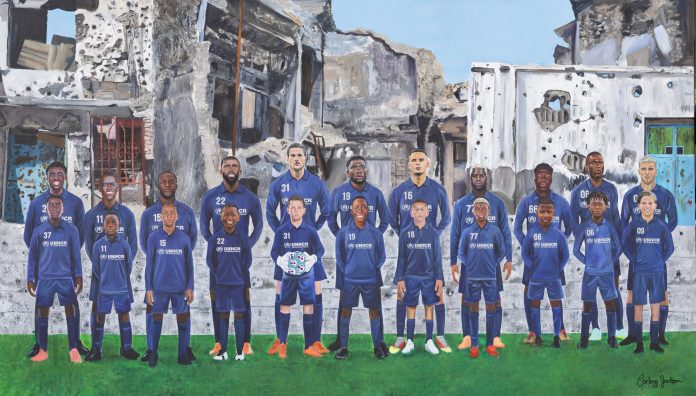
In light of the first days of the 2026 FIFA World Cup getting underway, and to celebrate World Football (Soccer) Day, the Office of the United Nations High Commissioner for Refugees (UNHCR), unveiled a mural celebrating soccer players who came from backgrounds of displacement caused by conflicts and disasters around the world. The mural “Uprooted to Unstoppable,” was painted by Canadian artist and former soccer player Carling Jackson. The Peak spoke with Jackson to learn more about this mural, and the impacts of soccer around the world for diverse communities.
This interview has been edited for clarity and concision.
Please can you tell us about your mural “Uprooted to Unstoppable?”
It’s a piece highlighting the identities and journeys of 11 international soccer players, seven of whom are playing in this year’s world cup. All of them come from forcibly displaced backgrounds; they were forced to flee due to conflict, civil war, climate change, disaster, or persecution, or their families were. A good number of them grew up in refugee camps, and that’s where their journeys started with the beautiful game.
This mural spotlights the children that all these players used to be. What capacity does football have in creating hope for children?
In creating hope, soccer is a great equalizer. On the field it doesn’t matter what your socioeconomic standing is. It doesn’t matter if you’re rich or you’re poor, if you’re Black or you’re white. My best friend growing up was a refugee from the Congo, and all we did together was play soccer. We didn’t even speak the same language, but we both spoke soccer and that’s how we communicated. All you need is two pairs of socks rolled up in the ball, you can play on the beach, the grass, cement [ . . . ] it’s so popular for its universality.
Canada’s captain, Alphonso Davies, stands out as the UNHCR’s symbolic gamechangers captain, and features prominently in your mural. How important do you see him as being an inspiration and a role model for Canadians?
He was born in a refugee camp in Ghana and then his family fled the Liberian civil war, before his family resettled in Edmonton, and then he came to Vancouver to try out as a prospect for the Whitecaps. I think he’s important because Canada resettles more refugees than any other country in the world. Davies highlights what is possible when people are given freedom, safety, and opportunity beyond survival. I think Davies is just a beacon of what Canada and humanity should stand for, and what’s possible when we support one another.
Something that’s been bothering me is this very individualistic mindset; people equate worth with nationality. Every single one of us should want every single person on earth to have freedom of opportunity and safety. We see a lot of anti-refugee sentiment and it frustrates the hell out of me.
Do you think football has the capacity to repair some of this divide?
Something cool that I’ve noticed about this World Cup is that it has been highlighting minority populations, and bringing everyone together; look at the attention that Cabo Verde and Curaçao are receiving.
No other sport has the capacity to unite people in this way, and soccer has a powerful ability to bring people together.

