

By: Mason Mattu, Section Editor
While not among the top concerns for voters in this provincial election, the future of the province’s post-secondary landscape is top of mind for students. The financial crisis universities find themselves in are resulting in program cuts, tuition hikes, and more affordability issues.
On October 19, the SFU Graduate Student Society (GSS), UBC GSS and Simon Fraser Student Society hosted a provincial election town hall. The event was hosted at the SFU Segal School of Business.
Moderated by Dr. Maxwell Cameron, professor at UBC’s School for Public Policy and Global Affairs, the panel was attended by mostly graduate students, teaching assistants, and members of the general public.
The BC Green Party, CentreBC, and BC New Democratic Party (BCNDP) each sent a representative to the town hall.
The context of this town hall: an outdated education funding model
According to BC Policy Solutions, post-secondary funding in the province is “facing its worst funding crisis in history.” 19 out of the province’s 25 post-secondary institutions are currently operating under a deficit, and since 2024, over 180 programs have been cut and 1,300 faculty and staff laid off across all post-secondary institutions.
What’s leading to this result? The answers lie within the province’s funding model for post-secondary institutions. During Christy Clark’s premiership, the university funding model shifted, based on the idea that international student tuition could be a primary source of revenue.
Fast-forward to today, Prime Minister Mark Carney’s reduction in international student permits have heavily hit the revenues of universities. With a funding model that is reliant upon international student tuition, universities find themselves in a bind.
SFU is no stranger to the austerity of the resulting financial crisis. Students are facing tuition increases while academic programs face budget cuts and increased faculty shortages. The university has also resorted to a hiring freeze. Recently, the institution shut down their Vancity Office of Community Engagement, a hub for student career opportunities, alongside Woodward’s community cultural programming. Most recently, the SFU Senate approved the “suspension of admission” to the master’s of publishing program.
The GSS’ decision to have a town hall was an intentional one. “If we endorsed certain candidates, yes, those candidates would be the best for post-secondary or for graduate students specifically, but that doesn’t really bring post-secondary forward,” SFU GSS director of external relations Kody Sider told The Peak.
The parties represented were largely in agreement that post-secondary institutions require more funding. However, the pathways to securing that funding looked different for the representatives.
BC Green Party (Tanya Webking, candidate for Vancouver–Strathcona)
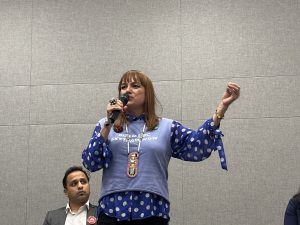
“We’ve been the lobster in the pot, and things have been slowly defunded over time. We have forgotten the systems that used to be there.”
The party was represented by Tanya Webking, an Indigenous person who is of mixed Dene and German heritage. She is also a community support worker on the Downtown Eastside. She is currently running with the BC Green Party in Vancouver-Strathcona. “We’ve been the lobster in the pot, and things have been slowly defunded over time. We have forgotten the systems that used to be there,” Webking said. “I’m very disappointed in the system where there is an over-reliance on quadrupling costs for foreign students. That is not sustainable, and that is a highly colonized perspective.”
Webking added the current funding model solicits donations from private funders and threatens institutional independence — especially in regards to free speech and protests on campus. “We need to be able to have proper funding channels so the billionaire class or the ownership class that’s funding these education systems do not override us as citizens.”
According to Webking, the BC Greens commit to eventually restoring public funding for post-secondary institutions’ operating costs to 75% of total costs, in line with the level recommended by the BC Federation of Students. She was the only candidate who presented a specific percentage value.
This increase in funding, Webking explained, will come from the BC Green Party’s wealth tax proposal. The policy position calls for the taxation of the 2,500 households in BC who hold wealth above $50 million — generating $22.2 billion in the first year, and $5.4 billion in subsequent years.
Furthermore, Webking criticized the casualization of labour in universities, leading to cleaners and educators being contract labourers. Other key pledges include a domestic tuition freeze, creating more union jobs within universities, bringing campus housing under the Residential Tenancy Act, engaging in more dialogue with student unions and faculty associations, and establishing cooperative grocery stores on every campus.
A key part of the BC Green Party’s platform is to work with the federal government to secure funding for tuition-free post-secondary education. The Peak asked Webking how her party planned to work with Carney.
Webking argued that securing such concessions would require pressure from organized labour and grassroots movements.
“When you’re trying to negotiate with a government where you might not be walking alongside one another, it’s really important to remember that nothing we’ve received in the working class was given to us,” Webking said. She continued by criticizing the increase in the amount Carney is spending on the military. “Out of our full [federal] spending, we are only allocating 1.9% to post-secondary education. That is shameful in a country as rich as ours.”
BC New Democratic Party (Niki Sharma, candidate for Vancouver–Hastings)
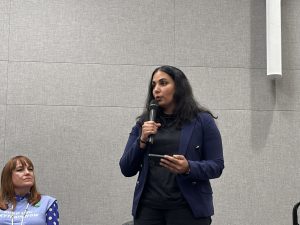
Niki Sharma, the province’s attorney general and deputy premier, represented the BCNDP on the panel. She is carrying the party’s banner in Vancouver–Hastings.
Sharma referenced the government’s $1.3 billion grant allocations to post-secondary institutions given the difficult time with regards to international student cuts from the federal government. During the Q&A period, The Peak asked whether she would follow the recommendations to increase post-secondary institution operations funding. She referred to the grant allocations, but did not commit to funding the recommended 75% of operating costs for post-secondary institutions.
In 2022, the BCNDP government commissioned a review of the post-secondary institution funding formula. In the review, it was found that there would be “no funding formula” without an increase of at least $200 million per year in funding for the sector. This report was abandoned after its first stage and its access remains restricted. In 2025, the government announced another review of the post-secondary institution funding formula. The results of that were supposed to be released by March of this year, but its release was delayed. It still has not been made public. Sharma told The Peak that when released, the review will help the government make future funding decisions.
Sharma also stressed the importance of funding research and innovation in post-secondary institutions. “We’ve invested hundreds of millions of dollars in research infrastructure for life sciences and technology, and we’ve structured dedicated strains, particularly for early career researchers, and those that are having interdisciplinary studies.”
“The money that we’ve put into the system already shows our commitment to supporting education, including access grants and the freeze on interest rates on loans.”
After the town hall concluded, The Peak asked what message it sent that her party was the only one on stage without specific mention of post-secondary education funding in their platform. Sharma stressed that voters will have to look at the government’s record in supporting higher education. “The money that we’ve put into the system already shows our commitment to supporting education, including access grants and the freeze on interest rates on loans,” she said. “Look at our record.”
CentreBC (Sam Chandola, candidate for Vancouver–Yaletown)
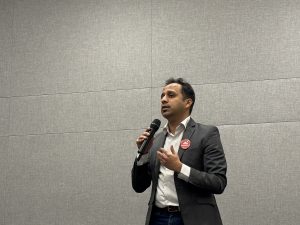
CentreBC was represented by Sam Chandola, a tech entrepreneur turned venture capitalist and candidate for Vancouver–Yaletown. Chandola highlighted CentreBC as the “moderate option” for voters in this election.
Chandola explained CentreBC’s plan to restore funding to post-secondary institutions — a $125 million post-secondary stabilization fund. The fund would be available to post-secondary institutions if they made appropriate administrative cuts of 5% and redeployed that money to investments in programs such as healthcare and technology.
Chandola also referenced his party’s support for increasing the R&D tax credit by 5% to “give companies more reason to hire researchers” from BC, and having the government become the “first customers where applicable for startups coming out of universities.”
Election day is Saturday
To readers, the GSS director of external relations Kody Sider said, “People should go out and vote. Students across the board? Extremely low turnout. You have to pay attention.”
Election day is this Saturday. For more information on how to vote, please visit elections.bc.ca.

