Home Blog Page 876

University Briefs

0
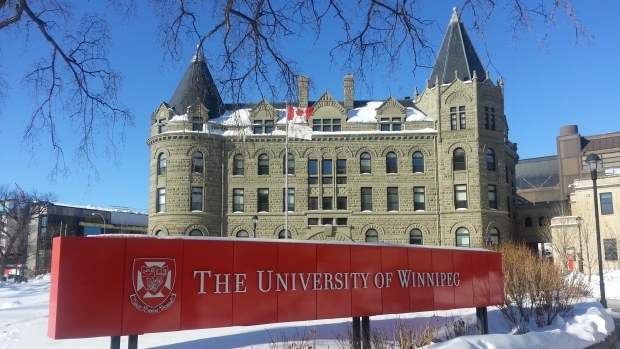
The University of Winnipeg is the first university in Canada to require all students to take an indigenous studies course. - Photo courtesy of CBC

UWinnipeg requires students to take indigenous course

[WINNIPEG] — The University of Winnipeg has announced a new requirement for newly admitted students in the 2016–17 school year to take at least one Indigenous studies course.

Two other Canadian universities have taken on similar requirements, but not quite to this extent. The University of Regina requires its students to enroll in an Indigenous class, but only for those in the Faculty of Arts. Thunder Bay, Ontario’s Lakehead University has recently declared that next year all students must take a “minimum of one course with at least 50 per cent Indigenous content.”

With files from CBC News

U of T revises sexual assault policy

[TORONTO] — When a female student of the University of Toronto was sexually assaulted by a male classmate, the school’s counselling and psychological services told her to go to class anyway so as not to let him “win.”

The student reported that this advice left her “totally isolated, alone.” This prompted an in-depth investigation by CBC. The university is now implementing a revised program to better address students who have been sexually assaulted. The program will also feature a greater emphasis on mental health and counselling as a whole.

With files from CBC News

Dal alumnus tears apart degree to protest divestment decision

[HALIFAX] — Dalhousie University’s board of governors voted against divestment from fossil fuels companies one year ago this month.

In response, alumnus Scott Vrooman shredded his master’s degree, expressing his resentment over the decision of his alma mater. Since then, Vrooman has continued with his protest and plans on working alongside a student group called Divest Dal. Vrooman’s goal will be to convince more Dalhousie alumni to join the cause.

With files from The Dalhousie Gazette

Would an emoji by any other name sound as sweet?

0

[dropcap]I[/dropcap]t’s that glorious time of the year when the ‘best of’ lists begin, and (insert generic noun here) of the year are announced. As a lover of year-end lists created by groups of people arbitrarily deciding what singular thing best captures a year, I can’t help but feel as though Christmas has come early.

So when the Oxford English Dictionary (OED) announced their choice for word of the year I was definitely intrigued, though I will admit that my hopes were not very high, as previous words of the year have been “vape” in 2014 and “selfie” in 2013. But with this year’s announcement I wasn’t so much disappointed as I was surprised.

The OED word of the year is “face with tears of joy.” This isn’t even a word — it is an emoji.

Now, for some people the idea of replacing a word with an image is sacrilegious. A word is a word, not an emoji. A word is composed of a combination of letters from the 26 in the English alphabet, not a little yellow face that may be misused by your mother in a text message.

Though, as someone who has managed to have conversations using only emojis, Oxford’s choice does make sense to me, on some levels. I realize that each year’s ‘word’ documents the evolution of language, and past announcements of more colloquial words have helped log this evolution.

However, if the OED really wanted to capture the language’s evolution by immortalizing an emoji as the word of the year, they should have picked either the eggplant, peach, or ‘splashing sweat symbol.’ Because with our sex-obsessed culture in 2015, too many have sent these as a way to solicit sex without actually having to say, “hey, lets have sex.”

But on other levels I am disappointed. We now live in an age where “your” and “you’re” are practically interchangeable, and the Internet has me questioning whether “breathe” is actually supposed to end with an “e.” Each year, the OED has the opportunity to help educate a public that at certain times clearly needs it. Yet they squander this opportunity by declaring an emoji as word of the year.

Granted, the other contenders for word of the year were not as interesting or surprising — “face with tears of joy” beat out ‘ad blocker,’ ‘Brexit’ (a term for the potential or hypothetical exit of the UK from the EU), ‘dark web,’ ‘on fleek,’ ‘lumbersexual,’ ‘refugee,’ ‘sharing economy,’ and ‘they’ (singular) — used as a pronoun to refer to a person of an unspecified gender.

Overall, an emoji as word of the year opens up debate on to what even constitutes a ‘word.’ But, when in doubt, we can remember that Ancient Egyptians used hieroglyphs, and those were just words in picture form. So, maybe we are just getting to a point where using pictures to communicate is more efficient than using letters to make words.

Walking ‘round in winter wondergear

0
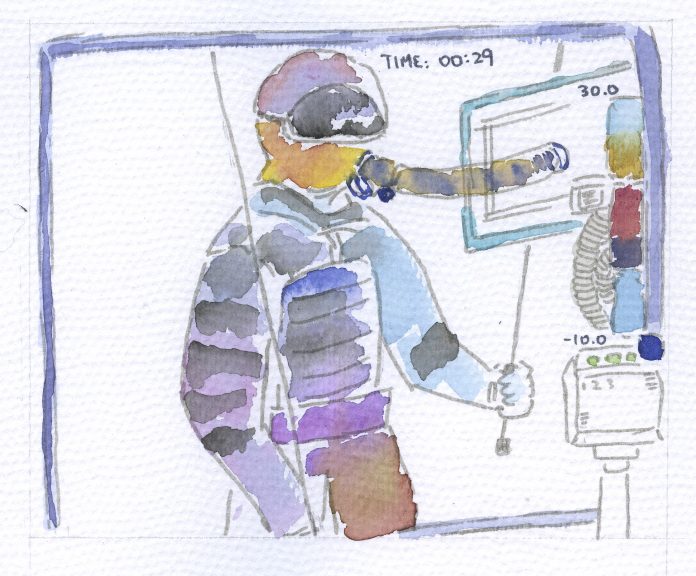
Study participants test out the gear while walking in a climate-controlled chamber. - Illustration by Momo Lin

[dropcap]W[/dropcap]ith temperatures dropping across the Lower Mainland, one of the foremost thoughts on people’s minds is how to stay warm. For the designers of technical apparel, this is an ongoing preoccupation.

A new partnership between SFU Environmental Physiologist Matthew White and Mountain Equipment Co-op (MEC) will study the performance of new MEC cold-weather designs.

White stated, “The goal of thermal testing winter wear is to optimize the performance of the clothing and the thermal comfort of the individual.”

Participants in this study will walk on a treadmill in a climatic chamber that is at a temperature of -8˚C for 30 minutes. While walking, they will have their body temperatures, surface heat loss, and metabolic rates monitored and compared with their pre- and post-exertion levels. This information will also be compared against the participant’s own perceived comfort.

“During our testing [of] the cold chamber we get thermal comfort ratings,” said White. “So we try variants of a given piece of clothing and see if the performance or thermal comfort ratings are better or worse for a given garment.

“We can compare that to the heat loss responses to see whether or not the subjective assessments of a winter garment are the same as what the physiological or heat loss data telling us.”

On the horizon for White is the building of a new climatic chamber that will allow testing across a broader range of temperatures, from -50˚C to 50˚C. While the weather in the Lower Mainland never reaches these extremes, they want to understand how the body reacts to these additional stresses, and develop technical outerwear that can meet these challenges.

According to White, a benefit of building this new chamber is that it will allow for students to be trained in the methods required to conduct thermal testing, which has high industry demand but few qualified individuals.

Currently, Canadian companies have to ship their garments to Kansas State University to get tested for thermal performance. The ultimate goal in building this chamber, aside from being able to conduct further explorations into environmental physiology, would be for Canadian companies to be able to send their garments to SFU for testing.

Women’s basketball down to six players

1
Meg Wilson is out for the year, one of the team’s many recent injuries.

Have you ever wanted to play basketball for the SFU Clan? Well, now may be your chance. The women’s basketball team is going through an injury crisis the likes of which Head Coach Bruce Langford has never seen. The team is so desperate for players that they’re looking to the student body to fill the gap for the injured players. No matter what position you play, you will be welcomed to the team with open arms.

“Well, when you only have six or seven bodies you can’t afford to be too choosy,” explained Langford to The Peak. “If a person can play, if a person can shoot, if a person has a basketball IQ, [we’re looking for them].

“Everybody likes bigger or faster, but right now we’re in a position where [. . .] we need to find somebody who can sort of be the finger in the dam for the rest of this year to help us get through it.”

This all started over the team’s road trip, where, though the team won some games, they lost some players along the way.

“We had a good weekend in California where we won two games and lost one. And then we had a couple of injuries. Meg Wilson, who everyone would agree is probably one of our best players, is out for the rest of the year with compartment syndrome. [She will be] getting an operation in December, we hope.

“Then we lost Sophie Swant to a concussion, and we lost Sam Beauchamp to a knee injury that we’re not certain yet what that’s going to get diagnosed as. So we’re crossing our fingers. We’re down to six players which is a bit of a challenge for a season, so we’ll see.”

However, one former player has already stepped up to help the team during this unprecedented injury crisis.

“One of our [former] players who played a year and a half and then became our trainer for the last couple of years, Rachel Halipchuk, we’re going to add her to the roster for the rest of the year. She knows what we do, she knows what we run, she’s athletic, she shoots the three a bit, so we’re excited to add another body.”

The NCAA has some strict rules regarding who is eligible to play. Players must have had 24 credits per year in each of the years that they have attended school, and taken at least 12 credits in their last full-time semester. For example, a third-year player has to have taken at least 24 credits every year previous to be NCAA eligible. “There’s just like nine pieces of the puzzle that need to be right in order to be certain they would be eligible. It’s a challenge.”

If you can ball, give Head Coach Bruce Langford a call at 604-614-4667, or email him at [email protected].

Men’s basketball loses second game straight

0
Oshea Gairey (middle) was a standout.

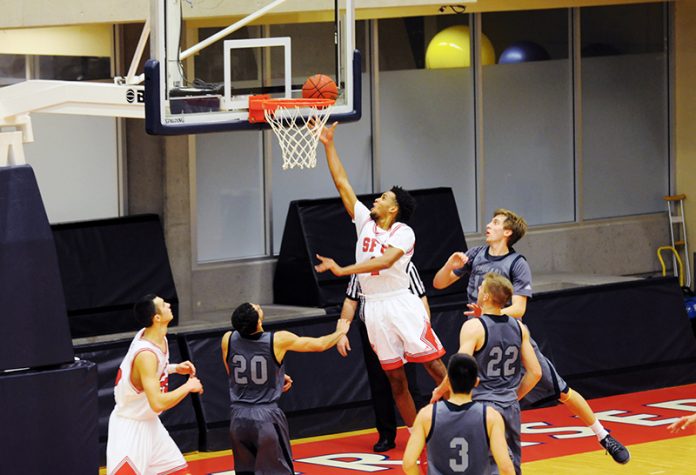
Saturday night, SFU’s men’s basketball team played their last home game against Colorado Christian University before they open up their GNAC season December 3. Despite looking good for some stretches of the game, the Clan wasn’t able to put any solid runs together, and ended up losing 89–79.

Screen Shot 2015-11-27 at 3.56.49 PM“They’re a team that doesn’t make mistakes, and we’re still a team that makes those mistakes,” said Head Coach Virgil Hill after the game. “We keep shooting ourselves in the foot. Whether that’s missed free throws, turnovers, missed box outs, [or] rebounds [. . .] until we can complete those, we’re going to find ourselves in the same [situation].”

SFU dug themselves an early hole in this one, as the visitors ran out to a 7–4 lead which quickly turned into a 14–8 lead. The Clan was missing easy buckets, and just couldn’t defend the three. The half ended with the team down 38–34. SFU’s Michael Harper had a strong half with eight points as well as four defensive rebounds.

In the second half, SFU came out with renewed purpose and desire. Hidde Vos was able to hit a big three early on, and a bucket by Michael Harper gave the Clan their first lead of the game. However, they weren’t able to hold on to it for long. Colorado was deadly from behind the arc, finishing the game over 50 per cent from behind the three-point line. Despite junior Max Barkeley’s attempts to drag SFU back into the game — at one point boasting four straight threes — the Clan was subjected to their second straight loss the in two nights to the same team.

A big player in the Clan’s defeat was Colorado Christian’s Stefan Hackethal. Playing like a young Steph Curry, he finished the night with 28 points, and a ridiculous 70 per cent three point percentage.

“He didn’t do anything [in the previous game] that was noticeable,” explained coach Hill. “Today, he comes out and all of a sudden he doesn’t miss a shot. We probably didn’t play him as well as we could.”

So what does Hill think needs to be improved the most heading into GNAC competition?

“I think it’s going to be guarding the ball in terms of penetration. The GNAC teams are probably a little more athletic, so we have to be able to, one: stop them in transition, which most of the team are very good [at]; and two: get them to play five on five. Just keeping people in front of us and then hopefully get the rebound.”

The team’s first game against GNAC competition will be against Seattle Pacific at 5:15 p.m. on December 3 in the West Gym.

Facebook values Western lives over Middle Eastern ones

0

[dropcap]I[/dropcap]n light of the Beirut and Paris tragedies that occurred November 12, there has been, to say the least, a media frenzy. Millions of Facebook users have overlayed their profile picture with a French flag — an option that Facebook not only makes available, but automatically suggests when you log on. Facebook also implemented its “safety check” feature during and in the aftermath of the attacks, allowing users to ‘check in’ to let family and friends know they’re safe. While Facebook’s actions may have good intentions, they show value over the West than the East.

Firstly, not only was this the first time in history that the safety check has been implemented in a non-natural disaster scenario, but the check was only initiated after the Paris attack — not the Beirut bombings that happened 24 hours prior. Furthermore, the option for the flag is limited to the French flag. The Lebanese, or any other country’s flag, aren’t options.

Defenders of this choice to exclude the Lebanese flag argue that users can make a Lebanese flag version themselves, but this isn’t the point. Rather, the point is that Facebook doesn’t give users the option to add it automatically.

Firstly, with regards to the flag overlay, there are more French Facebook users than Lebanese; therefore, more people would be inclined to use the French flag. However, if the point is solidarity rather than shared experience (which it must be, considering only a minority of those with the French flag have ever been to Paris or have family or friends there), why should number of users matter? More importantly, why is the popularity of the flag even relevant? Shouldn’t those who want to express solidarity with victims of tragedy be given an easy way to do so?

When a nation with whom we identify with is attacked, it makes us feel more at risk as well.

Secondly, defenders of the safety check feature have explained that mobile connectivity is comparatively weaker in Lebanon, making the safety checks less useful. Formerly, safety checks were implemented during natural disasters (the 2011 tsunami in Japan, typhoons in the Philippines) where there were also major connectivity problems. The premise behind safety checks is to provide solace for families and friends during an emergency that poses danger to human life. Connectivity has never before been considered in these situations, so why now?

The question then becomes: why does Facebook value Western lives over others? I argue this is because Facebook is the product of an entire society that does this very thing constantly.

Western nations identify with France more so than with Lebanon for a variety of reasons, including similar racial distribution, religions, and government styles. Additionally, France is a strong ally of both the United States and Canada, and Paris is a common vacation spot for Western families. When a nation that we identify with is attacked, it makes us feel more at risk as well. We begin thinking: If it happened to them, it might happen to us.

Widespread Islamophobia only exacerbates this problem. This prejudice, curated in part by Western governments in an attempt to justify wars throughout the 20th and 21st centuries, has flourished in post-9/11 North America. This leads our society to be less sympathetic with Middle Eastern tragedies, such as Beirut, regardless of the context that surrounded the incident.

However, none of these are valid excuses for Facebook. As a billion-dollar enterprise, Facebook doesn’t need to wait until it becomes more socially acceptable to care about non-white lives. In fact, as such a popular social media site, Facebook has the opportunity to spur some amazing change. Facebook, take a first step: treat similar international emergencies in a similar fashion.

Alex Iezzi’s journey comes to an end

0
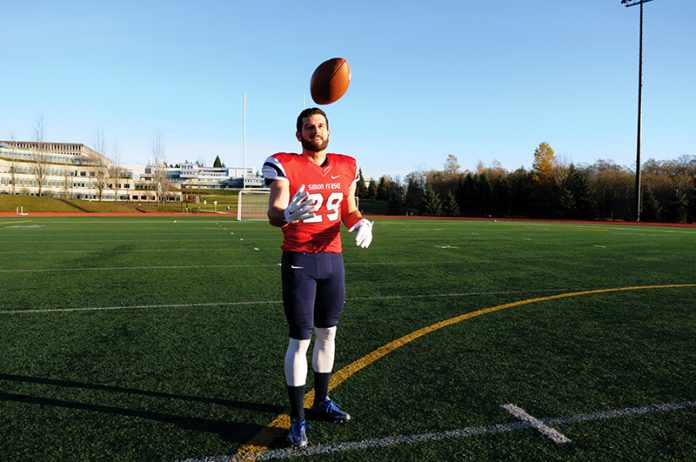
From Ontario, Alex played on the team for three different head coaches and in two different positions.

To many, football is widely recognized just for the physical contact, padding, and touchdowns, but for college players it’s a lifestyle that requires commitment, organization, and great mental awareness. From winning on the field to winning in the classroom, senior running back Alex Iezzi has brought his best effort with him through his journey as a part of the Clan over the past five years, from 2011–2015.

Alex’s story starts in London Ontario, where he played 12-man football as a running back on offense all throughout high school. However, his passion for athletics began at an early age when playing soccer.

“I played soccer for seven years when I was younger and that was my first sport. [. . .] I still really love watching and playing,” said Alex.

Schools such as Queens, McMasters, St. Francis Xavier, and SFU all expressed interest in Alex’s athletic ability during his final year of high school. Alex’s father’s advice to explore opportunities outside of Ontario helped him make the choice to move out west to play in the NCAA.

“My dad was born in Montreal and now works in Ontario, but he was moving around everywhere when he was younger and wanted me to experience the same thing [. . .] he was just telling me to get out and explore what’s out there.”

SFU provided Alex with the opportunity to explore western Canada, but it also gave him the chance to see different regions of the United States when traveling to football games.

[My dad] was just telling to get out and explore what’s out there.

“It was great to travel around and go to places like Los Angeles, Northern California, Las Vegas, and even Utah. I think that place is pretty cool.”

As is common for many freshman, Alex redshirted his first year at SFU, which gave him a chance to adjust to a new life in a new place. “Like many first-year students, I was a bit nervous for school because I didn’t know anyone, especially because I was from out of province,” said Alex.

The following year Alex made the decision to change positions and play defense after asking his coaches what the fastest way to travel with the team and earn playtime on Saturdays would be.

“Coach Johnson [former SFU head football coach] sat me down in one of the tutorial rooms in west mall after our running back meetings during camp in August and told me that he could really use me on defense, since they were lacking some personnel at the slot corner position.”

Such a transition can prove challenging for any athlete, but going from a running back to a defensive back position requires a player to learn a completely different running technique and overall strategy for the game.

“I didn’t even [play] defensive at all in high school [. . .] defensive concepts, playing inside or outside the hash marks, covering receivers; these were things that were super foreign to me at the start,” he said.

Alex was up for the task, and his decision to move on from the running back position proved successful: he made an immediate impact on the team, earning extended playtime and helping the 2012 team establish its most successful season since entering the NCAA.

One of his most notable performance with SFU came during the penultimate game of his second year, when injuries forced him into the starting position against Humboldt State University. After starting the game trailing 24–0, Alex helped dig his team out of a deficit by recovering not one, but two separate fumbles from the Humboldt offense, and taking them both to the house for touchdowns.

“I was thrown into the Humboldt game which was extremely foggy and I was a bit nervous because of the atmosphere and the speed of the game [. . .] the first one came pretty easy since the ball right in front of me after the running back had fumbled it, but the second one took a bit more effort since I had to get off a blocker, grab the ball, and weave around the quarter to walk in for the touchdown.”

The following three years proved to be a bit of a challenge for Alex and many other football players as they experience playing for three different head coaches within that same period.

“There were a lot of coaching changes over the next few years and that forced me to change to the safety position since we were running different defensive schemes [. . .] at that point I wasn’t enjoying myself as much. It wasn’t the same feeling I had during the second year since we constantly had new coaches and new things to learn.”

Entering the 2015 season with a new head coach, Alex made the decision to go back to running back position where he would be able to close out his collegiate career on his own terms. Lingering injuries kept him out of a few games this season, but Alex’s motivation and commitment helped him to finish what he started at SFU.


Screen Shot 2015-11-27 at 8.41.31 PM

WQB requirements are pointless

2

[dropcap]W[/dropcap]QB — writing, quantitative, breadth. Since I began at SFU in 2012, I have spent way too much time investing, financially and otherwise, in classes that have had nothing to do with my degree, my interests, or my academic skill.

These classes are supposed to make for ‘well-rounded’ students, but I’m not convinced that thet have been anything other than a massive waste of my time. In total, these requirements amount to 10 additional classes over the course of our studies — sometimes you luck out and a class just so happens to be a part of your degree program, but for the most part, we get screwed by these requirements. Ten courses, after all, amounts to over two full semesters’ worth of extra school, and can cost upwards of a few thousand dollars.

I have slogged through earth sciences and kinesiology, almost ripped my hair out taking archeology, and cried myself to sleep for fourth months as I pushed myself through a Canadian history class. None of these classes led to a newfound interest in the given field, nor did they make me appreciate these subjects any more than I already did. The fact of the matter is that I would have rather explored different subjects on my own terms, without worrying that I was falling out of compliance with my graduation requirements.

SFU has built its reputation on being the a comprehensive university with diverse faculties, but there is fine line between being well-rounded, and stretching your studies too far over a variety of unrelated fields. Truth be told, there are plenty of unique courses at SFU that I am way more interested in than an introduction to some science topic, but I’m not going to have time to explore those subjects because of the amount of time I spent fulfilling my WQB requirements.

All of us are adults who should be allowed to have full control over our studies. If someone wants to solely focus on computer science, then that’s their prerogative. To force an academic interest where it does not exist is a waste of time, energy, and money. In herds, students consistently enroll in what has been deemed “a good science class for an arts student,” but what does that even mean?

I imagine having massive groups of students enrol in a class solely because it has been deemed an ‘easy science credit’ is a massive inconvenience for those registered who are actually invested in that subject matter. I simply can’t contribute to a conversation the same way a student who is passionate in that subject can.

When I took BPK 110, I only met one kinesiology student over the course of the semester. One. The rest of us were there only to complete our WQB requirements. I can’t imagine having to be a prof or a TA in a class where 90 per cent of the students are only there to check off a box on their transcript. I will be the first to admit that I don’t try as hard in my WQB classes, because I am simply uninterested and unmotivated.

Having huge swaths of students who are, without a doubt, more apathetic towards the subject creates a less desirable classroom atmosphere and more work for the educators, since they constantly have to help bridge the materials for students from other departments. Honestly, everyone walks away a winner when you let students decide what they should study.

Woohoo, Boohoo

0

Woohoo: Christmas Eve

Put aside the capitalist layer of gobbledygook that  often overshadows Christmas and admire what the penultimate hours of the Noël blitz really stands for: sharing a moment with loved ones and getting some much-needed time with the family. At the end of the day, it’s all that really matters. It’s about slowing things down and just taking a moment to be thankful for your health and the people around you that help make your life the lovely gift that it is.

The wonderful thing about the holiday season over the last few years is that it has lost its exclusivity. All walks of life are welcome to enjoy the celebration and make their own meaning out of the holiday in a way that fits their family’s values. And hell, if that isn’t worth raising the eggnog and rum up for toast in this jumbled and shook up world, I don’t know what is.

Boohoo: New Year’s Eve

As the drunken ensemble of people around you begin the countdown from five, it becomes ever more apparent to you that hosting a New Year’s Eve party was a catastrophic mistake. Five people are passed out in your bathroom drenched in the regurgitate combination of spinach dip and cotton candy vodka. Four types of liqueur have stained your upholsteries and have ruined your coffee table irreparably.

Three inebriated colleagues have tried to make out with you and have only succeeded in head-butting you and slicing your lip in two places. You have received two noise complaints and you’re about one police visit away from giving your landlord ample reason to kick your vociferous ass to the curb.

And to make matters worse, you are so wasted the room is spinning like your little brother’s Beyblade. Good luck trying to call in sick tomorrow — you’ll need nothing less than a gurney and toe tag to pull the wool over their eyes this time.

BoG-gled

0

Sustainable Investment

The board was presented with a motion to increase the amount invested in what is classified as “sustainable investment holdings.” The $12 million, or 3 per cent of the endowment portfolio, currently invested will be increased to $20 million, or 5 per cent of the endowment portfolio.

Said SFU President Andrew Petter, “This very much puts us in a leadership position. Concordia and Trent, I think, are the only two other universities that have actually gone this direction in creating funds, or in our case enlarging funds, for this kind of purpose.”

Concerns were raised by undergraduate student representative Deven Azevedo about how the other 95 per cent of the endowment could be invested “potentially in morally ambiguous funds.” In addition, he expressed concern over the lack of commitment to when the remaining portion of the endowment portfolio would be dealt with.

Petter responded to this concern by noting this is a positive first step and that there are ongoing discussions around how to measure the university’s carbon footprint and whether it is better to divest or be an “active investor.” After a vote, the motion passed.

Energy Utilization Policy

The board voted to approve a university-wide policy on energy utilization effective immediately. The policy is to help the university reduce its overall greenhouse gas emission levels.

Said board member June Francis, “We decided to have a policy that strongly reflected our expectations around following the guidelines without making it a policy that we could not actually enforce.”

These considerations gave rise to amending language in the policy, which previously read “required” and “encouraged,” in regards to SFU community members and campus groups becoming more energy efficient and reducing greenhouse gasses. The new language dictates that these groups are “expected” to do so, in order to meet these institutional goals.