Home Blog Page 860

Registering for rage: SFU’s failed course enrolment system

0

SFU has a major course registration problem

[dropcap]C[/dropcap]ourse enrolment pisses me off. If seats are full we should have the option to either stand or bring our own stool to class,” read a recent comment posted on the SFU Confessions Facebook page.

After 20 minutes, the comments had received 40 likes; after an hour it had over 100. By the next day, it had garnered almost 1,000 likes, making it one of the most popular comments on the group in the past year, by far.

The message conveys a distinct frustration that SFU students experience while registering for courses each semester. SFU’s annual undergraduate satisfaction surveys routinely cite encountering full courses, scheduling conflicts, courses not offered frequently enough, students’ late scheduling dates, and courses reserved for other students. These frustrations have students — predominantly from the Arts and Social Sciences, the Faculty of Communication, Art and Technology, and the Beedie School of Business — pulling their hair out in anger.

“The course selection process is extremely difficult and frustrating,” said third-year criminology major Yvonne Hanson in a video by The Peak. “I’ve been struggling with it the whole time. If you haven’t declared your major yet, you can’t get into any classes you need. So you wind up with the most bullshit little courses.”

“I had a horrible time with enrolment this year,” said second-year IAT and Business major Gabriel Yeung. “I wasn’t able to get into most of my [IAT] major courses [. . .] I tried for eight courses, and I didn’t get into them. Now I’ve ended up with a semester of electives.”

“When I get [an enrolment] date I can already tell that I’m going to have a disadvantage,” responded Christina Valenzuela, third-year health science major. “I’m looking at the availability of courses, and then once my [enrolment date] reaches, the majority of them are already closed.”

These negative sentiments were reiterated in last year’s SFU Undergraduate Survey “course availability” section. Popular comments including “offer more courses” and “better class availability” further confirm student frustrations.

Issues with course enrolment have affected SFU students for years, as indicated in the 1998 Undergraduate Student Survey, which conveys that only 60 per cent of undergraduates were able to register for the courses they wanted. Since then, student satisfaction with registration in the courses they want to complete their degree has not improved. In fall 2005, only 56 per cent could enrol in the courses that they wanted; in 2008, it was 54 per cent; most recently, in 2014, it was 58 per cent.

Furthermore, in 2005, just over half (53 per cent) of the undergrad population found they were taking longer than expected to complete their degrees — a number that hovered around 57 per cent in 2013, before jumping to 64 per cent in 2014.

SFU’s 2010 Degree Completion Experience Survey shows that students complete their degrees overall 2.1 years past the traditional timeframe (defined as “less than 5 years for Secondary students, less than 4 years for Transfer students, and less than 3 years for Second Degree students”), a statistic which must have come as a surprise to the 69 per cent of students in the same survey who said they expected to complete their education in explicitly four years or less, and the 85 per cent from the Fall 2013 Undergraduate Student Survey who claimed graduating within their expected timeframe is important.

SFU’s Institutional Research and Planning (IRP) office conducts an annual undergraduate student satisfaction survey to “[provide] essential feedback on academic experiences and concerns,” which usually garners roughly a 20 to 30 per cent student response rate. They also publicly provided a variety of indepth studies specifically into resolving course availability issues from 2007 to 2011.

The 2007 study states on its first page that “Course Availability at SFU has been deteriorating,” and that “compared to other British Columbia universities, students at SFU experience considerably more problems with course availability and timely degree completion.”

Despite several reports, surveys, and recommendations, the statistics in student satisfaction have remained very similar since the first online report was posted in 1998.

Many students at SFU clearly have trouble enrolling in many of the courses they want — an issue that is caused by multiple facets of the university system, and which could ultimately increase student attrition rates and damage the school’s reputation.

“The course selection process is extremely difficult and frustrating.” — Yvonne Hanson, third-year student

Why can’t SFU students get into the courses they want?


“[dropcap]W[/dropcap]e’re working on it,” Gordon Myers, SFU’s Associate VP Academic, explained to The Peak in regards to students’ enrolment concerns. “We know that course access is a serious issue.”

Myers directly oversees all enrolment planning at SFU, and keeps in contact with SFU’s IRP office for patterns in course access research findings. He sits on the Senate Committee for Strategic Enrolment Management, which reports to SFU’s Senate with findings and proposals regarding course registration.

SFU’s course registration issues are caused by a variety of interconnected problems, all of which are related first and foremost to the ever-looming budgetary constraints that every university faces.

Myers mentioned that once government funding (which decreased another 1 per cent for the 2014/15 fiscal year) has made its way to SFU, the money is then dispersed among the faculties in accordance with how many enrolments each faculty receives.

“It’s a student-centred budget,” stated Myers. “If a faculty gets more students choosing courses from that faculty, they’ll receive a bigger budget. [. . .] This gives [faculties] the resources to solve course access problems because it gives them the money to put on those extra courses.”

When Aoife Mac Namara began her position as the Dean of the Faculty of Communications, Art, and Technology (FCAT) in August 2015, she revealed that “the bottom 10 per cent” of the faculty’s funding is used for administrative-only use, which means that the top 90 per cent of her resources are pushed to teaching and research.

Mac Namara did state, however, that she feels her faculty could prioritize its budget differently. “I want to see, this year, that all the [departments] show in their budgets how [they are] being used to improve course access. It’ll be quite definitive.”

Though, the problem seems to lie not in the allocation of government funding, but in an overall lack of it. In fact, in its most recent five-year academic plan, the Faculty of Arts and Social Sciences states that one of its weaknesses is how “insufficient base funding has [. . .] created significant and sustained losses in research expertise in a number of our departments and schools,” and that “these losses threaten the quality of our undergraduate programs, our graduate programs and our international reputation.”


The constraints of a trimester system


[dropcap]A[/dropcap] major factor contributing to SFU’s budgetary constraints is its unique trimester system, a way of operating that Myers acknowledges is more expensive than the traditional semester system, but one that is not without benefits.

“The trimester system was [established] so that we’d use our buildings for the full year, and we can therefore save resources,” Myers explained. “We don’t need as many buildings to educate the same number of students if we’re running all year round. It also provides additional flexibility for students — for example, you can start any semester.”

While these factors have merit, SFU’s trimester system has been mired in controversy from its very origins.

In his 2005 book Radical Campus, Hugh Johnston details how, during the university’s construction, higher education was being given an infusion of public money while members of the public and politicians alike criticized universities for expecting this increased funding yet operating only on a semesterly (fall and spring) basis.

While university presidents tried to explain that summers were coveted by professors to keep their research current, SFU delegated academic planner Ron Baker to examine the question of whether or not to open the school year-round.

According to Johnston, while extensive evidence from American universities proclaimed a year-round system to be more expensive than the traditional route, Baker hurriedly calculated SFU would save costs within the trimester system. Johnston writes how “after the university had been running for a few years, [Baker] could see that the savings were not there,” and in fact, “[by] 1972 a management consultant firm calculated that the trimester system was costing SFU an extra 19 per cent per full-time student.” But by this time the system was so ingrained in the school’s culture that the administration “[expected] that SFU would lose students without it.” Baker himself soon grew to dislike teaching within the trimester system.

Back when the system was implemented, the idea was that schools operating yearround would be more deserving of additional government funding, but currently SFU is given more or less the same amount as its comparative universities that operate on a traditional academic calendar.

SFU received a grand total of over $293.5 million in government funding for its roughly 35,000 students for the 2015/16 year — around $8,400 per student. Similarlysized schools such as Ryerson received a close-figured $7,500 per student, while the University of Victoria, a smaller school, received roughly $12,250 per student.

This means that while students at UVic or Ryerson have a certain amount of funding for them for the two thirds of the year in which they are open, SFU must use a similar amount for the entire year. The significant difference is stretched over to operate the third semester while keeping all expensive facilities fully operative.

Johnston also states that Baker incorrectly assumed the trimester system’s advantages for students, as “he calculated a decided financial gain for students heading into professional careers if they decided to forgo summer jobs so they could start their careers a year earlier.” Johnston suggests that taking three full course loads per year isn’t practical for most students, who take part-time jobs to support themselves while in school.

As it stands today, a significant population of students work part-time while attending SFU. According to the undergraduate enrolment report for Fall 2015, SFU enrolled 13,160 full-time undergraduates along with a striking 12,161 part-time. Moreover, the previous summer semester saw 4,163 full-timers dwarfed by over 12,000 part-timers.

The Canadian University Survey Consortium (CUSC) states that 37 per cent of SFU’s first-year students in 2013 worked off-campus while attending school as opposed to the average 25 per cent from comparative universities, while those mid-degree from 2014 and graduates from 2015 work 46 and 49 per cent respectively. Comparing this with the 40 and 41 per cent comparative averages, SFU definitely has a higher than average number of students who are employed while completing their educations.

Though while SFU may provide educational flexibility for students who work part-time, the trimester system may actually be influencing students to find a means to finance their own education while they attend school.

SFU’s 2010 Degree Completion Experience Survey confirms one third of delayed graduates actually reduced their course load because of course availability issues, and not because of part-time work, thus prolonging a degree that becomes more expensive as the trimesters add up.

As such, SFU’s administration faces difficulties of scheduling classes in accordance with the times students are available and not at work, which could further limit the quality and diversity of course options during registration. This is especially tough for students interested in co-op — a paid work-only semester — and frustrates their schedules further if they choose a co-op term that conflicts with preferred or required courses. Difficulties also arise for students who have yet to declare a major, and thus aren’t given priority registration dates.

The trimester system is uncommon in Canada, and, in addition to SFU, has only been adopted by the University of Waterloo and the Université du Québec.

“We know that course access is a serious issue.” — Gordon Myers, Associate VP Academic

Spatial constraints and deferred maintenance problems


[dropcap]W[/dropcap]hen it was adopted, the trimester system was supposed to use classroom space more efficiently than a semester system since the university was in operation year-round. But the overall growth of enrolment at SFU outpaced the creation of teaching space, and the year-round system causes special problems for building maintenance.

According to Rella Ng, the Associate Registrar at SFU, spatial constraints play a large part in whether or not courses are offered. Ng works at Student Services and makes sure that the course schedules submitted by the faculties can be properly implemented into the scheduling system in a way that allows for the class capacities to be assigned to the appropriate rooms on campus.

“We only have a certain number of large classrooms and theatres,” Ng said.

Ng is not the only SFU employee to vocalize spatial problems. Dean of FCAT, Aoife Mac Namara, expressed her concern that “the biggest resource we don’t have is space. So even if we had 10 faculties and whoever to teach the course, there wouldn’t be any room for it.”

SFU has also grown in population over the past few years, and the school’s most recent Five Year Capital Plan released last year indicates that total full-time undergraduate enrolment “has grown by 59 [per cent] during the period from 2001/02 to 2012/13,” and that “space inventory during this time has not kept pace, increasing by only approximately 47 [per cent].”

Moreover, Beedie School of Business’s Five Year Academic Plan states as one of its current “threats” that “space limitations across all three campuses compromise the effective delivery of undergraduate and graduate business programs, and future program opportunities.”

SFU is especially struggling to accommodate the exponential student growth at its Surrey Campus, which places further constraints on courses offered due to increased competition at this location.

“Surrey’s FTE [full-time enrolment] is over capacity by a long shot,” explained Elizabeth Starr, development planner at SFU Facilities and Services, and co-writer of the university’s Five Year Capital Plan. “FTE capacity in Surrey is 2500 [. . .] And we know we’re incredibly underserviced in Surrey,” she said.

SFU’s most recent Surrey enrolment report confirms that FTE for Fall 2015 was at 3,380 — placing SFU Surrey’s population at 35 per cent over capacity. Currently, SFU plans to expand the Surrey campus to allow for 5,000 FTE students, but this project has yet to be officially approved.

In addition to spatial constraints, SFU also has maintenance problems that affect the number of course offerings. As an associate registrar, Ng said she “quite often” removes classes from the registration system entirely due to the abundance of deferred maintenance issues plaguing this half-century old university.

The Five Year Capital Plan states that out of SFU Burnaby’s 35 academic buildings, only 10 are in “good” condition, while 13 are in “fair,” and 12 are labelled as “poor.” Because of this, the plan has made restoring the school a priority.

Ng said that because there are fewer courses offered during the summer, SFU can make efficient use of this time to take classrooms offline in order to make the necessary repairs, but many times this isn’t the case.

“In fall and spring we get calls from Campus Planning and Facilities who say, ‘this room needs to be taken offline because it’s leaking,’” Ng explained. “Then we struggle to find [new] classrooms, and sometimes we [visit the departments] to discuss moving these classes around.”

SFU relies on government funding for the major maintenance repairs it needs, and would take an estimated $532 million to make all the necessary upgrades to SFU Burnaby’s “poor condition” buildings. In an email, Associate VP of Finance Alison Blair stated only “$3.9 million [was given] earlier this year, and $3.3 million more recently.”

Mac Namara does claim that a “big deferred maintenance [deposit]” from the provincial government is likely heading toward SFU, which “will be the first in line given the state of [the] facility.” An email message to The Peak from the Associate VP Finance did not indulge in the rumour, stating that while there are “indications that the sector will receive additional deferred maintenance funds [. . .] there is currently no certainty.”


FCAT’s plan of action


Despite the web of interconnected systemic factors contributing to the growing dissatisfaction with SFU’s course enrolment system, the Dean of FCAT feels that the issue really isn’t that difficult to solve — it simply requires a culture change in student course planning advising.

Mac Namara stated that fixing FCAT’s course enrolment is her top priority, and that she has a threepronged plan.

The first prong is to have the university uniformly understand what constitutes a full course load. SFU currently labels a minimum of nine credits (usually three courses) as “full time,” a number Mac Namara alludes is too low.

“What I hear all the time is that students can take only three [courses] because the workload is too high, and that shouldn’t be the case. [. . .] Ideally, we should be able to tell students that if you come and do a full course load the whole way through, then you should be able to finish [a degree] in four years or five with coop. [. . .] When you don’t have a full course load it’s much harder to predict how many people are going through at what time.

“The first thing we need to look at is what workload is involved in our courses, and then we need to ask students and advisors why we keep encouraging people to take fewer courses,” she said.

The second prong would require first-year students to sit with an advisor and fill out a planning sheet for their entire four- to five-year degrees. This will force them to understand from the beginning that there’s a relationship from one course to another, which will give them a better understanding of the prerequisites they’ll have to meet to take the courses they’re really interested in.

Dean Mac Namara believes that “there has to be a social contract between the students and the administration [stating] that we’ll both work together to help the student progress in a timely way.”

The third prong is to construct better networks between the advisors and different faculties in order to broaden faculty knowledge of similar course offerings.

“For example, if you wanted to do a course and it got cancelled there [will] often [be] courses [in other faculties] that are similar,” she explained. “[They probably won’t be] the same — but they might give you something from another faculty [to substitute].”

Executive Mark Roman, who took his position as SFU’s Chief Information Officer (CIO) in September 2015, echoes Dean Mac Namara’s notion of strengthening administrative relations, and reveals that there is large disconnect between the faculties. Each currently uses their own computer systems to plan and manage their own sectors.

“For example, Beedie School of Business has a system called Tracs, which [allows] them to see the faculty visually, to see what course they’re teaching and in what term, and they can start to plan for faculty workload.

“There’s a number of systems out there, and they’re all different. [. . .] Once faculties receive a system they have to change large percentages of the system’s code to adapt to their own particular needs.”

Roman currently has a vision for a “one Information System” in which SFU’s systems behave cohesively and the people work more collaboratively. He relays that SFU will soon be receiving $75 million dollars from the Canadian government to set up one of Canada’s four high computing data centres.

Integrating SFU into one system will take at least a couple of years, but Roman hopes that a unified information system will allow the administration to work cohesively, and that SFU “can start to do more integrative planning with [this] data,” in terms of not only smoothing out course access issues, but all facets of administrative systems.

“What I hear all the time is that students can take only three courses because the workload is too high, and that shouldn’t be the case.” — Aoife Mac Namara, Dean of FCAT

Executive action


Both Gordon Meyers and Rummana Khan Hemani, Director of Student Success and Strategic Support, sit on the Senate Committee for Strategic Enrolment Management. Currently, they are reportedly attempting to determine ways to improve course access and are “constantly looking at survey data” from the Institutional Research and Planning (IRP) office.

“We look at which classes are full at the end of week one during class registration, [and] one of the first things Rummana and I did was simply send a list of courses that were full to the deans and associate deans to have them tell us what the deal was,” said Myers.

Myers said that through the process of relaying course statistics to the faculties, they feel they’ve recently noticed some improvements in course registration data.

“[We’re] leading a joint project where we’re studying the question of course access,” Myers continued.

“A year ago, the former registrar and I went to talk to the Chairs and Directors, and asked them questions. [Because] we got some sense in the last couple years that things have been improving [. . .] we’ve decided to sit down and see if that’s actually correct by doing another study, rather than just being satisfied with the one from five years ago.”

This study reportedly involves a new data capture method. Hemani said that, along with examining course enrolment data from students with undeclared majors in order to better understand what students are interested in, Student Services have begun to capture data from students’ course planners, located on the Student Information System, which allows students to place potential courses in lists for future semesters as a means of helping them plan their degrees.

“Students are actually starting to tell us through the system [. . .] ‘well, I want to take this in the Spring,’” Hemani said. “We’re not using the data right now, but we’re starting to capture it. There’s a lot more I think we can do just through mining our own data and actually using it a bit more effectively. We have the capacity now with the system to do that sort of thing. It’s just [a matter of] figuring out the best way to do it.”


Is it time to ditch the trimester system?


One of the most prominent challenges SFU’s administration currently faces lies hidden behind the obstacles of the trimester system — it’s difficult to learn, analyze, and provide resources for student educational preferences when courses are selected on a term-by-term basis.

According to Rummana, at a university with a two-semester system — such as UBC — students plan and lock in their courses a year in advance, allowing the institution to effectively schedule and provide resources for those courses, as well as to predict future course offerings, thus leaving students more satisfied overall.

SFU does not currently have this advantage and is left navigating other less concrete or effective routes in order to understand what students want.

To further complicate matters, a number of SFU students themselves don’t know what they want because they have no idea when their preferred classes will be scheduled, thus further influencing constant switching and dropping of courses — combine this with part-time employment, and SFU is left with a steady cycle of confusion, frustration, and inefficient planning.

Hemani indicated the possibility that administration would consider allowing students to schedule two or three semesters in advance.

“We’ve talked about it a number of times. [. . .] Departments are actually scheduling a year in advance. They know what to offer, and they adjust and adapt. [. . .] But what is preventing us from allowing students to enroll for the year? I don’t know the answer to that. It’s an important perspective, and we can probably start to gather that information from students in terms of asking whether that would be helpful.”

But what if SFU were to rid itself of the trimester system entirely to potentially alleviate many of the university’s problems, including course enrolment frustrations?

“My personal view is that [the trimester system] is likely something that needs a study to know whether it’s a smart idea or not,” said Myers. “I hear discussion about it with the faculties, but the building thing is big and there is a loss of flexibility. People don’t really take a full course load so [a student] ends up taking more than four years. It’s been a long time — 50 years since we’ve adopted it.”


So will we ever get into the courses we actually want?


SFU’s Institutional Research and Planning office has conducted over the last decade clearly indicate SFU has long had a major course availability problem that threatens the integrity and efficiency of the institution.

This university seems to be an anomaly within a society that has distinct cultural and financial expectations when it comes to post-secondary education. A trimester education, as opposed to the semesterly one, defies the cultural standard, inconveniences students, and ultimately burdens the administration — a notion enhanced by the fact that SFU only allows its students to pick courses one semester in advance.

It might be best for this university to consider switching to a semester system, which would ultimately save resources, provide students with access to more courses and professors, and provide the institution with concrete knowledge on students’ preferences.

Structurally, SFU’s internal operations could run more efficiently. As Dean Mac Namara expressed, faculties should consider establishing consistent, detailed communication with each other and the rest of SFU regarding what they’re doing to improve courses access within their faculties and departments.

Further, faculties should be encouraged to make their actions publicly transparent; while many of the faculties cite course access improvements in their academic plans published every five years, preparing a yearly public report on course access improvements within their sector would further enlighten and ensure the public that actions are being taken.

In the short term, it may be in students’ best interests to login to the Student Information System (SIS) and add prospective classes to their course planners. If SFU is truly beginning to capture and analyze this data, then, apart from visiting an advisor directly, this could prove a useful option to help administration. Conversely, SFU should seriously consider allowing students to enrol multiple semesters in advance, given that departments are reportedly churning out their schedules as such.

While it may be perceived to have taken far too long, it’s refreshing to see that the administration has this complex problem on its priority list. Perhaps if SFU’s developing system technology proves itself, as Hemani expressed, progress just may move at a swifter pace.

In order to capture the data they need, the executive should increase their efforts to encourage the faculties and departments to make the SIS course planner more transparent. Additionally, executives should also make their specific actions and progress more transparent altogether — perhaps through more frequent meetings and reports from the Senate Committee on Enrolment Management and Planning.

And in order for the school to establish much-needed consistent relationships with students, the executive should expand departmental advising staff, and request that advisors work longer hours during the high-demand periods of the semester, as the current FCAT five-year academic plan cites “inadequate advising” as one of its internal weaknesses.

In the end, communication and understanding is key; the Faculty of Arts and Social Sciences has transparently recognized in its academic plan that it has “been largely ineffective in communicating its [. . .] needs to develop an effective communication strategy with clear goals for success,” and that “inadequate [. . .] communication with Student Services has resulted in errors and frustration for students and advisors.”

Because course access is a such a multifaceted issue, it’s crucial that all components of the administration, and the students alike, work together to improve the student experience as much as possible within the unique constraints of this institution.


SFU needs a sexual assault centre

0

[dropcap]N[/dropcap]early one in five female students will experience sexual assault while at university, according to U of Windsor professor Charlene Senn.

Despite sexual assault being a huge issue at Canadian universities, there is very little data regarding university assaults. As reported by Maclean’s, this is because Canadian universities are not required to “make public or even keep track of the number of sexual assaults reported.” Many have no policy on sexual assaults at all and often will discourage survivors from reporting their case to police for fear of garnering a bad reputation.

A notable example of this is the ongoing scandal at the University of British Columbia, where the faculty’s failure to respond to reports from multiple women against a single student led to “additional harm,” according to an open letter from UBC published on January 7.

Just 45 minutes away lies our own university. When searching SFU’s website for a policy on sexual assault, the only information to be found is on what to do if you’re assaulted: don’t shower, don’t douche, tell a friend, the list goes on. While important, it’s concerning that there’s no assurance on what will become of the attacker. While no scandal has yet taken place here, something else concerns me: SFU doesn’t have a sexual assault centre.

Sexual assault centres offer a plethora of services that other university resources, such as the Women’s Centre or SFPIRG, are simply unable to do. Examples include, but are not limited to: accompaniment to the hospital, assistance in filing police reports and with the court process, accompaniment to the court, and personal counselling.

These resources would not only provide indispensable support for survivors, but the presence of a centre could have major influence in decreasing the frequency of assaults.

Too alleviate the risk, SFU needs an accurate scope of the issue at hand.

There are two main arguments against such centres. The first is that it would be too expensive. To respond to this, one should examine the overall cost of sexual assault to begin with. According to the website Canadian Women, medical costs to victims can be calculated at roughly $113 million per year. Upon considering lost productivity, an additional $211 million is lost, and when putting a price on “pain and suffering,” the number skyrockets to $4.3 billion.

These are just the costs to survivors. The annual cost for taxpayers to fund the criminal justice system’s prosecution of these cases, social services to victims, and employee losses is estimated by Canadian Women to be $200 million. The economic toll is significant, and nothing compared to the cost of a sexual assault centre.

The second argument against a centre is that many opponents also claim that upon the arrival of such centres, assaults actually increase. What is true is that reports of sexual assaults have increased. According to the CBC, many universities report between zero and five assaults per year; SFU reported three on the Burnaby campus for 2015, and zero on both the Vancouver and Surrey campuses.

This seemingly positive low number should not be regarded as such. Statistically speaking, it’s impossible for the number of assaults to be this minor.

What’s actually happening? Survivors aren’t reporting — by no means a local problem, but a problem all the same. What a sexual assault center would do is make survivors feel safer in filing a report. This is not only extremely important for survivors, but also the university as a whole. After all, in order to alleviate the risk, SFU needs an accurate scope of the issue at hand.

As a university that shouts its progressive and radical nature from the top of its concrete rooftops, I am, quite frankly, appalled that SFU has yet to take this simple step forward to lead universities across Canada in the fight against sexual assault.

SFU Replies!

0

Hi SFU,

Longtime student, first time writer. I’m wondering if someone can make the water refill stations pour a bit faster. When I refill my bottle, it always makes me late for class! Can’t the stations fill a bottle in a bit less than half an hour?

Kai Lau


Hi Kai,

I’m glad to see that you’re using water bottles, instead of those nasty plastic bottles! The system is working!

I’m also glad to see that our new refill/relaxation centres are slowing down your perception of reality. The system is working!

The refill breaks actually only last 25 minutes, but also temporarily inhibit your striatum, as well as your prefrontal cortex, leaving you feeling refreshed.

Breaks are both necessary and too often neglected by those of us in the university setting. A stressed student is unhappy, and an unhappy student who isn’t a team worker isn’t living up to their fullest potential, Kai. We have a system that needs your support, Kai, and no one would want to be ostracized from the community for asking too many questions.

What do you want to be, Kai? When I was growing up, I always wanted to be a community leader, a painter, and, most importantly, chief water fountain consultant at a medium-sized university. I kept my head down, I worked hard, I did what my university asked, and I got all three! Even though being a community leader is, I admit, more of a hobby. Haha.

You worry too much about being punctual, Kai. Stop and smell the roses. Stop asking questions. The 25 minute breaks are a much-needed respite from your busy day, and you love the relaxation time.

Nothing gives you more satisfaction than working your hardest for SFU, Kai. Paying your tuition is a close second.

You’re feeling really nice now.

Sincerely,

Yulis Everbleed,

SFU Chief Water Fountain Consultant,

Ranking Wizard to the Grand Order of Narfinschmell

Beedie students sell wares at bookstore for management

0
Sean Brown (above) said applying theories to a real-world setting is highly valuable. - Photo by Lisa Dimyadi

A recent addition to the curriculum at SFU’s Beedie School of Business grants students a first-hand glimpse of just what working in the business world is like.

The Bookstore Product Management Experience, or BPME, is a “business challenge” that has been implemented into BUS 202 (Foundations for Collaborative Work Environments), currently in its fifth semester. In approximately 15-person teams, students work alongside the SFU Bookstore to manage, market, and do accounting work for a Beedie-themed product.

“They’re learning about collaboration, [so] they need to have something to collaborate on. That’s the venue [in] which they do that,” said Shauna Jones, professor at Beedie and co-instructor of the class. “It’s very experiential.”

Students make pitches to the bookstore regarding their intended strategies for marketing their product, use funds granted by the bookstore to achieve their objective, complete assignments relating to their teamwork and performance, and make recommendations to the store for how to improve their sales of the product in the future.

In lieu of exams and papers, the BPME favours coursework that allows Beedie students to work in a “real-life” business setting. In particular, the curriculum places a strong focus on students assessing and developing their ability to work in a team.

“People [have] been on sports teams, they’ve been in teams in different projects that they’ve had in class, they’ve done a bit on teams and volunteer work, but they’ll take teams to a certain level. Most teams — and this is also true for the workplace — will not actually get to that high performance stage, because they don’t want to work through the conflict,” said Jones, referring to the early stages of developing the bookstore challenge.

“What we’re doing in this is saying, ‘this is a course that’s related to teamwork. We want to take it up a notch. We want to take it to a level where they’re actually being collaborative.’”

Jones describes the BMPE as improving with each iteration, based on feedback from students and teaching assistants alike.

Although Jones acknowledged that not all students “see the value right away,” she concluded that those students often come to appreciate the experience and understand its worth after completing the project.

Indeed, many former participants in the BPME consider the course to be a powerful lesson in coordination and group skills.

Sean Brown, a current Beedie student, reflected on his experiences with the bookstore challenge: “We weren’t perfect by any means, but I think we definitely grew. We definitely learned, and understood what it actually entails to be in a [big] group, to work with 15 other people who have 15 different opinions and 15 different motivations.”

Brown elaborated on the particular skills the BPME taught its participants. “You learn what drives people to be the way they are. You learn how to work with other people [. . .] you have to understand where everybody comes from.

“Dealing with conflict is something that really arises from it. Everyone sees conflict as this negative thing [. . .] but a lot of the time, conflict is a way of getting better. If you’re not constantly facing opposing opinions, you can’t progress.”

Life’s an adventure, not a quest

0

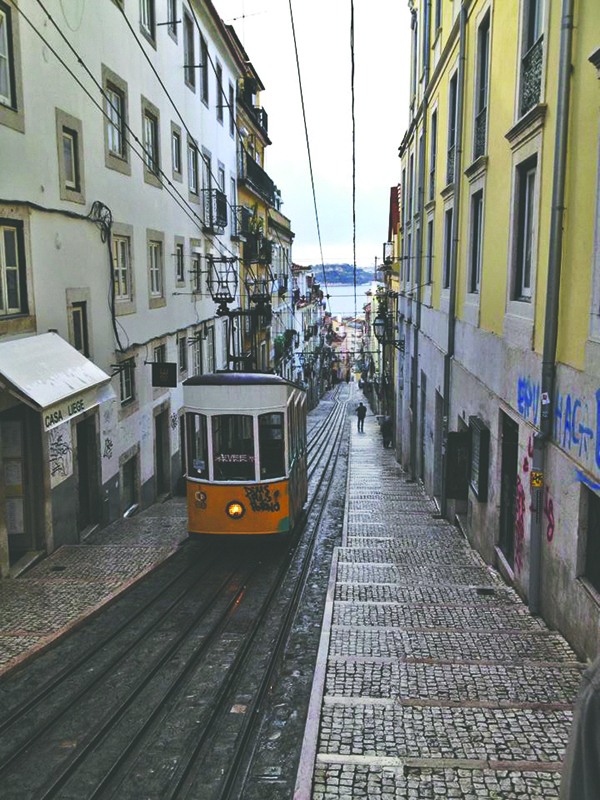
[dropcap]I[/dropcap]t was the first nice weekend in January when I and my friends boarded a plane traveling from Marseille to Lisbon.

A few weeks prior to this beautiful, warm January day, we decided to chase the sun west and spend some time away from our small dorm rooms. Naturally, as the group control freak and planner, I devised a long list of must-sees and can’t-miss attractions. I spent hours researching restaurants, and reading about hidden hot-spots. At the time, I believed there was a process, that there was somehow a right and wrong way to travel.

This was the trip, however, in which I learned an important lesson: the best memories are the ones you can’t anticipate or find in any kind of Lonely Planet guide.

There was one afternoon, about halfway through our trip, where all of my friends wanted to spend a few hours resting in a waterfront café. All they wanted to do was sit. Just sit. And I will give you that this particular café served mind-blowing espresso (or as the locals called it, “bica”) and delicious pastries, but after having a short rest, I decided to move on — without my group — and finish the day’s agenda on my own.

I had a list of sites I thought I had to see. As far as I was concerned, I would never truly see Lisbon, or get to know it, if I didn’t let my list guide me down breathtaking side streets to some kind of infamous landmark. But as I quickly learned after parting ways with my group, you can’t give yourself a final destination and plan your way there — life’s an adventure not a quest.

As I packed up my bag at the waterfront café, I ignored the eye rolls and pleas from my friends to stay, sit down, have another espresso, and just watch the water.

I told myself that I had a tower to climb, a street market to wonder, a parliament building to awe at, a garden stroll through and a cathedral to see. So off I went. And everything almost went according to plan. Almost.

I climbed the Arco da Vitória for beautiful sights of the Praça do Comércio, strolled through a lovely street market, took selfies in front of the parliament building and sat in the botanical gardens.

While I was sitting in the gardens, however, I witnessed an act against nature itself (or so I thought at the time). It was this unplanned, unexpected event that made my trip to Lisbon unforgettable.

As I sat quietly on bench in the gardens, watching ducks on the pond, I noticed that there was one duck who became quite aggressive with another. I was bothered by this. Ducks are, after all, one of my favorite animals. I, in fact, have a history of being quite protective of these simple birds. So naturally, I wanted to go help the duck being picked on.

I walked over to side of the pond where they were. The aggressive duck, let’s call him Jack, was biting the, poor, innocent one, let’s call her Susan. Jack then started holding Susan’s head under water!

“Duck murder,” I thought to myself. I was so sure I was witnessing cold blooded duck murder. Susan kept trying to swim away, but Jack always seemed to be able to pin her down.

It was a fight or flight moment for me. I was becoming increasingly stressed out by the whole affair so I decided to fight; fight on behalf of poor Susan. So I collected up small rocks and sticks and started throwing them in the water near Jack, to try and scare him off. Nothing was working, though. I could tell Susan was in great distress. So I walked as close to the water as I could and began quacking loudly at the two of them. Maybe of Jack saw how serious I was, I thought to myself, he would swim off. Surprisingly, though, the quacking didn’t work either. Eventually, Jack did swim off though, leaving a distraught, and assaulted Susan behind.

It was this unplanned, unexpected event that made my trip to Lisbon unforgettable.

I was in shock. I had no idea what just happened. At this point though, I had attracted quite a bit of attention from passersby and felt that I couldn’t go back to sitting quietly on my bench. I could tell you that I was embarrassed, or that I cared about the weird looks, but that would be a lie. As far as I was concerned, I was doing something good, I was saving a poor innocent duck from from it’s death.

Suddenly, the unmistakable ringing of church bells from the cathedral across the street filled the gardens. I looked at my watch; it was nearly 5 p.m.

“Oh, it must be a five p.m. mass,” I thought to myself. The cathedral was the final destination my list, and I was quite worked up from the duck incident, so I decided to leave the gardens and head on over to the cathedral.

On my way over, confused and upset about the garden situation, I thought that turning to the church, and staying for the five p.m. mass, seemed right. Maybe, somehow, I could find some answers about the atrocious duck actions I was witness to.

I hid out at the back of the crowd. I had never been to mass, nor did I speak any Portuguese. I thought if I hung out at the back, and did what the locals did, I wouldn’t stand out too much.

As we shuffled in, I took a seat on a pew near the back. About 10 minutes into the ceremony, I couldn’t help but feel that something was a little. . . off.

People were crying, and everyone was in black. . . and what was that large box in the front covered in cloth, flowers, and photos. . .?

“Oh shit,” I thought. I was at a funeral.

I tried to keep cool. But I was panicking pretty bad at this point. After about 15 minutes, I waited for what I will describe as a natural lull in one man’s eulogy, and made a graceful dash for the exit, my wind breaker swishing as I went for the door.

I was down the street in a matter of minutes.

At this point, between the duck incident and the funeral I just crashed, I decided that the best thing I could do for myself was go back to my hostel and wait for my group to return.

When I returned, no one was back in the room but me. So I went up to the hostel bar, ordered a drink, and waited. About an hour later they all rolled in, and took a seat at the table I grabbed for all of us.

They asked me what I had done, and I, needing to get off my chest what a debacle my afternoon was, began telling my story to the group. Once I got to the part about the ducks, however, the story took an all new turn.

“You do know that’s how ducks have sex, right?” my friend Chloë interrupted.

The short answer, is no. I didn’t know that how ducks had sex. If I did know that’s what duck sex looked like I wouldn’t have spent my time throwing sticks at Jack and Susan or quacking at them loudly.

The bizarre looks a received from strangers, though, suddenly seemed more justified. At this point I wasn’t embarrassed or even surprised. I could barely believe this was all really happening.

So in the end, I cock-blocked some ducks and crashed a portuguese funeral. And this helped make one of my most memorable days in Lisbon.

By the time I finished telling my story at the bar, my friends and I were laughing so hard there were real tears rolling down our cheeks.

I began laughing too. My perfectly planned afternoon turned into a whirlwind adventure that I surely will never forget.

And so I learned a valuable life lesson in Lisbon. Life isn’t a quest — you can’t predict how your travels are going to go, no matter how much prior planning and prep you do.

Rather, life is an adventure. Every day is a mystery, the ending unknown and unforeseeable. Stop looking for your final destination and just enjoy what’s happening now.
I can assure you the next time you take a trip, even if it’s just for a day, your favourite memories are the ones you never could have planned for.

Yoga belongs to India, so hands off

7

[dropcap]A[/dropcap]t the University of Ottawa last November, a yoga class was cancelled due to concerns that it was culturally appropriated from India — a culture that “experienced oppression, cultural genocide and diasporas due to colonialism and western supremacy.” At first, the story seems ridiculous and inconvenient. How did a simple yoga class become a political issue?

However, when you consider the debate on cultural appropriation, the issue becomes much larger than a yoga class. Cultural appropriation occurs when one culture takes and uses elements interpreted as a way of diminish the elements of distinct cultural identity. In this particular case, reimagining an originally Indian practice as a Western activity mirrors the colonialist idea that certain groups of people can take whatever they want from others without permission.

So, am I supporting colonialism by taking a yoga class? It is wrong to explore cultures outside my own? No. I am not accusing anybody of being a thief. I am not calling you a racist. I am saying, however, that people should take more seriously the cultural origins of whatever they do. People should think more about the sacred activities they engage in beyond the idea that “they are fun.”

If you are not going to respect the people that created a cultural practice, do not bother participating in it. A simple yoga class may mean much more to you than to another person. These classes are symbols of a culture that belongs to someone else. Your lack of understanding does not give you the right to forego empathy, compassion, and respect, and to me it does not matter if the activity is as benign as a yoga class or as serious as a traditional headdress.

People should think more about the sacred activities they engage in beyond the idea that they are fun.

At the end of the day, we have to come to terms with the fact the yoga belongs to India. It should therefore be practiced according to the rules and regulations set by India. You cannot claim rights to something that does not belong to you.

I have read many online comments that claim these views as too politically correct or restrictive. Unfortunately, minority groups have been increasingly painted as the villain in these situations for being ‘annoying’ and ‘overly sensitive,’ so I’ll offer up an alternative reason for this saturation of political correctness: nobody truly listens to each other.

Minority groups try to be understood while dominant groups accuse them of oversensitivity. We are not connecting. We do not understand one another. It is ridiculous that some people believe they have all the answers and cannot be bothered to learn more.

I do not have all the answers. You do not have all the answers. No particular culture has all the answers. We owe it to each other to listen and try to empathize with the other. If we do not find a way to communicate, we will continue to hurt one another.

I’m incredibly disappointed that yoga has been culturally appropriated due in part to this lack of communication between cultures, and I’m happy to see University of Ottawa take action against this. While it may take a while, I’d like to see some more public respect for the traditional roots of this sacred activity that has been ransacked by Western ideals.

Video games are a terrible alternative to exercise

0

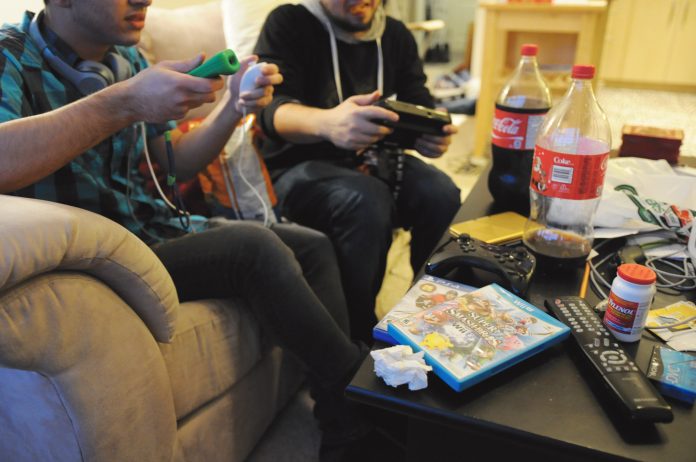
[dropcap]B[/dropcap]eginning next August, Norway’s Garnes High School will be offering students gaming classes in place of gym class, including only 90 minutes of exercise optimized for their favourite game. This is not the first time a school has made this decision, as other schools in Norway and in Sweden also offer eSports classes. However, this decision shows an unsettling shift away from the obvious purpose of gym class: exercise.

One thing can not be denied — eSports are a large, growing industry expected to be worth about $2 billion dollars by 2018. If schools mean to prepare our young people for the future, then it makes sense that we teach them about new, emerging industries. However, eSports are simply not an appropriate substitute for traditional physical activity.

Some eSports players take home six figures in earnings, or competition earnings and sponsorship. UBC’s esports team won a $180,000 scholarship last May in a video game competition. Many universities and colleges across North America now offer scholarships for eSports. Students should absolutely learn about these opportunities while in high school. Who doesn’t want to get paid to play video games?

Garnes High School says that these classes will train “[young] eSports pros bodies as well as their minds.” They will learn teamwork, sharpen reflexes, as well as build focus and endurance for long tournaments.

Truly, a training session for video games would likely aid in all those categories. However, the issue here is that you cannot substitute video games for physical exercise.

The benefits of gym class simply cannot be taken away from students. Just 30 to 45 minutes of moderate exercise per day has been shown to enhance memory, concentration, mood, cardiovascular endurance, and self-confidence. These are things that teenagers probably will not get out of an eSports class.

I’m not intending to bash video games. Personally, I have logged an embarrassing amount of time playing Call of Duty, Age of Empires, and numerous Fallout games. I enjoy them as much as the next person. However, it doesn’t seem right to allow students to opt out of gym class in order to play video games.

The entire purpose of physical education is to teach students the benefits of maintaining a healthy body, and, sadly, sitting does not contribute to health maintenance.

Perhaps, it would be better to offer eSports training as an extracurricular opportunity, so as not to diminish the importance of physical exercise. Students deserve the chance to pursue their interests, especially when it has the potential to earn them scholarships.

The fact of the matter is that the benefits gained from the two different types of classes are not identical, or even similar. A healthy body as well as a healthy mind is vital to ensure that students live a good life during and after high school.

Workshop offers potential hint of future for First Nations academics

0
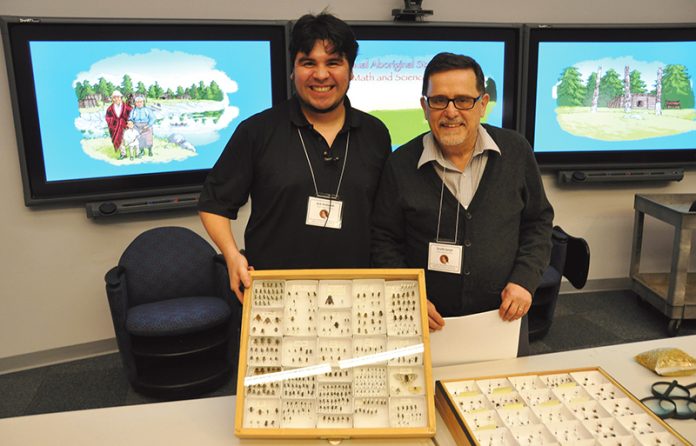
Kyle Bobiwash (left) and Veselin Jungic (right) were two of the presenters.

In an interview with The Peak last week, Director of the Office for Aboriginal Peoples William Lindsay mentioned that there was a lack of Aboriginal academics at SFU. However, there are initiatives in place to fix it for the future.

The sixth annual Aboriginal Students in Math and Science workshop was held on Jan. 14 at the IRMACS presentation studio building at the Burnaby campus under the guidance of professor Veselin Jungic. Over 70 First Nations students gathered to be inspired and indulge in their passion for math and science programs by four prominent math, biology, and astronomy presenters.

One of those researchers was Dr. Edward Doolittle from the First Nation University of Canada, whose aim was to help the students see that they actually have some news or values that they learned in high school can be used in something interesting.

“Ever since I have been in university at the age of 18, I have wondered about what I can do for the people,” said Dr. Doolittle. “I have been interested in math for most of my career. It seems that math is a major problem since not many Aboriginal students enjoy mathematics.”

For his part, he brought forward activities and education on string theory, which included making different shapes and figures from a string, realizing a string figure from a random drawing. String figures have been used throughout many culture groups and each of them contains cultural heritage from which students can learn.

Professor Veselin Jungic from SFU’s Department of Mathematics added that the meeting is also a way to promote scholarships, careers in math and science, and that the four eminent Aboriginal researchers invited to the meeting could serve as new role models.

The workshop reached a wider scope than just students at SFU, as some of the conference participants came from outside the Lower Mainland. Jungic says he is proud that SFU welcomes many Aboriginal students each year. Furthermore, according to SFU institutional research and planning, 7.6 per cent of SFU undergraduate students come from communities outside Metro Vancouver, and over 120 courses that focus on Aboriginal knowledge and issues are offered at SFU as stated by SFU Office of Aboriginal people.

The reaction from students was very encouraging, with those who attended showing fascination and excitement. Students tackled the problems given by the presenters,  and worked on new mathematical puzzles that arose over the course of the day. They said the activities were very fun to do, easy to understand, and caught their attention.

Programs like this could be one of the major keys to fighting lack of Aboriginal academics currently in Canada.

New masters program uses art for social change

0

Are you an art lover who wants to change the world? SFU’s new master’s degree in Art for Social Change (ASC), the first of its kind in Canada, is the program for you.

The new Master of Education in Art for Social Change will offer training in group facilitation, project management, communication, and ASC processes. The two-year program will launch this fall, with cohort-based classes to be held on Saturdays at the Harbour Centre campus. The degree also includes internship opportunities with local community organizations.

Judith Marcuse, an Artist in Residence and Adjunct Professor at SFU, explained that art for social change takes two forms. In the first, artists create pieces that contain content about social change and are intended to start a dialogue around specific issues. In the second, groups of people produce artwork about a subject that matters to them, with the help of an artist or facilitator.

Despite being the first formal graduate program in Canada, Marcuse said that art for social change has been used in a wide range of contexts all over the world including HIV and AIDS stigma reduction through puppet shows and other forms of performance, and hospital policy change through a play created by former patients.

“Because the range is so vast, it’s difficult to pigeonhole it,” said Marcuse. The interdisciplinary program has taken a long time to find a place at SFU; Marcuse started working towards the creation of this master’s program seven years ago.

Marcuse believes formal training will help provide the specific skills necessary to do ASC work as safely and richly as possible.  Producing art for social change includes both communication and exploration. She created a five year project that explored teen suicide, in which 400 youth used art to explore their own experiences around teen suicide.

The results of the project, she said, were powerful. “It becomes personal and it becomes a feeling, rather than just information,” said Marcuse.

ASC can have very different results from more analytic forms of activism. Marcuse said forms of art such as photography, storytelling, dance, and theatre, have the ability to affect people at an emotional and intellectual level.

“You can read all kinds of statistics about a certain subject, but then if you see a film about it or a play or you read a poem, it’s a very different experience,” she said.

Art for social change can be used for a wide variety of agendas, including education, policy change and conflict resolution. “So it’s not just for artists,” Marcuse stressed.

Who is the ideal applicant, in Marcuse’s opinion? “Anyone who wants to make change in the world and who sees the integration of the imagination as an integral part of that change-making.”

Whitewashing the 2016 Oscars

0

[dropcap]I[/dropcap]f 2015 ended a little bit more hopeful with regards to media representation for minorities, given the release of a Star Wars sequel featuring a black man and a woman as the main characters, as well as Viola Davis’s Emmy, the 2016 Oscar nominations managed to crush that hope.

This year’s Academy Awards continued last year’s pattern with zero non-white actors nominated for any of the four categories available. Similarly, no women were nominated for Best Director and Alejandro Iñárritu was the only non-white director on the list.

More surprising was Sylvester Stallone’s nomination for his supporting role in Creed while actor Michael Jordan was left out entirely. Likewise, Straight Outta Compton’s white screenplay writers were acknowledged while neither black director F. Gary Gray nor any of the film’s actors were. This is not to mention the LGBTQ+ actors who have yet to be cast in a large-scale movie (most recently, the missed opportunity to allow a trans woman to play Lili Elbe in The Danish Girl).

As expected, the overall lack of non-white nominees and other minorities has generated harsh retaliation. Celebrities Jada Pinkett Smith, Rashida Jones, and Martha Plimpton, as well as Straight Outta Compton producer Will Packer, have openly expressed their disappointment. While the backlash the Academy continuously receives for their lack of diversity is unlikely to destroy the Oscars entirely, the awards’ reputation is certainly diminishing among people from all ethnicities. After all, who cares for an awards ceremony that doesn’t even acknowledge the actors and filmmakers who represent it?

Simply put: old white men pick white people to represent the ‘best of the best.’

Not only this is the second year in a row that the Oscars failed to feature actors of colour, the Academy votership is 94 per cent white, 77 per cent male, and has a median age of 62 years old. Thus the Oscars are just a consequence of an overwhelming lack of diversity in the Academy. Simply put: old white men pick white people to represent the ‘best of the best.’

While it’s easy to assume actors of colour were simply not ‘good enough’ to be nominated for the 2016 Oscars instead of holding the Academy accountable, this year featured countless amazing performances that were oddly forgotten — Will Smith’s role in Concussion, Jason Mitchell’s in Straight Outta Compton, and Idris Elba’s in Beasts of No Nation. This pattern repeats itself across filmmaking categories in which the work of coloured people are under-recognized and undervalued.

The fact that the Academy continues to exclude different ethnicities and other minorities amplifies the notion that to be predominantly straight and caucasian is all it takes to be noticed in the film industry. It’s no wonder celebrities like Spike Lee are encouraging a boycott of the ceremony. It might be time to seriously re-think Hollywood recognition if it continues to perpetuate this exclusive environment.