Home Blog Page 771

Three must-see events this month

0
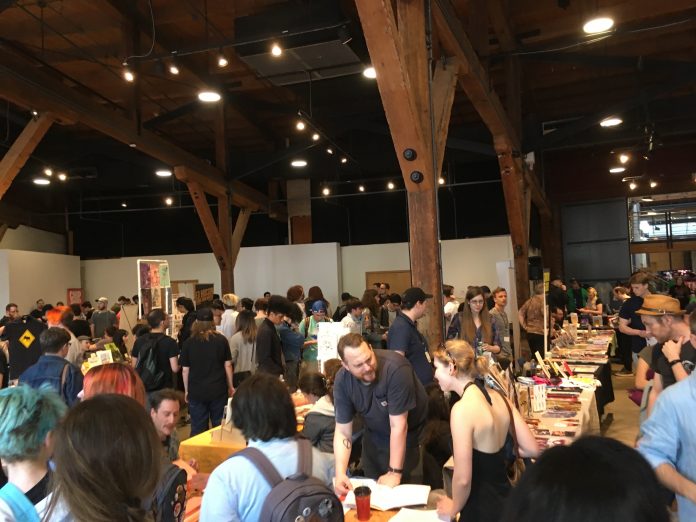
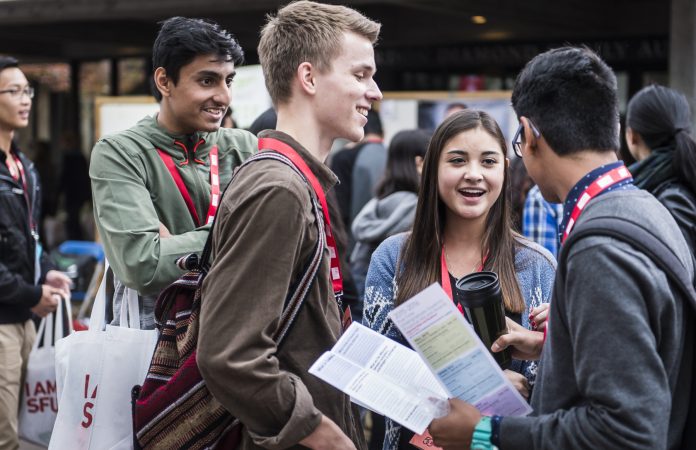
VanCAF, hosted in the Roundhouse community centre is a bustling congregation of graphic novel writers, illustrators, and readers.

May 19 — Existence as Resistance: Two Spirit Cultural Placeholders in Art, Activism, and Kinship: Artists and activists Jamie Lee Hamilton, Raven John, Tyler Alan Jacobs, and Trevor Blackman-Wulff will be discussing what it means to be Indigenous and queer. It is being organized through a partnership with the Queer Arts Festival and the Native Education College. This discussion will take place at the Native Education College from 7 p.m. to 9 p.m. For more information visit: http://queerartsfestival.com/event/existence-as-resistance/

May 20–21 — VanCAF: The Vancouver Comic Arts Festival is a two-day exposition of comics and graphic novels that will feature authors and illustrators from all over the globe. There will also be readings, panels, and workshops. The festival will take place at the Roundhouse Community Arts and Recreation Centre. Admission is free. For more information visit: http://www.vancaf.com

May 31 — The Critical Hit Show: Live improv comedy unfolds as performers play Dungeons & Dragons, the role-playing game. Ages 16-plus due to language and alcohol is available to those of legal age. The show is at the Rio Theatre, doors are at 7 p.m., and show starts at 8 p.m. For more information visit their Facebook page at: https://www.facebook.com/events/1884848981786237/

Lind Prize award ceremony caps off 2017’s Capture Photography Festival

0
One of the installation: Brandon Poole, The Principle of Original Horizontality, Mixed Media Installation

This year’s 2017 Capture Photography Festival wrapped up on April 28 with the closing reception and awards ceremony for the second annual Philip B. Lind Emerging Artist Prize. The prize is intended to support up-and-coming artists working in the fields of photography, film, and video and is awarded to a student studying in a Bachelor of Fine Arts (BFA) or a Master of Fine Arts (MFA) program in BC. The ceremony wrapped up a three-week exhibition run at North Vancouver’s Presentation House gallery that featured the work of shortlisted students from SFU, UBC, UVic, Kwantlen, and Emily Carr. The show featured diverse approaches to photographic images, including videos, projections, still images, analog film, and photographic installations.

The Philip B. Lind Prize was inaugurated last year by an opening and awards ceremony that was held in conjunction with the opening of the 2016 Capture Photography Festival on April 1, 2016. The prize is supported by Presentation House Gallery and funded by Rogers Communications in honour of Philip Lind’s retirement from the company and the communications industry. At this year’s award ceremony, it was described by Reid Shier, the director of Presentation House Gallery, as an opportunity to focus on the achievements of promising students who will become artists to “hear about and to keep an eye on.”

This year’s shortlist included two SFU students: Ryan Ermacora from SFU’s film program and David Biddle from the MFA program. Ermacora’s work, Empire Valley, is a nine-minute-and-twenty-second short film that is composed of seven shots. Empire Valley presents a landscape of sublime grassland in BC’s interior through wide expansive shots. Omitting the sky, and isolating the subtle (but impactful) human presence, Ermacora presents a landscape as a principal character that is temporarily occupied by a human presence which varies between tourist, observer, and resource extraction. The seven long shots in Empire Valley, which exist between still image, image loop, and moving image, invite a long, close look at the land and its permanence.

David Biddle is an SFU MFA student, video artist, and saxophonist for the band Dada Plan. Biddle’s work at the Lind Prize exhibition was a 23-minute video installation of Development Application, a 2016 work that is hybrid presentation, performance, and spectacle. In it, he appropriates the tools of professional business presentations and combines them with spoken work, intense electronic music, and the imagery of housing developments and applications from throughout Vancouver. These buildings become source material that he zooms into, pans through, and dissolves in a psychedelic-new-age-sci-fi consideration of the visuals and language of Vancouver’s absurd housing boom.

At the reception, this year’s Lind Prize was awarded to Marisa Kriangwiwat Holmes of Emily Carr University of Art and Design (ECUAD), while honourable mentions were awarded to Durrah Alsaif of Kwantlen Polytechnic University and Natasha Habedus of the University of British Columbia. Holmes, a fourth-year photography student at ECUAD was awarded for her photographic multi-media installation. The award includes $5,000 towards the production of a new work which will be exhibited alongside that of last year’s winner, SFU MFA Vilhelm Sundin at the new Presentation House Polygon Gallery opening in the fall of 2017 next to Lonsdale Quay on the North Vancouver waterfront.

Stuff We Like And Don’t Like: Summer Reading Edition

0
(Elena Hsu / The Peak)

By Gabrielle McLaren

Stuff we like: Homegoing by Yaa Gyasi (2016)

Effia is a village girl in Ghana who grows up to marry a British slaver. Unbeknownst to her, her half-sister Esi is sold from the very castle in which Effia is raising her family and sent to Alabama. This historical novel provides quick, but deeply personal, twenty-page glimpses into the lives of Effia and Esi’s lineages alternatively. Everything from the horrors of the transatlantic slave trade to the Harlem Renaissance and the fight for Ghana’s independence is covered in this ambitious, fast-paced, and truly addictive debut novel.


Stuff we don’t like: The Crown’s Game by Evelyn Skye (2016)

This young adult novel rests on the premise of the Crown Game in which two enchanters compete with each other, in what is essentially the Triwizard Tournament, to become the Russian Tsar’s advisor. Of course, they end up falling in love along the way — quickly, and for no good reason — despite knowing that at the end of the Game, the loser must die. Predictability aside, the novel has a lot of problems. Here’s a short list: unrealistic and boring dialogue, cookie-cutter characters, plot holes big enough to drive trucks through, loose threads tied up quickly and sloppily . . . if a young adult series based on Russian folklore is your cup of tea, I would rather recommend Leigh Bardugo’s excellent Grisha Trilogy, whose enticing and palpably real world and characters are also featured in a spunky duology about criminal and magical prodigies.  


Stuff we like: History is All You Left Me by Adam Silvera (2017)

This is a romance that will mess you up. Long story short, Griffin and Theo were best friends, who then became boyfriends, who then broke up because Theo left for college, where he started dating Jackson . . . and then died, leaving Griffin, Jackson, family, and friends to mourn for him. Like I said, this romance will mess you up. Silvera jumps across Griffin and Theo’s long timeline, showing you all kinds of firsts and all kinds of goodbyes, a thousand reasons to hate Theo and a thousand reasons to miss him. Silvera also gets bonus points for writing queer romances that aren’t only about being queer.


Stuff we don’t like: The Hamilton Affair by Elizabeth Cobb (2016)
If you’ve been (trying) to rap about American history thanks to Lin-Manuel Miranda’s hit musical, this book might be on your radar. It follows the childhoods, courtship, and marriage of founding father and economic genius Alexander Hamilton and his wife Elizabeth Schuyler. The book was clearly written by a devoted historian and the story is brilliant and interesting (because that’s the legacy of Alexander Hamilton). The execution, however, needed a bit of tender love and care. Enormous blocks of time were skipped between chapters which meant playing catch-up a lot, and the novel told more than it showed. Ultimately, characters and events were reduced to what they are in any old textbook: dead historical figures and checklists of events. Plus, Elizabeth Hamilton falls into the terribly annoying cliché of the “Period Woman Who Has Merit Because She Is Not Like Other Women.” Helpless and unsatisfied, I just went back to listening to my show tunes and reading the biography which inspired Miranda in the first place.    

SFSS shuts down Highland Pub, the Ladle for summer

5

Students hoping for one last drink at the Highland Pub before its permanent closure on June 15 are out of luck. The Simon Fraser Student Society (SFSS) shut down the pub on April 28 with little warning to students.

The closure of the pub kitchen also marks the end of the Ladle and SFSS catering services, but the Higher Grounds Coffee Shop will remain open for the time being.

Newly-elected SFSS President Hangue Kim said that the previous Board of Directors made the decision to close the pub for the summer semester, as was done in 2016. He noted that no special announcement was made because the summer closure was part of usual operations.

“Regardless of whether or not [the Highland Pub] was still operating for the next year, it would have been closed for the summer,” Kim explained.

On April 7, the outgoing board announced that it had decided to close all of its food and beverage (F&B) operations, citing years of significant deficits. Despite closing the pub for four months out of the year, the F&B operations still saw a loss of nearly $350,000 in 2016.

“Food and beverage services for the SFSS is done,” said Kim.“The biggest thing for us as a student society [is that] we are a small organization and we don’t have the resources or the buying power to compete in such hyper-competitive markets.”

“Last year’s board just made the decision and said that it wasn’t an efficient use of student dollars.”

The new board is now tasked with determining how to allocate the F&B funds and what to do with the space that housed the pub and the coffee shop. The pub space is part of a long-standing lease held by the SFSS, but Kim did not rule out the possibility of renting it out to other businesses.

“We’re open to options, and we’ve heard the student concerns that were brought up,” Kim said, noting that the board will be detailing their plans in the coming months.

“We didn’t take the decision lightly and we’re going to look for the best alternative option for students, and hopefully come up with a solution,” Kim stressed. “I hope students understand that we are exploring options to continue to make the space better for students.”

Faculty launch petition after SFU cancels Aboriginal transition program

2
The cancellation came without warning to instructors, students, or program staff.

Members of the SFU community are speaking out after the university abruptly cancelled the Aboriginal University Transition Program (AUTP) last month. Vice-President (VP) academic Peter Keller said that the “difficult decision” to cut the program was the result of declining enrolment.

Faculty have launched a petition calling on the administration to reinstate the program for the upcoming academic year. So far, it has collected over 650 signatures.

Natalie Knight, an AUTP instructor, said that the cancellation came without warning to students or staff on April 19. She noted that the program blended Indigenous knowledge with traditional academics to assist Indigenous students transitioning into university.

“I think the university has a real opportunity to right a wrong and show that they are still committed to Indigenous education,” said Knight, who is a doctoral candidate and a member of the Yurok and Navajo nations.

However, VP academic Keller told The Peak that the university plans to put the program’s funding this year toward a review.

“What we are doing here is we are shutting down the existing program to allow us a pause to re-envision [the program],” Keller said. “But our commitment to pathways and bridging programs for our Aboriginal students to access and thrive in post-secondary studies remains an absolute top priority.”

The AUTP, based at SFU Surrey, saw almost 80 students enrolled over six years between the Aboriginal University Prep Program and the Aboriginal Pre-Health Program.

One staff position was eliminated as a result of the decision to cancel the program.

Program supported students

Herb Varley, a community activist, graduated from the Aboriginal University Prep Program a few weeks ago and intends to pursue an undergraduate degree at SFU. He said that he was “angry, but not surprised” that the university chose to shut down the AUTP.  

For Varley, the administration’s actions show that they are not fully committed to Indigenous students.

“It was the strength of the students and the staff and the faculty that [made] the program work,” he said. The AUTP provided a support system for students who might otherwise feel isolated in the university environment.

“We came from all different walks of life; we all had different experiences. And I know that every single one of us had wanted to walk away from it all because it was really hard, but given that it was a small cohort, we were able to support each other,” Varley explained.

After being out of school for 14 years, Varley said that the program helped him gain the practical skills necessary to succeed in an academic environment.

“Many Indigenous students are wary of attending any Canadian institution” given the history of colonialism and residential schools, he explained.   

Low enrolment

Keller noted that the Aboriginal Pre-Health Program has not run for two years as a result of low enrolment.

In the 2015–16 academic year, only two students enrolled in the Aboriginal Pre-Health Program and were offered placement with the further nine students in the Aboriginal University Prep Program. This past year, no students enrolled in pre-health and five attended the prep program.

Enrolment numbers peaked during the first year in 2011–12 with 10 students in each of the two programs, capped at 12 students.

“[Y]ou need a critical mass of students to run a meaningful, cohort-based program,” Keller explained. “The numbers clearly weren’t what we are hoping to achieve here.”

“At some point, you have to make a hard decision and you have to just say, ‘Would it still be responsible to allow very few students to enrol in this program when we know if we re-envisioned it we could do so much better?’”

However, Knight disagreed.

“We need small classroom sizes because we would not be able to provide the intensive support that we do for students [otherwise],” she said, adding that the university could dedicate more resources to recruitment and do more to assist students in covering the annual tuition costs.

Pressure to reinstate the program

“It’s above all a loss for students because it was creating a space for Indigenous students to learn at SFU,” said Rochelle Tucker, a senior lecturer and former instructor in the pre-health program.

Students and staff have voiced that they want to see the program reinstated immediately for the 2017–18 academic year and are urging the administration to consult those who are affected by the decision.

The department of sociology and anthropology also sent a public letter addressed to Keller expressing their opposition.

Knight wants to see the university involve the students, instructors, and staff that they cut out of the decision to cancel the program in the review of the AUTP. The commitment from SFU is there, according to Keller.

“What [the program] really needs is this re-imagining in full consultation with the Aboriginal communities,” he said.

Students engage at SFU through peer programs

0

Every year, hundreds of students volunteer with the various peer education and peer mentorship groups, which help to provide services to the greater university community. There are currently over 700 students who give their time to these programs on top of their school work, and are a key component for the success and functionality of these programs.

Without students helping to run these groups, many of the resources and services would not be able to reach the number of students that they currently do.

One example of such groups include the Learning and Writing Peers, out of the Student Learning Commons, who help students with writing and studying better. The Health Peers are another example, and they lead workshops and do outreach on campus to help improve students’ physical and mental health. Along with these groups are the peer mentorship groups, which can be found in many of the faculties and programs at SFU. They help to engage first-year students early on, and ease their university transition right from the moment they start their undergraduate careers.

After completing two terms as a Career Peer Educator, Matthew Furtado reflected on how he almost didn’t join due to an already full schedule and an indifference to making friends. Furtado calls this experience “incredibly rewarding” and “an encouraging break from studying.”

“Over the past two semesters, I’ve met with dozens of students for resumé and cover letter consults, as well as interview tips and finding work on campus,” Furtado said. “I genuinely feel like I’ve made a positive and lasting difference in students’ work search[es].”

As a Learning and Writing Peer coach and past First-Year Learning Community mentor with the faculty of arts and social sciences at SFU Surrey, Ken Ip says that it provides students with an opportunity to “build up their portfolio of experience for the workplace or for professional development.” Ip has seen year after year how most of these commitments are structured flexibly around students’ schedules and also equips students with professional skills through training curricula.

Another Learning and Writing Peer, Robyn-Mae Deang, enjoys when the student she is helping is able to have the ideas make sense in their mind: “It’s truly a heartwarming feeling to know that I have facilitated in that self-guided process.” Alongside helping others, Deang has found that through helping students with their writing and seeing so many writing pieces, she herself has grown to become “a more conscientious writer.”

Beyond the students’ stories here, there are currently about 40 postings up on myinvolvement.sfu.com that are looking for volunteers. The full list of peer programs, as well as other opportunities to volunteer on campus, can be found on the Student Services “Get Involved – Build Community” website.

SFSS decides to close all its food and beverage options

0
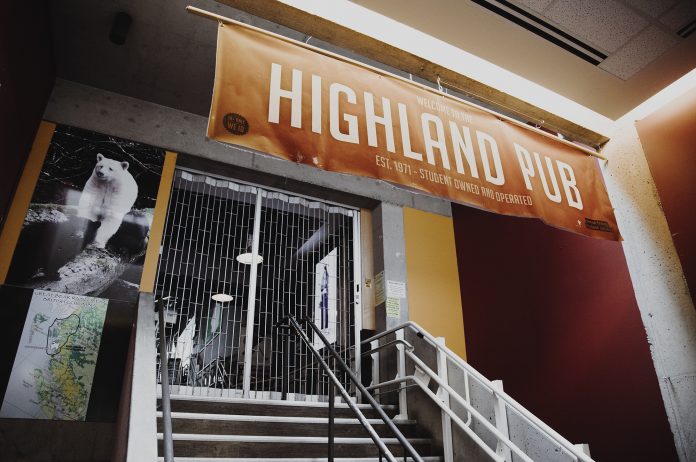
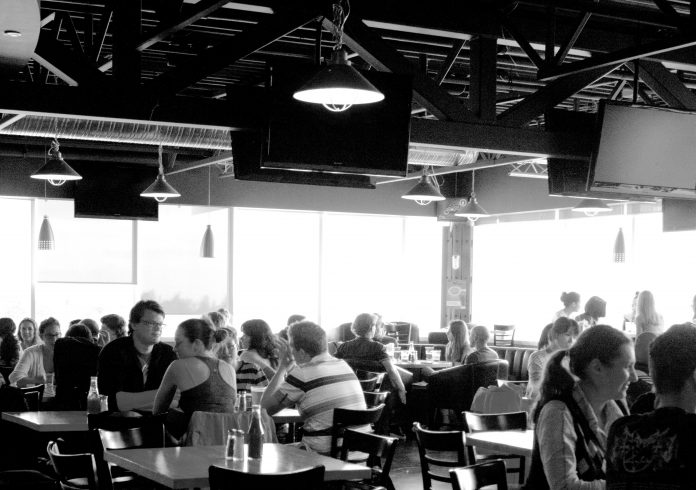
There was a time when the Highland Pub was filled with patrons, but in two months it will be closing its doors, as will all SFSS F&B operations.

In a shocking statement released today, the Simon Fraser Student Society (SFSS) has announced that it will be permanently closing its food and beverage (F&B) operations effective June 15.

In a press release made by the SFSS, it cites the ongoing deficits incurred by the F&B services.

“This decision comes after years of the SFSS food and beverage operations annually incurring a deficit. In 2016, the operations saw a loss of $348,294, which is comparable to previous years.”

This decision comes in the same week as the results of the SFSS general election, which means that the Board of Directors that made this decision has less than a month left on the job. They will pass this — and all other board matters — on to a new team.

““Each year, the food and beverage operations faces a large deficit, subsidized using student dollars. The Board believe it is in the best interest of students to not continue to run this deficit,” said outgoing President Larissa Chen in the statement.

Along with the food outlets, the SFSS catering services will also be shut down. Those services have been a bit controversial in the past, as Departmental Student Unions (DSUs) and other groups associated with the SFSS have been forced to use them to cater their events, much to the chagrin of students like Kelsey Wilson.

“What does this mean for DSUs that have previously been forced to use SFSS catering for events? Do we get to buy from wherever now?” she asked on Facebook, in response to the press release.

While there are many questions that are going to arise in the coming months, outgoing vice-president (VP) student life Curtis Pooghkay wanted to express how difficult this decision was and give thanks for the F&B employees to end the press release.

“We know that some students enjoy pub nights and the social gathering spaces and we did not take this decision lightly”, said Pooghkay. “We are grateful to our staff and management for working so hard for the food and beverage operations over the years,” he said.

Men’s basketball’s goal for next season clear — make playoffs

0

First-year head coach Steve Hanson was glowing about the challenge he faced as a first-time university head coach. After spending years as a high school head coach, last year he was an assistant coach for SFU.


“It’s exciting, you just have to be sharp everyday, every practice. Every minute in practice means something,” he explained. “I love it. I wouldn’t change it for the world. I’m really proud to be here and expect big things from the future.”


It’s that kind of attitude, perhaps, that despite a 4–24 overall record for the team, had graduating senior Gibran Sewani say that this was the most excited he was for the men’s basketball team going forward in his five years in the program.


Hanson, who had coached championship-calibre teams at Terry Fox Secondary before joining the SFU staff, seems to embrace the challenge.


“You never come home from the gym on a Thursday night saying we’re going to beat this team by 30 [at this level] — that happens in high school quite a bit when you have a good high school program.”


But a challenge it was. After winning two consecutive non-conference Division II games in November, SFU went on to lose 19 consecutive games, before nabbing their first conference win of the season on February 11.


“The growth came a lot later than I had hoped or expected,” explained Hanson. “We just looked disjointed early in the season. It’s a process, and [for] a lot of teams that have been together that process has already happened. So, I can already tell right now that [in] the runs we’ve just been having over the last few weeks, we’re just meshing a lot better right now.”


By the end of the year, the Clan looked like a much different team than the one in November and December. In late-January and throughout February, they were competitive most nights and pulled out a couple of wins.


“About mid-January, there was just a change in the way we were playing, especially on the offensive end. And we made a few adjustments defensively — just tactical adjustments — but really there was an adjustment with just how we meshed on the floor, and that took a long time.”


And that’s the advantage he has going into the off-season — something to build upon.


Last year, Hanson took over as interim head coach after then-head coach Virgil Hill resigned on April 1, less than a year after former head coach James Blake had resigned. While he got the permanent job title on May 26, he had inherited a roster of only six returners who had seen minutes (eight counting redshirts), with the promising freshman Oshea Gairey having left the program, and a shortened recruiting season to rebuild the team.


Any progress that one saw at the end of the 2015–16 season likely dissipated with the turnover of coaches and players.


Now, for the first time since the 2014 off-season, with Hanson leading the ship, the men’s basketball team will be entering recruiting season with a stable coaching staff.


“Doing a really good job in recruiting, you have to develop relationships with guys, and start young,” said Hanson. “Because if you’re talking to a guy for the first time in April, you really don’t know what you’re getting, and that leads to a lot of bad decisions sometimes with coaches.”


He’s looking everywhere for players, with priorities being BC high schools, to Ontario, to junior colleges throughout the United States. Washington State, which he notes is a good spot due to the quality of basketball there and closeness in climate and proximity, is also being heavily looked at. (The men’s team hasn’t had a player listed from Washington since the 2013–14 season).


“We look everywhere, honestly. It starts in BC, we want the best BC kids here,” he said. “[But] it’s international now, it only takes a YouTube video for me. I get 30–40 emails a week from guys in Australia, Asia, all over the place.”


The importance, however, is seeing these prospects in-person.


“Most guys in their highlight tape shoot 100%, so they’re perfect,” Hanson said. “It’s much better to see them in person, meet them in person, and get them out for tryouts. We’ve had a few guys up for tryouts the last couple of weeks.”


While the particulars he is looking for are players with size and who can rebound, they also have to be capable of SFU academically and fit in with the culture.


“Number one is we want talent. Number two is we need to have great students. Number three is we need somebody who fits, and what I mean about fits is you have to come here wanting to get an SFU degree; you have to want to hit the gym and really work on your game, because now after exams we have a long off-season — close to four months off where coaches are not allowed to work with players,” Hanson noted.


According to BCHoopScoop, 6’7” Vancouver College forward Sam Bailey has verbally committed to SFU. On Monday, Howard Tsumura reported that Keegan Kohn, a six foot point point guard from Holy Cross has committed to SFU.


According to Verbal Commits, SFU has at least two outstanding offers to junior college players, and one to 6’3” Kelowna high school point guard Mason Bourcier. Bourcier was named to the BC 4A boy’s basketball first-team, while Bailey was named to the second-team. (Hanson did not name any specific recruits or offers).


“We have a couple of BC walk-on guys who will be really good additions in a couple of years,” said Hanson. “For us, there’s a lot of good quality guys out there, but they have to mesh with our guys and we have some time, but we hope to announce a few signings on April 12.”


But the biggest thing Hanson will have at his disposal is a strong group of returners. Out of the 15-man roster last season (including redshirts), 10 will return. SFU lost seniors Sewani and Hidde Vos to graduation.


Despite a shortened recruiting period, the men’s basketball team was able to add a couple of freshmen last year who look to have the potential be primary pieces for the team.


Michael Provenzano, as a redshirt freshman, was the team’s biggest offensive threat and looked at home in his first year of university play. He was also relied on extensively, playing a full 40 minutes twice, and averaging 31.3 minutes a game.


“A big part [of] our growth as a team was him. I think coming in, as a redshirt freshman, he was trying to prove he could play at this level. So, I think he made a lot of mistakes early, just by trying to do too much,” said Hanson. “A big part of our change was his play: better shot selection, he’s a very good passer — he showed that a lot more later in the year.


“He had a few more turnovers than we would’ve liked, but again, it’s forcing things he didn’t need to force.”


Pure freshman (straight out of high school) Othniel Spence also showed real promise, putting up a team-high 29 points and 24 points in the final two games. Hanson commended Spence’s work in the gym and on shooting the ball.


“It leads to confidence in games. His minutes really went up,” commented Hanson.


The core seems like it will be intact, with Hanson also indicating that Kedar Wright, JJ Pankratz, Iziah Sherman-Newsome (next year’s senior class), Tyrell Lewin, and Graham Miller appear to be in the team’s plans. (He did not specify the three non-seniors were leaving).


“What’s really nice is that out of our 10 guys [returning], nine guys are going to stay in BC this year and train all summer. We expect that to really help the process in September,” said Hanson.


“That culture and that gelling has happened now, when you bring in one or two pieces now to that mix, it’s going to be a lot smoother transition. The 10 guys coming back know what the expectations are.”


While Hanson is happy that the team played its “best basketball the last five or six weeks of the season, which is what I want to get to every year,” he’s not satisfied. The expectation for next season is clear — there’s no mistaking his words.


“That’s our expectation: make the playoffs,” said Hanson. “If we don’t make the playoffs, we failed.”


While last season the hope was for the playoffs, it seemed more like a long-term ambition rather than an expectation for the coming season. For the 2017–18 season, the expectation to contend is sincere.


“This year, it would’ve been a great thing to do, but if you look back on the season, and we were where we were in in mid-January, we would’ve been right there — if you look at the number four to number 10 team, it was like a one-game difference between all those teams,” he said.


“We’re not satisfied. We’re not going to be satisfied until we’re in the playoffs every year.”

Food contract controversy ends with happy resolution

0
After a long-fought battle, workers with UNITE HERE Local 40 finally gain the job security for which they have been fighting.

The cafeteria workers who previously feared for their job security have reached an agreement with SFU’s new food services contract, Sodexo.

This agreement confirms that all 174 workers will receive all of their health care and pension benefits, seniority, and wages that they received from their past contract with Chartwells, a division of Compass Group Canada.

In a press release from UNITE HERE Local 40, cafeteria worker Bruna Padularosa, who has worked at SFU for 29 years, explained, “We are happy that we resolved our main concerns with Sodexo — that our jobs are safe and our union will be recognized. Now, we look forward to working on our contract.”

This agreement comes after both students and faculty got involved to ensure that cafeteria workers received their benefits and wages while SFU solidified a new contract.

As The Peak previously reported, roughly 100 cafeteria workers and students rallied in a march asking SFU to guarantee that all cafeteria workers jobs be renewed with the upcoming contract. This call to the SFU administration was also met with a petition that was signed by roughly 2,000 members of the SFU community.

Throughout the ordeal, students, faculty, cafeteria workers, and the union UNITE HERE Local 40, called to protect the cafeteria workers’ jobs. SFU assured a new contract with a new food service provider would be made on the basis of providing the same wages and benefits to all cafeteria workers.

Bill Keith, vice-president operations for Sodexo said that the “[bidding process] was a very competitive RFP. It’s one of the premier universities in Canada.”

“It’s an exciting opportunity for us, we’ve always wanted to be at SFU. We thought we lined up really well from a vision perspective, and we’ve got a really good local team here, so we thought we’d fit really well in the community,” said Keith.

They also explained what they hoped for the future of food services at SFU: “We’re looking at this as a culinary transformation, rethinking food. First of all, there is a world of opportunity here, we’re looking at potentially bringing in some celebrity chefs, some brand new, first-in-Canada concepts.”

Keith also assured that Sodexo values all SFU cafeteria employees. “We know they are part of the community, we know they are part of the past of food service providers’ success, and we also know how important they are going to be for our future success. So I can’t emphasize that enough that there is a lot of misinformation. We are hiring all the employees.”

World News Beat

0

By: Gabrielle McLaren

USA – United States of America takes a step back in climate change policy

President Donald Trump has signed an executive order to repeal many of the United States’ climate policies, notably the Obama administration’s Clean Power Plan (CPP) which limits greenhouse gas emissions from power plants. The United States previously piloted world-leading research and provided billions of dollars of funding to climate change action, much of which helped to persuade poorer nations to accept the 2015 Paris Agreement. The US is the world’s second biggest emitter, producing 14% of global carbon dioxide. Undoing the CPP could increase emissions by 25%. This ties back to the Republican electoral promise to bring back coal mining jobs.   

With files from The Guardian and Washington Times

Russia – Russia denies all claims of meddling in US Election

Russian President Vladimir Putin has denied claims of Russian hacking and influence in the 2016 US presidential election. Putin has claimed that “the anti-Russian card” was being played in the interest of political groups within the US, and that these claims handicapped the president’s ability to to fulfil his campaign promises. Furthermore, he expressed his readiness to meet with the American president.

With files from CTV News

North Korea – Negotiations for the return of Kim Jong-un brother’s body come to a close  

Malaysia has released the body of Kim Jong-nam, the estranged half-brother of North Korean leader, for return to Pyongyang. Kim was murdered at Kuala Lumpur airport last month, which has lead to major diplomatic disputes, including Malaysia accusing North Korea of keeping Malaysian citizens as hostages within the country. Interpol is still investigating the case.

With files from BBC News