Home Blog Page 689

Food trucks, glorious food trucks!

0

Summer in Vancouver could be defined as an extended stretch of time with little or no rain. And when it’s sunny, you can’t stay home! You could, but wouldn’t you rather be out, discovering the city you live in? Restaurants may not be very ideal in this situation; you want to be able to move around, as well as grab some food. And what’s out when the sun’s out? FOOD TRUCKS! This will be your guide to some of Vancouver’s best food trucks and everything you need to know about them.

Breakfast

  • What better time to start the day outside than in the morning? That way you can make the most out of a sunny day. Don’t worry if you haven’t had the time for breakfast, because our first food truck is a breakfast one! At Yolk’s Breakfast Trailer, you get your entire breakfast, with all the nutrition you need, in a sandwich! It’s easy to eat while walking (or at least standing). It also fills you up enough to keep you going, but not enough to make you lethargic. You cannot leave without trying their lemon truffle hashbrowns as a side! The prices range from $7.50 for a single egg sandwich to $10.75 for a double egg sandwich; that’s cheaper than iHop, but just as good, maybe better! Sometimes mobile, but mostly parked, you can find this blue trailer at 500 Burrard Street at West Pender Street.

Drink

  • Now, that you’ve finished breakfast, you want to pick up something cool to drink as the day is starting to get warmer by the hour. The Juice Truck, usually in Gastown, will help quench your thirst! Along with many food options too, this juice truck is quite hailed in its area, with a 4.1/5 rating on Zomato! Their cold-pressed juices and smoothies have an average price of $8!

Lunch

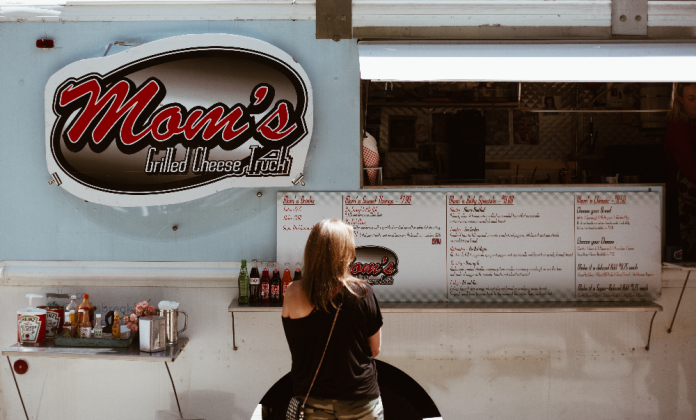
  • If you step out for lunch, one of the best and most talked-of food trucks to grab an unhealthy little treat for yourself is Mom’s Grilled Cheese Truck. Usually parked on 884 West Cordova Street, it’s also featured in Zomato’s “super sandwiches” collection. This particular food truck is famous for serving variations of the classic grilled cheese, leaving you with different choices for breads and cheeses! Many have recommended you try their sourdough with Havarti. What’s more is that the price range does not exceed the $10 limit for a classic sandwich!
  • This next one is something that Vancouver streets boast about. Rated #1 on almost every search of food trucks in the city, it’s a fusion of traditional American street food and Japanese spices, sauces, and delicacies. Yes, you guessed right; it’s Japadog! With food trucks spread all over Vancouver, mainly in the downtown area, it offers basic as well as specialty hot dogs. Their Kurobuta terimayo is listed as “one of the must-eat items in the world” On their menu. Another favourite amongst frequent visitors is the Okonomi. While all dogs are priced in the range of $7–$10, they also offer shaked fries as sides!
  • Since we’re on the topic of sausages, Eli’s Serious Sausage is another food truck to check out. They are serious about their sausage, and they are seriously on the move! They can be found anywhere from New Westminster to Main Street to Burnaby to the West End; it would be a good idea to check their schedule at http://www.eateli.com/Schedule.php before planning your food adventure. There’s an array of authentic German-style sausages, at an average price of $7 with their most tried dishes being the bratwurst and the currywurst. With a larger good to bad reviews ratio and a Zomato rating of 3.5/5, do as most foodies do and trust Zomato!
  • Home of the famous hot-smoked salmon sandwich, Kaboom Box, is another food truck that is highly rated, visited, and loved in the city! A must-try here is obviously their delicious Hot-smoked salmon “salmwich” that’s $9! The little but powerful red truck also is known for serving some good poutine or a special maple slaw as a side to any burgers or sandwiches. While they are mobile and on the move, they are usually located at Granville Street at West Georgia Street, or at the North Shore Night Market. They are a hit amongst seafood lovers, because of their Oyster Po’Boy burger, another one of their delicacies!
  • If you want to kick your lunch up a notch and try something a little more meal-ier than sandwiches, then you have to hit up the pies at Aussie Pie Guy! This Aussie guy’s location varies. His location information can be found at www.aussiepieguy.com. Their chook (chicken) pies seem to be the most popular amongst pie-eaters, and are quite affordable at about $8. If you consider yourself a meat-lover and are into exploring exotic meats, then this is one of the easiest places for you to try kangaroo meat!

Vegetarian

  • With an all-vegetarian menu, the Chickpea Truck makes it to this list because it may have been too biased on the meats so far. It works in a Subway-format, where you choose your bread, or base and then the mains and entrees. This is any Mediterranean-food lover’s dream come true . . . in a food truck, on the go! The average price for this hidden gem is in the range of $9–$13, and they are mostly known for their chickpea fries and hummus. They are mobile, but can be found at 33 Acres Brewing Company or at 884 West Cordova Street, amongst their other locations which you can look up at https://streetfoodapp.com/vancouver/chickpea-truck.

Desserts

  • It is only fair if we now focus on desserts, after such a long journey on all kinds of other foods! The first favourite amongst Vancouverites seems to be Johnny’s Pops. They boast themselves as the city’s best homemade, artisanal popsicle makers, and what attracts most people to their cart are their different and exotic flavours! Some of their flavours are blueberry mojito and rhubarb elderflower, while avocado lime remains to be a people-pleaser! They serve a single popsicle for $3.50, and 3 for $10! The bicycle cart can usually be spotted in the Mount Pleasant area.
  • To give this list the perfect, sweet ending, we cannot miss out on another famous and beloved dessert parlour on wheels! The last ice cream truck to make it on this list is our very own Rain or Shine Ice Cream. With flavours such as London fog and Honey lavender amongst many others, there’s something for everyone. Almost all their ice creams are gluten- and egg-free and in the price range of around $6. They are new to the food truck business and are usually parked at David Lam Park, 1300 Pacific Boulevard.

As we have come to the end of this long, mouth-watering list, I hope for two things: you try these and many more food trucks out this summer, and that we have sunnier days in Vancity!
Famous musicians and bands from Canada

0
(Alex Bloom / The Peak)

Tory Lanez: This Canadian hip-hop artist from Brampton, Ontario is most known for his hit singles “Say It” and “Luv” which landed on the Billboard Hot 100.

Fun fact: His birth name is Daystar Peterson and he’s producing a film entitled I Told You. – EB

Drake: Born in Toronto, Ontario, this multi-Grammy-award-winning Canadian rapper, songwriter, and actor is famous for his role in the teenage drama Degrassi: The Next Generation and his hit songs “Hotline Bling,” “One Dance,” and “Take Care.”

Fun fact: He has done voice acting, appearing in Ice Age: Continental Drift as Ethan the mammoth. – EB

A Tribe Called Red: The group is comprised of Ian “DJ NDN” Campeau, Tim “2oolman” Hill, and Ehren “Bear Witness” Thomas who are of the Nipissing, Six Nations Mohawk, and Cayuga nations respectively. The trio hails from Ottawa, Ontario and is known for their electrifying beats that blend various forms of Indigenous music with music styles like hip hop, reggae, and dubstep, among others. They recently released a new EP in 2016 called Stadium Pow Wow.

Not-so-fun fact: At one of their concerts, they had so many white people wearing culturally appropriated “Indian” headdresses that they refused to play until they all took them off. – AB

Billy Talent: Hailing from Mississauga, Ontario, this punk rock band consists of frontman Benjamin Kowalewicz, guitarist Ian D’Sa, bassist Jon Gallant, and last but not least, drummer Aaron Solowoniuk. They achieved worldwide success with their second album, Billy Talent II and are best known for songs such as “Fallen Leaves,” “Rusted from the Rain,” and “Red Flag.”

Fun fact: The band has been together since high school and remains together to this day. – AB

k-os: Originally from Toronto, Ontario, the Canadian-born rapper is best known for songs like “Crabbuckit,” “Man I Used To Be,” and “Sunday Morning.” His original style incorporates elements of jazz, electronic music, and hip hop through his own brand of highly poetic rapping and singing.

Fun fact: k-os stands for “knowledge of self.” – AB

Celine Dion: Born in Charlemagne, Quebec, no list of Canadian musicians would be complete without her. She is by far one of the better-known Canadians out there. Some of her most famous songs are “My Heart Will Go On” and “Nothing Broken but My Heart.” Her success was buoyed somewhat by the use of her music in the hugely successful Titanic.

Fun Fact: Don’t let go, Jack. – AB

Shania Twain: Hailing from Windsor, Ontario this singer-songwriter has broken barriers in the music industry, being one of the most successful women in her field. Best known for songs like “Party for Two”, “Don’t!”, and “Shoes.”

Fun fact: It is rumoured that she will make a small appearance in the fourth season of the series Broad City.

Famous actors and actresses from Canada

0
(Alex Bloom / The Peak)

Michael J. Fox: Best known for playing Marty McFly in Back to the Future, this Edmonton, Alberta-born actor has gone on to play significant roles in TV series such as Spin City, Rescue Me, and Family Ties. He even made a cameo appearance as himself in Curb Your Enthusiasm.

Fun Fact: Fox has done a lot of voiceover work and was the voice of Stuart Little. – AB

Ryan Gosling: Born in London, Ontario, Gosling is best known for his role in The Notebook and, more recently, La La Land. He also appeared in Drive, The Big Short, and showed off his talent for physical comedy alongside Russell Crowe in The Nice Guys.

Fun fact: Ryan Gosling is in a two-man band called Dead Man’s Bones. – AB

Ryan Reynolds: Yeah, we got all the good Ryans. Born in Vancouver, British Columbia, Reynolds is best known for The Proposal and would like you to forget that he was in Green Lantern. Thankfully we can, because of his hilarious portrayal of Deadpool . . . Er, his second portrayal of him anyway.

Fun fact: He’s touching himself tonight. – AB

Adam Beach: Born in Ashern, Manitoba of the Saulteaux people, Beach is most well-known for Smoke Signals, Windtalkers, and Bury My Heart at Wounded Knee among many other films. He also made a short appearance in Suicide Squad.

Fun fact: Adam Beach has agreed to be an ambassador for Canada 150, promoting the celebrations on the condition that he is allowed to give voice to the Indigenous peoples of Canada and to discuss the ongoing struggles they face due to our country’s troubled history of abuse. – AB  

Tatiana Maslany: Hailing from Regina, Saskatchewan, she is most known for her lead role in Orphan Black, but she has also appeared in Defendor and Two Lovers and a Bear.

Fun fact: Maslany has been commended greatly for her unique lead role in Orphan Black, where she plays upwards of five recurring characters, demonstrating her phenomenal acting ability. – AB

William Shatner: From Montreal, Quebec, Shatner is best known for playing Captain Kirk in Star Trek. His career is extensive, but later appearances include Boston Legal, $#*! My Dad Says, and various voice acting appearances, including an upcoming one in the My Little Pony series.

Fun fact: While it is disputed when the first interracial kiss on television did actually take place, the 1968 kiss between Captain Kirk and Uhura in Star Trek is a contender for the title. – AB

Rachel McAdams: This actress from London, Ontario is famous for her roles in both television and film productions such as The Notebook, Mean Girls, and True Detective.

Fun fact: She was born in the same hospital as The Notebook co-star Ryan Gosling, at St. Joseph’s Hospital in London, Ontario. – EB

Seth Rogen: An actor, comedian, and writer from Vancouver, British Columbia, Rosen is famous for films like This Is the End, The Interview, and Neighbors (parts one and two).

Fun fact: He attended Point Grey Secondary School in Vancouver, British Columbia and started performing stand-up comedy at the age of 13. – EB

Ellen Page: Born in Halifax, Nova Scotia, this Canadian actress is most known for her roles in films such as Juno, Inception, and the X-Men series.

Fun fact: She got her nickname “the tiny Canadian” from her roommates in New York.  – EB

Sandra Oh: Born in Ottawa, Ontario, she is best known for her role in Grey’s Anatomy as well as The Princess Diaries, Double Happiness, The Diary of Evelyn Lau, and Arliss.

Fun fact: Oh once said she was “. . . the only person in her family who doesn’t have a master’s in something.” – AB


Honorary degrees dishonour our schools

0

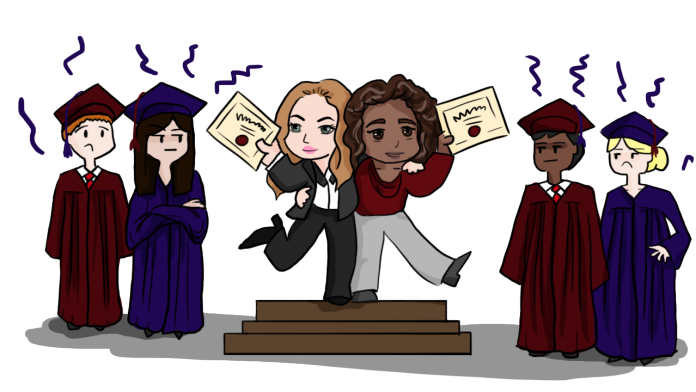
University students and alumni know that, no matter your field of study, getting your degree is a challenge that involves a rigorous workload, a lot of cash, and constant GPA calculations to see if you qualify for a scholarship or even your graduation.

Honorary degrees are pretty self-explanatory. An individual is given an honorary degree when they have made considerable contributions to the betterment of society, so much so that they are being formally recognized by an academic institution.

But what exactly have certain celebrities accomplished in order to be deemed as worthy candidates for these types of rewards?

There is no doubt that some famous people have gone out of their way to help others. A prime example would be Oprah Winfrey, a world-renowned talk-show host and candidate for three honorary doctorates, whose charitable works include opening up a boarding school called the Oprah Winfrey Leadership Academy for Girls in South Africa for women living there to have access to an education.

However, as a whole, I find that the increase in celebrities receiving these degrees undermines the hard work of people who actually attend or have attended a university; namely, being properly registered, going to class, and completing the required work to earn the credential.

What baffles me is that there are many other awards out there honouring work that celebrities have done, including the People’s Choice Favorite Humanitarian Award, the BET Humanitarian Award, the Critics’ Choice Joel Siegel Humanitarian Award, etc., yet many academic institutions find it necessary to formally acknowledge them as well.

This raises the question: why is it necessary for celebrities to be awarded honorary degrees when they have already won other awards for essentially the same reasons? Frankly, this is why we should be keeping academic honours and honours of the entertainment industry separate.

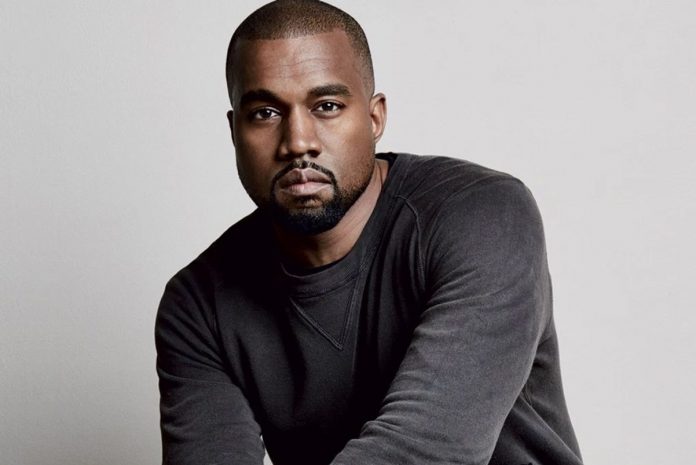
Recording artist Kanye West was awarded an honorary doctorate in 2015 from the Art Institute of Chicago. He has had a very successful career as well as a significant impact on the entertainment industry. But, in my personal opinion, he is in no way deserving of such a prestigious honour. He himself actually did previously attend Chicago State University as an English major — but did not complete his degree.

There were some displeased past students regarding West’s achievement, with alumna Corinna Kirsch saying she is “offended that the school’s exorbitant tuition and fees will help fund this nonsense.” To say the least, I am in complete agreement with Kirsch.

The reasoning behind the award was not even about West having any direct effect on society’s welfare, and hardly resembled anything philanthropic. Rather, he was honoured because he “produced work which is imaginatively rich, and sometimes also provocative, and controversial, shifting the cultural landscape.”

I’ve heard similar reasoning on award shows and ceremonies solely meant for celebrities. Furthermore, West has won a total of 21 Grammys and also, in 2015, was presented with the Video Vanguard Award for his achievements to MTV culture through performing arts, which seems very similar as to why he was awarded the honorary doctorate from the Art Institute of Chicago.

At best, honorary degrees are arbitrary and redundant. At worst, they conflate fame and financial success with academia in a way that inaccurately presents what a degree is meant to celebrate. When people do cool things, famous or not, we have plenty of methods of recognition specific to them — let’s stick to those without getting superfluous.

THE BAD RAP: Kanye West

0

Celebrities and people in the public eye are often placed on a pedestal — whether they choose to be or not. With that spotlight comes glaring judgement and an intense examination of everything that they do. Some celebrities often get a bad rap for some of the choices they make, yet there are often good things about them that go unnoticed and deserve to be celebrated.

Like him or not, there is no denying that Kanye West is one of the most well-known and polarizing figures within music and popular culture. From the crazy Twitter sprees to the seemingly unhinged rants at live shows, West seems to have controversy following him constantly.

West does have a way of communicating that can be explained through a narcissistic lens and context. Blatantly stating “I Am a God” or calling himself “Shakespeare in the flesh” is ridiculous and incredibly egotistical. Kanye is no stranger to flirting with the fine line between confidence and narcissism — often landing on the wrong side. Combined with his odd connection to a certain egotistical and problematic US president, he seems to be further cementing his place as one of the messiest and most challenging figures within popular culture.

However, for all of his faults, West does have an incredibly gifted eye and ear for music and art. His work consistently, uniquely, and accessibly combines high art and fashion with popular culture. He has always been able to push hip hop forward in a manner that freshly paves the way for others to come up behind him.

From Chance the Rapper’s use of gospel music on his records to Drake’s incredibly powerful string sections on Take Care, West’s influence on hip hop has been felt for a long time. He has always focused on staying true to his artistic vision while pulling upon artistic excellence to inform his work.

As for those crazy rants of his, some may be unhinged, but at other times he’s actually able to bring attention to some bigger issues. The infamous “George Bush doesn’t care about black people” statement, while absent of any sort of nuance, actually illuminates the fact that US government resources were not being sent to the predominately black and impoverished 3rd Ward in New Orleans following the devastation of Hurricane Katrina.

Yes, the method was a mess. But West still spoke a greater and deeper truth that needed to be said. This doesn’t mean that his comments should be taken straight as fact, but it does mean that we should pay a bit closer attention when he does speak.

Then, of course, there’s the fact that West has been very public about his struggle with mental health. In his song “FML” he explicitly references being off of Lexapro, which is a medication for forms of extreme depression, anxiety, and some manic behaviour. In addition to this, he’s also talked about seeing a psychiatrist in another song off of The Life of Pablo and was even recently hospitalized mid-tour in order to address his mental health.

The bigger picture here is the fact that discussions of mental health don’t happen often enough amongst black men. West’s very public and open struggle should be a point of engagement with issues of mental health and not something to simply write off or ignore.

In addition to his public mental health challenges, he’s also been very public in his grief. Following the sudden passing of his mother, Donda West, Kanye tried to cope and respond as best as he could. Some could argue that much of his public outbursts have been exacerbated by the grief of this loss.

The main support for this can again be found in his music. He’s written songs about wishing that his mother could meet his wife and children to wondering how his mother would respond to his crazed and wild antics. In many ways, this seems to reveal his humanity and reminds us that underneath the sensationalized mess is a human being who simply wants to be loved.

As of late, Mr. West has been very quiet, having recently celebrated his fortieth birthday. As a black man from the south side of Chicago — often considered to be one of the most marginalized, impoverished, and dangerous parts of the United States — this is no small feat. Hopefully, following some rest we’ll get a new artistic masterpiece. Time will only tell where he goes.

Justice was served in the case of Michelle Carter

0

We all know that killing is wrong; that’s a given fact. The law’s primary job is to keep people safe, in part by punishing those who take the life of another. But how should the law react when one person’s actions lead to another’s suicide?

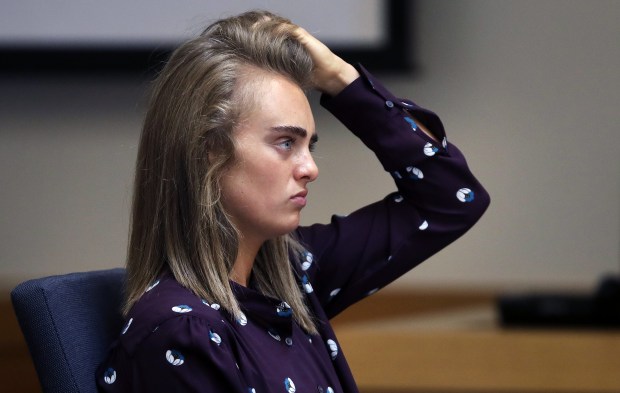
This question poses a challenge to the legal system, as evidenced in Michelle Carter’s trial currently taking place in Massachusetts. Carter was recently found guilty of involuntary manslaughter against her ex-boyfriend Conrad Roy III after the young man locked himself in his truck while it filled with carbon monoxide.

Ultimately, Roy took his own life. But text messages between the couple served as evidence that Carter knew about the suicide prior to and while it was happening. She even encouraged the troubled teen to go through with it, going as far as saying things like “the time is right and you’re ready, you just need to do it!” when he expressed hesitation.

There is no doubt that Carter played a part in Roy’s suicide. But controversy exists surrounding whether or not she was directly — and legally — at fault for his death.

As someone who has taken an interest in law all my life, I became instantly intrigued by that controversy. When I heard about the ruling, I couldn’t help but agree with the judge. Although Carter didn’t explicitly take her partner’s life, she exemplified behaviour that was reckless and intentional, and in turn, her actions led to the teenager’s death.

The United States Code defines manslaughter as “the unlawful killing of a human being without malice,” adding that involuntary manslaughter includes actions committed “without due caution . . . of a lawful act which might produce death.” Carter’s actions definitely fall under these criteria, particularly the second. The conversations that she exchanged with the victim, lawful or not in and of themselves, exemplified encouragement for Roy to take his own life — encouragement which definitely qualifies as an “act [that] might produce death.”

A large consideration that exists with this case is that the victim was reluctant to take his own life. In the texts the couple exchanged, Roy heavily hesitated, giving excuses for not committing the act which included not wanting to hurt his family and that the time was inconvenient. Had Carter not instructed him to follow through with the act, there is a strong possibility that Roy would have desisted.

Carter’s failure to direct Roy to “get out of the truck” as it filled with deadly carbon monoxide was indeed criminal, as determined by the judge presiding over the case. In fact, according to witness testimony, Carter even directed Roy to get back into the truck over the phone after he got out in hesitation. Roy, being depressed, was extremely influenced by his girlfriend’s insistence that he carry through with his suicide. Had she reacted differently while he was taking his own life, I agree that he would not have been able to follow through with it.

This case could have major implications on the legal system, as a teenager was convicted of murder in another’s suicide. CNN reports that this exemplifies a “judicial willingness to” extend the liability of one’s independent choice to commit suicide onto others.

However, I believe this is the way that the legal system should be heading. I think it is time that people start taking responsibility for actions that can cost a life. Carter’s case is no different; she had a duty to inform authorities that her boyfriend was dying, but instead of doing so, she encouraged and insisted that he follow through with it.

In the case of Michelle Carter, I believe justice was served.

SFU athletes clinch best season yet in collegiate sports

0
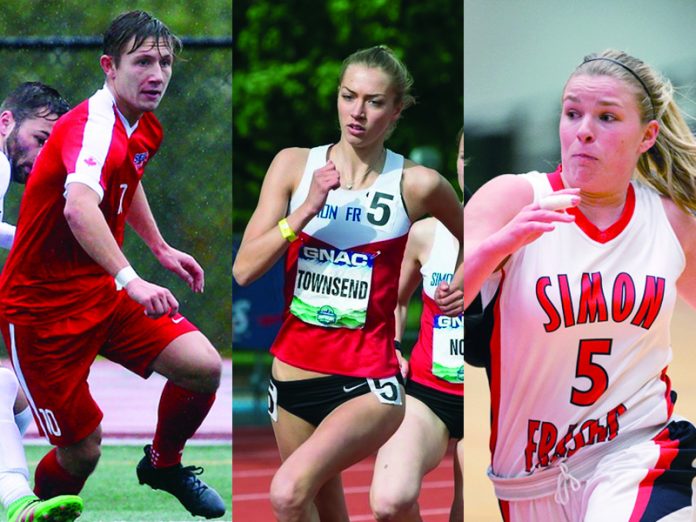
Adam Jones (left), Addy Townsend (middle), and Ellen Kent (right) were among the athletes who stood out this past season.

Simon Fraser University athletes are setting the bar high for themselves next season, having just come off their most successful year ever in the National Collegiate Athletic Association (NCAA) division.

The university secured a 15th place finish overall in the 2016–17 season, against over 300 other schools vying for the Learfield Directors’ Cup, awarded to the university or college with the highest success in athletics.

“I would like to say how proud I am of the student athletes and our coaches because — to get a 15th overall — that’s a collective achievement,” said senior athletics director Theresa Hanson, “[that] I think speaks volumes to what we’re doing here at Simon Fraser.”

“I attribute it to the coaches and I attribute it to the athletes, it takes a huge commitment to be successful at academics and athletics,” she noted.

As the only team from Canada in the NCAA, the Clan’s previous best finish was 26th place overall in the 2014–15 season. Last year, the school fell to 55th place in the standings.

However, the athletes have come a long way in the past two years. The university hopes that its current success will attract top athletes to programs at the school.

“I really am a believer that success breeds success,” said Hanson. “You need to get those athletes and some of them are game changers, they come in and you . . . build your team around them.”

SFU joined the NCAA division in 2010 with 11 programs that qualified them for national championships as well as post-season tournaments.

Prior to joining the NCAA, Simon Fraser University dominated the National Association of Intercollegiate Athletics awards, winning six titles. Between 1996–2001, the university won the award five times in a row.

It was in 2002 that SFU joined the Canadian Collegiate Athletic Association, where they finished second in the 2007–08 season and the 2009–10 season.

This past season, some of the athletics highlights from the men’s competitions were soccer and wrestling. The women’s side made some advances in volleyball, golf, cross-country, and basketball. Both men and women’s teams performed highly in swimming, as well as track and field.

The women’s volleyball and golf programs made their first-ever appearances in the post-season competitions while the cross-country team captured their best placing ever, finishing sixth nationally.

The winner of the season’s Learfield Directors’ Cup was Grand Valley State University with their 12th win in the second division. The school tallied a total of 1,020 points, with high scores in the maximum 14 sports. They won a national championship in women’s cross-country, as well as four runner-up titles.

Some SFU athletics programs that have achieved much recent success are still waiting for a spot in the NCAA. While women’s wrestling has been a highlight for the university, it has only been granted an emerging sport status by the division.

“When I first applied to SFU, I believed that we have all the tools to be a consistent contender in the top ten Learfield Cup, and I really believe that,” Hanson reflected. “I think we’re going to improve. We will continue to do great things, and we have a unique offering here [as] the only Canadian school in the NCAA.”

She continued, “That’s our goal, and that will bode well for [the program’s] future.”

SFU engineer tests technology for youth mental health, addiction recovery

0
Researcher Faranak Farzan is leading the cutting-edge technology studies.

A Simon Fraser University neural engineer is getting noticed for her research combining engineering and psychiatry to improve youth mental health.

Faranak Farzan is currently involved in two technology trials, one soon to be underway at Surrey Memorial Hospital testing brain stimulation therapy, and another using leading virtual reality in addiction treatment at John Volken Academy.

It is important to develop new avenues for treatment because other methods have a high rate of failure for a significant number of youth struggling with mental health issues, explained Farzan.

“Current treatments are not effective or cause side effects in a large percentage of individuals with mental illness,” she told The Peak, noting more than 30% of individuals with depression fail to respond to conventional antidepressant medications or psychotherapy.

“Therefore, it is important to develop new and more targeted therapies that are more efficacious and have less side effects.”

A professor in the School of Mechatronic Systems Engineering, Farzan was recently appointed the inaugural Chair in Technology Innovations for Youth Addiction Recovery and Mental Health, by Simon Fraser University, the John Volken Academy, the City of Surrey, and the Surrey Fire Fighters’ Charitable Society.

The research projects are based in Surrey, a city that houses a significant youth population.

“Creating new pathways of care for youth impacted by mental health in Surrey would minimize impact of mental health on youth, society, and [the] healthcare system,” said Farzan.

Farzan aims to increase the use of non-invasive technologies, such as transcranial magnetic stimulation (TMS) in hospitals and health-care settings. She is currently in the process of setting up a trial at Surrey Memorial Hospital for the technology which works by stimulating the brain and simultaneously recording its activity.

“This technology . . . allows us to look at the integrity of specific brain processes in awake humans and compare them between healthy individuals and those impacted by mental illness,” explained Farzan. “The ability to objectively assess the integrity of specific brain processes through multimodal technologies can lead to development of objective diagnostic techniques.”

Another program headed by Farzan at the John Volken Academy is using virtual reality headsets to simulate situations for recovering addicts in order to assess their response to treatment.

“The progress has been great,” said Farzan. “We have formed many important partnerships, have rolled out several new studies in collaboration with people with lived experience.”  

Farzan is a PhD graduate from the University of Toronto, specializing in medical science and biomedical engineering, and completed her postdoctoral training in cognitive neurology at Harvard Medical School.

She is SFU’s second female professor in the School of Mechatronic Systems Engineering.

“I was at a point in my career that wanted to put more focus on translating our research outcomes into real-life applications,” she said.

There is still progress to be made with these technologies, and the trials are currently in their very early stages, noted Farzan. One drawback to the TMS technology is that it is only accessible in hospitals.

This is another area where innovative technologies may come to help “by creating portable devices that can be safely used at home, minimizing the need to come to dedicated [centres],” she said.

More details on the progress of the trials will be rolled out in the coming months.

With files from CBC News.

University researchers make a breakthrough with tiny, biodegradable battery

0
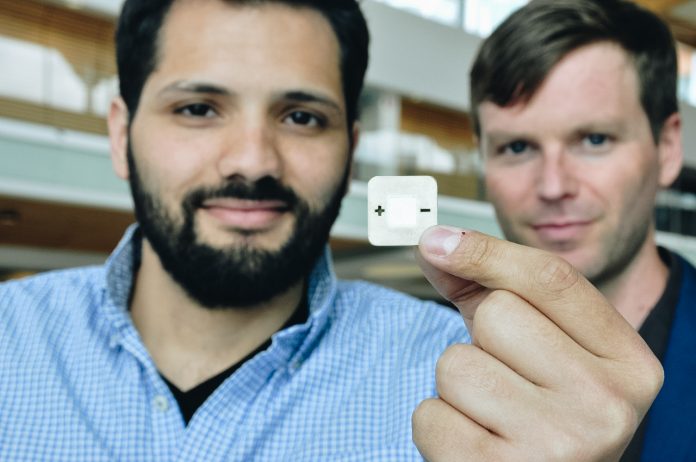
SFU mechatronics engineering student Omar Ibrahim is working with professor Erik Kjeang on biodegradable battery technology.

A team of researchers have developed an innovative solution to electronic waste, inventing a biodegradable battery that packs enough power to replace the average lithium ion cell battery.

SFU researcher Erik Kjeang, who is the Canada Research Chair in Fuel Cell Science and Technology Development, and his team, along with their collaborators at the Instituto de Microelectrónica de Barcelona in Spain, produced the eco-friendly power source.

The patent-pending PowerPAD battery is a single-use disposable battery — roughly an inch in diameter — that is activated using only a few drops of water. It provides the user with up to 120 minutes of power and then is easily tossed away, according to the researchers.

Currently, every battery on the market has some level of toxicity and requires sophisticated recycling facilities, noted Kjeang. However, the PowerPAD battery is environmentally friendly from its production to recycling stage.

As water enters through the battery’s inlet pad, it is wicked into the electrodes, where it then activates and undergoes a series of chemical reactions to generate electricity. In addition, the battery is made up of natural materials such as beeswax, carbon paper, and cellulose.

Once activated, the current prototype runs up to two hours and then can be disposed of in an organic waste container or discarded anywhere it will degrade with minimal environmental impact.

“This battery solution is not only made from environmentally [friendly] materials but also from processes with low energy consumption,” said Kjeang.

The idea first stemmed from the Electrochemical Energy and Water Summit held in Mexico in 2014 where Kjeang and his Spanish colleagues were awarded $50,000 in funding through the Science for Solving Society’s Problems Challenge for their disposable power source idea.

“The SFU team was responsible for developing the power generating elements of PowerPAD — its reactants and electrodes — while the Spanish researchers were responsible for device integration and material selection,” said Kjeang.

The challenging aspects of this work truly required international collaboration, he emphasized.

“A single PowerPAD cell is able to generate 0.5 to 1 volts of electricity, while 3 cells can generate 1.5 to 3.0 volts of electricity,” explained Kjeang.

The current model can provide electricity to small electronic devices, such as signal processors and measuring devices. It also costs less than $1 to build, even on the lab scale, which is “very cheap for a research prototype,” said Kjeang.

For the next phase of the project, Kjeang will look into increasing PowerPAD’s electricity output. The team is currently seeking partners to help bring the technology to market.

SFU researchers develop novel method for predicting hockey performance

0
The model devised by two SFU researchers, computing science professor Oliver Schulte (right) and recent graduate Zeyu Zhao (left), advances the field of analytics.

A software program designed by two computing science researchers has proven successful in predicting player performance.

When sport scouts look for young talent, they have to observe players across a number of games in order to assess their skills and techniques. However, it is not possible for the scouts to keep track of all games in the National Hockey League (NHL).

SFU professor Oliver Schulte and Zeyu Zhao, an undergraduate alumnus, developed statistical machine-learning models to combat these challenges. The assessment system is able to capture the similarity in roles and styles of hockey players.

“The overall objective of this assessment system is to be able to foretell how successful a NHL player is in securing a win for their team,” said Schulte.

The model did just that when it predicted Ottawa Senators defenseman Erik Karlsson’s key role, according to analysts, in advancing the team to the playoffs. Before the start of the 2016–17 hockey season, Schulte and Zhao released a paper in which Karlsson scored the highest of all the players.

“Karlsson’s score was 6.09 and the next best player, according to the model, [was] Sidney Crosby, [who] scored 4.475,” said Schulte. Karlsson was the only NHL player in the model to achieve a score above six.

Nearly a year later, and Karlsson is being credited with catapulting the Ottawa Senators back into the Stanley Cup playoffs.

By utilizing new game events and location data, Schulte and Zhao introduced a player performance assessment system that supports coaching, drafting, and trading decisions in the NHL. The assessment system clusters players who tend to play in similar locations into one cohort.

“Clustering players avoids apples-to-oranges comparisons, like comparing forward to defensive players,” said Schulte. Within each cluster, players are ranked according to how much their actions impact their team’s chance of scoring the next goal.  

“Basically, our model can predict how a player’s actions affect their scoring. We look at all the actions the player makes — block, hit, and pass — and assign a value to every action they make. At the end, we total up the value,” explained Schulte.

The system builds on the work of Schulte’s former master’s student Kurt Routley who devised the model for valuing player actions.

In addition, players are clustered according to the heat map concept — the ice rink is divided into 12 regions and each region is colour-coded. Players who have similar playing styles end up sharing the same heat map.

Afterwards, the model compiles players with similar heat maps into one category, which then allows for fair comparison of the players within each respective group, said Schulte.

Although the assessment system is not 100% accurate in predicting a player’s scoring ability, when Schulte looks at the top 20 players and his model’s prediction, there is usually an agreement between the media’s ranking and his. 

Currently, the assessment system does not take into account the game time and arena space. Schulte expressed that deep learning and match prediction will be the two components he will be working on for the next phase of the project.