Home Blog Page 677

Summer news round-up

0

Just because most students take a break in the summer doesn’t mean our news team does. Below are summarized bits of news stories written by our News Editor and contributors over the course of the past semester.


“SFSS shuts down Highland Pub, the Ladle for summer”

Despite saying the SFSS Food and Beverage Services would be permanently closed on June 15, the Highland Pub and the Ladle were shut down nearly three weeks early. SFSS President Hangue Kim cited last year’s summer closure as the reason for the quietly announced earlier shut down. The decision to end the Food and Beverage Services came after years of heavy deficits. Decisions about what to do with the vacant space and money formerly for the Food and Beverage budget have yet to be announced.


“UniverCity population expected to double”

This year marked the halfway point for the Univercity project. The plan is to eventually house 10,000 people within the next five years as well as create more space for businesses. UniverCity’s elementary school even has an expansion in the works to add eight new classrooms to the building. Other possible projects include a daycare centre, a clinic, more food options, and even seniors’ housing. And of course the idea of a future gondola is always on the table.


“Action group probes SFU data on animals in research”

In the process of researching animal testing at SFU, Wild Salmon Creative Action hit a roadblock when SFU refused to release its records. The group was told by the University Animal Care Committee there was no public record because the BC Freedom of Information Act did not enforce them to have one as creating the record “would unreasonably interfere with the operations of the University.” The university also stated that they did not keep records of the information Wild Salmon Creative Action was looking for. The group hopes to get the university to release its animal testing records and, eventually, to end animal testing at SFU.


“SFU researchers take greenhouses to the next level”

Majid Bahrami, an SFU professor, was given almost three quarters of a million dollars to fund his ongoing research project with scholars from Kwantlen Polytechnic University. The goal is to create a new sustainable way of growing food. Much of their research focuses on improving greenhouses to maximize crop growth and minimize costs. They are working with a closed design that provides the ability to grow anything at anytime of year in any climate. The researchers also hope to harness ‘waste heat’ (the byproduct of burning fossil fuels) to create an eco-friendly power source for these greenhouses.


“SFU’s legendary wrestling coach Mike Jones retires after four decades”

After 41 years at SFU, Jones has achieved much and leaves some big shoes to fill. Several of his past students have won Olympic gold, he’s a member of the BC Hall of Fame, and he has even been called “Canada’s greatest wrestling coach of all-time.” He was basically able to create the wrestling program he wanted at SFU and it clearly has paid off. Jones prided himself in the confidence he was able to give athletes and the wide range of opportunities he was able to provide them.


“SFU students develop app to ease parking in cities”

Baker Al-Nakib, Thamer Matar, and alumna Tiana He have created an app to help cut costs of parking in cities, starting with Vancouver. Parking stalls are listed on the app and drivers can book them for hours, days, even months depending on the owner. The app, which is not unlike Airbnb, encourages lower, fixed costs to avoid drivers having to pay a premium during prime times. In case someone overstays their time limit in the spot, the app will suggest a new nearby parking spot at the same rate for the driver trying to park while simultaneously organizing a tow truck to come pick up the overdue car.


“SFSS looks to secure student space on Surrey campus”

Surrey students were asked to provide feedback on possible improvements for much needed student space. Despite past attempts to create more space at Surrey campus, the SFSS hopes a new building opening in 2018 could provide the space they’re looking for.


“Investigation underway after deadly police incident on Burnaby mountain”

Police were called to investigate a potential self-harm incident on the morning of July 13. The call was placed after a Coquitlam man left his home with the intent to harm himself. By that afternoon, police had found a man, who they believed to be the same one they received the call about, carrying a gun near SFU. Police tried to intervene verbally but the man shot himself. At the time, the Independent Investigations Office (IIO) of BC was looking into if police involvement played a role or could have prevented the incident, however no public updates have been made.


“SFU career services develops job-seeking guide for transgender students”

With the help of Out on Campus and other students, career services is in the process of creating a guide to help transgendered people with their unique job search. The hope is to help provide guidance for concerns when searching for work. The guide will be a resource for students as well as advisors at career services to help better support transgender students. The guide also informs job hunters of their legal rights. The guide should be available online sometime this semester.


“SFU undergraduates team up to fundraise for wildfire relief”

The story of the summer in BC this year was the state of emergency issued following a number of devastating forest fires in the province. Thousands were evacuated and even now there are fires still burning. Several SFU clubs teamed up to raise money for a wildfire relief fund set up by the Canadian Red Cross. The group was able to raise about $1,500 in the week of July 17–21.
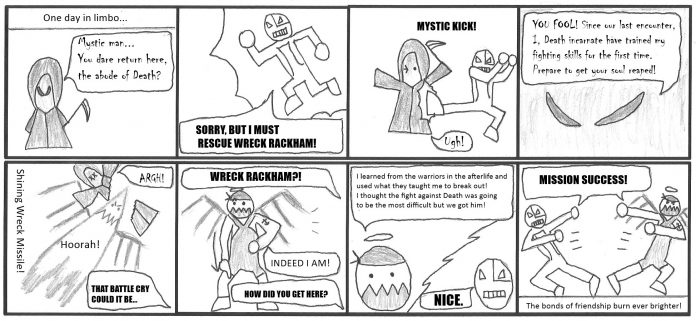

Mystic Man 31: The Rescue

0

Say it with flowers

0
Illustrations by Phoebe Lim

Because everybody was suffocating in their corsets, had their pantaloons in a bunch, or were starting to grapple with the horrible series of mistakes that was colonialism, the Victorian English were not the most . . . emotionally coherent of societies. These are the people who gave us Charles Dickens, who was paid by the word and had it in his best interest to ramble on forever, and Wuthering Heights, a novel about people who can’t stop being absolute dicks to each other because the hills they live in are just too wild for their Victorian sensibilities — and all die within six months of one another. Naturally, in the affairs of the heart, these people were also emotionally handcuffed and started sending each other specific flowers to represent specific sentiments, such as meet me after the ball and don’t wear any petticoats, as well as these:

Roses

There’s nothing wrong with getting roses. Is it creative? No. Is it a surprising, quirky, or unusual choice? Not really. But you know, it shows that you or your date had enough hope and interest in this date to take the time to go pick up some flowers at the grocery store and hunt down the bouquet on display that was the least dead.  Roses show that you are reliable, and props to you.  

Wildflowers

What this means in the language of petals is “I forgot to buy you flowers and picked some random ones growing along your street, hoping that you saw wildflower bouquets on Pinterest once and thought that they were whimsical.” It can still be pulled off as long as the flowers aren’t still attached to their roots or clumps of dirt. Attention to detail matters, folks.

Daisies

Daisies are the absolute cutest, but did you know that they’re actually an invasive species and an enormous pain in the ass after about three years of relatively peaceful growth in your garden? This is the perfect bouquet to give your prospect a heads up that you are adorable and worth it, but that if they wrong you — no matter how soft and cute you are — there will be hell to pay. Make sure they know that you’re worth it, though, because you are.

Buttercups

Another adorable member of the flower world, these yellow fucks look like a child’s drawing brought into life through the will of the sunshine fairies. Even better, buttercups are one of the most helpful flowers to plant in your garden if you’re looking to save the bees. Make sure your significant other knows where they stand in the scheme of things — under the bees. Seriously, do you know how fucked we would be without the bees?  

Ivy

More specifically, poison ivy is a good way to get rid of a blind date you never wanted but got stuck with because your best friend’s boyfriend lost a bet with his nasty friend and had to set them up with somebody. Why you? Because they think you can take it. Well you know what, you don’t have to. If we as a society start to use Pavlovian methods to train asshats on the dating scene to associate misogynistic, rude, and otherwise inappropriate behaviour with the hellfire that is poison ivy, we’d be taking one step towards utopia.

Cacti

Are cactuses the cutest? No. But neither are you when you wake up hungover in your significant other’s bathtub because you thought there was an earthquake and refused to leave the tub for your own safety. Or when you haven’t showered or changed sweatpants in five days and are developing permanent Cheetos stains on your fingers and around your mouth. In a relationship, the goal isn’t always to be cute. Actually, seeing each other at your worst will help you and your date know each other better and better, and learn to live with each other, too. Which is exactly what a cactus says: I enjoy you as a person and hope this relationship endures, please tolerate me despite my prickles.

SFU women’s soccer defeats California State Golden Eagles 2–1

0
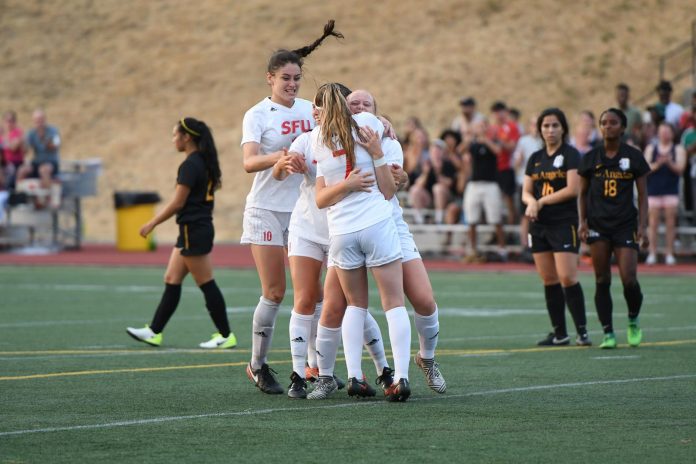
The Clan celebrating their overtime victory. (Photo courtesy of SFU athletics)

On a hot afternoon at the Burnaby Mountain campus, the Clan managed to beat, in overtime, a team that is used to training and playing in temperatures that are not far from today’s mid-thirties. It’s great news for our women’s soccer team, who are now 2–0 and still “setting the tone for the season and building their identity” as coach Annie Hamel said at the end of the match.

The first half of the match was well-controlled by SFU, with solid defence from our two centre backs Hollis Roeske and Emma Lobo, and some very dangerous attacking by Emma Pringle and Katelyn Erhardsen.

“The team has awesome freshmen who are stepping up and doing an awesome job,” said Hamel.

In the very last minute of the first period, Erhardsen took a shot off a great play by Lauren Fuerderer and Samantha Donald which was blocked by the Golden Eagles’ keeper Adriana Maldonado. This play was the last chance of the first half of the game, which ended with a 0–0 tie.

The second period began similarly to how the first one ended, with SFU taking control of the ball and game while California State continued to look for offense through their quick left winger, Paulina Chaidez.

It was through Chaidez that the Golden Eagles scored the first goal of the game. She managed to dribble through several SFU players and assist to her teammate Victoria Arredondo, who kicked the ball into an empty net. Our goalkeeper Priya Sandhu (Sr.) couldn’t have done anything to stop this great play.

With a 1–0 score in favour of the Golden Eagles, the Clan’s reaction was immediate and the game became an intense fight for every ball. While the tension grew, the Clan remained patient and did not let nerves interfere with their plan.

All the patience paid off in the 72nd minute when Fuerderer managed to pick up a loose ball that had been previously blocked by Maldonado. She shot it into the net for the first goal in her collegiate career, and to bring the game to a 1–1 tie.

Intensity in every play kept increasing. Just a few minutes before the end of regular time and with the match still tied 1–1, the California State’s head coach got a red card for rejecting a referee’s call.

After regulation time, both teams entered overtime and tried to dominate possession, but no one could fully control the game as the ball went from one side of Terry Fox Field to the other.

The score remained 1–1 up until there were two minutes left of the second overtime period. That was when Pringle managed to create a beautiful play that ended up provoking a penalty kick in favour of SFU after she received a poorly measured slide tackle from a California State defender.

In a highly tense atmosphere, Erhardsen proved to be a calm and confident player and shot the ball to the bottom left corner of the net to seal the victory.

Coach Hamel was satisfied with the win and said that it was really impressive “to be able to come back from a goal down and to never give up after just [a] 48-hour recovery from the previous game.”

Simon Fraser’s women’s soccer team will next host the Stanislaus State Warriors on Friday. Kickoff is at 5 p.m. at Terry Fox Field.

Prejudice in blood donation sucks, but Canadian Blood Services isn’t the source

0

As blood shortages become a recurring problem for Canadian Blood Services, their relationship with non-straight donors is called into further question. We know the controversy: restrictions against sexually active gay men donating blood.

Last year, Canadian Blood Services changed their restrictions on male blood donors: instead of five years of abstinence from oral or anal sex with other men, only one year is required. Although this is significant progress, I would like to see more accountability for the prejudice that has prevented gay men from donating for decades.

It would be too easy to completely blame Canadian Blood Services, but to my surprise, Canadian Blood Services themselves took charge in reducing the five-year restriction to one year. Who, then, argued against it? Why did it take so long to shorten the time?

According to the Canadian Blood Services online FAQs, back in 2006, they consulted with experts about potentially lowering the bar (at that time, gay men were barred from donation entirely). “Patient advocacy groups . . . [supported] . . . a five year deferral period but nothing less.” That change happened in 2013, after “extensive review of scientific and epidemiologic evidence,” and “a minimum of two years of data was required for re-submission to Health Canada to support a further change.”

The evidence suggests that Canadian Blood Services, at least, is taking initiative on lowering prejudicial restrictions as much as reasonably possible. The root of the continued ban stems back to the “patient advocacy groups” and Health Canada, and there appears to be little clarification of those group’s reasoning at that time beyond a mention of  “extensive review of . . . evidence.” Does this mean that the one-year deferral change is the best we can do?

It’s definitely not the pinnacle of progress, and continuous work must be done to reduce that number further. We should be able to aim for a time where such a deferral can be dismantled completely. But unilaterally blaming Canadian Blood Services doesn’t help. Like the rest of us, they are obstructed by the rules other have set, and they’re doing what they reasonably can.

However, I would like to see an official apology from the advocacy groups and Health Canada, publicly recognizing their fault — it’s clear based on the recent data that the previous restrictions, at least, were certainly excessive. Whether or not they feel that they had good reason for the past mistakes, they need to recognize how they have perpetuated institutional prejudice.

Outrage can be a positive force of change, but we still have to be careful where and how we direct it. If we want real progress in this regard — progress that lets us save more lives and indulge in less injustice — we must keep the right parties accountable. If we can do that, we’ll be that much closer to a future where the important work of blood donation isn’t undercut by policies borne of fear and not rationality.

The actual frequency of same-sex sexual behaviour is up for debate, but for the moment, let’s assume, based on Alfred Kinsey’s research, that about 13% of men are gay. In 2016, Stats Canada reported the Canadian male population to be about 17,995,000*. That would mean approximately 2,300,000 gay men — 2,300,000 possible donors — face this bleak deferral if they aren’t abstinent.

If one blood donation saves three lives on average, and men can donate every 56 days in Canada, then theoretically, we could save up to 32,400,000 more lives per year if the limit was relaxed.

Even with much more conservative figures — let’s assume 1% of men have sex with men (a number lower than most averages), and given that only 1 in 60 Canadians successfully donated blood last year, let’s assume that only 1.6% of those men end up donating in Canada — that’s still about 60,000 more lives that could be saved every year.

In a future where blood donation is free of inequality, those are the lives who benefit. Hopefully, the groups who aren’t working toward that future stop to consider that.

*Update 09/07/2017: A mathematical error in the final calculations was corrected.

Though we fight hate well, Vancouver still needs to crack down harder

0

As many of you know, representatives of the the World Coalition Against Islam Canada and the Cultural Action Party of Canada recently hosted an anti-Islam rally at Vancouver City Hall. It attracted about 20 people; the city came together to respond with a 4,000-person strong counter-protest. This, along with similar rallies in the United States, have sparked debate on hate speech laws versus free speech laws. What is and is not an acceptable way to deal with public bigotry? What can our community’s leaders do when faced with it?

Vancouver mayor Gregor Robertson spoke up on the issue: he condemned the rally, declaring that Vancouver has “zero tolerance” for hate. Yet he also claimed that, due to the participants’ right to public demonstration, there was little he could do to shut it down.

I disagree. Robertson could have protected Vancouver from this rally in the first place (it was at City Hall, for Christ’s sake!) Section 319 of the Criminal Code of Canada states, on the topic of public incitement of hatred, that anyone who publicly “incites hatred against any identifiable group where such incitement is likely to lead to a breach of the peace” or “willfully promotes hatred against any identifiable group” can be charged with “an indictable offence” or ”an offence punishable on summary conviction.”

Some might say that our laws on public demonstration are too loose, that they let too much hate speech slide, but I would argue the opposite: that, at the federal level, we already have laws in place that are designed to quell hate. Harder laws than what we already have in terms of free speech and hate speech will complicate things even more than they already are and they aren’t necessary.

Perhaps laws cannot change people’s deeply entrenched opinions and thoughts, but the currently established laws in the criminal code must be enforced. Our community’s leaders, our municipal government, cannot shy away from that. It is reckless and irresponsible for the police and mayor to not have done more to arrest those guilty of crime.

“Only a handful of the members [of the anti-Islam groups] came out to the rally because the massive public response was so dramatic. [. . .] The counter-protests . . . sprung up naturally, without government direction,” said Peter Rautenbach, SFU honours political science graduate, who attended the counter-protest.

I don’t disagree with Rautenbach here, as I think the public response plays an extremely important role in society — especially in these hate-crime rallies. The government support and police presence kept the public event safe: it was this collaboration and unity of these two powerful groups that made this rally such a success, and that at least deserves recognition.

Some of the attendees that showed up and were expressing anti-immigrant views engaged in discussion with those at the rally, but police kept close tabs on them and escorted problematic or violent ones out of the event — such as notorious Holocaust denier Brian Ruhe, who was openly conveying Nazi support by raising his arm in a Nazi salute. If the police had not been there, the event could have taken a whole different direction, perhaps as violent as the ones in the United States.

“I would argue that the counter-protestors were extremely successful. This natural response and sheer physical turnout demonstrates solidarity without the complex topic of censorship and illegalizing demonstrations coming into play,” said Rautenbach.

Free speech laws shouldn’t protect hate crime, nor free or go easy on criminals under Criminal Code section 319 (1) and (2). It’s not that Canada needs more laws, but that the government needs to re-examine the Criminal Code and remind themselves what they committed to protecting its citizens from.

BC salmon spawning stream monitoring in sharp decline, study finds

0
Brigitte Werner via Pixabay

The number of visits by the department of fisheries and oceans (DFO) to salmon spawning streams in the province is at an all-time low, according to SFU researchers.

A recent study published in the Canadian Journal of Fisheries and Aquatic Sciences and authored by SFU professor John Reynolds and PhD candidate Michael Price found that the DFO is not monitoring enough streams on the north and central coasts to assess salmon health.

“I knew monitoring was declining, but I was very surprised at how few streams are now being monitored,” Reynolds told The Peak. “There are huge black holes in our understanding of how many populations are doing, including many that we suspect are in trouble.”

The researchers found that despite the government’s ambitious plan for salmon conservation setout in the Wild Salmon Policy in 2005, the monitoring of salmon streams in BC has dipped lower than ever before. As a result, the DFO lacks the data to gauge the status of nearly half of all the province’s coastal salmon populations.

The number of streams being monitored dropped dramatically from 1,533 streams in the mid-1980s to an all-time low of 476 streams being monitored in 2014 — a 70% reduction. That year, the number of spawning salmon were measured by surveying only half of all spawning locations.

The results of the study mean that the knowledge that informs salmon conservation efforts is lacking, the researchers concluded.

This summer, lower-than-expected sockeye returns closed fisheries on both the Fraser and Skeena rivers.

The study made a number of recommendations to the federal government, including urging the DFO to meet the monitoring standards contained in its Wild Salmon Policy which aims to make salmon conservation the “highest priority for resource management.”

It calls on the government to immediately develop a plan to implement the policy and develop a supportive fund to ensure that the DFO is working towards the initiative.

“Salmon are the lifeblood of our streams. They feed other species like eagles and bears, and our research has shown that their carcasses fertilize plants and ​help support diverse populations of birds,” noted Reynolds.

“Native people on the west coast have always depended strongly on these fish, with cultural traditions that are deeply embedded in both salmon and their central role in coastal and stream ecosystems. There are also huge economic benefits from commercial and recreational fisheries, as well as tourism.”

“If you care about BC’s natural beauty and wilderness, you have to care about salmon,” Reynolds added. “We did this study in the spirit of helping DFO and everyone else who has a stake in managing and benefiting from healthy salmon populations.”

Spot the first-year

0
Illustration by Emma Wu

Students at SFU don’t always get along; we all like and hate different things. But now that fall has come around and school is beginning once again, there is one thing that we can all come together on: shaming the first-years.

The joy they have in life still lingers in their smiles and has yet to be drained by post-secondary education. Their bags are full of books, and their pencils are always sharpened.

Now, you might think that it would be difficult to spot a first-year among the many students at SFU, but nothing could be further from the truth. First-years consistently engage in behaviours suitable of their rank and station that make them stand out as below the rest of us. And what’s more, these are some of the behaviours we hate them for the most.

We thought there would be no better way to celebrate the beginning of the term than to compile a list of the behaviours guaranteed to label you as a first-year.

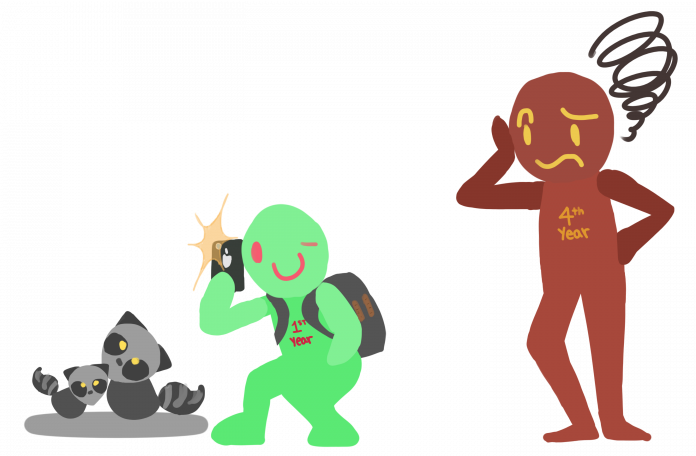
Taking pictures of raccoons (extra points if the raccoons are digging through the garbage)

Raccoons are as much a part of SFU’s personality as the greyness itself. Throughout your time at SFU, you learn to respect and fear them. Yet every year you’ll find a congregation of first-years taking pictures of them in one way or another. No, they are not cute. You’re literally taking pictures of them digging through the trash. Yes, they will give you rabies. Back the fuck away.

Getting lost in Robert C Brown

Let’s be honest: RCB is a nightmare to get around. We’ve all gotten lost in it at one time or another. That doesn’t mean it isn’t hilarious to see the looks of fear and confusion in the eyes of first-years when they can’t find their room and think they’re going to be late for class.

Being prepared for class

Come on. Seriously? Who are they trying to impress?

Actually attending lectures

We can only hope they’ll learn the error of their ways eventually.

SFU football falls by six points in season opener

0
Miles Richardson and the Clan barely fell short on the final fourth quarter drive. (Photo courtesy of SFU Athletics)

When SFU went down 14–7 in the first quarter, giving up touchdowns the first two times the National Association of Intercollegiate Athletics (NAIA) Arizona Christian University Firestorm (ACU) saw the ball, it looked like they might be in for a rough night at their season opener in Phoenix, Arizona.

But SFU answered back the next drive, with quarterback Miles Richardson running it in himself for the first touchdown of the season.

It was the story of the night: a team that didn’t give up.

While they weren’t able to close out the win, they came within six points of winning — their closest margin since a 24–30 loss on November 6, 2015. To put that in perspective, last season their closest game was a 26-point loss.

After preventing the Firestorm from achieving a first down in their next drive, the Clan opened the second quarter by tying up the game, with Richardson completing a 44-yard pass to sophomore wide receiver Nathanael Durkan.

The next drive, Arizona Christian put themselves back in the lead, scoring a touchdown to make it 21–14.

Neither team could put up anything more before halftime, as both defences shut down the offensive game. SFU blocked a field goal attempt at the 18-yard line to prevent the Firestorm from building their lead.

Arizona Christian built their lead in the third quarter, when running back Devonte Carter easily ran it in seven yards for a touchdown, after the team had blocked SFU’s punt attempt and got to start their drive in the redzone.

A 25-yard pass to Gavin Cobb at the end of the third quarter started a successful drive for SFU. Two consecutive passes to Jalen Jana finished the job, giving SFU a touchdown, and cutting the lead to 28–21.

While the Firestorm answered back the next drive, they left points and a potential comeback on the table as they missed the extra-point kick.

Sure enough, SFU answered back when Richardson — who earlier in the drive, passed it to Cobb for a 69-yard reception — ran it in himself the second time in the game to chop the lead to six.

SFU was able to hold ACU to just one first down, and get the ball back in a matter of 51 seconds.

23- and 38-yard passes got SFU into the redzone at Arizona Christian’s 19-yard line, but a too many men penalty set SFU back five yards. Richardson was then sacked for a loss of nine yards. Going for it on the fourth down, SFU’s chance for their first win since the 2014 season ended with an incomplete pass.

Richardson made 28 completions on 55 pass attempts (50.9%), and threw for 434 yards.

“Miles had his best game as the starting SFU quarterback,” head coach Kelly Bates told SFU Athletics. “He got the ball out of his hands quick[ly], made good decisions, and stepped up in the pocket well. He gave us a chance to win.”

Cobb led the team in receiving yards with 183 on eight receptions. Durkan had 115 receiving yards, while Jana notched 117 combined yards (79 receiving, 38 rushing). Middle linebacker Jordan Leech led the team with 13 total tackles.

SATURDAY: SFU will open their season at home next Saturday against Texas A&M Kingsville, their second of two non-conference matchups before Great Northwest Athletic Conference (GNAC) play starts the following weekend. (Note: “Kingsville” is a satellite campus of Texas A&M . . . SFU is not in fact playing the Division I powerhouse.)

Last year, Kingsville dominated SFU 68–7, with SFU’s lone touchdown coming on a punt return. Kingsville lost their season opener yesterday to SFU’s GNAC rivals, Central Washington, 34–10.

Kickoff is at 1 p.m. at Terry Fox Field.

What to know and where to go

0

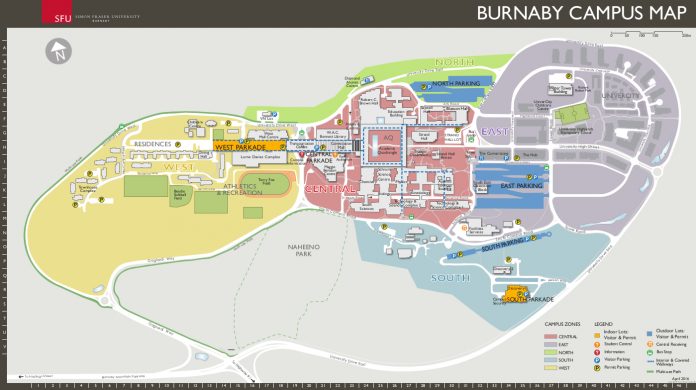
It can be daunting coming to a new school. Making new friends, getting good grades, and finding a balance between work and personal life are just some of the struggles faced by students. Whether you’re new to SFU or just hoping to learn something new about the campus, I’m here to walk you through SFU Burnaby.


Maggie Benston Centre (MBC)

MBC is home to most of our student services. Registrar and Information Services can be found on the 3000 level (located in the mezzanine at the Surrey campus and in the main lobby at Harbour Centre). Here students can make appointments with advisors (both academic and financial).

The next floor down is the bookstore, the Peak office, and the offices for the Simon Fraser Student Society (SFSS). The SFSS is our student government here on campus. They advocate on our behalf for things like more space for students on campus, the U-Pass, and the health and dental plan. Speaking of the health and dental plan, their office is also on this floor. The health and dental plan is flexible, so students who have extended health benefits can opt out of services they don’t need. You can also choose different levels of coverage depending on your needs and budget. Head to their office if you have any questions about how to change your plan.

The 1000 level of MBC is home to the Centre for Students with Disabilities. This office can help students with either temporary or permanent accessibility issues find solutions so that they can still attend classes. This can include providing note-takers or alternative spaces for students to write exams.

Down the hall from that is International Services for Students. For international students, this is a great resource for you to ask questions and for help or support in adjusting to living so far from home. For all students, this is the office to go to if you want to travel while getting your degree. They have information on both exchanges and field schools.

Next door to that is the Work Integrated Learning office, home of the co-operative education program. Co-op is a great way to gain experience in your field before you graduate. It’s also a good way to make some cash. Students pay a small fee to join the co-op program and gain access to a list of different opportunities locally, nationally, and sometimes internationally.

On the bottom floor, or 0000 level, you’ll find Career, Health and Counselling, and Parking Services.

Career Services can help you with your resume, interview skills, and networking skills. They can also lead you through career exploration in which, through asking questions about your values and skills, they will help you brainstorm career possibilities that not only you would like but you’d be really good at.

Health and Counselling is a fully working medical clinic right here on campus. They can act as your family doctor during your degree and even have flu shots during flu season. They also provide a wide range of counselling services. The Vancouver campus offers all these features while SFU Surrey only offers counselling.

Finally, Parking Services is where you would go to buy a semesterly parking pass or pay a parking ticket.

If you ever have any questions about where a service is, or which one you should go to, you can head to Student Central (on the top floor, right beside the main entrance). The student information assistants behind the front desk know everything about this campus and are always happy to help.


Convocation Mall (Convo Mall)

The big open space between MBC and the library is called Convo Mall. Twice a year convocation happens in the space, but during the rest of the year it hosts some pretty great events.

An important one coming up soon is Clubs Days. Almost every club on campus will come and set up a table at least once during the four-day event. You can walk around, talk to people, and try and find a group to join. If you want to make friends at SFU, joining a club is the easiest way to make that happen. And, if you don’t see a club you want to join, you only need 10 signatures to start a new one.


The Rotunda

The Rotunda is a great group study space. The big tables, heated floors, and proximity to Starbucks makes it the perfect winter study spot. It’s also home to several social justice groups on campus.

If you’re interested in environmental justice (as well as other social justice initiatives), the Simon Fraser Public Interest Research Group (known as SFPIRG) is the place for you. They conduct research on different services and programs run by the university and make recommendations on how they can be improved as well as many other great projects.

The Women’s Centre provides a great study space for all genders as well as a 24-hour safe space lounge for self-identified women only. The centre also offers lots of resources such as snacks, books, tampons and pads, supplies for safe sex, and crisis support.

Out on Campus, our LGBATQ+ group, also provides a safe space for all as well as resources like educational material and safe-sex supplies. They also host workshops, provide guides for trans and gender diverse SFU community members, and are currently working on a project to preserve queer history.

One floor down is the campus radio station CJSF. If you’re interested in radio or music, I highly recommend volunteering. You might even be able to start your own radio show!


Lorne Davies Complex (the Gym)

The gym is a great place to get in shape. Both the pool and the fitness centre are included in your tuition and your student ID card acts as your membership card. SFU Clan games are free for students and make a great night out!

SFU Recreation offers a wide range of teams, clubs, intramural, and classes. Some of the classes have fees but there’s a free trial week every semester so you can try the class before you pay. Check out the full schedule for classes and other programs on their website.


W.A.C. Bennett Library

The library has seven floors and over two million different resources both online and in print. To help students navigate all those sources, the library has a research help desk on the main floor as well as librarian help available in person, by phone, and online. There are even librarians for specific departments to help with really in-depth research.

Speaking of research papers, the library is also home to the Student Learning Commons. Here, students can get help with every stage of writing papers. They have workshops, consultations (both in person and online), and helpful handouts. They can also help you with study skills and time management.

The library also features lots of study space at different volumes (loud to silent), the largest computer lab on campus, and equipment rentals like laptops and phone chargers. All these services are available at the other campus libraries as well (the Surrey campus library has a games room!).


General

It can be hard finding your way around campus at first. If you haven’t done it already, do yourself a favour and download the SFU app. It has a room finder feature that will help you find the classroom you’re looking for on all three campuses.

Be familiar with important deadlines:

  • Last day to add, swap, or change classes is September 11.
  • Last day to drop classes and get a full refund is also September 11.
  • Tuition is due September 18.
  • The change of coverage period (the time you can make changes to or opt of the health and dental plan) is from September 1–18.

If you miss these deadlines, bad things can happen. Check for other important deadlines online.

Use things like ratemyprofessors.com and course descriptions or outlines to help plan your classes, but take them with a grain of salt. If you like a course, take it. Some of the best classes I’ve taken had terrible ratings, but I loved them.

You can book tours of both Surrey and Burnaby campus. For Vancouver, try exploring their website to find out more about what they have to offer. They even have a page on cool study spaces.

Most importantly, if all else fails, do what’s best for you. It’s your degree, it’s your life, so make sure you enjoy it.