Home Blog Page 650

The dildo-industrial complex

0
Illustration by Emma Wu

We all remember January 17, 1961, the day when Dwight D. Eisenhower warned us of the ever growing presence of the little-talked-about dildo-industrial complex (DIC) in the halls of power. His advice to Americans on that day supposedly applied to his highly efficient successor, as much as it did to citizens of various nation states of the world.

As the world prepares for new orgies and as other orgies are ongoing, we should take into serious consideration the sultry words that the diddler-in-chief of America’s Fucking Forces put forth on that freaky night about achieving and erecting the long term peace of his wet dreams.

In this atmosphere of Kumbaya, the amount of peace in the world right now is so perverse — the charging tensions are set to explode into a sexual apocalypse of copious proportions, and we must prepare for the impending deployments of weapons of mass seductions.

Everybody is involved — at home, offices, mosques, hospitals, churches, shrines, convents, and so on. The DIC makes us horny when we don’t want to be by infiltrating our entertainment companies and buying them to over-promote the importance of dildos. It’s done with advertisements — Are you angry? Then get a dildo to solve your woes. Are you happy? A dildo can make you happier. Are you alone in the middle of the night in your Rapunzel-like quarters? A dildo will usurp the powers of any unwanted patrons.

Video games and movies are not exempt, since they reproduce stories where our fictional protagonists go to far away countries and introduce them to the absolute reproductive powers of the dildo. Others portray those far away countries as having dildos so massive that the practicality of employing them often makes these movies comical. Though entertaining, the reality is often much more complex for diddlers in the orgy fields as they often find it hard to understand what it is they are fucking for. They enter these countries and find out that those dildos and their rumoured sizes have all been faked to titillate the citizenry. Most countries are often aware of the powers of the dildo, but are exploring other ways of peaking in the world.

Many look for other ways to get off, but none is more culpable than the university. And, as General Ike warned, research is central to the maintenance of the system and its production of knowledge. The labs, offices, classes, and especially the quiet dorms. Outrageous magnitudes of research thrive as young minds getting politicized feel the urge to contribute their time to the maintenance of this system, often neglecting their other duties. As Little Ike said, gone are the days when climax could be achieved by the mental capacities of a single individual and an “American maker of plowshares could, with time and as required, make dildos as well.” Technological improvements have made it so that research has become total and more complex while wearing a veil of amateurishness.

What must we do to fight the influences of the DIC? How do we counter arguments that say that farmers use dildos to make wild animals submit, that countries like North Korea only exist in their sexless forms because dildos were confiscated by the controllers of those societies, and that the need for the dildo is just natural? I get it, it’s hard, but we must resist the “recurring temptation to feel that some spectacular diddling could become the miraculous solution” to all our political problems. Not everything has to be solved by fucking.

My holier-than-thou attitude might nauseate some, and for full disclosure, I have to admit I possess a dildo of my own and have never felt more powerful in my life. Confident that when tested, even if physically unprepared, I can rise up to the pressures of any situation.

SFU researchers discover that literal toxic masculinity exists

0
Illustration by Alisha Lee

SFU chemists and sociobiologists have found out that there may be EVEN more harm connected to intense forms of masculinity than just condescendingly explained alpha-male theories and threatening fraternity chanting during male-dominated events. The varied group of researchers has recently found that these kinds of terrifying habits can also lead to a physiological change where pores on the body secrete a toxic airborne chemical named NoHomonium (NoHo). It has been confirmed that it is not fatal, but many of the symptoms can lead to permanent neural damage and social isolation.

The discovery of this occurred during an unrelated study concerning male sexual openness, where participants were asked their interest in intercourse with a variety of people. When shown attractive men, many (but not all) of the straight participants who expressed interest also had an intense impulse to clarify their sexual orientation — despite none of the researchers making a comment on their choices. After the most aggressively masculine participants had answered the question, an odour that smelled like gasoline and energy drinks filled the room — and less traceable amounts of these compounds were found within most of the overly defensive straight men.

This was found to be a feature of the toxins expelled through skin pores by men who exercise questionable beliefs of masculinity, which the researchers have now deemed “NoHomonium” after the phrase many of them exclaimed during their unnecessary explanation. The danger of NoHo is that it travels like a disease, causing those who inhale the toxin to be at risk of developing NoHo cells that generate more of themselves. After it grows and attaches, it adapts the host’s body to expel it automatically and continue reproducing.

There are two symptoms that the toxic element NoHomonium cause when found in humans. The first is a complete inability to maintain conversation based on typical social norms. This is due to generators that attach themselves to the neural pathways responsible for person-to-person interaction, which in turn cause the victim to focus on highly unrelated topics of conversation. Common unrelated topics of conversation include their sexual orientation, as well as a desire to impolitely insult topics of conversation they may not relate to (such as insulting someone’s preferred alcoholic drinks because they’re “too girly” or “lame”). The other affected area is the amygdala — the emotional centre of the brain — which when infected, results in an unhealthy restriction in expressing emotion and instead presenting an unnatural machismo persona in all situations.

Treatment is currently still in development, as many of those infected with the toxin can also be uninterested in improving their condition because they are unaware of the harm these behaviours can cause to themselves and others. However, the surgeon general has suggested that if anyone recognizes these symptoms in their friends or family members that they should do what they can to encourage them to get their blood tested and to report to the head research office to find a cure for toxic masculinity before it becomes a fully normative trait of humankind. In addition, while this toxin can develop on its own, it’s strongly recommended that you also get yourself tested if you’ve recently been in a high risk area of exposure to NoHomonium. These include barbeque competitions, competitive sport games, and bars airing World Wrestling Entertainment pay-per-view events.

SFU revives cancelled Aboriginal transition programming

1
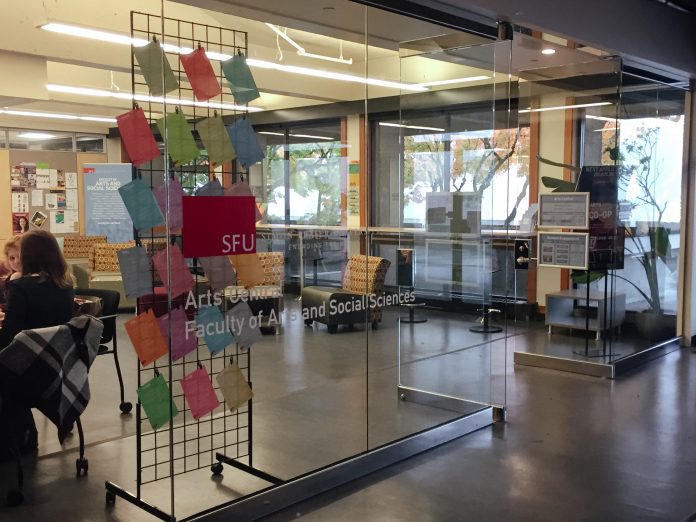
The interim program will be housed in Arts Central until a review by vice-president academic office is complete.

A program for Aboriginal students transitioning to post-secondary studies will once again be available at Simon Fraser University. The decision to reinstate the program in the coming semester followed an outcry from university staff, faculty, and students when it was cancelled last spring due to declining enrolment.

The interim Aboriginal University Preparation Program for students affected by the cancellation of the earlier program will be overseen by the faculty of arts and social sciences.

“I think we were all very interested and keen in allowing a transition, [and] at least having a kind of continuation despite this hiatus,” said Bettina Cenerelli, who is responsible for the restart of the program.

The interim program is being piloted by a steering committee while the vice-president academic office is undertaking a simultaneous review to determine a successful model for transition programming at the university.

The university abruptly cancelled the original Aboriginal University Transition Program without warning to students and staff in April. At the time, vice-president academic Peter Keller told The Peak that the decision was due to declining enrolment with only five students who attended in the preparation program that year.

A petition by faculty and staff, which gathered a total of 885 signatures, called on the university to immediately reinstate the program for the fall semester, in addition to strengthening the program, boosting recruitment efforts, and offering free tuition to Indigenous students.

SFU made the announcement in August that the faculty of arts and social sciences would immediately be tasked with the program pilot. The first session will launch in the spring semester, though the faculty did attempt to reinstate the program for its intended start that fall.

“We did try, we simply could not get the instructors and the supports necessary for the students in place,” explained Catherine Murray, an associate dean in the faculty of arts and social sciences. “It just simply wasn’t possible.”

The students affected by the cancellation of the fall session were offered other supports, according to Murray.

The interim program now located in a faculty will guarantee admission for students who achieve the necessary grade point average, which was not possible under the former program housed in continuing education. The students will also be under conditional admission which means they will receive the same benefits as any other student enrolled at the school including the transit pass and access to other student services.

“We may need some additional access to counselling and other additional services because these are non-traditional students in some cases. Some may have completed high school, some may not, some may be in families struggling with the residential school trauma,” Murray added. “We are staying faithful to Aboriginal-led and inspired programming.”

The cohort will have a dedicated elder in residence to provide guidance as students progress through the program. The advisory process for the program has been modeled on a core recommendation of the SFU Aboriginal Reconciliation Council which called for the inclusion of Indigenous peoples in decision-making.

The majority of the people on the steering committee are Indigenous, Murray noted.

The faculty also recognizes that costs do represent a significant barrier for many considering the program and it is something which will need to be addressed. However, Murray added that the faculty is not able to change tuition policy at the university to make the program free for Indigenous students.

“I think it is a very careful question of redistributed justice that needs to be had, and that conversation will be had, but we can’t preempt it,” she said. The program instead offers the opportunity for a work internship to recoup some of the costs.

The interim program is currently recruiting students and intends to have its first cohort start in January.

“Students are in contact with us, so we do respond even now to a current and existing need,” noted Cenerelli.

World News Beat

0

SPAIN / CATALAN – Spanish court releases arrest warrant on ex-members of Catalan government

A Spanish court has issued a warrant for former Catalan leader Carles Puigdemont who fled to Brussels after his regional parliament which declared independence was dissolved last month. The European warrant calls for Puigdemont and four ex-ministers who followed the leader to Belgium to be returned to Spain. The charges leveled against Puigdemont have climbed to include rebellion, misuse of public funds, sedition, disobedience, and breach of trust. The Belgian authorities have declared that the warrant will be studied and given to an investigative judge. They have a maximum of three months to make a decision regarding Puigdemont and his extraction from Belgium. In an exclusive interview with Belgian media, Puigdemont has also announced that he still intends to run for office in Catalonia’s regional elections to be held in December from Brussels, additionally stating that the Spanish government has no authority to dissolve his government before their term is over.  

With files from CBC News, Radio Télévison Belges Francophones, RTBF Monde, and Al Jazeera.

SYRIA – Syrian government takes back last major city held by so-called Islamic State

Militants from the so-called Islamic State have been driven out of the eastern provincial capital of Deir al-Zour following the efforts of Syrian, Iraqi, Iranian, and Russian forces on the ground and in the air. The city has been mostly held by the extremist group since 2014, save for one zone where 93,000 Syrian civilians and military personnel have been trapped for years. Across the border, the Iraqi city of Qaim, which had been an important border crossing, was also seized by Iraqi and Iranian forces. This development comes weeks after the Syrian Democratic Forces, lead by Kurdish fighters, took over Raqqa, the Islamic State’s de facto capital, and represents a significant blow to the group’s self-proclaimed caliphate.     

With files from The New York Times and The Independent.

EGYPT – A new chamber is discovered inside great pyramid

An international team of scientists has found an undiscovered and extremely large void inside Khufu’s Great Pyramid at Giza, directly above the Grand Gallery. The team used cosmic-ray imaging technology to ‘scan’ the inside of the Egyptian pyramid and detect the presence of the 30-metre long void. It isn’t clear yet whether or not the space constitutes a separate chamber, or was simply left by the pyramid’s architects to alleviate the weight of the stone on the Grand Gallery’s ceiling. The Great Pyramid was built as a royal burial chamber around 4,500 years ago and is the only surviving wonder of the ancient world.  

With files from The Globe and Mail and BBC News.

PAPUA NEW GUINEA – UN expresses concerns for Australian refugees detained in Manus Island detention centre

The Manus Island detention centre, an offshore processing centre for Australian asylum-seekers located in Papua New Guinea, was closed last Tuesday. Yet 600 men inside are refusing to leave, despite water and electricity being cut off. The refugees state that they do not feel safe outside the compound, citing past violence at the hands of locals. The United Nations is calling for the Australian government to work with the Papua New Guinean government to de-escalate the situation, and for Australia to provide direly needed food and water supplies. The former Papua New Guinea prime minister Sir Michael Somare has called Australia’s hypocrisy “astounding,” pointing out the ancestors of many Australians who opposed the migrants arriving by boat also landed by boat some years ago. The United Nations noted in a press release that the off-shore detention centres are “unsustainable, inhumane and contrary to its human rights obligations.”

With files from the Australian Broadcast Company and The Guardian.

Study finds bail ‘no-go’ zones block access to harm-reduction services

1
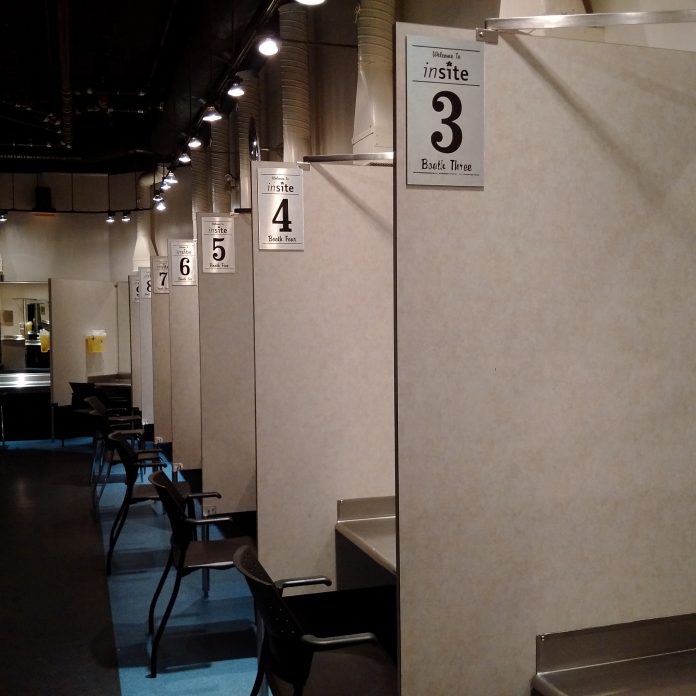
Insite is a supervised injection site located in Vancouver's Downtown Eastside. (Photo via Vancouver Coastal Health)

A recent study shows that the bail conditions placed on alleged offenders — especially drug users — are preventing access to harm-reduction services in the Downtown Eastside of Vancouver.

SFU geography professor Nicholas Blomley and master’s student William Damon recently published a joint study with the University of Ottawa and the Université de Montréal that looked at ‘red zone’ and ‘no-go’ bail conditions which prevent people from being in proximity to a certain area.

The study found that more than half of the bail conditions for drug offences included a no-go zone, 92 per cent of which were concentrated in the Downtown Eastside. This has implications for the health and well-being of drug-users in Vancouver because the red zone can prevent them from accessing vital local resources, including safe-injection sites and overdose-prevention sites, due to fear of legal repercussions.

“Our study reveals that conditions of release are too frequently used in Vancouver in ways that are counterproductive, punitive, and frankly unlawful, threatening fundamental constitutional rights,” said Marie-Eve Sylvestre, lead researcher of the study, in a press release.

The conditions of release in the current bail system can make alleged law-offenders more susceptible to re-entering the criminal justice system. Between 2005 and 2012, 97 per cent of all bail orders in Vancouver included conditions of release, which contradicts the Criminal Code requirement of unconditional release, the study outlined.

“In the case of bail, the presumption of innocence applies,” explained Blomley. However, the current bail system regularly violates this right and many others, such as the right to security of the person.

According to Blomley, there haven’t been any substantial changes made by the BC government to address these faults within its bail system.

“Some governments, such as Ontario, are thinking about changes to bail,” he said. However, it is hard to say if there will be any changes soon to the current bail system because “one argument that governments might respond to is that of the high cost associated with the prevailing system,” he added.

As for an alternative solution that law enforcers can use instead of imposing red zone bail conditions, Blomley suggested that the courts should “abide by the Criminal Code, that says that the norm should be that people will be released, without conditions, and that conditions be justified, reasonable, and non-punitive.”

Student Spotlight: Fire Out

0

What John Green gets right about mental illness in his new novel

1
(Image courtesy of Penguin Young Readers Group)

Turtles All the Way Down is the recently released YA fiction novel that is John Green at his most personal. After a five-year break from his most popular novel to date, The Fault in Our Stars, Green tackles teenage drama, a far-fetched mystery, and what it’s like to live with mental illness in this new novel.

     The book follows the life of Aza Holmes, a 16-year-old girl with obsessive compulsive disorder, her courageous and unabashedly nerdy friend Daisy, her well-meaning and caring mother, and her beloved car Harold. Along with the soft-spoken Davis, whose billionaire father goes missing, Aza and her best friend embark on a journey to uncover this mystery.

     What is most refreshing about Green’s novel is that mental illness for once is neither romanticized nor an obstacle the protagonist overcomes in some neatly written conclusion. Aza along with Daisy, and romantic interest Davis are written with a generous amount of depth that does justice to the lives that teenagers live. Whether it’s the drama associated with different Star Wars fanfiction pairings, or grappling with the turmoil and frustration they face with themselves and those around.

     The book, of course, is not free of all flaws. The detective mystery route it takes is all but dropped, and tied up with a far-fetched solution. In classic John Green manner, the book’s prose borders on pretentious, and has teens spouting off highly intellectual musings on the world constantly, which to be fair, is true of all teenagers. Turtles All the Way Down is a moving story of friendship, romance, the nature of pain and how one can articulate it, and realizing one’s own agency in dealing with mental illness.

Wi-Fi upgrade in residence causes connection issues for students

0

SFU Residence and Housing has received increased complaints about Internet access since it upgraded its service to include a wireless connection in dorm rooms this semester. The issues have caused frustration for some students and prompted the office to work to implement a solution.

“There have been times when I haven’t been able to connect to Wi-Fi on my phone, and I had to unplug the router and plug it back in to get a connection, again,” said Prabhdeep Dhaliwal, a student living in Barbara Rae House. “One of my friends living in residence didn’t have Wi-Fi for three weeks, he just couldn’t connect to it.”

Other residents, like Mayank Jha living in Shell House, cited reduced Internet speed as the main issue.

Last month, the Residence and Housing office acknowledged the issue on its website and suggested potential solutions for residents experiencing problems with their wireless connection.

Students moving into residence this semester were met with a surprise on move-in day with wireless routers in their room. This decision by SFU Residence and Housing, partnered with Shaw Communications, was a result of feedback from the residence community, according to Dana Beaton, the associate director of Residence Ancillary Services at SFU.

However, as the semester progressed students experienced issues with residence Wi-Fi. Students in residences across campus expressed frustration when issues with the wireless connection prevented them from completing online academic and leisure activities.

Holly Taylor, a student living in Pauline Jewett House, explained she has had the Wi-Fi connection drop during online quizzes in lecture halls and in her residence room. The students who spoke to The Peak generally agreed that the Wi-Fi in residence is still better than in other parts of SFU, despite issues with the Wi-Fi routers in their rooms.

The residences previously offered a wired modem and Ethernet cord for students who could choose to bring their own Wi-Fi modem to hook up to the system. The buildings also had a wireless connection available in the common rooms. The introduction of complementary Wi-Fi modems in each room this semester is part of a transition towards a single, building-wide system.

“We are working with Shaw to implement the full managed Wi-Fi solution as quickly as possible,” said Beaton. “Updates regarding the implementation of this service are posted to our website as we receive them.”

An email was recently sent to students in residence with troubleshooting tips, including to not use their personal router, to use the original username and password, and instructions on a factory reset. IT Services at SFU has also been able to help students with Wi-Fi issues in residence.

“Service issues on our interim Wi-Fi solution have reduced since the beginning of the term,” explained Beaton. “In most cases the issues have been disruption of service due to residents ‘personalizing’ the Wi-Fi network within their room either by adding a secondary Wi-Fi router or by changing the username or password of the router in their room. Any of these actions can cause a disruption to the signals of routers in the surrounding area resulting in a disruption of service.”

Those students who are still struggling with their wireless connection even after adhering to the above tips can contact IT Services or submit a maintenance request through the housing portal.

Graduate Student Society holds referendum to raise part-time student fees

0
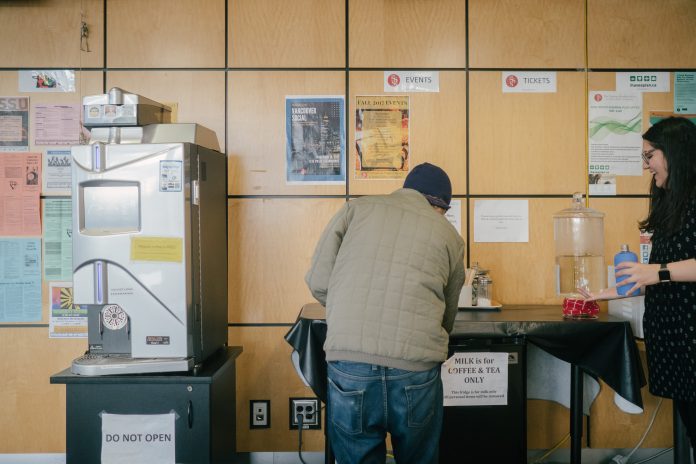
Among its services, the society provides free coffee and tea for graduate students.

The SFU Graduate Student Society (GSS) is advancing a referendum question regarding a possible change to student membership fees in tandem with the election for student society executive positions this semester.

The society membership will vote on a proposed increase of part-time student fees to match the amount already collected from full-time graduate students. For the GSS, the primary motivation behind the change in fee scheduling is to equalize contributions across the society membership.

“Currently, all graduate students are entitled to the same benefits at the GSS regardless of [their] status and the majority of our benefits are accessible off campus,” explained finance director Heather Baroody.

The GSS collects fees from both the full-time and part-time graduate students, though the fees are scheduled differently. A full-time graduate student pays $51.65 per semester, while a part-time graduate student pays only $25.83 per semester. The proposed change to the fee schedule would make the cost for both part-time and full-time graduate students $51.65 for every semester they are enrolled.

The referendum must receive at least a five per cent voter turnout in order for the results to be valid, as per the society bylaws. The society is required under provincial law to put the proposed fee changes to a vote by the entire membership.

Although part-time graduate students currently pay around half of what full-time students pay, their presence on campus does not impact the level of services they receive, according to executive director Pierre Cenerelli. While leveling the field is the main motivation for the change, the society is also looking to boost its services with the added income.

“We are looking at long-term sustainability of the GSS,” said Baroody. “We had to cut a few programs this year just to keep our budget balanced. We are hoping with that extra money we can bring back some of those programs and expand more programs to more graduate students.”

The money levied from students goes towards society services such as financial support programs and room booking.

This equalization of fees across the student body is common in post-secondary institutions. Jeanette Ordóñez — the GSS administrator — stated that the “GSS is one of the only student societies that has differentiated fees between part-time and full-time.”

The Simon Fraser Student Society (SFSS) which represents undergraduate students at the university does levy different fees depending on the student course load. Full-time undergraduate students pay a fee of $42.74 while part-time students pay $21.38 in addition to other levies — including those for the stadium and the food bank program — proportionate to the student’s course load.

While the University of British Columbia has equalized its undergraduate and graduate student fees regardless of course load, the University of Victoria undergraduate student society collects different fees from full-time and part-time students and the graduate student society collects a flat fee unless students are taking a co-op work semester or distance education.

The GSS referendum will take place during the election period from November 27 to December 4. If the referendum is to pass, a majority must vote in favour of the change, at which point the society intends to begin collecting fees at the new rate in the fall 2018 semester.

Four players see last home game with SFU football in 51–0 loss

0
It was a snowy afternoon on Terry Fox Field. (Photo courtesy of SFU Athletics)

On a cold, snowy November day, SFU fans said ‘goodbye’ to the football team’s seniors, as four players saw their last game on Terry Fox Field on Saturday, where the team fell to the undefeated Central Washington Wildcats 51–0.

“They’ve bought into the long-term vision of what we’re trying to do here, and they understand that they’re in a very tough spot,” said head coach Kelly Bates of the senior class on a team that is facing its third straight season without a win.

“Your team’s strength is usually determined by your junior and senior classes, and we have very small junior and senior classes due to things that are out of our control before we got here, so credit to all of them as they have not quit. They understand that they are helping set the tone as we go forward, and they’ve done that. I’m very proud of that.”

On SFU’s 71-man roster, just 18 players are in their junior or senior year.

Linebackers Trevor Kemp, Jordan Leech, Deondre Townsend, and wide receiver Justin Buren were the four players honoured as seniors. Of the four, just two — Buren and Leech — have played their entire careers at SFU, as the last holdovers from former head coach Dave Johnson’s 2013 recruiting class. Kemp joined the team last year as a junior college transfer from Southwestern College, while Townsend joined the team this year as a graduate student with one year of eligibility left, having played three seasons at the University of Calgary.

Leech dressed, but did not play Saturday.

Kemp put up a dominant showing, leading both teams on defence with 14 total tackles (six solo), a sack, and a forced fumble.

SFU didn’t find much on offence, putting up only 30 yards total and gaining only five first downs. The team lost yardage on rushing, going negative 31 yards.

Central Washington redshirt sophomore running back Hasani Childs was dangerous, running in four touchdowns, and 232 total yards of offence. He looks to be a threat in the GNAC for years to come.

Dionte Simon led the team on the ground game, and Nathanael Durkan led receivers for SFU, both achieving 21 yards in their respective categories.

“I think we’ve got some very talented young men, but they need to build the two most important things that all players needs, that’s football IQ and physical maturity . . . that only comes with time and dedication, and it doesn’t happen overnight,” said Bates.

“That’s what gives me great promise, that we’ve got 75–80 per cent [of] our team in their first or second year,” he continued. “And that’s [what] we must build on. We must continue to see a long-term vision and continue to build with high school kids, bringing them in, and having them here for four or five years, building their physical maturity and football IQ . . . it takes time.”

SFU will have one last chance for a win this season when they go on the road to face Western Oregon in Monmouth, Oregon on Saturday, November 11. Western Oregon are the second-worst team in the conference with a 1–6 GNAC record.

Their only conference win came against SFU in an 82–21 contest in Burnaby. Western Oregon linebacker Bo Highburger leads the conference in tackles with 89 total.

Kickoff is at 1 p.m.