

JOB AD: AQ Accident Control Officer
By: Mason Mattu, Humour Editor and Sarah Sorochuk, Peak Associate
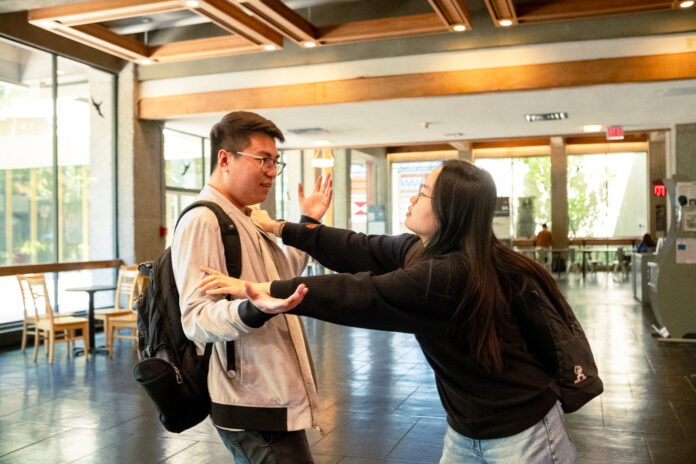
Feel an urge to make a difference in the world? Do you have big muscles and are built like a Greek god? Are you ready to block student hooligans who dare walk on the wrong side of the hallway? We have just the job for ya!
AQ Accident Control Officer — A paid position starting at $2 every 3 hours (legal note: accident control officers will be officially labelled as freelancers to save us some big bucks. Attempts to unionize will result in banishment from the realm).
Seeking multiple students to work on each floor of the AQ in between classes (during peak travel time) to prevent further collisions and future lawsuits. Applicants must have a strong understanding of the violent situation at hand. Background information is provided below:
A (BRIEF) BRIEF ON THE SITUATION:
The AQ has been known for countless runovers and walking traffic incidents. Since the dawn of time, and everywhere on earth, people have walked on the right side of the hallway. Everywhere but SFU. This is causing some major emotional and physical damage, with 50 students being involved in “got run into by a person walking on the wrong side of the hallway-and run” encounters. Here is a victim’s testimony:
“Last Monday, I was on my way to Classic Shakespearian Lit [ENGL 312] with an extra-large vegan cucumber coffee in one hand and my own personal copy of Romeo and Juliet (the smut edition) in the other. Out of nowhere, I was violently run into by a HOOLIGAN who was walking on MY side of the hall. It was a horrible attack on my life and the sanctity of the AQ. This ought to be ILLEGAL!” — Anonymous SFU arts student
MORE ABOUT YOUR JOB:
As an officer with the AQ Accident Control, you will be tasked with enforcing the right way of the hallway rule for all students. We’ll provide you with a safety whistle, a vibrant safety vest, and a 2010 Blackberry with the latest ticketing software installed. Extra perks include receiving a “get out of class early” pass for officers in lieu of benefits or dignity.
Officers are not allowed to use force, and will instead imitate a common enemy of delinquent students: a 1,000 year old professor who refuses to give out A’s.
You will also be in charge of providing students who have been run into by someone walking on the wrong side of the hallway with emotional support. Please do not refer them to our SFU counselling department if they’ve exceeded the three complimentary appointments for the year given to each student.
Job requirements:
- Must be a second or third year SFU/FIC student looking for an easy way to make some quick cash.
- Have no social life and can work at all hours of the night.
- Are happy to be the center of attention, by being loud and disruptive to the student body.
- Have 2–3 years of acting or roleplaying experience.
- Come to work with a settled frown every day.
- Are willing to sign an NDA in case you decide to accuse us of labour violations.
- Look scary. Have a few piercings in your nose, belly button, and thumb. Make them believe you are an emo guard. Really make it feel like you’re gonna kick the shit outta them if they walk on the wrong side of this here hallway.
Apply by emailing: [email protected]. Deadline: 3 hours ago.
Concerns arise around controversial instructor’s past
By: Lucaiah Smith-Miodownik, News Writer
Content warning: mentions of sexual violence, misogyny, the death penalty, homophobia, and transphobia.
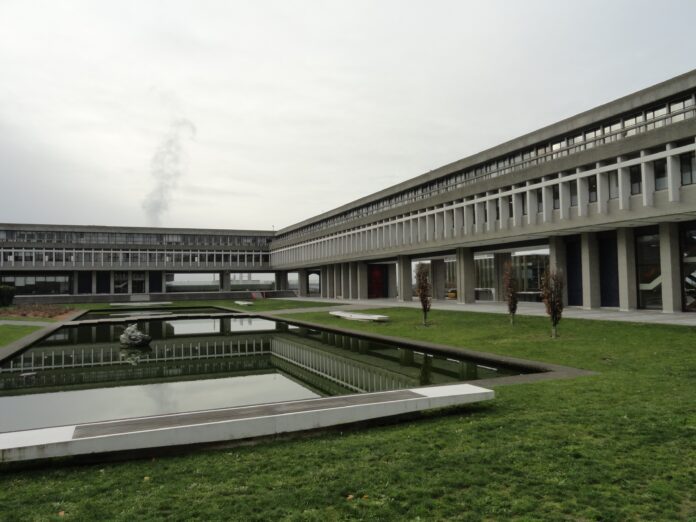
SFU has recently come under fire for its alleged decision to hire Gleb Glebov as a sessional instructor for the 2025 summer term. He is not currently on the summer calendar, where he was allegedly slated to teach EDUC 313. Taryn Lees, a student in the teacher education program, told The Peak that she noticed the instructor had been changed when she checked goSFU. Glebov was previously fired from Fraser International College (FIC), an affiliate of SFU located on the Burnaby campus, for a series of YouTube videos he posted. CBC reported he claimed rape allegations were made up justifications for abortion, advocated the death penalty for those “who have abortions and the doctors that perform them,” characterized both homosexuality and transgender identities as “garbage,” claimed all non-Christian gods to be “the antichrist or satan,” and more.
In November 2019, Glebov was a math instructor at FIC when the school received an anonymous tip regarding his videos. In the following weeks, after a meeting with FIC’s director and an investigation into the content of his recordings, he was fired. Glebov’s videos, which the director described as containing “potentially hate speech,” violated FIC’s “professional code of conduct for teachers” as well as the school’s “conflict of interest policy.”
He alleged religious discrimination over the decision, claiming that “the videos were made in the context of a sermon.” In response, “FIC argued that, no matter how deeply Glebov believed in the things he said, he needed to prove [that] his freedom to practice his religion would be compromised if he couldn’t post these statements on YouTube.”
“Given that students in the program are expected to demonstrate program goals which include ‘an openness to worldviews’ and ‘celebrating diversity,’ it is unacceptable that they should pay to be educated by an instructor who so clearly violates them.” — Taryn Lees, petition starter, teacher education program student
Glebov brought his complaint to the BC Human Rights Tribunal, which ruled against him in January 2024 by finding he “failed to demonstrate a genuine religious belief requiring him to publicly share his views.” Glebov also left Capilano University in February 2024, with the university telling the Capilano Courier he was no longer “associated” with the institution. It is unclear if Glebov was fired from Capilano University.
A student petition against SFU’s alleged decision to hire Glebov began circulating in March, with over 450 supporters. EDUC 313 “is one of few options that teacher education students in the secondary stream can take to satisfy a graduation requirement,” Lees, who started the petition, wrote. “Given that students in the program are expected to demonstrate program goals which include ‘an openness to worldviews’ and ‘celebrating diversity,’ it is unacceptable that they should pay to be educated by an instructor who so clearly violates them.
“The integrity of the program and the safety of teacher education students — particularly women and 2SLGBTQIA+ students — is in jeopardy so long as Gleb Glebov remains a sessional instructor for our program,” the petition continued.
The Peak reached out to SFU Glebov’s employment status, who provided the following statement: “We take all allegations that contravene our values of inclusivity and belonging seriously, as well as our commitment to foster a safe work space. Due to privacy obligations, we cannot comment on specific employment matters for any employee, past or present.” SFU could not confirm whether Glebov had already taught at SFU in 2023. The Peak reached out to Glebov as well, but did not hear back by press time.
Passive screen time is dulling your life

By: Ana Maria Tofan, SFU Student
How often have you caught yourself scrolling while walking 10 steps to the kitchen for a snack? If you’re part of the generation of young adults who did not grow up glued to a screen (like me), you might like to think you’re holier than thou for having “played outside” as a kid. When tech companies spend billions of dollars to engineer the most addictive algorithms to keep our attention, is it really a surprise when it works? The reality is that these companies will stop at nothing to lock eyes into the endless loop, even when they belong to impressionable children. If we want to reclaim our mental clarity, physical health, and long-term wellness, it’s our responsibility to learn to have a healthy relationship with screens.
Here’s what research shows: spending over two hours a day in front of a screen has similar impacts on both children and adults. It harms our eyes, hinders learning and memory, and increases the risk of early neurodegeneration, the loss of neurons in the brain associated with aging. The kicker is that children’s brains are fragile and highly malleable during their early developmental years and critical periods. Excess screen time in children can delay their development in learning, communication, critical thinking, and more, leaving them with long-term difficulties. Excess screen time impacts both the quality and quantity of sleep for all ages and has even been linked to lower grey matter in our brains. For those unfamiliar with the brain, grey matter is a key component of our everyday functioning in memory, decision-making, movement, and more. So, if you’ve ever worried about Parkinson’s, dementia, or a stroke, conditions related to your brain’s grey matter, consider the things you can do to lower your risk: limit your passive screen time.
Passive screen time can be thought of as the feeling of having a really good cupcake: it gives you an instant dopamine hit from the sugar but no nourishment.
A massive body of ever-expanding research is dedicated to the effects of screen time — particularly passive screen time. This is when you consume information through your device without engaging with it. The information or entertainment is disseminated to you from the screen, with minimal effort from the brain. Active screen time, on the other hand, involves more interactive activities or content that enriches brain activity, like educational apps or games. It is recommended parents limit children’s tech use to such activities, but adults should approach screen time the same way.
Passive screen time can be thought of as the feeling of having a really good cupcake: it gives you an instant dopamine hit from the sugar but no nourishment. Compare that with broccoli: unexciting, but good for your long-term health. This is why we frequently choose passive screen time over enriching activities: it gives your brain more delicious dopamine hits. Passive screen time has been linked with lower social interaction abilities in children and a lack of imagination, which you may have encountered if you’ve ever tried to have a conversation with an iPad kid. This is essentially like having a brain run on cupcakes. This is why many people experience brain fog with high passive screen time; it’s your brain being passive because it doesn’t have to exercise its imagination. The addictive qualities of passive screen time are especially dangerous to young children because their growing brains are drawn to the exciting colours, sounds, and movements, and the instant gratification appeals to their impatient tendencies. These tendencies are why a child is more likely to want one candy now instead of two candies later.
So what can we do instead? First of all, just being mindful of the tiny moments where we unnecessarily use our phones can open our eyes to the reality of our dependence. Second, giving ourselves an hour in the morning without our phones can decrease our dependence over time, decrease anxiety, and improve sleep. Lastly, taking note of the ways you use your phone, and decreasing the passive, scroll-heavy ways. Screen dependencies aren’t our fault, but managing them is our responsibility, and with these steps we can begin to deconstruct the dependent routines we’ve built around our phones and start healing from scrolling sickness.
Is the Richmond Night Market worth the hype?

By: Osna Hadef, SFU Student
Celebrating its 25th anniversary this summer, the Richmond Night Market has become one of Metro Vancouver’s most anticipated annual events since it started in 2000. The huge market offers over 500 food options, 100 retail shops, and a wide array of entertainment, attracting more than a million local and international visitors every year from April to October. It is the largest night market in North America and has even been featured in the New York Times.
This year will mark my fourth consecutive year returning to the market. I consider it a favourite hangout spot and a must-do summer activity with family and friends. While I spent most weekends working at one of the food vendors last year, I have visited it twice more — having a blast both times!
As someone who is not too adept at trying new foods, I will say that the food at the night market slaps! It is a paradise of primarily East Asian food, but it’s also full of magical fusions and creative food presentation — drinks in glowing light bulbs or churros in ice cream served in a cup in a tiny floaty, for example. Twisted potato, flying cup noodles, cheese coin, corn cheese, Korean corn dogs, and mango sticky rice are just a few of the popular foods featured.
Is everything about the Richmond Night Market overpriced? Undeniably, yes. Can you make the most of it and have a fun, enjoyable experience? You bet!
My personal favourite is the garlic shrimp with vermicelli noodles — glass noodles topped with shrimp soaked in rich garlic-based sauce and garnished with chopped green onions. This Cantonese dish has not left my mind since I tried it with my friend last year at the night market. Since then, I’ve lost count of how many times I’ve kept bringing it up to her. It’s literally a chef’s kiss! Another love of mine is the Indomie Donut — spicy, flavourful Indonesian noodles fried into the shape of a donut, hence the name.
Besides the food, which is definitely the main character of the show, what also brings the crowd to the market is all the entertainment it offers. Visitors can spend hours exploring the rows of retail booths, enjoying live performances, or getting caught up in endless attempts to win carnival games with maybe 0.0001% odds of winning (trust me). The market also features different thematic festive decorations and spots to take photos for a fresh experience each year. To spice things up even more, the organizers even added a zipline over the market this summer! If being in the market itself wasn’t enough, now you can view it from the sky.
In the light of such enjoyment, the Richmond Night Market is definitely worth and deserving of the hype it is receiving. Being a go-to local event that runs for months and attracts so many visitors annually is a testament to that appeal. However, while I would say the market is not overhyped, it is undeniably overpriced. The general admission fee was hiked up from the $2.25 in 2015 to $7 today (before tax), and the food prices have also risen compared to the previous years. It is not uncommon to find snack-sized portions of food costing over $10 and the games are expensive considering their slim odds of winning. As people start to complain about breaking the bank every visit, the market risks losing some of its hype, causing regular visitors to reconsider how often they come in the coming years.
Is everything about the Richmond Night Market overpriced? Undeniably, yes. Can you make the most of it and have a fun, enjoyable experience? You bet! The sky-high prices may not be worth going there more than once or twice a year, but those who have not been there yet are missing out on one of the best local summer events. I recommend everyone to go there at least once. The event is more than the delicious and interesting foods it offers — it is a whole experience that can’t be found anywhere else in the Lower Mainland.
Italian-Estonian relations hit a bitter brew over Eurovision song

By: Zainab Salam, Part-time barista
Eurovision has presented the world with its fair share of entertaining spectacle. This year, the diversion presents a brewing controversy of the caffeinated kind. Estonian artist Tommy Cash’s performance of Estonia’s entry song, “Espresso Macchiato,” has destabilized an international relationship stronger than ten espresso shots taken after an all-nighter. Cash’s provocative lyrics have outraged Italians, with Italian foreign minister Antonio Tajani suggesting the government of Italy could impose 100% tariffs on Estonia in retaliation to what he deems “a racist depiction of Italians.”
The song in question? A blend of made-up Italian and enough espresso references to cause acid reflux.
The following is an interview I conducted with minister Tajani to discuss his view of everything that transpired in Eurovision.
Q: Minister Tajani, thank you for joining me today! How are you doing?
A: Yes, yes, yes, hello. Thank you for being a real journalist in such a trying time. Journalists like you are the backbone of civilized society. Did you know that the first-ever newspaper was an Italian invention? Yes, that’s right. Also, the typewriter, the moon, Abraham Lincoln, and God were all invented by Italians. We are the most important people on the planet. Have you done a DNA ancestry test? Maybe you’re Italian?
Q: No, I haven’t taken a DNA test, but now I’m scared it’ll come back 100% Estonian. Thoughts?
A: Dio mio! Don’t say such things, especially not out loud! You’ll give my nonna heart palpitations from beyond the grave. But, God forbid, if that’s true, don’t worry! We have a nationality naturalization program: two weeks in Tuscany, with mandatory denunciation of all that is not Italian, with the exception of all that we have modified and call ours now. You’ll be one of us by the end of the program.
Q: Thank you . . . I guess. Let’s get back to the interview, please. The Italian government has suggested they may be interested in a 100% tariff on Estonia. Some may think of that as an overreaction to Tommy Cash’s song. Do you have any comments regarding that accusation?
A: Overreaction? Those people are lucky we didn’t call for a full diplomatic relations severance. Estonia has declared war on our cultural values. On our crema. On our nonnas. This is not just about a song. It’s about our shared identity as Italians. If we don’t respond harshly to this vile transgression, what would we be? The Swiss? Hogwash!
Q: But isn’t the song kinda . . . catchy?
A: Catchy? The Black Plague was catchy, too! That doesn’t mean we should celebrate it at an international event. The man raps about marked coffee like it’s a religious experience. And the lyrics, don’t even get me started on the lyrics! If my grandmother had wheels, she would’ve been a bike. If Dante heard this song, he’d rewrite Inferno to add a circle for linguistic crimes. The grammar’s not even correct!! There’s a reason why the Eurovision jury didn’t give it much attention — it sucked ass!
Q: In a press release earlier this morning, you stated that you are personally offended by the line, “I’m sweating like a mafioso.” Why is that?
A: Simple, really, he is depicting Italians in a disgraceful manner. You think we all walk around sweating in pinstripe suits, waving pasta, and collecting protection money? That’s only some of us! This is the kind of stereotype that sets us back decades. What’s next? He’s going to rap about Michael Corleone being from Bologna?
Editor’s note: Since this interview, minister Tajani has demanded UNESCO declare espresso a protected cultural heritage. Eurovision have responded by sharing the song on their official website, with a link which takes the viewer to an alternative music video of “Espresso Macchiato” by Tommy Cash.
Out on Campus hosts Australian drag film screening

By: Corbett Gildersleve, News Writer
On May 20, Out on Campus (OOC) screened their first movie of the summer with The Adventures of Priscilla, Queen of the Desert. OOC is a student organization “dedicated to supporting SFU’s 2SLGBTQIA+ students and allies.” This 1994 road trip movie follows three drag queens touring Australia. It is based on the lives of three real drag queens — Cindy Pastel, Strykermeyer, and Lady Bump — portrayed by Hugo Weaving, Guy Pearce, and Terence Stamp. The film highlights the harms of deadnaming and portrays a cast who support one another in the face of violence. The Peak attended the event and spoke with Constantin Lozitsky, interim OOC coordinator, to talk about why its messages are relevant today.
Classics club is a movie night series run by OOC, focused on queer content “for, by, and about the community.” Lozitsky chose this movie to start the series because they heard it was influential at the time of release.
The movie centers on drag queens Anthony “Tick” Belrose (drag name Mitzi Del Bra), Adam Whitely (Felicia Jollygoodfellow), and Bernadette, an older, recently bereaved trans woman. Their bus, Priscilla, is vandalized with homophobic messages after their first stopover, and the trio continues to face verbal and physical abuse throughout their journey.
Speaking with Lozitsky, they noted that while the movie was full of both honest and tough depictions of queer life, it ultimately has a positive message: the queens demonstrate how perseverance is possible in the face of hate.
At the time of the film’s release, many Australian states and territories still had anti-gay legislation. Same-sex marriage wasn’t legalized until 2017 in Australia.
While drag queens have become much more mainstream since the ‘90s, now with shows like RuPaul’s Drag Race, they continue to face conservative backlash as seen with Drag Queen Story Hour in the US, Australia, and Canada. Drag Queen Story Hour “is a program or event featuring drag queens reading stories to children in libraries, schools, or bookstores.” In Kelowna, the first Story Hour event saw 160 children and parents attend, the library’s most successful event. There was pushback from management and social media, but the second event had an even larger turnout, and ultimately, the library board backed the library staff, and management apologized.
Lozitsky found it hard to find another “movie that is as effective at telling its story with such grace and compassion towards 2SLGBTQIA+ characters while also dumping buckets of slurs and insults and everybody’s fighting and everyone hates eachothers’ guts, but at the end they’re all compassionate and taking care of each other.”
On why this movie is still relevant today, Lozitsky said, “It’s not trying to be educational, it’s not trying to be pandering [or] uplifting, and its describing things through a lens that understands the queer community, the trans community, that understands intimately what each character is going through.” They also expressed that “it is incredibly refreshing to see unflinching dedication to show that humanity in ways that might make you uncomfortable, or might make you feel like you’re too much, or you’re too extra, too other — but that dedication to showing those characters as lovable and regular. They’re regular people who are also drag performers.”
“They” is correct, and so is respect

By: Zainab Salam, Staff Writer
Content warning: descriptions of misgendering and transphobia.
A surge in anti-2SLGBTQIA+ hate crimes and discrimination in Canada over the past few years is emboldened by the anti-trans agenda pushed by right-wing figures like Pierre Poilievre. Such rhetoric is often thinly veiled beneath false claims of intellectual superiority regarding biological and linguistic “correctness.” For example, some refuse to respect peoples’ pronouns because “they” as a singular pronoun is supposedly “grammatically incorrect.” The internet is rife with clips of right-wing figures on radio shows or college campuses roping queer individuals into a debate about their identities and basic human rights to make a spectacle for ridicule. For example, a clip between UK TV host Julia Hartley-Brewer and journalist Shivani Dave went viral after Brewer invited Dave to the show under misleading pretenses to purposefully misgender them for the sake of “correct grammar.” Such interactions are predictable at this point. They’re a deliberate misdirection to catch queer people off guard with a linguistic debate that dehumanizes them.
To show you how this has nothing to do with grammar, let’s be clear: “they” is grammatically correct and has functioned as a singular pronoun in English from as far back as the 1300s, including in the works of Shakespeare and Jane Austen. It is still part of everyday language, even by transphobes themselves, when referring to a person whose gender is unknown. These so-called grammar experts wouldn’t blink twice at someone saying, “Can I speak to the manager? I want to complain to them.” However, as soon as they see the person, they want to immediately assume their gender identity based on a limited binary.
Language changes all the time to adapt to speakers’ needs. For example, the singular pronoun “thou” and plural “ye” used in Old English were replaced with “you.” “You” has also been adapted into “y’all” in certain areas to accommodate for a plural “you.” Did civilization collapse? No. Furthermore, approximately 57% of languages spoken worldwide don’t employ gendered pronouns. Citing English as the authority for how we see the world is not just wrong, but it reinforces colonialism.
This is not a matter of semantics, though. Language is political and changes because society changes. It shapes and reflects who holds power, who are seen as “normal,” and who are pushed to the margins. When people insist that “they” is an invalid pronoun, they assert that only identities within the gender binary deserve to be recognized.
The idea that there are only two genders is not universal. Many cultures around the globe have long recognized the existence of genders beyond the women-men binary. Indigenous cultures on Turtle Island, for instance, have always recognized and embraced more than two genders in their communities. While Indigenous cultures have their own unique terms, the umbrella term “Two-Spirit” was developed in 1990 to describe identities that blend or move beyond categories of men and women. The Navajo Nation uses the word “nádleehí,” which means “one who transforms.” In Cree, “aayahkwew” means “neither man nor woman.”
Even if singular “they” was a recent invention, language is not fixed — new words and forms of grammar emerge constantly. We’ve embraced countless neologisms in the past two decades alone — “selfie,” “unfriend,” “Google” as a verb. The question to ask is not whether the language is “correct,” but whether it serves the purpose of reflecting and respecting the people who use it. The answer is obvious: respecting people’s identities is more important than clinging to grammatical purity.
Queer people have always existed. Both as regular people and as notable history-altering individuals. The right-wing’s reaction to people using non-conforming pronouns presents queerness as a new-age phenomenon, protesting to exclude inclusivity from education spaces or limit access to gender-affirming care. They claim this is an effort to protect children, or women, when in reality, these things exist to help queer and trans people. Yes, 2SLGBTQIA+ acceptance and its influence over language might be relatively new, but that doesn’t mean that queerness and queer people are.
We shouldn’t excuse persistently misgendering people for innocent reasons, when it doesn’t take much to ask a person for their pronouns and respect them. The issue is not grammar: it’s power. Using someone’s correct pronouns, whether they use “they,” multiple pronouns, or neopronouns, is about acknowledging their personhood. Something as basic as sharing your pronouns can encourage others to share theirs without.
So yes, “they” is grammatically correct. More importantly, it’s ethically correct. Grammar is not a cage, it is a tool. And tools are meant to serve people.
Six non-fiction books that ask you to feel deeply
By: Ashima Shukla, Staff Writer and Michelle Young, Co-Editor-in-Chief
I love books that breathe — that smile gently at me and invite me into their orbit; that ask, “Will you join me? Will you look at what you’ve been avoiding?” If you think non-fiction is about dry facts and dull history, this list is an invitation to reconsider.
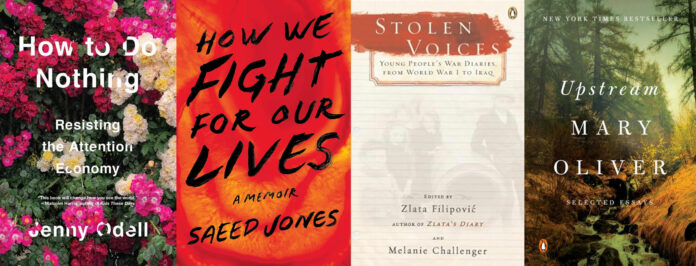
How We Fight For Our Lives by Saeed Jones
Jones’ memoir is a heart-wrenchingly honest account of growing up Black and gay in the American South. Born in Memphis to a Buddhist mother and an evangelical grandmother, Jones’s vignettes move through geographic and emotional landscapes in search of identity, understanding, and belonging. Written in a searing poetic prose that is equal parts fearful and courageous, Jones allows his full self to emerge in these pages — with all his multitudes and contradictions. In doing so, he invites the reader to confront the costs of surviving in a place that demands silence in exchange for safety.
Upstream: Selected Essays by Mary Oliver
Known for her poetry, Oliver’s essays inspire quiet wonder. In Upstream, she writes about nature, solitude, and creativity with a luminous attentiveness that invites you to slow down and look around. Soft but stubborn in her clarity, she writes of the divinity of nature like a lover full of reverence and gratitude. In these lucid but grounded reflections, she explores what it means to belong to the world, to pay attention again to the gentle rhythm of the river and joyous birdsong.
How to Do Nothing: Resisting the Attention Economy by Jenny Odell
What seems like a productivity detox is, in reality, a deep philosophical excavation of attention. Odell gently guides you to reconsider: what if your worth wasn’t measured in output? Part meditation and part love letter to idleness (and birdwatching), she helps you reclaim your time. It is not so much about disconnecting as it is about reconnecting — with the present moment, with your community, with yourself.
Stolen Voices: Young People’s War Diaries, from World War I to Iraq edited by Zlata Filipović and Melanie Challenger
This haunting collection of war diaries is a lesser-known but highly relevant anthology in this time of global catastrophe. Helping us to personalize and make real the war statistics we consume (or are consumed by), this book is a testament to adolescent wonder and resilience in the face of violence. It asks you to listen to voices we often overlook, to face the raw and unfiltered accounts of survival that remind us that peace must never be taken for granted.
In a world that asks us to scroll away, these books ask us to stay, to witness, to feel, to remember.
— Ashima Shukla, Staff Writer
Small Bodies of Water by Nina Mingya Powles
Another author known for her poetry, Powles’ essays are just as descriptive and gravitational. Like water itself, her prose pulls you under the sea to explore identity and climate anxiety. She writes on recurring whale dreams, the exploitation of sea animals, and ponders how we can “write about nature without writing an elegy.” Weaving these themes with her experience of studying abroad in Shanghai and her mixed Chinese-Malaysian heritage, Powles interrogates how history has shaped the present day.
A Cup of Water Under My Bed by Daisy Hernández
This memoir explores the intersections of class, race, and sexuality in a vivid coming-of-age commentary on what it means to grow up Colombian-Cuban in the US. Hernández not only details her experience growing up, but also confronting racial biases in journalism — notably while working at The New York Times. This piece is sure to tug at the heartstrings for any part of the queer diaspora, but it especially touched me with its tinges of Spanish unapologetically sprinkled throughout the book.
— Michelle Young, Co-Editor-in-Chief
Lead with Joy: how Johnson’s memoir is touching millions

By: A humble grad student, forever changed
Have you ever wondered, “what if Brené Brown ran a university like a Fortune 500 company — but make it The Chair?” Then SFU president Joy Johnson’s long-awaited, totally real, best-selling memoir is the answer you didn’t know you needed (but are now required to cite in every funding application). Where Ji-Yoon collapses under the weight of moral contradictions, Johnson ascends — brand-safe, donor-friendly, and backed by a communication team reportedly headed by Margaret Thatcher’s ghost.
From the (co-)author of more than 180 peer-reviewed articles, Lead With Joy: Leader is Johnson isn’t just a memoir. It is a paradigm-shifting manual for Canadian academic leadership and a manifesto for academic girl-bossing. Plus, it comes with a legally binding invoice for the emotional labour of narrating her own excellence.
When Lead With Joy first hit SFU’s bookstore shelves, no one on the West Coast was ready. The Board of Governors cheered. The students wept. Our precious mountain tilted ever so slightly out of respect. Even a hummingbird spotted reading a copy paused mid-flight in what could only be called a rare review from nature’s fastest critic.
Tracing her journey from being a nurse to Canada’s most spreadsheet-savvy university president, Johnson’s magnum opus reads like a hybrid between Sun Tzu’s The Art of War and Brianna Wiest’s The Mountain is You. Where most self-help books offer vague affirmations, Lead with Joy arms readers with a data-driven roadmap for cultivating the perfect leader: one who quietly and expertly outsources the messy business of morality.
Her leadership philosophy? A delicate balance between denial in the face of inconvenient ethical questions and Key Performance Indicator (KPI)-driven ambition. As she passionately and eloquently argues, “to truly heal an institution, one must ignore the symptoms, quantify the wounds, and propose a data-driven five-year plan to reimagine wellness.” In one stirring chapter, “Care as KPI,” she boldly declares, “Joy, too, can be a deliverable.”
Proudly documenting her previous success in raising SFU’s research income from $103 million in 2014 to $161 million in 2020 as vice-president research, she distances herself from the Barbie brand of commodified feminism. No, this isn’t pink outfits and empowerment merch. It’s feminist leadership optimized for the metrics. Where equity is performance-based and glass ceilings are broken only to install skylights in the president’s office.
For instance, writing on the complexities of freedom of expression on campus, she clearly states, “Freedom of expression matters. So do limits.” After all, to lead with joy is to “host the hard conversations, schedule them quarterly, and issue branded reports afterwards” complete with community-facing search engine–optimized insights.
Now mandatory reading for first years and emotionally destabilizing for tenured radicals, Lead With Joy is already outselling the iconic SFU dog hoodie. So much so that the bookstore has made Lead With Joy a bestseller (totally on their own accord).
Grab yours before the limited-edition hardcover — printed on recycled equity statements — sells out faster than funding for anti-fascism scholars during budget reviews. Buy two to receive a branded lanyard, endless joy, and a vague sense of institutional belonging, while supplies last.

