Home Blog Page 604

Board Shorts

1
Irene Lo / The Peak

SFSS approves a motion to cease to restrict student groups to SFU catering

The Meeting, Event, and Conference Services (MECS) monopoly on SFU student catering services is over. The Simon Fraser Student Society (SFSS) Board of Directors approved a motion to “remove all restrictions on student catering,” after a long period of back-and-forth with MECS about their high prices and depreciating food quality.

SFSS president Hangue Kim stressed that the decision was made neither lightly nor swiftly. The concern about MECS had been germinating “over the course of the year,” and the catering survey the SFSS launched recently served as further evidence that students were dissatisfied with what they were getting.

“This is going to open up the floodgates and allow all student groups to be able to use other types of catering sources,” Kim stated. He anticipates potential “kickback” from the university: “It might be a war where it’s tit for tat. [. . .] They do control a lot of the services that we offer to students. I’m already predicting that there’s going to be a bit of push and pull.”

Some of the Board worried that SFU might try to overrule the change, in the sense that they might claim that regardless of the SFSS’s stance, SFU itself will not permit students to use outside catering. However, it was deemed unlikely that the school could reasonably do this.

“We’ve given them ample opportunity to respond in direct questions on three different occasions regarding whether [they can reference] specific policies that compel us to require student groups to single source,” said SFSS chief executive officer Martin Wyant. “They’ve not provided any, they’ve been given lots of time, so [. . .] you’re reasonably within your purview as a Board.”

The Board approved the motion unanimously.


The SFSS approves new policy for ex camera versus in camera Board meetings

The new policy outlines the reasons that a Simon Fraser Student Society (SFSS) Board meeting may be held in private (in camera). Meetings involving “SFSS HR matters,” “open contract negotiations or competitive processes”, or discussions of “a litigation process” that involves the SFSS or “advice subject to solicitor-client privilege, such as legal counsel” are all sanctioned to be held in private. Also meetings that deal with “subject matter that relates to, or is subject to the Personal Information Protection Act (PIPA)” may also be held in camera.

According to vice-president university relations Erwin Kwok, this policy is “based on the best practices today within other government offices,” particularly at the municipal level in Ontario. “Historically, Board has not had any sort of standard for using closed meetings, so we could just do it if we wanted to,” Kwok stated while explaining the importance of the policy. “We could hold this whole thing today in closed meetings because there’s no standard that tells us not to.”

“I love the policy. I think it’s very transparent,” vice-president student services Jimmy Dhesa commented. “A lot of the time, the membership doesn’t know why we’re going in camera. I don’t think we’ve had bad practice in the past by going in camera, [but] it’s good for members to understand why we’re doing it.”

While the Board may hold in camera sessions for the above reasons, they are still required to release the outcomes of their sessions in their “publicly available meeting minutes.”

Wyant approved of the closed meetings policy as well. “Many of you probably ran [in the most recent SFSS election] on a platform that may have included the need to be more transparent, the need to share more information with students [. . .] That starts to wear off when you get controversial issues, and you’re going to get some. You’re going to have issues come forward where you’ll say, ‘Man, do I really want The Peak to be aware of my position on this while I’m debating it in front of the other 15 Board members?’”

Wyant explained further the importance of keeping in mind the public nature of one’s job. “Having something like [this policy] is a good piece of guidance for the Board. You’re going to be having some conversations that you may wish were in private. But it’s a good reminder that most of what you do is not [private]. When you’re having your debates, talking about important things, remember that The Peak and others will be there to record that and characterize it, and just keep that in mind as you contribute to the conversation.”


SFU offers to recognize time served with the SFSS as co-op credit

According to Kim, after some “back-and-forth” with the university, SFU “is willing to recognize the student society position as a co-op recognized program.”

Although Kim was “fairly indifferent” to the idea, he felt it was important for the Board to discuss it and be sure that it was something the SFSS wanted to accept. “There could be some implications in terms of the work that we do with the university. We’re very at opposites a lot of the time, so us accepting this co-op recognition could make it seem like we’re not at odds.”

Many Board members agreed that there might be complications in allowing Board positions to be assessed as co-op terms; co-op generally involves a level of oversight or supervision from the school, which would clash with the requirement for the SFSS to remain independent.

The Board did not come to a conclusion one way or another. Applied sciences representative Jeffrey Leung suggested that, if there was enough interest, the Board could task someone with engaging SFU in further discussion about the pros, cons, and limitations of the new proposed dynamic, and have the information be brought forward to the incoming Board for further deliberation.


A student approaches the SFSS about their belongings being stolen during an exam

An unnamed student reached out to Kwok about a dispute he had with a professor, who refused to allow him to keep his backpack near him during an exam despite the fact that he was carrying $3,000 worth of valuables at the time. At some point during the class, the backpack was stolen. SFU allegedly denied liability for the theft.

Kwok referred the student to the ombudsperson, and spoke to the Board to see if there was anything that the SFSS could do for them. The amount of power the SFSS has to act in such situations is unclear.

Arts and social sciences representative Jackson Freedman noted that departments generally set the policy about exam procedures: “As unfortunate as it is, what authority do we have as a student society to recuperate this loss? We don’t have any. [. . .] Our scope is not wide enough to address this problem.” Freedman suggested that, aside from the ombudsperson, the student consult with the faculty dean, the department administration, and/or student services.

Vice-president finance Baljinder Bains disagreed that there was nothing the SFSS could do. As the SFSS partially serves to advocate for students, he considered this “something we should look into.” He questioned the general exam procedures much of SFU has in place for personal belongings: “We live in the 21st century. We carry phones, we carry laptops for studying purposes [. . .] We do advise students to put their items in the front of the class; that may not actually be best practice.” Bains disclosed prior to this that he is a teaching assistant himself.

UPDATED: Mysterious disappearances reported after reflecting pond parking lot opens

0
Chris Ho / The Peak

Update: On March 30, 2018, Magnolia Thresh, a fifth-year kinesiology student, submitted the following story to the Burnaby Police Department:

The walkways of Burnaby campus were quiet and undisturbed. The full moon was out, as I made my way across the Academic Quadrangle courtyard, holding my jacket closed against the breeze. I stopped at the edge of the reflecting pond, despite wanting to get home. My friend once told me that someone removes the koi fish in the winter, but I still peered into the water, hopeful.

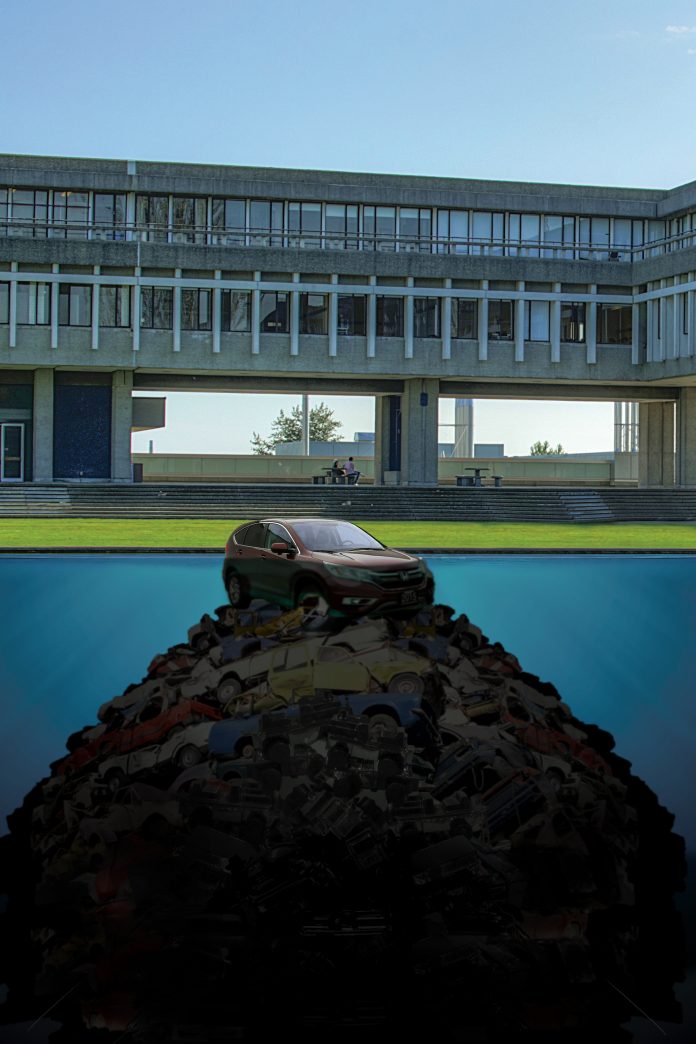
In the moonlight, I could make out bubbles rising in the middle of the pool. I moved across the walkway for a better look before a foreboding shape rose out of the water. It grew until it surpassed my height and eclipsed the moon. From its pale silhouette, I could make out the shapes of wheels, rearview mirrors, and limp hands. What floated before me was a small mountain of cars. No, not a mountain, I thought, casting my eyes to the water once more.

I pulled out my phone and turned on the flashlight. Below the surface, hundreds of vehicles descended into the deep. The light illuminated rotten human heads, some serene and others with looks of terror slashed across their faces. I turned off the flashlight. It was an iceberg. A gruesome iceberg made of frozen cars and people. That was all I remembered before blacking out.

***

In October 2017, a car drove into the AQ reflecting pond. The older man behind the wheel, who asked not to be named, cited unfamiliarity with the area as the cause of his blunder, but later admitted he knew exactly where he was going.

“When I was a student here in ‘67, my brother and I found three Volkswagen Bugs in the surrounding forests of SFU,” he explained. “There were symbols carved all along the insides of the cars. My brother became obsessed with them and spent every moment trying to interpret them. One day, I went into the forest to check on him, but he and one of the cars were gone.”

The man noticed tire tracks near the forest. He followed them until they tapered off right at the edge of the reflecting pond. His brother was never heard from again.

“After that, I became a bit like my brother,” he admitted. “I studied the symbols within the remaining cars for hours, but knew that the key to it all must have been in the third car. I gave up on my brother and the symbols when I graduated.”

Driving his car into the AQ pond was a last-ditch effort at retrieving his brother. “I’m lucky to be alive,” the man commented. “It was a foolish endeavour in a moment of weakness. I can’t even tell this to the police; they’d think I’m a looney.”

Soon after the incident, a local publication picked up the story and made it into a joke about parking availability on campus. The article advertised the reflecting pond as a new parking lot for SFU students who could not get parking anywhere else on Burnaby Mountain. Unfortunately, it became a popular story that attracted the very real, post-ironic attention of desperate students.

Later in the semester, professors began to note an unexplainable decline in turnout for lectures and tutorials. Some students approached campus security about friends who hadn’t turned up for class in weeks, but they were laughed away.

“There was this girl in my humanities tutorial, Samantha or Stefanija or something,” said second-year Shay Ogilvie. “I never got her phone number or anything, but I noticed she hadn’t shown up in a while, which was weird because she’s really smart and usually smart people don’t skip class? I don’t know. Maybe I’m just being paranoid.”

When asked about the article on parking spaces in the AQ pond, Ogilvie replied, “Article? Oh yeah, the girl in my tutorial definitely said she was going to look into that actually. I told her not to listen to anything the paper said, though. It’s all fake news. They have tits on their cover every other week.”

Recently, Burnaby Mountain received below-zero temperatures and heavy snowfall which completely encased the reflecting pond in ice. Some students vowed to send an exploration team into the pond once it has thawed, but weather reports look grim; The Weather Network predicts that the next warm day will be in late March.

Game Night softens the blow of unexpected twists with good comedy

0
(Image courtesy of Warner Bros. Pictures)

Calling all murder mystery fanatics and Clue players! Buckle the fuck up for a riot of a movie — everything you didn’t know you wanted, rolled up into one beautiful hour-and-40-minute film reel called Game Night. I didn’t even notice any promotions for this film, but wow am I glad I went to see it.

     Jason Bateman and Rachel McAdams play Max and Annie: a charming couple with a competitive obsession for games. Their married life consists of hosting weekly game nights with their friends, but things take a turn when Max’s assbag of a brother, Brooks, comes into town, and hosts a murder mystery party. Quite similar to the game Clue except . . . well . . . paired with actors playing thugs and federal agents. When Brooks legitimately gets kidnapped, the game night crew is put to the test of how they can apply their teamwork skills to find Brooks and not get murdered.

     Max and Annie were couple goals. I loved that throughout all this chaos, their relationship developed and went through all sorts of shit while they were narrowly avoiding death. It was such a tense and awkward contrast, but I loved it because they didn’t let the fast-paced drive of the plot detract from character development.

     The script is incredibly sharp, with a lovable, dynamic group of characters, and truly gasp-for-air laughing humour. John Francis Daley and Jonathan Goldstein did an excellent job of directing, and the end result is a not seamless but cohesive project. The cuts and cinematography are much more innovative than what you would expect from a comedic film.

     As funny as this movie was, it is categorized as a mystery/crime film, which I’m not sure I completely agree with. I would say the film is more of a satire or a parody of your typical mystery/crime film. The movie impressed me, however, with the twists and turns. Just when you think you’ve figured out the plot, they throw another plot twist at you that you didn’t even have time to mentally prepare for. Multiple times my friend Dave and I audibly gasped or looked at each other with gaping fish-out-of-water mouths, or seal-slapped each other on the knee in hysterics.

     I highly recommend this movie because trust me — you don’t know what you’re walking into. This was charisma made into a movie, and so refreshing compared to the awful comedy being released recently. It had me laughing until the credits, and as I walked out of the theatre.

Late Night Against Procrastination fuels students to successful studying

1
(Chris Ho / The Peak)

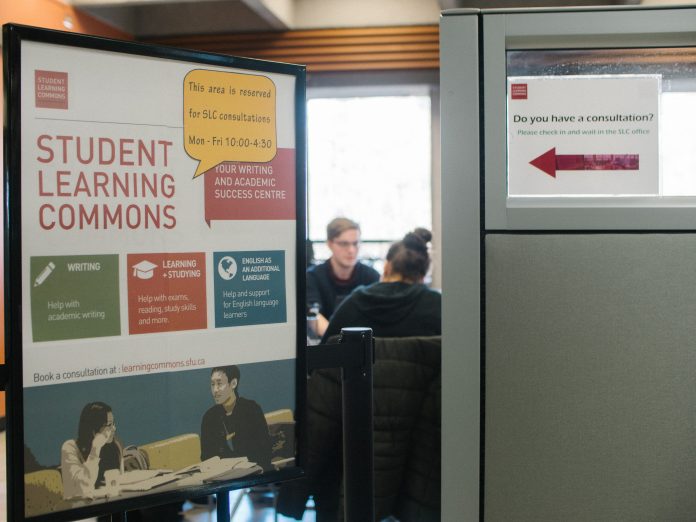
To kick off the start of SFU’s spring finals season, the Student Learning Commons (SLC) invited students to attend their Late Night Against Procrastination (LNAP) to buckle down and get some work done while attending workshops, study breaks, and fueling up with plenty of food. The event was held on all three campuses: the third floor of the WAC Bennett Library in Burnaby, the Yosef Wosk SLC room at the Fraser Library in Surrey, and the Yosef Wosk SLC room at the Belzberg Library in Vancouver.

     Founded in 2006, the SLC consists of a team of graduate students and undergraduate volunteers overseen by university staff who provide one-on-one academic writing and learning consultations.  

     The event was a spin-off of the Long Night Against Procrastination held by other North American institutions, which itself is a spin-off of the Lange Nacht Der Aufgeschobenen Hausarbeiten (of similar meaning) originally held in German institutions.

     However, unlike other LNAP events, which literally continue through the entire night into the next day, the event held by the SLC ended at midnight. According to event organizer Poh Tan, this was done purposely, as the SLC does not promote the student-ritual of late nights fuelled with caffeine and junk food. While they understand that this is the habit of many students due to work or life arrangements outside of school, the organizers wanted to stress the value of sleep and good nutrition to support learning and deeper understanding of the material.

     The evening at the Burnaby campus started off quietly, and more students filed in as the night progressed. Over 40 students attended the event in total. Each participant received a goodie package which included information about the schedule, anti-procrastination notes for the night, SLC-branded Post-its, a fidget cube, and a coupon for Menchie’s. Snacks and dinner for the attendees was provided as well.

     Tan, who is a PhD student pursuing her second PhD with the faculty of education, started the evening by introducing herself and the team, emphasizing that the goal of the evening was “to help [students] achieve academic success.”

     University staff was present throughout the event. Many of the library’s staff from the Student Learning Commons came out to help with research questions and writing.

Along with providing a supportive studying environment, the event featured research and writing workshops such as citation, proofreading, and exam strategies.

     The workshops varied from the usual studying tips to some more unique workshops, such as “Rejuvenating Yoga for Hardworking Study Muscles” and “Energize with Hawaiian Hula Dancing.”

     Tips provided during the workshops for students included setting up a “check-in system” of family members and friends to help keep themselves accountable for the goals they set, keeping a journal of work productivity and task-lists, critical reading strategies, a crash course on effective theses, and the benefits of study breaks and stretching.

     The SLC is already planning an LNAP event for this fall, and looks forward to having even more attendees from students and faculty of all academic endeavours and levels.

SPOOF: Bigfoot spotted in the woods of Burnaby mountain?

1

One SFU student claims she caught a glimpse of a mysterious creature in the woods around SFU.

Created by Janis McMath and Melissa Campos

Board Shorts

0
Irene Lo / The Peak

Board approves a total of $56,500 over the course of three years for a new online platform

In the interests of improving the SFSS’s current online infrastructure, the Board has moved to replace their current platform with the CampusVibe system. Among other things, the new system will be a step up from how the Simon Fraser Student Society (SFSS) currently handles “grants, room booking, events reports” and similar services as well as replace the current club and departmental student union portals, according to faculty of arts and social sciences representative Jackson Freedman.

“I think we’ve all collectively realized that [our current system is] a little bit out of date . . . This will provide us with an opportunity to build on that and actually get some really cool things installed that will help improve the way the society functions moving forward,” Freedman added.

The new system will help centralize the various services that the SFSS offers into one place. It is also likely to refine the SFSS’s engagement strategy with students, allowing students to build profiles that will help the SFSS log what students are interested in and which students to target with certain events.


Board discusses the decline of quality in MECS catering.

SFSS president Hangue Kim briefed the rest of the Board on a meeting held with the heads of Meeting, Event, and Conference Services (MECS), where they discussed various elements of their catering services at SFU.

“The main two issues that we brought up were the high cost [of their services] and the decrease in quality overall,” said Kim. He added that in the wake of the discussion, MECS will be “getting back to” the SFSS on “the specific policies that reference the requirement of student clubs or students groups to use SFU catering services.”

According to Kim, MECS has attributed the decline of the catering quality for students to their heavy focus on successful catering for larger-scale campus events.

“When we get to the point [of our next meeting with MECS], we should be asking them specifically, ‘what are you going to do to improve quality and decrease price?’” said SFSS chief executive officer Martin Wyant.

Toss Yer Cabers brings together wargamers in support of local charity

0
A group of Space Marines battles the forces of Chaos in a game of Warhammer 40,000. (Photo courtesy of Findlay Craig)

On March 31, over 40 wargaming fans turned up for the 2018 Toss Yer Cabers tournament at the Croatian Cultural Centre, an event held in support of local charity the Lookout Society. 30 people participated in the popular Warhammer 40,000 event, while 12 players attended the tournament for The Hobbit/The Lord of the Rings Strategy Battle Game.

     Event founder and head organizer Findlay Craig could not be more enthused with the turnout and results of his event. He said that the event was first held in 2014 when he decided to learn how to host an event, using a style of tournament which he was not sure the community would enjoy. Despite its “haphazard” first year, the tournament became a for-charity event in its second year. Craig said that each year has seen the event grow in size, and become more proficiently run, with this year’s event practically doubling in size from the previous two and selling out.

     Previously, the event averaged 21–22 Warhammer 40,000 players, but with the hype surrounding the game’s eighth edition, there were 30 this year, and an additional 12 Hobbit players in a second tournament held as part of the event for the first time. Craig mentioned that “If the Hobbit players hadn’t joined the event, we’d have sold out just on [Warhammer 40,000] players,” pointing to a long waitlist for spaces in the event. Craig shows no signs of slowing down, hinting at a larger event in the future to accommodate the demand for spaces in the tournament.

     Craig said, “The biggest thing I would like to really explain to people is just the sense of community we have. You say ‘wargamer’ and people say, ‘that’s like Dungeons and Dragons, people did that when I was 15, my brother did that, and it was kind of weird.’ You look at an event like today, we had 42 players in the room. We had 12–15 people just show up to hang out and have fun. This room was full of people who were joking, laughing, genuinely having fun and enjoying the community spirit. It’s not rare nowadays to have that, but it’s great when you see it. ”

     Regarding sponsors, Craig says he’s been lucky that his employer (who is not in the gaming industry) paid nearly half of the room cost. He emphasized the importance of the sponsors’ contributions, some of which were international, with companies pitching in from California, and as far away as the UK and Spain. One such sponsor was Relic Entertainment, the makers of Dawn of War, one of the most successful video games set in the Warhammer 40,000 universe. He went on to explain that most of his sponsors are small companies that contributed free of charge, which is a big effort for small businesses. The contributions made by his sponsors mostly came in the form of prize support for raffles, and Craig is grateful for the help they have given his event. In return, he attempts to create exposure for these small businesses however he can.

     Craig also sees painting miniatures as an often integral part of the community. While he understands that not everyone loves to paint their miniatures, and often want to simply paint them quickly and get to playing or don’t have time to paint, he sees it as a major aspect of the togetherness for a lot of the players. He said, “I just think it’s awesome when you go somewhere and you see the amount of effort people have put in. That’s part of that thing that you get when you’re at the event, seeing the amount of effort and work people have put into their armies . . . You walk around this room . . . you see so many people stopping, just going to people they’ve never met, [and saying,] ‘that is awesome work’ and people just going ‘thanks man, I really appreciate that,’ and [they have] a little smile on their faces as they turn away. That makes it worth it.”

     Craig was ecstatic about the results of the event, saying that last year, the event raised somewhere around $1,500. When he spoke with The Peak, he estimated that this year’s event had raised about $3,000, but when the final total was counted, they had raised $3,503.52, of which 100% goes to charity.

     According to Craig, the funds, as they have for the last few years, go to the Lookout Society. “They were recommended to me by someone who worked with vulnerable adults as a very proactive, forward-thinking, very positive charity,” he said. He went on to say that the charity has grown to absorb other non-profits and do great work, stating, “We all know just how vulnerable a community we have in Vancouver with homelessness. They’re doing absolutely amazing work.” He also touted the charity’s multi-faceted focus on everything from mental health services to addiction services, sheltered housing, and emergency shelters, and that’s why he chooses them.

SFU symbiosis in all its forms

0

Mutualism: Hard-working, kindly, and intellectual educators and inspired students

Mutualism is pretty basic: two organisms work together and mutually benefit. When professors and TAs actually care about their subjects and their students, and the students in turn have respect for their teachers and their courses, anything is possible.

The student gets good grades and lifelong knowledge, the profs and TAs get good reviews and a sense of fulfilment and continued work. It’s all rainbows; everyone’s happy, like bees pollinating flowers.


Commensalism: The hapless droning professor and the students who have given up

Commensalism is a type of symbiosis where one organism benefits and the other goes unaffected. Not all professors go in for this, but the ones who do are the ones whose lectures are as bland as Siri. As their dispassionate, voluminous voices fill up the hall, students find themselves drifting off, only to refocus three hours later and ask themselves, are you seriously still talking?

Through subjecting the students to this, the professor benefits by maintaining a job that nets them a fat paycheque from the university. The students, meanwhile, are neither helped nor harmed: though they learn little, they have long since adapted to reading everything out of the textbook or checking the lecture slides later.

Essentially, you are a coral reef, and these professors are swimming around inside you like clownfish, building opulent undersea castles out of your biological tissue where they can play and frolic.


Parasitism: Overpriced campus businesses and broke students

Parasitism, as you likely well know, is when one organism benefits by sucking the life out of the other. It may seem strange to classify financial transactions under this label — isn’t the whole point that it’s an exchange of goods taking place?

The problem is, everything you need to buy is so stupid that you may as well be getting nothing in return. When will you use an iClicker once you’re done school? When will you need to suffer under the reign of SFU Document Solutions once you’re no longer doing your graphic design work at a school that offers few-to-no other high-quality printing options? When will you benefit from the various fees you pay in your tuition fees for services that you don’t even use, like the Recreation fee?

It’s all a trap. Like the delicious sashimi you find yourself eating south of the border before realizing you’ve taken in a tapeworm, all the supposed goods you get for what you pay with are just dressing concealing the true enemy.


Synnecrosis: Student bureaucracy and students

Everyone knows about symbiosis — but synnecrosis is when two organisms work together and both of them suffer. For example, a parasite that takes shelter in your stomach before realizing that it got the wrong host species. It gets sick and dies, and then you get sick, too.

As the various tiers of student government at SFU try to collaborate to bring joy and love to the student body, all they seem to do is trip over each other, and make life for students more difficult. Room booking beef, Build SFU levies on students who won’t use the SUB, everyone’s advocacy for the gondola . . . sigh. Meanwhile, many students strike back at the student government, by refusing to vote on anything important, yet complaining every time something at the school doesn’t go their way.

Until these two groups sink or swim, we will be left suspended in the in-between space of everything being basically, but not actually, dead.

The deadly, deadlier, and deadliest snakes at SFU

0
(Jarielle Lim / The Peak)

Black mamba

     When you first enter university, you think that you’re the bomb because you’ve just received multiple scholarship offers, and got straight A’s in high school. You think the world revolves around you and that your opinions matters more than others. Simply put, if you believe something is right, it’s right in general.

     This is the dreaded black mamba, also known as first-year students, that everyone at SFU dreads, from faculty and staff to senior students. Everything that comes out of their mouths is full of arrogance, self-entitlement, and shallowness. Their personality is so dark and the things that they say are so bitter that their whole mouth is black. Whoever they talk to starts feeling a little bit disappointed as they boast about their accomplishments and such.

     Their speech (venom) is so potent that they create a competitive environment wherever they go and that just plagues the other person’s day and mindset. If the person does not go and talk to someone else who is more down-to-earth, humble, and welcoming (in this case, the antivenom), the person can start experiencing headaches, a sense of worthlessness, and depression, all of which are classic symptoms of the black mamba’s venom. Even when you don’t want to interact with the black mamba, as soon as it sees you, it will chase after you until it can bite you. They’re highly aggressive. In this case, the undergraduate student would come up to your face and talk about their grades and scholastic achievements and extracurricular involvements, even when you didn’t want to be a part of the discussion.


Eastern coral snake

Students in the faculty of science can be really competitive, especially kids from biomedical physiology (BP) and molecular biology and biochemistry (MBB). The competition is so cut-throat and the friendships you make don’t last very long. I mean, most friendships end once you no longer have class with the other person for these two departments.

     The thing to worry about is that some of these kids can look really nice, bubbly, and optimistic on the outside, but on the inside they just want to sabotage you and make you fail. It’s true. They’d literally teach you the wrong thing, tell you false information so that they can get 4–5 marks higher than you on a midterm because that’s what determines the A and the A+. In the jungle, it is about being the fittest to survive, but it’s also about being the slyest, foxiest, and most cunning individual in order to rise to the top.

     These BP and MBB kids are similar to the eastern coral snake. If you misinterpret that colouring pattern, and are unable to recognize the shadiness that is underneath their layer of bubbliness and pretentiousness, death, and academic failure are inevitable. Therefore, be careful when you associate yourself with these kids because the relationship might not be as mutualistic as you’d expect.


King cobra

Besides the instructor, the teaching assistant (TA) stands at the top of the hierarchy. They’re usually responsible for all of the marking, and if you have an English TA, their marking scheme can be incredibly subjective. I mean, no matter how convincing your essay is, if the TA doesn’t like your writing style, you’re bound to get a mark that you’re dissatisfied with. Moreover, these TAs can be really mean and cold. If you don’t use specific jargon on the exam, the TA will take half a mark off. Seriously, there is so much content to remember for certain courses, like endocrinology, and taking half marks off just demonstrates how cruel and heartless TAs can be. The TAs in a sense are similar to king cobras: their opinion matters more than yours and whatever marks they give you can have an impact on your future. They were undergraduate students once, but they don’t empathize for undergraduate students who are going through the same stuff. This is similar to what a king cobra does in nature: they eat the smaller snakes when they’re hungry even though they’re the same species.

Must-see event

0
(Linda Shu / The Peak)

Taking place on April 7, the SFU Concert Orchestra will be performing X Part II: Through Space and Time. This comes as the second and final instalment in a series of performances held by the orchestra to celebrate their 10-year anniversary. Held at the Leslie and Gordon Diamond Family Auditorium, doors open at 6:45 p.m. and music will be played from 7–9 p.m. There will be a short intermission, during which light refreshments will be offered. In addition to Mozart and Tchaikovsky, the programme for the night includes music from Hayao Miyazaki’s Castle in the Sky, as well as DreamWorks’ How to Train Your Dragon. Admission is by donation.

For more information regarding their program, visit their event page.