Home Blog Page 513

SFU men’s basketball fall to Concordia University 84–72

0
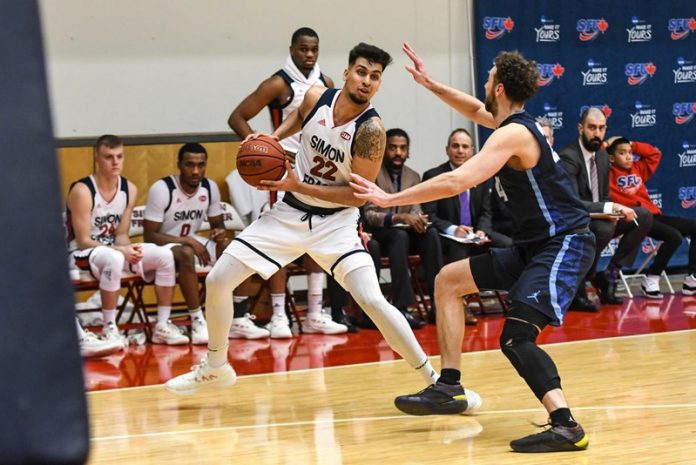
This sets up an exciting season finale for the Clan. (Photo courtesy of SFU Athletics)

On Thursday night, the SFU men’s basketball team faced off against Concordia University, looking to extend their their game winning streak and move closer to clinching a playoff berth.

In front of a crowd of 575, the visitors stunned SFU, dealing the Clan a 84–72 loss. SFU, lead by Wilfried Balata (30 points, 16 rebounds), mounted a desperate comeback but fell short, dealing a blow to SFU’s playoff hopes.

The game started with a back-and-forth affair, with the Cavaliers jumping to an early lead, but after a three-pointer by Balata, SFU found themselves up 14–10. SFU’s lead did not last long as Concordia responded with a 10–0 run of their own, with all of their points coming inside the paint. This was a regular theme through the night, as Concordia finished with 46 points in the paint and 51% shooting.

SFU went into the half trailing 36–31.

The game looked like it was getting out of hand early as a four-point play by Tyler Wells put the Cavaliers up 42–33. Concordia followed that possession with an and-one by Hunter Sweet, extending the lead to 15.

With momentum shifting, the Cavaliers came down on the fast break once again looking for a basket but a big charge drawn by Michael Provenzano put life back in the SFU squad.

An energized SFU team began to lock down on defense, whittling the deficit to seven with 14 minutes left. A big three by Othniel Spence (17 points) made it a 48–44 game. With inspired defense forcing a big stop, SFU was able to find Spence again who knocked down another one of his five threes in the game to bring SFU within one.

But once again Concordia had an answer, with Dominique Bradley hitting back to back and-ones to pull Concordia back to a double digit lead.

It was then Jasdeep Singh came to life, fresh off of a season high the game before. Battling foul trouble, Singh went scoreless in the first half, but erupted for 17 in the final frame, keeping SFU within striking distance. After Singh hit a three to pull SFU within six, it began to feel like a comeback was in the works. Cody Starr, however, hit a tough contested three over Michael Hannan to push the lead back to 9.

The teams traded baskets as SFU was unable to get the critical stops in the final possessions. Eventually, SFU would lose by a score of 84–72.

What’s Next:

SFU is still in position to clinch a playoff berth, and it all comes down to a huge game on Saturday against Western Oregon University. The game will tip-off at 7 p.m in the West Gym. It is the final game of the regular season.

The Amish Project sheds light on the power of radical forgiveness

0
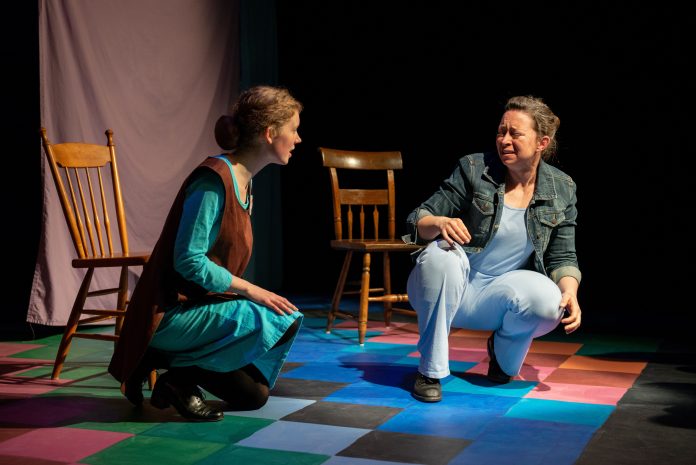
Image courtesy of Julia Siedlanowska


The Amish Project is a play that takes on the difficult and often controversial of being an art piece about a criminal of the the Nickel Mines shooting. While fictional, it is a deeply moving play based on how the Amish families were affected by it in Pennsylvania 13 years ago. Instead of anger, the Amish families shocked the world when they chose the challenging path of radical forgiveness to heal as a unified community.

The play focuses on the ripple effect that this forgiveness had in the lives of all that were affected — including the family of the shooter. The Amish Project by Jessica Dickey was originally written as a one-woman show, but it has now been evolved by director Angela Konrad into a dynamic all-women cast of four actresses playing seven characters.

The set consists of pastel sheets in various sizes and layers draped on clothing lines, along with five chairs — a minimalist concept to draw focus onto the character’s dialogue and the simplicity of the Amish lifestyle. Scenes of different characters’ stories come together slowly and purposefully along with the play’s message of how forgiveness and grace helps bridge the disconnection that happens in the face of trauma, violence, and grief.

A big part of this play and its most powerful scenes is the repetition of phrases and first-person narratives is. The play is neither violent nor graphic, acknowledging the event of the shooting through the repetition of the phrase “Man enters Amish schoolhouse and opens fire.”

The sound effects of the play were very minimal, and I loved that it displayed the power of words to convey the severity of a trauma without having to reenact the experience onstage. The acting was incredible, and had to be as the play was stripped down and entirely driven and carried by the acting itself.

The play humanizes Eddie, the shooter, by giving him a full character and by giving us a fluffy backstory on how he met his wife and how normal he was in his daily life. I found this aspect of The Amish Project, where artistic space was made for the perpetrator of the violence that traumatized a community, to be rather unsettling and uncomfortable to watch.

The Amish community is placed in the position of the othered in this script through the absence of the Amish people being given characters. The play focuses on the perspectives of witnesses from outside the Amish community’s perspective with only the whimsical characters of the two Amish schoolgirls to give us that first-hand cultural perspective. With the knowledge that Jessica Dickey did not interview any of the individuals involved in the actual incident, I think it was an appropriate call, but it was still strange to see that the Amish were othered in their own story.

The Amish Project asks the question “How could the Amish forgive such a thing?”.  The answer seems to be that the way that the Amish could best heal as a community was to abide by the teachings of their faith in the most difficult of times. The play seemed to intend a “live by example” kind of message in how to react to other tragedies of violence through mentions of many tragic stories similar to this shooting.

Although I strongly disagree that passiveness and forgiveness is the most effective way towards reconciliation and the healing of a community, I was able to look past my clashing beliefs and see the play for what it was. The Amish were able to extend immense compassion that helped heal themselves and the family of the shooter. Overall it was an intense, interesting, thought-provoking production to watch and unlike anything I’ve ever seen before.

For more information about future shows from the Dark Glass Theatre company, please visit www.darkglasstheatre.com.

Political Corner: The People’s Party of Canada’s unexpected success in the Burnaby South by-election is concerning

0
Image courtesy of the People's Party of Canada

Three by-elections to fill seats in the House of Commons took place on February 25, the closest of which was in the riding of Burnaby South. It was an incredibly important race for the New Democratic Party (NDP) as Jagmeet Singh was running, aiming to solidify his claim as a capable and legitimate party leader (the fact that only the Green Party respected the tradition of not running candidates against party leaders seeking seats in the House is telling in this regard). Ultimately, Singh won with around 39% of the vote, a comfortable margin given that the Liberals only tailed him with 26% of votes.

Or, at least, it seems that way until you realise the Liberals got that close with a substitute candidate, Richard Lee, following Karen Wang’s removal. And that, as political analysts have pointed out, Burnaby South the NDP’s for the taking given the pipeline debacle.

The real shocker for me was how well the People’s Party of Canada (PPC) did. The PPC was only founded in 2018, after MP Maxime Bernier dramatically left the Conservative party (essentially because it wasn’t conservative enough). Since then, the party has been hailed as a far-right and populist one. Yet somehow they clinched 10.6% (rounded up to 11%) of the vote in Burnaby South — with a politically inexperienced and controversial candidate at that.  

This is a surprisingly strong performance for a new party, especially when compared with the 22.6% of the vote that the much more established Conservatives walked away with. Not only that, but Bernier’s controversial party was definitely staying out of its comfort zone. Bernier’s policies, from his pro-pipeline stance to his anti-immigration platform and concerns over “extreme multiculturalism,” do not fit the profile typically attributed to Burnaby South. After all, Burnaby South is one of the most diverse ridings in Canada, and an urban one too. Though Burnaby South is a new riding created in 2015, Burnaby itself has traditionally been NDP.  

The PPC’s surprising popularity begs some questions about what they may accomplish when running more experienced and savvy candidates, in ridings where their platforms align more readily with voters. What happened, here? Were conservative voters dissatisfied with Scheer and swayed by Bernier? Is this a fluke product of low by-election voter turnout (29.89%)? Did Burnaby South’s political landscape draw a protest vote?

While these questions may not be answerable just now, the Burnaby South by-election results can be paired with larger national signs of popularity, such as the nearly 1 million dollars the PPC has fundraised since its creation. The PPC is now looking less like Maxime Bernier’s personal fantasy, and more like an actual party that needs to be taken seriously and watched in the general October election.

You can’t take United We Roll seriously when it serves as a platform for hate and climate change denial

0
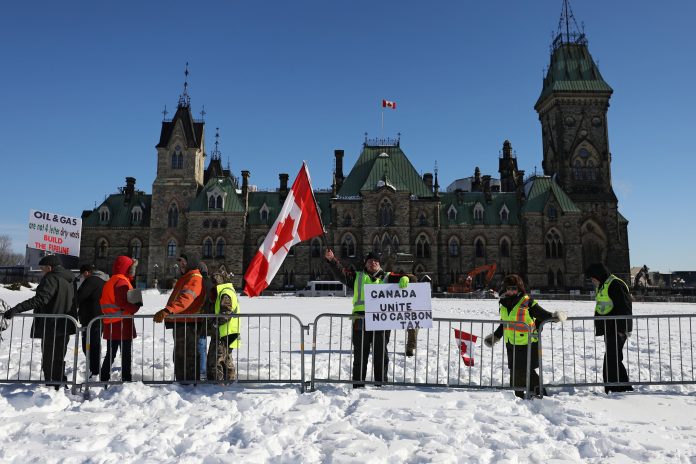
Image via the Globe and Mail

The Sparknotes version of United We Roll’s story is that a convoy of trucks traveled from Red Deer to Ottawa in the hopes of raising concerns over Alberta’s economic development with Prime Minister Justin Trudeau. They essentially wanted him to ditch two environmental laws getting in the way of constructing oil pipelines, and also for him to take a stronger stance regarding the Trans Mountain Pipeline (despite the Liberals being under fire for being too supportive of it). They came, they saw, and then went home on February 20.

Before I go on, I want to acknowledge the massive moral problems with the United We Roll convoy: Namely, that the convoy itself is a beacon of xenophobia, Islamophobia, racism, and all manners of hatred. This was greatly due to its past and lingering affiliations with the nationalistic Yellow Vests Canada, whose Facebook page is rife with hate towards visible minorities. Despite what Conservative leader Andrew Scheer may say, supporting the convey can’t be done without supporting these attitudes by default, given the crowds of protesters sporting yellow vests, “Make Canada Great Again” hats, and chanting against migration. Organizers have done little to divorce themselves from this or clean up the movement.

While the convoy’s leader claimed that they were “100 per cent, unequivocally” successful, there were still internal and external concerns that the convoy’s message got lost somewhere amongst all those racial slurs. While I’m far from qualified to talk about racism other than to say “don’t be that way” (which Indigenous protesters and other anti-fascism activists did much better than I could), I think that one of the convoy’s messages was loud and clear, particularly the part that said “fuck climate change.”

The problem with United We Roll is that they make one point while ignoring twelve others. Alberta’s economy does hinge on oil production, and the province shouldn’t be allowed to suffer economically because of it. But in the process, United We Roll ignores the environmental consequences of that status quo. Should Alberta be allowed to fizzle in that environmental crisis that scientists are giving us a 10-year-or-so ETA for along with the rest of us instead?

United We Roll isn’t acknowledging any complexities and — in the same way that it’s become a cesspool of hate speech — it’s become a platform for anti-science climate change deniers. A good example of this is Mark Friesen, a Yellow Vest Canada organizer who checks both the racism box and the climate change denial one (because, according to him, climate change is a scam that anyways wouldn’t affect Canadians given how many trees there are in the country).

While speaking at the United We Roll rally, Scheer — who has a rocky relationship with the issue of climate change — told the crowd: “I am sick and tired of watching people, you know, chaining themselves to trees and laying down in front of bulldozers trying to block Canadian energy from reaching markets.”

Not only does that statement generalize and belittle environmental activists, but it also mischaracterizes them as wanting no energy and no economic growth, while really, the call is for sustainability and innovation. Worth noting is that Indigenous activists have also made the incredibly strong point that pro-pipeline activism and anti-environmentalism slip into colonialism and anti-Indigeneity.

The political right has a lot to figure out right now, but recognizing that energy, economic growth, and environmentalism are not inherently incompatible is urgent. In 2018, Georgetown, Texas became the largest American city to be powered entirely by renewable energy under a Republican governor who recognized that “it’s good for our citizens,” thus becoming the largest American city to be powered entirely by renewable energy.  Leaders like Hillary Clinton have offered plans and platforms to help workers and economies dependent on coal transition to sustainable green energy, and NGOs have also made reeducation efforts, meaning there are ways for conservatives to progress without hurting their constituents.

These things are possible. They just require the kind of willingness to change, openness, and education that the United We Roll movement didn’t have.  

8 things to make on the Burnaby campus’ fire pits

0
Image courtesy of SFU

It’s so cold and snowy that students on the Burnaby campus have been congregating at the fire pits like moths drawn towards a light. While there are always happy students there ready to provide you with marshmallows and roasting sticks, if the cold is going to keep this up, we as a school need to level up and make the most of these fire pits.

As a note though: we’re going to limit this list to items that you can make without disrupting other fire-goers. This means that the camping cooking category of “wrapping things in tin foil and sticking them on the coals” is out. Additionally, we’re going to stay away from fresh meat in this article because salmonella is an embarrassing way to die, which rules out the school of “wrap things in bacon and cook that on a fire,” delicious as it might be. However, you still have plenty of good ideas. Trust me, I was a girl guide.


1) Elevate your marshmallows to s’mores

Nesters is so close that there’s no reason not to grab graham crackers and some chocolate — Jersey’s Milk chocolate bars are awesome for s’mores. If you’re looking for a life hack: pick up Celebrations cookies and get your cookies and your chocolate squares all in one. Fair warning, though: my friend who did this was quickly forced to share his goods with other strangers. Some other s’mores hacks include sticking your cooked marshmallow in an Oreo, or throwing a Reese’s Cup into your s’more.


2) Spider weenies

I mentioned that I was a girl guide leader, yes? Well, the kids would actively chant for these. You’re going to want to get a package of wieners, sausages, or veggie sausages. With a knife, slide the ends of the sausage four ways. Do not chop the end of the sausage off: simply slice it halfway once and then twice so you have four “legs” on each end of your sausage. This way when you cook your sausage, the ends will curl up. The name of this old favourite should be pretty self-explanatory now.  


3) Roasting fruits

Does your mother sound worried about you on the phone? Does it worry you that university students as a population still deal with scurvy? Well, stick some fruits on a kebab and roast them over the fire! Pineapple is delicious when it’s all nice and warm and roasted. Peaches and apples are also good choices, but the opportunities are as endless as the produce section, really. You can also follow-up with some creativity: will you dip your roasted fruits in caramel or Nutella? Will you get around to roasting peppers, zucchinis, carrots, corn cobs, and other vegetables? Are you going to go down the route of kebabs, here? You are the master of your own fate, friend.


4) Pigs in a blanket

Pillsbury crescent dough is going to be our friend in this list. Impale your hotdog on your roasting stick. Then, break off a square of crescent dough and stretch it out so that you can wrap it around your hotdog. No need to be pretty with this one; it doesn’t have to be even, you can leave some of the hotdog exposed, etc. Once your dough starts to brown, test it for doughiness and cook. Once you’re satisfied with this, you get to worry about what kind of condiment to dip it in. Ketchup, mustard, mayo, relish, chipotle mayo… Keep in mind that while The Peak doesn’t endorse stealing condiments from the food places around campus, you already probably do.


5) Cinnamon buns

Go find a package of frozen biscuits, and wrap it around the end of your campfire stick — make sure that the dough isn’t wrapping over itself, so that you have an easier and more even cook. Once the dough starts expanding (and be patient on this one, a mouthful of raw dough will ruin your life), remove your creation from the fire and slather it in butter, brown sugar, and cinnamon.


6) A grilled cheese

This is easier to make once you’ve found a nice V-shaped branch to balance a sandwich on in the wilderness, but you should be able to replicate this on Burnaby Mountain. All you really need to do is assemble your grilled cheese (throw in some cold cuts or tomatoes or pesto if you’re feeling frisky), and balance it over the fire. Pro-tip: if you pound out your bread beforehand, it takes less time for the cheese to get all melty, which is what the end goal here is anyways.

If you’re trying to get creative, a strategically folded and impaled burrito is also a possibility when armed with patience, some tortillas, and whatever filling your heart desires (again, if you’re being meaty about this, use pre-cooked). I’m also going to put it out there for any vegan chefs that peanut butter is delicious when melty, so echoing this sandwich principle with peanut butter and bananas isn’t a bad idea either.


7) Potato spirals

You  might have seen these at fairs, and now is your chance to make them on your own instead of spending $7 on them. This one is going to take a little more handiness: you’re going to want to peel a potato, and use a knife to cut it into a spiral. If you’re lazy: just cut them into slices and them impale that. If you’re feeling up to it, this YouTube tutorial will show you the proper technique. Once you’ve roasted up your spiral potato, the world is yours. Sour cream, green onions, and those bacon bits made for Cesar salads can bring you to instant baked-potato level. Ketchup and mayo will make this just like fries. Cheese can bring you to nowhere but happiness.


8) Pockets of goodness

I don’t know what these are called, but we make these on the fire pit in my aunt’s backyard every summer, and they’re absolutely delightful. We’ve found no name for them other than the very apt description you see above. What you’re going to want to do is get a package of Pillsbury crescent dough. Unroll a dough square, and stuff it with marshmallows, chocolate chips, and a chopped banana. The ratio is flexible on this one. Wrap up your little pouch of delight, and stick it on the roasting stick. Physics may or may not be on your side on this one, so make sure that you’re really solid before roasting that until the dough starts to brown.

What Black history month means in Vancouver

0
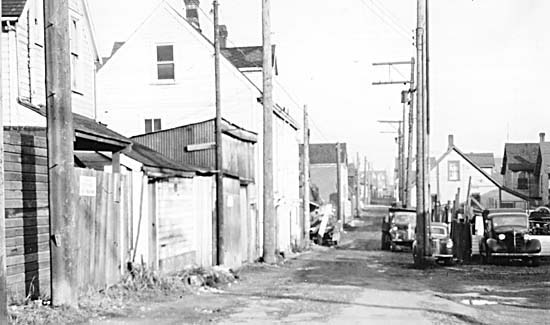
Hogan's Alley, image courtesy of the City of Vancouver archives

As February rolls around each year, I always look forward to a month of acknowledging and celebrating the Black community’s achievements. Black History Month is a time to reflect on the sacrifices our ancestors made in the past so that we could define excellence today. It’s a time where we commemorate how far we’ve come as a community, and how far we still need to go.

Growing up Black in Vancouver is an interesting experience, especially when celebrating Black History Month. According to statistics conducted by the 2016 Canadian consensus, African-Canadians comprise 1.2% of the Vancouver area’s population. I’ve found that celebrating Black History Month in a city with such a small Black population can feel particularly isolating.

As a Black student at SFU, these feelings of cultural isolation are way worse. With a limited Black population on campus, it’s difficult to even ascertain where you can celebrate Black History or who you can celebrate it with.

One option to find a Black community on campus is the African Students Association (ASA). They’re a club that works to centralize the voices of African students and bring awareness to the social, political, economic, and historical issues that derive from the African continent. The ASA does their best to utilize events and resources to make students who have recently moved to Canada feel as close to home as possible.

Every two weeks, ASA facilitates nights of discussion where African students can engage in conversations regarding sexuality, mental health, and career expectations. This past February, ASA teamed up with the Global Student Centre to host a Black History Month event that celebrated African literature. However in spite of its resources and efforts, ASA faces a number of limitations. For example, as a fairly new group, ASA has stated that they often have minimal access to funding. Resultantly, they are forced to pay for large events themselves and, can be forced to wait long periods of time to be reimbursed by the SFSS.

SOCA (Students of Caribbean and African Ancestry) is another cultural resource centre available for SFU’s Black students. Giovanni HoSang, the current president of SOCA, works hard to acquire resources and services for SFU’s Black student population. However, SOCA has faced a number of ongoing frustrations on campus, specifically regarding issues of space. The resource centre for Black students has historically faced threats of displacement, most recently as part of the larger crisis on space in the new Student Union Building. This in turn communicates to SFU’s Black student body that their community is not prioritized by the SFSS.

These acts of displacement and erasure at SFU are eerily reminiscent of what’s transpired within Vancouver’s larger Black community. Hogan’s Alley was once the heart of the city’s thriving Black community. Located in the Strathcona area, Hogan’s Alley was once a place where Black Vancouverites could find refuge from housing discrimination in other parts of the city, dine at exciting restaurants like Vie’s Chicken and Steaks (where music icon Jimi Hendrix’ grandmother Nora Hendrix was a cook!) and enjoy the familiarity of people who share cultural backgrounds. Hogan’s Alley was truly a place where Vancouver’s African-Canadians could celebrate their Blackness away from the hostility of the city’s historical anti-black racism, which presented itself in many ways including an active branch of the KKK in the early twentieth century.

As years progressed, the city of Vancouver made a number of attempts to rezone the Strathcona area. Additionally, newspapers in Vancouver began depicting Hogan’s Alley as a place where deviant activity was rampant. As a result of the community’s  rezoning  and negative depictions,  house owners in Hogan’s Alley struggled to enhance their homes or procure mortgages.

Towards the end of the 1960’s, the city started to build a freeway that cut directly through Hogan’s Alley. Even though the construction of the freeway eventually ceased, its production ended up creating the Georgia viaduct. In the process of the freeway’s construction, Hogan’s Alley was annexed and, consequently, many houses in the community were decimated.

This act of gentrification was detrimental for the community. As Vancouver decided to build new infrastructure in Hogan’s Alley, and as the city began to tear down homes, members of the Black community became instantly displaced. These community members lost their homes, integral common resources, and even the identities they made in Vancouver. The displacement and erasure of Hogan’s Alley communicated to Vancouver’s African Canadians that their community’s well-being and unity was not a priority for the city. As a result of this, Vancouver no longer has a thriving community where its Black citizens could immerse themselves.

Although these instances of Black erasure are fairly discouraging, it’s important for Vancouver’s Black citizens and SFU’s Black students to acknowledge and appreciate that there’s still an ample amount of Black history to celebrate! Just this month, SFU’s library provided access to a number of books and movies that celebrate Canadian Black history.

On February 28th, SFU’s Global Student Centre (GSC) offered students with a separate event that celebrated Black History Month. The GSC  provided guests with games, music, and snacks from the African continent.

Another exciting moment this past February was when SFU lecturer Chantal Gibson released a book that centralizes Black Canadian women. How She Read, a collection of poetry written by Gibson, also works to destructure the colonizing effects of the English language. As a result of her publication, Gibson was included in CBC’s lists of “20 works of Canadian poetry to watch in 2019” and “6 Black Canadian writers to watch in 2019.”

The history of Vancouver also carries a number of inspirational Black figures who made significant and admirable accomplishments.

Emery Barnes, a professional football player and member of the U.S. Olympic Track and Field team of 1952, emigrated to Canada in 1957. He was elected into the Legislative Assembly of British Columbia in 1972, and in 1994 he became the first speaker in the province elected via secret ballot.

In 1972, feminist and community leader Rosemary Brown was elected into British Columbia’s provincial legislature, becoming the first African-Canadian woman to ever be a part of a parliamentary body in Canada. Bonus: she also taught women’s studies at SFU and was an officer of the Order of Canada.

Harry Jerome, legendary track and field athlete, also once called Vancouver home. From 1960 to 1967, Jerome was titled “the fastest man on the planet” five separate times. Today, you can find Jerome’s statue along the seawall in Stanley Park.

So yes, living in Vancouver can be a challenging experience for Black individuals. Every year, as Black History Month arrives, it can be frustrating to realize that the availability of Black spaces and resources in this city is restricted. Nevertheless, it’s important to remember that Vancouver has a rich and comprehensive history of individuals who defined Black excellence.

While the number of individuals within Vancouver’s Black community may be small, there is great strength and resilience in the legacies of our parents. By looking at what our community leaders accomplished in the city, we can always be reminded of the profound power that stems from our existence in Vancouver.


SFU hockey take three of four points but fall out of contention for second place

0
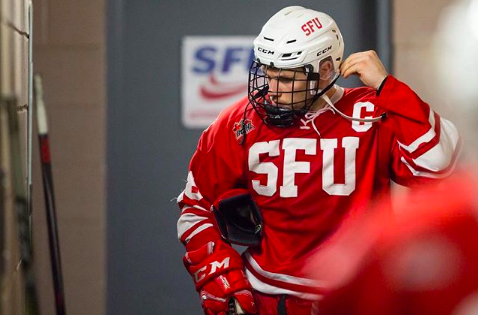
SFU captain Mathew Berry-Lamontagna tied the BCIHL record for games played over the weekend. (Photo courtesy of SFU hockey.)

A couple of weeks ago, the SFU men’s hockey team knew they had an opportunity to take advantage of multiple games in hand to leapfrog their rivals in the standings and build momentum as playoffs quickly approached. After a weekend series at home against the visiting UVIC Vikes, the Clan have played out most of their games in hand.

Unfortunately, a nail-biting shoot-out loss to the Vikes on the back end of the weekend double-header has ensured the Clan will play at least the first round, and possibly the second, on the road.

Now, with only two games remaining in their regular-season schedule, the Clan face only two possibilities for their first-round playoff matchup: either a showdown with their geographical rival and league leading Trinity Western University Spartans or a visit to the hostile confines of the Castlegar recreation center for a series against the Selkirk Saints.

On Friday night, the Clan rode a stellar performance from netminder Michael Lenko to a 4–0 shutout victory over the Vikes. While goaltending was a significant factor in the win, the team was also able to penetrate into scoring areas relatively effectively, especially in the second half of the game, and also maintained strong defensive zone play.

Scoring in the win were forwards Jaret Babych, Kyle Bergh, and Cole Plotnikoff, all in the second period, with captain Matthew Berry-Lamontagna tallying the opening goal in the first. The victory momentarily kept the Clan’s hopes of a second-place finish — and home ice advantage in the first round of the playoffs — alive, as the team would have needed to win their remaining three games, with the final two against Selkirk needing to be in regulation time.

Disappointingly, the Clan were unable to repeat their strong performance the following evening and would see their hopes for favourable playoff positioning fade away. The focus now turns to building momentum for a first round series on the road.

On Saturday night, SFU fell 3–2 in a shootout for just the fourth win of the season for the visiting Vikes. Again, the game was an extremely tight checking for the first half of the game, but this time, the trend continued for the duration of the contest. This time around, the Clan could only muster limited offense with goals from forwards Ian Mackey and Mitch Ledyard.

After an intense third period that saw multiple penalties handed out and a huge amount of special teams play, the game moved to three-on-three overtime. Somewhat surprisingly, given the wide open nature of the new overtime format, this decided nothing. A shootout followed in which the Clan, opting to shoot first, were unable to beat UVIC netminder Zack Wear on any of their three attempts. This meant that a single goal on two attempts by the Vikes was enough to secure the win.

Starting both games for the Clan over the weekend, Michael Lenko arguably had one of the best weekends of play in his BCIHL rookie season. With a shutout on Friday night, Lenko followed it up by giving his team a chance to win again with 28 saves on 30 shots on Saturday plus one save on two attempts in the shootout. As playoffs are now just two weekends away, the Clan will count on Lenko to continue to strengthen his play throughout the rest of this season, into the postseason and in years to come (Lenko is playing his first year for SFU hockey.)  

Discussing the team’s performance over the weekend, coach Mark Coletta lamented the inconsistencies in the club’s execution throughout the crucial stretch of games the Clan is on the verge of completing.

“At times, we are competing hard, using our team speed to set the tone and carry the play while at other times we are sitting back, not fighting for pucks and letting the other team dictate the pace of play,” he said following the shootout loss on Saturday night. Building on this, Coletta noted that the team has all the pieces it needs to make a playoff run but that “it will be up to the team as a whole to find a way to consistently play at its best over the next month.”

What’s next:

SFU will play their remaining two games of the regular season on Friday, March 1 and Saturday, March 2 at home at the Bill Copeland Sports Centre before moving into the first round of the BCIHL playoffs the following weekend. Both games will have a 7 p.m puck drop.

The visiting Selkirk Saints will arrive with their playoff seed already clinched and only their first-round opponent left to be determined. The Saints will face the VIU (Vancouver Island University) Mariners in the first round of the playoffs if they defeat the Clan in regulation time in either game this coming weekend. On the other hand, the Clan will only secure a first-round playoff series in Castlegar against the Saints if they are able to take at least three of a possible four points over the weekend.

Otherwise, the Clan will open up the playoffs on the road in Langley against the league leading TWU Spartans. As the spring semester enters the home stretch and the BCIHL regular season winds down, it is clear that regardless of concerns over playoff positioning, it is now or never for the Clan as they look to put everything together and build momentum in time for a run at the BCIHL championship.

SFU men’s basketball pull off clutch victory against WWU

0
Singh filled in beautifully for Julian Roche. who was unable to play. (Photo courtesy of SFU Athletics)

The SFU men’s basketball team kept their winning ways going on Tuesday night as they hosted Western Washington University, coming up with another huge win to position themselves for a playoff spot. Coming into the game, the Clan and the Vikings were tied for fifth place in the conference. With the win, SFU now has sole position of the spot and have a great chance of playing in the GNAC postseason.

The win was huge for standings purposes, but it was also huge when you consider the adversity that SFU were under. Missing starting centre Julian Roche, the leading scorer and rebounder on the team, it was clear that somebody had to step up to lead the team. That man would be Jasdeep Singh, who led the team with a season high 31 points, seven rebounds and two blocks in a game high 39 minutes.

After the game, head coach Steve Hanson told The Peak, “Adversity hits every team and you have to be ready. Julian brings rebounding, communication and scoring every night and the rest of our team had to bring a little more of that tonight. I think we did that.”

He added, “Jas had some pressure tonight with his front court partner out. He had to play tough, stay out of fouls trouble and be efficient. He did that plus more. We’re proud of his performance.”

The team’s were neck-and-neck the entire game, and finished the first half with a score of 36–34 in favour of the home team. The Vikings held a slight lead for the majority of the second half, but clutch play down the stretch would eventually help the Clan prevail with the win.

Tyler Payne did his best to give Western Washington the win, scoring each of his team’s final 11 points, but was unable to single-handedly defeat SFU. He was countered by two three-pointers by Singh down the stretch and a three from Othniel Spence, as well as a couple free throw makes by Bongani Moyo and Michael Hannan. With seven seconds left and a three-point lead for the Clan, Payne attempted to tie the game with a three. He missed, and Singh grabbed the rebound to end the contest with a score of 76–73.

“It was a tough battle the entire game,” said Hanson, “What we expected this time of year with two teams battling for a playoff spot.”

The win gives the Clan a 9–9 GNAC record on the season, and more importantly, sole position of fifth place in the conference. The top six teams qualify for the GNAC Championships, but SFU’s position in the postseason is far from guaranteed. Three teams behind SFU in the standings have eight or more wins, meaning that the next two home games are very important to ensure that the Clan make the postseason.

The team is definitely playing their best basketball of the season so far, winning six of their last seven GNAC games. That being said, Hanson believes the team has room to grow, saying, “I don’t think we are peaking but we are playing tough and smart basketball. We had to play that way to be in this position.”

Peak player of the game: Jasdeep Singh

Singh had to step up on Tuesday night with Roche out, and he did that and more. His 31 points were a season high, and he played big for team missing their starting centre, grabbing seven rebounds and blocking two shots. He also did a great job of avoiding foul trouble, playing a game high 39 minutes (he only rested one minute!) while also playing strong defence. His two threes down the stretch were key in SFU’s ability to grab the win, it what was the most important game of the season thus far.

What a performance.

What’s next:

The Clan have two more games this season, both at home, and both later this week. They will host the 4–14 Concordia University Cavaliers on Thursday, before taking on the 12–6 Western Oregon University Wolves on Saturday. Both games are at 7 p.m, and both have huge playoff implications for the SFU men’s basketball team.

Reading breaks aren’t a vacation

0
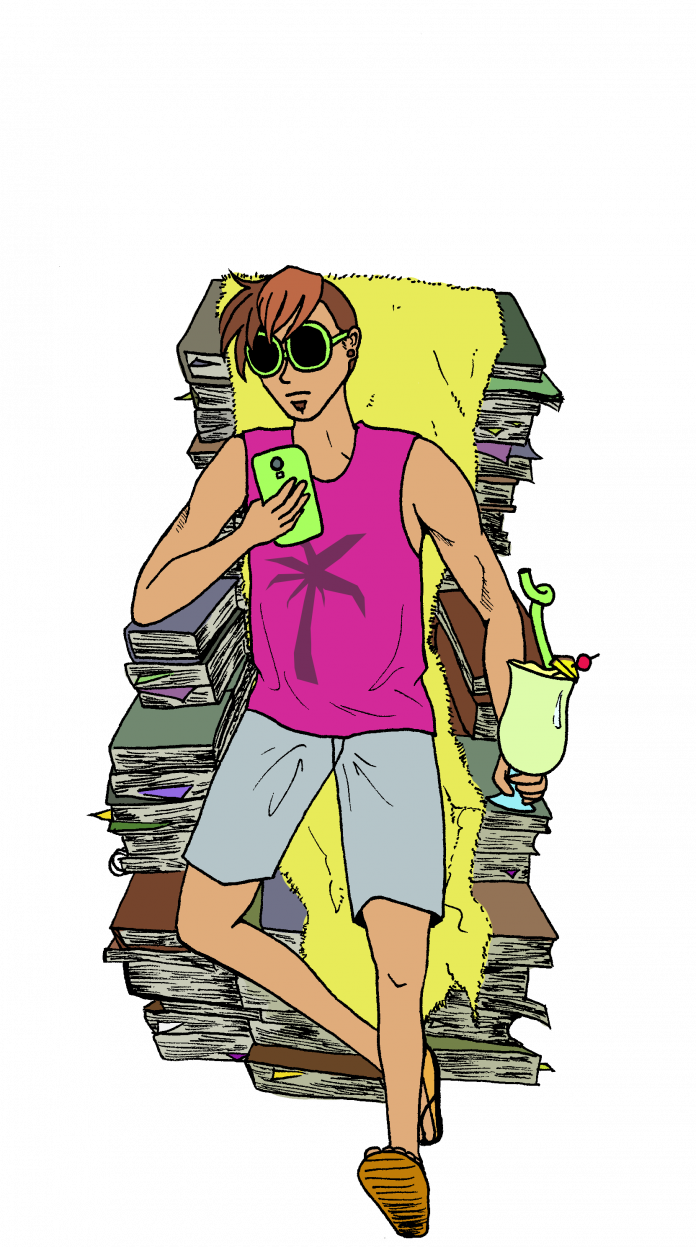
Illustration by Alice Zhang/The Peak

During the past week, I’ve spent an unnecessarily large amount of time writing apology notes to a classmate over a group presentation, because I’d yet to finish my section of the PowerPoint in time due to some other assignments. While I’d be panicking on any other week of school, reading break was thankfully here to save me. Without the time required to travel to and attend my lectures, I could finally recover from everything I was behind in.

But to those people who reserve reading break for a big trip, I feel like you may be misusing this time a bit. The amount of work we have to do as post-secondary students is massive, and a week out of class is often just enough to keep us from drowning in stress and textbooks.

SFU’s learning commons recommends that students spend two to three hours per week studying outside of lectures for each credit we’re taking that semester. This can add up to at least 18 hours for full-time students — and at least 30 hours with a maximum course load — to be working on our own time to learn and practice, which becomes more difficult when you have a job, family responsibilities, or long travel times to campus cutting into your schedule. Reading break gives us a time to allocate our hours more freely, and be as constructive as we can on our own clocks.

Sometimes, this reorganization means you put a little extra time into the newly empty spots where your classes usually are. Now, you can fill up your “lecture blocks” with better constructive learning time. If you aren’t as behind as I usually am, it means you get a bunch of extra free time by just maintaining your normal study schedule, and you can at least relax a bit. We’re in school to succeed, and reading break is a tool for achieving that.

This isn’t to say you shouldn’t travel if you think you can afford it, or if you need to for the sake of family. If you can somehow get ahead of your work enough to take that time away, then power to you. But given how much time you need to put into school to begin with, you’re either going to be packing a lot of extra work into a short period of time before you leave — something the SFU Learning Commons also recommends against — or putting yourself way behind. Alternately, you could maybe plan to do some work while you’re on your trip, but the last thing you want to do is go back to a hotel room to work on a research paper.

I realize how preppy and paranoid I sound, and it’s definitely still important to make some free time to relax. After all, I would be lying if I said I hadn’t used some parts of this week to visit friends and cross things off my Netflix list. But this is a week for reading, not from reading. Take a safer bet and buy your plane tickets after finals.