Giving back more wilderness to bears is one way to avoid altercations in the future Photo courtesy of Nathan Denette via Global News
On June 24, picnickers at Burnaby Mountain Park were visited by a black bear. The bear tried to get into their backpacks for food and when challenged, the bear swiped back. The picnickers reported minor injuries from the incident, and the bear left without further bother.
The next day, what was believed to be the same bear was caught eating garbage in a residential neighbourhood. The bear was subsequently put down for exhibiting “unusual bear behaviour” and for having lost its fear of humans. According to conservation officers, this behaviour removed all hope of relocating the bear to another area.
To kick off the list of things that are wrong with this situation, let me just say that the bear wasn’t exhibiting “unusual behavior.” The bear was exhibiting regular bear behavior in that it was searching for an easy source of food. Arguably it was the picnickers who were exhibiting unusual human behavior by leaving the security of their urban environment and venturing into the territory of wild animals — not to mention their decision to confront a large predator.
On that note, the inability to rehabilitate the bear because of its “habituation to humans” highlights just how pervasively humans have encroached on wild areas. That there are no environments far enough away from human habitation to place a bear safely paints an alarming picture of the pitiful lack of truly wild spaces, even within our vast nation.
Conservation officials note that black bears have been sighted over 2,200 times in the Lower Mainland this spring alone. The number of reported sightings continues to grow as bears recognize human habitation as sites of easy food. This permeable boundary between human and bear territory points to how humans have altered the environment such that either the bears’ normal food sources are too scarce or human food sources are too easily accessible.
The further we sanitize the remaining pockets of wild space for human recreation, the more we must expect that encounters with wild and potentially dangerous animals will occur. We cannot allow our solution to this issue to be killing or enclosing what few apex predators remain. We as humans have the unique ability to rationally alter our behavior to find creative solutions to environmental hazards.
As students on Burnaby Mountain, we live and study alongside a host of wildlife, and we must always be conscious of the impact our presence here has on the local fauna. It is fundamentally wrong to expect bears to stop doing bear things in the areas where bears live. Instead, we need to do the human thing and find a way to coexist with wild nature. This ultimately may mean withdrawing from it altogether.
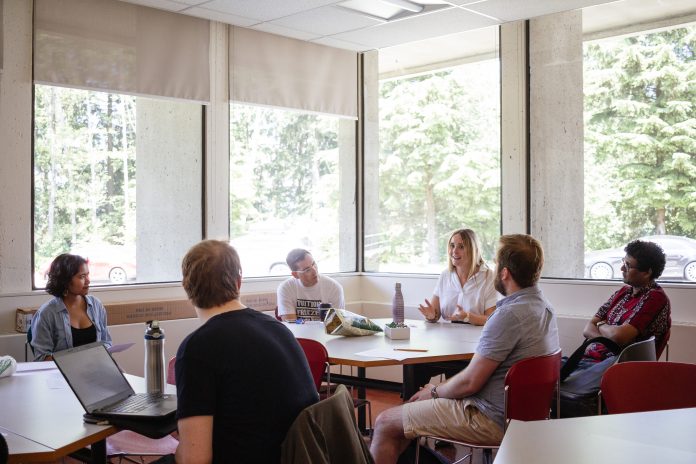
On June 26, members of Tuition Freeze Now held their third general assembly chaired by Annie Bhuiyan, an undergraduate student. The meeting was held in the Robert C. Brown Hall. Its objective was to create a schedule for their July activities and update attendees on the group’s recent activities.
Attendees were split into groups of two and asked to brainstorm ideas about what a charter for Tuition Freeze Now would entail. The two groups were encouraged to think about what TFN stands for, what the organization’s standards should be, and what they want from the province and/or the school. At the end of the brainstorm session, it was decided that TFN stood for affordability, feminism, and anti-oppressiveness, amongst other things. They highlighted that what they wanted from SFU was different from what they wanted from the B.C. government — for example, tuition freeze versus government tuition funding. However, they also acknowledged that there were some similarities, such as an “outlook change.”
According to Bhuiyan, Tuition Freeze Now currently has members at the University of Victoria, University of British Columbia and Langara College. Bhuiyan mentioned that the main tool for cultivating solidarity amongst the chapters would be engaging them in the planning of the charter. She highlighted the need for solidarity, stating that now that Tuition Freeze Now was growing, “they are a part of the movement too and I don’t want to leave them out.”
Bhuiyan also brought up the need for Tuition Freeze Now to host social events as a tool to build solidarity amongst its members and other chapters. SFU community member Corbett Gildersleve had suggested a potluck as a social event Tuition Freeze Now could hold in the Summer 2019 semester. The subject of a possible date for the event was brought up and it was agreed that the event would be held in late July.
The meeting ended with a discussion about the possibility of Tuition Freeze Now hosting a debate amongst federal party leaders. However, this project is still under development.
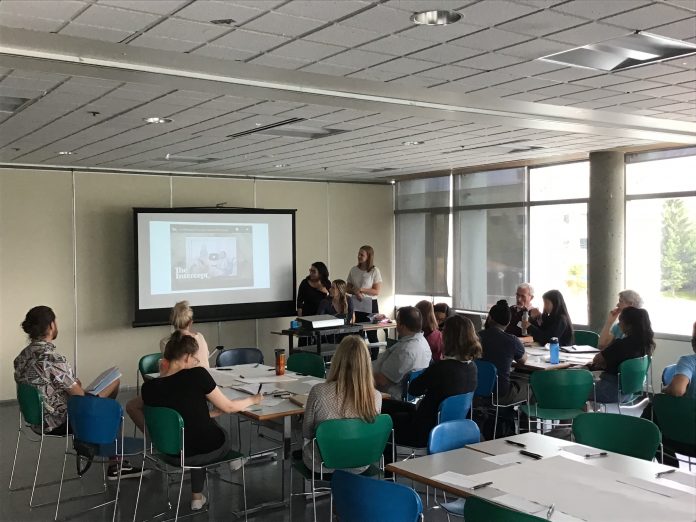
On June 26, a Green New Deal Town Hall was held at SFU Burnaby’s Maggie Benson Centre. The meeting was one of many similar talks across Canada which aims to foster discussion about what Canada’s vision for the environment should look like. The event was co-hosted by Embark Sustainability, Teacher Support Staff Union (TSSU), SFU 350, along with support from SFPIRG.
As noted by SFU 350 member, Skye Noh, in an interview with The Peak, “It really started with a movement down in the States with Alexandria Ocasio-Cortez, inspired kind of what by [Franklin Delano Roosevelt] did with the New Deal.”
In an interview with The Peak, SFU 350 co-president, Abby Herd, detailed why the GND is a worthwhile issue to consult students about and is important to the SFU community overall.
“Students are a group that are impacted by climate change … I think it’s really important to consult [students] and especially SFU as well, because we will have a pipeline going right under this university, and we’re situated up on a mountain.”
The event began with a message from Haidee Pangilinam and Ishmam Bhuiyan, members of Dogwood, a grassroots, non-profit, B.C.-based environmental advocacy organization.
Kristen Zickfield, associate professor from SFU’s department of geography, presented on the findings of the most recent report from the Intergovernmental Panel on Climate Change (IPCC) and the many changes needed to combat climate crisis. Zickfield highlighted the need for political will and leadership to achieve change.
Following Zickfield, Alicia Massie, TSSU coordinator, delivered her own speech. Massie spoke of the necessity of acting as a collective to incite change.
“We need a movement. We need it yesterday,” she said.
“How we achieve real change is through collective struggle.”
After, the audience was shown a video titled “A Message From the Future With Alexandria Ocasio-Cortez,” detailing Ocasio-Cortez’s vision of what a future with the Green New Deal in motion would look like.
Following the video, hosts Abby Herd and Stephannie Yu asked attendees to brainstorm large-scale changes that would help combat the climate crisis (referred to as “Green Lines”) and action that ought to end (referred to as ”Red Lines”).
The attendees then came together in groups to discuss and then present their top two Green and Red Lines. A few ideas included ending fossil fuel subsidies, Indigenizing the conversation around the climate crisis by putting Indigenous people at the forefront of how we deal with crisis, and investing in public transportation.
In the closing statements of the event, attendees were asked to leave their name and email in order if they wanted to keep organizing. More information on future town halls can be found online through Green New Deal Canada’s website.
Thousands of people participated in a protest on June 16 Photo Courtesy of Tyrone Siu via CBC
Editor’s note: The author’s name has been redacted from this article.
Recently in Hong Kong, there were massive protests against the government’s proposal to amend the Fugitive Offenders Ordinance, also known as the extradition law. This law would allow case-by-case extradition proceedings between Hong Kong, Taiwan, and the People’s Republic of China without review from the Legislative Council. However, due to the complicated history between Hong Kong, China, and Taiwan, the amendments have sparked renewed concerns over the erosion of Hong Kong independence and the extent of China’s authority.
Shortly after a protest march on June 9, inwhich more than one million people participated, the government released a statement saying it had no intention to suspend or withdraw the extradition bill, claiming that people did not understand the details of the amendments. This subsequently triggered more protests against the extradition law and the government.
Only after the protest on June 16, inwhich around two million people marched, did the government appear to shift its stance. The chief executive apologized to the public and suspend the amendments temporarily.
The inaction of the Hong Kong government with regards to the protests and demands of the people perfectly sums up the unsettling impasse in Hong Kong at the moment.
The government has stated that the purpose of these amendments is to address a so-called “loophole” in the criminal justice proceedings between Hong Kong and Taiwan (Republic of China). However “loophole” isn’t an entirely accurate way to describe the situation. The British colonial government intentionally excluded China when drafting the original extradition legislation.
Yet these amendments further allow for the delivery of fugitives to China, AKA People’s Republic of China, and Macau, which were not involved in this specific murder case, but which also are not covered in the existing law. This complication is created in part because they involve the complex issue of what exactly is meant by “China” — a definition that is further muddied by the contentious 1992 Consensus, which was supposed to settle the ambiguous relations between Taiwan and China.
Taiwan has stated openly that it does not agree with these extradition amendments. Taiwan has asked the Hong Kong government to consider alternative agreements, but has yet to receive a response. Since Taiwan is unwilling to accept the murder fugitive under the proposed extradition amendments anyway, the government’s decision to push them forward is rendered moot.
The government has neglected the concerns and demands of the protestors, including the complete withdrawal of the bill and the resignation of the chief executive. It seems as though the government is not listening to its people in order to establish and maintain authoritarian power. This puts the role of the government and Hong Kong’s autonomy into question. The utter loss of such autonomy at this point in time would further jeopardize the rights of the citizens of Hong Kong to speak a diversity of opinions.
We must, however, remind ourselves that it is often those times when we think no change is possible and no action is effective that allow us to imagine and innovate different ways of thinking and doing.
Editor’s Note: Some information has been changed to protect the identities of the featured students.
You’ve seen these girls either in your classrooms, or on your phone screen.
Meet YM and Rafaella Enderica — or rather, @rafaellaenderica (9,291 followers). YM and Enderica are two SFU international studies majors and also part-time influencers.
Chris Ho/ The Peak
From photo shoots to Shrum Science Hall
When I first met the girls for an interview with The Peak, my immediate reaction was, “God, I’m underdressed.” It was a too-sunny Monday afternoon. I met YM first in a leopard-print dress under a jean jacket, while she cooled down with a Starbucks iced soy latte (and was five minutes early to boot). Rafaella Enderica, on the other hand, we found wandering the Cornerstone parking lot, fresh from her six-hour shift at Starbucks, though she didn’t look it from her sharp outfit, a still-smooth silk top and culottes.
“Before a shoot with YM, I arrive late. At least 45 minutes,” she laughs.
I sat down with the girls in a remote study hall, away from the post 1:30 p.m. student rush. I started with a question not even the Oxford English Dictionary can answer — what, exactly, is an influencer?
“So to me, being an influencer is almost like creating a brand for yourself and an image,” Enderica began.
YM agrees that being an influencer primarily involves marketing, sharing favourite products, and even your life, with your followers. But even then, the girls aren’t too keen on the term “influencer” in the first place.
“It’s more content creating,” Enderica said.
“I wouldn’t even say, like, influencing, because I don’t know if I’m influencing anybody, and at the end of the day, it doesn’t matter if I am or if I am not.”
Content creation compen$ation
Given that being an “influencer” is a new thing even as a side hustle, let alone as a full-time job, there’s a lot of mystery surrounding the work. Especially when it comes to the money surrounding it. I asked YM about how collaborations between brands and people’s profiles can even exist.
“So obviously when you’re starting, you’re kind of the one reaching out to brands,” she admitted.
She detailed her routine for collaborating with brands. It begins with sending out emails to brands, mostly containing her media kit, which is a sort of resume for bloggers.
“There’ll be collaborations where they will gift products to you, and there’s some who will offer to pay you. Usually you don’t get paid until you have like 10,000 followers, that’s where it starts,” YM said.
In YM’s case, her main (and favourite collaborator) is Mejuri, a jewelry brand company. It was love at first collab.
Chris Ho/ The Peak
“Initially, they told me they weren’t doing collaborations but they would keep my name on file, but after a couple months, they were like, ‘Hey, we’re opening up a pop-up in Vancouver and we’d love to send you some products in exchange for posts and mentioning we’re doing the pop-up.’”
And the rest is happily-branded-ever-after. To YM, that collaboration was a key highlight of her life as an influencer so far. Just trying to describe the feeling makes her stop short and make a noise that sounds both like a laugh and gasp of excitement.
YM mentioned that ever since that first collaboration, Mejuri still sends her products on a monthly basis.
Enderica, on the other hand, was more cautious. And more to the point.
“I’ve been a little apprehensive in trying to collaborate with brands because a lot of them, there’s a lot of companies out there that will fish you like, ‘Oh, why don’t you become an influencer for us?’” she said.
“One tip I have that I learned the hard way, there’s a lot of brands that comment under your photos, asking to do ambassador work and things like that,” YM said with a sheepish smile. “Those ones are those kinds of ones that are fishing to, like, get you to pay for their product.”
Their solution to suspicious brands? Reach out to brands via email for serious inquiries.
influencer + international studies = Rafaella and YM
YM mentioned that she’s currently a fourth-year student, but being a content creator is only a part time gig for her. “I don’t see myself doing content creation full time, I do see it as a hobby, but I don’t know where that’ll go,” she reasoned.
On average, the girls estimate they both spend several hours a week working their side hustle. Their tools are plentiful: iPhones, VSCO, Snapseed, Planoli, and FaceTune (Enderica defended her choice of the FaceTune app because of its Paint Tool alone).
A regular day of shooting was made of the following: planned outfits, a location, and little patience for parking.
“Downtown [Vancouver] would be really nice, but parking is really tough there and it just takes a lot of time sometimes we will do that, but usually North Shore, I feel has some pretty good shots. So we find our spot, we change into our outfits—”
Enderica cuts in with, “Oh, guys — changing into your outfits is so annoying,” and the two dissolve into a fit of laughter.
YM, giggling, nodded along and confirmed the problem with changing, “In the back of the car, pretty sure we flashed people before.”
The two estimate that once they start snapping photos, 200 to 1000 photos are taken until either one is satisfied. Post-shoot rituals vary between the two girls (“Edit and eat,” Enderica says). But both ultimately end up at home, editing through pictures and agonizing over captions together.
Chris Ho/ The Peak
Success in the era of smartphones
Enderica addressed some of the harder truths around collaboration deals with brands.
“Like with any sort of start-up or any business, you’re probably going to lose money the first year, you’re probably going to lose money in the first three years, it’s something you have to dedicate yourself to and grow your followers, grow your community. And that’s sort of how you get compensated, is you get more exposure.”
I then asked both girls what they believed were key pieces of success for up-and-coming influencers.
Enderica was candid. Before answering my question, she asked if she could swear. Caught off guard, I told her yes.
“Not give a fuck!” she exclaimed with a bright grin. “That’s my thing: if I like something, I’m gonna post it. And it might be weird, it might not look cool as some people think. I might make a lame joke, but literally, don’t give a fuck. Just do you.”
Check out The Peak’s Student Spotlight on Rafaella Enderica and YM:
They watched as the figure walked closer, slowly lit up by the desktop’s light. Now they could see that it was just another person, but she was straight out of the uncanny valley. Her long, lanky limbs seemed to stretch for miles, and her straw-like hair dangled lifelessly just below her shoulders. There was a weird stench that permeated the air, like decay.
“Well well, children. What do we have here? Are you tampering with my computer? I’ll have you know I’m one of the SFU administration clerks, and that’s a really big violation.” The stranger said, glaring at the two students with her anguine-like eyes.
Pauline and Barbara stared at each other, both looking like they just encountered something supernatural.
“We’re sorry! Please don’t report us. . . we just needed a place to stay, we just want our home back,” Barbara said frantically, her gaze darting between the SFU admin and the closed door.
“A place to stay? Well, then I guess you will have to stay here and do all my paperwork. Otherwise, I will report you,” the SFU admin said, pointing to the papers scattered around the room.
It felt like a jail sentence; doing all this labour and not getting much of value in return? Sounded like a minimum wage job in Vancouver!
The duo nodded solemnly and began to create a filing system. Hours had passed when they realized they barely made a dent in the paperwork.
“We have to get out of here,” Pauline whispered to Barbara, watching as the SFU admin leisurely browsed minion memes on Facebook. Pauline could make out some weird-looking minion in a skirt with the text that said “if you can’t handle me at my worst, then you don’t deserve me at my best.”
That seemed about right.
Pauline saw the snow flurries accumulating outside and then looked at the two chairs right by the door. She had an idea! She quietly turned to Barbara.
“Barb, we need to trick the SFU admin to get away from the front of the room so we can run out and lock her in by jamming a chair underneath the doorknob,” Pauline whispered.
When Barbara nodded, Pauline rapped on the big window, letting out a surprised gasp.
“Look! It’s starting to snow, I think they’re going to close campus and leave us all stranded on the mountain!”
The SFU admin quickly turned around and slithered slowly to the window, cursing under her breath.
As she moved to the back, Barbara silently unlocked the door and folded up one of the chairs, preparing to take it with her.
“What? No, this can’t be another snow day! They always tell us at the last minute and then the buses stop running,” the SFU admin huffed, easing up the blinds on the window.
This was their only chance at freedom; they had to make it.
Once the SFU admin’s back was to them, Pauline made a beeline to the computer, force quitting minion memes to get to the administrative page and entering their names into the Residence portal. She shoved past the Admin and as Pauline dove into the hallway, Barbara slammed the door door closed and wedged the chair underneath the handle.
They heard enraged screaming from the inside, and then the sound of papers flying everywhere. The stench of decay was getting stronger, and they wondered if the SFU admin could unlatch the door through sheer fury.
The duo didn’t want to stick around to find out. They ran out into the blistering cold — it felt like a storm was brewing — and zigzagged their way back to the Construction Maze. As they looked down, they saw the scattered balls of paper and made haste to follow them, frantically looking over their shoulders every now and then.
As they made it to WMC and then out, they ran to the resident housing, their hearts beating hard and fast.
There stood the RA, looking overjoyed to see his two favourites return. They ran into his arms, crying about how they “never wanted to be left again” and that “there was a witch locked up in the dungeon on campus” — whatever that last part meant.
Hobbies: Zdeljar enjoys trying out new places to eat as an avid foodie, singing and dancing around her room, and cooking.
Work experience: Zdeljar worked at David’s Tea as an event organizer and started off as a CSA secretary prior to her CSA presidency. She currently works at Lush.
Fun fact: Zdeljar’s favourite colour is yellow and she loves sunflowers.
“I love that people are so ambitious and so passionate about a lot of things [ . . . ] you can see that anything is possible.”
Those were the words that Ivana Zdeljar spoke without hesitation when I asked her about her favourite part of being in the Criminology Student Association (CSA).
In the midst of a busy summer semester, clubs and student unions have been itching to put together activities and mixers that appeal to students. Organizing these types of events may seem simple on the surface, but a lot of compromising, leadership, and delegation goes into making it all come together. For Zdeljar, a huge part of her presidency revolves around fixing the small cogs in an overall big wheel with the help of her colleagues.
Zdeljar began her journey at the CSA by getting dragged to a meeting by her sister who, at that time, was the CSA’s faculty representative.
“If you go to the CSA Instagram page, you will find a picture of little me in first year,” Zdeljar said laughing, ”[ . . . ] so that was my first introduction to that.”
As time went on, Zdeljar became involved in the Faculty of Arts & Social Sciences, but soon realized she wanted to do more volunteering. Since she was already part of the CSA, she thought it would be a perfect place to start taking on more responsibility.
“One thing that is important to me is being of service,” Zdeljar explains.
Even though Zdeljar did not necessarily set her sights on the secretary position, she was motioned into the position by other members of the union. Although Zdeljar admits it was terrifying at first, as the secretary is one of the four core executive positions, she went into it with an open mind.
“It’s not even that people were giving me a lot of responsibility. It’s that I was asking for it,” Zdeljar says.
After the previous CSA president took her leave, it was a natural choice for Zdeljar to take on the role. However, such a position is not without its difficulties. Zdeljar explains that this year, it has been tough juggling her personal life and the CSA.
As it turns out, there is a lot of planning and compromising that revolves around this position. As a person of authority, one of the most important things is to practice having empathy toward colleagues. Zdeljar had to learn this firsthand at the beginning of her semester; the dynamic of the club always changes a lot when a new person takes the lead.
“As soon as you’re a president, people either love you or hate you — that’s just it,” Zdeljar explains. “You’re doing well or you’re not.”
Zdeljar goes on to explain that it is crucial to not take any of these criticisms personally, as the best approach to others is an empathetic one.
“The way I run [CSA] is that, if you have an idea and you want to do it, I will support you and find a way to do it. [ . . . ] I want to [empower] people to do what they want to do,”
For Zdeljar, this rings true for many events that the CSA host, like start-of-semester mixers and fundraisers. Even the upcoming pub night run by Pre-Law and the CSA has been made possible through the cooperation and collaboration of her colleagues.
“Leadership [is] moving people in a direction, but it’s also like rowing, you need others to help you, and [in turn] support them.”
Zdeljar is a strong believer in the idea of shaping your own journey around what makes you happy and what you are most comfortable doing. Even in her own professional pursuits, Zdeljar has been struggling with the realism of her future. While criminology is her biggest passion, she feels strongly about countless issues that leave her torn about what she wants to do in her career — a relatable situation for many fourth-year students.
As a kid, Zdeljar loved watching Forensic Files, which she assumes was a big influence on her current love for criminology and exploring the unknown. After becoming more knowledgeable in her department, Zdeljar wants to bring awareness to the inaccuracies and the myths of crime statistics.
“People jump on these numbers and these buzzer words and are like, ‘Oh my God, oh my God! Murder is everywhere!” Zdeljar says. She suggests that while awful things do happen in the world, we need to recognize that the world is not as terrifying as it is portrayed on the news, once you take a more critical look at the facts.
As someone interested in the practicalities behind criminology, Zdeljar is also passionate about advocacy and promoting change, which she hopes will be encouraged by the CSA.
For Zdeljar, it is important to acknowledge the existence and emergence of certain crimes, but people should also pay attention to over-representation in media and become educated about the numbers.
In particular, as someone well-versed in Canada’s judicial disciplines, Zdeljar also emphasizes that we must hold our legal systems accountable for the genocide of Indigenous peoples and communities. She goes on to explain that society can’t afford to be complicit, since the justice system is a reflection of people’s attitudes and values.
“I don’t want to sound really pessimistic because change is very possible, we are seeing that in a lot of places” Zdeljar says, “but I think we have completely let down the Indigenous [communities].”
Zdeljar suggests that the legal system must do more, and one of the first steps is admitting that there is a cultural genocide that is happening. She expresses her concerns that many people may need to familiarize themselves with the word “genocide,” as the common definition rarely encompasses what is happening with Indigenous communities in Canada. Zdeljar emphasizes that once people start educating themselves on this, we can begin to see more pushback and more advocacy.
Ultimately, Zdeljar wants to bring people together and help new ideas flourish through her presidency at the CSA. By hosting events and volunteering, she hopes to inspire others to take the reins of their own passions.
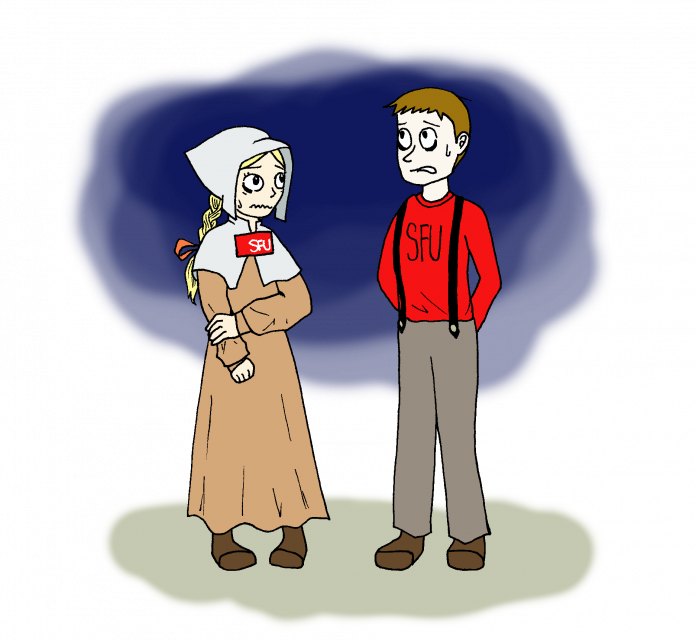
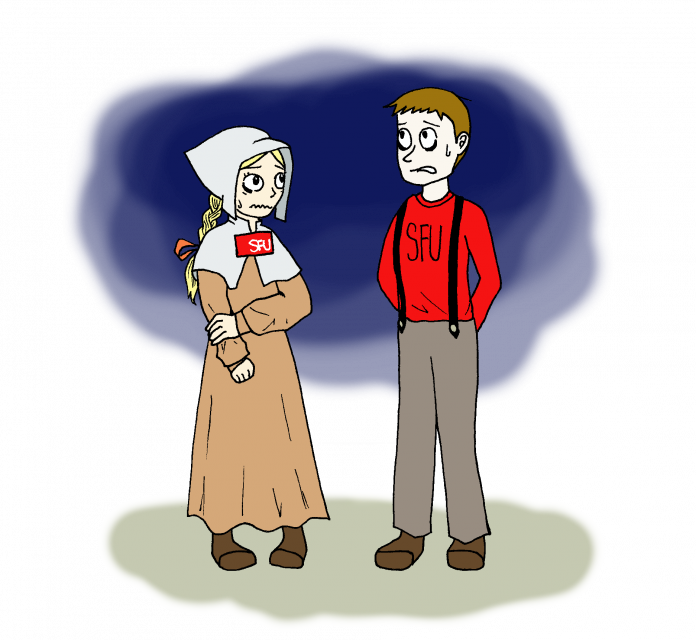
Come now children, gather around the Convocation Mall fire pit and get your marshmallows ready. It is time to tell an old SFU fable . . .
Once upon a time, atop Burnaby Mountain, stood a proud and somewhat domineering university called SFU. Within this university lived two first-year students named Pauline and Barbara, enamoured with student life and learning. They both still had a twinkle in their eyes that had yet to be snuffed out by crazy tuition prices and 8:30 a.m. classes.
As the winter semester rolled around, SFU got the bright idea to up its student housing prices, because logic. One chilly November morning, the floor RA approached Barbara and Pauline, looking sorrowful. They had gotten to know him well over the last few months — he would always sneak them snacks from the Dining Hall.
“I am sorry, but you have to leave the resident housing,” he said, wiping away one single tear. “You can’t afford it anymore, so we have to let you go.”
The RA quickly hurried away before Pauline and Barbara could say anything, and soon they found themselves huddled outside of the building, freezing and hungry. Snow started to dampen their jackets as night approached. Desperately, the duo began their journey further into the mountain, hoping to find another place to stay.
“You know, I heard students apparently live at this place called ‘The Library.’ Maybe we can go live there with everybody else,” Pauline suggested, adjusting the strap on her backpack filled with heavy textbooks. Little did she know she would never have to take them out of their plastic covering.
“That sounds like a good idea, I think that . . .” Barbara began to reply, but trailed off as she came face to face with a tall, tarp-covered metal barrier.
The duo fell quiet, listening to the snow softly falling around them. A blanket of darkness had been draped over the campus, but they could just make out the metal jungle before them. There it was . . . the Infamous AQ Construction Maze.
“There’s no way we can navigate this. . . why don’t we ball up our lecture notes and scatter them behind us so we can find our way back if we need to?” Barbara suggested, taking out her notebook.
“That’s actually really smart,” Pauline replied, “never heard of that original strategy before.”
They began to tear off pages from their notebooks, leaving a trail of doodles and math equations on the pavement.
The duo took a shortcut by the right side of Convocation Mall, completely passing their original destination and finding themselves lost in Robert C. Brown Hall. The further they went, the more the place looked like a dungeon — they couldn’t even get a stable Wi-Fi signal.
While it was barely 4 p.m., the outside looked dark and uninviting. The exhaustion was starting to set in, making them sluggish and slow. It was as though their limbs were full of lead.
Pauline stopped short in her tracks when she noticed a tiny office illuminated by a computer screen. It was like a beacon, enticing them to come inside. The duo went in and gathered around the computer.
“Hey Barbara, look!” Pauline said excitedly, already opening 50 tabs on the browser.
“The computer is unlocked. We can access the main system and the records.”
“Why don’t we just put our names back into the database for housing? We can have our home back!” Barbara exclaimed, looking over her shoulder.
The office was filled with loose paper — it was on the desk, on the cabinet, and even on the floor! If procrastination had some sort of physical embodiment, this would be it.
Right by the entrance, there were two plastic chairs, like the ones used in assemblies. They were pristine and untainted by the papers, which made them look oddly out of place.
Barbara considered pulling up one of them to sit by the desktop computer, but just then, the already ajar door let out a loud creak, and a tall shadowy figure came in. It stalked in, quiet as a snake and locked the door behind itself.
On Tuesday, June 18, SFU’s current Semester in Dialogue cohort facilitated a discussion titled “Youthless City: Global to Local Housing Solutions.” The event was held at the SFU World Art Centre, aimed at promoting dialogue around the current housing crisis in Vancouver.
It was an open event, with attendees varying in age, occupation, and background. This was touched on by the event moderators at the start.
“We’ve arrived at this conversation with a variety of backgrounds and perspectives. As you go home tonight, please do not let other peoples’ perspectives affect your mood. There is no right or wrong [ . . . ] we accept and make place for different contributions.”
After, attendees were split into four groups. The groups rotated among four stations, with each representing a different city: Vienna, Montreal, Hong Kong, and Berlin. Each station also had an infographic that gave statistical information about the city. Some of them also recommended policy changes to help solve Vancouver’s housing crisis, based on that station’s chosen city.
Using some of these as starting points, facilitators initiated discussions on how and what must be done to solve Vancouver’s housing crisis.
Some of the recommendations included rezoning industrial zoned land for non-market housing, restructuring the city of Vancouver’s zoning regulations, and increasing access to social housing.
Students will be posting their findings to the Semester in Dialogue webpage at a later date.
The event included a discussion panel that consisted of Sekani Dakelth, a Downtown Eastside-based activist, and Leo Yu, director of community giving and operations at the hua foundation. It was moderated by Ana Mendez, a Semester in Dialogue student. Dakelth and Yu reflected on what they had observed throughout the dialogue.
Both noted that in any discussion on the topic of housing, it was critical to consider reconciliation.
“I don’t think you can talk about housing without talking about the land we’re on and the fact that it is unceded,” Yu remarked.
Dakelth added that she doesn’t use the term “unceded” because it presumes that elsewhere, like in Eastern Canada, the land was ceded.
“In legal terms, [the land has], but in essence [the people have] been duped. They’ve been tricked into signing. And they’ve signed away all their rights and all their lands and they were duped centuries and centuries ago,” Dakelth elaborated.
Speaking to The Peak after the event, John Mwonga, third-year SFU student, noted that he was learning from the discussions he had been a part of.
“I’m always looking for places I can learn stuff [ . . . ] I would like to go into politics at some point at home and one of the crises we’re going through now at home is a housing crisis.”
SFU alumnus Shidan Giua praised the event, and the Semester in Dialogue program as a whole, as a good way to facilitate learning and start conversation on the housing crisis.
“It’s something we complain about, but it’s not an issue that we delve into deeper, and I think today was a great opportunity to not only inform ourselves but also to bounce our own opinions off each other,” he noted.
“Honestly, if my program had something similar to this, I think I’d still be in SFU today. I feel this is a much more conducive approach to learning than 400 kids in a classroom with a professor on a mic.”
This sentiment was reflected in the comments of Brian Portner, a member of the current Semester in Dialogue cohort, who is in his final semester in the health sciences department.
“I just felt like I wasn’t done at SFU yet. I felt like I wanted one more experience, and I wanted a different kind of experience. This course has been so different from any of the typically academic courses I have taken before,” he stated.
This was further echoed by Camille Ancessi, Ann Tony, and Vanessa Cheng, all of whom are also in the current cohort.
“It’s very different from a traditional classroom, but interacting with different ideas you come to very different conclusions than if you were in a classroom setting with people with very similar backgrounds,” explained Cheng.
After the dialogue had concluded, Jackie Wong, an instructor in the program, reflected on how important the event was in creating dialogue in the community.
“I think it’s very important to be able to show that there are many different voices that should and can be taking up space in public conversation, particularly about housing.
“A lot of times, if you Google ‘housing lecture Vancouver,’ the people who are usually stewarding those conversations are of a particular demographic that often excludes younger people, excludes LGBTQ people, excludes women, excludes racialized people, and it’s really important for us to be able to lift those voices up. I’m excited about how this event can productively take up space.”
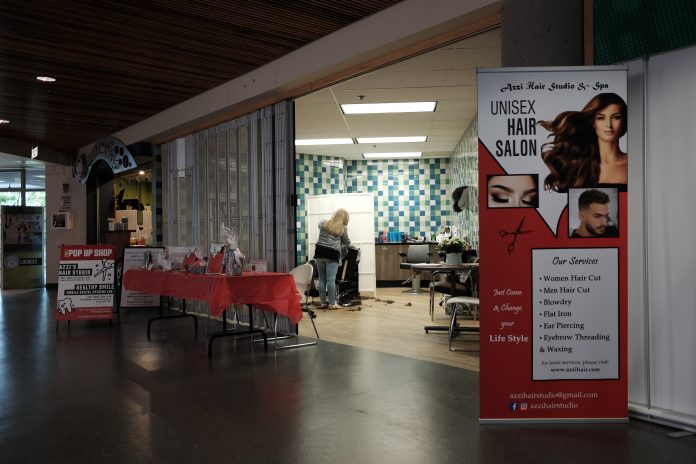
On April 22, Azzi Hair Studio, a hair salon at UniverCity, opened up its second branch on the second floor of the Maggie Benston Centre (MBC). It shares its space with the new dental clinic, Healthy Smile Dental Clinic.
The Peak reached out to owner Azadeh Bakhisan for comment on why she decided to open up a second location in Maggie Benston Centre (MBC). Bakhisan recalled how she opened the first studio at Cornerstone Plaza 13 years ago.
“I decided to open the second one inside of SFU [because students] don’t know there is a hair salon on campus, and most staff members have just half an hour for lunch break, and they don’t have enough time to walk all the way to Cornerstone just for a haircut. Now we are here to be more convenient for the students and staff on the other side of SFU.”
Bakhisan then said that along with the new MBC salon, the Cornerstone salon would stay open to benefit more students and staff on that side of the campus.
The MBC branch operates Mondays, Thursdays and Fridays from 10 a.m.-6 p.m. The studio is non-operational on Tuesdays and Wednesdays, which is when the dental clinic operates in the space. It is closed on Saturdays and Sundays. The salon’s first branch is located in Cornerstone at 8926 University High Street.
The studio primarily focuses on hairstyling, with services including styling, deep conditioning, perms, and colouring. The studio also features a diverse amount of treatments such as nail art, lash and brow tints, manicures, pedicures, facials, massages, and facial waxing.
Bakhisan stated that the studio is currently only taking walk-in clients, but they intend on making online appointments available for clients in the future.