Home Blog Page 476

SFU’s “Re-use for Good” initiative sparks accessibility concerns

2
Single Use Plastics and products discouraged at SFU

Break out those metal straws and show off your most overpriced tumbler cup because this fall SFU is cutting out an array of single-use plastics and products (SUPPs) as part of its Re-use for Good initiative. 

Around campus, reusable replacements for single-use objects will make their way into the daily lives of SFU community members. SFU’s Ancillary Services and the Sustainability office drove the initiative in partnership with the Simon Fraser Student Society, the Graduate Student Society, and the student-run Ban the Bottle club. SFU’s Ancillary Services mention in their mission statement that they “endeavour to demonstrate community and global leadership through our sustainable practices and engagement as a fair trade campus.” Lowering single-use plastic use on campus is a challenge these groups are facing head-on.

However, some students with disabilities were left concerned by the consultation and decision-making processes, as The Peak learned through email interviews with Vivian Ly and Sanam Prasad, members of SFU’s recently formed Disability and Neurodiversity Alliance (DNA), a group representing students with disabilities. 

When climate change initiatives clash with accessibility
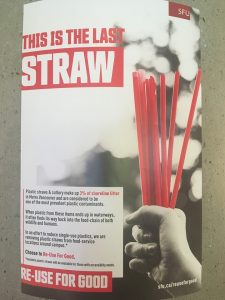
Photo Credit: Paige Riding // The Peak
SFU has rolled out promotional material for Re-Use For Good campaign.

Throughout the day at the Dining Hall, staff can be seen with carts of washable plastic and metal cutlery, cups, and plates to meet the demands of the buffet-style eatery. Once patrons finish their meal, they clear dishes through a restaurant-style dish drop-off station hidden smartly behind a sign boasting their environmentally-friendly initiatives. 

While the metal utensils are eco-friendly, for students like Sanam Prasad — a fourth year history student who experiences severe hand pain and jaw problems — they do not replace plastic utensils. 

“Metal utensils are not always usable by people with hand pain. I would personally find it very heavy to use some days and [it] would require me to eat slower,” she wrote to The Peak via email.

At other dining services around campus, plastic straws are also being put out of sight and discouraged. 

As Prasad explained, “not everyone who needs a straw looks visibly disabled in a way that able-bodied people expect us to look like. For example, someone may need a straw for sensory reasons and may not look disabled . . .” 

Prasad notes she experienced being denied straws previously, though not at SFU as of yet. In areas where plastic bans are active, this has become a recurring problem.

“Every time the onus is put entirely on a disabled person to ask for things that provide access, there is a very real chance we are denied,” Ly writes. Ly is “glad that SFU is at the very least committing to ensure that plastic straws are available to those with disabilities.” 

Juan Paolo Santos Dantes of the Sustainability Office notes that “for Phase One of Re-use for Good, we are merely making changes so that straws are not the default option/set-up for beverages. Nonetheless, students requiring straws for accessibility needs have the option to request a straw at point of sale. They do not have to prove, justify, or identify any accessibility reasons to get access to straws.” 

Posters around campus repeat this message. However, Prasad argues that “if I have to request something in order to gain full access to something, that means it is not truly accessible. I do not need to ask for an elevator or a ramp in order to access a building, so why do I need to do the same in order to drink on campus?”

Consultation to ensure inclusivity

Photo Credit: Paige Riding // The Peak
SFU has rolled out promotional material for the Re-Use For Good campaign.

The Peak reached out to the Sustainability office to find out what specific steps SFU had taken to address the concerns of students with disabilities. Dantes responded that the university had consulted both the CAL and the SFSS (which has representatives on the Re-use for Good task force). The SFSS was “asked to represent both the general student perspective and the perspective of students with disabilities.” According to Dantes, the SFSS also referred the Sustainability office to the DNA. 

“We have been actively reaching out to the DNA and the SFSS Accessibility Committee for consultation as we launch this phased initiative,” Dantes writes. 

Dantes points out that Re-use for Good is a phased initiative and that, as he writes, “There are still opportunities for the community of peoples with disabilities at SFU to share and give feedback on the changes before and as they are implemented.” However, according to Ly, DNA has only received consultation as of this week in a “hasty” decision that “shows a disregard for disabled voices on campus.” 

“Accessibility is not an add-on. You shouldn’t implement an initiative and then retrofit accommodations later . . . Meaningful consultation takes time. And you need to do it prior to implementation so you get it right as much as you can the first time.” 

Likewise, though members of the SFSS sit on the task force and the Accessibility Committee, according to Ly (who sits on the committee), they have neither discussed nor been consulted about the initiative to date.

“What is most disappointing and frustrating about all this is that the initiative is already being implemented . . . but we are only being asked for a meeting after the fact,” said Ly. “That’s the crux of the issue — they are going full speed ahead and only bringing us on board later.”  

“SFSS and CAL do not consist of disabled voices . . . involving the SFSS and CAL is great, but also part of a worrying trend of seeing abled people as authorities on disabled people,” Ly continued. “First person perspectives (aka taken from actual disabled students) should be centred at the forefront, not one of the last to be consulted.”

Prasad added to this point, “able-bodied people who work with disabled people [are] not a substitute for the voices of actual disabled people, because they cannot truly represent our voices, concerns, and lived experiences.”

With plastic straws no longer the default serving option around SFU, Ly suggests that the universal design principle, which stresses designing for the inclusivity and accessibility of as broad of an audience as possible regardless of ability, is preferred, rather than the extra step of disabled students having to request straws. This, Ly states, would be “incorporating accessibility into the very building blocks of your design.”

Dantes wrote to The Peak, “Students with disabilities are highly encouraged to learn more about Re-use for Good and fill out our feedback/volunteer survey. Students are also welcome to send any general inquiries, feedback, and questions to [email protected].”

“By going ahead with Phase One without consultation of the SFU disabled community, Re-use for Good runs a real risk of repeating the mistakes of other similar policies and causing direct harm to vulnerable members of our community,” said Ly.

 “There is a saying in the disabled community,” Ly said. “‘Nothing about us, without us.’”

At the time of press, SFU Auxiliary Services informed The Peak that they were meeting with DNA on Friday, September 6. 

The Peak will continue reaching out to other stakeholders and further discuss and report on this issue in subsequent stories. 

Romantic preference needs to be honestly examined to avoid racial stereotyping

0
We all have preferences, but they shouldn’t fall back on racial stereotypes. Photo: Chris Ho / The Peak

Most of us have probably heard someone say (or perhaps even said) that a certain race is just not our “type.” As a woman of colour, I don’t take it personally when I hear individuals say, “I’m not into Asians,” because those aren’t the people I’d like to date anyway. But I wonder how confident someone must be to disqualify approximately 4.6 billion people from thousands of different cultures. Grouping together all of these people under a single homogenous entity reduces the astounding diversity of Asian communities and individuals. Essentially, racial stereotypes are reductive and shouldn’t be grouped with romantic preferences. 

It’s not racist to be attracted to certain traits, but it is racist to assume that all members of a certain race look or act the same. While opinions seem divided on whether or not having a racial preference is problematic, many fail to see that the issue isn’t in having preferences. The issue, rather, is using rhetoric that is very general and can both cause and continue to nurture harmful racist attitudes and beliefs. Sweeping generalizations that specify attraction, or lack of attraction, to a certain racial or ethnic group are based on stereotypes that leave no room for the exceptions that almost always exist. After all, there is always a one in a million chance that these assumptions might be proven wrong (or in this case, one in 4.6 billion). 

It’s important to understand that unless a consensus can be made — with no exceptions —  that accurately encompasses all members of a race, preferences are likely a product of socialization. Similar to political leanings, philosophical outlook, and social interests, romantic preference does not exist inside a vacuum. Exposure to media, political climate, or even those around us ends up affecting the way we perceive race. 

While most people who say, “I’m not into [insert race]” would actively deny that they are racist, subconscious biases still exist that promote racist tendencies. These manifest in problematic rhetoric. Instead of being fixed in an idea that only a certain race can ever be attractive, deconstruct why these preferences exist in the first place.


Wobbly step to lower bus loop victimizes 12 first years and counting

0

Yet another student is in critical condition after trying to take the stairs to the lower bus loop at SFU’s ugliest campus Friday morning. 

According to Campus Public Safety, the incident took place at 8:29 a.m. on the steps to the lower bus loop between Convocation Mall and West Mall Centre. The innocent first year student, dressed up for his first week of university, accidentally stepped on the infamous wobbly concrete step. 

Suffering from wounded pride and a shattered dream of university success, the student was taken to Burnaby Hospital for emergency treatment — though not before being carried, at his request, to The Study Public House to day-drink his sorrows away for a few hours. 

This is the twelfth first year since Welcome Day to be victimized by the wobbly concrete step, and he will likely not be the last. However, Campus Public Safety have disclosed none of the injured students’ names. They cited both reasons of privacy and the fact that first years’ names aren’t worth learning until they’ve made it through at least two semesters.

Despite efforts to respect the students’ dignity, however, Friday’s incident was caught on several cell phone cameras. At first an addition to multiple Snap Stories, the video has been circulating on Facebook, Twitter, and even Canvas discussion forums, captioned “the human tumbleweed.” 

Experienced SFU students have learned the hard way that when leaving Convocation Mall, one misstep could end their university career forever. Third and fourth years are careful to avoid the murderous slab of concrete, which has terrorized SFU for years.

An SFU lecturer who witnessed Friday’s event considers the whole situation “truly tragic.” 

“The whole thing is just unfortunate,” says Dr. Gladys Nottmi, who has been teaching at the university for 25 years. “It’s why I keep urging these kids to enrol in CSS 100: Careful Stair-Stepping for Firsties. It really prepares students for the trials of real life.” 

Dr. Nottmi expressed further frustration that few students take any courses at all within the Faculty of Careful Stair-Stepping. 

“I mean, I know that 75% of seats in upper-division courses are reserved for major students only,” Nottmi stated. “But stair-stepping is important common sense for this ridiculous millennial age.” 

On Friday evening, the SFU Board of Governors released a statement suggesting that the school build a miniature gondola to carry students over the step. Despite the fact that there are no concrete plans yet, board member Zach Wood-Beaderday stated that “students can expect these campus improvements as soon as Spring 2020, or within the next 69 years.”  

In the meantime, the board has appointed an emergency response team to handle the growing danger the wobbly step poses to the public. They aim to assist by physically carrying first years over the step to ensure their safety. (You can find chances to volunteer with the emergency response team on SFU’s one-stop shop for work opportunities, myLackOfInvolvement.)

If you see a student heading towards the wobbly concrete step, Campus Public Safety states that the best way to react is to scream at the first year incoherently or tackle them to the ground.

QUIZ: SFU, are you in love with the gondola? Or is he just really, REALLY tall?

0

It’s the question on all of our minds here at SFU: Are you in love with that tall, tall, dreamboat gondola project? Or are you just infatuated with the idea of him? If you’ve been tearing your hair out over the quiet but handsome transit vehicle with his head in the clouds, fear no more: we’ve got just the quiz for you! 

Just answer these five questions, HONESTLY, and find out whether you and the gondola are meant to be or if this is just another passing crush — like that time you thought the public bus was going to be the love of your life . . . ugh . . .


  1. Do you like living in a big city?

a) I loooooooove everything about big cities! From the busy people to the constant, complicated, crazy construction — it’s home!

b) I like the city just as it is, but like, aside from my weird neighbours.

c) I like the convenience, but I also preferred it before I had high rises looming over my house. I mean, where’s the privacy when I want to garden at midnight and ugly-cry into my rose bushes?

2. Do you like guys who are idealists?

a) I just think those guys with their heads in the clouds are so dreamy . . .

b) I think the idea is cool, but he needs to be realistic about his choices!

c) He needs to have his feet on the ground and see where he’s going — we know those guys who don’t think beyond the next step ahead of them. Eww.

3. Do you like to take things slow?

a) I don’t like to rush things. Sure, we could speed, but then how would we see all the sights along the way?

b) I like to plan relationships on an 18-month schedule and see where they go, you know?

c) I take things as fast as they’ll go! 

4. If you were a tree, what kind would you be?

a) A dead one. I hate trees.

b) A maple. They look so pretty from above…

c) Evergreens! You know, those tall ones that a gondola would kill or something.

5. Finally, let’s get to the point: how do you feel about our handsome man’s height, at a whopping 8,858 feet and 3 inches tall?

a) He’s tall? He’s cute? That’s really all I need to know.

b) I’d like to see more of him than just his height, if you know what I mean . . .

c) Everyone just swoons over those tall boys with one quirky, niche interest and a kinda boring personality and a little sensitivity to criticism and . . . well, you know that type. I kinda like guys who aren’t as needy, ya feel?


If you answered mostly As . . . your feelings for the gondola are REAL LOVE! 

Yeah, sure, he might have some flaws — like his total disregard for the community living on Burnaby Mountain, or maybe some apathy towards the environment. BUT, you see all of him, and you still love him for all that he is. You’re definitely ready to spend the rest of your life on campus with him!

If you answered mostly Bs . . . you’ve got a HUGE crush on the gondola . . . but that’s ALL it is. 

You’re infatuated with the moving, grinding, whizzing parts of transit, how much money he’s worth, and how pretty he looks on the outside, but this isn’t capital-T True Love.

If you answered mostly Cs . . . you’re coming to your senses and realizing your feelings for the gondola are just another crush. 

Sure, you might have a thing for tall, mediocre guys, but you’d rather keep things casual with the gondolas in your life and enjoy UniverCity as it is.

Dangerous noise levels on TransLink’s trains need to be made a top priority

0
TransLink’s lack of concern for passengers’ health is ear-responsible. Photo: Maxwell Gawlick / The Peak

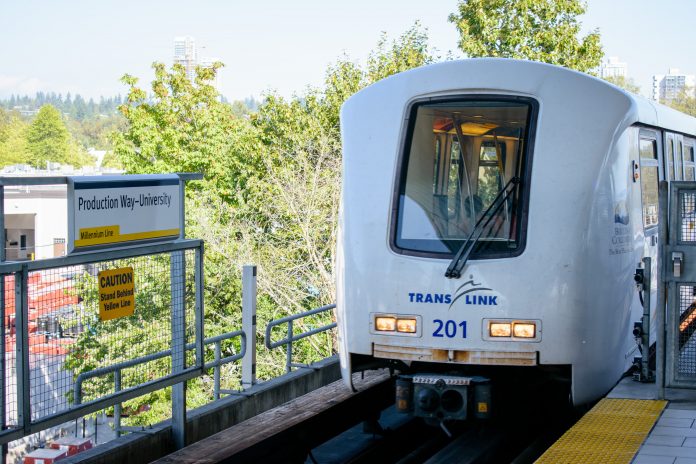
Taking the SkyTrain is one of the most common ways for students to get up to campus, as well as being much better for the environment than driving. But is it worth the risk to your own health? According to a new study, certain sections of the SkyTrain are so loud that they can cause permanent hearing damage. The issue of noisy trains had previously been ignored by TransLink, until residents living near the tracks complained — and that lack of concern is unacceptable.

Noise levels of up to 106 decibels (even louder than active construction sites) have been recorded, and prolonged exposure to this amount of noise is not only extremely annoying to listen to, but can also cause permanent damage to your ears. TransLink is advocating several improvements to our transit system (the gondola, line expansions, extra buses), however, the issue of noise has been ongoing for years now. The fact that nothing has been done yet to address it when these decibels are clearly dangerous is, frankly, shocking.

WorkSafe BC says that hearing loss can occur during prolonged exposure of just 85 decibels, and with students transiting to-and-from classes on the regular, this exposure adds up. Even levels lower than these can create health problems. Being continually exposed to noise of even 70 to 80 decibels could increase the risk of heart disease. 

So why has so little been done to fix this issue? The worst of this noise was recorded on the original Mark I cars, with the Mark III being significantly quieter. But the old Mark I trains won’t be replaced for another five years. If TransLink had any concern for the public’s health then an immediate solution should be put into place. 

Twenty percent of people in the Lower Mainland rely on transit for their daily commute. Many of those people may be unaware of the permanent damage they are doing to their hearing and the risks they are taking with their health. 

Before we can start talking about further line expansions and gondolas, TransLink needs to fix the issue of hazardous noise rather than sweeping it under the rug. However, with no immediate solution in the near future, riders should consider wearing earplugs on their next SkyTrain ride. 


Sleepless at Simon Fraser: What you can learn from Vancouver’s first Sleep Expo

1
Sleep is a key element of being a good student

According to SFU’s Fall 2018 Undergraduate Student Survey, 65% of respondents work 10–29 hours per week and 42% were involved in an SFU club.  Factor in a full-time course load and personal responsibilities on top of those students’ lives. Now consider the likelihood that they are getting an adequate amount of sleep. . . 

This is a question that will be on the minds of many people attending Vancouver’s inaugural Sleep Expo, which is part of the World Sleep Congress. Open to SFU students and the general public, attendees can learn more about healthy sleeping habits from sleep experts on Saturday, September 21 at the Vancouver Convention Centre. 

The National Sleep Foundation recommends that young adults aged 18–25 require 7–9 hours of sleep — but students rarely meet this requirement. The Foundation says, “too few of us make those eight or so hours between the sheets a priority.” 

A university student’s packed schedule  often makes it difficult for them to catch a few hours of good quality sleep. With this in mind, The Peak reached out to a few students to comment about their own sleeping habits in their personal lives. Alan Cai, a fourth year full-time economics student who works 14 hours per week, claims to only get five hours of sleep per night. He says, “I am pretty sure that is not enough sleep for me.” 

Another student, Madison Wilson, is a fourth year English major and publishing minor who works 8–10 hours a week. She is also involved with the FASS Peer Mentorship Program, participated in co-op, and believes she averages more hours of sleep than other students — she does, however, still feel she does not get enough. 

However, Jacob Koochin, a third year behavioural neuroscience major, recalls the difficult relationship he had with sleep last year in which he slept too much, sometimes over the recommended hours. He tells The Peak, “I would average twelve to fourteen hours of sleep each night.” Koochin continues by stating, “I had pretty severe depression and found out I had sleep apnea and a deviated septum.” 

Considering the lengthy amount of time that is dedicated to note-taking, lectures, studying, working, and even commuting, many students try to catch up on sleep whenever, and wherever, they can. Cai says, “I usually have classes for four to six hours straight . . . [and] when I feel deprived of sleep in the morning, I try to take some naps during the SkyTrain ride from VCC to Production [Way]. If I still feel sleepy after that, [and] when classes get boring, I might doze off during class.” 

When asked about what other factors contribute to the lack of sleep amongst SFU students, Wilson says, “I think stress is the biggest factor of not getting enough sleep. I’ll catch myself half-asleep thinking about everything I need to get done for the upcoming weeks, and it prevents me from truly falling asleep.”  

For Koochin and the situation with sleep he had last year, he says, “I couldn’t keep up with classes and would struggle to even make it to school. I believed something else was wrong and sought out all the medical help I could get.” He describes the changes he has taken to improve his life and says, “[I] am better and happier than I ever have been in my life. I feel successful as a person and husband, and I know I have the strength to pick myself out of any hole I may get in.” 

Each and every student has their own distinctive relationship with sleep; they struggle with it in a multitude of ways and by different contributing factors in their life. A study from the Journal of American College Health  says “student stress and demands may interfere with sleep habits . . . [which] in turn, lead to further problems and thus create more sleep difficulties. This pattern may become a self-perpetuating cycle that students are unaware of and may be unable to alter.” 

It is a common sight across SFU’s campuses to see people left and right with droopy eyes and firmly held Renaissance coffee cup. Yet the National Sleep Foundation further states that “it is important to note that caffeine cannot replace sleep.” And though students constantly turn to caffeine to help them last throughout their six hour — sometimes even longer — day sleep is the preferred way to recover from tiredness and rest the body. 

SFU Health & Counselling Services (HCS) suggests for students to “avoid screen-time at least one hour before you sleep,” and to “monitor your sleep using a wearable device or phone.” Daily exercise and eating nutritious meals are also recommended for maintaining good physical and mental health, which contributes to easier sleep. 

When The Peak asked Cai about his perspective on the general population of SFU students and their own relationship to sleep, he claimed that, “I feel that most of my friends are lacking sleep, but no one is really putting in effort to change it.”

Renee Boldut, a research assistant at the H-Behaviours Research Lab, has been helping to promote the event to SFU students and the community. Boldut is involved with organizing the, “How to Promote Sleep and Injury Prevention?” symposium, as part of the Sleep Expo. She said, via email, “attendees can expect lively presentations about sleep, injury prevention, how to communicate the importance of sleep [and] facilitate discussion about what can be directly applied in the community.” 

Boldut “hope[s] that students will be able to take away points about how they can be more self-aware of their tiredness and how ‘being tired’ affects their performance — and of course how they can measure tiredness and what they can do about it!” 

As stated on their website, “the congress will feature the most current, world-class scientific content in the field of sleep medicine and research,” that “bring sleep professionals from more than 75 countries together to advance sleep health worldwide.” 

The Sleep Expo event is from 9 a.m. to 12:30 p.m. with speakers from Austria, France, and Canada. Event topics include “Youth, Sleep & Drugs: Vigilance Fluctuations,” “Sleep Deprivation: The Perspective from the Emergency Room & Sleep Medicine,” and more. 

Cai, like many students, is hoping to be able to improve his own relationship to sleep. “I feel that it might have adverse effects later, which could easily be prevented [. . .]” said Cai.

 “We are all too short-sighted to see.” 

Students who wish to attend the Sleep Expo can register to attend at sleepexpo.org. 

More affordable food options need to be provided to students

0
Students in dire need can rely on a few programs to help cover basic nutritional requirements. Photo: Markus Spiske / Unsplash

The student life isn’t an easy one. Many of us have been in the situation at one time or another where we’re forced to cleverly move money around, just to make sure that all of our bills get paid on time, if only just. Sometimes, this means bringing some home-brew coffee instead of feeding that Starbucks addiction. But for some students living much closer to the razor edge of poverty, paying tuition, rent, and utilities can mean that the food budget is gutted entirely.

Fortunately, SFU has a few programs intended to assist students who have traded a full fridge for keeping the lights on. The Simon Fraser Student Society (SFSS) has a food bank program that allows students to anonymously apply for grocery store gift cards of up to $25, three times a semester. Similarly, once a week Embark gives away free fruits and vegetables that don’t meet the aesthetic standards of grocery stores. 

While these programs provide a valuable service for students who have trouble making ends meet, it’s worth taking a step back to consider the conditions that make such programs necessary. Why, in one of the richest countries in the world, are university students in such dire straits that they require assistance just to feed themselves?

To be sure, part of this issue stems from the fact that university is traditionally seen as a vehicle for social mobility, especially for those on the lower end of the economic spectrum. This subsequently means that a portion of the student body begins university from a place of economic insecurity, and therefore may struggle with the balance between the cost of living and the cost of tuition during their four year commitment to this investment. 

However, we shouldn’t discount specific, food-related economic factors that compound these difficulties for students from lower-income households. The BC Centre for Disease Control measures food security as the proportion of income it takes to purchase a nutritionally sound “food basket.” The Centre notes that the rising cost of this basket (an average increase of $45 between 2015 and 2018) predictably hurts lower income families the most. 

Students at SFU are easily able to quantify food costs against their own budgets. Affordable dining options are severely limited at SFU, with Tim Hortons providing one of the cheapest options available for food. Veggie Lunch previously also provided affordable lunch options, however the service has now been discontinued. 

While it is commendable that SFU provides emergency food aid to students in need through programs like Embark and the SFSS food bank program, it is arguably more beneficial to address issues of economic hardship and food insecurity among students before they reach the point when emergency aid is required. More affordable dining options, especially those provided by the university itself, need to be made available. Similarly, while it is nice to have a grocery store on campus, Nester’s isn’t exactly on the cheaper end of the scale. 

It is important to remember that not everyone who attends university does so from a basis of financial security. Every effort should be made to ensure that the basic necessities of life provided on campus cater to a range of economic circumstances. The existence of emergency food services at SFU highlights the absence of this range, and demonstrates the regrettable reality of food insecurity for some students.


SFU News Round-Up – Aug-Sept 2019

0
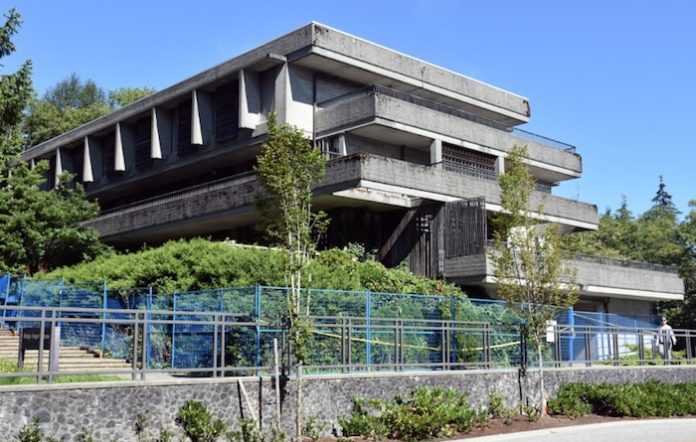
The Madge Hogarth House at SFU (photo courtesy of Burnaby Now)

SFU community discourages demolition of the Madge Hogarth House

Simon Fraser University administrators have agreed to dismantle the Madge Hogarth House which is currently located in the West precinct of the Burnaby campus. The SFU administration has decided to move forward with its decision in order to meet its plan of doubling the number of residence beds at the Burnaby campus from 1,554 to 3,250 by 2035. 

According to an article written by Canadian Architect, the university explains that upgrading the building to meet the “seismic, fire and life safety requirements is unfeasible.” Thus, the university has no other choice but to demolish it. 

However, a few members of the SFU community voiced their concerns with the university’s decision due to believing that it is a sign of disrespect to the architects, Arthur Erickson and Geoffrey Massey, who developed the architectural framework for the Burnaby campus in 1965. Certain community members worry that the new building design might not blend in with the current architecture of the Burnaby campus including Donald Luxton. Luxton sits on SFU’s campus master plan design review panel, told Vancouver is Awesome that he has “no idea how that building bears any relationship to the architectural vocabulary of the original SFU buildings.”

Furthermore, in a letter to the SFU administration, Phyllis Lambert, Chair of the Arthur Erickson Foundation Council stated  “[. . .] The Madge Hogarth House [is] one of the high points of Canadian civilization. This building is a rare example of the architects’ thought about—and execution of—communal residential structures [. . .]”.

Lambert further urged the university to seek an alternative site on campus for their plans of increased student housing, as well as designated the Madge Hogarth House as a heritage site as an important component of the SFU legacy.

New research finds Canada’s salmon population is decreasing significantly

A joint study conducted by SFU and Fisheries and Oceans Canada has discovered that over the last century, Canada’s wild sockeye population has declined by as much as 99%. 

The study was spearheaded by Michael Price and John Reynolds, a PhD candidate and a professor at the Department of Biological Sciences, respectively. Price and Reynolds analyzed a collection of fish scales that has been preserved since 1912. These scales were collected by fisheries scientists between 1912 and 1948 from commercial fishing operations. 

Most of the current data on salmon population only go as far back as 1960, due to differing technological standards, and methods of sample collection in earlier research. 

“Historical perspectives for exploited species are critical to understanding the extent of decline in depressed populations,” said Price, according to a press release from SFU. “Naturally, the better we understand the past, the more informed our decisions towards recovery will be.” 

Therefore, Price and Reynolds’s study is better able to look at longer-term trends in Canada’s salmon population than most modern research.


Trudeau’s weak showing at the G7 Summit may hurt him in the election

0
Trudeau didn’t bring home much in the way of concrete plans to help Canadians. Photo: C. Barria / Reuters

The G7 recently met in France and the summit was particularly important for Trudeau. With a federal election coming up, everyone expected Trudeau to take a strong, decisive stance on both the economy and climate change — both of which are key pillars of his re-election campaign. That didn’t really happen.

Throughout the summit, Trudeau’s overall tone was reserved. The meeting with President Trump about the United States-Mexico-Canada Agreement (USMCA) was so uneventful that it did not even merit reporting by the press. Talks about the USMCA were especially vital, given the fact that neither country has actually ratified the deal yet. Being able to push for an official ratification date within the US would have allowed Trudeau to confidently return home knowing that the US would not suddenly decide to renegotiate the deal — something that could potentially hurt Canadians.

It was also expected that Trudeau would side with Emmanuel Macron — President of France — and take a strong, unified stance against the fires in the Amazon. After all, Trudeau agreed with Macron in labelling the fires “an international emergency,” and called on the world to take action for future generations on Twitter. Climate change has been a key pillar of the Liberal re-election campaign, so leading a strong response from some of the world’s wealthiest countries would have been a major point for Trudeau. 

Instead, the G7 pledged just $20 million combined to fight the fires — a pledge that the US did not even contribute to. While Trudeau did promise that Canada would donate an additional $15 million, plus other resources, to fight the fires, many still saw the contributions as disappointing, considering that the Trudeau government actually purchased the Trans Mountain pipeline earlier this year for $4.5 billion. This directly counters the party’s commitment to initiatives that promote clean energy.

Both the economy and the environment are major talking points for Trudeau and are areas where he has promised tangible change. Seeing a relatively reserved attitude being taken with some of Canada’s allies should be of concern for voters in the upcoming elections. These are issues that require collaboration and discussion. If Trudeau does not feel comfortable pushing for meaningful change and results by discussing said issues with Canada’s closest friends, voters should wonder if he will be open to discussing them with the Canadian public.


#AllTheRagrets: What SFU students wish they knew in their first year

Photo: Chris Ho / The Peak


What I wish I knew as a baby SFU first year is . . .


… you are going to be bad at university at first, and that’s okay 

My high school teachers and parents had pegged me as a really curious and academically-minded kid with strong writing skills. And they were right, I do like the rhythm and work of university. However, breezing through high school and all of this encouragement didn’t really prepare me for sitting in front of a nineteenth-century German essay on literary theory and thinking ‘I don’t know what I’m doing here.’ It didn’t prepare me for taking courses outside of my comfort zone and having no idea how to study for them, getting stuck on term paper prompts, or picking myself up after bad grades — which, in my delusioned brain, was a B. I convinced myself that if things didn’t come easily to me, I wasn’t meant to be here after all. Because I wasn’t used to doing it, I was operating under the false impression that there was something shameful in seeking help and had no idea how to ask.

The bravest thing I did in university was ask for help — I took a walk to a professor’s office to ask a question about a term paper, scared of what she’d say when she saw that I couldn’t figure it out on my own, and was instead greeted with kindness and offered tea. And you know what? That essay got an A. This summer I registered with the Centre for Accessible Learning to cope with an injury and I passed all of my classes. There are some things you can’t do alone and that you aren’t supposed to. — GM 


… running from Quantitative Courses will only make school harder 

Look, I’ve been an SFU student for almost six years now. Something that haunts me to this day, an obstacle that I wish I had dealt with way back as a lost and confused first year, is this: you can’t run away from the courses you fear — namely, quantitative courses. Yes, it’s true. I am, based off of credits, a fourth year student, but I consider myself a sixth year because I’ve been here for that long. You would think that at some point this English major would have attempted to tackle even one quantitative course — but no. I’ve been running from these demons for years now and I’m at a point where I only need five courses to graduate — except two out of those five are unfortunately quantitative requirements and, as this is written, I still am not enrolled in a quantitative course. Conclusively, I wish I knew that quantitative courses can and will haunt you until the very end, and it’s better to deal with anxiety-inducing courses sooner rather than later so that you’re not a sixth year reluctantly quaking in your boots in a toss-away first year math course on shapes. — JB 


… the most essential skill at university is time management

When I first entered SFU I thought that the only way to do well was to attend every class, write down everything the professor said, do all of the readings, all of the homework, and all of the supplementary work as well. I thought success meant staying up all night before an exam surrounded by empty cans of Red Bull, and that if I wasn’t devoting every waking minute to studying, I wasn’t doing university right.

I soon learned that this is a recipe for a quick burn out and that, in fact, the first thing any university student should dedicate themselves to learning is time management. This involves figuring out one’s own pace and best way for studying. It sometimes involves deciding which assignments are and are not necessary to enhance understanding. Additionally, it means figuring out how best to absorb lectures. But most of all, it requires balancing time for studying and time for one’s own personal needs. Some of the most important things we learn at university aren’t on slides or in lecture notes. One of those things is learning to prioritize our time to work smarter, not harder. — NM


… joining SFSS clubs = making friends 

Joining a club makes your university experience that much richer. And let’s face it — SFU is a commuter college. Burnaby campus is a little over 50 years old, we have three sprawled campuses, and our main one is on top of a literal mountain. I originally thought there was no campus life whatsoever at SFU. So for me, it was very easy to join the Stay-Home club (wherein all you do is go to your classes and you go straight home). I remember going ‘round Clubs Days, feeling desperate to make some friends, but too anxious to actually approach any of the clubs. My first semester at SFU was a pretty lonely one. It wasn’t until my second semester that I took the plunge and joined a music club that a tutorial friend roped me into. I didn’t know anything about music, but I knew clubs = people. Somewhere along the way between SkyTrain rides home, hanging out at club events, grabbing lunch with fellow execs, etc., I made friends. Obviously there is no foolproof way to make friends. But here at SFU, I wish I had known sooner that just putting yourself out there and joining a club is a great first step for making friends. — WY


… on-campus jobs are a great way to make some $$$ and get involved!

I’m kind of cheating at this, because I actually got my on-campus job in the first month of my first semester at SFU. However, over the years I’ve spent in school, I’ve been shocked at how few students know about the endless job opportunities SFU offers. The job postings span all three campuses and all kinds of departments — the bookstore, Student Services, housing, IT Services . . . You could even get a job in your academic department, which opens up a lot of networking opportunities. There really is something for everyone, whether you’re looking for something entry-level or you’ve already got some work experience under your belt. The benefits are also plentiful: the pay is well above minimum wage, the hours are flexible because your employer knows you’re a student first, and you might even qualify for a — gasp — partial tuition waiver. If you’re okay with spending a large part of your existence at SFU, then an on-campus job is the best way to make money, get involved with the school, and maybe even make some friends. — AR


… financial aid is available; use it!

When I started university, I naively thought that I would never use the financial aid program. I’d heard all the horror stories about adults going into debt over student loans, and I swore that would never be me. I was very fortunate and privileged to not have to take out said loans. But then I applied for my first credit card, and proceeded to set a very poor example of financial management for my future child. By third year, it looked like I would need some of those loans after all. With an extremely average GPA, no outstanding community activism or extracurriculars on my resume, I was doubtful of my chances at a scholarship. Luckily, someone told me to apply for a student grant instead, and suddenly I had enough money again. The threshold for the part-time study grant is pretty attainable for anyone not working full-time, and since most people end up taking a part-time course load at least once a year, that’s a pretty good way to pad out your bank account consistently throughout your degree. And of course, now that the provincial government has eliminated interest on all BC student loans after February 19, 2019, borrowing some money isn’t too bad of an option either. Just watch out for the Canada Student Loan portion if it’s applicable to your loan; interest will still be charged on loans issued by the federal government. — CH


… talk to the people in your tutorials

Making friends in your classes is probably one of the most beneficial things that I have ever done at SFU. Not only does it make showing up to class slightly more enjoyable, but it helps you immensely if you’re ever ever are sick or “accidentally” forget to show up to class. Back in my first year, I was terrified of talking to anyone. SFU seemed so big. Since SFU had a reputation as a commuter school, I felt like everyone went for their classes and left immediately afterwards. It wasn’t until probably my second semester that I decided to actually talk to someone and make an effort to be friends. All of a sudden I liked going to classes, and having friends in said classes helped me be less anxious at the beginning of the semester. Tutorials were a lot more fun too because I would be more confident to actually participate rather than watch The Office by my lonesome self in the corner of the room. While making friends is easier said than done, I really wish I had made the effort in doing so when I first started at SFU. At the end of the day, almost everyone is waiting for someone to make the first move. So don’t worry and just go for it! — MO