Home Blog Page 468

What grinds our gears: Do us all a favour and stay home if you’re sick

0
You and your are cough harbingers of death! Illustration: Sabrina Kedzior/The Peak

Dear Typhoid Mary,

You know who you are. You’re the one who comes into class with a red nose and black-rimmed eyes, sits down, and immediately starts producing the deepest, wettest series of coughs that would make even a plague doctor cringe. To you, Typhoid Mary, I have only two words:

Stay. Home.

The world is not going to end if you miss one week of class. Think about it — half of your peers vanish at week four only to be seen briefly again on exam days, and they somehow manage to pass. If they can miss whole months and be fine, I’m sure your GPA can take a single week’s absence.

I’m going to let you in on a secret, Typhoid Mary: some of us actually can’t snap back as quickly from seasonal illnesses as you can. Some of us have compromised immune systems, and that cold of yours that could be solved with a day of bedrest and Netflix can mean serious and lengthy complications for us.

So with the deepest sympathy to your long-suffering work ethic, please stay home when you have the sniffles. Stay home if you have a fever. Consider grabbing a flu vaccine to avoid having to make these oh-so-tough decisions in the future. No one wants what you have, and you don’t want to be that kid in class everyone hates for spreading H1N1 v2.0.


Election rundown: The NDP have little chance of winning a majority and should focus on a coalition instead

0
NDP leader Jagmeet Singh has had to overcome a lot this election season. Photo: Adrian Wyld/The Canadian Press

Jagmeet Singh and his New Democratic Party are riding the perpetual struggle bus. The troubles for the NDP initially began with difficulty attempting to nominating candidates across the country, and continues in the form of a crippling deficit that makes running a successful campaign much more difficult. The party’s $1.4 million dollar deficit for 2018 is not a good look for Singh and his party, as they claim to be competent enough to balance the national budget and run Canada’s economy. However, I suppose a lack of appeal is an inherent quality of the NDP more generally, being that they have never won a federal election

Given that the NDP have done a relatively poor job at managing their finances, they have had to modify their strategy and budget what resources they have available. For example, the federal NDP campaign (which launched out of Ontario) has had to rent a plane by the hour instead of purchasing one, as is standard. Their financial dilemma, in addition to making it more difficult to travel, has also forced Singh and his campaign to depend on more creative and nuanced outreach approaches, such as running more targeted digital advertisements to disseminate their message to Canadians. 

As for their initial struggle to nominate candidates, the NDP cited equal representation and a rigorous vetting process as their reasons. This is a valid point as the vetting process has undoubtedly been made a much more arduous task, given the ubiquity of social media and the long-term effects that negative content could have on potential candidates’ political careers. The necessity of equal representation within the party is also unequivocally important. However, although the NDP struggled to secure candidates in the beginning, they have now managed, surprisingly, to fill all of the ridings across Canada.

Clearly, the results of their campaign strategies have not manifested in a positive way as they are not making marked advancements in the polls; they have been hovering around 14% since mid-June. This is in part due to the fact that they aren’t really doing anything out of the norm in terms of marketing themselves. They are simply spending less money on travel and advertisement — the NDP spent approximately $130,500 on Facebook advertisements, compared with the Liberal’s $692,600, and the Conservative’s $438,500. 

What is evident from their standing in the polls is that the NDP are having a difficult time competing in this election cycle. The NDP’s struggle to nominate candidates in the months leading up to the campaign and their financial woes have made their objective to win a majority government seem rather unlikely. 

Nevertheless, they are very much still in the game if there is an opportunity to form a coalition government. This should be Singh’s objective instead. Rather than going at it alone, as he has previously expressed, Singh would be in a better position if he were to demonstrate that his party’s platform could mesh well with the Green and/or Liberal parties. Although they differ on some issues, relative to the Conservatives, the Liberals, Greens, and NDP are more alike than they are different. 

Dear grad admissions board: my failed courses are non-canon to my personal narrative

0

To Whom It May Concern,

It is my great honour to recommend myself, Jake Jacksonian, for SFU’s Graduate Program in the Department of English. Yes, I know you already have my personal statement, which described at length my research interest in the rhetorical devices of the “why you always lying” Vine. Yes, I also recognize that submitting your own self as a reference for these applications is a little #quirky. But after knowing and working with myself for 26 years, no one could be more qualified than me to explain — again — why I deserve to be here. 

Looking for generic platitudes about my work ethic, my class participation, or my bubbly disposition? Read my other two reference letters, the ones I so lovingly schmoozed out of my sessionals through weekly SFU Mail correspondence that was one-way for most of last semester. No, this reference letter is to offer you insight into a very particular slice of my life — a close reading, if you will, of the semester where I achieved a 0.0 GPA.

To unpack, my refusal to attend any lectures that tragic autumn was hard to grapple with. My total disregard for my early morning tutorials, start times ranging from 8:30 a.m. to 3:30 p.m., was difficult to field. The emotional deficiencies that led me to skip every exam and ignore my kindly professors’ concerned emails? Truly rude. 

But I’m better now. Because those five failed courses? I’ve declared them to be NON-CANON to my personal narrative.

You see, after a long self-structured programme of inspirational YouTube videos and Lululemon commercials (as a BC resident, it was my most fiscally responsible therapy option), I realized that Susan C. Young and 30 knockoff Medium articles were right. I really WAS the author of my own life story. And if I learned anything from J.K. Rowling, it’s that authors can totally go back and rewrite the details of their story universe however they see fit. 

And so, you can rest easy: I’ve decided that the 2015–2016 chapters of my life, controversially bad grades and all, have no bearing on the greater Jake Jacksonian timeline. All the character backstory explained there that doesn’t align with the personal work/school timeline I outlined on my CV? Retconned to Westeros and back. The out-of-character behaviour? Blame that on the tight publication schedule and my terrible editor (thank you, general academic advising!). The traumas that should have had a lasting effect on my psyche but which were never addressed or mentioned again? Those are actually still around, but any English professor would agree that, as an author, I’m not here to spoon-feed the answers to you.

I’m sure some of you will now take to Reddit, a fanfiction.net reviews section, or some backwater forum, where you will go on to debate this non-canonicity revelation with complete strangers and post nostalgic fanart of an empty seat in C9001. I give you my blessing on that. (Wouldn’t such a gracious individual be a wonderful addition to your program?) 

But after that, I hope you’ll take some time to admire the artful, canonical self-identity I’ve cultivated for myself. The immaculate 2.005 GPA. The adorable plastic-wrapped bullet journal I have carried unused in my bag for three years. The contributions to my SFU community which I’m so very passionate about, like my on-and-off job as a Supreme Marshmallow Roasting Educator. 

I have a deep respect for myself and my scholarship, and I am confident that I will be a thriving asset to your department. I highly recommend myself to your program. Please feel free to contact me about any points of clarification you may have; I promise to respond to you much faster than my other references ever could, that’s for sure.

Kind regards,

Jake Jacksonian

Written by Zach Siddiqui, Humour Editor

SFU should follow in Oregon’s footsteps and grant mental health absences to students

0
Basic activities can be a struggle for students suffering from poor mental health. Photo: Dmitry Schemelev/Unsplash

For students suffering with mental illnesses such as anxiety and depression, university — and life in general — can be extremely overwhelming. As someone with an anxiety disorder, there have been multiple days when I wished that time would just stop so that I could breathe for a minute. For students like myself who find they also need a much needed break, school-sponsored mental health days can help. 

A new state law passed in Oregon allows students “up to five excused absences within a three-month period” for mental health-related reasons. Rather than simply skipping school and potentially facing grade-lowering sanctions, students in Oregon now have the option to make up assignments at a later date. While students may use this as a free pass to cut class, it’s no different than cutting class on the pretext of physical illness — something students do now, anyway. 

BC should absolutely follow Oregon’s lead. Having the option to take an excused absence would mean that students wouldn’t have to drag themselves through an unproductive school day when their mental health is in a poor state.  As of 2016, 20% of post-secondary students in Canada deal with anxiety, depression, and other mental health issues. Students suffering from adverse mental health need to be assured that their struggles are taken just as seriously as coughs and fevers already are.

Studies have shown that pushing through classes when dealing with mental health concerns can be detrimental and in fact counterproductive. Everything needed for success at university, from energy to cognition, can be greatly decreased when students are not in the healthiest headspace. Decreases in performance due to the symptoms of poor mental health can lead to lower GPAs and subsequent decisions to drop out of school or take lengthy absences. In allowing sanctioned days off to recuperate their mental health, students may be able to avoid some of these hardships. 

Treating mental illnesses requires multiple supportive measures, and while current services like My SSP are appreciated, they are not enough to adequately address the issue for many students. It is necessary to take legislative steps in order to ensure their continued well-being. Taking care of students’ mental health is just as important as taking care of their physical health.  

However, it’s important for students to remember as well that these days off cannot act as a substitute for professional help if chronic mental health issues are interfering with their lives.

SFPIRG hosts “Putting Students back in SUB” workshop

0

Editor’s Note: This article is a recap of an event that occurred on campus. The discussion that occurred represented one specific point-of-view of events related to Rotunda groups and the SUB. 

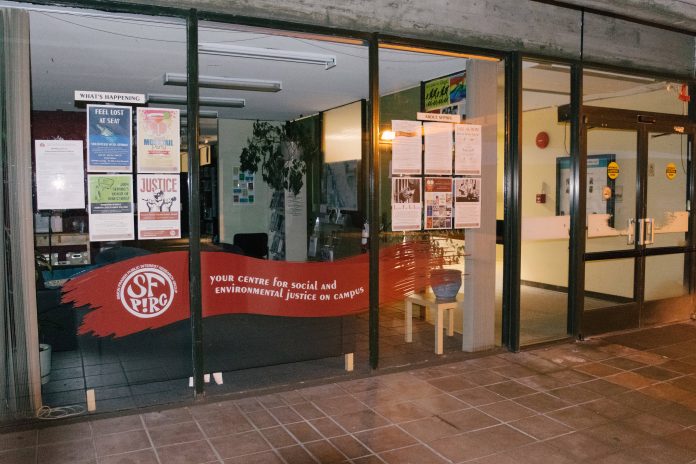
SFU’s long-awaited Student Union Building (SUB) has been the source of much controversy, as previously reported by The Peak. The Simon Fraser Public Interest Research Group (SFPIRG) recently hosted an informational session titled “Putting STUDENTS Back in ‘Student Union Building’” as part of its Dis/Orientation Week 2019 — an alternative orientation week of events intended to offer critical analysis, insight, and research about a range of social and environmental justice issues to the SFU community.

The SFPIRG is a student-funded resource centre dedicated to social and environmental justice. SFPIRG’s Director of Communications, Craig Pavelich, hosted the presentation on Thursday September 19 in the SFPIRG lounge. This event’s aim was to inform guests on the history of the SUB and why multiple student organisations are at risk of displacement from campus. Pavelich, a long-time campus presence, is quick to emphasize that the presentation is his interpretation of events, and should not be seen as the official position of SFPIRG.

Pavelich recounted the following history of the SUB:

In Spring 2012, the Simon Fraser Student Society (SFSS) held a referendum asking students to fund a new Student Union Building and Stadium. After it passed, the SFSS and SFU began working on the $65 million project called ‘BuildSFU.’ BuildSFU invited the Rotunda groups to discuss their organisational needs in the SUB in order to accommodate them accordingly in June of 2014 . The Rotunda groups include SFPIRG, Out On Campus (OOC), The Women’s Centre, The First Nations Student Association (FNSA) and Students of Caribbean & African Ancestry (SOCA). These groups were all subleased their current spaces in the Rotunda by the SFSS Board, to whom SFU leased the rotunda.

He explained that in Spring 2015, the Rotunda head lease between SFU and SFSS was renegotiated, so that the lease’s end date was set in the same time period as the SUB’s initial opening in Fall 2017. This was based on the understanding that Rotunda groups would be housed in the SUB, according to Pavelich. Later, due to various construction delays, SFU extended Rotunda head lease to a month-to-month basis until the SUB was completed. 

However, Pavelich noted with serious disappointment, “[In] November 2017, SFSS management and Board members met with Rotunda groups, telling them that they would not be [given space] in the building. Instead, they would be using a shared space model to give bookable space to clubs and student unions.” 

He adds that the Rotunda groups “asked SFSS to honor what they led everybody to believe over the years — to put everybody in the [Student Union] building.“

However according to Pavelich, there was little dialogue. “[The SFSS] invited groups to attend their board meeting in September 2018 to talk about the space issue. They indicated that they would continue to meet and dialogue with the groups. Despite requests from us to meet, as they said they would, they never replied. . .” He adds that in November 2018, SFPIRG received a message declining the invitation to meet, as they had “come to a decision in terms of space.

“No public discussion or decision about the space had ever occurred. There’s nothing in their minutes, it was all in private.”

Sharing recent updates with the audience, Pavelich said “In Spring 2019 a new Student Society board was elected. In May of this year, their new President, Giovanni HoSang, put forward an alternative shared space model, which would put all Rotunda groups into the SUB. [But] they didn’t have a decision about it yet.” 

He further added, “In Summer ‘19, reps from student society board and management met with Rotunda groups to discuss their space needs. We were told that this was for the new ED’s [Executive Director] benefit so that she could learn what’s going on. We have asked to meet with them to continue that conversation about putting everybody in the space. We have not heard back from them.”

Pavelich expressed serious concern about the precarious housing situation of Rotunda groups. “SFPIRG, CFSF, [and] SOCA are at risk of being pushed off campus.” he said. He encouraged students to be more proactive about Rotunda group’s housing crisis and to voice any concerns to SFSS Board members. 


39th Annual Terry Fox Run connects SFU community

0

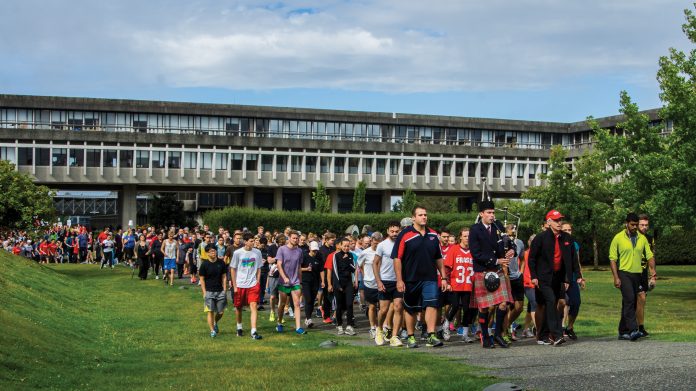
At the 39th Annual Terry Fox Run at the SFU Burnaby campus, Convocation Mall hums with anticipation as a hefty group of runners and walkers stood together to fight against cancer. SFU hosts the event every year in honour of former student Terry Fox, the renowned athlete who became world-famous during his Marathon of Hope. Fox aimed to run across Canada to raise money for cancer research on a prosthetic leg that he was given after his leg was amputated. Though Fox didn’t make it all the way across Canada due to the recurrence of his cancer, his impact on cancer research was much bigger than just that one run — his Marathon of Hope has continued every year since.

SFU president and vice chancellor Andrew Petter says a few words before the run begins. At a podium, Petter reports that over 150 volunteers are involved in the annual run this year. Despite the run conflicting with the Climate Strike, the turnout is impressive. With over $9,000 raised in funds for the 2019 run, SFU community members proved that they do not intend to slow down in the race to beat this devastating disease. 

“I love this event not only because it brings out such great, enthusiastic people, but because it speaks to the spirit of SFU. It really shows that we are Canada’s engaged university, and that we are prepared to come together to raise funds for cancer research,” Petter says. His voice booms from the speakers facing the participants. Sunlight peeks through the bars overhead, promising great weather for the outdoor run.

After the speech, the coveted SFU Terry Fox Gold Medal is awarded.  It includes a plaque, $5,000, and a medal awarded to SFU undergraduate students who “demonstrated those personal qualities of courage in adversity and dedication to society,” according to SFU’s website. Two women, Laura Gutierrez and Anne Peirce, are awarded by Andrew Petter. This is the first year since 2001 that there were two recipients of the award.  

Following the awards, the MCs invite up the SFU cheer team and warm-up leader to get the crowd going. Pop artist Lizzo begins to blare over the speakers, encouraging the crowd to move. Once the warm-up exercises finish up, it’s time to run. The group moves to start by the Terry Fox statue that overlooks the AQ reflection pool. Around 1 p.m., the run starts.

As the group passes by the Autumn trees changing colours all around Burnaby campus, the pleasantly surprising blue sky above and warm weather urges the race along. Runners and walkers old and young followed the route. Some participants brought their furry friends along for the fun. Signs with photos and facts about Fox encouraged the runners along the route. The energy of the diverse group of participants was high as many people from all walks of life gathered for the cause. The run concluded at Terry Fox Field with participants of the event boasting sweat on their brows and smiles on their faces. 

“Even if I don’t finish, we need others to continue. It’s got to keep going without me,” Fox said during the Marathon of Hope back in 1980.

To learn more about the cause and why it matters to run, visit the Terry Fox Foundation website. The Marathon of Hope continues each September as participants carry on the tradition, each for their own reasons. With over $170 million raised by the Terry Fox Foundation, this past SFU student’s legacy lives on through continuous research working towards a cure.


Another new hot spot for food on campus: Taco Cantina

0

“No! Move it up! Swing! To the left!” 

 “Down, down, down! There! Hit it!” 

 “Oh no! You were so close!” 

 Do you remember these voices when you were five years old? You were blindfolded, holding a long, colourful stick. Someone then spun you around three times and told you, “go!” With three chances, luck, and a little bit of peeking, you flung the stick in the air hoping to hit the piñata and be the one to crack it open with the colourful, sweet, and sugary candy falling down to the floor. 

Students were able to relive this wholesome childhood activity this past week when SFU Dining Services yet again opened a new restaurant in James Douglas, Taco Cantina. Though they started serving their food in August, the new Dining Hall Marketing Manager, Carol, says they did not want to interfere with the opening of celebrity chef Vikram Vij’s new restaurant in Mackenzie Café that opened weeks prior. Taco Cantina wanted their own time to celebrate their opening. Furthermore, Carol also pointed out that there is a substantially number of students on campus in the summer, so fall seemed to be the perfect time to open and celebrate Taco Cantina – which replaced Junction 66, a fast food restaurant which served burgers and poutine.

To celebrate their grand opening, Taco Cantina offered prizes and activities for students in attendance. They decorated the restaurant with hanging piñatas, banners, and balloons. From 10:30 a.m. to 2:30 p.m., they offered chances to win $50 worth of Dining Dollars which can be used at any food spots on campus. Locations where Dining Dollars can be used include Tim Hortons, the Dining Hall, Mackenzie Café, and Taco Cantina itself.  

Taco Cantina also provided three piñata parties throughout the day where students passing by or studying in the cafeteria can participate in taking a chance to break the piñata. And as the piñata received hits, Nerds, Rockets, lollipops, and other candy fell on the floor, where anyone was welcome to grab as much candy as they could. Like Charlie in a taco factory, one lucky kid could find the special piece of candy that tells you how to claim their Dining Dollar prize. 

The sound of the plastic ticker on the prize wheel hitting the pegs rang throughout the day, while students enjoyed free samples of Taco Cantina’s food. One prize winner said they’ll use their dining dollars to buy, “coffee, coffee, and more coffee.” 

With inspiration from Mexican culture, Taco Cantina offers taco salad, crudo nachos, tortilla soup, rice pudding, mini churros, Mexican coffee, and jarritos. From beverage drinks to food items, the price ranges from $1.69 to $9.99. Offering vegetarian and gluten-free options, Taco Cantina made an effort to include dietary options for students on campus. 

Say goodbye to Old el Paso, and say hello to Taco Cantina which is open Monday-Thursday from 9 a.m.–6 p.m., Friday from 9 a.m.–4 p.m., and closed on the weekends. 


SFU students in the Global Climate Strike

1

Body to body, jostling, jampacked, and barely enough room to move. It’s warm, despite it not actually being a warm day, and you can feel the hot breath of the person behind you, quite literally breathing down your neck. But, then again, you’re doing it to the person in front of you. Endless crowds of people as far as the eye could see fill Downtown Vancouver. It’s Friday September 27, in the afternoon. You should be at school or work, but instead you pound the pavement with hordes of others, chanting along to “WHOSE STREETS?! OUR STREETS!” 

And why are you out here on a school day? It’s damn hot and uncomfortable, but the Earth is burning anyway and you give a shit. Hundreds of thousands do. My name is Kelly Chia, but today I have no name. I subsumed my individual identity to the collective mass of people who hit the streets because they give a crap, taking a scorched earth, set-fire-to-the-sky approach to the scorched Earth and the burning skies. The Global Climate Strike took a fierce group of many thousands from Vancouver City Hall after a 3km march across Cambie Street Bridge to West Georgia and Hamilton street. 

Many SFU students gathered to join the Strike on Friday, however SFU did not grant blanket academic amnesty to students like some other schools did. SFU President Andrew Petter made a statement on the strike on September 20, saying that SFU “supports members of the university community engaging in activities related to climate change [ . . . ] Thus while the university will maintain regular operations throughout this period, we encourage faculty members and academic units to make accommodations for those who wish to engage in Strike activities.” Following this, SFSS made a statement that they reached out to all department chairs, requesting them to not penalize students. SFU 350, a club pushing for climate action, also wrote an open letter to SFU urging them to follow in Emily Carr University’s footsteps and grant academic amnesty, allowing faculty and TA’s to join.

In the SFU Goldcorp building, a group of contemporary arts students gathered, organized by Laura Marks and Ed Biddle, professors at the School of Contemporary Arts. Earlier in the week, Marks had previously done a lecture about streaming media’s impact on the environment in her “Teach-in for Global Climate Strike Week.” Before the strike, Biddle, Marks and their students got together to make signs. The Peak spoke to Marks and some of the students that had joined to ask them what the strike meant to them. 

“I hate it when people from my generation say the youth environmental movement gives them hope. It’s so unfair. We need to do our own activism and create reasons for the young people to hope that the climate will survive, including things young people can’t do, like making sure our pension funds are not invested in fossil fuels. That said, I love that we professors can make a framework for our brilliant and angry students to do creative activism,” Marks said, on the impact of her activism as a professor. An hour before we left for the strike, students were sprawled on the floor or on the tables to finish their signs. 

The room pulsed with the urgent creative energy that only arts students can generate. Yet, as Marks pointed out, the energy was channeled towards productive solidarity. This was true with the students I spoke with.

Sage, an SFU student, said, “For me, I grew up in a small town in rural Alberta, and I think that a lot of the argument was whether climate change was real or not . . . and I feel at this point in my life, it doesn’t matter if people don’t believe in the science, it’s just important to take action right now. The dominant paradigm in Alberta right now is that it’s not something that’s important to us, we’d rather care about the economy.”

For some students, being in such a large group is empowering. The group at Goldcorp not only consisted of SFU students, but some high school students who had come in support of the Strike. 

“This strike will be a very good way for us to show everyone just how much the climate means to us,” said Riley, a grade 11 student from Cariboo Hill Secondary. “Maybe it’ll show more adults [. . .] how much this matters to us [. . .] I think this many people coming together to show just how much it means will affect everything.” 

Altogether, Marks estimates that the Contemporary Arts group had 75 people. Embark Sustainability, a non-profit student group at SFU, had coordinated a meet up for SFU before their march to City Hall. They estimated about 500 students, staff, and faculty had met up to join the Strike. The Facebook page for the Global Climate Strike estimated 11,000 attendees would join the march. As the day drew on, that number grew to 80,000, then over 100,000. On the street, the numbers didn’t matter though. It felt like an ocean of people with the energy of a tidal wave that could topple governments, and the current moving fast towards a more sustainable just world.

As the group prepared to leave, we decided on a collective chant: “We want you to panic! Help save the planet!” Among signs that read, “Will you fight with us? Or lay down and die?” and “There is no Planet B,” our group marched forward to Waterfront station, then rounded the block before going to City Hall.

“Just the spirit of people coming together, and voicing their concerns. I’d feel complacent if I didn’t join and it [feels] really good to be vocal on the streets,” said one attendee Meghan Hill, of the feeling in the air that day. 

As we turned the corner, our excitement grew as our little group joined and became just one of the many in the jostling and screaming masses of people gathered today, all demanding justice and a sustainable future. I was one of them. 

My name is Kelly Chia. But today I have no name, for I was one of the many, the faceless masses demanding justice for the scorched Mother Earth and the burning Father Sky.




Seven furious notebook scribbles from the SFSS federal election debate

0
Three candidates appeared at the October 3 debate. Image: /Simon Fraser Student Society

Earlier this month the Simon Fraser Student Society hosted a debate for three of the candidates running in the Burnaby North-Seymour riding. I think it’s fair to say that the event was far more entertaining for those who attended than anyone expected — especially for local politics. 

New Democratic Party candidate and clear fan favourite Svend Robinson came to the debate with both charm and proverbial knives, while incumbent Terry Beech fought a losing battle to defend the honour of the Liberal Party. Meanwhile, Green Party candidate Amita Kuttner bonded with the audience over post-grad trauma. Recently disavowed Conservative candidate Heather Leung didn’t show up at all. What follows are some of my witty observations, interpreted from the mad scribbles in my notebook.

  1. Terry Beech starts strong by telling a room full of university students that they can’t have free tuition. This was perhaps the boldest gamble of the night and it did not play well. Credit given to the audience for not slinging any tomatoes; who can afford to waste good produce? But even if they had, Beech probably would have shielded himself with his economics degree. I understand that fiscal responsibility is something that politicians have to keep in mind when campaigning, but it probably wasn’t the best idea to tell a group of students who just lost a hard-fought battle against tuition increases that if everyone could attend university for free, their degrees would become worthless.
    Honestly, the fact that many employers now demand a four-year degree at minimum speaks to the insane ways that society both privileges and maintains wealth at the very top. I’m sure if we somehow managed to help anyone who wanted a degree to get one we could also come up with a way to make sure everyone has a good job. We as a society forget sometimes that these economic barriers are human made, and can therefore be changed by human initiative. 
  2. Svend Robinson shivs his opponents and the crowd goes wild. The fact that Robinson is a seasoned politician was starkly obvious next to Kuttner who, while having several attractive policies, lacked the experienced political rhetoric to really make them shine. However, Robinson reserved his most cutting verbal attacks for the embattled Liberal MP, calling out Beech and the ruling Liberal government as though the debate would be won by the candidate who landed the sickest burn. This sort of old school political bombardment had the potential to grow old quick with a crowd saturated by the vitriol leaking out of the political scene to the south; however Robinson saved himself by confidently laying out his policies in contrast to those of the Liberals — policies that were undeniably well-received by the audience.

  3. Beech casually name-drops Oxford and Harvard and suggests that an SFU degree can get you there too! After his comment implying that the value of university degrees should be preserved by enforcing financial barriers, this just smacked of such privileged elitism that even the audience didn’t know what to do — and so defaulted to polite applause. In the background, the sound of Robinson gleefully sharpening his knives could be heard. 
  4. Amita Kuttner calls for the dramatic overthrow of capitalism and colonialism (sorry not sorry). Aside from the heartfelt stories they shared about their struggles throughout their post-secondary experience, by far Kuttner’s biggest and most successful talking points were about the necessity of rethinking our relationship to both our economic system and our settler-colonial history and society. Unsurprisingly, coming from the Green Party platform, Kuttner based these policies on the urgent need to address the climate crisis, with special emphasis on the historic role of Indigenous peoples as the stewards and protectors of the land. Personally, if Kuttner is leading the way for a complete overthrow of our political and economic order in order to buy us a few more years of breathable air and clean water, I’m here for it. 
  5. Business, economics, and the natural sciences are the only majors worth talking about, apparently. All right, this critique might be a bit unfair given that the candidates (Beech and Kuttner specifically) were speaking out of their own educational experience, but as someone studying in the social sciences, it always rankles a little to feel as though my study field is undervalued. This is neither the time nor place to launch an impassioned defence for the arts, humanities, and social sciences, however it would have been nice to hear the candidates talk about the holistic value of the university, and not speak as though only a handful of majors actually even exist here. 
  6. Heather Leung’s absence starts to feel like a strategic move for Conservatives. Setting aside the anti-LGBTQ2+ rhetoric that got Leung kicked out of the Conservative party (and which likely played a large part in her refusal to attend the debate) her absence definitely hurt the Liberals more than the Conservatives. Without a candidate sitting to the political right of Beech, the Liberal MP limped through the debates dragging the baggage of the entire Liberal Party behind him. Coupled with the debate taking place at a predominantly left-leaning university, Beech ended up looking like the furthest right candidate on stage by a large margin. Given that the Liberals are the biggest competition of the Conservative Party at the moment, Leung’s absence was definitely a net-win for the Conservatives. 
  7. The pipeline was a big mistake, no contest. Both Robinson and Kuttner pounced on Beech over Justin Trudeau’s decision to purchase and subsequently approve the Trans Mountain pipeline for $4.5 billion in almost the same breath as calling a national climate emergency. While the audience waited on baited breath for the ensuing bloodbath, Beech countered with his own record challenging the prime minister on the issue of the pipeline. For all the rest of his hiccups that evening, Beech still managed to successfully stand on his commitment to listen to and bring forward the concerns of his constituents. For that, neither the NDP nor the Green candidates were able to take him down.

Overall, the debates brought up several issues deeply important to many students studying at SFU. The audience was engaged, and the candidates thoughtfully and respectfully responded to the questions, and to each other. Political engagement is important for a healthy democracy. It was nice to see so many students had come to be a part of the event, and that the candidates took the time to listen to our concerns and considered them seriously.

Oh, The Places You’ll Go (Before and After you Convocate)

0

Oh, the places you’ll go!

(Unless there is snow.)

. . . 

Congratulations on gradu-waiting,

it only took you six years.

From construction that’s deteriorating

and destroying your ears,

to crowded lines at the 145.

(When will the gondola arrive?)


There are some things you won’t miss,

Like Beedie-branded bottles

and staring into the abyss.


What about April Fools’ Day,

when we farted in Convo Mall and walked away?

Or those posters about some Club Crawl,

and Naruto-running to class in the AQ hall?


Don’t forget searching for microwaves on campus,

and bros dropping loud weights at the fitness centre.

Or finally breaking a sweat to make the bus,

only to be forbidden to enter.


But other things you don’t mind,

like earning tons of likes and shares on a meme,

and raccoons eating all the trash they can find

(AKA the piece of paper you call your degree).


Oh, the places you’ll go!

(But don’t visit the avocado.)

From the shuttle to the SUB,

and don’t forget the Anime Club,

SFU does many things to engage —

remember that when you cross the stage.