Home Blog Page 455

Canadians, overseas wars are too heavy for your jokes

1
Make peace not memes. Stock courtesy of Rockstar Games

Don’t get me wrong. I like memes just as much as the next Gen Z/Millennial youngling. Two identical Spider-Men pointing to each other? That’s my shit. Joking about SFU’s lack of adequate response to snow? Chef’s kiss. But when I see memes that joke about WWIII, I am appalled. Not simply because of the serious possibility of a war happening in the Middle East, but because of the enormous amount of privilege that creating and sharing these images demonstrates.

Recent conflicts between the United States and Iran have sparked a flurry of #WWIII content across the internet. There are constant tweets joking about being drafted into war. Meanwhile on Facebook, SFU’s own Dank Memes Gang have posted multiple memes about student conscription. These images fly in the face of the real human costs of war around the world, while at the same time flippantly flaunting the fact that conscription hasn’t been a part of Canada’s military agenda in generations. 

This country has had the luxury of not being an active target in recent wars. Canadian civilians can watch newsworthy aerial highlights of dropped bombs safely behind their screens, without having to experience or even witness the micro-level human carnage on the ground. How can people joke about a war whose effects would most likely never touch their lives? War has not been seen inside Canada’s borders in ages. There have been no bombs, no wartime human rights violations, and no propagandist racial prejudices abroad against Canadians or Canadian culture. 

This isn’t to say that people in the west have not been affected by overseas conflicts, though. Tragically, the Ukraine International Airlines flight 752 was recently shot down in the midst of tensions between the US and Iran, killing 176 people — including 63 Canadians. But how dare some sit comfortably in the west, jokingly positioning themselves as the major victims in this situation, when in reality it is people in the Middle East who have suffered for decades under the United States’ endless imperial conquests masquerading as proactive security? 

I understand the desire to joke about frankly terrifying concepts in a seemingly non-consequential way. However, when we joke about being conscripted to go kill the people who will be affected by the horrors of war, we show just how rich in safety we are. To have the privilege to poke fun at this topic when we sit secure and safe in our homes with no fear of danger is dangerous in itself, as it breeds apathy towards the real atrocities that our neighbour to the south is committing — again. 

I implore everyone who creates or shares these kinds of memes to think more deeply about jokes made about war. We should be looking for solutions and advocating for peace, not lounging in our existential self-entitlement. Save the memes for something that doesn’t put petty displays of privilege above those who actually are under threat of dying.


 

We have to pay better attention to who and what has access to our data

0
What has your smartphone been telling third parties about you today? Photo: Zeh Daruwalla/The Peak

Few of us, if any, read user agreements prior to entering personal information or allowing applications to track our location. This is incredibly convenient for data corporations. The legal requirements for your explicit consent are camouflaged in microscopic print that seems to go on for pages and pages. As such, we are basically signing away our privacy rights, all to access the latest trend in smartphone applications.

A recent New York Times op-ed outlined how location tracking services embedded in smartphone apps are being archived and disseminated by data corporations. The thought of this occurring without users’ knowledge is both unsettling and enigmatic. An investigation led to the revelation that millions of Americans are having their locations tracked through their smartphones. And since the practice is legal in the U.S., the applied uses of location data are endless. Although the article is focused on the U.S. population, the same deceptive methods are carried out in Canada, as well. 

A 2018 report by The CBC names major Canadian telecoms complicit in the mining and selling of users’ location data. Any time you allow an app to use your location data, you are essentially “consenting” to having your location data collected and stored. Even if you don’t want your data distributed, once consent is given, these companies are legally permitted to obtain user locations — among other personal information — and sell that information to third parties.  

Although the laws in Canada and the U.S. demand different levels of oversight, the telecommunication companies operating in Canada are doing just enough to remain barely legal. The Office of the Privacy Commissioner of Canada says that “meaningful consent” must be obtained prior to gathering personal data. However, even if individuals do consent, are they aware of what they are consenting to?

Some of us here at SFU might be indifferent about this issue, saying, “Who cares if our locations are being perpetually tracked?” and “who cares what companies have access to this information?” It seems that we care about consent only when it is convenient, or when the potential for misuse is directly perceptible in our everyday lives. 

These data corporations are betting on us being too lazy to investigate exactly what we are consenting to. However, our growing reliance on technology and the rate at which it is being developed and distributed continues to blur the lines of cyber ethics. This makes government oversight over these companies increasingly difficult to legislate and enforce, thus delegating the task of trying to interpret “meaningful consent” onto the user.   

Aside from reading the entirety of the user agreement — which I don’t expect anyone is going to do — there are a few relatively easy ways of lessening the likelihood that your location will be tracked. Start by limiting the number of applications that operate using location services. Turn off location services for programs that are still able to operate without them. 

Even taking these precautions, there is evidence that your location is still tracked, notwithstanding users’ explicit instructions not to. There’s no reason why we should make this any easier on data miners. Educate yourself on what your phone is doing behind the scenes and protect yourself — and your location — from prying eyes.


Fossil fuel divestment is painful but necessary for universities

0
F— off capitalism, you’re ruining my Earth. Photo: Jp Valery/Unsplash

Editor’s Note: This piece has been updated to clarify SFU’s actions in reducing the carbon footprint of its portfolio.

For the second winter in a row, I am staring out of my window in Burnaby at more than a foot of snow, unable to get to school. It’s -4 degrees outside — warm compared to the last couple of days — and the snow is predicted to start again. For our relatively mild climate on the west coast, seeing this much snow back-to-back for two winter seasons is unusual, to say the least. 

It’s hard to deny that weather patterns are changing, following our growing climate crisis. It’s likewise getting harder to deny that serious organizational and institutional changes need to be implemented with rapid urgency in order to prevent the crisis from getting any worse.

The topic of university divestment from fossil fuels is blowing up on campuses across Canada in these early days of 2020. The CBC reports that at the end of last year, tenured professor Gregory Mikkelson, formerly of McGill University, tendered his resignation following the university Board’s third decision against full fossil fuel divestment. January 10 saw the end of a near five-day student hunger strike at UBC, after the administration issued a promise to commit to a plan for full divestment. Meanwhile, at SFU, full divestment from fossil fuels appears to be off the table — for now — though the Board of Governors “passed a motion to increase the University’s commitment to reduce the carbon footprint of the public equity portion of the investment portfolio to 45% below the baseline measurement, by 2025.”

Fossil fuel divestment represents one of a growing number of ways in which grassroots campaigns of ordinary people are demanding structural change to address the climate crisis. By making investment in fossil fuel or carbon emission-heavy financial portfolios socially unacceptable, the idea is to starve offending companies and industries of investment capital. However, as McGill University notes in their decision not to divest, this may also leave large institutions scrambling for “clean” portfolios that also yield profitable returns. 

In context, it’s important to remember that the climate crisis arose from and affects complex networks of historical, social, and environmental factors. As such, it is inseparable from our economic activities and social institutions. In order to address the crisis in any meaningful way, we need to be willing and able to not only critically assess all the deeply imbedded moving parts of the issue, but to also begin to dismantle the systems that perpetuate the crisis and hinder its solutions. This includes a willingness to examine the machinations of our current economic system to honestly assess whether the benefits of increasing capital accumulation are worth the cost of a potentially inhospitable planet in the not so distant future. 

Yes, university divestment from fossil fuels may come at a financial cost to institutions. But this is only the case if we continue to collectively agree to the immutable supremacy of capitalism over all aspects of our lives. Could we not envision a future in which we are both freed from fossil fuel dependency and have a retooled economic system that isn’t predicated on the harmful exploitation of human and non-human resources in order function?

In our capacity as social animals, human beings are capable of some truly marvelous feats of imagination, organization, and advancement. Our social and economic institutions didn’t spring from a beautiful accident of chemistry and physics, as did our planet. We have the power to course correct through actions like divestment activism, and we have the power to dream up new ways of existing without reliance on fossil fuels and the financial institutions that support them. What we can’t do is continue to pretend that capital is more important than the world we live on.

We can be volunteers or we can be victims. We can either choose how to recreate our world free of fossil fuels, or we can have the choice made for us.


What Grinds Our Gears: UBC students are spoiled for bus choice while SFU only gets four routes

0
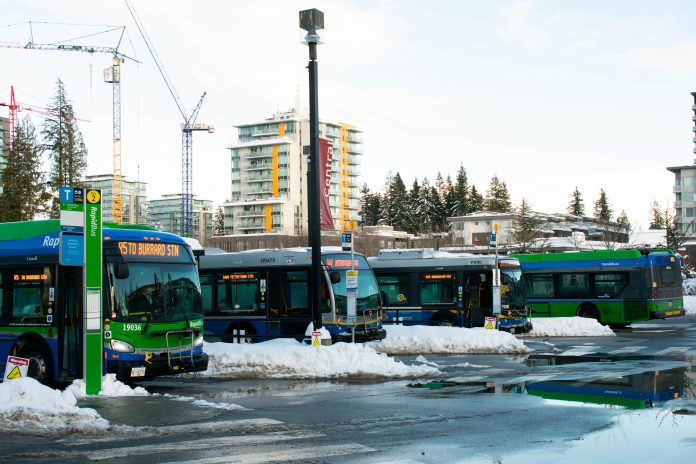
There aren’t many direct options for students needing to transit up the mountain. Photo: Maxwell Gawlick / The Peak

It seems from most places in Vancouver it’s possible to catch a direct bus to UBC. The same cannot be said about SFU, and that must be because all of TransLink’s executives graduated from UBC. How else do you explain UBC’s current 15 bus routes to SFU’s four? You can’t tell me there’s no bias in service.

I understand this may be a niche concern, but there are at least a few East Vancouver folk who aren’t in the Renfrew-Hastings area who should be able to relate. To get to SFU, I currently take the 22, then the SkyTrain — and then depending on timing — get off at the appropriate station for the 143, 144, or the 145. Meanwhile, my roommate has the option of taking either the 25 or the 33 directly to UBC from our place. Only one of us has to take three different modes of transportation to get to class. Spoiler: it’s me. 

Look, I understand we’re a commuter campus, so some bus hopping is always going to be expected. We’re also smaller than UBC. But given that UBC is getting a whole SkyTrain extension to themselves, shouldn’t it be time for TransLink to do more than just throw us an R5-shaped bone in hopes that we wouldn’t notice that it’s the exact same bus as the 95? Sure, the service is a little more frequent, but how exactly does this increase the service area going to SFU?

If SFU has approximately 60% of the student body that UBC does, shouldn’t we at least have 60% of the number of bus routes they do? (That would be nine for anyone wondering about the math.)

Research Roundup

0
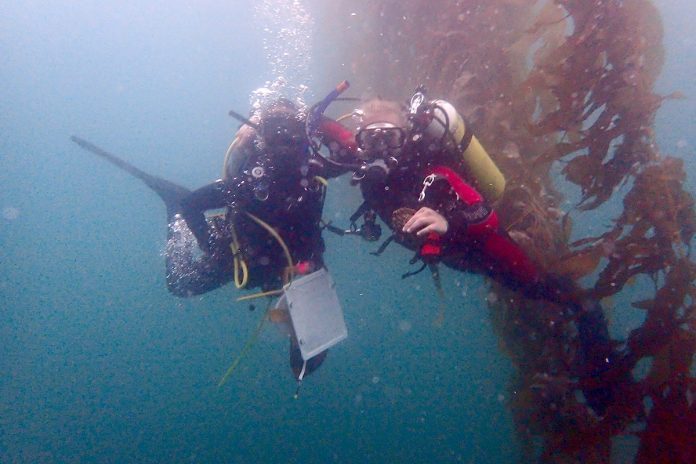
Jordan Hollarsmith and Michael Doane collecting reproductive fronds from a San Diego kelp forest. Photo courtesy of SFU News (Photo: Jordan Hollarsmith)

Warming waters pose problems for the future of coastal kelp 

From melting ice caps on our poles to forest fires in the Amazon, the impacts of climate change are everywhere. New research by SFU post-doctoral student Jordan Hollarsmith and colleagues reveals that rising temperatures may be affecting life closer to home — right here on BC’s coast. 

Hollarsmith’s study, published in the Journal of Experimental Marine Biology and Ecology, investigated how increasingly warm, acidic oceans are changing life for giant kelp populations. In a lab experiment, she found that kelp were unable to reproduce in hotter conditions.  

Kelp is a primary source of food and shelter for many ocean species, and the findings have important implications — both ecological and economical.

“Ecologically speaking, kelp habitats up and down the Pacific coast are important as they form habitats for many different species,” says Hollarsmith in an interview for SFU News. “These species are critical not only as food sources for other species, but for various industries including fisheries and even tourism.” 

Bringing some empathy to chatbot conversations — one painting at a time

It’s a familiar experience: You attempt to file a customer complaint, end up speaking with a chatbot, and eventually leave the “conversation” feeling unfulfilled and frustrated — perhaps with more complaints than you started with. 

Until now, artificial intelligence (AI) has been unable to replicate the emotional intelligence that makes human conversation so rewarding. SFU professor Steve DiPaola and his research team are trying to change that. To bring some more empathy and creativity to AI interactions, the researchers have developed a number of new AI systems. Among them is the Empathy-Based Affective Portrait Painter, which literally paints a portrait of each person it interacts with, based on an evaluation of their emotional state. 

“Using our special system, the AI avatar can, through conversation, evaluate the user words, facial expression and voice stress to make an empathetic evaluation — just as a human would be able to, about someone they are talking to,” says DiPaola in an interview with SFU News. 

The resulting images are not only experimentally fascinating; they’re also visually unique. DiPaola’s emotional portraits have been featured at the Whitney Museum of American Art, the Museum of Modern Art, and other museums across the world.   

A psychological solution to Canada’s tax deficit?  

No one likes paying their taxes — especially in Canada, where taxpayers’ efforts to minimize their taxes are contributing to the nation’s $8.7-billion tax deficit. 

New findings by SFU researchers Emily Thornton, Lara Atkin, and colleagues suggests that there may be a simple way to turn that around: remind people who their taxes are helping.  

To better understand what motivates people to pay (or not pay) their taxes, the team interviewed more than 470,000 adults from over 100 countries about their views on taxation. The results suggest that taxpayers who recognize that their tax dollars will be used to help others are more willing to pay up, as well as more supportive of taxation overall.

The study, which was published in PLOS ONE, has the potential to transform how we approach taxes here in Canada. 

“Some people will . . . go to extreme lengths to avoid paying taxes,” Thornton told SFU News. “Our findings raise an intriguing possibility — would Canadians be more willing to pay their taxes if the CRA better publicized how their tax dollars help others?”

SFU appoints Dr. Joy Johnson as incoming president

0
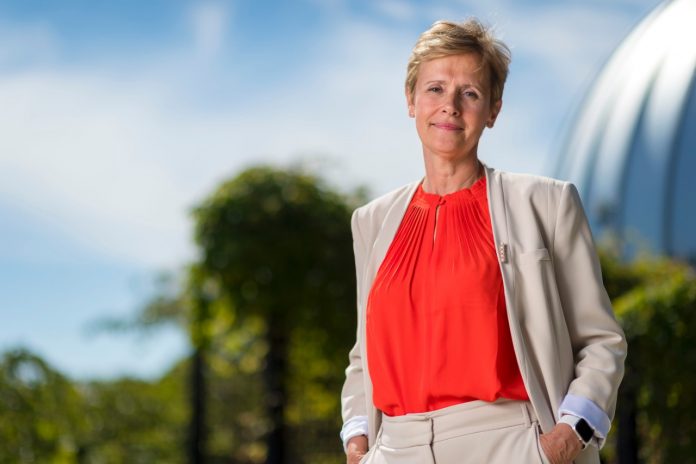
SFU's next president is going to be Dr Joy Johnson

After an extensive search process that spanned 2019, Simon Fraser University announced its new incoming president. Dr. Joy Johnson will be SFU’s new president for a five-year term as of Fall 2020. She will be replacing outgoing president Andrew Petter, who served two consecutive five-year terms at the helm of SFU. 

Since 2014, Johnson has been the university’s Vice-President, Research. 

“I love being part of SFU — so much is possible here as we develop new learning opportunities, enhance student support and services, expand our facilities, strengthen our research infrastructure, and forge new partnerships,” Johnson wrote in a press release about the announcement. “It’s my great privilege to have the opportunity to serve as President and Vice-Chancellor, and I look forward to getting started.”

The Peak had the opportunity to sit down with Johnson, and asked her how she would like to introduce herself to SFU students. 

“I have been at SFU for just over five years, serving as the Vice President of Research and International and I have seen the potential of this amazing university,” she said.

“I think we’re just at such a fortunate place at SFU in terms of the three campuses, exciting things happening like the new Student Union Building opening, new energy systems engineering building out in Surrey, and more potential to come. So that excites me a great deal and that’s partly why I put my name forward [for the presidency] because I do believe there’s so much potential, so much more that we can do.”

Aside from her previous positions at SFU, Johnson has an extensive history in academia. She previously earned a PhD in nursing from the University of Alberta, and served as a professor in the School of Nursing at the University of British Columbia. Her research focused on “how environments and social dynamics influence health outcomes and opportunities, particularly among youth,” according to the press release issued by SFU. She also co-authored more than 180 peer-reviewed manuscripts as part of her academic career.

The president of SFU serves as the public face of the university. 

According to Johnson, “You can kind of think of it as the CEO role, and that’s to lead the leadership team,” like the vice-presidents and associate vice-presidents of the universities. 

She adds that the position also includes “creating relationships with other entities, be they industry, community, et cetera.”  

The president is also unique, according to Johnson, as they chair the Senate, the chief academic body of the university, and sit on the Board of Governors, the chief operational body of the university. Part of their role is ensuring that these bodies are coordinated and “strategically aligned.”

However, Johnson emphasizes that, despite the president’s role being complex and multifaceted,  she considers students to be her top priority as president. 

“I do want students to know that students come first. They’re at the heart of the university and it’s really important to me that the learning environment be front and center, for the president, to be thinking about the ways in which we provide an excellent education for students and provide them the support that they need.”


Board of Governors votes to reduce carbon footprint by 45% by 2025

1
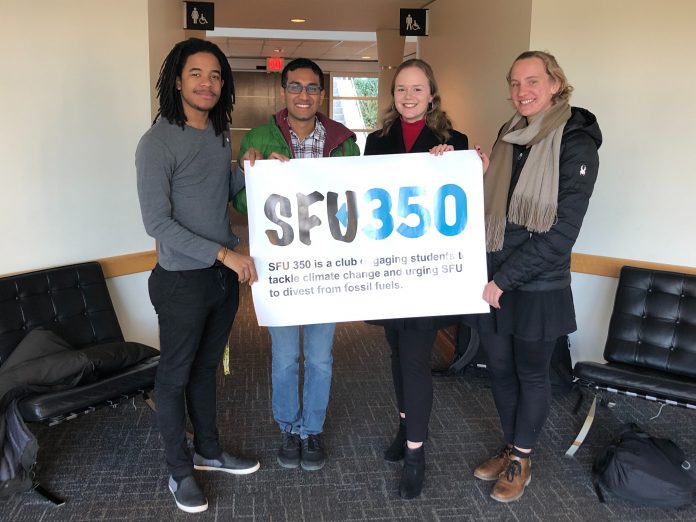
SFU350 presents for the Responsible Investment Committee. From left to right: Giovanni HoSang, Raaj Chatterjee, Abigail Herd, Elise Burgert.

SFU’s Board of Governors has voted in favor of eliminating investment in carbon-emitting companies by 45% over the next five years. 

Alison Blair, Associate Vice-President, Finance, expanded on what this entails in an interview with The Peak.

“We’re not divesting — we measure the carbon footprint of our investments, the public equity portion of the endowment and the non-endowment portfolios, and we commit to reducing that carbon footprint, not to divesting from fossil fuels.” 

Blair explained that a large factor in the Board’s decision was the Intergovernmental Panel on Climate Change (IPCC)’s announced goal of 45% reduction by 2030 in order to comply with reductions needed to maintain global warming below 1.5 degrees Celsius. 

Blair noted that student activism did have a role in the Board’s decision. 

“Certainly the student activism, and listening to and meeting with SFU 350 contributed to enhancing our thinking on the issues and bringing the issues more to light, more to our attention, making us more aware.”

SFU350 is a student organizations that has been advocating for SFU to divest since 2013. According to their Facebook page, “SFU350 is a lead organizer of DivestSFU campaign, a coalition of students, faculty, staff, and alumni calling upon SFU’s Board of Governors to realign SFU’s investment practices with its research record and values of sustainability and integrity.” 

SFU350 has presented to Board members on multiple occasions and have had several meetings with the Board’s responsible investment committee. 

The Peak interviewed both co-president Abigail Herd and former co-president Raaj Chatterjee of SFU 350. While they said that SFU is taking steps in the right direction, they both stated that making investment decisions based on a company’s carbon footprint can be problematic. 

Herd and Chatterjee explained that a company’s carbon footprint can sometimes inaccurately portray how much carbon said company emits, because the measure of carbon footprint does not consider all aspects of production and consumption. 

“It can lead to investments in an airplane company [ . . . ] instead of solar panels because the manufacturing process for producing solar panels can be more intensive than the manufacturing for producing a plane,” explained Herd. 

Herd also provided an example from Policy Options. For coal mining companies, only the carbon emitted in the extraction of the coal counts toward the company’s carbon footprint, and not the carbon emitted in the consumption of the coal. 

“The way that financial instrument [carbon footprinting] works allows that to happen.”

However, Blair noted that “We think measuring the carbon footprint of the portfolio and reducing the carbon footprint overall is more effective than divestment [ . . . ] there are other areas other than fossil fuels that contribute to carbon footprint.”

Concordia University and the University of California have both voted to fully divest. UBC has also voted to divest $380 million from its $2 billion endowment fund. 

Although UBC is divesting less than 45% of their endowment fund, Herd believes that their decision will make a greater impact than SFU’s. 

“I think that is a much stronger route than what SFU has done because they are fully divesting that amount,” said Herd. 

Chatterjee noted, “I think it’s really exciting that UBC is going forward with this, because that means that they’ll have all these financial instruments which are fossil free that SFU can also look into investing [ . . . ] it’s really exciting that potentially that SFU could piggyback off this as well.” 

When asked if this is an initial step in the direction of 100% in the future, Blair responded no. 

“We think it’s more effective to measure the carbon footprint and reduce it overall.” 

Chatterjee confirmed that SFU350’s goal remains 100% divestment of all fossil fuel companies. 

In terms of the next steps for SFU350, Chaterjee said that they will “continue to support the climate strikes that are going on, and build the interest for SFU students to take action on climate change, not only at the university level, but at the federal level.” 

“SFU sees itself as a leader in sustainability [ . . . ] we are concerned with reducing GHG [greenhouse gas] emissions for the university as a whole,” said Blair. 

Political Corner: Canada’s stance on the Rohingya genocide is all talk

0
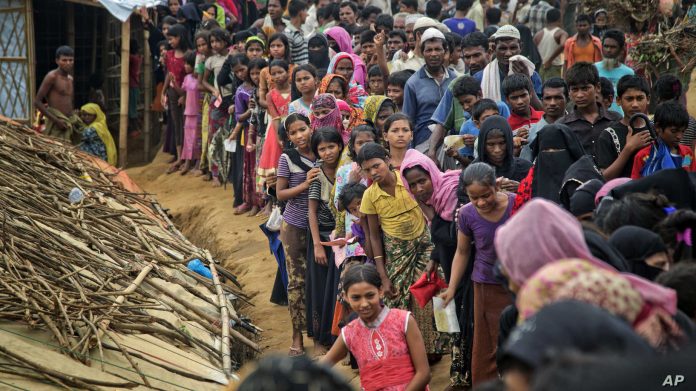
The Rohingya have faced violent persecution in Myanmar since 2017. Photo: A.M. Ahad/AP

In late August 2017, a genocide began against the Rohingya Muslim minority living in Myanmar. The catalyst for the genocide was an alleged terror attack carried out by the Arakan Rohingya Salvation Army that resulted in 12 deaths. In response, the Myanmar army began a concentrated attack against all Rohingya Muslims living in the country. This lasted until approximately mid-2018 when various groups began to push for investigations into alleged human rights abuses. 

In November 2019, Gambia brought a legal case to the International Court of Justice (ICJ) that cast blame on the Myanmar military and their civilian leader, Aung San Suu Kyi for the persecution of the Rohingya Muslim minority in Myanmar. The case was focused on their involvement in genocide and crimes against humanity.

In December 2019, hearings took place in the International Court of Justice, which concluded with the UN General Assembly issuing an emergency order. This order ensured that there would be legal protection placed on the remaining Rohingyas in Myanmar.

But why was a legal case only filed in the International Court of Justice in November 2019, despite the world having known about the atrocities for two years?

The Canadian House of Commons unanimously voted to recognize the violence in Myanmar as a genocide in September 2018. This followed the removal of Aung San Suu Kyi’s honorary Canadian citizenship. So why not take it a step further and take legal action? In the same year, humanitarian groups even pressured Canada to bring the case to the International Court of Justice themselves. Canada does have a legacy of protecting human rights, yes? 

If one looks at the ICJ’s list of past cases, Canada has only brought forward three. Of those three, only one, brought in 1999, focused on human rights. Although Canada still resettles the highest number of refugees every year, this might not be enough anymore to justify the country’s beloved mantle as protectors of human rights. 

Canada can’t continue to think of itself as the champion of human rights while at the same time offering a flaccid response to political humanitarian crises. Countries like Canada that have the power and the legacy to protect persecuted minorities must take stronger, more affirmative actions to protect human rights, or groups like the Rohingya will continue to face persecution.

SFU embraces full open-concept design by expelling all its students

0

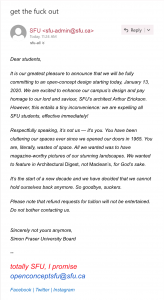
While SFU is already known worldwide for its exceptional architecture, the university has decided to update its interior design for a new year by completely embracing open-concept design. To declutter its buildings in pursuit of this goal, SFU has committed to expelling all of its students, “effective immediately.”

On January 13, SFU students received the following email.

A totally, definitely, absolutely real email from SFU, telling students to “get the fuck out,” or something.

The defining characteristic of open-concept designs is neat, decluttered areas which gives the illusion of more space. Other open-concept design choices visible around campus include use of negative space, natural light (sometimes), and the fact that literally everything is grey.

As swarms of bustling students invaded the Convocation Mall and the Academic Quadrangle despite their strategically placed uncomfortable seating, SFU realized that students were “cluttering [its] vibrant space” and they needed to GTFO.   

While some students were confused and infuriated by the news, many also saw this as an excuse to get out of SFU. 

“I guess SFU took the whole ‘leaving toxic people behind in 2019’ thing too seriously,” said Matilda Smith, former third-year chemistry student. “At least I won’t have to climb up this dreary mountain anymore.” 

“I’m not even mad,” said James Lee, former second-year anthropology student. “This is like the ultimate real-life meme. You be you, SFU.”

The Peak would normally promise to continue investigating this story, and to provide more news as the story develops. But we can’t, because SFU has already kicked us off all three campuses. Go figure.

Best comfy spots at SFU Burnaby

0

Picture this: You’re on the mountain. Maybe you’re between classes and want to do some readings — or at least, attempt to. Maybe you want to take a power nap before your next four-hour lecture. Or, maybe you just want to have a nice place to sit while you existentially contemplate your uncertain future. Regardless, you realize that you have nowhere to go. All the spots you know of are taken.

Fear not, weary traveller, for I have searched and scoured SFU Burnaby for the comfiest and coziest spots that the school can provide. These spots range from warm hideaways to calming coves that offer the best environments for restoring your sanity. Best of all, each spot is wheelchair accessible and not restricted to students of certain departments. Look to these recommendations when you’re put on the future SUB nap room’s four-year waitlist or your go-to place is polluted by constant construction noise.

Photo taken by Madeleine Chan

Bottom Floor of MBC

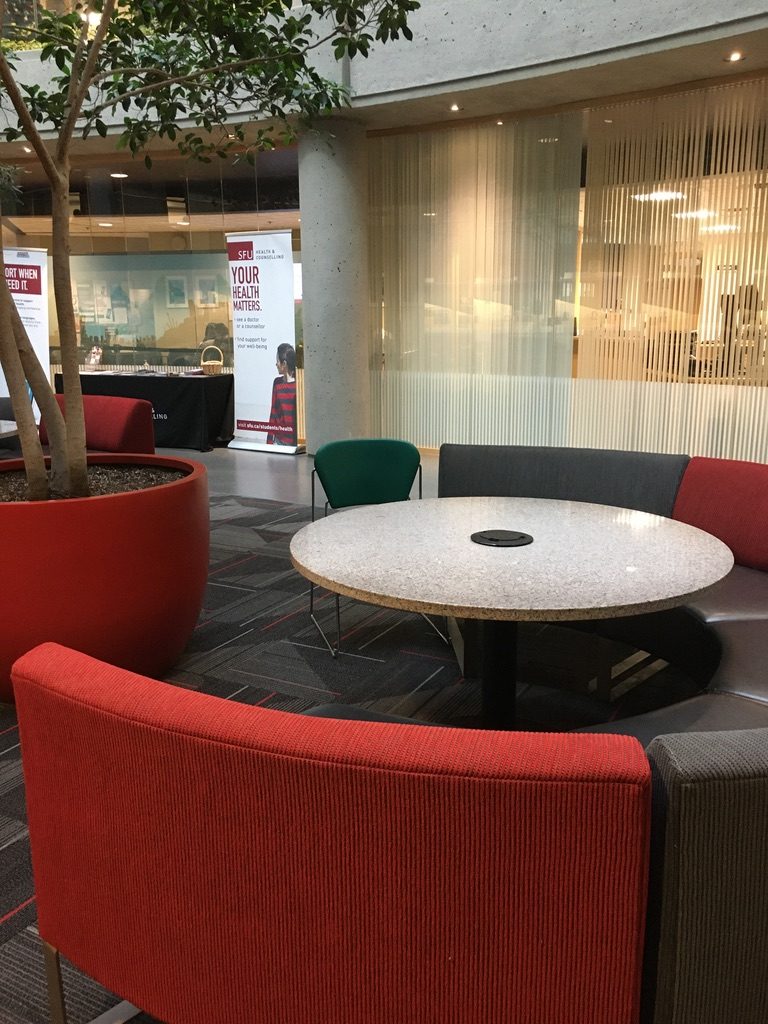
A spot that feels like you’re at the bottom of a fantastical castle spire. Multiple circular, lounge-style chairs are paired with circular tables that dot the lowest floor of Maggie Benston Centre. The decently spongy seats have angled backs, which are great for slouchers like me. The area’s position underneath the stairs also gives it an added sheltered feel. Oversized pots filled with lush trees also create a canopy of comfort. The sunken and hidden feel of the area can sometimes be overshadowed by chatter from the upper levels during busier hours, but overall this spot is a nice, cool place to chill.

Tags: 10/10 forest feel, nine circles of heaven, carpet

Photo taken by Madeleine Chan

AQ 2130: Northwest corner, second floor

The squishiest couches I could find. This large study area is great for studying and napping as it has both single seats and longer couches. There is at least a one-to-one chair-to-table ratio, so there is no need to worry about where to put all of your overpriced textbooks. The varied sizing of the light fixtures is a nice touch that adds warmth to an otherwise concrete-filled space. Its secluded location underneath the main AQ walkway also makes this space the ideal hideaway from the stress of avoiding people handing out pamphlets on your way to class.

Tags: cloudlike chairs, individual space, sleepy

Photo taken by Madeleine Chan

Sixth floor AQ Mini Lounges

These little spots scattered around the top floor of the AQ make for great getaways. The soft SFU-red chairs are placed near wide windows with stellar views of the sky. On nice days, you can even see the mountains and the city below depending on which side of the building you’re on. The windows also let in an ample amount of natural light which increases the calming nature of the area. Considering that not many people go to or even know about the sixth floor of the AQ, you can bet on minimal noise and traffic, which is perfect for lengthy naps on the longer, couch-like red seats. Potted plants also make the spaces feel more homey. These small and snug alcoves are ideal havens for the extrovertly-challenged.

Tags: THE SKY, good save point, calm

Photo taken by Madeleine Chan

The Hangar: TASC2 East Lounge

A hidden gem of a spot. This lounge in the Environmental Science area is a perfect place to escape SFU’s bustling halls and construction noise. It’s nicely nestled at the bottom floor of the building and has a long floor-to-ceiling glass wall which immerses the seating space in natural light. The red cushiony seats that surround large tables are all long enough for napping, but especially the two couches on the ends of the area that are double the size. With a vending machine right beside the area, you could stay here forever and not know that there are flurries of students rushing to get to their next class. The secluded area, large tables, and comfortable couches make this a great study or sleep space.

Tags: nap time, sleeping beauty, no actual planes

Photo taken by Madeleine Chan

Blue couches in the hallway between the Shrum Science Centre Kinesiology and Applied Sciences Building

I know this recommendation is in one of SFU’s many busy hallways, but it’s still a favourite of mine. This place’s cool blue couches and textured floor are a tonal respite from SFU’s onslaught of red. The couches themselves are also very comfy, especially the one in the corner of the hall opposite Renaissance because of its chaise-like extension where you can lay down your legs. In fact, the other seats also have low tables that are a prime place to prop your feet up. To top it off, the wide windows that line the corridor also offer a good amount of natural light and an opportunity to look out to the grassy hillside to contemplate the life decisions that led you to this spot.

Tags: couch city, red-hater’s delight, existentialism