Home Blog Page 1084

Doctors require the right to refuse treatment based on beliefs

0

The College of Physicians and Surgeons of Ontario (CPSO) is currently reviewing its policy which accords doctors the right to refuse to treat a patient based on religious or moral grounds in non-life threatening situations.

While at first I was in favour of this re-evaluation, I have since come to realize that this situation is not a simple one.

I initially thought that this policy change could stop a doctor from denying a woman contraception or an abortion, and stop any discrimination based on homophobia, racism, or sexism; it seemed to allow for more respect and equity toward everyone.

But there is a question lingering in the back of my mind: have we forgotten the rights of the health professional? And if so, could that make them less effective at their work? Forcing someone to undertake a task that they find to be incompatible with their moral beliefs doesn’t seem to be the right course of action.

Carolyn McLeod, a philosophy professor at the University of Western Ontario, is part of a research team studying conscientious objections in health care — the team plans to submit their work to the CPSO as a part of its review.

She explained to The Globe and Mail, “We argue that [doctors] need to provide referrals for health services that they morally object to, [and] we talk about the importance of not demeaning or humiliating a patient while they’re refusing to provide the service the patient seeks.”

She has the right idea here. By denying the right to refuse treatment, we could prevent some doctors from doing their jobs to the best of their ability. Furthermore, doctors, regardless of their decision to treat the patient themselves, should be responsible seeing have that their patient receives the proper care.

To force a doctor to do something they don’t agree with is to make many situations too methodical, to take the humanity out of the situation. A textbook or machine can outline what’s wrong with you and what the possible solutions are, but there is a reason we don’t completely rely on that kind of objective discretion. There is comfort in knowing that you are being handled by a person who cares about their decisions and the outcomes.

If a doctor is biased by beliefs that are against what the patient desires, then their treatment options will be made under that shadow of doubt. Medicine is a science and in the end a medical decision should be based on scientific reasoning, not on the will of God or any other belief system. Doctors should feel obligated to think beyond this, and give a referral if they don’t agree with a procedure.

All doctors should be aware going into the profession that they will be working with all kinds of people, and that sometimes they will have to make decisions that they may feel uncomfortable with. If it is going to be a common problem, then maybe they should consider another profession.

Doctors need to care about the outcomes of their choices in order to provide their patients with confidence. And while they should have the right to do so, any doctor should be very careful about denying treatment to a patient. We put ourselves in a position of vulnerability with our doctors, and they shouldn’t forget that. They are, after all, there to provide medical aid, not judgement.

Planet of the Apes sequel is all action and no plot

0

DAWN OF THE PLANET OF THE APES

The long awaited sequel, Dawn of the Planet of the Apes, has finally hit theatres nationwide, and this ardent fan had the opportunity to watch the premier. 

Set 10 years after the events of the previous installment, the deadly virus known as the Simian Flu has spread and killed much of the human population. Only pockets of immune humans survive and try desperately to rebuild their lives in the hope of returning to the lifestyles they enjoyed before the outbreak. The genetically modified apes, meanwhile, managed to escape into the forest, and while the humans were dealing with the virus, these apes built their own society, religion, literacy, and traditions without interruption or further conflict. 

Their uninterrupted peace comes to an end when a group of humans looking to revive a dam for their potential energy stumble upon two hapless apes. The events that follow throw into havoc the human and ape communities. Caesar, the leader of the apes, tries desperately to maintain peace, but his efforts are thwarted by a human-hating ape known as Koba, who usurps Caesar and declares war against the humans. 

This sequel provides an action packed, suspense filled thrill ride to complement its predecessor. This viewer was on edge the entire movie, as every moment of the film provided a unique experience into how these apes lived. As human society deteriorated, the ape society thrived, providing a unique parallel between these two communities. 

Appropriate attention was also placed into understanding why these apes might hate humans. The captivity they endured and the cruel animal testing that they suffered has irrevocably scarred them; as a result, their reasons behind wanting to live in isolation and only with other apes resonates with the audience. As the movie progresses, however, the viewer sees just how similar these two species are. 

Despite all the praise, there is an issue with this movie, but it is not specific to this one franchise. As Hollywood has moved into the trend of seemingly endless sequels to generate as much profit as possible, this franchise has fallen victim to this mode of thinking. Its simple plot and small advances from one movie to the next make this viewer question if this franchise will ever come to an end; and if it does, it might be from a jaded audience and not from a well thought out story. 

Nonetheless I do recommend this movie to fans and to the general audience. The movie on its own will not disappoint, and you will come out wanting more. 

World Cup: the beautiful connection

0

WEB-World cup-A C Moraes-Flickr

I don’t usually watch soccer.

I am not saying this as some badge of honour in some attempt to put myself ‘above’ soccer, nor am I trying to make the argument that hockey is 10 times better (at least not now.)

No, I am just stating that for some reason I, along with many other North Americans (or north of Mexico really), just never really caught the soccer bug. It’s a fun game to play, but normally, you would not catch me watching a match for more than a minute before changing the channel.

That being said, the World Cup was pretty cool.

I, again, am not going to claim that I went all out and watched every game, or even most games, and the fact that Canada did not have a team competing took away some of that connection that perhaps some of the international community here had. But at the end of the day, it did not really matter.

The fact that it is only every four years, like the (Winter) Olympics, makes it quite a spectacle. Even though I am not much of a soccer guy, I still wanted to be a part of it. It felt like I would be missing out if I did not catch at least a game or two.

You could argue that we should bond over more than what we watch. Maybe. But who cares?

Perhaps the greatest thing that the World Cup, or really any sport, does is to evoke a sense of community.

Whether it be seeing people at the pub wrapped up in the game, cheering after a big save or goal, or just seeing it being discussed on facebook, it was just fun to watch the community engage in such a spectacle.

To me, one of the great things about sports is the avenue of communication they open up. One of the reasons I watch hockey, beyond the excitement of the fast pace, is the connection it provides to others.

You cheer together, you revel in disappointment together; it gives you something to talk about. That’s what does it for me, that bond that connects a lot of us really.

And certainly the World Cup is no different. As a matter of fact, that connection I speak of is probably magnified with the amount of people watching and how much of an international event it is.

It was just fun just having a conversation with the person next to you, possibly a complete stranger, asking them to clarify the rules or asking them what team they were rooting for.

Perhaps it’s silly, you could argue that perhaps we should connect and communicate over more meaningful things. You could argue that perhaps we, as a people, should bond over something more than just something we watch.

Maybe. But at the end of the day, who cares?

Anything that promotes people coming together and becoming closer as a community is good in my books (except for some mass crime, I guess). And to me, that’s what sports do, whether you’re talking about playing or watching.

And despite its country vs. country theme that could be divisive, the World Cup instead brings people together. In my opinion, it is the epitome of this quality.

For now, however, it’s over for another four years and maybe next time I’ll get more into it, catch more than just a game or two. Just maybe.
(A)side Jab: “I’ve been with Germany since they won” sounds remarkably similar to “I’ve been with Germany since day one.” Use this, and you, too, can be a clever bandwagon jumper like me.

Coffee, Tragedy, History: Forty Ninth Parallel

0

Coffee and a good donut: A beautiful combination. The only problem with this pairing, however, is that so many of the places that make great donuts don’t make very good coffee and vice versa. Forty Ninth Parallel is the solution to that problem.

The atmosphere of the Main street cafe is just toeing the line of feeling like a warehouse, but they pull it off. The exposed brick, rugged wooden beams, and muted metal piping combined with the sleek glass and finished wood surfaces give a sophisticated and modern look to the cafe. The overall effect on the inside is very comforting and very much a part of the experience that keeps me coming back.

At the 4th Avenue location, wood grain peeks out from behind patchy teal paint, weathered window sills and faded colours recall someone who spends an hour each morning styling their hair to look like they just got up, but it works. Both locations provide an enjoyable experience and the quality of the goods is the same at either cafe.

At Forty Ninth Parallel, they take their coffee very seriously. Various roasts and blends are available, the brewed coffee is characterful and rich and the specialty drinks are made with the utmost care. Their cup of coffee is not the cheapest in Vancouver, but it is one of my favourites around town and a surefire solution to the pounding headache I get if I’m jonesing for another cup of java.

At Forty Ninth Parallel you can get a wide variety of donuts and other sweet confections to satiate that aching sweet tooth. Choices range from classic glazed, to peanut butter and jam, to maple bacon (with actual pieces of bacon sprinkled on top). Regardless of my own disdain for that last option, the donuts are truly delightful. I recommend the Classic Cinnamon, which is reminiscent of the classic fairground mini donuts.

Forty Ninth Parallel unfortunately does not support the arts much other than providing a quiet place for artists to work away from home. There are, however, various coffee related events open to the community, such as coffee tastings and other informational events that show customers the process (bean sourcing and roasting) behind the coffee.

The cafe is the offspring of two companies. The donuts are made by the locally based Lucky’s Donuts while the coffee is made by Forty Ninth Parallel Coffee Roasters. Together these companies create the perfect cafe experience. In fact, the cafe was recently awarded the title of Best Coffee House by Vancouver Magazine. Great Coffee. Great Donuts. Forty Ninth Parallel is everything a certain Canadian donut chain wishes it was and more.

Forty Ninth Parallel is located at 2902 Main Street and 2198 West 4th Avenue in Vancouver.


Couture: It ain’t so juicy

0

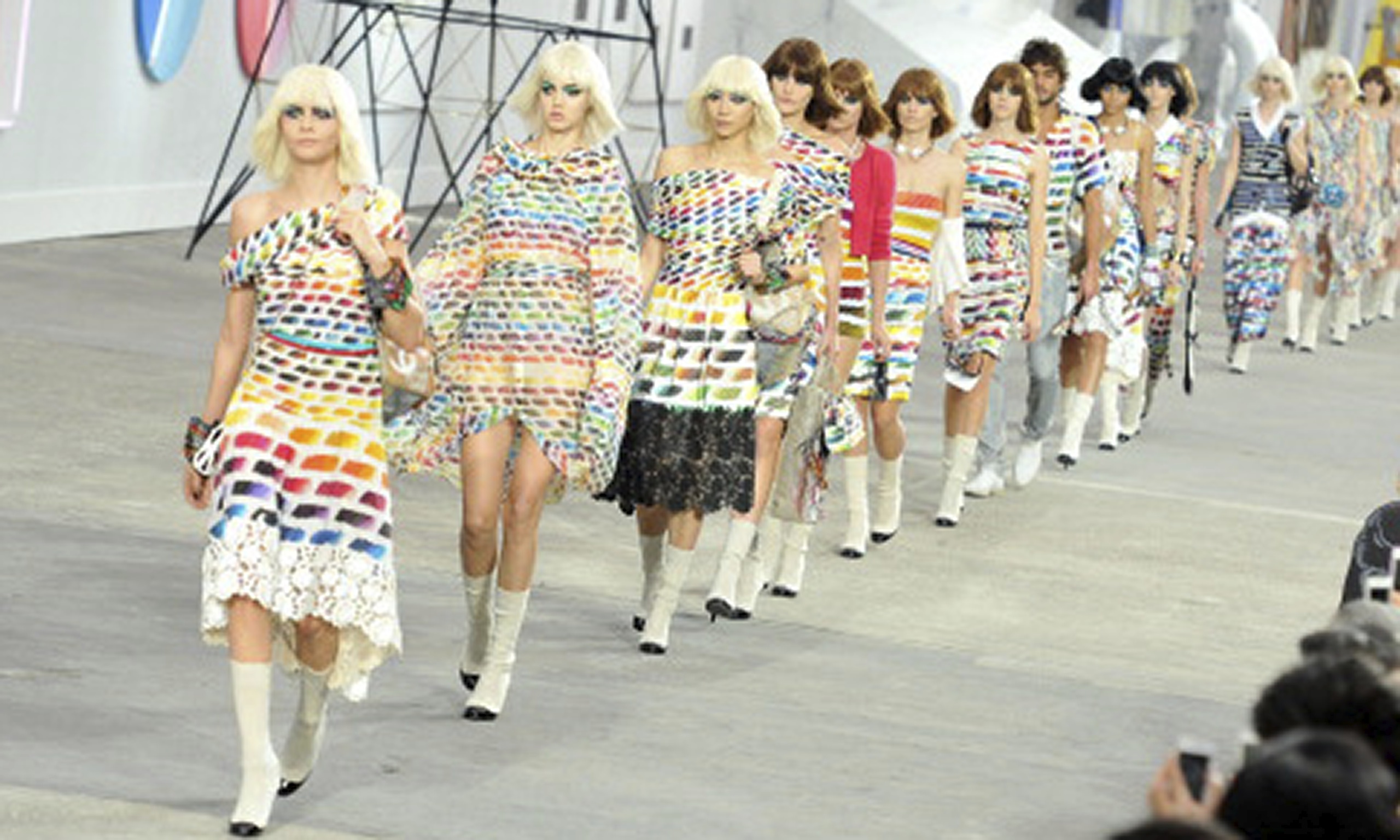
Say it loud: the Chanel show at Paris Fashion Week womenswear spring/summer 2014.

For many of us, the word “couture” brings to mind a bedazzled velour tracksuit, an exposed mid-drift, and a chihuahua popping out of a fake Louis Vuitton bag. 

We flashback to 2006, when The Simple Life of Paris Hilton and Nicole Richie was a trend-setter for us pre-pubescents, and an eyebrow wider than two millimeters was a cry for help. This Throwback Thursday is over, but the misconception of couture still remains. Well, buckle your seatbelts and unzip the Juicy because you are about to be shown the world of true haute couture. 

Close your eyes and imagine a woman. She is the uber-wealthy heiress to a French something-or-other empire and has just seen the Chanel Haute Couture collection at the Grand Palais in Paris. She wants one of the dresses, but one does not simply walk into the Chanel store and pick one of these garments off the rack. Those garments (that most of us are familiar with) are known as prêt-à-porter or ready-to-wear. 

For couture, she first has to make an appointment with a woman known as a vendeuse, a specialized sales person who knows the exact details of each client’s taste, figure, and budget. Once the dress is selected, meticulous measurements are taken and the work begins. On average it takes a team of pattern makers, seamstresses, embroiderers, and other craftsmen 120 to 150 hours to complete a couture garment, and the work is all done by hand! 

The most astonishing aspect of couture is the fit. Feeling like a second skin, couture garments are fitted a minimum of three times to ensure a perfectly snug and sensual silhouette. The garments are so well-fitted that all of the seams, buttons, and hems are adjusted to the exact proportions of each body. With the hand stitching, the fittings, the finest fabrics, a simple day suit with blouse can start at $10,000 to $15,000. Adding embroidery, laces, and 800 hours of manual labour (required for many of the finest dresses) can increase the price to hundreds of thousands of dollars. 

Paris Haute Couture Fashion Week took place this past week and did not disappoint. Couture has always been a fine and delicately embroidered balance between the Golden Age of Hollywood fashion and the constant nuances of modern style. 

One designer to note this year is Marco Zanini of Schiaparelli. What most love about Zanini is his unsuspecting rise to couture creating fame at the helm of the house of former surrealist couture giant, Elsa Schiaparelli.

This 40-something, with a Smiths tattoo and rugged looks, brings a rebellious and electric edge to his creations, which hasvebeen setting the trend for the rest of the couture world. Zanini is all about the mixing of things that traditionally wouldn’t go together. To give you an idea, the opening look featured a loose fitted cheetah print coat that sported sculpted mink sleeves — a distinct cross between glamour and the Michelin Man. 

Another favourite was from the seasoned house of Chanel and their quirky kaiser, Karl Lagerfeld. This most ‘un-couture’ couture collection was based off the apartment of visionary Swiss-French architect Le Corbusier who was a true pioneer of modern architecture. Generally, sandals, bike shorts, and concrete don’t come to mind when thinking of couture, but it was these words that Lagerfeld used to concoct his collection, and what a sumptuous feast it was. 

Couture: it is a jacket for the rich or a dress for the Prince of Monaco ball but, more importantly, it is the epitome of craft, care, creativity, and beauty — even if we can only afford to admire from afar. It reminds us that looking good is an artform and that wherever you are in life, there is always room for beauty and fantasy. 

Israel/Palestine: one state solution

3

Gaza strip - wikimedia commons

It is easy to label the erupting crisis in the Israel-Palestine corridor as a meaningless tragedy; in many ways, this is correct. What began as a small Israeli incursion into the West Bank to rescue three Jewish teenagers from a suspected kidnapping by Palestinian radicals has quickly escalated.

Palestine’s influential Hamas faction has sought vengeance for the heavy-handed tactics of the Israeli incursion, responding with a hail of largely ineffective rocket attacks. Israel has responded in kind, and now, has initiated a ground invasion, targeting the rockets’ epicenter in the Gaza Strip. Negotiations between the Palestinian Authority and Israeli state have been cast asunder, optimism forgotten.

But, there may be a silver lining to this mayhem. With peace negotiations dead for the moment, it may be a long time before trust between the two sides is sufficiently rebuilt for peace negotiations to begin again. By then, Israeli settlement into West Bank will have likely expanded extensively, leaving the possibility for neatly separating Jews and Arabs cleanly into two states much more doubtful.

If Palestinian political forces abandoned aspirations for independence, they could further the interests of their own people.

The longer negotiations wait and settlements continue, the more impossible a two state solution will seem. Indeed, even now the prospects are dim. Israel, with a decisive military advantage, has little reason to offer Palestinians anything more than a territorially gutted rump state. Under such circumstances it is difficult to imagine the entirety of Palestinian society being left satisfied enough to give Israel the peace it desires.

Still, both sides cling to the prospect of two states. Many Palestinians, hardened by conflict, remain nationalistic — hardly enthusiastic to take up the passports of their archenemies. And many Israelis neither want to make territorial concessions nor have to deal with diluting the Jewishness of the Zionist project their ancestors worked so hard to create.

However as hopes for a two state solution continue to wane, perhaps hopes for a one state solution may wax. This would offer a far more meaningful path forward for the region. For if Palestinian political forces were to embrace Israeli annexation and abandon aspirations for independence, they could further the interests of their own people far more significantly than their current course.

For the Palestinians, official Israeli annexation could offer access to participation in the labour markets of one of the region’s most advanced economies, and relief from Israel’s robust welfare state. Israelis, too, could benefit from such a path. Given access to meaningful economic opportunities that Israeli citizenship would afford them, Palestinians would likely become less receptive to the seductions by violence advocates.

Israelis seek security. Palestinians seek a future. The status quo does not offer this, but nor does the two state peace plan both sides currently aspire to. However, as each successive crisis crumbles hope in these aspirations, the peace discourse may veer toward a healthier direction.

Religious, irreligious, whatever

0

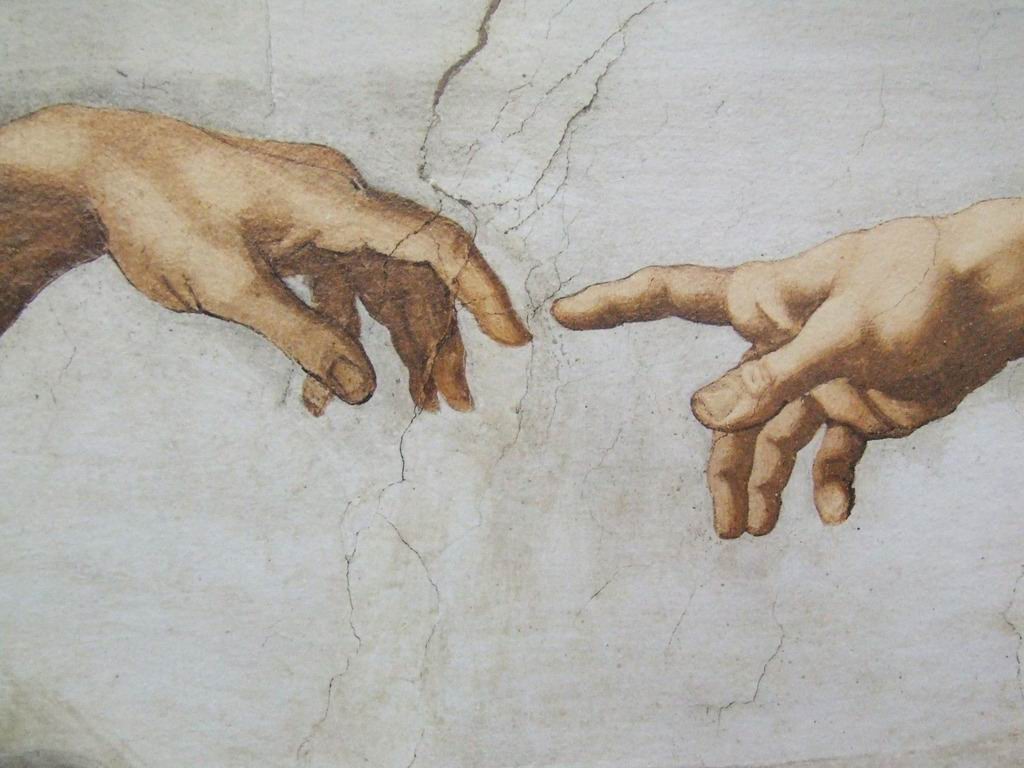
Web - The_Creation_Michelangelo - Wikimedia commons

I suppose I am what we call irreligious, or perhaps a humanist, maybe even an atheist.

I bring this up now to stress that I do not know whether my beliefs can be categorized, and also to make a point: it is easy to get lost in the semantics of religious debate, but we need to realize that by doing so we are avoiding the bigger questions. So, let us dispense with semantics and divorce this article from nitpicking and categorization and look at my beliefs for what they are.

There are no gods, nor god, nor God. There are no beings that are capable of defining our way of living. Faith unnecessarily obstructs the lives of the faithful, and believers are reliant on a predefined way of living, one developed separately from their own experience. Thus, they live incomplete, unfulfilled lives, deprived of experiences because they were denied by faith.

For me, life is about the totality of experience, and I see religious teachings as an obstruction to this goal. Experience should dictate the principles that bind you; you should discover what is right and wrong on your own. You will suffer. You might act immorally. But you will acquire a nuanced and more complete understanding of what makes these principles right and worthy of adherence. Observing the doctrine of faith might permit an agreeable life, one perceived as prosaically moral, but ultimately this morality exists only within the context of that faith.

And thus is my belief summarized. At least, it was my belief. I believed strongly this way for a while, but have recently found myself to be hypocritical. Unravelling my own doctrine, I find myself in the same boat as the conventionally religious.

A truly pious individual will have faith in their principles, but sometimes struggle to respect them.

There are certain things that I do not need to experience in order to understand their moral content. I do not need to kill to know that killing is bad, nor do I need to be killed. To find a reason more basic than simply, “because life and experience have an inherent value,” is impossible, and ends in a circular logic. This makes me no different than the religious. For them, a god is worthy of devotion because they are god, just as I find life worthy of experiencing simply because it is life.

My opposition to adhering to religious principles, because they are unnecessarily limiting, is also narrow-minded. To have structure and predetermined responses where you do not have experience allows for an opportunity for internal conflict. To be faced with a choice where an external force, your god, has defined the supposed correct action, and to disagree with this action, allows for a striking dialogue to occur within you.

I made the mistake of believing that the faithful do not struggle enough. But I believe that a truly pious individual will have faith in their principles, but sometimes struggle to respect them. These struggles permit an internal dialogue that allows for an even greater understanding of themselves and their faith. In short, religion provides a moral awareness and gives rules that you are meant to struggle against in order to eventually understand their roots.

To sum up my thoughts, I realize now that those practicing religion seek the same totality of understanding that I seek, but with perhaps more structure. I do not find my way of living any worse than an individual of faith, nor do I find it any better. It is simply a different method of adopting a moral and virtuous way of living; ultimately, everyone is trying to understand life, and perhaps only differences of culture and birth define the way we go about it.

Be kind and humble to other faiths, and be accepting of those without an institutionalized faith.

Social housing provides shelter from mental illness and addiction

0
Image credit: Kenneth Uzodinma.

CMYK-cityscape-kennethuzodinma

SFU health sciences professor Julian Somers recently released new findings that demonstrate the effectiveness of supported housing in assisting those with drug addictions and mental illness in Vancouver neighbourhoods.

Conducted by Somers along with the Mental Health Commission of Canada, the five-year study provided apartments to participants throughout Vancouver. Results showed that the situation of formerly homeless people improved both in a financial sense and in overall health.

These improvements included fewer emergency department visits, reduced time spent in institutions due to criminal convictions, improved quality of life, and less time on the streets. Overall, these indicate an across-the-board improvement caused by the new interventions that were introduced by the study in Vancouver.

The research showed that the costs of providing these individuals with housing and support versus leaving them on the street where they may end up in shelters, emergency rooms, and jails, were roughly equivalent.

For every $10 invested in providing housing, there was an average savings of $8.55 in avoided use of social services.

In discussing the overarching research program, Somers stated, “We conducted some experiments to try to discover effective housing and support models for people who had been excluded from existing services.”

The study looked at 500 participants who had been homeless for roughly 10 years — people that were chronically homeless and oftentimes experiencing mental illness.

Analyzing each individual’s mental status, Somers said, “The most common diagnosis that people met criteria for was schizophrenia. The majority also had significant problems with substance abuse.”

Somers described the living conditions for the participants of the study: “The housing itself is market housing. It isn’t the house that is built for homeless people or anything of that sort.  It is just regular housing from the existing stock. And in order to make that work, people are provided with support.”

Somers continued, “[That support can manifest as] a team, individuals with different expertise, or, if individuals do not have needs that warrant that, they could be a case manager.”

A large aspect of the research was giving people some choice in their circumstance.  Somers explained, “It is client-centered in the sense that it gives people choices in [. . .] getting involved in health or mental health treatment. It also gets them involved in places around their home.”

Somers spoke to the importance of the study, but mentioned its limitations in a population that can often find itself trapped. “Homelessness includes a diverse group of people, most of whom, fortunately, will find their own way out of homelessness, but there is a subset [. . .] who don’t find their own way,” Somers said.

Somers said that one of the biggest challenges to homelessness is the stigma surrounding mental illness. “Stigma concerning mental illness is profound. It is evident, not only among members of the public — it is evident even among health care providers.

“Neighbours being able to welcome people into their mix, accommodate people who happen to have been homeless. That is an example of the stigma of mental illness being overcome. [. . .] Simple and straightforward acts like talking to people.”

Instagram’s nudity policy is an insta-no

0


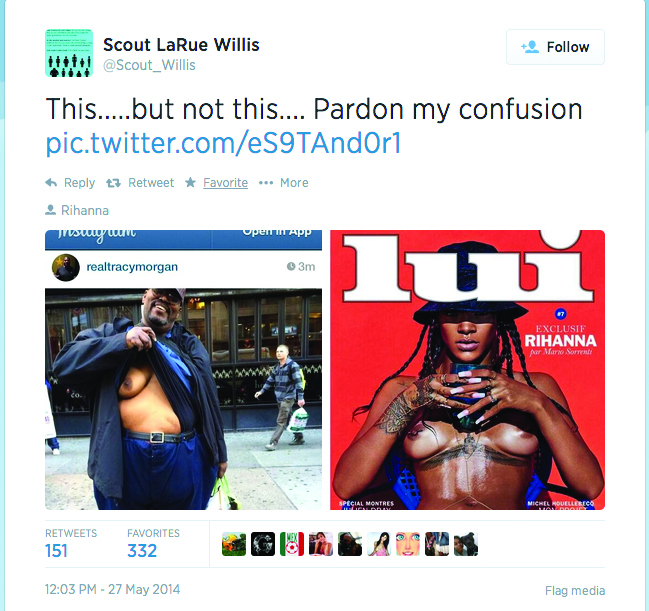
Web - bewbs - Twitter

Considering Instagram’s conception and birth happened in modern society, it baffles me that their nudity policy is archaic and works hard to strengthen classic double standards concerning female bodies.

In recent news, celebrities such as Scout Willis and Rihanna have had their Instagram accounts suspended for posting topless pictures. Willis’ major Insta-indiscretion came in the form of a sweatshirt that depicted two topless women, while Rihanna’s fatal post featured her topless magazine cover for Lui.

In response to the punishment, Willis tweeted out a photo of a man showing his nipple, posted by Tracy Morgan, one that passed Instagram’s merciless “no nipple” clause, contrasted by Rihanna’s magazine cover with the caption “This….. but not this…. Pardon my confusion.”

As a defense, the CEO of the popular social media app was quick to proclaim, “Our goal is really to make sure that Instagram, whether you’re a celebrity or not, is a safe place and that the content that gets posted is something that’s appropriate for teens and also for adults.”

The policy seems to me like a thinly veiled reincarnation of enduring double standards.

Perhaps if, like Instagram’s CEO stated, the app enforced policy with an even and fair hand, I would not be writing this article. Unfortunately, that is not the case. While Instagram’s vigilantes continue to suspend and ban photos of art, photos of those who are or were battling breast cancer, and photos of new moms, popular accounts like billionaire Dan Bilzerian’s, who has over three million followers, go untouched.

Apparently photos of bare-chested women, hugging guns and draped on Bilzerian’s bed wearing nothing but a thong is what Instagram considers content that contributes to an appropriate and safe environment “for teens and also for adults” . . . as long as Bilzerian graciously blurs our their nipples with a cute blue star!

Or how about his photo of a girl covering her lower half with a plaque that reads “Dan Bilzerian Pulls The Bitches” while her companion crouches down and covers her nipples with her hands? If you ask me, parents can sleep soundly knowing that Instagram has banned sexually explicit baddies (like breastfeeding moms) while allowing Bilzerian’s mild and almost pious content to perforate this safe Insta-environment.

Frankly, I don’t believe Instagram’s nudity policy has much to do with creating a safe and appropriate experience for all ages. Instead, it seems to me like a thinly veiled reincarnation of enduring double standards with one important lesson: sex sells, ladies and gentlemen, while reality does not.

Either Instagram steps up to the plate and cracks down on those who violate the principles of their nudity policy with an even hand, or they should do themselves a favor and leave all the Insta-boobs alone.

Compass card delayed due to technical difficulties

2

CMYK-compass translink-Mark BurnhamTranslink recently announced that the official rollout of the new compass card system is to be further delayed due to speed and reliability issues, with no firm date in sight.

There are already 85,000 cards in circulation and the system just received its 25 millionth tap, but since the system is being introduced in phases of consumer groups, it is not yet available to the entire public.

The compass card is designed to be convenient and easy for transit users on the go, requiring only a quick tap in and out. However, some card-users have experienced trouble with delayed card reading and failure to tap in or out. Card readers are reported to have an eight to 10 per cent error rate.

Translink’s director of operational initiatives, Mark Langmead, stressed the importance of ensuring the desired level of speed and reliability before introducing the card to the next group: The compass card’s ideal scan time should be under half a second, he said. Translink is in the process of improving its mobile validators to meet this standard before the next phase.

For the next phase, Langmead said that Translink plans to provide cards to people who use the West Coast Express and then to U-pass holders after that. “We’ve committed to providing an update in October. At that point we’re going to be advising the timing for the next customer group.

“We’ll know better [then] as to the exact timeframe in [which] U-pass customers will be receiving cards or able to get cards,” he explained.

Langmead assured The Peak that the transition will not come without notice. Translink aims “to make sure that we have a good communications plan, we [will] provide lots of notice for people who are about to be able to receive the card, and we [will] give all the information about how to use the card. So, we’ll certainly give a lot of notice ahead of introducing the card for the U-pass.”

He also mentioned some of the anticipated features of the card, such as the capability to load the card via the Internet. “You can do it while you’re sitting in a lecture, or you can do it while you’re sitting at a bus stop. It just makes it a lot easier to facilitate your getting a fare product,” said Langmead.

Other attractive features include a security element. “If you lose your card, you’re able to — if you’ve registered your card — have balance protection, where the card balance can be transferred to another card.”

The card is also equipped for auto-loading. If the balance dips below a threshold set by the cardholder, it will automatically load itself.

Langmead concluded, “We’re really excited to be offering this product and we’re confident that students will really appreciate the benefits of it.”