


March, April, May: the spring semester is coming to a rapid end and the time for course registration is upon us. Another term where we must face the challenges of schedule accommodation for our institution as we attempt to meet their demanding prerequisite requirements. These prerequisites are often topics that are not of interest to us and are typically seen as a means to an end.
As irrelevant as these courses may be, they are highly publicized and promoted by the university. Everyone is familiar with classes that meet our WQB requirements, regardless of their minimal appeal. What is not advertised, though, are directed study course opportunities.
As students who are supposedly “engaging the world,” we need to be aware of opportunities that encourage us to take education into our own hands and be given the opportunity to resist the conformity of a conventional university classroom.
Directed studies are available in every department that I have researched. English, education, business, sciences, and mathematics all allow for these opportunities. They are typically accessible for third- and fourth-year undergraduate students.
Yet when students register for their courses, directed studies have a minimal course description that make them seem confusing and unappealing. SFU describes these courses as “independent reading or research in topics selected in consultation with the supervising instructor.” Snooze.
Perhaps this ambiguity is due to the university’s concerns with the quick success of too many students. While SFU encourages academic success, it also encourages students ‘take time’ to complete their education. Under the regular class-structured system, students are more likely to experience less success, which in turn may set back the amount of time it takes to complete their education and allow the institution financial gain.
They leave room for creativity and independence, so a student can succeed in all courses.
Directed studies, on the other hand, are geared toward what the student is interested in learning. They leave room for creativity and independence, and with this added motivation, a student can succeed in all of his or her directed studies courses.
This semester I had the privilege to partake in an empowering directed study within the Faculty of Education. I have been able to take control of my own education by reading articles that are important to me. My particular directed study meets once a week in the Highland Pub, where we discuss social issues in education. We also have the opportunity to mentor students during office hours, a deeply engaging educational experience.
I have the freedom to choose what I study and eventually compile a final project that is useful and relevant, rather than an academic paper that will only see the recycling bin.
I have never been so impassioned by a course in the five years that I have been a student at this institution. Directed studies provide a much-needed escape from the monotony and stress of regular coursework. I recommend them to all students at SFU.






 The Adventures of Agoraphobia Man: World Defender (Jacey Gibb)
 Seagull Square (Jill Mandrake)
 Peers (Leslie Lu)
 Much More Better (Talha Qadir)







Click with compassion
Monica Lewinsky returned to the public stage to speak about her very public scandal at the TED Conference Truth and Dare on March 19.
“At 22, I fell in love with my boss. At [. . .] 24, I learned the devastating consequences.” It’s no secret that Lewinsky was publicly and globally humiliated by Internet users due to her sexual relationship with then-president Bill Clinton. “I was branded as a tramp, tart, slut, whore, bimbo, and, of course, ‘that woman,’” she recalled from the comments posted online.
Lewinsky’s ‘slut-shaming’ experience was one of the first of many experiences women have had online since 1998. But this type of web-shaming is only one of the forms of a bigger, more prevalent issue: cyberbullying. This issue is responsible for similar recent events, including the leaked nude photos of female celebrities such as Jennifer Lawrence and Kaley Cuoco.
Cyberbullying is a problem that needs to be addressed due to the exponential damage it has caused, not only to women, but to all genders. However, we can counteract this issue through simple online compassion.
One mustn’t forget the other notable and devastating occurrences of women’s privacies being infringed upon online, due to desensitized online hatred. Look no further than British Columbian Amanda Todd’s suicide, provoked by the online abuse she received from posting a topless photo — a tragedy that could have been prevented if more online users had actively recognized the sensitive situation, and stood up against this harassment.
Unfortunately, cyberbullying has become incredibly prevalent in our society. According to a study by Internet security firm MacAfee, at least one in three teenagers are now bullied online in America. Moreover, online anonymity allows for hatred that often targets women, minorities, and LGBTQ individuals. Because of this, Lewinsky is now calling for a revolution, and I stand behind her.
Comment sections, forum posts, and personal profiles have become the public battleground for what seems like a neverending spread of hate. With social media platforms failing to offer protection, cyberbullying also stole away lives like that of Nova Scotian Rehtaeh Parsons. While our government needs to create laws that make this a crime, the reality is that changes must be made directly through web users.
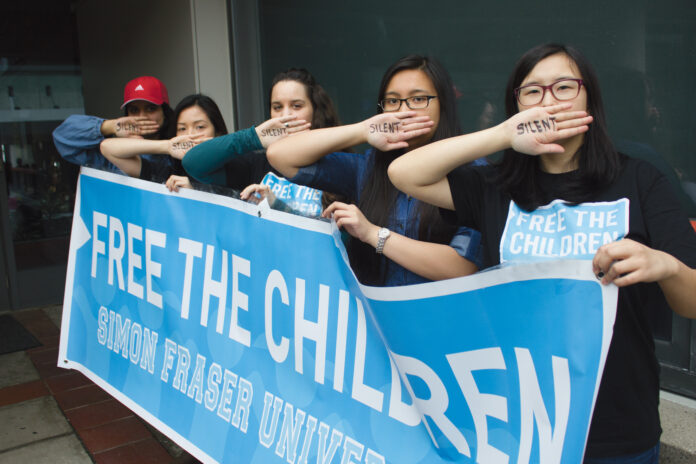
We have the power to affect real change on the web, and to fight the disassociation between the real person and the virtual profile that cyberbullying causes. The Internet has become a bystander society that continues to permit this behaviour — since the consequences that occur from such behaviour in the real world often do not apply, this online culture has projected a deafening silence that blocks the pleas of real person’s pleas behind the screen.
Though, it is easy for us to become upstanders within our bystander society: we just have to counteract the negativity by making the personal choice to empathize with our friendly comments, rather than remain desensitized.
“Empathy from one person can make a difference,” Lewinsky advised. “Compassionate comments help abate the negativity.”
With so many suicides and so much harm caused by cyberbullying, the least you can do is to click with compassion.