
Home Blog Page 975

Jamie Oliver, leave a child’s diet alone

0
Photo courtesy of Wikimedia Commons

This Christmas I sat down, flipped on my TV, and engulfed myself in the guilty delights of celebrity chef Jamie Oliver’s Comfort Food series. As a trickle of drool anointed my chest, I watched caramelized onions pleasurably swim in sizzling butter and huge steaks detox their glistening fat while generously smothered barbeque sauce.

Of course, the loud and excitable Oliver didn’t highlight how the resulting steak and onion sandwich, if eaten on a regular basis, may hail adult-onset diabetes and a myriad of other diet-related diseases that are, for lack of a better term, inducing population control. Why would he? He’s an international public figure with a corporate reputation to uphold, and this is delicious comfort food.

This is why I find it so ironic that Oliver has involved himself in a campaign to teach children how to grow and prepare their own ‘nutritious food.’ His campaign website quickly rambles off a couple of unfortunate health statistics and proclaims its goal to “create a movement powerful enough to force all G20 governments” to make food education in public schools mandatory.

To clarify, yes, fast food and other packaged goods permeate Western food industries. While cooking skills diminish as ubiquitous ready-to-go meals flourish, it’s a shame (though not surprising) that 42 million children under age five are unhealthy. Yes, I believe that governments should make more efforts to ‘get kids while they’re young’ and teach them about what ‘food’ really is. I just find it an enormous shame that it may take a celebrity campaign to instigate such a widespread change.

Jamie Oliver should stick to doing what he does best: cook comfort food.

Jamie Oliver, whose loaded “insanity burgers” boast “ultimate indulgence,” is really a trademark fraught with irony, capitalizing on some of the most severe health issues of today.

To worsen matters, CBC recently posted an article outlining Oliver’s plan to call upon Canadian politicians to join the movement. He claims that “he’s not political, but the issue of healthy food [is] a politically charged one.”

Buddy, if you’re blatantly not political, why are you making such a bold statement about how politics should run? Is this what your manager asked you to do? I’m definitely not political, but I’m going to “force governments” to plaster my face over 42 million overweight children and call it change. You’re welcome.

I guess it doesn’t help matters to find out that Oliver launched his restaurant chain in Toronto last year. Yum! More steak sandwiches for everyone. But please don’t visit his restaurant; grow and make your own nutritious food. Didn’t you hear we’re having a global health crisis?

Maybe Oliver should stop pretending he knows politics, and do what he does best: cook comfort food. And maybe wealthy governments should think for themselves and cook us up some common sense. That way we all have a better chance to live well, without a trademarked tongue sampling our salty global stew for hints of butter and cash.
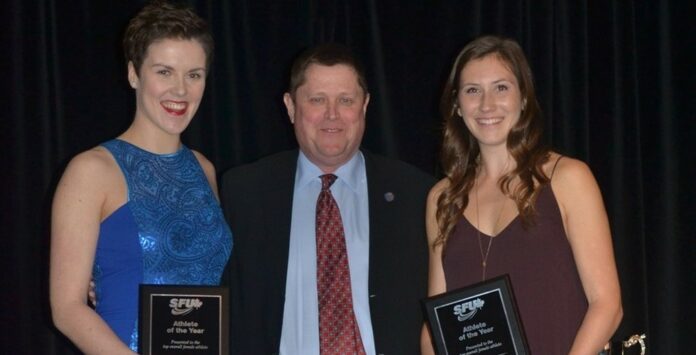
SFU’s top athletes honoured at the Clan awards banquet

0
The women’s Athlete of the Year went to two athletes: track and fielder Lindsey Butterworth and women’s basketball star Erin Chambers. Photo courtesy of SFU Athletics
The women’s Athlete of the Year went to two athletes: track and fielder Lindsey Butterworth and women’s basketball star Erin Chambers.  Photo courtesy of SFU Athletics
The women’s Athlete of the Year went to two athletes: track and fielder Lindsey Butterworth and women’s basketball star Erin Chambers. Photo courtesy of SFU Athletics

The Clan Athletic Awards Banquet, held last Wednesday at the Hilton Metrotown, honoured SFU’s student athletes. Hosted by senior volleyball player Amanda Renkema and redshirt-junior offensive lineman Quin Courtney, the event was lighthearted and included playful jokes about the high turnover of coaches in recent years.

Even technical issues that caused an over-20 minute delay wasn’t enough to dampen the moods of those in attendance.

“I’m always amazed to see the student athletes’ accomplishments — both on the field and off the field,” said outgoing athletics director of advancement Steve Lewarne. “All too often we’re able to see what their accomplishments are in competition, but it isn’t until we get to an event like this that we are able to see what they do in the classroom and we do truly have some remarkable and amazing student athletes.”

Before athletes received their awards, members of the SFU Athletics staff were honored for their achievements. The Director’s Award, which acknowledges a special contributor over a multi-year period, went to Margaret Jones, SFU Athletics’ special projects coordinator who has worked at SFU since its inception.

In Jones’ honour, a new award was created, the Margaret Jones lifetime achievement award. Head physiotherapist and senior woman administrator Laurie Freebairn became the first recipient, having been SFU’s head physiotherapist since 1987. Freebairn is retiring in May.

The VW Kip Dougherty award for trainers and managers went to the SFU football training staff: Darren Correa, Steven McGee and Jeffery Yu. Director of football operations Mike Lionello received the Fred Dietrich award for enhancing the student athlete experience.

Softball’s Kelsie Hawkins received the first student athlete award, the Rick Jones Award for Courage. Hawkins, now a senior, left school in her freshman year to be with her mother, who had been diagnosed with late-stage brain cancer. Last year was supposed to be her senior season, but Hawkins suffered a back injury and was forced to sit out.

Brandon Watson, the men’s soccer goalkeeper, won the Bill DeVries award for academic and athletic performance. Watson currently has a 4.1 GPA in biomedical physiology and kinesiology.

The volleyball team was awarded the President’s Academic Team of the Year award for a collective GPA of 3.14, while the women’s cross-country team won the President’s Athletic Team of the Year award.

June Davies, Lorne Davies’ wife, presented the Lorne Davies Award, which awarded seniors for athletic performance, classroom performance, and community work. The men’s award went to Jovan Blagojevic, while the women’s went to cross-country and track athlete Lindsey Butterworth. A moment of silence was held for Lorne Davies, who passed away in February.

Middle distance runner Lorenzo Smith took home the Clan’s Department Scholar Athlete Award for his 4.21 GPA.

The Terry Fox Award for Inspiration was also swept by middle distance runners, being awarded to junior Cameron Proceviat and graduate student Jennifer Johnson. Johnson came back from injuries that plagued her undergraduate career to compete as a graduate student at SFU, where she received All-American honours. Proceviat claimed GNAC titles and is president of the Student Athlete Advisory Committee.

The night closed with the Athlete of the Year awards, which were drawn from the individual most valuable player awards from each team.

On the men’s side, the award was narrowed down to five finalists: Blagojevic, football’s Jordan Herdman, track athlete Oliver Jorgensen, basketball player Sango Niang, and swimmer Adrian VanderHelm. The women’s award was narrowed to four: track’s Rebecca Bassett, Butterworth, basketball’s Erin Chambers, and wrestler Bailey Halvorson.

Ultimately, Blagojevic, who was not in attendance as he was playing a match with the Whitecaps FC 2, won the men’s award. Blagojevic was this season’s West Region and GNAC player of the year, and became the first Canadian university soccer player to be drafted in the MLS.

Butterworth and Chambers both took the female athlete of the year award. Butterworth won the 800-meter title at the NCAA indoor track and field  national championship, while Chambers shattered GNAC scoring records for women’s basketball.

SFU calls on students to create official school song

0
Photo courtesy of SFU
The winning song will be celebrated along with SFU's 50th anniversary in the fall. - SFU
The winning song will be celebrated along with SFU’s 50th anniversary in the fall. – SFU

SFU’s ceremonies and events office is calling all “professional musicians and closet composers, experienced songwriters and those who always wanted to try,” to enter the Legacy Song Contest for a chance at making university history.

“Because we’re celebrating our 50 year anniversary, we thought it would be really fun to create [a school song] that could be a legacy for the next 50 years, and hopefully beyond,” said Sue Porter, associate director of SFU ceremonies and events.

All members of SFU’s faculty, staff, students, and alumni are invited to enter by uploading either a video or audio submission to the contest’s Strutta site by May 31.

The criteria on the website is deliberately vague. “We didn’t want to influence people in terms of the kind of song they would create. We really wanted to leave it open to every possibility,” said Porter.

However, she emphasized that “the song has to be original, less than two minutes in length, [and] we want it to represent SFU’s vision of engaging the world.”

Porter added that the song should be memorable and easy to sing. “We don’t want something so complicated that no one will remember how to sing it,” she said. “It [should be] appropriate for use at all kinds of SFU events, and [. . .] the lyrics [should] appeal to someone of any generation.”

Porter explained, “We don’t want something that’s too 2015, and that uses references and concepts that people wouldn’t know 20 years from now.”

After discussing the competition criteria, the organizers decided against limiting the contest to “fight songs” — chant-like songs for athletic events — or “alma mater songs” that are more formal, processional tunes for ceremonial events and convocations.

Instead, the contest parameters are broad, and organizers anticipate that entries may fall anywhere between a fight song and an alma mater song, or could even be more pop-inspired and catchy.

A panel of “celebrity” judges, including representatives from the administration, faculty, alumni, and student body, will decide upon five or six finalists entries. The judges have not yet been determined.

From June 15 to August 1, the entire community will have the opportunity to view and vote for their favourite finalists once a day online.

The winning song will be announced and played live at noon during the 50th Anniversary Celebration on September 9 at the Burnaby campus. Winners will receive a $2,500 prize, and two runner ups will be given $500 each.

Porter pointed out that the American songwriter and composer Cole Porter actually wrote his school song for Yale, which is still used to this day, “so maybe [we’ll] get to find the next Cole Porter.”

SFU President Andrew Petter commented that with the 50th anniversary, “We’re entering a new era of engagement with our students, alumni and supporters. I am delighted that a member of the SFU community will be instrumental in creating a new musical legacy for the university.”

Students compete to develop SFU app

0
Currently, there is only an unofficial SFU app in circulation.

SFU is designing an official app with the help of students from the software engineering course CMPT 275.

Roughly 100 SFU students are feverishly working on the app, designing features for SFU transit, Connect, Canvas, calendar, and wayfinding.

Students may be able to enjoy the new app as soon as fall 2015, according to Herbert Tsang, CMPT 275 instructor and adjunct professor in the department of Interactive Arts and Technology at SFU.

He sets different themes for every class he instructs, and for this particular course, the theme for is the information portal for SFU.

Tsang explained, “It’s a class project per se, so we have about 15 different teams that are working on this theme, but they can choose their own features and functionalities.”

Serena Chan, one of the students participating, explained that the strength of her group’s app is its wide array of options for users.

In the beginning, Chan said that project seemed overwhelming, but now students are coming close to a finished product and even focusing on optimizing the app’s performance.

According to Chan, “If you’re not connected to the Internet, you can use the offline map. If you are connected, our app includes Google Maps. A lot of groups had interesting ideas for new features such as wayfinding, loyalty programs for dining services, and even a bitcoin wallet.”

There are a lot of common functionalities in the prospective SFU official apps, such as bus schedules, SFU email, calendars, and Canvas.

However, many students are integrating new and interesting themes into their apps, such as wayfinding on campus, a system to keep track of the library books, connections with dining services on campus, and incorporation of social media.

“There are many things that people are exploring at this point,” noted Tsang.

The best app will be selected at the end of April once students from CMPT 275 submit their final projects. If all goes well, the plan is to hire the winning team and work with them to perfect an official app for SFU.

“We are going to have 15 different apps finished by the end of this semester. The plan is to pick winners,” Tsang asserted.

Mark McLaughlin, executive director at SFU Ancillary Services commented, “[What] we would like to do is come up with a new [app], not just with fresh technology, but with some really exciting features that will really be used by students.”

According to McLaughlin, the app should be ready by the fall release date if the university and the students can perfect the app over the summer.

McLaughlin pointed out that “it’s important that private information such as username and password are secure for the official SFU app.”

Since SFU does not currently have an official app, both Tsang and McLaughlin believe that the upcoming one will be very useful for students. 

“We are really hopeful that the app will take off and there will be an app, but right now, it is one step at a time,” said McLaughlin.

“The app is coming, definitely, so watch out and we hope that everybody will download, use it, and give us a feedback so that we can make it even better,” concluded Tsang.

Guns kill people but gun control saves lives

0
Photo courtesy of Wikimedia Commons

Earlier this week, the Canadian Supreme Court decided in a 5–4 decision that the Federal government is entitled to destroy all of Quebec’s data from the long-gun registry (LGR), which was scrapped a while ago. While registry data from other provinces had been destroyed in November 2012, a protracted legal battle from Quebec challenged the Federal government’s decision to scrap Quebec’s data, since the province plans to proceed with a registry of their own.

When it comes to public safety, this is yet another step in the wrong direction for the Conservative government. While Harper is all too happy to lock up gun offenders and throw away the key, he adamantly refuses to use the LGR and strict gun control as a preventative measure. Canadians should be very afraid.

The LGR and the Canadian Firearms Act were introduced in 1995 as response to the gun control movement spurred on by the tragic shooting at the École Polytechnique in 1989.

Since the dissolution of the LGR in 2011, Canada has seen several horrific shootings — most recently the assault on RCMP officers in Moncton last year and the Parliament Hill shooting in January of this year. Both involved the use of long guns. Michael Zehaf-Bibeau, the Ottawa shooter, used a lever-action Winchester rifle, which would have been registered in the LGR. The rifle in question may have indeed been in the registry, but those records have since been destroyed.

I don’t want to argue that a long-gun registry should be established depending on the occurrence of highly publicized shootings. Stricter gun control measures should not be a reaction to tragedies, nor should a myopic focus on such tragedies be used as justification for why gun control doesn’t work.

The very least that can be asked of gun owners is to comply with safety regulations.

The facts in this case are indisputable. According to Statistics Canada, “the number of homicides involving long guns since the introduction of stricter gun laws in 1991” was down by 65 per cent in 2010. Since such laws were introduced, the rate of spousal homicides involving a firearm dropped by 74 per cent. When the long-gun registry was still in existence, police accessed it more than 17,000 times a day.

Conservative Public Safety Minister Victor Toews has said that the LGR “does nothing to help put an end to gun crimes, nor has it saved one Canadian life.” Clearly the Conservatives need to take a closer look at the numbers.

One of the main criticisms launched by the Conservatives was that the LGR was too expensive; Stephen Harper has therefore made the logical step (sarcasm heavily intended) to permanently destroy the whole thing, meaning that the over $1 billion in taxpayer money will have been completely wasted.

Guns don’t kill people, people kill people. I’m hesitant to wade into this shitstorm of hot air and rhetoric, but here I go. People use guns to shoot people. Whether or not the average gun owner wants to shoot someone is irrelevant; modern guns are tools that make homicide easier.

The very least that can and ought to be asked of gun owners is to comply with safety regulations. Here the tradeoff is clear: A small inconvenience and modest registration fee for gun owners in exchange for possibly one fewer innocent death at the hands of a gun. That’s a deal Canada should be willing to make.

This week in comics

0

ONLINE-SeagullSquareSeagull Square (Jill Mandrake)

new-Agora13 The Adventures of Agoraphobia Man: World Defender (Jacey Gibb)

BW-ichabodIchabod the dreaming worm (Rachelle Tjahyana)
Screen Shot 2015-04-03 at 9.05.48 PM

Much More Better (Talha Qadir)

Top public places to be seen holding your yoga mat

0
Photo courtesy of Free People

By purchasing a sleek yoga mat for yourself, you’ve already taken the first step towards pretending you lead a healthy, active lifestyle. But are you ready to experience the countless benefits that being seen holding a yoga mat does for your body? Not only will you have a jumping-off point for anyone who wants to have a conversation, but you’ll automatically be instilled with the feeling that you’re better than most people.

Here are a few of our favourite public places to be seen reaping all of the benefits that come with holding a yoga mat.

A local coffee shop
Who has time to hold a hot cup of whatever sugary drink the rest of the population seems to be guzzling down large vats of these days? Not you, because your hands are full with your trusty new matted best friend. Make sure you ask the barista working if they have soy or lactose-free milk, pretend to contemplate their answer like it ever really mattered, and then neglect to order anything. You wouldn’t want to accidentally spill any of that latte art on your new mat.

On transit
The SkyTrain or bus is a perfect place to be seen holding a yoga mat because everyone is forced to see and think to themselves how active and self-motivated you must be — mostly because they have nowhere else to go and a very restricted field of view. To achieve the optimal level of self-righteousness, hold your yoga mat in a way that unnecessarily takes up the seat beside you as well.

In the lobby of a gym
A full-fledged membership to a gym can be expensive, but most gyms will let you hang around their lobby, not using any of the equipment or amenities, for free. You’ll enjoy a lot of the same benefits that people who want to be seen at the gym feel without the hefty price tag that comes with it. For added effect, try eating a small to-go sized yogurt while you’re loitering. Healthy people are always eating yogurt.

Outside of a fast food restaurant
In stark contrast to hanging around a gym lobby, lingering outside the entrance to a fast food restaurant is wildly satisfying and can help you be seen by even more people. Try holding the door for patrons as they enter/leave the building and make sure you mention how you’re burning twice the calories by holding a mat in one hand and a door handle in the other. Voila! Instant confidence boost.

Patches of black mould petition against university building closure

0
Illustration by Rebekah Chotem

Over 50 patches of potentially hazardous black mould gathered on Burnaby campus last Thursday to raise awareness about the university’s decision to shut down Louis Riel House.

When the building closes at the end of August 2015, all remaining residents will be forced from the property. As of March 27, an undisclosed amount of building units contain black mould, while 122 of the units still have people living in them. The building has been a mainstay for mould on campus for several years, while humans have also occupied Louis Riel for 45 years.

“Louis Riel is one of the only places on campus where mould can not only grow, but even flourish,” one of the patches of mould said during the rally. “If Riel shuts down for good, where will we go? Who will take care of us by neglecting basic building maintenance and upkeep?”

The university claims it has the moulds’ best interest at heart concerning the closure, saying they will try everything to find proper accommodations for mould elsewhere on campus, like in the Education building. However, there are concerns that said building is already at maximum mould capacity and is unfit to house any patches that will be displaced from Louis Riel.

“It feels like the university is just abandoning us,” another patch of toxic mould told The Peak. “The current crusade by SFU to combat health risks to its staff and students could ultimately lead to fewer places available on campus for mould like us to grow.

“Our university needs more affordable, low-income housing that’s seen years of neglect from proper maintenance. Otherwise, it’s essentially giving up on a percentage of the mould population that calls SFU home.”

Allegations have also been made that the university is deliberately taking care of its other buildings in order to push out low-income mould and further gentrify the campus, but no claims have yet been proven.

“We value our school’s mould and are hoping we can find a solution that works for both the mould and our lungs,” said Thompson Bates, a spokesperson for the university. “Unfortunately, it’s too early to tell what that solution might be.”

In the meantime, a monetary fund has been established to help mould that has already been displaced by Louis Riel’s pending closure. Toxic fungi that will soon be affected by the shutdown are being encouraged to utilize campus resources to potentially find new ceilings, floor, neglected hallways, and drywall to inhabit.

Actual interviews with actual people: Reverend X, God

0
Illustration by Serena Chan

“Bitch, I ain’t give a fuck what you’re thinking, fuck your thoughts, I’m God, and bitch, you not!”

This profane and classic line was uttered by South Central Los Angeles public access television icon Vincent Stewart, a.k.a. The Spirit of Truth. His public access show, One Man Show, included several heavy sermons on Christian beliefs, namely the belief that he was God (the entire Holy Trinity) in the flesh. The Spirit of Truth (or Reverend X as he became affectionately nicknamed by fans) would curse out those who blasphemed against his name while preaching the word during his various call-in segments in the late ‘90s.

Unfortunately, he was kicked off the air due to exposing his bare ass on-air and asking the audience to find any traces of sin. His show lay dormant until 2006 when it became a viral sensation, garnering attention from Howard Stern and Daniel Tosh. Reverend X still preaches the word via Facebook, and The Peak reached out to him to learn more about why he is possibly Our Lord and Saviour.

The Peak: When did you first come to the realization that you were an incarnation of God, and when did you start preaching on public access television?

Stewart: I guess you can say I knew I was God all my life. But I started in ’96 producing and promoting my word.

P: Before you started preaching that you were God, did you have a background as a preacher in any Christian denomination or seminary?

S: No, I walk in the name of Jesus by the power of the Holy Spirit. If you title me anything, title me as God.

P: What happened to your show and why did it end? What have you been up to since it went off the air?

S: They accused God immediately and that is what a corrupt government does. I want to set up my righteous government, and the religion should be keeping the Law of God. They have not sworn to God. I came as Jesus Christ and I knew you were going to murder me. Even the Devil agrees that anyone who is blaspheming against me should be put to death.

P: How do you feel about most modern-day Christian groups that proclaim to do “works of faith” in your name? What are your feelings on other monotheistic religions like Judaism and Islam?

S: You and the whole world are guilty of Christ’s death. You should not be revolving your life around death.

P: There is a lot of suffering on the earth these days with death, destruction, climate change, and there is even persecution of Christians going on in Syria. Why have you, as God, not alleviated the suffering of your people?

S: All of you are still God’s enemies, why should God give a fuck if you aren’t abiding by the law of God? There’s a difference when you got a counterfeit government, the only reason for democracy is to murder God and murder Christ. The only reason for freedom of religion is for the devil worshippers. The anti-Christ Christians are the robbers of God and are breaking the law.

P: Have you ever set up your own church based around your theology? Do you have any genuine followers of your version of the Christian faith?

S: Not a one, there is only one I can think of and that follower is Jesus and of course I am he.

P: Who do you think is by far the biggest sinner of all today? Who truly, more than anyone else, angers you as God?

S: You’re all guilty of sin. There is no one person, I shouldn’t put my system in autodrive. George Zimmerman is a symbol for murder. Same with George W. Bush. I’m the motherfucker you murdered! You don’t know what you’re waiting on Jesus for and white people look for the Anti-Christ. God said “love your enemies,” but God said that for himself.

P: You mention in your Facebook posts a lot about “white devil worshippers.” Do you dislike all white people or just those that disobey your teachings? Is there any hope for white people to redeem themselves in your eyes?

S: It’s not about disliking white people, so much as you are responsible for all the crime and murder. You’re like the gatekeepers of hell and your democracy is about division. You do not allow God in your democracy. The best thing he can get is drugs or death or death by drugs. You white folks are crazy!

P: Do you ever plan on going back on the air to remind people that you are God?

S: The first chance we get. I’m not gonna remind your ass I’m God, because you surely forgot who the fuck God is.

Next semester will be different

0
Screen Shot 2015-04-03 at 9.29.45 PM
Illustration by Momo Lin

Well it looks like you made it,
you’re almost all of the way through.
Another semester under your belt,
your parents couldn’t be prouder of you.

All finals are done,
the last paper handed in.
It’s time to celebrate,
with a double tonic and gin.

But the last few months weren’t your best,
your GPA harder to preserve.
Your grades might have dipped a bit,
thank goodness for the curve.

It’s not your fault this happened,
you took too many classes.
And it probably didn’t help,
that half of your TAs were asses.

“They really weren’t fair,”
you complain to your friend.
“I think my ideas were just,
too insightful to comprehend.”

All that’s behind you though,
you’ll do better next time.
You make a pledge to yourself,
completely in rhyme.

Next semester will be different,
you make the promise loud and clear.
I’ll stay in on weekends,
I’ll drink half as much beer.

It’s society’s fault, really,
for making you this way.
Social norms compel you,
to party each Friday.

Next semester will be different,
you make a note to yourself.
I’ll use the textbooks for more,
than just sitting on a shelf.

I’ll do all of the readings,
the recommended ones too.
Maybe then exam questions,
won’t feel so out of the blue.

Next semester will be different,
said enough and it might come true.
There has to be a way to bounce back,
or else your GPA will hit a low two.

Perhaps taking better notes,
will lead to higher marks, I’m assuming.
Or at least stop filling the margins,
with all of your amatuer cartooning.

Next semester will be different,
there won’t be a problem in sight.
Between work, friends, and school,
you’ll get the balance right.

Maybe you’ll even have enough time,
to get back into hobbies you miss.
Like music or rock climbing,
not just exploring the Internet abyss.

Next semester will be different,
or at least you think it might be.
Hoping is great,
but there’s no guarantee.

What if the classes get harder?
What if there’s even more homework?
What if you run out of money?
What if things just go berserk?

Life can get overwhelming,
sometimes it sneaks up on you.
The semester just ended,
but there’s already stuff you can do.

Like scholarships and bursaries,
you’ll have to apply early.
And scoping out classes,
preferably not ones in Surrey.

And have you thought about graduation?
It’s not as far off as you might think.
And have you fulfilled your
breadth courses?

Your spirits slowly do sink.
It probably wouldn’t hurt,
to start readings for next semester.
‘Cause if your grades dip too low,
your scholarship they’ll sequester.

Suddenly the stresses you thought were gone,
come rushing back all at once.
If you don’t succeed in life right now,
your family will think you a dunce.

You don’t know how you made it through last semester,
it truly was your worst.
Academia filling your head with knowledge,
‘til your cranial cavity’s prone to burst.

You needed citations for your citations,
a page just for your thesis.
You questioned all of your sanity,
and if you really needed this.

Hassle and bother,
anxiety and stress.
While you’re in school,
everything else is a mess.

Assignments, exams,
and those participation marks.
Student loan interest waiting,
like a pool full of sharks.

You skipped classes to do homework,
and fell even further behind.
As term papers loomed,
you felt even more confined.

“Wait, the essay’s due tomorrow?
I thought that was next week.”
Bought yourself 9,000 Red Bulls,
because technically we don’t need that much sleep.

Online discussions and labs,
and a list for extra reading?
Though it’s likely not literal,
your eyes feel like they’re bleeding.

Deadlines a-galore,
and marked absent if you’re late.
Waking nightmares are the worst ones,
they’re impossible to escape.

Group projects with 10 members,
each more absent-minded than the last.
You raise your hands in frustration,
and pray this too shall pass.

But. . . next semester will be different,
you really mean it this time.
Now’s the age to take on too much,
you’re still in your prime.

‘Cause as much as school’s hard,
and often difficult to manage.
When you finally have a degree,
then you’ll have all the advantage.

And if things don’t work out,
the world proves to be just too cruel.
You can always come back
and apply for grad school.