Home Blog Page 869

History of Art

0

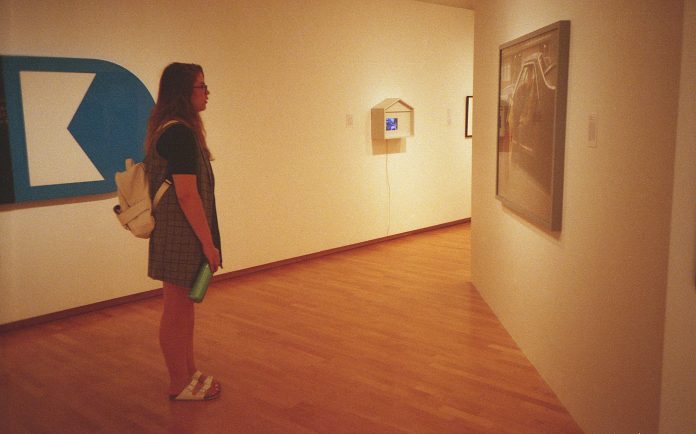
[dropcap]H[/dropcap]alfway down the South Concourse of the Academic Quadrangle, there are a pair of indescript glass doors distinct from the sea of wood paneling. Over it, a sign says SFU Gallery — admittedly not a particularly imposing entrance.

A relatively small space, it exhibits both contemporary art created primarily but not exclusively from Canadian artists. As the only dedicated Art space on the Burnaby Mountain campus, you’re more likely to stumble inside between classes, than to actually seek it out.

The small space doesn’t do justice to the long and dynamic relationship between the arts and Simon Fraser.

The current SFU Gallery system consists of three spaces: the SFU Gallery in Burnaby, the Audain at Woodwards, and the Teck at Harbour Center.

The SFU Gallery runs semesterly programming, and tries to connect an undergraduate population from diverse backgrounds and disciplines with Contemporary Art.

The Audain is a public Contemporary art space with diverse programing, it includes a spring and summer exhibition, undergraduate and graduate shows, and a fall artist-in-residence program, balancing the School for the Contemporary Arts with a city wide public audience.

Meanwhile, the Teck functions as a short term public art space with year long projects in a multi-purpose function and study space in the Harbour Center Atrium. The arts at SFU and the SFU Gallery have a longer history that predates this current set-up.

[dropcap]O[/dropcap]ur University opened its doors in 1965. At the time, its approach to education was unique in many ways, along these lines was the potential for interdisciplinary exchange in the liberal arts and sciences.

Those founding years were filled with excitement about the potential in that approach. The Centre for Communication and the Arts was one of the initial bodies to be created. Formed under the Education program, it is the predecessor to the School for Contemporary Arts and the SFU Galleries.

The Centre was an incubator for the arts that existed as a non-credit hive for programs, workshops and events open to the entire University community. It fostered artists and performances with a nationally recognized faculty in an environment with few boundaries and barriers.

Many of SFU’s initial experiments in education did not survive long. The Centre was no different, and it was restructured. Eventually, the Centre for Communications and the Arts shifted away from the radical freedom of its early years and eventually transitioned into the credit based program we know today as the School of Contemporary Arts. This reflected broader trends at the university for a return towards the entrenchment of long established ways of thinking and working.

Artist Iain Baxter& — who at the time was simply Iain Baxter, adding an ampersand to his name in 2005 — founded SFU’s visual arts program and was the creator of SFU’s original logo. He was responsible for fostering a lot of that initial freedom and experimentation at the Centre for Communications and the Arts.

One of his notable attempts was when he taught what was supposed to be a semester long class — 13 two-hour lectures — as a 26 hour marathon session instead, an experiment born out of the free-wheeling mentality of artists at the time and the freedoms afforded in a Centre running on a non-credit system.

Without a dedicated gallery space, this was an environment where art could, and did, happen all over campus.

1969’s Catalog for the Exhibition, organized by Seth Siegelaub is one such project. It included participatory and durational pieces by artists like Sol Lewitt and Lawrence Weiner, which were situated around the campus.

Jan Dibbet’s “Perspective Correction” for instance, involved the cutting and removal of a perfect square of grass in perspective from the lawn next to the theatre. This was then photographed and made into postcards available in the theatre.

[dropcap]O[/dropcap]ne of the Centre’s key figures in the early years of SFU was James Felter, a visual artist and curator who joined the Centre in 1968. He advocated strongly for a gallery space at SFU — a goal he achieved in 1970 when then President Ken Strand established the Simon Fraser Gallery and named Felter as its first director, a position Felter would hold for sixteen years.

Under Felter, the gallery would exhibit and work with many renowned artists and curators, while simultaneously developing the young, but strong collection of artworks by Canadian artists that the University started in 1965.

It was a prolific time in the gallery’s history, with 127 exhibitions being held in the first ten years, an impressive rate of an arts exhibition per month. Felter also developed a program of circulating exhibits that could be sent on tour to other public galleries in Western Canada and beyond, venturing into the traditional territory of much larger galleries with expansive collections.

This was an initiative cut short by the University’s growing budgetary crisis in the 80s.

[dropcap]I[/dropcap]n the years following James Felter, the Gallery would be separated from the successor to the Centre, the Department of Fine and Performing Arts.

With this new found independence, the gallery would no longer be run by Visual Arts faculty. Now under one of the University’s vice-presidents, the appointment for Gallery director would draw from other faculties and departments. With this administrative separation of the gallery came an ideological one as well. As the gallery took a more conservative approach to art, and as the Visual arts faculty continued to develop and experiment within a contemporary environment, their direction would diverge considerably.

The openness to public art and experimentation that existed prior to the gallery was partially fed by the shifting ideas on the purpose of galleries in general.

Contemporary artistic discourse was exploring the idea that art didn’t need to be relegated to a devoted gallery space. The thought was that it could, and should, be part and parcel with the world and the public sphere. The idea of the ‘white-cube’ as a meaningful mode of explanation, with the gallery as a blank slate for the exhibition of work also came under fire.

This was a period where the gallery and institution were criticized for their role and conservatism, creating a generation of artists that would question the role and exhibition of art. The movement in this direction by artists and faculty contrasted with the direction of the gallery under non-art directors.

Though the conversation around public art would continually develop and change, the familiarity between the university community and public art would continue, through permanent works installed around campus, but also through temporary exhibitions and programs.

One notable example is the first year campus project — a project where first year students develop and create a site-specific public art piece at the end of their second semester.

Until the completion of the Woodwards complex and the final movement of the School for Contemporary Arts downtown, this was a project that formed a regular part of the Burnaby Campus. A lasting tradition of taking art outside the gallery space, that met with the mixed results of first year students developing their nascent artistic practices.

Another particular moment in the development of art came in the 80s, when Jeff Wall, a rising and soon to be leading artist of photoconceptualism in Vancouver, began giving classes in his studio on the 100 Block of West Hastings. With time, Wall would join the Visual Arts faculty, and the program would move into the same building.

This arrangement included a gallery space that showed a variety of artists, not restricting itself to students or graduates. It was a gallery space in line with the developing artist-run centre culture of the time. With the moving of the Visual Arts program to its current location at 611 Alexander Street in 1993, this location of the gallery would cease to exist.

However, this didn’t leave the University without a downtown exhibition presence — a gallery space came with the 1989 opening of SFU Harbour Centre in the renovated Spencer’s department store building.

This is the Teck Gallery space at the far end of the Harbour Centre atrium, and it would be joined in 2010 by the Audain Gallery on the ground Floor of SFU’s Goldcorp Centre for the Arts. Throughout the years, despite the shifting locations, administration and nature of the arts, SFU’s various gallery spaces provided an important opportunity for students and members of the public to be exposed to art, and its development in the city and beyond.

F-61-1-2-0-23

[dropcap]B[/dropcap]eyond exhibiting work, the SFU Galleries are also responsible for the SFU Art Collection, an important collection of local and regional artwork. This collection covers work of historical and contemporary value and stands at over 5,500 pieces. Large parts of this collection are either hidden away in short term storage in the AQ, or long term storage under Strand Hall. Though occasional portions of the collection that are in storage occasionally come out as part of exhibitions, the majority of those remain largely unseen.

However, a substantial portion of this collection is displayed around SFU’s various campuses, this includes over 1000 public sculptures, murals, large format paintings, and prints. The original two pieces of the Art Collection are amongst those found on display — Gordon Smith’s mosaic murals, commissioned in 1964 and installed in 1965, form a permanent part of the Academic Quadrangle.

Located atop the monumental staircase that rises from the Mall to the AQ, they face each other across the central east-west pedestrian axis that defines the university’s design. Their commissioning for the new university, and prominent site make them a fitting start for the Art Collection.

The murals are amongst the best known works in the collection, frequently used for photo-ops, and promotional photos. They have presided over the Quadrangle and Mall throughout SFU’s history, and frame the yearly processions of students who graduate having successfully slogged it through years of a university education to make it to their convocation ceremony.

Their visibility is one utilized for SFU’s 50th anniversary campaign, as the murals found themselves used as the backdrop for signage and promotional material across printed and digital media.

On the western side of SFU’s Burnaby Campus, on the opposite end of the spectrum, sits the most recent acquisition. This is the large Damian Moppett sculpture Large Painting and Caryatid Maquette in Studio at Night (Sculpture Version), that was installed over the Residence Dining Hall Building. It was originally commissioned for the Vancouver Art Gallery’s offsite public art space on West Georgia, and was on display from November 2012 to April 2013.

Here at SFU it joins a long-running tradition of public sculpture that began with Gordon Smith. Adding to the many examples of public art permanently located around the AQ and throughout campus.

Donated by the artist, the Caryatid Maquette took two years to prepare and install. As it had been commissioned for a different site — a specific site — relocating it meant finding the right site on campus and also adapting the work to meet it, all while following the procedures and considerations of the University.

According to the current director and curator of the SFU Galleries, Melanie O’Brian, “It was a process unique to working in the arts within a large comprehensive institution.”

Bringing the Caryatid Maquette to SFU was a long process that sometimes had to take a step backwards in order to continue. The initial approval, was followed by site selection, and consultation with facilities to seismically test the site, and engineer it for safe installation, a process that had to be repeated when the site was changed.

Compared to a free standing sculpture like that of Terry Fox, or Mahatma Ghandi, this process was considerably more complicated since the sculpture was to be installed onto a building.

As well, the previously free-standing sculpture was originally a layered three dimensional array that referenced the artist’s studio as a stage set. To fit its new home, it had to be flattened and welded back together into a new unique arrangement that didn’t interfere with the original vision.

Despite the long process, it’s one that O’Brian would like to do again. As projects like it set the tone for her desire to “bring Contemporary Art up to campus and contribute to a culture of vibrancy,” something that can happen through paintings like those in the AQ concourse, “but sometimes requires bigger statements.”

[dropcap]A[/dropcap]nyone entering the SFU Gallery in the Fall of 2013 would have encountered Samuel Roy-Bois’ Not a new world, just an old trick. It was a large white construction, whose exterior could be used to study, or to lounge and sit amongst cushions and blankets.

In the interior, were two small rooms that held a selection of the work from the SFU Art Collection that Roy-Bois curated as part of his installation. These works included such diverse things as photographs, drawings, paintings, sculptures and some silverware that would not have felt out of place in the proverbial North American home of our grandparents, or in a period piece on HBO.

As Christina Hedlund, the collections manager with SFU Galleries, put it, “No collection is perfect, all collections will have weird and unusual works.” Developed over the years from purchases and donations, it has grown in an organic and uncontrolled fashion.

The SFU Art Collection has a variety that includes grandmother’s silverware, but only has a limited amount of contemporary photography or SFU talent — an absence important in our local context due to the recognition of Vancouver as an important place for the development of conceptual photography.

This is curious considering SFU has a strong arts tradition tracing back to the Centre for Communications and the Arts, that focuses on contemporary art and critical thinking, and has always had a strong cohort of alumni, professors and students.

These kind of gaps are amongst the issues the Gallery seeks to address, to the extent of its ability with limited options for space and storage. In this context, small steps are being made when they can, such as the handful of works from SFU artists joining our collection following last summer’s exhibit, Through a Window: Visual Art and SFU 1965-2015.

In the past three years, Melanie O’Brian has focused on both small, and large movements. Improving things behind the scenes, silently reinforcing the Gallery’s status as a professionally recognized art space, while simultaneously making big statements. This work includes curatorial experiments such as last Spring’s Geometry of Knowing Series, and last Summer’s Through a Window.

The former consisted of four interrelated exhibits held at both the Audain and SFU Galleries throughout the spring semester. Three of the exhibits were curated by SFU Galleries, with a fourth curated by a third year School of Contemporary Arts Visual Art Core Studio cohort.

The setup allowed for the development of dialogue around related themes across the two galleries.

Through a Window consisted of concurrent exhibits at all three SFU gallery spaces providing a particular historical summation of the arts at SFU.

This approach to exhibiting stems from O’Brian’s desire to think about programming together across the Gallery spaces, exploring the potential crossover between ideas and audiences in the process. The focus on combined programming started with the rebranding of SFU Galleries as a coherent three gallery system, beginning with a new logo, a new website and a single program guide.

It continues through programming that bridges the physical distances between the galleries, and through the Gallery’s foray into publications.

This reassertion, and heightening of the visibility for SFU Galleries, within and outside the university is a continuing and multifaceted process, that they have to do while maintaining the socio-politically involved contemporary artwork that the University and the Gallery are known for.

Despite attempts to bring them together in new and interesting ways, the three gallery system presents challenges.

“They can have distinct audiences and distinct shows, and operate with their own sense of conditions,” said O’Brian.

It is fitting that the three gallery system reflects the structure of SFU itself, split into three different campuses, each with their own ways of thinking. Bridging this structure presents unique opportunities to create, in the spirit of that initial freedom and experimentation that started with the Centre for Communications and the Arts.
“I Can’t Get Into My Classes Again!?”

3


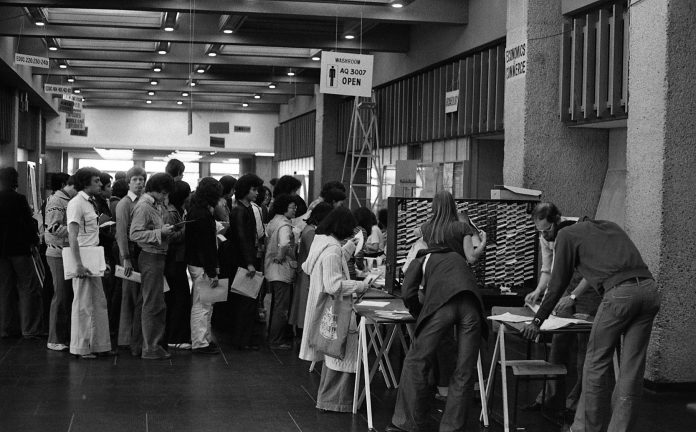
[dropcap]“[/dropcap][dropcap]C[/dropcap]ourse enrolment pisses me off. If seats are full we should have the option to either stand or bring our own stool to class,” read a recent comment posted on the SFU Confessions Facebook page.

After 20 minutes, the comments had received 40 likes; after an hour it had over 100. By the next day, it had garnered almost 1,000 likes, making it one of the most popular comments on the group in the last while, by far.

The message conveys a distinct frustration that students experience while registering for courses each semester. In surveys, SFU undergraduates routinely report encountering full courses, scheduling conflicts, courses not offered frequently enough, students’ late scheduling dates, and courses reserved for other students. These frustrations have students — predominantly from the Arts and Social Sciences, the Faculty of Communication, Art and Technology, and the Beedie School of Business — pulling their hair out in anger.

“The course selection process is extremely difficult and frustrating,” claimed third year Criminology major Yvonne Hanson in a video by The Peak. “I’ve been struggling with it the whole time. If you haven’t declared your major yet, you can’t get into any classes you need. So you wind up with the most bullshit little courses.”

“I had a horrible time with enrolment this year,” said second year IAT and Business major Gabriel Yeung. “I wasn’t able to get into most of my [IAT] major courses [. . .] I tried for eight courses, and I didn’t get into them. Now I’ve ended up with a semester of electives.”

“When I get [an enrolment] date I can already tell that I’m going to have a disadvantage,” responded yet another student. “I’m looking at the availability of courses, and then once my [enrolment date] reaches, the majority of them are already closed.”

These negative sentiments are reiterated in last year’s SFU Undergraduate Survey “course availability” section. Popular comments including “offer more courses,” and “better class availability,” further confirm student frustrations.

Issues with course enrolment have affected SFU students for years, as indicated in the 1998 Undergraduate Student Survey highlights, which convey that only 60 per cent of undergraduates were able to register for the courses they wanted. Since then, student satisfaction with registration in the courses they want to complete their degree has not improved. In Fall 2005, only 56 per cent could enrol in the courses that interested them; in 2008, it was 54 per cent; most recently, in 2014, it was 58 per cent.

Furthermore, in 2005, just over half (53 per cent) of the undergrad population found they were taking longer than expected to complete their degrees — a number that hovered around 57 per cent until 2013, before jumping to 64 per cent in 2014.

SFU’s 2010 Degree Completion Experience Survey shows that students complete their degrees on average 2.1 years past the traditional four-year time frame, a number which must come as a surprise to the 70 per cent of students in the same survey, who said they expected to complete their education in explicitly four years, and the 85 per cent from the Fall 2013 Undergraduate Student Survey who claimed graduating within their expected timeframe is important.

SFU’s Institutional Research and Planning (IRP) office conducts an annual undergraduate student satisfaction survey to “provid[e] essential feedback on academic experiences and concerns,” which usually garners a 20 to 30 per cent student response rate. They also prepared a variety of in-depth studies specifically into resolving course availability issues from 2007 to 2011.

The 2007 study states on its first page that “SFU’s course availability has been deteriorating,” and that “compared with other British Columbia universities, students at SFU experience considerably more problems with course availability and timely degree completion.” And despite several reports, surveys, and recommendations, the statistics in student satisfaction have more or less remained the same since the first online report was posted in 1998.

Many students at SFU clearly have trouble enrolling in many of the courses they want — an issue that is caused by multiple facets of the university system, and which could ultimately increase student attrition rates and damage the school’s reputation.

[dropcap]“[/dropcap][dropcap]W[/dropcap]e’re working on it,” Gordon Meyers, SFU’s Associate Vice President Academic, explained in regards to students’ enrolment concerns. “We know that course access is a serious issue.”

Meyers directly oversees all enrolment planning at SFU, and keeps in contact with SFU’s IRP office for patterns in course access research findings. He sits on a Senate Committee for Strategic Enrolment Management — which reports to SFU’s Senate with findings and proposals regarding course registration.

SFU’s course registration issues are caused by a variety of interconnected problems, all of which are related first and foremost to the ever-looming budgetary constraints that every university faces.

Meyers mentioned that once government funding (which decreased another two per cent for the 2015 fiscal year) has made its way to SFU, the money is then dispersed among the faculties in accordance with how many enrolments each faculty receives.

“It’s a student-centred budget,” stated Meyers. “If a faculty gets more students choosing courses from that faculty, they’ll receive a bigger budget [. . .] This gives [faculties] the resources to solve course access problems because it gives them the money to put on those extra courses.”

The problem seems to lie not in the allocation of government funding but an overall lack of it. In fact, the most recent five-year academic plan Faculty of Arts and Social Sciences states as one of its weaknesses that “insufficient base funding has [. . .]  created significant and sustained losses in research expertise in a number of our departments and schools” and that “these losses threaten the quality of [its] undergraduate programs, [. . .] graduate programs and [. . .] international reputation.

[dropcap]A[/dropcap]major factor contributing to SFU’s budgetary constraints is its unique trimester system, a way of operating that Meyers acknowledges is more expensive than the traditional semester system, but one that is not without benefits.

“The trimester system was [established] so that we’d use our buildings for the full year, and we can therefore save resources,” Meyers explained. “We don’t need as many buildings to educate the same number of students if we’re running all year round. It also provides additional flexibility for students, for example you can start any semester.”

While these factors have merit, SFU’s trimester system was mired in controversy from its very origins.

Hugh Johnston details, in his 2005 book Radical Campus, that during the university’s construction, higher-education was being given an infusion of public money while members of the public and politicians alike criticized universities for expecting this increased funding and yet operating only on a semesterly (fall and spring) basis.

“The course selection process is extremely difficult and frustrating.”

— Yvonne Hanson, 3rd Year Student

While university presidents tried to explain that summers were coveted by professors to keep their research current, SFU delegated academic planner Ron Baker — who would soon grow to dislike teaching within the trimester system himself — to examine the question of whether or not to open the school year-round.

According to Johnston, while extensive evidence from American universities proclaimed a year-round system to be more expensive than the traditional route, Baker hurriedly calculated SFU would save costs within the trimester system. Radical Campus  conveys that “after the university had been running for a few years, [Baker] could see that the savings were not there,” and in fact “[by] 1972 a management consultant firm calculated that the trimester system was costing SFU an extra 19 per cent per full-time student.” But by this time the system was so ingrained in the school’s culture that the administration “expect[ed] that SFU would lose students without it.”

Back when the trimester system was implemented, the idea was that schools operating year-round would be more deserving of additional government funding, but SFU is given more or less the same amount as its comparator universities who operate on a traditional academic calendar.

SFU received a grand total of $293.5 million in government funding for its roughly 35,000 students in 2015, around $8,400 per student. Similarly-sized schools such as Ryerson received a close-figured $7,500 per student, while the University of Victoria, a smaller school, received roughly $12,250 per student.

This means that while students at UVic or Ryerson have access to all academic resources during the fall and spring semesters, many students at SFU — especially the 35 per cent who currently attend the school only during the fall and spring semesters — do not have access to the school’s full range of resources during these periods. The significant difference is stretched over to operate the third semester while keeping all expensive facilities fully operative.

Johnston also states that Baker incorrectly assumed the trimester system’s advantages for students, as “he calculated a decided financial gain for students heading into professional careers if they decided to forgo summer jobs so they could start their careers a year earlier.” Johnston suggests that taking three full course loads per year isn’t practical for most students, who take part-time jobs to support themselves while in school.

As it stands today, a significant population of students work part-time while attending SFU. According to the Fall 2015 undergraduate enrolment report, SFU enrolled 13,160 full-time undergraduates along with a striking 12,161 part-time. Moreover, the previous summer semester saw 4,163 full-timers dwarfed by over 12,000 part-timers.

The Canadian University Survey Consortium (CUSC) states that 37 per cent of SFU’s first-year students in 2013 worked off-campus while attending school as compared with the average 25 per cent from comparator universities, while middle-years from 2014 and graduates from 2015 work 46 and 49 per cent respectively, compared with the 40 and 41 per cent comparator averages. Hence, there are more undergraduates at SFU who are employed while completing their educations, than there are at any comparator universities.

While SFU may provide educational flexibility for students who work part-time, the trimester system may actually be influencing students to find a means to finance their own education while they attend school.

SFU’s 2010 Degree Completion Experience Survey confirms one third of delayed graduates actually reduced their course load because of course availability issues, and not because of part-time work, thus prolonging a degree that becomes more expensive as the trimesters add up.

As such, SFU’s administration faces difficulties of scheduling classes in accordance with the times students are available and not at work, thus further limiting the quality and diversity of course options during registration.

This is especially tough for students interested in co-op, and frustrates their schedules further if they choose a co-op term that conflicts with preferred or required courses. Difficulties also arise for students who have yet to declare a major, and thus aren’t given priority registration dates.

The trimester system is uncommon in Canada, and in addition to SFU, has only been adopted by the University of Waterloo and the Université du Québec.

[dropcap]W[/dropcap]hen it was adopted, the trimester system was supposed to use classroom space more efficiently than a semester system since the university was in operation year-round. But not only has the overall growth of enrolment at SFU outpaced the creation of teaching space, the year-round system causes special problems for building maintenance.

According to Rella Ng, the Associate Registrar at SFU, spatial constraints play a large factor in whether or not courses are offered. Ng works at Student Services and makes sure that the course schedules submitted by the faculties can be properly implemented into the scheduling system in a way that allows for the class capacities to be assigned to the appropriate rooms on campus.

“We only have a certain number of large classrooms and theatres,” Ng said.

Ng is not the only SFU employee to vocalize spatial problems. Aoife Mac Namara, Dean of the Faculty of Communications, Art and Technology (FCAT), expressed her concerns that “probably the biggest resource we don’t have is space. So even if we had 10 faculties and whoever to teach the course, there wouldn’t be any room for it.”

SFU has also grown in population over the past few years, and the school’s most recent five-year Capital Plan released last year indicates that total full-time undergraduate enrolment “has grown by 59% during the period from 2001/02 – 2012/13,” and that “space inventory during this time has not kept pace, increasing by only approximately 47%.”

Moreover, Beedie School of Business’s 5-year academic plan states as one of its current “threats,” that “space limitations across all three campuses compromise the effective delivery of undergraduate and graduate business programs, and future program opportunities.”

SFU is especially struggling to accommodate the exponential student growth at its Surrey Campus which places further constraints on courses offered due to increased competition at this location.

“Surrey’s [full-time enrolment] (FTE) is over capacity by a long shot,” explained Elizabeth Starr, development planner at SFU Facilities and Services, and co-writer of the five-year Capital Plan. “FTE capacity in Surrey is 2500 [. . .] And we know we’re incredibly under-serviced in Surrey.”

SFU’s most recent Surrey enrolment report confirms that FTE enrolment for Fall 2015 was at 3,380 — placing SFU Surrey’s population at 35 per cent over capacity. Currently, SFU plans to expand the Surrey campus to allow for 5,000 FTE students, but this project has yet to be officially approved.

In addition to spatial constraints, SFU also has maintenance problems which affect the number of course offerings. As an associate registrar, Ng said she “quite often” removes classes from the registration system entirely, due to the abundance of deferred maintenance issues plaguing this half-century old university.

The five-year plan states that out of SFU Burnaby’s 35 academic buildings, only 10 are in “good” condition, while 13 are in “fair,” and 12 are labelled as “poor.” Because of this, the Plan has made restoring the school a priority.

Ng said that because there are fewer courses offered during the summer, SFU can make efficient use of this time to take classrooms offline in order to make the necessary repairs, but many times this isn’t the case.

“In Fall and Spring we get calls from Campus Planning and Facilities who say, ‘this room needs to be taken offline because it’s leaking,’” Ng explained. “Then we struggle to find [new] classrooms, and sometimes we [visit the departments] to discuss moving these classes around.”

SFU relies on government funding for the major maintenance repairs it needs and while it would take an estimated $532 million to make all the necessary upgrades to SFU Burnaby’s “poor condition” buildings, in an email, Associate Vice-President of Finance, Alison Blair, stated only “$3.9 million [was given] earlier this year, and $3.3 million more recently.”

Mac Namara does claim that a “big deferred maintenance [deposit]” from the provincial government is likely heading toward SFU, which “will be the first in line given the state of [the] facility.” An email message from the Associate VP Academic did not indulge in the rumour, stating that while there are “indications that the sector will receive additional deferred maintenance funds [. . .] there is currently no certainty.”

“We know that course access is a serious issue.”

— Gordon Meyers, Associate Vice
President Academic


[dropcap]D[/dropcap]espite the web of interconnected systemic factors contributing to SFU’s less-than-satisfactory course enrolment system, the Dean of FCAT feels that the issue really isn’t that difficult to solve, just one that requires a culture change in student course planning advising.

Mac Namara stated that FCAT’s course enrolment is the top priority issue she’s currently working to resolve, and that she has a three-pronged plan.

The first prong is to have the university uniformly understand what constitutes a full course load. SFU currently labels a minimum of nine credits (three courses) as “full time,” a number which MacNamara alludes is too low.

“What I hear all the time is that students can take only three [courses] because the workload is too high, and that shouldn’t be the case [. . .] Ideally, we should be able to tell students that if you come and do a full course load the whole way through, then you should be able to finish [a degree] in four years or five with co-op [. . .] When you don’t have a full course load it’s much harder to predict how many people are going through at what time.”

“The first thing we need to look at is what workload is involved in our courses, and then we need to ask students and advisors why we keep encouraging people to take fewer courses.”

The second prong  would require first-year students to sit with an advisor and fill out a planning sheet for their entire four to five-year degrees. This will force them to understand from the beginning that there’s a relationship from one course to another, which will give them a better understanding of the hurdle-prerequisites they’ll have to meet to take what they’re really interested in.

Mac Namara believes that “there has to be a social contract between the students and the administration [stating] that we’ll both work together to help the student progress in a timely way.”

The third prong is to construct better networks between the advisors and different faculties in order to broaden faculty knowledge of similar course offerings.

“For example, if you wanted to do a course and it got cancelled there [will] often [be] courses [in other faculties] that are similar,” she explained in reference to better networks. “[They probably won’t be] the same — but they might give you something from another faculty [to substitute].”

Executive Mark Roman, who took his position as SFU’s Chief Information Officer (CIO) in September 2015, echoes Mac Namara’s notion of strengthening administrative relations, and reveals that there is large disconnect between the faculties. Each currently uses their own computer systems to plan and manage only their sectors.

“For example, Beedie School of Business has a system called Tracs, which [allows] them to see the faculty visually, to see what course they’re teaching and in what term, and they can start to plan for faculty workload.

There’s a number of systems out there and they’re all different [. . .] Once faculties receive a system they have to change large percentages of the system’s code to adapt to their own particular needs.”

Roman currently has a vision for “one Information System” in that SFU’s systems behave cohesively and the people work more collaboratively. He relays that SFU will soon be receiving $75 million dollars from the Canadian government to set up one of Canada’s four high computing data centers.

Integrating SFU into one system will take at least a couple of years, but Roman hopes that a unified information system will allow the administration to work cohesively, and that SFU “can start to do more integrative planning with (this) data” in terms of not only smoothing out course access issues, but all facets of administrative systems.

[dropcap]G[/dropcap]ordon Meyers, along with Rummana Khan Hemani, Director of Student Success and Strategic Support who also sits on a Senate Committee for Strategic Enrolment Management, are also reportedly attempting to determine ways to improve course access and are “constantly looking at survey data” from the IRP office.

“We look at which classes are full at the end of week one during class registration [and] one of the first things Rummana and I did was we simply sent a list of courses that were full to the deans and associate deans to have them tell us what the deal was,” said Meyers.

Meyers said that through the process of relaying course statistics to the faculties, they feel they’ve recently noticed some improvements in course registration data.

“[We’re] leading a joint project where we’re studying the question of course access,” Meyers continued. “A year ago, the former registrar and I went to talk to the Chairs and Directors, and asked them questions. [Because] we got some sense in the last couple years that things have been improving [. . .] we’ve decided to sit down and see if that’s actually correct by doing another study, rather than just being satisfied with the one from five years ago.”

This study reportedly involves a new data capture method.

Hemani stated that along with examining course enrolment data from students with undeclared majors in order to better understand what students are interested in, Student Services has begun to capture data from students’ course planners, located on the Student Information System, which allows students to place potential courses in lists for future semesters, as a means of helping them plan their degrees.

Hemani said, “Students are actually starting to tell us through the system [. . .] ‘well I want to take this in the Spring [for example].’ [. . .] We’re not using the data right now, but we’re starting to capture it. There’s a lot more I think we can do just through mining our own data and actually using it a bit more effectively. We have the capacity now with the system to do that sort of thing. It’s just [a matter of] figuring out the best way to do it.”

“What I hear all the time is that students can take only three courses because the workload is too high, and that shouldn’t be the case.”

— Aoife Mac Namara, Dean of FCAT


[dropcap]O[/dropcap]ne of the most prominent challenges SFU’s administration currently faces lies hidden behind the obstacles of the trimester system — it’s difficult to learn, analyze and provide resources for student educational preferences when courses are selected on a term by term basis.

At a university with a two-semester system — such as UBC — students plan and lock-in their courses a year in advance, which allows the institution to effectively schedule and resource those courses, and to predict future course offerings, thus leaving students far more satisfied overall.

SFU does not currently have this advantage and is left navigating other less concrete or effective routes to understanding what students want. To further complicate matters, it could be said that many SFU students themselves don’t exactly know what they want because they have no idea when their preferred classes will be scheduled, thus further influencing constant switching and dropping of courses — combine this with part-time employment, and SFU is left with a steady cycle of confusion, frustration, and inefficient planning.

Hemani indicated the possibility that administration would consider allowing students to schedule two or three semesters in advance.

“We’ve talked about it a number of times [. . .] Departments are actually scheduling a year in advance. They know what to offer, and they adjust and adapt [. . .] But what is preventing us from allowing students to enroll for the year? I don’t know the answer to that. It’s an important perspective, and we can probably start to gather that information from students in terms of asking whether that would be helpful.”

But what if SFU were to rid itself of the trimester system entirely to potentially alleviate many of SFU’s problems including course enrolment frustrations?

“My personal view is that [the trimester system] is likely something that needs a study to know whether it’s a smart idea or not,” said Meyers. “I hear discussion about it with the faculties, but the building thing is big and there is a loss of flexibility. People don’t really take a full course load so [a student] ends up taking more than four years. It’s been a long time — 50 years since we’ve adopted it.”

[dropcap]T[/dropcap]he numerous studies that SFU’s IRP has conducted over the last decade or so clearly indicate that this university has long had a major course availability problem that threatens the integrity and efficiency of the institution.

This university seems to be an anomaly within a society that has distinct cultural and financial expectations when it comes to post-secondary education. A trimester education, as opposed to the semesterly one, defies the cultural standard, inconveniences students, and ultimately burdens the administration — a notion enhanced by the fact that SFU only allows its students to pick courses one semester in advance.

It might be best for this university to consider switching to a semester system, which would ultimately save resources, provide students with access to more courses and professors, and provide the institution with concrete knowledge on students’ preferences.

Structurally, SFU’s internal operations could indeed run more efficiently. As Dean Mac Namara expressed, faculties should consider establishing consistent, detailed communication with each other and the rest of SFU regarding what they’re doing to improve courses access within their faculties and departments. Faculties could further be encouraged to make publicly transparent their actions; while many of the faculties cite course access improvements in their academic plans published every five years, perhaps preparing a yearly public report on course access improvements within their sector would further enlighten and ensure the public that actions are being taken.

In the short term, it may be in students’ best interests to login to the SIS and add prospective classes to their course planners. If SFU is truly beginning to capture and analyze this data, then apart from visiting an advisor directly, this could prove a useful option to help administration. Conversely, SFU could seriously consider allowing students to enrol multiple semesters in advance, given that departments are reportedly churning out their schedules as such.

While it may be perceived to have taken far too long, it’s refreshing to see that the Executive has this complex problem on its priority list, and perhaps if SFU’s developing system technology proves itself, as Hemani expressed, progress just may move at a swifter pace.

Therefore, in order to capture the data they need, the executive should increase their efforts to encourage the faculties and departments to make the SIS course planner more transparent. Additionally, executives should make their specific actions and progress more transparent altogether — perhaps through more frequent meetings and reports from the Senate Committee on Enrolment Management and Planning.

And in order for the school to establish much-needed consistent relationships with students, the executive should expand departmental advising staff, and request that advisors work longer hours during the high-demand periods of the semester, as the current FCAT five-year academic plan cites “inadequate advising” as one of its internal weaknesses.

In the end, communication and understanding is key; the Faculty of Arts and Social Sciences has transparently recognized in its academic plan that it has “been largely ineffective in communicating its [. . .] needs to develop an effective communication strategy with clear goals for success,” and that “inadequate [. . .] communication with Student Services has resulted in errors and frustration for students and advisors.” Because course access is a such a multi-faceted issue, it’s crucial that all components of the administration, and the students alike, work together to improve the student experience as much as possible within the unique constraints of this institution.

If we continue to make academic life as much of an inconvenience, then SFU will continue to be a dissatisfied ‘radical campus.’

The Best and Worst Movies EVER Filmed at SFU Burnaby

0

THE BEST:


Fly2_1

The Fly 2


The film tells the story of Martin Brundle, a young man whose life changes when he mutates into a human-fly hybrid, a condition inherited from his father. The Burnaby campus shined as the ruthless Bartok Industries. The Convocation Mall, Freedom Square, and the inside of the AQ — specifically the corridor where IMAGES Theatre now resides — make up the cold, corporate facility where the young Brundle is treated like a lab rat.  Out of the movies filmed at SFU, this is my favourite because of its practical effects, rather than relying on CGI to get things done.


Underworld

Underworld: Awakening


Kate Beckinsale, appearing as Selene, the good girl vampire, is awoken after a 12 year cryogenic sleep in Antigen’s (evil corporation alert!) laboratory — played by Burnaby Campus. Yes, once again, SFU plays an evil corporate science lab, with the Bennett Library portraying Antigen’s exterior. Unlike previous instalments, where Selene had only vampires and werewolves to deal with, now humans have evolved to bad guy status, and she has to kill them too. Other locations at Burnaby Campus that are featured include the Convocation Mall and Freedom Square, which give performances as a courtyard and security guard post for the main entrance into Antigen.  Even the side of the AQ that faces Freedom Square and the Convocation Mall are featured as the outside of an elevator shaft that leads into Antigen’s main building. Watch this film for a gritty performance by SFU Burnaby and to watch Beckinsale kick both supernatural and natural butt.


daytheearthstoodstill_1

The Day the Earth Stood Still


An alien traveller named Klaatu, played by Keanu Reeves, arrives on Earth to start a phenomenon that will ultimately destroy all of humanity, unless Dr. Helen Benson, a scientist, can convince him otherwise. In the remake of the 1951 sci-fi classic, Klaatu is  yearning to understand what humanity is — while trying to destroy it to save the earth. The relationship between Benson and her stepson is quite touching, and Klaatu learns a bit of humanity (spoiler alert: humanity survives). Despite the convincing performance by Reeves as a largely emotionless alien, the best actor on screen is probably SFU — the Burnaby Campus makes an appearance as a military base. From what we’ve listed, it’s a deviation of sorts for the campus, instead of playing a cold, heartless evil corporation, it’s a cold heartless government base. Featured in the film are the Transportation Centre, Terry Fox Field, and Convocation Mall.


WORST:

codybanks1

Agent Cody Banks


Cody Banks may appear to be an average school student, but he is really an operative for the CIA who is tasked with preventing the villainous plot of an evil and ambitious mastermind from taking shape.  Unfortunately, he also appears in a below average movie filled with clichés and a cheesy villain, that can’t be saved by a solid comedic performance by Frankie Muniz as Banks. The one saving grace is, you guessed it, SFU. The transportation centre on Burnaby campus is featured as the CIA “War Room”, while the AQ Pond is featured as the exterior for the CIA headquarters — where we catch a glimpse of Bennett Library and Convocation Mall. Also there’s presumable CIA agents riding hover scooters over the pond, so that was kind of cool.


MVP_1

MVP: Most Valuable Primate


Jack is a smart and humorous chimpanzee that has lived in the confines of some university.  When he finds out that he’s going to be sold to another university as a research subject, he flees and arrives in Nelson, BC, where he meets two siblings, named Steven and Tara.  Surprisingly enough, Jack has impressive skill in hockey and is soon trained by Steven’s hockey team to become the first chimpanzee hockey player. I found the film’s humour weak and characters underdeveloped. Although the film was not to my liking, SFU once again cheered me up a bit. Though the “some university” mentioned wants us to believe it’s some generic American university — even using an establishing shot of a different school — the interior is clearly SFU. Jack and his janitor friend (a friendship I didn’t buy) wash the floors of the AQ hallway in rollerblades, while the bad guys scheme in the AQ stairwell. Also Jack lives on the SFU Theatre stage — I guess he has a knack for the theatre.


6thday1

The 6TH Day


When Adam Gibson (Arnold Schwarzenegger) realizes that he has been cloned without his knowledge, he is suddenly being pursued by the very company that caused this ordeal.  Gibson must now find out how he got cloned in order to get to the truth. The film, like many Schwarzenegger vehicles, lacks character development, and has bad guys who seem only to exist to die by Schwarzenegger’s hands — and be conveniently cloned. Also the CGI sucked. But in what seems to be a recurring theme in these worst movies (and best), the one reason to watch is SFU — and it just might be worth it. In a brief scene, Schwarzenegger drives his car over the steps outside the AQ and through Convocation Mall. BONUS: Not SFU related, but look close at the end as the coliseum-like Vancouver Public Library is blown up, as it plays the bad guy’s headquarters.

An Artwalk to Remember

0
Aside from the breathtaking mountain views, and the occasional flourishes of nature, beauty and Simon Fraser are two words that people generally don’t put side by side. Most people have probably heard an SFU prison joke — with the brutalist, concrete design of the Burnaby campus —  and certainly, it can be gloomy in the winter months. And it seems almost everyday someone complains about the school’s commuter culture — SFU is not known for its culture or art.

That’s why Artwalk may just be one of the university’s best kept secrets.

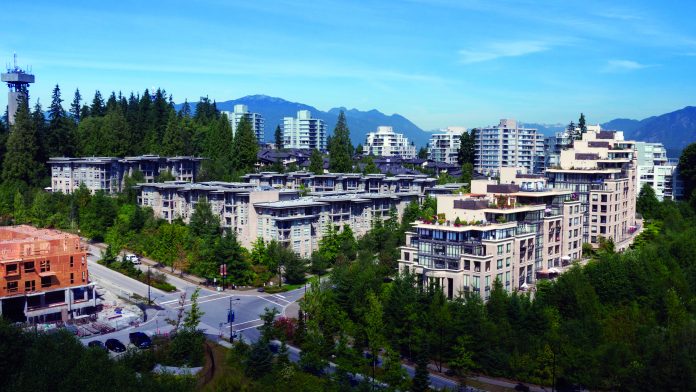
What is Artwalk? Well, it is a public art initiative located in UniverCity which began in 2006 by the SFU Community Trust, starting with the piece Concrete Tree Imprint.  The art initiative is composed of eight pieces that are so subtle and integrated into the buildings and area it resides in, that most people have probably walked by without even realizing that they were witnessing art pieces.

“The artist is trying to integrate art into the community as opposed to being in your face,” said Angela Nielsen, Director of Communications for the SFU Community Trust.

Jesse Galicz, the manager of development for UniverCity and the program manager for the Public Art program adds that there is a recent trend in public art towards integrating art into the environment so that it feels like it is natural to the community.

Public art is important for a budding community, because it creates social sustainability, and a sense of community culture. When there is art and culture in a community such as UniverCity, it creates a community spirit — this was the intent of Artwalk. When nurturing the public art installation, Galicz and Nielsen said they wanted to be “builder[s] of community, not just buildings.”  Their belief is that public art should not just be aesthetically pleasing, but it should also “give people something to care about, [ . . . and] foster [a] sense of community.”

Artwalk is so embedded into its community that many of its residents don’t even realize that they are a part of this walking art display.

EcoSoMo by Matthew Soules


This piece is the most recent addition to Artwalk and was unveiled June 16, 2015. The art project consists of thirteen pieces, essentially smaller sculptural clusters comprised of concrete. Matthew Soules, the leader of the project, is an artist and architect from West Vancouver. EcoSoMo may seem like a strange title, but that’s because it’s really an abbreviation for Ecological Social Modules. The series of sculptures are spread out on the path from University High Street to Tower and Crescent. On their own, the sculptures may at first glance look like individual puzzle pieces, but when given a closer look the pieces work together and symbolize the exchange between people, the environment and reflect the passage of time. Fun fact: each concrete sculpture has information about Burnaby Mountain engraved on it in the Roman alphabet, braille and pictographic lettering. Furthermore, these pieces have a practical use — some have places to sit while waiting for friends, and one piece functions as a place to leave trinkets or share objects. Now it has become an unofficial lost and found for the residents of UniverCity.

Nest with Chrome Eggs by Bruce Voyce


The title of this piece gives the mystery away — it’s a nest with chrome eggs. The Nest is unique in that it was commissioned by the city of Burnaby. In fact, this piece was installed before the public art initiative at SFU began. This goes to show that the community that Artwalk belongs to encompasses a much larger community and local history beyond the boundaries of the UniverCity community. Bruce Voyce, the artist of the Nest, is also famous for being the artist that did the Guardian Eagles piece on Marine Way in Burnaby. The piece is supposed to be a celebration of life as seen with the eggs who are in a prebirth stage. It gives off a sense of possibility of life and presents beauty in something familiar — eggs in a nest — a sight we may have walked by on our way to school or work and not really given too much thought about. The piece consists of a metal bird’s nest that is placed into an already existing tree stump, and highlights the importance of embedding public art into the natural environment.

Knowles-1

Near As Far As Near by Devon Knowles


Devon Knowles is the recipient of a Mayor’s art award and this piece was one of the works she was judged on. Near as Far as Near consists of a series of banners that appear slightly different in colour depending on the direction the viewer is coming from. The banners  feature different perspectives of SFU and use a colour contrast to show that difference. The colours of these banners not only change as one moves up or down High Street but also with the seasons. The banners are green in the cold of winter and bright blue and purple in the heat of summer. The green of the winter banners juxtaposes with the gloomy winter landscape, while the purple and blue banners are a reminder of the cool-toned winter weather during the summer months.

Nightswimming by Brent Comers


The title gives off an image like no other. Named after a childhood memory the artist had, Nightswimming is conveniently situated in front of the University Childcare Center and functions as a bench for people to wait for their children. But it isn’t just any ordinary wooden bench, as the wood taken for its artistic use was repurposed. Additionally, a staircase design is hewn into the heavy wood to facilitate its use by children who may not have legs long enough to comfortably sit otherwise.  Just the simple idea of taking wood in itself and reimagining it into something that can be used for practical purposes and be visually appealing has an air of childlike creativity and imagination to it. To a child it may not even be a bench, but a tightrope and they are the tightrope walker suspended high above the ground. In this way, this piece of art serves to foster the imagination of the children in the community.

Rootwad Cellar Climber by Warren Brubacher


This piece is a massive repurposed driftwood stump which the artist has smoothed out to show where the roots pushed through the rock and hard soil. In essence, the history of the massive stump is revealed in the marks it carries from its life as a living tree before the logging of the Squamish rainforest.

TreeImprint-1

Concrete Tree Imprint by Amelia Epp and Kevin Sandgren


Concrete Tree Imprint was installed in 2006 and gets the honorary title of being the first piece of public art that was initiated by the SFU Community Trust. The piece was created by then-SFU undergraduates, Amelia Epp and Kevin Sandgren, who studied Fine Arts and Humanities respectively. The tree at the centre of this piece was felled for the development of UniverCity, and the students created a cement mold of it to preserve it as artwork.  Slowly, forest developed around it, and it will eventually be overwhelmed by nature. It symbolizes the birth and growth of UniverCity along with the natural cycles of Burnaby Mountain.

Yellow Fence by Erica Stocking


This piece is found incorporated into the UniverCity complex itself.  Each of the gates are slightly different, starting out fairly simply at one end of the complex, but as you progress down the lane, the design of the gates becomes more abstract. Out of the entire lane of gates, only one is painted bright yellow. This piece is deeply embedded in the UniverCity complex, as the gates have actual use for the residents. Additionally, the name Yellow Fence shares its name with the company that provides fencing for construction sites, creating a link to the construction of UniverCity itself. While UniverCity was being built, the artist went for a stroll on one of Simon Fraser’s characteristically foggy days, and was guided by the length of yellow fence which surrounded the construction area, giving her the inspiration for Yellow Fence.

BranchHuts-1

Woven Huts by Alastair Heseltine


Made from repurposed cedar branches cast off by logging corporations, this interactive piece of art is striking.  Alastair Heseltine has taken these scraps and woven them — a type of construction known as wattling — in order to create striking huts reaching up to eight feet in height.  These huts are accessible and have enough space to accommodate several individuals.  Furthermore, these huts are reinforced by a metal foundation, so these structures can support the weight of people on top of them, swinging from them as well as withstand the weather.  Truly, this piece is an exploration of the potential of ancient cedar.

Future Installation: Cosmic Chandelier


The Artwalk initiative is one that is far from done. “The public art project will continue with the ongoing development of Univercity, [. . .] what I hope to see is a maturation of the public art program itself and the art it facilitates on Burnaby Mountain,” said Galicz. Here’s one piece that’s coming soon: Cosmic Chandelier.

This piece is an exciting new entry into the already lively public art display. It will use lighting and steel structures to build a chandelier in an open space of the plaza. Interesting enough, the piece will actually mimic the Orion constellation. It is looking at a summer 2016 installation. So look out for it and who knows, maybe you’ll be allowed to swing from it!

Get with the Program!

0

[dropcap]E[/dropcap]ver wonder what life would be like if you had chosen to study a different subject — maybe business instead of communications, or even visual arts instead of molecular biology? Well, we interviewed some students and tried to get a sense of what these programs are like. As there are a lot of ways to move through a program, this is just a small window into those potential experiences. Maybe we can all find some small way to relate:

With Duchamp you learned, ‘Anything can be art.’ Now explain it to your family. Everyone knows someone in art school and many would study it if they had the time. You made the time. Learn from others, then be different. Figure out how to talk about your work, distinguish Artspeak from English and develop fluency in both. Look at the material choices, define the subject, be critical, be inspired . . . Now discuss work, learn from each other and organize a group show. Considering every choice, constantly stuck between being subtle, and being obvious, it isn’t obvious how to get funding. Who doesn’t want to know what you’re doing after you graduate? Make a gesture, hang something, paint a surface, create a noise, release a shutter, and do it all over again, looking for an answer. Admit the truth, It was never really going to be finished was it? Solving things and improvisation become second nature. You’re not sure what you’re doing. You’ve got an idea.

VISUAL ART

vector_artist

With Duchamp you learned, ‘Anything can be art.’ Now explain it to your family. Everyone knows someone in art school and many would study it if they had the time. You made the time. Learn from others, then be different. Figure out how to talk about your work, distinguish Artspeak from English and develop fluency in both. Look at the material choices, define the subject, be critical, be inspired . . . Now discuss work, learn from each other and organize a group show. Considering every choice, constantly stuck between being subtle, and being obvious, it isn’t obvious how to get funding. Who doesn’t want to know what you’re doing after you graduate? Make a gesture, hang something, paint a surface, create a noise, release a shutter, and do it all over again, looking for an answer. Admit the truth, It was never really going to be finished was it? Solving things and improvisation become second nature. You’re not sure what you’re doing. You’ve got an idea.

COMMUNICATIONS

vector_cmns

Be critical of the outside world, in your head and on the page. Get accustomed to writing, reading, researching, and condensing ideas. It’s not a one way street, be creative and approach things from your own unique angle. Find a focus. Look at what’s new and developing, what’s familiar, what’s passing, and figure out how to understand it. Live with being second hand in new media, writing, and business, but appreciate that you bring them all together. You’ve heard anyone can do it, but know it takes more than open mouths to communicate ideas across mediums and forms of thinking. It’s not what you expected, is it? Step back and view the whole picture, recognize conflicts, problematics and avoid pessimism along the way. Learn to reconcile economics, sociology, psychology and culture, and decide how we can relate to each other in a meaningful way. Use that critical lens, and look at the public sphere, at Marx, at capitalism. Supplement the theory with practical learning, supplement with another program. Be critical, get a job, and ask yourself what you’re doing. You’re unsure, but you try, you learn.

HISTORY

vector_history

You went from figures, numbers and names to cause and effect, then entered a realm of complicated interrelated events, ideas and agents. You read, in an attempt to understand and make sense of how we impact each other, read more. Along the way, learn to distinguish between primary and secondary sources. Now incorporate photographs, oral recollections, and consider the environment and its non-human subjects. Research and ask the right questions. Weave sources into a narrative, and find a thesis along the way. You know objectivity is out of date, and have come to terms with thinking critically about everything. Read some more, revisiting literature and taking it apart. Recognize who benefits from a particular narrative, and identify subjectivity. Reconcile all this while explaining there’s more to what you do than museums, or conspiracy theories. Discover the line between history and current affairs. Look at things differently, find an untold perspective, then ask, why?

CRIMINOLOGY

vector_crim

Learn to approach your subject from multiple viewpoints and perspectives, building your interpretation on the theories of crime. Figure out how to reconcile theories and beliefs along the way. Do it over, and over, and over. Grow frustrated with opinions based on assumptions, biases and misunderstandings — everyone has one they’d like to share. Then move that struggle to the realm of public policy and the media. Get used to reading, growing familiar with legal jargon, reports, proceedings, and law codes. Revisit the theories, go back to reading, and write it all out. Progress or punishment, social development or isolation, restoration or revenge? Remember the theories, then develop and describe the terms of justice. There’s more to your future than just lawyer, police officer or criminal, though apparently not everyone got that memo. Figure out how to listen to the silent, to the victims, tearing down barriers rather than tearing down people.

GEOGRAPHY

vector_geography

It’s more than just a drawing, more than just a map. You’re in a mixed field with lots of approaches, bridging society, science, and economics. Be interdisciplinary, then focus on something, deciding between humans, landforms, spatial data, or our environment. Learn how to interpret information and adapt to it, making plans and proposing ideas for moving forward. Look forward to that post-exam learning trip, what’s the destination this time around? Read and write, incorporating various ways of thinking. Recognize potential mistakes in an attempt to understand the structure of cities, how they work, how they move, how they lie still. Follow the water, look through the soil, and explore the ecology. Analyze the land underlying our existence and infrastructure, through its timeless process of change. Collate large amounts of information along the way, then visualize the data in an accessible way. Manage it and present it, growing your skills with each passing attempt. Understand where you stand, where you want to go, then figure out how make it there.

BUSINESS

vector_business

Everyone’s always impressed with your degree choice, from a financial standpoint at least. Thought the focus on money, value, productivity, and investment return doesn’t always make friends. Get excited about the opportunities to be involved, to grow. How do you plan and where do you begin? Learn to prioritize, learn to say no. Love the bell curve, or at least learn to live with it. Jump from concentration to concentration, orphaning spare courses and doubling concentrations in the process of figuring out where to commit. Compete and differentiate yourself along the way. Exist in an incubator, very integrated to the outside world and the business community; a part of and apart from the University. Get some experience presenting and working as part of a team. Be pressured into co-op, into competitions, and get used to comparisons and being judged against your peers. Be ambitious, be realistic, compete. Are you sure you did enough networking?

ENGINEERING SCIENCE

vector_eingeneer2

Build around problem solving. It’s assumed you’re smart, but those 2:00 AM nights at the lab where you’re stuck with no solution make you doubt. Apply numbers as part of a larger framework, it’s not arbitrary when it’s part of a system. Though there’s an imbalance and the odds might be good for everyone, they can often be odd. Geekiness goes around, but there’s unacknowledged diversity underneath it all. Figure out how to be social in large groups or small groups, where you fit in and where you don’t. Learn to know your lounge, your lingo and your E triple S, then feel the pressure for co-op, knowing there’s no option. Can you write? It’ll get you places ahead. Ask for exemptions, wait for approvals, then do your 12 credit minimum anyways. It’s all or nothing in your field, when you commit your soul there’s no space for electives. You know the frustration, but you also know that feeling of epiphany when things finally come together. Work together — you’re not in it alone.

MOLECULAR BIOLOGY AND BIOCHEMISTRY

vector_biology

You work at small scales, trying to comprehend the processes of life. The laboratory takes you hostage. Time spent in it, time spent preparing for it, learning back material for it, agonizing over it, and putting it all together. Don’t just learn to live with the lab, learn to live it. Perceive subtle social cues when you talk about your work, from suspicion, to admiration, to confusion. If general science is removed from society, you’re one step further. Understand ethics, and learn to follow through on every detail through to perfection. You will fail, it will hurt. You move on.There’s more to your aspirations than just white coats and fancy titles, but there’s also a lot of pressure in the way. It’s a personal journey, but also part of a bigger picture. You’re not alone in trying to unwrap secrets and attempting to finding solutions. Can you publish? Understand research papers before nurturing cell cultures and tending to your equipment. Develop new knowledge, and then cross reference it for potential. Now replicate results.

Consortium

0

The leaves are as red as rosary.

I look as though you were

moving your hand in your hair

like a child absently at an abacus.

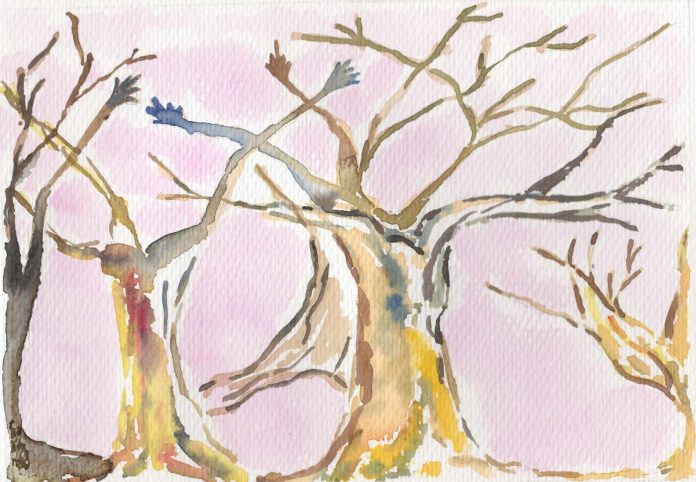
Some trees trace themselves above us,

drifting their arms into each other

with their fists blown open to touch.

We are at the margin of the forest

beside the sea. I think the days are

performed in full, meeting us where

we are, each agreeing with the next,

with you, with myself.

Thank You For Understanding

0
[dropcap]T[/dropcap]here are those who are included, and those who are not. Those who are included feel the seriousness and possibility of life everyday. They venerate everything silently. They are the nurses who work double shifts in emergency wards. They are the social workers that bring first aid kits to unconscious abusers on cold evenings. They carry on tired without praise. Their humbleness is what allows them to see the subtlety of God’s glory in the nuances of personality that come from the beaten and bruised, that arise when the human spirit is tested with adversity.

In my early life I felt as if I were one of those who is un-included.

That evening I had that same, familiar sensation, and was scared like a child. I was nervous like when I was a pre-teen, when girls would look at me and I’d feel strange. It wasn’t entirely nervousness and strangeness, but a type of misunderstood and disturbing solidarity. I remember those days being ripe with warmth and undiscovered emotion, as well as coloured with guilt and derision.

I remember derisive laughter, and feeling confusion emanate through my body like a sickness.

Then years later, in that cold, small room, walled mostly with large windows, and dying trees and parked cars laying in a layer of mist outside, I began to exhale this fever.

It began with affection. I was drunk and I stroked his hair and I didn’t even realize for a few minutes that I was doing it. He didn’t react in those early moments.

‘Why are you brushing my hair back?’ he finally said.

I quickly withdrew my hand when I understood what I was doing. A flush of regrets reddened my body. I became silent and little and felt threatened.

He then got up, to make eggs he said. I could tell he was slightly disturbed from his original temperament, which was tranquil as we lay, sharing a single bed, watching a movie. It was there that I had committed my presumptuous act, and I then slid onto the floor, legs outstretched, looking remorseful. I awaited more reaction intently, to see if I had done wrong. Rather, I knew I had done something wrong, and was anticipating the impending consequences. We hadn’t known each other for that long. I was sure he was straight.

Before going into the kitchen he looked at me, stretching his arm, and said casually, ‘I guess that’s what faggots do’, in a manner that was indistinguishable between snide and accepting.

Nothing very drastic changed, however, when we both entered the kitchen. I watched him make eggs and we talked as we normally did. I put my feet up on the table.

I could not tell if what I had done was taboo for him, nevertheless I felt like I was beneath a shadow.

‘Sometimes when I look at people,’ he said, ‘even friends and acquaintances, I feel I can see through them, their outer appearance, their face and body, that at other times occupy me entirely and make me forget there is a soul beneath the body. Then sometimes I am deeply shallow. I judge everyone superficially, and feel as if everyone’s appearance in some way informs who they really are.’

I felt as if I was being x-rayed, but listened carefully all the same. ‘Does this make you lose any love or affection for your friends?’

‘Yes completely.’

‘That’s a shame’ I said.

‘Not really’ he said sheepishly, and I knew that he was viewing me in the simplest terms. But I didn’t mind.

I kept on thinking about acceptance, and the feeling of being a ghost inhabiting a body without a real connection to its surroundings. As well about what I had, as a child, bitterly thought of as God’s exclusivity, and came to think that perhaps this form of love that I was feeling was something God is simply not able to bestow.

‘Thank you for understanding’ I said.

He looked at me sharply and did not respond, but then nodded with a tepid smile and pretended to be distracted by his cooking. I wondered if at any moment he would tell me to leave, or make a more extensive remark, but he remained in weightless silence, while I felt like I was balancing on a bridge between two voids, trying to decide which fall would be deeper.

Then we ate together, sitting across from each other silently. All the while I wondered if the soul is gendered, and decided it is not. I thought also of the covenant, of how sacred marriage is meant to be between a man and a woman, and understood this to be an incomplete picture if it is incompatible with the desires of the soul. I was still unsure, however, if my love was anything other than a product of some repugnant perversion that occurred during my formative years, or worse still a punitive act of repulsion towards my self; or contrarily, if it is a purer love, being without the intricate differences of the opposite sex. For even the most inseparable bond between a male and female has to navigate the inherent divisions of gender, which infringe upon what could be an indivisible unity of spirit, mind, and flesh.

I think of a reoccurring dream, which I’ve had only twice, that varies slightly each time. It involves him and I, close, barely clothed, underneath white sheets, warm, always at the peak of daytime, under sunlight. We are practically in a cocoon, motioning over each other’s skin steadily with deliberation. There is gripping of sheets and also body, and squeezing and pressing, so that our skin twists and whitens, and folds in undulations like the kneading of bread, channeling euphoric pinches of sensitivity through our nervous systems, creating chills of hot and cold, making us close our eyes and fall into each other; our fingertips and lips burning. Feeling our pleasure grow over matter. We cover ourselves completely with sheets so that the sunlight dims and becomes shallow, and our breathing becomes more noticeable and hot.

During the days after these dreams he continues to run my mind constantly, making it difficult to concentrate or even sit still. At the worst I experience an ugly mixture of envy and possessiveness at the thought of him. At the best of times he is goodness, and a testament to the harshness of life.

I looked across at him and thought of my life as a contradiction, a fringe in the seams, which has, I suppose, allowed me to see the traces of blackish gray importance in the periphery of our vision, that to the untrained eye look merely like absences of light.

He got up and took my plate to the sink, whistling to himself. I started to smoke a cigarette, flicking the ash out the window into the wind. Outside it was damp and cold, and still foggy. I could hear cars driving on the highway a block away from the house, and saw the occasional porch light flicker on. If I listened closely I could hear the sky falling.

‘I think I’m in love with you’ I said.

He turned around.

‘You don’t want to be in love with me’ he said sincerely, and returned to washing dishes.

Rattrap

0
[dropcap]S[/dropcap]o there I am, trying to balance four vintage tennis rackets, as many badminton rackets, the used skates, the amazing rollerblades, AND all the crap that Benji needs for pond hockey.  You’d never believe how many pads they need to strap on — I had to get at least five random people to advise me as I sorted through the heaps of body armour (he’s going to look like the Michelin man) — when what do I see in the corner? Drumroll. BICYCLES. But not like a ton of them; I see three — no, four, and I see at least as many people milling about them like sharks on a misplaced diver. Move it or lose it.

So you know I’m over there so fast and I don’t drop a thing and I’m scanning the remnants. Kid’s bike = too small. Mountain bike = not bad. Oh! — too slow, there it goes. Two down, two to go. And here comes Mrs. Hockey pad advisor number three or four (sorry lady, all is fair in love and thrift shopping), and we make eye contact and we look at the bikes and she reaches for the really really shiny yellow one and so I reach for the other one (my bicycle!!!). Well, I reach for it with a sort of full body lean as my arms are still loaded up with all the other precious stuff I’m protecting — but my position is clear and I’ve claimed the bike.

I glance over at her shiny bike, envious for only a moment, until I hear her partner school her that that bike is like a complete diva of bikes and that it will basically burst into flames if it touches a bit of gravel off-road. It is so fancy, a racing bike for cyclists. Well I am not a cyclist, and plus hubby just told her it’s still two hundred bucks—ha! That’s what she gets for lunging at the shiny one. She’s not taking the yellow one but lingers around and I know she’s just waiting for me to walk away or go to put my stuff down. (Where the hell is Benji?!) Well, no way is that gonna happen. And so I’m trying to lower my treasures to the ground like some cartoon character with a leaning tower of Pisa stack of objects, leaning first one way then the other, and I lower it and myself all to the ground, landing in something resembling a contortionist yoga pose. But now I’ve got my hands on the bike I’ve cornered and I scramble up, not letting go, and that’s when I see it: the price tag: $20. Twenty dollars!! For a BICYCLE! I know!

Feeling almost criminal I hand over only $95 for all my loot; thus the cashier has no problem upselling me with two $5 hotdog for charity specials. For the amount of sports equipment — including my bicycle! — that I fit into my hatchback, there should be a prize. By the time I get it all in I barely know where I’m supposed to put Benji, but with the help of some passers-by and creative use of the camping bungees, we make it home. By the time I get it all unloaded at the other end, and pack up and ship off Benji to Jack’s for the night, all I want is a nice, strong, smoke.

Stepping onto my patio square, having lit a gross herbal cigarette (super gross), I exhale and admire my purchase. Tires, sufficient air; brakes, only one working; chain, not too rusty; seat, hard as hell. I want to take it out for a spin. Do I need to get changed first? Should I not be wearing flips? Fuck it. I’m just going to get on this bicycle and ride it. Stopping only long enough to throw my wallet in my mini-backpack and lock the sliding glass doors behind me, I hop onto a bicycle for the first time in more than twenty years. The handwritten price sticker of $20 is still firmly planted in between the two handlebars and since it makes me smile, it stays.

It turns out that that whole cliché about not forgetting how to ride a bike is true. Except maybe with regards to riding without hands. Feeling no urge at all to try that. And to think I used to be able to turn corners like that! With a few aimless laps around my block it becomes clear to me that the first order of business will be to purchase a bike lock; can’t go anywhere else without one of those. And I should probably get someone to check the bike over, get the left brake cable replaced. Maybe I can ask about a kickstand—and a rattrap!!

Elated, I kick off in the general direction of strip-mall-land. I’m happily engaging my pedaling muscles, clicking through the gears to find the right one, the winds of youth and freedom billowing through my flapping mane. Breathing comes easier riding into the wind, and I think that I haven’t taken a true deep breath in a very long time. Making my way across town, seeing it for the first time, everything seems more real than from the car window. It’s like I am a part of each moment, connected to each aspect of the setting. A cute house here, a yappy dog there, here a punchbuggy, there a yard sale, everywhere a community alive! I swear I know all of two Queen songs but suddenly the lyrics “Biiii-cycle—Biiii-cycle” start playing through my head and my grin grows bigger and the song plays louder. “I want to ride my bii-cycle…”

At a red light I come up next to a car that catches my attention because I’m on the sidewalk and not in the car lane next to her—a totally different perspective. The driver is a woman of roughly as many years as me, dressed in business casual with a Bluetooth cable dangling alongside her hoop earring. She makes eye contact with me, all the while yapping animatedly to whoever is on the other end of her call. As the light turns green, I kick off again as she accelerates, leaving me to inhale the lingering scent of her exhaust before becoming nothing but a speck in the distance. But I am not in a hurry. I have somehow managed to circumvent the rat race, merely by mounting this very bicycle. (Biiii-cycle, biii-cycle.) Every block I become younger, freer, lighter, more present. The smell of the sun on tarmac. The rhythm of skateboards as they travel across the grooves between sidewalk squares. The aroma of onions frying, wafting through an open window. The wind, the blessed wind, filling my nostrils and lungs and hair and soul.

A few blocks along I see that same lady in her car, still squawking away, and she is stuck at another red light. But this time I don’t wait, I don’t have to. There are no cars coming so I just keep on riding, and the impatient grimace on her face as she taps her steering wheel is imprinted on my mind’s eye, and I know how she feels. Because every other day, I am her. It’s my board meeting, my 5am conference call. My son whom I wish I could hug one more time because I was such a bitch on the way to school. I am in a hurry. I am stuck in traffic. I am late, so late. I have to be somewhere, dress some way, multi-task. Time always seems to be running away from me, leaving me to chase, but never catch it. But here on my bicycle, time has slowed down; I am in time, and time is in me. And we are not late. The lady in her car has gained on me again, yet I am convinced that we have not spent the same ten minutes at all.

Totally emancipated, I pull up at the local bike shop, except it’s not really a “local bike shop” as I’d hoped, but instead a big-box bike superstore. Spotting a rack marked “Bicycle Parking,” I dismount my sexy beast and take a few tentative steps on two legs again, casting a worried glance back at the bike rack before entering the store. Surely no one will steal a $20 beater in this company.

“Hello, can I help you today?” The voice seems disembodied at first as I am so overwhelmed by the shininess and rubber-ness and fanciness of this bike store.

“Yes,” I reply, my big smile and goals returning to me. “I’d like someone to take a quick look at my bike to make sure it’s safe, and I also think I need a new brake cable if they have time for that. Oh! — and I need a bike lock.”

“Did you want to make an appointment for a full service bicycle tune-up?” he asks. “If you leave your bicycle here today, it would be ready for pick up by next Thursday.”

I don’t like this guy, something artificial about him. I think he blow-dries his bangs. “Umm, no,” I say. “I don’t think I need anything that fancy. I’d just like someone to take a quick look at my bicycle. It’s parked outside. I can’t leave it here because well, I need it to ride home.”

He looks perplexed, like what I’ve asked of him cannot be answered on the flip chart that he’s had to memorize in order to work here. “Our bicycle technicians are all busy right now. You will have to leave your bike here if you need it serviced.”

I feel my frustration growing, and the stress level of the lady in the car and mine are surely approaching each other. “I can hold off on the cable,” I say, attempting to speak slowly and clearly enough for him to comprehend the simplicity of my request, “but I just want to make sure everything seems attached where it should be!” I finish with a forced laugh, trying to break down this guy’s artificial glazed expression. “Perhaps,” I add, “you could take a quick look for me?”

Pride in his expertise and discomfort in breaking protocol are vying for victory over his features, but in the end he nods and we exit the cool shop back into the blazing sun. I point to my bicycle lovingly, as his expression switches to something less appreciative.

“How long have you had this bicycle?” he asks me, distaste curling the far edges of his lips.

“About four hours,” I reply, grinning, but in less pure form than before. Defense is worming its way into my posture as well. “Figured for twenty dollars I couldn’t go wrong.”

His beady black eyes tracing my poor bicycle’s features—“And you rode this here?”

“Well of course I rode it,” I snap, losing patience fast. An inexperienced zitty kid I can tolerate, but not a pompous asshole prick.

“Well, you’re lucky you made it here in one piece,” he continues, pressing on the tire seams. “Both of these tires need to be replaced, and probably the wheel rims as well. Your left brake is shot, the right one is close behind, and it looks to me like the gear cables are loose. Would you like me to show you the selection of discounted new bicycles we have in stock?”

Dis-counted? Does he think I can’t afford a new bicycle? Who does this little shit think he is?

“No,” I say, with forced calmness, as my blood pressure begins to elevate and I start to feel all tingly. “I do not want to look at new bikes. I just want to fix up the bare minimum on this one to make it ridable—that is all.” I crack my knuckles and tuck my windblown hair behind my ears, trying to retain my composure. “And I need a bike lock,” I add curtly.

“Well like I said, I wouldn’t ride that bicycle if I were you, but I can certainly show you our selection of bicycle locks. Right this way…” He leads us back into the store, with its superbikes—pricetags of over a thousand on some of them—and over to the locks section. “Were you looking for a D-Bolt or something with a combination?”

My eyes scan the selection and either I’m seeing double or they all cost upwards of forty dollars. “Where are the simple chain locks?” I ask innocently.

He lets out a little laugh and says: “Chain locks? Oh, we don’t carry those.” In answer to my raised eyebrows he adds: “Thieves cut right through those.”

“I see. Well I think I’ll just hold off for now. I can’t see myself spending more on a lock than I did for the bike,” I say, attempting to return to good humor but he doesn’t seem to get the joke.

“I noticed you’re not carrying a helmet,” he says. “Would you like me to show you our most popular models?” he asks, determined to make a sale yet.

“No thanks,” I reply easily. “There’s no way I’m wearing one of those. Although I haven’t figured out yet how I’m supposed to justify that to my kid who absolutely has to wear one, even in the driveway.” Another joke over his head. Does this guy have a personality at all? “It’s my generation,” I continue. “We didn’t wear helmets skiing either. I mean, what’s the point if I can’t feel the wind through my hair, you know?” No, obviously, he doesn’t.

“Well you better hope you make it home without a fine,” he says, clearly with judgment.

“A fine?”

“Yes, it’s mandatory to wear a helmet.”

“Mandatory? What? Since when?” I can’t help but to show my genuine surprise.

“Since ’96, mandatory for everyone riding a bicycle on roads and bikeways.” He sounds like he’s spouting right from the book of bylaws.

“Well that’s okay,” I say. “I don’t plan to ride on roads or bikeways, I’m a sidewalk kind of girl.”

“You do know that bicycles are not allowed on the sidewalk, right?” he asks.

And I really don’t have an answer for this. No, I didn’t know that. But for all I’ve just learned, I somehow feel like I know even less now, than I did ever before. I don’t need to compare myself to a kid whose puppy just got kicked, because I am now that girl who just got told that her bicycle is basically a death trap, which if it doesn’t throw me into the street will probably get me thrown into jail. Which I think is pretty much not in need of further metaphor.

Biiii-cycle? Sniff.

I mumble something to the effect of I’ll just keep browsing, and duck out of the store before the marbles in my throat become too painful to disguise. By the time the tears well up in my eyes I’m already riding and it could just be the wind. I ride slowly, so slowly, afraid that my bike will implode into a dozen pieces. I stay off the main roads, so that if it does, I’ll just crash and not fall into oncoming traffic. By the time I reach my driveway I am so heavy, my shoulders so dejected. Consumerism and bureaucracy have found me even here, on my bicycle.

I stop here, straddling the seat in my driveway, reluctant to park it just yet. Then an idea lands: The Dollar Store. Maybe they will have a regular bike lock. I decide it is worth checking. No matter what that clerk jerk said, I still think a shitty lock will at least detract from the easy steal. I ride over to the local dollar store, low-traffic back roads all the way, and quickly duck into the shop, with my bike leaning on the storefront window. There for two dollars is a bike lock with two keys, a chain link covered in blue plastic tubing. Two dollars. I buy the lock and an awesome retro silver bell for another two dollars. Brring-brring!! Take that, zitface.

Needing an excuse to try out the lock, I figure I’ll grab a couple dinner items from Coopers. Maybe some lunch materials for Monday. I’m locking up my bike with great care at the rack as a familial caravan pulls up on their bikes, resplendent with two parents and the full set of them in matching aerodynamic head cages. A niggling reminder that when I dropped Benji at his dad’s earlier, he warned that I need a helmet so I don’t fall and hit my head. My sweet child. I hope that he can feel the wind in his core, even with all the restrictions I place on him. Perhaps I will need to purchase a helmet for me, and be a little freer with him.

Nutella for Benji…bread. The refrigerated aisles already feel like Monday’s sealed vault of office cubes. What shall I have—spreadsheets and salad? Profit margins and macaroni? I charge the groceries on my Gold card, wondering if we have almost enough travel points for our next trip to Florida. When I return to my bike, a hint of stubborn pride returns to me as I unlock it. But what to do with the groceries? Must still invest in a rattrap—make that two. Two matching rattraps to remind us not to fall into one. I take the long way home, stopping to pick blackberries into my shopping bags for over an hour. I realize they’ve escaped the GDP, and they don’t even have a single carbon footprint. Unaccounted for, wild and so sweet. I pick two bulging bags full, which dangle one from each of the handlebars, staining my knees with dripping blackberry juice all the way home.

The New Denny’s

0

[dropcap]A[/dropcap]lan looked out the small, greasy window at the new Denny’s, across the early traffic of Cluff Crossing Road. His eyes scanned the fractured pavement that the city should have patched, past the manhole slightly raised due to Salem’s harsh winters. He followed the small gravel road that led to the full parking lot of the new Denny’s. The brick symmetry of the building was pleasing. The late morning was cool and as sweet as a turkey leg, one of those days that just seemed to imply greatness. Before the cold snap that kills off the onions, before rain and sleet pressed down on you, before you felt the Earth’s gravity and the heaviness of snow. It was September and a good month to be alive, to feel the crisp air being sucked in through your nose and into your lungs, mixing with your capillaries and feeding your brain beautiful nutrients. It was a smart location for the new Denny’s because that’s where the last body was found and the Gulliver’s got a good price on the land. The plot overlooked the Stonehenge and from the furthest booth, you could clearly make out the slight edges of Canobie Lake. You could really appreciate Salem from the plastic seats of the new Denny’s. They found the body of the Agnew girl, the nurse, down by the edge of the property and that was that. Whoever had done the killings had stopped, moved on or died, whatever the kinds of people who do those things do when they are done. The town breathed a sigh of relief when the bodies stopped showing up and although the killer was never found, the people of Salem felt a release. Like the families of the dead, they moved on but remembered.

The parking lot of the new Denny’s was starting to fill up with old model cars and newer, cheaper, foreign makes while at Jim’s, the hamburgers steamed and frizzled and fried. The blackened flat top grill was packed with sweating brown meat and Alan turned them over every now and then. Eventually he slid them into a large metal pan full of beef stock to keep them warm and moist. Alan was fascinated by the patterns the congealed grease left on the over-sized spatula as the beef and pork mixture dipped into the slime. That was the process for cooking the daily hamburger special at Jim’s. The patties would swim around in the broth like hippos in some African swamp, grinding into each other and milling around, until their number was drawn, then Alan would toss it on a bun with a pile of fries and hand it across the counter to a dwindling amount of fairly unimpressed customers.

“That fucking new fucking Denny’s man. That fucking pousti Gulliver man. Fucking killing me.” Jim calmly said, pointing with a long knife, dripping with the guts of a deceased, over-ripe tomato. Jim’s name wasn’t really Jim, Alan knew that, everyone in Salem knew that, but it was easier than trying to pronounce a mystifying string of vowels with a few consonants mixed in, so everyone started calling him Jim. Jim was part of the only Greek family in town, which made him kind of famous. That’s why he opened up Jim’s. His business consisted of a ramshackle, tiny framed trailer that had been converted to accommodate a seating area, a marvel of city bi-law infractions. You could squeeze in about twenty-five people if they didn’t mind touching each other, serving up homemade slaw, burgers, fries and a few other classic Greek dishes. The place had been bumping with tourists all summer long, but as the season waned, the khakied folk withdrew, taking their beige dogs and light brown children with them. Then it was all regulars, until the winter broke, and most of Jim’s regulars were dying. The younger, hipper folks preferred some place a little younger and hipper, like the new Denny’s, which attracted a veritable who’s who of local Salem celebrities and city officials. Across Cluff, a toddler tripped and fell face first on the grass. A young mother grabbed the crying child and cradled it, flailing, in her arms as he wailed. Alan laughed, which he usually did when kids fell down, not a vindictive thing, just his natural response to life’s little failures. “What the fuck are you laughing about Al? You want to be over there, hanging out at that new fucking Denny’s,” Jim screamed, spitting bits of old tobacco and ash everywhere. “Don’t forget who butters your bread.” It was Alan who actually buttered Jim’s bread, but he thought wiser about bringing that up, so he continued to admire the field of meat in front of him, dreaming of Flanders Field and the fallen cows that made Jim’s possible. Better days will come, he thought, when the heat of the restaurant made his flesh scream and his rash flair up. He had to think that way. He was young and broke and had nothing to look forward to, so the only option was optimism.

Around 11:45 a woman walked in, more like a girl, maybe fourteen. She had a ragged Death To The Pixies black t-shirt on that reminded Alan of the one his sister Cora used to wear when he was young. Before she disappeared. “Look at that nigger,” Jim whispered, more to himself than to anyone, motioning towards the girl, who was clearly white and just a little tanned from the passing summer. Jim didn’t like black people. “They just look so funny,” he would say on one of his more insightful days. He didn’t really like Mexicans or Indians either. Jim only really liked white people and went out of his way to try and only be around white people. This, Alan thought, was quite odd because most people in Salem didn’t think of Jim as white at all. More like an off-white or mauve. The girl ordered a hamburger, fries, and Coke and handed Alan over a crumpled ten dollar bill which he slipped into his pocket while Jim wasn’t looking. Alan watched the girl sit down. She took the best seat in the joint, the one that overlooks the old Stonehenge. Occasionally, after a mid-summer afternoon rush, Alan would sit in that same seat and watch all the outsiders and visitors and tourists, people that weren’t from around Salem, all gather around the beat up pile of rocks that constituted America’s Stonehenge, sometimes holding hands and chanting ancient Druid texts, other times sitting in silence, just feeling the dilapidated power of the place, pleading and begging for a sign that they weren’t alone in the world, weren’t just made up of atoms and molecules, floating around, occasionally bumping into other bags of atoms, hoping for a mystical message, telling them that everything will be alright and that something, somehow, meant something. Alan enjoyed those quiet afternoons, the smell of burnt toast in the air mingling with Jim’s cigarette smoke. He relished silent contemplation on the utter silliness of life.

The girl must have been hungry, she really plowed the food into her and had a little bit of mayo on the corner of her mouth as she turned and walked out the door and Alan wanted to grab her and turn her around and kiss off the mixture of soybean oil and vinegar, but he just watched her go. He watched the back of her head, her almost grey hair, her exposed black bra strap and smooth round butt shimmy out the door and at that moment, all he wanted was for her to turn back to him and say, “Come with me. Wherever I’m going, come with me” and he would have left and maybe he could feel normal again and escape the days that lie ahead and fast forward all the shitty parts, stopping where he was happy and content and alive with pleasure, like a Newport menthol cigarette. After the tourists had gone back to their normal lives and their shitty jobs, after all Alan’s friends went back to school, working on building something that could be mistaken for a life if you squinted, the true personality of Alan’s hometown would settle back over Salem, like a cloud of mustard gas descending upon sleeping GI’s. “But you’ll never leave” a voice kept saying from way back inside of his mind, from the swampy depths of the deepest fissures of his brain. It was his Father, Burt Crawford’s voice and his Cub Scout leader, Freddy Barber’s voice and his high school football coach Donnie Davis’s voice (go Blue Devils!). Alan shook these bad thoughts away physically shaking his head from side to side, as if the actual movement would help him clear his head. It was Friday and nearly noon. The regulars would show up soon. Alan held his breath as long as he could and waited for the onslaught of customers to replace one craving with another.

Sometimes when Alan would get off work, he’d go for a long walk out around the lake. Past the cabins and camps, past the rental properties that most of Salem couldn’t afford, through the trails where Jane Boroski was attacked, down the long path towards the beach. He would sit and listen to the thick Boston accents, the strange Quebec and Canadian ones and even some European sounds, but not usually. He’d sit down on the old bench, the one dedicated to George Swinnerton Parker of Parker Brothers fame. He’d roll a joint and watch girls run around and swim and flirt with the life guard, Buck Ewan. Alan would pick out which girls he’d like to fuck and which girl he’d like to marry and which girl he’d eventually get caught cheating with, breaking up the new marriage and crushing his young bride. Sometimes he’d see a girl he really liked and if he was stoned enough, he’d walk up to her and ask her some stupid question like “where’d you get that burrito from?” or “do you think the Sox have what it takes this year?” Alan was an Orioles fan. Sometimes the girls bit and talked for a while until it got awkward. Sometimes it got awkward really fast and he took off. Once in a while, before his bike got stolen, Alan would ride out past the Boys and Girls Club and down to Wheeler Ave, by the Massachusetts border. He’d blast down the little hill on Haverpoint Road, through Smoker’s Path, by his old school and look at the neighbourhood. Everyone was gone, moved out or on. His parents left for Concord a few years ago. They didn’t expect him to go with them, so he stayed. There was nothing else to do. 160 Plaisted Circle was where his old Dobie house stood. It was originally made for the GI’s coming home from World War 2. It was cramped but nice for a family of four. There was a big back yard that led out through a damp area into a little park with a swimming pool. Alan would bring his two Doberman Pinchers over to the pool and let kids go wild over the dogs. The town seemed endless then. Things changed when his family was cut by a quarter. Then the backyard seemed too big for one boy. Around dusk Alan would get tired and walk his bike back up the hill to the Grainery, a little rooming house run by a nice old lady named May. Her back was really bent and he had to tie her shoes for her, but she didn’t charge him too much for rent and sometimes she made his bed for him. He’d go up the creaky, old stairs, through the musty hallway, past Gray, who’d always try to sell him old plaid suits. Alan would fall into his bed and dream about work or sex or magnets. Sometimes he’d stay up late, smoking hash and watching videos produced by paranoid old white men who were scared of the future and worried about the technological enslavement of humanity and computer chips being implanted underneath people’s skin. He always found it comforting that people believed that stuff because if people believed that stuff, there was a chance of it actually happening and Alan thought that maybe taking emotion out of the equation could work for humans. Maybe a bit of clinical robotics was what the world needed to get back on its feet.

The lineup at Jim’s was really a spectacle that Friday afternoon, a microcosm of Salem. Older white people who loved wet hamburgers. Also Cary Villa, Bob Villa’s nephew: strawberry milkshake and onion rings. There was Sandra Wilson, whose daughter Lara worked at the Rink: chicken fingers basket, there was Glen Fitzsimmonds, who once went to jail for killing his neighbour’s cat: two pogos and a large glass of milk. The cat deserved it. Then there was Eddie Fisher: Two piece cod and chips. Alan didn’t think Eddie was crazy. Eddie was always talking about what happened to him on his way to Boston in the winter of ‘67, driving his grey AMC Rambler Wagon with the wooden panels down the 101 towards Newton. His cousin, Charlie got called up to play with the Bruins and he got Eddie a ticket. The Bruins were riddled with injury that season. Centermen, Ted Green was hurt, so Charlie was in. That was months before the big Phil Esposito trade, so the Bruins needed some scoring. Eddie had his foot heavy on the pedal and was navigating the dark corners of the 101 like a champion, weaving in and out, passing cars on the shoulder, throwing empty cans of Pabsts at the Gordon Lightfoots, a term Eddie invented for slow drivers. He was making pretty good time to until around 6:13pm when his car stopped. The exact number of curse words that spewed forth from the man could never have been calculated, although, when drunk enough, Eddie would try to repeat the barrage. That’s why he can’t go into the new Denny’s anymore. Eddie scampered out of his ride and popped the hood of the AMC. It was still in fine shape. He examined the American craftsmanship. Everything was in place. He removed the dip stick, checked the oil, wiped his oil covered hands on the back of his jeans, and looked angrily to the sky. His body felt electrified and numb as a bright flash of blue light destroyed the heavens. He smoothly levitated up into a shiny metallic disc, and Eddie slowly shit his pants. The last thing he remembered was thinking that they’d never let him through the gates at the Gardens. When Eddie came to, he was sitting front row center, watching the Bruins get walloped by the Montreal Canadiens, 6-2. He had a full beer in his hands, was missing both pinky fingers and his pants were mysteriously free from both shit and motor oil. The Bruins would later go on to be eliminated by the Canadians in the sixth game of the Conference Finals. The score would be 6-2.

Eddie handed Alan a twenty with three fingers and Alan slid the twenty into his pocket “New Denny’s man. Don’t like that. Not one bit” Eddie Fisher said. Alan smiled and motioned for another customer to take his place. He had about seventy dollars in his pocket.

Whenever the lineups would get too big at the new Denny’s, Jim’s got the spill over. This usually happened on Sundays or holidays. The crowd would shuffle in, disappointed that they couldn’t order a Grand Slam Breakfast or a Moon Over My Hammy or an Ultimate Skillet.

As the afternoon wore on, something started to fester inside Alan. He didn’t know why he was stealing from Jim, who, although a racist and a homophobe, a sexist and a dimwit, hadn’t really treated him that poorly. Even though Alan was only allowed one fifteen minute break during an eight hour shift, Jim wasn’t an actual slave driver. Alan could have had it worse if he was born in Nigeria or Algeria or probably any country the ended in geria. He was allowed to think and dream of change. Still, something was eating at his stomach, and his back. Something was creeping up his spine.

The line of customers petered out, and Alan had the counter to himself. The sound of chewing had ceased and the slurping of sugary syrups had relented. The bills were paid and the ten percent tips were collected, half of which went to Alan. Jim started to break down the kitchen and the sound of scouring and scrubbing broke the peace. Jim was muttering under his breath about the UN and terrorism and different propositions. The sound was getting louder and louder, the scraping of metal Brillo pads on filthy pans increased second by second. There was a cloud of flat top cleaner steam that flooded out of the kitchen and into Alan’s nostrils and he just stared at the new Denny’s, with the polished cutlery and clean, freshly pressed linens that were such a mystery to him. Slowly, all the noise started to fade, to drift off to some place where outside stimuli goes when no one is paying attention to it and Alan’s legs began to vibrate. At first he thought there was an earthquake or he was having a seizure, the kind where your brain gets fried, but he was still aware that he was aware. His legs started walking on their own and his arms began swaying as he walked out from behind the counter and towards the door. He was being pulled towards the new Denny’s, with its lovely, brightly lit bits of flair and large yellow sign and sweet young servers. Alan heard Jim yell. His hands mechanically undid the knot of his apron. He watched as the dirty thing arced across the air and hit Jim in the face. The welcome bells clanged as he left Jim’s for the last time, welcoming Alan out into the cool September air. The bells seemed to signify something of importance. Alan walked across Cluff Crossing, his feet were careful to not trip over the fractured pavement and slightly raised manhole. He felt the cold metal of the door handle on his hands as his pinky fingers dissolved. Something slipped Alan a menu and as he was guided towards a swelling large booth, he slowly shit his pants.

Who’s Afraid of Thomas Wolfe?

0

[dropcap]T[/dropcap]homas Wolfe once said, “You can’t go home again.” To wit: once you’ve been out into the great wide world and seen what it has to offer, it’s always going to be a disappointment going back to the place you grew up. It’ll always feel smaller and more lacklustre than you remember.

Take me for example: my name is Hannah Hastings, and the home I can never go back to is the town of Northfield, British Columbia. It’s a pretty small place in the Southern Interior – about five or six thousand people altogether, and not a whole lot goes on from day to day. After my fiancé (then boyfriend) Bruce and I graduated high school, the first thing we did was head out for Metro Vancouver. We enroled at Simon Fraser University together and lived in residence on the mountain, working to support ourselves: I waited tables at a restaurant on Commercial Drive, and he worked in a sporting goods store in Kitsilano.

Unfortunately, things took a turn for the worse when we got our degrees. We had to find a new place to live, which took a few months on its own, and when we did we had to save every penny we had just to afford it. We scrimped and saved for eight months to keep our heads above water, and even so we still had to go to my parents for help twice. And then, just a couple weeks ago, Bruce lost his job when a development firm bought the store he worked at so they could tear it down and put up condos. We did the math about a half dozen times, but there was only one option: if we wanted to make things work, we would have to move back home.

As I write this, we’re driving into Northfield. On the outskirts of town, there’s a large wooden sign standing in a grass field to the right of the road. It’s got big, bold, capital letters on it in that proudly exclaim, “WELCOME TO NORTHFIELD!” Below that, in less proud, less bold letters, it says, “Using the Gregorian calendar since 1998.”

Gee, it’s good to be home.

I’d talked things over with my mom a few days before we left Vancouver, and she was more than willing to let me and Bruce stay at the house until we got things sorted out. She even fixed up my old bedroom the way I’d left it.

When Bruce and I got to the house, my whole family was out in the front yard waiting to greet us. I hadn’t been home since Christmas, and seeing them all in such a good mood made me wonder why I didn’t visit more often. They all helped carry Bruce’s and my stuff into the house and then we spent the next three hours in the living room, catching up and just having a great time. But then… my dad came home… and I remembered why.


***

Before I go any further, dear reader, you need to understand a few things about my family. Firstly, and most importantly, we Hastings come from some seriously old money. See, Northfield (and most of the surrounding area) began life as a fur-trading post in the 1830s. My great-great-great-great uncle was a wealthy merchant from Britain who came over to Canada with the HBC to help get the establishment on its feet (and supposedly get out of paying a gambling debt to the Duke of Wellington) and our family’s been here ever since. My grandfather owns half the news media in this part of the province and my dad’s been the Mayor of Northfield for about as long as I’ve been alive. My family’s name carries a lot of weight in this area, and my dad is the kind of guy who will never fail to remind people of that fact.

And that’s the big problem: my name comes packaged with a lot of hoity-toity aristocratic BS, and I’ve always wanted to keep my distance from that. That’s the main reason why Bruce and I worked so hard to support ourselves when we lived in the city. I wanted to prove to myself that I could live a successful life without leeching off my family’s money.

***

I distinctly remember it was about 5:30 in the afternoon when I heard the front door slam. My sister Jane was telling me about her postsecondary plans for next year when Dad came stomping into the living room. He was muttering and swearing under his breath, and his face was a much darker, more dangerous shade of red than it normally is. My mom got up to greet him, but Dad just shut his eyes and winced, pinching the bridge of his nose.

“Please, Fiona, not now,” he grumbled. “I’ve had an utterly ghastly day!” Then he stomped over to the couch and threw himself down upon it, stretching across its entire length. I don’t think he even realized Bruce and my brothers had been sitting there, but they all jumped out of the way as he collapsed. Dad threw his hands up toward the ceiling and bellowed, “WHO WILL RID ME OF THIS TURBULENT DEPUTY MAYOR?!”

Mom went over to the couch and tried to get his attention. “Sam? Honey? Aren’t you going to say ‘Hi’ to-”

Without looking away from the ceiling, Dad put a finger to Mom’s lips and shook his head. “Up-bup-bup-bup-bup-bup! Fiona, you know the rules: no personal business until I’ve had at least one drink.” With the same hand, he then snapped his fingers and shouted at the ceiling, “Hawkins! Martini! Here! Now!”

Our butler Hawkins (remember what I said about hoity-toity aristocratic BS?) nodded wearily and rose from the chair where he was sitting. He walked through to the kitchen, where there was a small liquor cabinet, and began preparing my dad a drink.

My dad sank lower on the couch and groaned. “On second thought, Hawkins, I’m in no mood to wait! Just come in here and pour the gin and vermouth right in my mouth! I’ll gargle a bit and hopefully that’ll have the desired effect!” He paused and then added, “Better yet, just inject it right into my veins! I don’t even care at this point! I am just…” He groaned again and ran a hand through his hair. “I am done with this day!”

My dad has a bad habit of acting like he’s the only person on Earth, and it sometimes takes a lot of effort to remind him that he’s not. I sat up straight in the hope that he’d notice me and waved to him. “Um… Dad?”

“I mean first the school board’s begging for funds to renovate the gym at Northfield Elementary, and I have to tell them we don’t have the funds because we still have to fix all those bloody potholes on Main Street…”

“Dad?”

“And then Deputy bloody Mayor bloody Stanford somehow twists that around and accuses me of ‘not being invested in our children’s education’, whatever the hell that means!”

“Dad? Hellooo?”

“And then somehow he convinces half the City Council that I have to do more to uphold this town’s educational infrastructure, all the while the other half is whining about the potholes, and now I’ve got one group of idiots dragging me in one direction, another group of idiots dragging me in the other direction… I swear to God, I feel like Damocles sometimes! Only instead of a sword dangling above my head, it’s a bunch of idiots!”

I clapped my hands loudly and shouted, “DAD!”

Dad gave me a deer-in-the-headlights look and said, “Where the hell did you come from?”

Bruce replied that we’d been here all afternoon, but Dad just looked completely lost. My mom tried to walk him through it in the most patient tone she could manage, and reminded him that they’d already discussed this arrangement between them.

Dad sat up and looked at her incredulously. “When did we discuss that?! I have absolutely no recollection of such a conversation ever occurring!”

“It occurred three times!” Mom replied hotly.

“Are you absolutely positive I was in the room for those conversations?” Dad asked.

“Yes! You nodded your head and said it would be fine!”

Dad shot to his feet and spluttered, “Well, for God’s sake, woman! Just because I nod my head when others are speaking to me doesn’t mean I’m listening! I would think you would have learned that by now!”

Somewhere across the room, my brother Jamie smirked. “Yes, clearly this is all Mom’s fault for thinking you would give more than two seconds of thought to someone other than yourself…”

“See?” Dad bellowed. “He gets it!” Then he turned and pointed at me. “You. My study. Now.”

Without another word, Dad turned and marched out of the living room. I followed him at a safe distance, because I knew that he was dangerously close to ‘going off on one’, as my grandfather would say. We walked upstairs to the second floor and Dad directed me into the study, closing the door behind him. He sat in a large burgundy armchair in the corner and gestured to a chair across from him, motioning for me to sit. I did so, and waited patiently for him to speak, like the calm before the storm.

After what seemed like an uncomfortably long silence, he finally said, “So. Hannah. Walk me through this once. Slowly, if you please.”

As patiently as I could, I explained how Bruce and I had hit a financial rough patch and couldn’t afford to keep living in the city. I laid out all the grisly details and I told him the arrangement was only temporary.

“I would certainly hope so,” he interrupted curtly.

I tried to keep my voice level. “Believe me, this isn’t easy for me either, but it’s not like Bruce and I have a whole lot of options.”

Dad scoffed and shook his head. “‘Not a lot of options’? For God’s sake, listen to yourself! You are a Hastings, young lady, and a Hastings does not settle for ‘not a lot of options’! We do not let the system knock us down, alright? We are the system! We do not play by the rules, we make the rules! So I don’t want to hear how you’re out of options! I want you to go out there and make some new options for yourself! Pick yourself up and tell the system it answers to you!”

I started to ask him what that meant, but before I’d even finished the sentence he snapped, “It means get out there and pull your own bloody weight! Your mother and I aren’t going to be here forever, so you need to realize you won’t always have a cushion to land on when you fall! You’ve already come back for money twice since you graduated. I was willing to help you then because you are my daughter. But this? No, I’m sorry, this is just too much! For God’s sake, you’re 23! You should at least be able to live on your own!”

And that’s when I snapped. The hypocrisy of that statement was positively blinding. My dad had inherited everything he’d ever had. He’d gone to one of the best schools in the country on a trust fund, he had used his dad’s media pull to secure a cushy job at City Hall, and then he had used a combination of family money and that same media pull to launch a full-on political coup. All of his power and influence was a direct result of his winning the genetic lottery, and the only reason he’d gotten to where he was today was because other people had given him a leg up.

And, in the midst of this white-hot fury, there came a revelation. Ever since I left home, I had been busting my ass to pay for school and keep my head above water, and having to go to my parents for financial help had been like chewing off my own arm. At the time, I hadn’t been able to figure out why that was, but now I knew. I didn’t want my mom and dad’s help. I didn’t want to end up like my dad, or my granddad, or any of the generations of Hastings before them. I didn’t want to be one of those arrogant, conceited snobs who coasts through life without a care in the world, who steps absentmindedly over the broken backs of the working classes that keep the ones at the top afloat on a sea of blood, sweat, and tears.

It took me longer than I would care to admit to notice that I was on my feet, screaming all of this and more, hurling a scathing tirade at my dad while he sat watching me in haughty, wrathful silence.

“You want to know something?” I finished. “I did everything in my power to not end up a Hastings except change my damn name. And now that Bruce and I are getting married, I may just do that anyway.”

While my dad sat and glowered at me, I turned on my heels and marched toward the door of the study.

“Where do you think you’re going?” he asked finally.

Without turning to look at him, I said, “I’m going to type up some resumés so I can go job hunting tomorrow. Then, as soon as I’ve done that, I’m packing up and I’m leaving. There are tons of people in this town who would be glad to put me and Bruce up for a while.”

Before Dad could respond, I slammed the door on him. Then I smiled to myself. I’d gotten the last word. Dad hates when someone else has the last word.

***

Two weeks since my big fight with Dad. Two goddamn weeks, and not once has the man called to apologize.

To his credit, my uncle Teddy has been super chill about letting us stay with him, and he even helped set me up for a couple of interviews when I started my job hunt. Nothing came of them, but at least he tried, which is more than can be said of some people.

The problem with a place like Northfield is that there’s only so many summer jobs to go around in the first place, and most of those usually get snapped up by the local high school kids within the first couple weeks of June. It was already July by the time Bruce and I returned to Northfield, so I was pretty SOL on that front.

Eventually, I got so damn desperate for work that I applied for and got a job at a fast-food restaurant in the nearby town of Cedar Falls. This was pretty much rock bottom for me: I’ve been a vegetarian since I was 11, and some of the practices this particular chain engages in are… well, my spellchecker doesn’t recognize “Mengele-esque” as a word, but let’s just say it’s pretty appalling how these people treat animals (it’s also worth noting that, according to their corporate line, customers and employees also fall under the heading of “animals”).

But what’s worse is that the job is in Cedar Falls. That probably won’t mean anything to you, but then you didn’t grow up around here. See, Northfield and Cedar Falls have always had a bitter – and I mean capital ‘B’ bitter – cross-town rivalry. You think there’s a strong divide between Pepsi and Coke fans, or console gamers and PC gamers, or the Canucks and the Flames? Brother, you ain’t seen nothing until you’ve locked a Northfieldian and a Cedar Fallsian in a room together. Quite frankly, you’d best count yourself lucky if they both come out of that room with all their teeth.

And remember what I said earlier about my family’s position in Northfield? Well, as far as a lot of people around here are concerned, the Hastings family’s wealth and influence basically means we are Northfield, in the same way that the royal family is the UK or the US President is America. For a born-and-bred Northfieldian vegetarian with a serious public profile to apply for a McJob in a town with a massive hate-boner for my home and my family is like cutting off my own arm with a rusty paring knife and dressing the wound in battery acid, barbed wire, lemon juice, and rock salt.

But hey, it’s still easier than trying to reason with my dad.

***

I’m in hell. I am literally in hell. I’ve been up to my eyeballs in fryer grease, toddler puke, and God knows what else for the past three weeks, and I’m already sick of it. I’ve been working double shifts the last five days straight. I think I’ve had about six hours of sleep in the past week. When I’m not being insulted by customers because they can, quote, “smell the stink of Northfield on me,” I’m getting a lot of really inappropriate sexual comments from the 17-year-old assistant manager, even though I’VE TOLD YOU ABOUT EIGHTEEN TIMES I’M ENGAGED, RICKY! My second day here I spent about an hour in the ladies’ room throwing up because of all the stress I’m under, and lately I’ve taken to crying in the shower when I get home because oh dear God how is this my life?! I am violating every principle I believe in just by being here, and I am legitimately starting to wonder if homelessness would not be a preferable option to working one more day here. I mean, some of the overpasses in Northfield are pretty nice, and if you throw down a tarp or a nice piece of cardboard, you could make a decent living space for yourself…

Somewhere around lunchtime today, I got stuck cleaning out the children’s play area. A young kid had had an “accident” in the ball pit, and the smell had caused another kid to throw up onto a third kid, and that kid had started crying, which started all the other kids crying, which killed the cat that ate the rat that lived in the house that Hannah built…

I really thought things couldn’t get much worse than that. And then… Dad walked in.

He was with Jane. She was leading him by the hand and had a very weary expression on her face, while he had his eyes shut tight and was clutching a large wooden crucifix to his chest. Now that’s weird, even for him, but it was nothing compared to the garlic bulbs hanging around his neck and the crucifix sticking out his back pocket.

Dad was murmuring a silent prayer under his breath, so Jane snapped her fingers to get his attention and told him to open his eyes.

As soon as he saw me, Dad did a double take and stared at me like I’d grown a second head. He couldn’t believe it was me. I just gave him a weak wave with one hand while I tried to stifle a yawn with the other.

Jane explained that she and I had talked on the phone the other day, she’d told Dad how completely miserable I was. She had then twisted his arm until he’d agreed to talk with me, and was determined that none of us would leave this restaurant until we’d come to some kind of understanding.

I dropped what I was doing and walked with Dad and Jane to a table at the very back of the restaurant. Jane sat beside Dad on one side and I sat on the other, looking warily at him. We just sat there in silence for a few minutes and glared at each other, and then I said, “So… you’re looking well…” (Hey, I had to break the ice somehow, alright?)

After another minute, Dad replied, “Yes, and you look… well, to put it frankly, completely bloody awful.”

“Well, what do you expect? This is what life looks like when you actually have to work for a living.”

He groaned. “Oh, for Christ’s sake, Hannah, what do you want me to say? That I was wrong?! That I should give you free rein to just sponge off family money whenever it suits your fancy?”

“No, but it wouldn’t kill you to offer a small helping hand now and then!”

“Hasn’t it occurred to you by now that I’m doing this for your benefit?”

“Oh, really?! Please, enlighten me, Father, how is any of this to my benefit?”

“BECAUSE YOU WERE RIGHT, OKAY?!”

“Wait,” I said, a bit shocked, “what did you say?”

He sighed and slumped back in his seat. “You were right. What you said that day you stormed out was absolutely true. About how I’ve won the genetic lottery and had everything handed to me and blah blah blah. You’re right. I am quite possibly the luckiest sonofabitch for fifty clicks in any direction.”

“And so what does this have to do with me?”

“Think about it, Hannah! I have pretty much everything a man could ever want in life and more! And look at what a grade ‘A’ basket case I am! I mean I drink, I smoke, I gamble, I burn people in effigy… hell, I’m pretty sure I’ve actually engaged in cannibalism at one point in my life!”

Jane looked at him in shock and said, “Wait, what?!”

Dad shrugged bashfully. “Yeah, what can I say…? I was at a dinner party with these East Asian dignitaries about six years ago and I wasn’t fully up to speed on the language and customs, but I definitely heard the words ‘long pig’ getting tossed about when they were serving the entrées…” He shook his head and said, “Look, my accidental consumption of human flesh is not the issue! The point is you’re a bright kid, Hannah. There is no doubt in my mind that you could do great things if you applied yourself. But that’s the key: if you apply yourself. I didn’t even start putting any effort into my life until I was in university, but by that time I was already well on my way to being the man I am now.”

“The raving, crucifix-wielding, garlic-wearing lunatic?” I asked slyly.

Dad chuckled and shook his head. “OK, A: I completely deserve that, and B: yes. Your grandfather’s the same way as was his dad before him and his dad before him. And that’s where you come in, Hannah. You’re different from us. When you went off to school under your own steam, I was secretly kind of impressed. You had the option to coast like so many generations of your ancestors, and you didn’t take it. But then you came back for help and I started to panic. I didn’t… I guess I didn’t want you to turn into me.”

I didn’t say anything for nearly a full minute. My dad always acted like he was the king of the world, the most perfect and amazing person in the room. He had an ego the size of Texas and he never second-guessed himself. I think this was the most humility he’d ever shown before another person.

I put my hand on his and looked in his eyes. “Dad, I’m not going to be that. I’m not going to be you. I think all this that I’ve been doing for the last six weeks proves pretty well that I don’t want to coast. If I have an option between the easy way and the hard way, I’m going to take the hard way. But sometimes, when the hard way gets too hard, it doesn’t hurt to have someone who’s got your back. When Bruce and I were living in the city, we knew tons of people who either moved back in with their parents or never left in the first place because they couldn’t afford anything else. And most of them are still working their asses off to make a future for themselves that’s just a tiny bit brighter. That’s all I really need is that little boost. I mean, there’s no shame in throwing a drowning woman a life preserver, right?”

Dad thought about this for a minute and then nodded his head slowly. “Alright. I suppose that’s fair. I’m not going to hand you everything on a silver platter, but I guess it couldn’t hurt to pass you the salt once in a while.”

I smiled and said, “I have absolutely no idea what that means.”

He smiled back and said, “To be perfectly honest, neither do I. It’s just you had such a good speech there that I wanted to punctuate it with something deep and poetic. I think it kind of got away from me.”

I held out my hand and said, “Truce?”

He shook my hand with an approving nod and said, “Truce. And for what it’s worth, I am sorry for the things I said.”

“Me too.”

***

I quit my job in Cedar Falls that same day and Bruce and I returned home. About six weeks later, the comic book store in Northfield started looking for a new assistant manager and I got the job. Now I’m working five days a week and making almost four times what I made before. We still can’t quite afford to move back to Vancouver, but maybe we don’t need to. There are some really nice apartments going cheap over in Brewerton, about forty minutes south of here…

You know, maybe Wolfe had it wrong… Maybe you can go home again…