Home Blog Page 822

Cherish your grandparents while they’re around

0

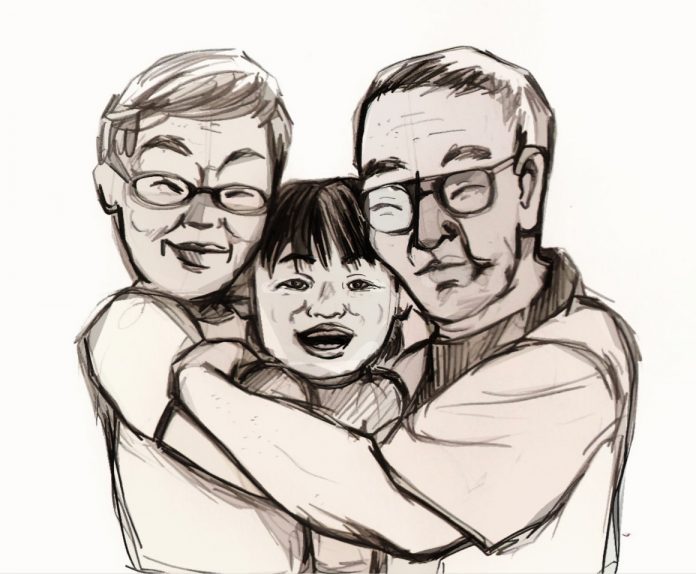
[dropcap]N[/dropcap]owadays, even your grandpa can get picked up as an Internet sensation overnight, and then turned into an online meme. Yes, Sad Papaw, I’m talking about you and your disgraceful grandchildren.

But all hilarity and memes aside, the minute that a picture was posted to Twitter of a defeated grandpa eating with only one grandchild at dinner-table after making burgers for all his six grandchildren, the Internet was awash with feelings of sympathy for him. Even though it was later revealed that there was a miscommunication between “Papaw” and his grandkids, it still sparked something deep within the hearts and minds of people that encountered this photo, including myself.

I wanted to address that throughout the course of this column, the “grandpa” I interacted with wasn’t my grandpa at all; in fact, I talked to many different people from my grandpa’s generation. With each week, I was able to address various topics and I got to see the differences between the generations — how we were the same and different, and ultimately, how things have changed over time.

My grandparents from both my mom and dad’s side have since passed on, all leaving legacies on my family and who we are. My mom’s father passed away when my mom was 16, so I never had the opportunity to meet him. My dad’s mother passed away when I was 7, followed by his dad when I was 16, and then my mom’s mother when I was 17.

One night, my maternal grandmother, before she passed away, looked at me with the endearing eyes she always had for me, and told me that she loved me. We were one month away from my 18th birthday when she said this. Then, heaving a laboured sigh, she repeated one thing that she always told me every time she saw me: “Always be thankful for your family.” She passed away a few weeks before my birthday.

Unlike many of my peers, my grandparents never lived to see the day I graduated from high school. They never saw my excitement when I received my first university acceptance letter or my first scholarship. They never got to ride shotgun in a car after I got my license. They will never see me graduate from university, get my first real job, get married, and start a family. And I will never get to hear my paternal grandmother’s singing voice, talk to my paternal grandfather about golf, or hold my maternal grandmother in a loving embrace ever again.

These simple words that I have always taken for granted, “Always be thankful for your family,” tore a hole through my heart when I saw the picture of the lonely Papaw. Even though it may have been a miscommunication and his grandchildren didn’t mean to not show up, the sentiment remains the same. You should always be thankful for everything that you have and everything that you are.

This column took me down memory lane time and time again, reminiscing of past conversations with those who have had a profound impact on my life. There isn’t a day that goes by that I don’t think about them and think about what life would be like if they still were here with me. And though I can’t turn back time, I am thankful for what they have given me: support, love, and a solid family to rely on.

Our grandparents, ever patient with us as we found our way through the world, taught us so much and showered us with unconditional love, and probably more gifts than we could ever imagine. The one thing we can do for them is to show them our gratitude and return their patience, especially in their times of need.

Jesus takes the wheel in upcoming Fast and Furious flick

0

After the conclusion of Furious 7, it would have been safe to assume that the Fast and the Furious franchise had driven itself from our lives for good. Alas, living in a world bereft of imagination and innovation in the medium of film, it should come as no surprise to anyone with a pulse that three more sequels to this vehicular crime saga have been announced for release as early as April 2017.

While audiences may think they know what to expect from the long-standing and expedient car series, recent reports suggest the series’ new direction will be nothing short of groundbreaking with its addition of a famous Biblical icon to its prolific cast of characters.

That’s right, folks: grab your cross and hit the NOS, because the son of God has joined the race.

A year from today, Jesus Christ will be cruising his way to the silver screen with Dominic Toretto and his gang of adrenaline junkies for yet another crazy action-adventure, filled with objectified half-naked women, forgettable hip-hop singles, and enough car porn to make any gearhead spurt motor oil.

The recent details on the film’s newest cast member was made known to the public last Friday, during a press conference led by long standing Fast and Furious star and musclebound potato-human hybrid, Vin Diesel.

“This time it ain’t about being fast or furious,” claimed Diesel with a wry grin, “It’s about taking the series to a whole new level. Fans can expect high-flying action sequences and more spiritual exploration than they ever wanted to experience before.”

With the effects of the announcement still rippling through the fanbase, rumours have already begun to swirl about the film’s plot and the loony direction it seeks to take the once grounded street racing franchise.

One such rumour is that the Toretto and his daring team will find themselves in Israel tracking down an old arch nemesis hell bent on exposing the United States’ nuclear codes to a covert terrorist organization, known only as the JUDAS Corp. It’s speculated that Jesus will join the team after facing Toretto in a high-stakes street race in his sick “Holy Roller,” rumoured to be a pimped out white and gold Zenvo ST1.

Diesel also teased fans that the casting for Jesus Christ was already in its final stages of completion. A rep for Universal Studios confirmed the role of the Biblical OG was shortlisted to Academy Award-winning beardos Jared Leto and Joaquin Phoenix. Yet similar sources have also alleged that the film’s role could also go to walking consolidation of lube and pubic hair, Russell Brand.

With the Fast and the Furious franchise set to continue until 2021, it has left many to wonder whether Jesus’s addition to the cast is a blessing in disguise for the series or a sign of the times. With the fate of the billion dollar series in the balance, all fans and executives can do is pray the series doesn’t stall out.

12 lessons this semester has (almost literally) shoved down my throat

0
Here's some food for thought: the most important lessons I learned this semester.

1) Don’t google your symptoms. Ever. Or watch House. And for the love of God, do not do both simultaneously unless you want to end up in the ER at three a.m. with some erroneous phantom disease.

2) If someone hurts your feelings, don’t dwell on it. As my friend Joe always tells me, just punch them in the dick (or tit) and go get some fucking ice cream.

3) Alcohol isn’t a quick fix for problems — most of the time.

4) Don’t over think things. Keep it simple, stupid.

5) Let me be the first to tell you: your douchey crush, whom you want to believe is ‘different,’ is more than likely just a douche.

6) Sleep heals a lot of ills. Nothing good happens when you’re overtired. Seriously though, if you find yourself morphing into an angry, bitchy, evil gremlin past 1 a.m., you’re not alone. Go to bed; there isn’t a bottle of wine, genitalia, or impending assignment worth missing out on your snooze time for.

7) Just because someone doesn’t perceive the world in the way that you do doesn’t make them any less of a great person. Just because someone is a great person doesn’t mean you can’t cut them the fuck out of your life if they’re not enriching it.

8) People show you very quickly exactly who they are. Be brave and respect yourself enough to accept it. Don’t waste your time trying to change people.

9) For the love of God, go to class! You’re paying for your education, nimrod. That joint and Netflix will still be there when you get home.

10) Don’t shame yourself for speaking your mind, having feelings, or changing your mind. Don’t let anyone make you doubt yourself for doing any of these things; if they do they’re probably shitty people and you should just go rule the world or something. Peasants.

11) Don’t count your calories. Eat what you like, eat well, smile, and shut the fuck up about it. Stop torturing yourself.

12) Know when to let go. (Hint: as soon as you ask yourself if it’s time to let go, it’s probably time to let go.)

turmOIL

1
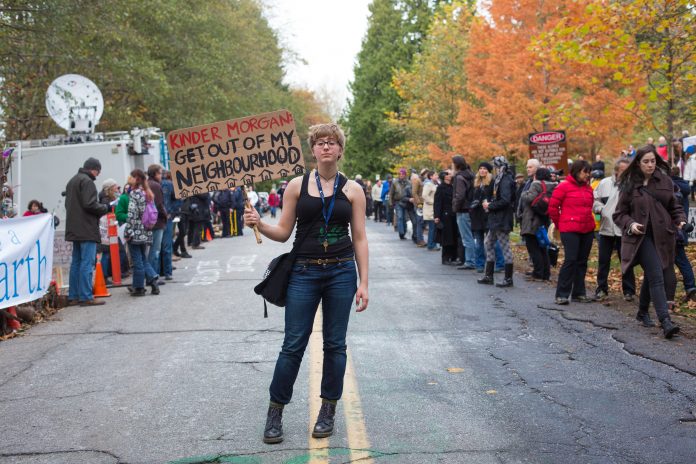
Photo of a protestor from a rally against Kinder Morgan and the oil pipeline.

Editor’s note: The Peak recognizes Burnaby Mountain as unceded Coast Salish territory. However for simplicity we will refer to the land as Burnaby Mountain throughout this article.


On top of Burnaby Mountain, SFU could have been a shining example of the white tower of academia, looking down on the masses. It is physically separated from the world around it, and if it chose, it could keep to itself.

But over the past 50 years is the university has been a magnet for protests and controversy. Faculty and students have weighed in on issues that they care about, and regularly lend their voices to the causes that they believe in. For better or worse, SFU has become a place of engagement — but not necessarily in the sense that SFU marketing has pushed for.

The university can’t afford to remain quiet, no matter how much it wants to.

In November 2014, that kind of engagement reached a boiling point when SFU students, faculty, and concerned members of the public protested the work being done by Kinder Morgan crews on Burnaby Mountain. Kinder Morgan Canada owns the TransMountain pipeline system, which has pumped crude oil from Edmonton to Burnaby since 1953 and stores oil in a tank farm at the base of Burnaby Mountain.

The work was being done to assess a route for a new expansion to the pipeline that would add 980 km of new pipeline and almost triple its capacity to 890,000 barrels a day. Kinder Morgan claims that the project would bring in significant economic benefits to the province, but various groups have opposed its construction due to safety and environmental concerns.

Among those against are the City of Burnaby, the SFSS, the SFU Faculty Association, and SFU itself. Final arguments about the project were submitted to the National Energy Board earlier this year, and the National Energy Board (NEB) has until May 20 to make a recommendation to Governor in Council.

This story of SFU and the pipeline has taken many twists and turns, and has drawn an incredible breadth of communities into the controversy. But among all of the disagreement, posturing, and media frenzies, a theme separate from the pipeline itself has become clear: this issue is testing how SFU supports its community, and the rest of the province is watching.

The university can’t afford to remain quiet, no matter how much it wants to.

The Mountain

Even atop Burnaby Mountain, there wasn’t any real way that SFU could have ignored the pipeline completely. The original route of the new pipeline would have taken it through Burnaby streets, much like the existing one between the Burnaby Tank Farm and the Westridge Marine Terminal.

Neil Abramson of the SFU Faculty Association explained in an interview with The Peak that, as he understood it, Trans Mountain was “going to have to close one of the three major entrances to the university for a long period of time.”

Perhaps understating the situation slightly, TransMountain spokesperson Ali Hounsell explained that “one of the things we heard from community members who live in that area is that they would like us to consider alternatives.”

Whether Trans Mountain will be able to handle any potential spills remains a huge issue in approving the project.

Which is understandable, considering the damage that a spill in 2007 did when construction crews ruptured a relatively small pipeline buried under the street. The spill released 234,000 litres of oil onto houses, the street, and the Burrard Inlet. There has since been another spill at the Westridge terminal in 2009, but the oil didn’t make it directly into the Inlet.

Whether Trans Mountain will be able to handle any potential spills remains a huge issue in approving the project. The Province of British Columbia has called on Trans Mountain to have a “world-leading marine oil spill response,” in addition to four other conditions in order for it to consider the pipeline.

Hounsell acknowledged that Trans Mountain hasn’t yet met the conditions that the province has put forward, but that they are “confident and hopeful that we can do that in time to move forward with the project.” She offered that Trans Mountain has already received an award for working in “environmentally sensitive areas” when they completed an expansion in Jasper National Park in 2008.

The award was bestowed by the Alberta Emerald Foundation, an organization that boasts that it has “created a legacy of elevating the environmental achievements of our province, setting an example for all to follow.” Among its sponsors are the oil companies Enbridge, Shell, Syncrude, ConocoPhillips, ATCO Gas, Cenovus, and Suncor.

The specific route and environmental damage aside, there are still serious implications for SFU if the pipeline is built. The fact that there would be increased oil transport and an expansion to the Burnaby Tank Farm means that a spill or fire there would be more difficult to control, something that SFU has taken great issue with.

In an official statement to The Peak, SFU said that it is “concerned about the ability of Trans Mountain to respond to and resolve a major fire given the evidence provided by Burnaby’s Fire Department that they have neither the resources nor mandate to respond to a fire event at the Burnaby Mountain facility.” The Simon Fraser Student Society (SFSS) has voiced similar concerns, leading both organizations to become intervenors in the National Energy Board hearing process. So far, SFU states that it requires a more comprehensive risk assessment on the tank farm and it “is not willing to accept an increased risk to its community.”

The politics and the money

It’s clear that having a new pipeline installed near Burnaby Mountain is not without its hazards, but the process in of itself has another completely different kind of influence on SFU and the surrounding area. For one thing, Trans Mountain claims on its website that it will “maximize Aboriginal, local, and regional employment opportunities” for the project. Over the coming two years, it says that it will hire the equivalent of “37,000 direct, indirect, and induced jobs per year” the pipeline is operational.

Trans Mountain has also taken other approaches to conferring a financial benefit to whichever communities participate in their project. The company has been giving money to cities like Hope, Kamloops, Merritt, and Abbotsford in order to “compensate for the disruption caused” by the construction of the pipeline. They’ve also offered money to post secondary institutions, with Kwantlen Polytechnic University accepting an offer in June 2015 for $300,000 to be given over 20 years, only if the pipeline is approved. In short order, KPU students vowed to refuse the scholarships that would be funded by that donation, and the Kwantlen First Nation’s opposition to the project eventually pushed KPU to withdraw from the agreement just months after signing it.

Thomson River University accepted an even bigger offer of $500,000 over 20 years, though some faculty are calling the move embarrassing.

Kinder Morgan has also been named in a list of oil companies that have given donations to the BC Liberal Party.

SFU hasn’t received money from TransMountain, but its faculty have given the project a lot of academic attention. In the earliest example, Kinder Morgan hired SFU’s John Clague and Doug Stead in 2014 to conduct a study on the route the pipeline may take through Burnaby Mountain or the streets. At around the same time, SFU’s School of Public Policy published a report on the economic costs and benefits of the pipeline expansion project, finding that  the pipeline might only provide a third of the jobs that it promises. The document concludes that “the pipeline project is not in the economic or public interests of the citizens of BC” and recommends that the decision-makers of BC “reject this pipeline.”

The next year, another study was published by SFU and the Living Oceans Society that found that Canada would incur a net cost of $4.1 to $22.1 billion if the new pipeline is built. The authors argue that the persistently low price of oil and the failure of the project to “provide any estimates of many of the potential economic, environmental, and social costs” causes the project to not meet the NEB criteria of being “clearly demonstrated to be needed” and “clearly found to be in the public interest.”

The vocal opposition

Throughout this development, there have also been intensely emotional moments. Concerned community members have endured personal risk to communicate just how seriously they oppose the project.

SFSS VP External Relations Kathleen Yang recalls that in November 2014, “there were so many SFU students that were camping on the mountain, [who] were actively taking a role in opposing the pipeline.” SFU faculty stepped up to the bar as well, with several members doing enough to get onto Kinder Morgan’s radar. Professors Steven Collis, Lynne Quarmby, and former professor Alan Dutton and others were the target of a multi-million dollar lawsuit for delaying the Trans Mountain pipeline. Quarmby was also later arrested with over 100 others for continuing to protest on the mountain after Kinder Morgan was granted an injunction.

In an official capacity, the SFU community has also been participating in the NEB hearings. The SFSS and GSS presented their final arguments in late January this year, with the SFSS later holding a rally outside. That Saturday, SFU students Mia Nissen and Amy Widmer were arrested along with UBC student Destiny Sharp for trying to enter the NEB hearing room. Hounsell said that she was unsure whether TransMountain knew students were arrested at the hearings.

SFU also continues to host events with an unapologetic anti-pipeline message. Only in the past month, a climate parade started at SFU Woodwards, Naomi Klein came to speak to the issues of climate change as part of the SFU Vancouver Public Speaker series, and the university hosted a “Carbon Talks” event in partnership with the David Suzuki Foundation and the Centre for International Governance.

Working together as a community?

Over the past two years, the SFU community has struggled with the pipeline expansion project. In that time, it has become clear that many different groups have a variety of reasons for opposing the pipeline. They claim the economics are unsound, there are huge questions about safety, and the environment stands to lose big time if there is ever a spill, not to mention from the increased emissions from the tar sands. So with all of this put together, wouldn’t it make sense for SFU to engage with the SFSS, GSS, SFUFA, and other groups and students who want to get more involved?

On the other side, Trans Mountain certainly feels it has been doing its part to engage the public. Hounsell explained that SFU students “were certainly included in our invitations to the open houses and the various activities that we held since 2012.” As part of the decision-making process, Hounsell said that “sitting down with people and really trying to understand their concerns and questions is the best way to approach these things.” They also note that the “offer continues to be open to sit down and meet with” the public. To address the concerns with spill response, TransMountain held an emergency response exercise at the Westridge terminal which SFU participated in.

So it’s perplexing to see that while Trans Mountain has been spending a lot of energy meeting with people who violently disagree with them, SFU has remained relatively silent; it didn’t even present an oral argument to the NEB about the pipeline. SFU could be using its influence to help community members get over the challenges of becoming more involved.

SFU Faculty Association’s Neil Abramson told The Peak  that even though his association made a public statement and have asked SFU to divest from fossil fuels, he considers those to be “symbolic gestures that, in a way, are [a] very very low commitment” because they “don’t really impact the lives of the people.” For the most part, in his experience, people at SFU are averse to taking action that changes their livelihood, even when presented with an opportunity.

But students are also affected by the mountain of new responsibilities they have when they are studying. SFSS VP External Relations Kathleen Yang spoke to the fact that even though students do care, she feels “it’s been a longstanding systemic issue, where it can be really difficult to be ‘engaged’ at SFU because of all the things that students have to deal with in their lives.” In order to change that, Yang says “we need to look at starting to dismantle the structural barriers that are preventing students from getting involved and taking action on campus.”

When asked if they were contacted by SFU or TransMountain about their organization’s position against the pipeline, Yang and Abramson didn’t mince words.

Yang answered that the SFSS has not “received any correspondence from Trans Mountain or from the university.” Similarly, Abramson said that they haven’t been contacted by Trans Mountain and he “didn’t think [SFU] noticed” when the SFUFA made their statement. He also conceded that he doesn’t “think there’s ever been a gathering of the university organizations that are opposed to this pipeline.”

The role we need to play

This pipeline is about so much more than the oil it is going to carry. The controversy around it has found a way to impact institutions and cities across the Lower Mainland, and it’s clear that SFU will be inconvenienced and put at risk if it is built. All of this evidence and outcry, and SFU has not really helped its community take action.

Although the communities at SFU are incredibly diverse, and may disagree about which is the most important aspect of the pipeline project, the common themes binding them together are their opposition and their home institution. We have these various groups on campus, all pushing back against something they don’t want.

SFU has an opportunity to set an example to the rest of Canada.

But it seems like there is a vacuous gap left by SFU. It is spelled out in its strategic vision to be engaging students about civil understanding, and to develop healthier and more vibrant communities — where was that engagement? SFU has provided the infrastructure and academic freedom in order for students and faculty to express themselves, for sure, but it is reasonable to expect just a little bit more.

The university has a tremendous opportunity to set an example to the rest of Canada in the kind of engagement that it talks so much about. The West Coast has been demonized as pipeline-hating hippies who don’t care about the well-being of other provinces, but SFU could lend its voice and credibility to Burnaby’s side of the story. Whatever it does next, SFU needs to realize that so far, it’s been incredibly distant from its community. It has made some statements that might be genuine, but until it actively supports the group of people that is looking out for Burnaby Mountain, it won’t really influence what will happen next.

SFU alum broke fast after protesting BC Hydro’s Site C dam for three weeks

0
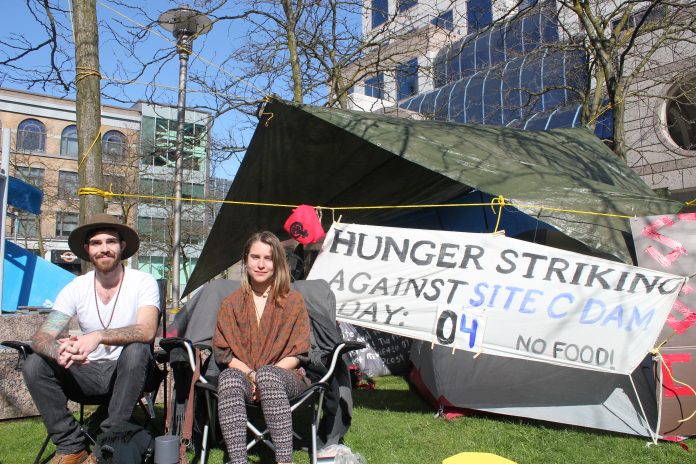
SFU alum Kristin Henry (right) sat with Sage Birley as she protested the Site C dam.

SFU alum Kristin Henry, a driving force behind a hunger strike in the wake of BC Hydro’s Site C Dam project, has broken her fast at the insistence of family and doctors according to a Facebook post. She was hospitalized on March 31, which was day 19 of her hunger strike.

Henry is still currently at the hospital, where she might stay until the end of the weekend while she recovers. According to Facebook, she stopped her hunger strike once “she was told that she was at risk of cardiac arrest, and moving forward without food would for sure start doing long term damage to her heart, kidneys and other vital organs.”

She was transferred to St. Paul’s Hospital by ambulance on Wednesday, where medical professionals are urging her to eat something so as to regain her strength. But Birley said that Henry had continued refusing to eat, saying that she is “waiting for test results to come back before she decides to eat or not”. She was also “visibly stressed and frustrated” at the lack of action that has been taken by the Trudeau government as well as BC Hydro.

The Peak spoke with Sage Birley, a farmer from the North Peace Region who has been welcome at the site where Henry set up camp. Throughout the time that Birley has spent on the site, he has become a “media spokesperson”, speaking on behalf of Henry who is still at St. Paul’s Hospital.  

On March 31, Henry was on the 19th day of her hunger strike when her heart rate dropped to 35 bpm. She eventually fainted and was attended to by nurses and other medical personnel that were present at the site.

“[Kristin] is frustrated that Trudeau and BC Hydro are unwilling to sit down and have a serious conversation with all the impacted groups regarding this issue,” Birley said. “She is facing a lot of stress right now.”

Despite the inaction from the federal government and BC Hydro, Birley says that the amount of support that has come about from this hunger strike is “incredible”. Birley, whose family has a long history of farming in the North Peace Region, has great concern for the issue of food security especially in that region. The construction of the dam, Birley says, will have a serious impact on accessibility of food.

To date, the Birley and other members of the camp have collected signatures and have written thousands of letters to the Trudeau government, asking for construction to be discontinued.

At the time of the interview, Birley noted that other movements were taking place, and that earlier on Friday, Green Party leader Elizabeth May had visited the site. With growing support and seeing new faces every day, Birley has hope that this fight for food security is not over.

“[Henry’s efforts] have definitely revitalized the dialogue on this issue,” Birley said. “People have been fighting this issue for 30 years, so it is great to see that all of that effort was not done in vain.”

Even though Henry’s strike is over, the group involved in the hunger strike, who have dubbed themselves “tent city” plan to continue the protest. According to their Facebook post, they “continue to grow and have no intention of ending this campaign. The hunger strike was the start of a beautiful grassroots movement, but it’s certainly not the end.”

SFU 100 encourages students to fight for fossil fuel divestment

0
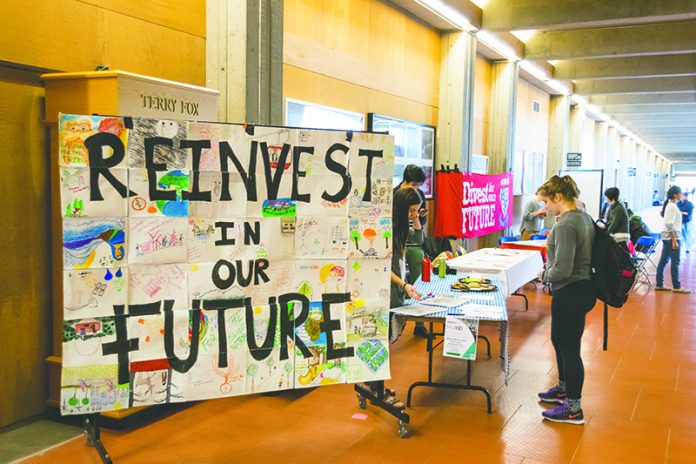
Wednesday's event took place in the AQ.

In the AQ hallway, SFU 350 and Embark’s Divest SFU campaign invited students to help their university decide where to keep its money.

The campaign, which calls for SFU to divest within five years from fossil fuel companies, is part of a movement that has had growing support. Many universities, colleges, and other organizations have pledged to divest, including Stanford University and Glasgow University. In a shocking development, the Rockefeller Brothers Fund also declared that it would divest its $860 million fortune that famously originated from the fossil fuel industry.

Closer to home, this “SFU 100” event encouraged SFU students to think of the future of their institution, and how it should use its financial weight.

SFU 350 president Raaj Chatterjee told The Peak that “divestment is a sizeable impact that the university can make in terms of the fight against climate change and holding companies accountable to their actions.”

Chatterjee explained that so far, the Divest SFU campaign’s petition has collected almost 2,000 signatures, and that SFU has been “responding in [an] appropriate way” to pressure from Divest SFU.

In the past, the university has announced that it has signed onto the UN Principles of Responsible Investment and the Paris Pledge for Climate Action, which both call for signatories to consider building resilience and social responsibility with their investments. Chatterjee was cautiously optimistic that SFU has agreed to create a divestment policy of some sort, but at this stage the idea is still “pretty vague.”

However, three Canadian universities have recently rejected divestment despite student pressure. McGill, the University of Toronto, and the University of British Columbia have all cited the limited effectiveness of divestment from influencing fossil fuel companies, as well as the responsibility to maintain financial returns as their reasons for not divesting.

If SFU decides not to divest, SFU 350 has also been circulating another petition that will become relevant. Chatterjee said that the group has collected over 300 signatures of students that have pledged to take some form of “direct action” in the case SFU does not divest. He explained that this might include “some sort of rally or sit-in.” Earlier this week, McGill students, dissatisfied with their university’s decision, staged a sit-in in the administration building and camped outside, catching the attention of the university’s Principal and Vice-Chancellor.

Rather than just gathering signatures, the event was a way for the Divest SFU to have a conversation with students. Said Chatterjee, “I think all students know about climate change, they all know about global warming [. . .] but students often feel that they don’t have a voice where they are.”

There is currently no timeline for the Board of Governors to elaborate on their divestment policy. However, after lobbying the Board for three years to get to this stage, the Divest SFU campaign has certainly proved that its members think of it as a responsible investment of their time.

The Peep Challenge

0

Happy Easter from The Peak! Created by Paige Smith & Eric Smith.

Why Students Don’t Vote

0

We asked SFU students if they vote in the SFSS elections. Turns out most SFU students don’t vote. Get out and vote!

Men’s basketball coach Virgil Hill resigns amidst allegations of misconduct

22

A number of former players who are departing SFU’s Men’s Basketball team have come forward with allegations against former Head Coach Virgil Hill. Hill resigned from his position earlier today.

SFU Athletics announced Hill’s resignation in a press release written by Steve Frost, Sports Information Director, less than a year after he was officially announced as SFU’s men’s basketball coach. He took over on April 15, 2015 after the resignation of former Head Coach James Blake.

Athletics Director Theresa Hanson said in a press release, “Virgil and I met to review and evaluate the basketball season and at that time he informed me that he has decided to resign his position as men’s basketball coach to spend more time with his young family.” Hill’s decision comes on the heels of several allegations against him, originating from several players who left the team this semester.

One of the players who left the team with four games remaining in the season spoke to The Peak about why he left. “It’s just such a horrible atmosphere. Losing never helps, but the coaching staff just does not look out for us.” The player asked to remain anonymous.

The “losing” to which the player refers is likely SFU’s results on the court. The team went 2–24 on the season, and 1–19 in the Great Northwest Athletic Conference. The team went through a 18-game losing streak, and got its first and only conference win on February 11 against Concordia University.

The player alleged that in one instance, the coaching staff did not provide the team with meals while on an away game. According to him, “Before Sonoma State, we passed around a XL bag of peanut M&M’s before we played, and that was the only thing we had eaten before a 2 p.m. game.”

A second player who wished to remain anonymous corroborated the first’s account. “It’s true,” the second player said. “We [were] told we would stop somewhere and then we just went straight to Sonoma. They told us to go to the locker room and just put a bag of M&M’s on the desk.”

Denver Sparks-Guest, one of the seven players who departed this season, said his reason for leaving was “100 percent coaching,” saying that “there was no other reason.”

The first anonymous put particular emphasis on Hill’s behaviour towards Pape Seck, a player from Senegal, recounting comments made about Seck’s language ability and religious beliefs.

“Losing never helps, but the coaching staff just does not look out for us.”

According to the player, those comments included, “‘Virgil countless times said things such as ‘this isn’t a language barrier, it’s a stupidity barrier,’ ‘my 10-year-old son is smarter than you,’ ‘you didn’t play in junior college, you haven’t played here, you’ll never play anywhere.’ He called him an idiot and retarded plenty of times.”

The second anonymous player also corroborated the first’s allegations of “[Pape] being called out in that manner” by Hill.

The first player added: “Ultimately the worst incident was when Virgil said to me in his office when it was just him and I [. . .] ‘Pape can pray eight times a day but he can’t make it to practice. . . His Muslim faith doesn’t fit in here in this culture.’”

The Peak reached out to coach Hill for his comments on the amount of players leaving the team. He provided the following statement: “Players and programs part ways for various reasons and we are no different. I wish the departed players the best of luck with the remainder of their collegiate careers.”

When asked to comment on specific allegations, Hill declined.

Seck said that he was “not comfortable” in practice and stopped practicing with coach Hill as a result. “It was more of the way he acted, [he was] not respectful,” he said. “You can’t take a high school coach [and bring him] to the NCAA. He’s not a good coach, he has to learn to talk to men.”

The first anonymous player also stated that people within SFU Athletics were aware of allegations against Hill. “Kelly Weber, Laura Reid, [and] the athletic director Theresa Hanson all know.”

Sparks-Guest stated that he talked to an unspecified Athletics Director before his departure, and Seck said that he “talked to Laura [Reid]” within SFU Athletics.

Athletics Director Theresa Hanson said that “I am aware of some challenges within our men’s basketball program. I was not aware of all of the allegations that you have brought forward. I am disturbed by them. It is unfortunate that student athletes from our men’s basketball program have had a negative experience.”

The announcement came after The Peak contacted SFU Athletics to provide comment on the allegations made against him the day before. It is unclear if these allegations factored into his resignation.

Frost in the press release added that, “The search for a new head coach of the SFU men’s basketball program will begin immediately.”

“I would like to thank Simon Fraser University for the opportunity to come back and coach at my alma mater,” said Hill in an official press release by SFU Athletics.

“At this time I am tendering my resignation. This decision was a difficult one as I wanted to bring this program back to a level of competitiveness that we know is possible. My decision is based on the needs of my young family and my need to support my wife in raising our children.”

Valentine’s Day Prank

0

Happy Valentine’s Day from The Peak!

Created by Paige Smith & Eric Smith