Home Blog Page 682

SFSS relocates the general office to the Think Tank

0
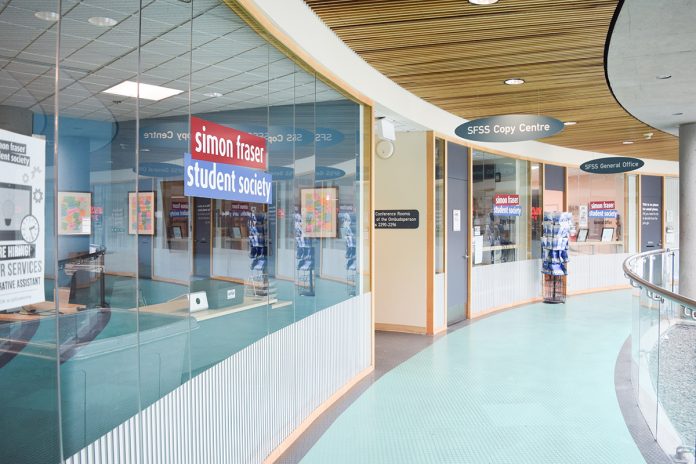
Many students pass by the former Build SFU Think Tank on their way to the food court.

The Simon Fraser Student Society (SFSS) intends to relocate its general office to the former Build SFU Think Tank adjacent to the food court in Maggie Benston Centre this week.

The new space, called the Club and Student Union Centre, will combine the services of both the general office and student union resource office, according to chief executive officer (CEO) Martin Wyant.

“There’s not anything new that is landing as a service at this point,” explained Wyant. “It’s just the same stuff, different place.”

Last week, the SFSS told The Peak that it does not expect any disruption for the general office during moving day on Monday, however the student union resource office will be unavailable, except by email.

The new office is slated to open the following day.

There is the potential for some service disruption during the move, but as of last week the SFSS said it did not expect to need to close the general office.

The move is intended to make use of the increased frontage of the Think Tank and implement a new model for delivering general services to students that will become a feature of the new Student Union Building, slated to be completed next year.

“In looking at that coming on stream, we said we should take the opportunity to model that now before we move so that we learn what works well, what we need to tweak,” Wyant said. “The idea is to try out the new service delivery model while we are here and then take that learning into the new building.”

Wyant said that some students already mistake the Think Tank, which until now housed administrative staff, for the general office.

“It is the most visible space that we have, it is right near the food court, we get a ton of traffic that walks by [t]here constantly,” said Wyant. “We often get students stopping in [t]here with questions because they assume [. . .] that [it] is a service delivery point.”

To accommodate the move, the administrative staff — including Wyant — will be moving to the resource office. The new offices will provide more privacy and space for the CEO to hold meetings, Wyant said.

The finance department will move into the former general office space and the finance office will become a meeting room primarily for the Board of Directors.  

Wyant noted that he did not anticipate the move to be much of a cost for the society.

Eventually, Wyant said that front desk staff will be cross-trained to handle all of the inquires that come into the office in order to increase how efficiently with which they can offer help to students.

He acknowledged that there might be some confusion with the new model at first.

“I think with any change you are going to run into some of that,” he said.  

New Music Friday

1
(Linda Shu / The Peak)

“Kisela” – Vanessa Mdee, Mr. P

Edna Batengas: I’ve been team Vee Money since like forever. Her voice is just something else, so pleasant to listen to, such smooth vocals. You go, girl, reppin’ East Africa! Never heard of Mr. P but he sounds great on this track.

Neil MacAlister: Getting Shakira vibes here. I like it.

Sera Akdogan: This is such a fun song. Love it. 


“Learn To Let Go” – Kesha

EB: Yaaassssss, I knew it, Kesha is making a comeback. I’m really digging this new Kesha, she seems so much more authentic and raw. I approve!

NM: There’s a degree of triumph and power in Kesha’s new music that makes me really happy. “I’ve been through hell and back” should’ve been the name of her album.

SA: I’m so stoked that Kesha is making music again. I know that she’s come a long way to do this. Though I still don’t think she’s the most talented female artist out there, props to Kesha for transcendence, musically and spiritually.


“Sweetest Life” – KWAYE

EB: So mellow and smooth, this song just screams good vibes. I don’t think I’ve come across KWAYE before, but he’s fantastic.

NM: I’m not even sure what era this song is mimicking, but it’s somehow making me nostalgic.

SA: Definitely adding this song to my ‘Slow Jamz’ playlist. It’s so sexy and playful.


“Marmalade” – Macklemore, Lil Yachty

EB: From the get go, I made a mental note to myself to download this song. I mean, how can you not like Macklemore? Oh, and Lil Yachty is pretty cool, too. I think he’s starting to grow on me.

NM: Alright, this song kinda goes. It’s like Broccolli part II. Boat’s features have been a little mediocre lately, but this is the Yachty I fell in love with, and Macklemore’s pretty much embraced how wack he is.

SA: Macklemore needs to stop making music. I feel like he’s trying to get out of one-hit Wonderland and it’s just not working for him.


“Gotta Get A Grip” – Mick Jagger

EB: Oh dear, pardon me, but I didn’t know that Mick Jagger was still alive, let alone still making music. I guess you learn something new every day. Aside from the shock that he’s still alive, I think it’s a great song.

NM: This sounds like Mick Jagger trying to make a political White Stripes song. Of the two mediocre singles he dropped this week, I’d rather listen to “England Lost” for the Skepta verse. But that’s just me.

SA: So I knew that Mick Jagger was still alive and kickin’, but I had no idea he was trying to make music again. This is kind of weird because I feel like I’m in the wrong era or something. Unfortunately, he is not going to do well with the millennials.


“Friendzone” – Sauti Sol

EB: Oh, Sauti Sol, I’ve patiently been waiting for this track. Only they can sing about jumping out of the friendzone and make you completely forget what they’re singing about.

NM: If you’re going to listen to a song called “Friendzone,” listen to Thundercat’s. No offense to Sauti Sol.

SA: This song is hilarious. I’m sure a lot of people can relate . . .


“Watcha Gon’ Do” – Diddy, the Notorious B.I.G, Rick Ross

EB: Meh, nothing special there.

NM: Damn, Rick Ross came through with one hell of a verse. Diddy’s just going to keep recycling Biggie verses until he dies, but whatever. Diddy can pretty much do anything he wants to now. I actually dig this, it’s way better than I expected it to be.

SA: This is kind of fun, but nothing I’ve never heard before at this point.


“Ball Player” – Meek Mill, Quavo

EB: Not a huge fan, but it’s pretty catchy!

NM: One of the least interesting tracks on Meek Mill’s mostly uninteresting new album, but at least Quavo’s going in. I’d rather listen to DC4.

SA: This seems to be pretty generic in terms of what mainstream rap sounds like these days. The lyrics aren’t bad, though, and it’s catchy enough for radio play I guess.


“No Love” – Kevin Gates

EB: Nah, I can’t even get myself to pretend to like this one. It’s kinda boring.

NM: Apparently Kevin Gates’ wife is curating an album of his old material while he’s in jail. I just wish she was picking better songs.

SA: This is just “meh.” The beat is decent but I’m not a fan of his voice overall.


“Bird Brains” – Holy Fuck

EB: Holy Fuck indeed, what did I just listen to?

NM: Wow, haven’t heard from Holy Fuck in a while. This sounds like just about everything they’ve done before, which isn’t necessarily a bad thing.

SA: Why am I only aware of this group now? This song is super strange, but I can’t seem to turn it off for some reason. It’s like one of those songs you hear on the radio and you’re waiting for something else to happen in the song before you skip it.


“82 Fires” – The East Pointers

EB: Eeeeppppp! I like this one. For some reason it reminds me of The Hobbit soundtrack

NM: “82 Fires,” sounds like the BC’s forests right now, am I right? Real talk though, wildfires are no joke. And what’s up with all these bands coming out of nowhere and dropping Celtic-sounding folk songs?

SA: I thought this was super country-esque at first, and was immediately turned off. But then it got interesting, and I kept listening. I actually don’t mind this song due to its folks-y sound, but I wouldn’t listen to it on my own time.


“In This Party” – Sean Paul, Wayne Wonder

EB: What a great way to end this playlist. It’s a bit more mellow than Sean Paul’s normal stuff, but come on. Who doesn’t love Sean Paul?

NM: Gotta love new Sean Paul. It feels like it’s been ages.

SA: Awesome, another Sean Paul song that I can ridiculously mock for years to come.

Board Shorts

0
Irene Lo / The Peak

Student health plan administrator presents to board

The Simon Fraser Student Society (SFSS) Board of Directors received a presentation from Studentcare, the administrator of the society’s health and dental plan.

“Our goal . . . is just to give you a little bit of background so that you feel comfortable going into the new year, answering questions that might come up and just being able to speak about the plan,” Studentcare representative Kristin Foster told the board at the July 24 meeting.

The presentation covered the major aspects of the plan, how it is administered, and the most recent initiatives by the company.

Studentcare processed $3.8 million in claims from SFSS members in 2015–16 and the numbers are expected to be up for the most recent academic year, according to Foster.

At-large representative Jaskarn Randhawa inquired as to how the SFSS can better reach students about their option to opt out of the program which is automatically included in their student fees.

Foster said that Studentcare does send alerts each semester and approximately 30% of members choose to opt out of the plan.

The SFSS chief executive officer Martin Wyant noted that the more people who opt out of the program, the higher the cost for those who remain.

Campus groups seek to expand peer support program

The SFSS Women’s Centre and Out on Campus sought support from the SFSS Board of Directors for an initiative that will train students to support their peers who are experiencing stressful situations.

The groups currently offer a peer support service, usually provided by the coordinators, for members who are under stress that is affecting their academic performance.

“Right now at the Women’s Centre and Out on Campus, staff are the only people who can provide that and it takes up a great deal of our time,” said Leah Horlick, the coordinator of the Women’s Centre.

“It is also an excellent opportunity for some volunteer help from the membership who want to get experience with a really useful skill that can be transferred to lots of different situations.”

Many members of the board voiced their support for the creation of the program. Erwin Kwok, vice-president of university relations, noted that peer supports can actually provide greater access to professional services for students who “need that referral.”

The health sciences representative Aarushi Sharma mentioned that she would like to see the program expanded to the Surrey and Vancouver campuses where there are already fewer health resources provided to students.

Jimmy Dhesa echoed the point, recommending that potential volunteers be asked if they are based at any of the satellite campuses.

The SFSS already has an office established at the Surrey campus.  

The demand for peer support has been “steadily increasing” at the Women’s Centre since the start of the year, according to Horlick. As the coordinator, she said she saw eight clients last month about topics ranging from sexual violence, pregnancy, gender identity, finding a job, and getting a divorce.  

Horlick emphasised that the peer support program would not cover crisis referrals, which are provided by the coordinator when someone is experiencing an acute emergency.

“It is maybe not a 9-1-1 type of emergency, but they want to talk to somebody who has a listening ear, who has great non-violent communication and active listening skills,” explained Horlick.

She added that the peers support program “will also hopefully free up coordinator time to focus more on provision of crisis services.”

The board agreed with the recommendation that a survey be circulated to establish the viability of the program before proceeding with its development.

World News Beat

0

EAST JERUSALEM – Metal detectors removed at Jerusalem worshipping site

Metal detectors at a famous holy site in Jerusalem were removed, soon to be replaced by another security measure, as per the order of Israeli security bodies. Israel installed the metal detectors after an incident on July 14 where two police officers were gunned down by assailants that smuggled weapons into the area, called Temple Mount by the city’s Jewish residents and Haram al-Sharif by Muslims. Palestinians protested the use of metal detectors at the site, angered by the Israelis’ apparent undermining of their access to the site. The violent protests resulted in the deaths of four Palestinians.

With files from BBC News.

GREENLAND – Greenland’s ice melting fast, scientists concerned over possible sea rise

Scientists have expressed concern over the possible rise in sea level due to rapidly-melting ice in Greenland. A British research initiative called Black and Bloom anticipates that the start of the next century might experience sea levels that are 98 centimetres higher than today. They also discovered that algae has the potential to accelerate the melt. These micro-organisms change the white surface of the ice to darker shades, reflecting less sunlight, and thereby making the ice melt much quicker. The project will continue with its study to track the changes over time.

With files from BBC News.

UNITED STATES – American company first to microchip its employees

Three Square Market had become the first company in the country to offer employees the chance to have microchips inserted into their hands. The $300 microchips would allow employees to do everyday tasks with convenience, such as purchasing food and logging into computers. Around 50 of the company’s employees expressed interest in having these microchips placed in their bodies. This new technology also sparks questions concerning whether the user could be tracked and how the process of placing or removing these microchips works.

With files from BBC News.

ENGLAND – Children’s hunger still a problem during summer holiday

Food banks in the United Kingdom issued a warning about the hunger many children face over summer holidays while away from school. The Trussell Trust stipulated that, despite benefits provided by the government through free school meals for infants, family hardships still remain. Not only do the organization’s figures show that demand for emergency food packages increases during the summer break, but the children receiving these parcels were largely in primary school or under four years old. The government is providing childcare benefits and budgeting advice to aid families with their financial difficulties.

With files from BBC News.

Report: Canada has the tools to lower vehicle emissions

0
The report asserts that there is no reason to wait to decarbonize transportation.

A pair of researchers from Simon Fraser University recently released a report asserting that the time is now for the country to move vehicles away from producing carbon emissions.

The report by master’s student Tiffany Vass and professor Mark Jaccard of the School of Resource and Environmental Management challenges a number of beliefs about the road to decarbonization.

It argues that Canada has the technologies and fuels available to begin the process of drastically lowering transportation emissions.

“Some people assume we need to wait for the cost of electric batteries to come down or for greater development of blendable biofuels. But our report [shows that if] we have the right policies in place . . . we can produce fuels today in ways that have low life-cycle emissions,” said Vass.

The research also addresses what policies can be used to get Canadian transportation moving toward low emissions targets.

Graduate student Tiffany Vass co-authored the report.

“Some economists will say we need to wait for governments to adopt carbon pricing at high

enough levels to drive substantial changes in the economy. However, there is an alternative which is flexible regulations,” explained Vass.

In Canada, transportation is one of the biggest sources of carbon dioxide emissions which are widely held to be a major cause of global warming. In order for the country to meet its emissions target by 2030, reducing emissions by 30% below 2005 levels, the report states that the government needs to increase the stringency of its current decarbonization strategy.

If Canada wants to decarbonize transportation, it will need to implement policies that promote those changes. “We don’t see those changes happening quickly enough on their own,” said Vass.

While electric vehicles have received a lot of press recently as a low-emission vehicle option, other options can also contribute to emission reductions, Vass noted.

Biofuels, made from biological materials, may be one way to help reduce the emissions produced by vehicles.

“When we extract fossil fuels, we’re adding carbon to the atmosphere that hasn’t been there for millions of years” explained Vass. However, with biofuels “there is no net addition of carbon into the atmosphere [because] it’s carbon that was very recently extracted from the atmosphere.”

There are policies across a number of provinces that require a minimum amount of biofuel blending in gasoline and diesel. However, the biofuels, such as ethanol, are often only added in the single-digit percentage points and are not enough to achieve substantial emission reductions, Vass noted.

Many governments and researchers have looked to carbon pricing, which may include a carbon tax or a cap-and-trade system, to reduce emissions. When the pricing translates to a higher cost for traditional fuels, it is expected that individuals will reconsider their mode of transportation and maybe even make the switch to greener technology.

However, politicians have often been wary of raising carbon pricing.

“The public is often resistant to carbon taxes, they will be more likely to oppose that policy,” said Vass. “It is difficult for government to raise the carbon price to a high level, but we need a carbon price rising to approximately $200 per tonne by 2030 to reach Canada’s targets.”

Currently, the highest carbon price anywhere in Canada is BC’s carbon tax of only $30 per tonne.  

However, carbon pricing is not the only policy option and flexible regulations present a potential alternative.

“In our report, we showed how either a clean fuel standard or carbon pricing can be used to achieve the same amount of emission reductions in transportation,” Vass said.

A clean fuel standard would see the government require a reduction in the overall carbon footprint of fuels in the country, encouraging the use of alternative or blended fuels or energy sources.

Without stringent government policies in place, the country is not getting anywhere near where it needs to be to achieve the emission reductions for climate change mitigation, Vass noted.

Forget ‘big’ books; read zines

1
OLYMPUS DIGITAL CAMERA

You don’t know where to turn. You’ve been down the library stacks multiple times, and can’t find anything that appeals to you. Everything seems to sing the same tune: vampires, dystopias, wizards, or kinky sex.

While some (or maybe all) of those things may appeal to you, do you really want or have time to read another 500-page novel about teens struggling to survive in a broken world? No, I don’t think so, and neither do I.

Most of these repetitive books come from big publishing houses like HarperCollins or Penguin Random House. If you want something fresh, it’s a good idea to avoid those sorts of publishers for a while. That’s right: it’s time to jump out of the mainstream and try the fringe world of zines.

Zines are handmade mini-magazines on all topics that anyone, anywhere can make, using minimal supplies. They’re often sold and traded at fairs such as Canzine and the Alternative Press Expo.

As they don’t rely on publishers picking them up, I can predict the kneejerk response: “Great, you’re suggesting I read unpublishable garbage.” No, not at all. Zines come in all colours of the written rainbow. While you may falsely assume that most indie work has weak prose, remember that even big publishing companies are known to crank out crap (I’m looking at you, Simon & Schuster imprint. You and your Hot Pterodactyl Boyfriend nonsense.)

It’s hard to stray from the safe haven of published books on library and bookstore shelves, but here are some reasons why you should try zines.

They’re usually short and easy to read

As a student, there’s no time to delve into any major texts but course readings. Those Cassandra Clare books are only getting thicker, after all. Zines, however, can usually be finished in one sitting. Writers often incorporate many pictures into their zines, and because they work on a budget similar to yours, most zines are only about 15 pages long. Short stories, poetry, and comics are prevalent, and can be read during your next bus ride or study break.

They’re made with passion

Most people who make zines expect little to no money in return; they do it for fun or to make a statement. Meanwhile, writers struggling to get published or even self-publish constantly worry about making money and producing content that appeals to the masses.

Without this stress, zines are less formulaic and more interesting. Zine creators have the freedom to write about whatever they please, which sometimes, in the case of Pepe the Frog, sparks worldwide discussion and controversy. This brings us to one of their biggest draws.

They’re diverse

After the Fifty Shades of Grey series’ success, writer Scott Haworth admits in his book Writing Journal: A Year in the Life of a Self-Published Author “. . . thousands of pissed off writers like me . . . decided to try their hand at [erotica] because it look[ed] like a quick way to make a buck.” Similarly, The Hunger Games triggered an influx of dystopian novels.

Zines have no reason to follow trends. Anyone with access to paper, pens, and preferably a photocopier can write about what they’re interested in. People create zines in many languages on knitting, biking, bad movies, and women who can predict their futures by looking at menstrual blood and ceiling mold. Whatever you’re interested in, there’s probably a zine out there for you.

They’re more unique than mass-produced books

The format and style of every zine is as unique as the content. Zines can be as small as your pinky, bound in silk or rubber bands, and even come with mixtapes or sticker sheets. A mass-produced publication has a set number of materials to choose from and must have a standardized look.

Aside from all the extra goodies you get with zines, authors often only make limited copies of their work. If you get your hands on one, it’ll instantly become one of the rarest pieces of literature you own.

On average, Canadian provinces have about one well-known hardcopy zine collection. Thankfully for you, there are two in the Vancouver area. Go find them!

A Q and A with one of communication’s most popular professors

0

After decades of teaching experience and years at SFU, Jody Baker has earned himself the respect of his students. His classes have become some of the most raved-about lectures within the communication program. As one of the most recognizable names amongst students in the school, his style has received great praise along with a few critiques. I sat down with Jody to discuss his thoughts on his style of teaching, its effectiveness, what he’s learned, and both the praise and criticism he’s received.


The Peak: I’ve taken a couple of your classes, so I’m familiar with them and how you like to run them. One thing that is always mentioned is how relaxed you are in your requirements . . . Students really seem to enjoy and appreciate that. I’m wondering, how crucial is that to you, that in moments . . . when they have a take-home thing [for example] that is big in seeing how they understand the material, that they are relaxed?

Jody Baker: I’ve never studied pedagogy [the theory of how to teach and how people learn], but I have 30 years [of] experience teaching, and it seems to me that stress doesn’t help . . . I think one of the reasons students enjoy my courses, what it comes down to, is a very simple formula that I am committed to student success[.]

[A]nd it’s not about grades [or] getting an A . . . I want them to enjoy the material. What’s really important is that they bring what they learn into their everyday lives. I’m trying to change their relationships to their everyday lives.

I have a love for theory, for textual analysis, cultural analysis, and cultural studies. It’s important that I share that love and enthusiasm with students. I don’t see how adding stress to the process helps that in any way. I want students to leave loving the material, and wanting to keep doing it.


P: Obviously, instructors, especially in this school, teach the same courses most of the year, as you do with [CMNS] 220 and 223 . . . Students mention how energetic and enthusiastic you are. How do you stop your courses from getting stale?

JB: It’s always fresh, it’s always interesting. It’s part of the privilege of teaching something like advertising, which constantly refreshes itself[.] [T]here’s always new ads, there’s always new things happening. It’s not like I’m teaching math or history, where it’s the same formulas over and over again. It’s always fresh, there are always new brands to talk about, and I can bring new things into it, and that keeps up the excitement and enthusiasm for me.

I’m sure one could make television and advertising boring, it’s probably not that hard to do. It’s not simply that: it’s also that I love theory, I love imparting theory . . . it’s a gift, it’s a set of tools. I love giving those tools to the students. I love to stand there, give them these tools, and I work with media on the screen, constantly, in the classrooms. For me to show something, unpack it, talk about it, and then I can see, in the classroom, people getting it, seeing something for the first time. I can see it on their faces, they’re learning it, figuring it out, and it’s changing their lives, how can one not love to do that[?]

Also, working with young people is great, I’ve been teaching since I was 30 or something, now I’m 57. So, working with young people is exciting, people who are inspired . . . [E]very generation is getting better, as far as I’m concerned. So no, I’m not burning out, I don’t feel like I’m burning out. I don’t dislike students, I don’t resent students, I love all my students, I love working with students, that keeps things exciting.


P: Do you think that the number of anecdotal evidence and stories that you use in your lectures is something that helps you connect with your students and keeps them engaged?

JB: Yes[.] I taught public speaking for years, and there’s a few things you learn, and the primary thing you learn is that you have to connect with your audience. It has to do with looking them in the eye, looking up, looking at them, speaking extemporaneously. If you’re just reading from notes, you’re a robot. I get criticized for . . . [stories], too. I get course evaluations that say ‘he’s wasting my time telling stories’ or I got one last semester, ‘what’s with these personal stories[?]’


P: In a bit of research, I looked you up on ratemyprof.com . . . The majority of the reviews of you on there are positive recommendations; the majority says things like ‘it’s a good class.’ The one recurring criticism is something along the lines of ‘he goes off on tangents that convolute the course material’ because you may lose your place in your lecture, and it can be confusing. How do you respond to that?

JB: You can see it as a weakness, I suppose. It’s who I am, it’s how I teach, how I connect, how I keep that excitement going. I have to do it. Like, I speak too fast, I get that constantly: that I speak too fast. I get excited and my octaves go up, and I talk faster[.] [I]t’s a weakness, and I can’t help it. It’s just how I’m wired. So, I get that critique a lot, and there’s not a whole lot I can do about it. Well, maybe there is something I can do about it, but it’s not something I’m compelled to fix.

And the anecdotal stories, I can’t be a robot, I can’t just read from a set of notes. I think learning is more than just a set of facts, or a set of processes. Education has to be living, it has to be part of me. I want to give myself, not just imparting material[.] [I]t’s giving myself, keeping that enthusiasm up, and connecting with people. . . .

[T]he first rule of public speaking is you have to make a connection. There’s all kinds of ways to do that, but you have to be personable. I don’t care if my students like me, that’s nice. In education, one doesn’t get respect because one wears a tie, one doesn’t get respect because they have [a] PhD attached to their name. One gets respect by one’s ability to teach, and students, I think, are really good consumers of their own education. They know good teaching when they see it, and I see them coming to my classes, so I must be doing something right.

I’m not perfect, I’m sure there’s lots of room where I can improve, but I want to enjoy myself. If I’m not enjoying myself, I can’t pass on my love of theory to my students.


P: What does it mean to you, in a school where so many of the professors are so well liked, that you are still one of the most raved about, recommended professors in the faculty?

JB: We have a lot of excellent instructors in communication, and I don’t know what happens in other classrooms so much[.] I probably should, maybe, sit in with other classes, Gary . . . [McCarron’s] class, Martin . . . [Laba’s] class. I hear great things about Martin . . . So yes, we have some great teachers here, I don’t feel like I’m competing with them in any way. I think we’re all working together.

I think part of it, too, is the discipline. The discipline of communication is multidisciplinary, it’s contemporary, it connects to students’ everyday lives. I think that creates excellent teachers, and it helps us build really good courses, that are relevant and exciting to students. So, we have that advantage. I think it’s easier to put together a great communication course than it is to put together a great math or physics course, but I don’t know, I don’t teach math or physics, and I know some great math instructors[.] I’m sure there are some amazing biology instructors out there.

Just from my perspective, I feel privileged, and I feel it’s a real advantage to be able to teach media studies, because it’s so much easier to create a course that keeps students engaged, teaching television or advertising, or [CMNS] 130, which is communication and social change, where you’re tying in media to history, and putting media in its historical context.


P: Speaking of media and its historical context, you wanted to speak about empowerment?

JB: Yes, so I want to talk about empowerment. I locate my pedagogy, I build my pedagogy around a concept of empowerment. That’s what I’m trying to achieve, I’m trying to empower my students, that’s why I want them to succeed. I want them to be empowered. To me, that’s what critical theory does, it empowers us in relationship to our everyday media experience. It empowers us in relationship to our democracy, our relationship to society as a whole, which is mediated by various mass media and consumer culture in particular. So I constantly locate back into our everyday lives, which is part of the reason why I have those little anecdotal moments. I talk about myself as a consumer.

The other thing I’m very careful not to do is to judge my students, and when you teach something like consumer culture there could be an impulse to judge, to wag one’s finger at one’s students, ‘you shouldn’t consume too much, avoid luxury brands.’ I can just see myself wagging my finger at them, telling them what to do. I carefully avoid that. I’m not there to judge them, or their practices, and I remind them of that, over and over again.

I don’t want them judging others, as well. It’s about understanding our own place and our own role in the ideological frameworks, and the way in which our own lives reproduce the dominant frameworks of meaning or those dominant ideological frameworks . . . [O]ne of the things I say in my classes: ‘ideology works through us, not at us.’ I want us to see and recognize our own participation in something like consumer culture. I want us to see our own participation in the ideological frames that we consume, when we consume television. So, I’m constantly pushing students up to the meta level, so they can see their own role and place in it.

I think, for some students, there’s a certain period, and a period I went through, where students get depressed, where they see ideology around them all the time, they don’t see outside the ideology, they don’t see a means of escape. What I recognized, between third and fourth year is ‘no, theory is the means to get outside of ideology, you have to get to that meta level’ and to me, that is really empowering. I think students tend to move this ‘oh my God, there’s this dominant ideology that’s suppressing us all’ and then they realize that understanding that and how that works is a form of empowerment. I’m constantly pushing towards that, building my courses around getting my students to that empowered place. It takes years, but I think most of the students get there, and that’s when I know I’ve been successful.


P: Going back a bit, then, you say that if you judged your students based on their choices as consumers, or you let them judge too much, perhaps that would artificially alter the path of learning in those situations?

JB: No, I think it diverts our attention from what’s important. What’s important are the systems, the media, political economy, the ideological frameworks, and how they get reproduced. So, it’s not about the individual, or us and our own practices. It’s about the system, about capitalism, and consumer capitalism. We’re all participating in it, we have to, we have to consume, we have to eat, and we have to wear clothes. We’re all consumers. Beating ourselves up about it doesn’t help, it’s not empowering, it’s disempowering.

If we switch to talk about exams, the way I formulate exams the way I do is because I don’t want to undo that empowerment, I don’t want to add stress to student’s lives.

Here’s my theory, and I don’t know if it’s correct, it’s ‘Jody’s cognitive theory’ and I know nothing about cognitive science. It seems to me that if you have an exam situation, I’ve walked into exam rooms, where all the backpacks are at the front, and you have people patrolling at the back, trying to catch cheaters. You can feel the tension in the air. You can feel the stress and anxiety oozing from people’s bodies . . . [I]t feels like prison, and I can’t imagine that any knowledge that comes out of that process is going to be retained by the human brain. I would imagine that any knowledge that’s associated with that amount of stress, the mind would reject, bury away somewhere, and those brain cells would burn off or move off to something else to avoid that stress.

So I try and create[.] I have perfected, I think, or [have come close] to perfecting, the stress-free exam. My exams are maximum challenge, minimum stress, and I think that’s what helps students learn.

So yes, all my exams are designed to be written at home. I say ‘get in your pajamas, get a cup of tea, relax, gather your course materials, and write the exam. There’s a time limit, so that’s your challenge,’ but I don’t think memorization is particularly useful, doesn’t replicate what we do as academics. I don’t have to memorize that much stuff to function as an academic. So, memory work is not what I’m after. What I’m after is, can a student find the resources they need to do the critical work that they want to do.

. . . I let my students have access to all the course material. It seems absurd to me that we make them do all these readings, and then we get to the exam and then say ‘oh no, I’m sorry, you can’t access those readings now, you can only access your memory.’ It makes [no] pedagogical sense, no critical sense.


P: How do you like to use Canvas and the resources that you have?

JB: I like Canvas. I like to provide a rich online environment to supplement and support the face-to-face learning that we do in the classroom. I’ve taught online courses for a number of years, and it was a humbling experience. I had to re-learn how to teach, because you can’t do the same thing you do in the classroom, online. Because I teach media course[s], I began using podcast lectures, first, then I migrated into video.

I’m teaching advertising, I’m teaching television, so it makes perfect sense. I started producing these videos as [a] supplement to the face-to-face experience or as the means of teaching an online course. What I found really quickly was when making videos, I couldn’t use the same voice I use in the classroom. The voice I use in the classroom is a voice of authority, I have to command the front of the room, I have to be the authority. I guess it requires a certain gravitas, maybe arrogance is the word, to control that space and speak to students. That voice doesn’t work on video, it doesn’t work as a podcast, you need something that’s more intimate.

When I make videos, I position myself, not in front of the student, but beside the student, looking at our material, at advertising, at television episodes, so I’m there facilitating their learning. That experience of making videos has really changed my thinking about what I teach, how I teach, and while I still do the same, formal, face-to-face lecture, it did change how I understand pedagogy . . . I’m not just simply imparting something to my students, not just that I’m gifting them knowledge, [but] . . . we’re learning together.

Using media, in the classroom, all the time, helps with that. I can get students to respond, work together, figure out ‘what does this ad mean, how does it mean it.’ I learned a lot from online teaching, I learned how to produce those online resources, and I want to give those resources to my students.

I sometimes wonder, if I have all these videos, and it ties into the course material and lectures, am I encouraging my students not to come to class[?] [But] I refuse to restrict resources to ensure butts get into the seats. Students come to my classes because they learn, it’s a great learning experience. If they choose not to come, that’s their choice, they’re adults. It’s important to me that I provide as many resources as possible, and more than just simply more and more articles. I could fill Canvas with articles for students to have access to. I do try and put in a lot of recommended readings as well as required readings.

I understand that some students are oral learners, some are visual learners, so I try and provide a variety of materials. When you’re teaching something like advertising, and you have a 30-second ad that you want to unpack, the best way to do it is video. I could do it in the classroom, but then I can also, for study purposes or paper purposes, provide them with a nice, neat, 10-minute video that takes apart a particular ad, which they can then use to write their own paper, or use for the exam.

So, I like using the medium of video, and I really think it has its pedagogical possibilities that can really facilitate the classroom experience.


Editor’s note: answers have been edited for clarity.

Increasing demand for solar power stirs up environmental concerns

0
The majority of the materials required to produce solar panels can be mined in Canada.

As global demand for solar panels and other green technology grows, so will pressure on Canada’s mining sector to produce the minerals and metals required to harness clean energy.

This means that the mining sector needs to focus on environmentally-responsible practices in order to avoid causing ecological damage, according to a new report from Simon Fraser University.

“A lot of Canadians aren’t necessarily associating the transition to clean energy with new opportunities for Canada’s mining sector,” said Dan Woynillowicz who is a policy director at Clean Energy Canada, part of the SFU Centre for Dialogue.  

The country has the potential to supply a significant amount of minerals and metals, including copper, silver, and tellurium, that go into clean energy technologies such as solar panels, wind turbines, and electric car batteries.

“Canada is home to 14 out of the 19 metals and minerals that go into manufacturing solar panels,” Woynillowicz noted. “There’s a significant opportunity for Canada’s mining sector and mining communities to capitalize on projected growth in solar power.”

The price of solar energy has decreased significantly over the last decade and it is becoming increasingly competitive as a low-cost source of electricity.

However, the booming market for Canadian-mined clean energy materials raises the potential for environmental disasters such as the 2014 tailings pond breach at the Mount Polley copper mine in BC.

According to the report, this means the country needs to take measures to ensure mining is done responsibly.

“I think there’s an opportunity for Canada to be producing metals and minerals in a way that is responsible and sets a high bar for the industry as to the kinds of performance that should be required around the world as well,” explained Woynillowicz.

In countries where these metals and minerals are found, there is often a history of weak performance for environmental standards, Indigenous rights, or worker safety, he added.

Whether or not responsible mining will occur is going to be a question of whether British Columbians and Canadians are willing to support this mining activity.

“We’ve seen a lot of opposition to things like pipeline and tar sand projects because I think Canadians have lost faith in the government’s ability to oversee these projects and for the operators of those projects to develop them in a responsible way,” said Woynillowicz.

The government and mining companies have to acknowledge that “unless there are environmental regulations and environmental assessment and enforcement of the rules that are sufficiently rigorous, then Canadians are not going to support [additional] mining activities. It simply won’t happen here,” he said.

This will not only create a missed opportunity for economic growth, but it means that the mining for these materials will likely take place in another country that does not have environmental protection measures in place either, Woynillowicz noted.

The report encourages the mining industry and policy makers to develop strict regulations to ensure that Canadians have confidence that the environment will be protected.

“If that isn’t in place, then I don’t imagine we are going to see more mining activities because there will be a lot of opposition and protest to it,” Woynillowicz said.

Graduate Student Society marks 10-year anniversary

0
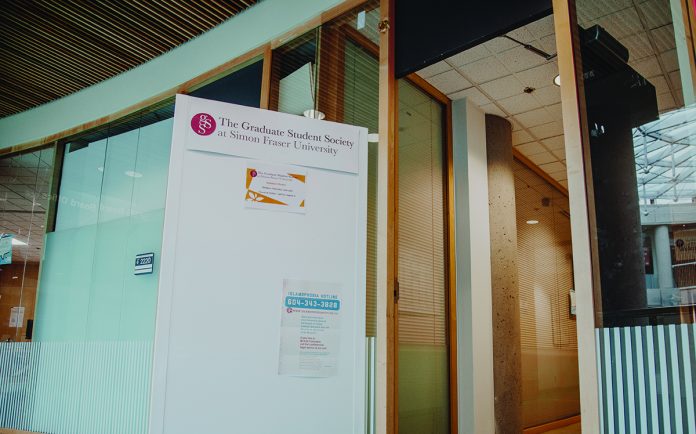
The GSS was officially made independent following a student-wide referendum in 2007.

The SFU Graduate Student Society (GSS) is marking 10 years since it became independent from the Simon Fraser Student Society and began to offer services geared towards master’s and PhD students at the university.

“During those 10 years, we grew a lot as a society and were able to implement very successful programs, and innovative approaches in how we deal with graduate students,” said Camila Miranda, GSS director of student life.

“It really shows where we started to where we are now, all the progress that we made with the programs that we have and the services that we offer.”

The GSS currently represents around 4,500 students in 38 different academic programs on the three campuses.

The society was formed following a student-wide referendum in 2007 that ushered in a vote resoundingly in favour of the creation of an independent society to represent graduate students.

At the time, The Peak reported that campaigners felt that graduate student interests were being overlooked by the student society, which was dominated by a much higher number of undergraduate students.

Miranda emphasised that graduate students require their own student society because their interests differ from those of undergraduate students, particularly in terms of family and work commitments.

“The needs of graduate students, they are somewhat different from undergraduate students,” said Miranda. “Most of the graduate students, they have families to support or they work full time. The amount of time they spend in university is different than undergrad students. Just for that reason, they need a different type of support.”

The GSS currently offers some unique services such as funds for students who have financial emergencies, a family subsidy grant for students with children, and professional development grants for students who present at conferences, according to Miranda.

“Many graduate students work at the university as sessional instructors, or TAs, or TMs so they have a different type of relationship — which is a professional relationship — with undergraduate students,” she added. “We think it is really important for some services to be specific for graduate students so we can maintain this professional relationship.”

Some of the services that the GSS provides are similar to that of the SFSS, such as a health and dental plan. However, while the purpose of some of the services are the same, the focus is a bit different, Miranda clarified.

The GSS is looking ahead to what the coming years have in store for the students and the society. According to Miranda, the society is intending to focus on engaging with members, expanding its services, collaborating with alumni, and implementing sustainability initiatives.

In the works is a graduate orientation in the fall to get more students involved in their caucuses, she said.

The GSS is also trying to identify where there are gaps in services at the university and how to address them.

In addition, there are upcoming initiatives organized between the society and the SFU Alumni Association, Miranda explained.

The society held a sold-out event earlier this month to mark its 10-year anniversary.

SFU opens up international mechatronics certification to local engineers

0
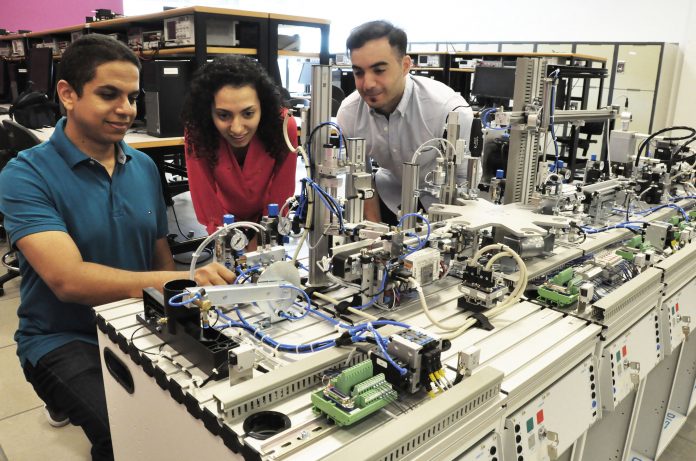
Instructor Amr Marzouk shows industrial training equipment to SFU mechatronics students and program participants Anahita Mahmoodi and Mouataz Kaddoura.

An internationally recognized mechatronics program from a high-tech company will be opened up to local students and professionals in the province when SFU launches its first session at the Surrey campus next month.

Simon Fraser University is one of three universities in the country, in addition to other polytechnics and colleges, to partner with the automation giant Siemens Canada and offer a certification on the equipment currently used by engineers in the industry.

It is the first university nationally to open up the program to industry professionals and other qualified members of the public.

“We are looking into expanding it because the demand is huge,” said Amr Marzouk, a professor in mechatronics and director of the program. “The program right now is full and we have a very long waiting list too.”

Another BC institution, Kwantlen Polytechnic University, also partnered with Siemens last year with the intent to host the program.

It will be taught by engineering instructors and focus on technical training around the systems used by employers.

“The program is hands-on [and] much more than theoretical,” explained Marzouk. “It is all training on state-of-the-art training equipment that we purchased from industry leaders.”

The field of mechatronics involves mechanical, electrical, and computer engineering in the creation of new technologies and manufacturing equipment.

The university also received a grant of a Siemens-made automation software, used by engineers at NASA to land the Mars rover, which will now be available to students in classrooms across the faculty of applied sciences.

“We have that software in mechatronics and all of SFU mechatronics can use it,” Marzouk noted.

Marzouk said that the decision to offer this new type of training at SFU came at the recommendation of the school’s own alumni who have gone on to work in fields such as automotives and biomedical engineering and attended similar training in their professional careers.

In preparation for the inaugural launch of the program this August, SFU instructors received training at the Siemens academy in Germany and are now poised to teach the skills necessary to get ahead in the industry.

“This program will help our students when they go [into the] industry; they’ll be starting as productive employees,” Mazouk said.

However, he noted that this will not have an affect on the way that mechatronics is taught at SFU, because this program is an extracurricular offering.

“It’s not going to change the curriculum: this is mainly hands-on training,” he explained. “It will supplement what we are already doing, but it will definitely help bridge the gap between academia and industry.”

Though the partnership with Siemens has been in the works over the past year, SFU only made a public announcement about the program earlier this month.