Home Blog Page 681

Spider-Man: Homecoming hits home run

0
(Image courtesy of Sony Pictures)

Spider-Man: Homecoming, the first joint Spider-Man film between Marvel and Sony, is the latest entry in the ever-growing Marvel Cinematic Universe (MCU). Despite being the sixth live-action reimagining of the web crawler in fifteen years, Homecoming manages to successfully separate itself from its predecessors.

     The film takes place a few months after Captain America: Civil War and follows Peter Parker (Tom Holland) and his desire to take part in another Avengers-level mission, leading him to Adrian Toomes, the Vulture (Michael Keaton). Rounding out the diverse cast are Peter’s best friend Ned (Jacob Batalon), love interest Liz (Laura Harrier), classmate Michelle (Zendaya), as well as Aunt May and Tony Stark who are once again played by Marisa Tomei and Robert Downey Jr., respectively.

     Marvel films have generally taken a particular film genre and mashed it together with comic book superheroes. Captain America was a war film plus superheroes, Winter Soldier was a spy thriller plus superheroes, and Thor was arguably a romantic comedy plus superheroes. Homecoming is no different, taking the superhero genre to high school.

     Peter’s high school life takes more of the focus than in previous Spider-Man films, which is great because this time he looks believably like a teenager instead of a guy in his late twenties. This helps to characterize the Peter Parker half of the dual identity, both humanizing him and establishing how he is different from the other heavy hitters of the MCU.

     Holland’s Spider-Man is able to bring a lightness to the character, as well as a sense of star-struck idealism left over from having literally met his heroes. The film also, like Civil War, suggests that Peter has been fighting crime for a bit of time already, giving him a bit of distance from the unspecified trauma of his early days and allowing him to really have fun with his powers. Homecoming is not so much an origin story as much as it is an introduction.

     The film also does a good job of making Vulture a legitimate threat. In other appearances of the character, he is generally depicted as an angry old man who is really into birds: essentially Mr. Burns with a bunch of pigeons and a wing suit. Keaton, while no spring chicken himself, conveys severity and determination in his Vulture. Keaton’s Vulture also strives for relatively simpler goals, making the scale of the film more personal than the grand or sweeping plans of most MCU villains, and also makes him the perfect bad guy for this Spider-Man’s first solo film.

     One of the factors that sunk Spider-Man 3 in 2007 was villain overload via their decision to include Sandman, Venom, and New Goblin. 2014’s The Amazing Spider-Man 2 repeats the same mistake of its predecessor by trying to force Goblin and Electro to share the villain spotlight. Homecoming wisely avoids this by having Vulture be the core villain. While other familiar bad guys do show up, they’re more like henchmen for now, giving Vulture plenty of space to spread his wings.

     With strong performances, a believable main character, and youthful energy, Spider-Man: Homecoming is a fun film with a lot of heart, whether you’re measuring it as part of the MCU or up against one of the many Spider-Man films that came before.

A sequel has already been scheduled for July 2019.

Actors with disabilities should be allowed to tell their own stories

0

Historically, there have always been issues with how certain groups have or have not been represented in pop culture. This doesn’t just affect characters; it affects casting. Recently, such controversy was stirred up in response to a 2016 low-budget indie film, Blind, where Alec Baldwin is cast as a novelist who lost his sight.

Although Baldwin is a terrific actor, there is one glaring issue with casting him in this role. He is not blind! This fact incensed the Ruderman Family Foundation, a prominent disability activist organization, in particular, who referred to it as “treating disability as a costume,” among other things.

Able-bodied actors playing disabled characters should be more of a scandal than it currently is. But it isn’t, because it it happens all the time. This is not something of which to be proud.

Rarely does the film industry grant communities the right to self-representation if they can get away with not doing so, and the disabled community is no exception. We need to recognize this trend and start fighting for actors with disabilities to have a better shot at representing their own lives and experiences in film.

Consider the old hit TV show Glee. It focuses a lot of energy on including and representing various demographics, especially the LGBTQ+ community, which is honestly great. But when they cast wheelchair-bound Artie Abrams, they chose able-bodied Kevin McHale to portray the role of the main character with disabilities.

Glee would never have considered casting a man as Rachel Berry, the show’s female protagonist — or a white actress in blackface as Mercedes Jones, a black woman who has a serious set of pipes on her and can sing like nobody’s business. There’s a reason we left the ban on women portraying women in the Shakespearean age, and refuse to accept blackface as an acceptable way to portray black characters.

It really is disappointing that roles such as Artie’s are still being awarded to able-bodied actors, when there are plenty of disabled actors who could play those roles true-to-life.

Things are slowly changing as more and more disabled actors claim opportunities to represent their own community. Breaking Bad star, RJ Mitte, has cerebral palsy and brilliantly plays Walter White Jr., son of the show’s main character, with whom he shares the condition.

Switched at Birth did a fantastic job. The show focuses on the story of two young girls who find out in their early teens that they were in fact switched at birth. The viewers get a glimpse into the deaf community as one of the girls, Daphne, is deaf. All the deaf characters on the show are played by deaf actors, and famed actress Marlee Matlin makes occasional appearances. Matlin is the “youngest person to win an Academy Award for best performance in a leading role, despite the disadvantages of being deaf,” according to Balder and Dash.

With such great examples, it’s hard for Hollywood to deny that disabled roles should be given to the many talented disabled actors who wish to represent their community. Despite claims that big names are needed for films and TV shows to take off, or that directors are casting purely on acting ability, it is undeniable that the necessary talent can easily be drawn from the communities whose stories one is trying to tell.

Women should be represented by women, people of colour have the right to be represented by people of colour, and people with disabilities have the right to be represented onscreen by people with disabilities. It really is that simple.

Best of SFU

0

Compiled by Courtney Miller, Jessica Pickering, and Natasha Tar


For those of you who don’t know, we here at The Peak ran a survey that gave you, the students, a chance to vote on the best things about SFU. Below are the most popular answers to those questions along with some answers that really stood out.


Best campus resource?

  1. Women’s Centre

  2. Student Central
  3. The Learning Commons
    Standout answer: Indigenous Student Centre


Best place to have sex?

  1. Off campus
  2. The avocado
  3. The AQ
    Standout answer: “Everywhere. The SFSS fucks us everywhere, all the time”


Best sports team?

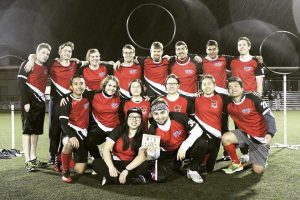
  1. Quidditch

  2. Women’s Basketball
  3. Men’s Basketball
    Standout answer: “Who has time for exercise”


Best nap spot?

  1. Library
  2. Women’s Centre
  3. In class
    Standout answer: On the bus


Best study spot?

  1. The library
  2. The AQ
  3. A department common room
    Standout answer: Women’s Centre


Best on-campus date spot?

  1. TIE: the AQ reflecting pool and the Highland Pub 🙁
    3. Club Ilia
    Standout answer: The observatory


Best coffee shop?

  1. Starbucks

  2. Renaissance Coffee
  3. Tim Hortons
    Standout answer: Higher Grounds


Best Instagram view?

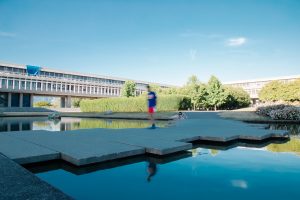
  1. The AQ reflecting pool

  2. Other areas of the AQ
  3. West Mall Centre
    Standout answer: Roof of the Rotunda


Best cheap lunch?

  1. Tim Hortons
  2. Mackenzie Café
  3. Veggie Lunch
    Standout answer: Poké


Best club?

  1. SFU Choir
  2. Anime Club
  3. Greek Life
    Standout answer: Club Ilia


Best chair?


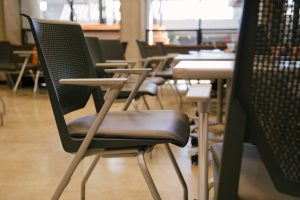
  1. Grey chairs in the Burnaby campus library
  2. Office chairs
  3. Highland Pub chairs
    Standout answer: All the people that were confused by this question


Best course for easy credit?


  1. Education 100
  2. TIE: Physics 190 and Mathematics 101
    Standout answer: History 115


Best SFSS service?


  1. U-Pass
  2. Food and beverage services
  3. Health and Dental Plan
    Standout answer: The Peak. [Editor’s note: We are an independent society, not an SFSS service, but thanks for the love.]


Best-dressed professor?


  1. Jody Baker

  2. TIE: George Arthur Alder, Michael Everton, and Endre Begby.
    Standout answer: “O BEBBI – C. BURGESS IN THE SUMMER MMM YEAH THOSE CHEST HAIRS MMM SO GOOOD”


Best bathroom?


  1. AQ upper floors
  2. AQ main floor
  3. Harbour Centre
    Standout answer: “Anything that’s been renovated in the last year”


Best weird bookstore purchase?


  1. Doctor Who snow globe
  2. Wool fox pillow
  3. Wool birdhouse pumpkin cottage
    Standout answer: “Regret”


Best lecture hall?


  1. Images Theatre
  2. The AQ
  3. Saywell Hall
    Standout answer: SUR 2600


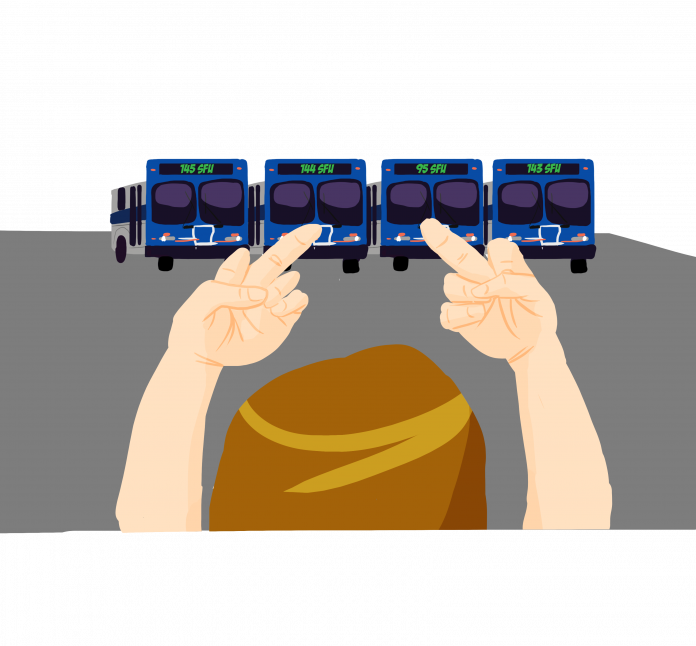
Best bus?


  1. 95 B-Line
  2. 145
  3. 135 #rip
    Standout answer: 144


Best SFU conspiracy?


  1. SFU was designed by a prison architect
  2. The avocado
  3. The SFSS
    Standout answer: “ANDREW PETTER IS CURSED AND CAN’T LEAVE THE MOUNTAIN HE WORKS HERE HE LIVES HERE WAKE UP SHEEPLE (the curse can only be broken by gondola)”


Best place to smoke?


  1. Rooftops
  2. TIE: the Highland Pub patio and the balcony of Convocation Mall
    Standout answer: “Maybe don’t?”


Best student politician?


  1. Larissa Chen
  2. TIE: Enoch Weng and Matthew Fong
    Standout answer: “Deepak Sharma – dude went all out for the lols”


Best SFU alum?


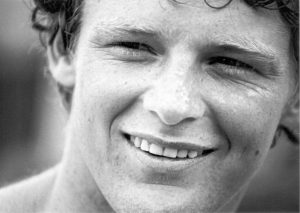
  1. Terry Fox

  2. Bill Nye
  3. TIE: Margaret Trudeau and Shad
    Standout answer: “Me”


Best parking spot?


  1. Off campus
  2. TIE: West Mall Centre and below Convocation Mall
    Standout answer: “Literally wherever you can find a spot”


“Best of SFU” we forgot


Best SFSS scandal?

You decide!


Best closure?

Highland Pub


Best SFU drinking spot?

The AQ reflecting pool after midnight


Best dog?

The political science advisor’s dogs


Best spot for Wi-Fi?

Literally nowhere


Most inspiring professor?

Shayna Plaut, SFU International Studies

SFU professor leads research on sexual health for people with HIV

0

A Simon Fraser University health sciences professor, at the leading edge of global research on the sexual health of people affected by the human immunodeficiency virus (HIV), has secured substantial funding to continue her work.

Epidemiologist Angela Kaida, whose research spans three countries across the globe, was recently renamed the Canada Research Chair in HIV and sexual and reproductive health.

“I’m looking to . . . expand my global research program and mov[e] into investigation, looking further into intervention,” said Kaida about embarking on her second phase as chair.

For chairs in the second tier, such as Kaida, the federal government grants the university $100,000 annually for the duration of the five-year term. Kaida’s work is built around achieving the global targets for HIV and acquired immune deficiency syndrome (AIDS) eradication.

The United Nations body responsible for addressing the HIV/AIDS virus, UNAIDS, has initiated an ambitious goal for the global community to end AIDS by 2030.

By the end of the decade, the goal is that 90% of all people with HIV will know their status and will be receiving antiretroviral therapy, while 90% of those receiving antiretroviral therapy will have a suppressed concentration of the virus.

“If we achieve these targets . . . the modelling science tells us that we will end AIDS by 2030,” explained Kaida.

Today, a person who is living with HIV and receiving proper treatment can attain an undetectable level of the HIV virus.  

“So when a person has an undetectable viral load, the emergent science tells us that there is no risk of transmitting HIV to an uninfected partner, even when condoms are not used during sex,” explained Kaida. “That has incredible implications for the sex lives for the people living with HIV, but it also has incredible implications for people living with HIV who want to become pregnant.”

Kaida’s work in Uganda, one of the three global settings where she is conducting her research, explores how people make decisions around pregnancy and the types of strategies used by men and women who are infected by HIV.

“Our research in that context . . . is now expanding into trying to understand how do we increase uptake of this service and to document how do you successfully implement a safer conception program,” said Kaida. “What are the pregnancy outcomes for people accessing this care [and] how can safer conception programming contribute to larger global goals around reducing ongoing transmission of HIV.”

Her other area of research is focused on young people in South Africa and in particular, young women. Over a quarter of all new infections in South Africa are among young people, especially those between 16 and 24 years of age.

“When we look more closely at that group, we can see that young women in particular have over three times the risk of acquiring HIV compared to young men in that same age group,” she said.

According to Kaida, the younger women don’t take the same precautions, such as pre-exposure prophylaxis, at the same rate as older women. Therefore, her work in South Africa is trying to understand how to implement HIV prevention strategies for young women, by understanding their daily experiences and what power they have over their sexual well-being.

“So in the second phase of my chair, [I aim] to work with young people to develop intervention and implementation strategies to improve young women’s uptake of HIV prevention strategies,” said Kaida

Her third area of focus is based in Canada where she is a principal investigator of a study called Canadian HIV Women’s Sexual and Reproductive Health Cohort. The research methods and interpretations are all done in collaboration with the leadership of women living with HIV in Canada.

“The overarching goal of that research program is around ensuring that we are asking research questions that are of highest priority of women living with HIV in Canada, and ensuring that the research that we do is translatable — so we can translate those findings into policy and programming change to improve the health [and] well-being of women living with HIV in Canada,” said Kaida.

“And one of the really urgent area of research focus for us is related to the criminalization of HIV non-disclosure in Canada,” she said.

The research is trying to untangle what women living with HIV know about criminalization laws in Canada and their experience having their sexual lives, sexual choices, and health-care engagement under the surveillance of law.

Prey (2017) is an excellent addition to the immersive sim genre

0
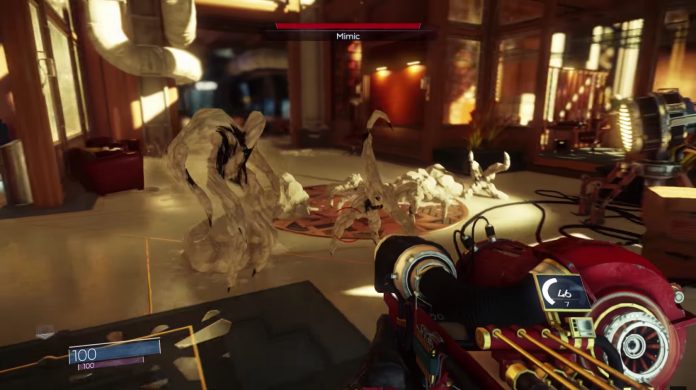
Weapons like the GLOO Cannon are useful for combat and creative problem solving. (Image courtesy of Arkane Studios)

Prey (2017) by Arkane Studios takes place on a space station in an alternate future . . . and is the only game that has made anyone afraid of coffee cups.

     The player takes control of Morgan Yu, a man or woman born into a world where JFK survived the attempt on his life and then doubled down on the space program. Morgan works aboard Talos I, a space station focused on the research and creation of neuromods, devices which inject knowledge and abilities into the user. The space station is invaded by aliens, as often happens.

     An immersive sim is a game which presents a believable, detailed environment and allows the player different avenues to creatively complete objectives. Other games in this genre include the Bioshock and Dishonored game franchises, the latter of which was also made by Arkane Studios.

     This allowance for creative problem solving is one of the strengths of the game. For example, a number of doorways have been hastily barricaded with furniture, requiring a skill to be upgraded to a certain level before Morgan can pick apart the pieces and reach the sweet loot on the other side. Alternatively, Morgan could simply throw other pieces of furniture at the barricade until enough pieces fall over. Or, of course, use one of the game’s recycler grenades to clear the way by breaking down the barricade into resource cubes of useful material.

     Like many recent games, Prey allows the player to craft things out of other things. Unlike other games, however, the crafting isn’t stupidly convoluted. While some other games might task the player with skinning seven sharks to make a wallet and 12 lions to make a slightly bigger wallet, this game streamlines it by having everything made up of four material elements. Everything can be made by various amounts of the four materials and everything that isn’t nailed down can be reduced to various amounts of the precious, precious cubes. It is super satisfying. As a result, Morgan is encouraged to pick up everything they can carry, effectively sweeping everything off a desk and into their pockets. This is where the aliens come in.

     The aliens, known as the Typhon, look to be made of shimmering tendrils of shadow. The aliens come in various sizes and shapes, as well as possessing different abilities. The most notable of these, and the first Morgan will encounter, is the dog-sized crablike Mimic. Their main ability is to disguise themselves by mimicking a nearby object in the room (such as a coffee cup). Their other ability is to screech and jump on your face when you get too close because you didn’t know they turned into a coffee cup.

     The game is also pointedly diverse. The station is staffed with a multicultural crew (Morgan is shown to be born to German and Chinese parents) with a notable number of racial and sexual minorities. More importantly, none of the minority characters are caricatured, and each of the 268 crew members are named and given at least some backstory regarding their life on the station.

     The game manages to balance resource scarcity while still letting you solve problems the way you want to, resulting in a very satisfying overall experience. This is slightly marred by the unfortunate loading times between segments of the station, but the art deco style of Talos I is rather pretty, so you might find yourself taking time to enjoy the large brassy and wood-paneled rooms as you go. Nevertheless, Prey is a game with great gameplay, story, and representation, as well as a worrying number of coffee cups.


The Switch is a show that tells the stories of transgender people through humour

1
It is one of the few shows both filmed and set in Vancouver.

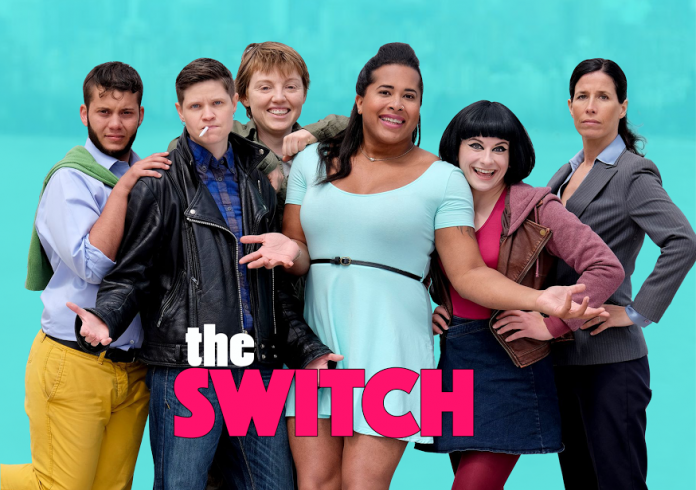
Created by Amy Fox of Trembling Void Studios and Elizabeth Marston, The Switch is a show that seeks to represent transgender people in a way that isn’t shallow. Rather than appear as a convenient moral lesson in a show, as Fox put it, The Switch seeks to show transgender people as simply part of “the breadth of humanity,” partly because it is unjust to erase their stories, but also because seeing only a narrow slice of humanity in TV is boring.

We sat down with Amy Fox to talk about the creative process.

The Peak: What is the basic premise of The Switch?

Amy Fox: Well, there’s a couple ways of answering that. One is that it’s about Sü, who leaves Trump’s America to come to Canada to work as an IT programmer and then comes out as trans and then 24 hours later winds up unemployed and sleeping on the couch of her ex who is an adorable eco-terrorist played by myself.

…Another way of looking at it is [that] it’s a contemporary millennial sitcom. It’s about people growing up in a wired world with unstable jobs, unstable housing, and unstable lives, but finding community and hope through that.

P: What motivated you to make the show?

AF: Initially we had a comedy routine about transgender issues created by and performed by trans people and we were suddenly living in different cities and going “ah, what do we do with this?” We decided we’d just make a web series. Now, neither of us had actually used a camera or written a script or acted before, so we figured that couldn’t be too hard. Anyway, seven years later and a web series became a TV pilot [which] became a TV series; six parts, shot and set in Vancouver.

Along the way we also wanted to make something that was featuring transgender stories, real ones (except for the parts we made up)… ones that you don’t see in the mainstream media, also with transgender actors in it, ones that would be fun and uplifting and hopeful all at the same time… and funny.

P: Apart from the humour in the show, what messages would you like to send to casting directors throughout the industry?

AF: It is much easier than people think to cast a show with multiple trans leads. A lot of the time when casting producers are making a show with an underrepresented, marginalized group they’ll go and fumble around for a week or two and come back and say, “Hey, we couldn’t find anybody!” and then cast someone who [isn’t from that group]…  They say, “Oh, we just couldn’t find anyone” or “these actors don’t exist.” That happened with the Dallas Buyers Club [sic], the director is on CBC saying [something similar to] ‘there aren’t any trans actors.’

We had a pretty minimal budget and five of our lead actors are trans, and three of them are from Vancouver. So they’re definitely out there and they’re very good actors; [they’re] representing the range of humanity.

If you’re trying to find trans actors or any other underrepresented actor group, what you have to do is, [speak] to the casting directors for a minute: you gotta think about how to look for people, people who don’t have agents who are checking on their behalf on casting director sites everyday. Put it out on Facebook, put it out on Craigslist, make sure if you are putting it on [casting] sites that it isn’t locked down only for people with agents. Understand that people have day jobs and that they can’t just go get coaching a drop a tape on your desk the next day…

P: The show is funny, of course, but we see that the show begins with Sü being fired for being transgender; how deep will the show delve into heavier issues such as discrimination and hate crimes against transgender people?

AF: Well, episode one talks about immigrating while trans and looking for housing while trans, and discrimination against trans people because we’re perceived to be sex workers. [It also talks about] gentrification, and suicidal feelings and people being afraid of moving somewhere because they’re afraid they’re going to get hate crime-d to death. But if they stay somewhere, they’re going to wind up homeless because that area that they are living in is being gentrified. That’s episode one.

We deal with a lot of heavy stuff, but it’s a very lighthearted show. It’s defiantly hopeful. And, over the course of the season, we [touch on] looking for employment while trans, bullying in schools, dealing with… job harassment, trans people in sports, trans people in cis-centric women’s spaces, dating while trans, and the medical system.

P: What are the main takeaways that you hope a given audience might get from the show?

AF: That it’s funny. That’s our primary goal, to make something that’s entertaining and is about stories that you’re not seeing a lot. It’s good, it’s fun entertainment. Go and check us out on Amazon or iTunes or Google Play, Vimeo, Revry or YouTube, Red: everything’s launching on August 15. It is there and I think you’re really going to like it.

P: What would be one word of advice you would give to a SFU student who wanted to get involved in making film or TV?

AF: SFU, Capilano, [and] Langara all offer great film programs: go study there . . . or don’t! You can also go to film sets and work, starting for free, which is cheaper than paying someone to teach you [filmmaking]… after that, you can start making a bit of a living…

P: Is there anything else you want to add?

AF: Go SFU! I went to SFU for, probably a little too long, picked up a bunch of degrees in unrelated subjects and I have used everything I have learned.

—

Season two of The Switch is already in the works. Once the show reaches 100,000 downloads, Trembling Void will have the funds necessary to proceed with creating their next season, which is likely to be longer than six episodes. Much of it has already been planned, so make sure to be on the lookout for more of this new sitcom. Until it launches on other platforms, you can watch it here.

Worst of SFU

1


For those of you who don’t know, The Peak is running a feature this week made up of answers from actual students from a survey about what the “best of SFU” is. But this is the humour section. So, below is some random bullshit that I made up about the worst of SFU.

 
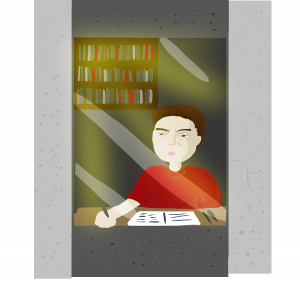
Worst study spot?

1. Any window table that faces the sun in the library

I do NOT wear my sunglasses at night, or indoors. So, SFU, what am I supposed to do if I’ve got the entire sun pressing its tits against these windows when I’m trying to memorize some irrelevant garbage for some irrelevant course that I’m not interested in, but required to take for my irrelevant degree? Give up. That’s what. This is your fault, SFU.


2. The concrete blocks under Images Theatre.

SFU, do you understand the concept of seats? Or is this stupid shit part of your brutalist aesthetic, too? You’ve succeeded greatly, if so — these benches are super brutalist on my poor ass.

3. Outside, anywhere.

You thought that this was going to be cute at first — but now you’re freezing and your papers have blown everywhere. You’ve lost lectures worth of material, but at least you can post that adorable pre-havoc spread shot of your studying spot on Instagram.


Worst place to have sex?

1. Everywhere, ya nasty.

This rainy campus shouldn’t have the power to make you wet — only damp. And
nothing is sexy about damp. Socks get fucking damp when the April showers begin (and continue into July in Vancouver, apparently) and your feet always smell like rotten swamp farts when they’re damp. Go home and wash your feet, girl; fuck with some clean socks on instead.


Worst scenic spot?

1. The AQ reflecting pool.
Let me ask, who takes care of the koi fish at SFU? You, sir, are not doing your job; those koi fish are absolutely rachet. They’re covered in green muck and the piss of drunk students, and that beauty routine isn’t getting them far. Get those girls a shea butter mask or something — damn.  


Worst bus?


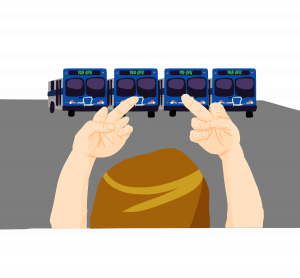
1. All of them.

Special shout-out to the 95 B-Line though — why the fuck don’t you stop at the mini stops in between the two main stops at SFU? Do I
really have to transfer? Pull over and pick me up, God damn it! It’s dehumanizing to transfer after a
three-second-long bus ride.

Worst lecture hall?

1. Anything in the South East Classroom Block.

Where the fuck am I, 
and how do I get back to campus?

2. Those tiny lecture halls in the AQ.

This is too intimate. If I farted in here, the whole class would experience the burrito I had for lunch today.

Worst bookstore purchase?

1.  Definitely the books.

Buy your textbooks secondhand, online from a foreign country, or pirate them like the rest of us, you silly first-year dunce.
 
Worst SFU parking spot?

1. Trick question.

There is no such thing as a good SFU parking spot, unless you have a kink for awkwardly speed walking a really far distance to your class on the other side of campus when you’re already 30 minutes late even though you showed up 30 minutes early to find a parking spot since this happened last time and you thought you could properly anticipate it, but you were totally wrong and you missed the quiz again and your professor probably thinks you’re a slacker and even though you are, you weren’t this time, but it’s not like you’re going to explain how awful the parking was to your prof because you’re a slacker and it’s not like you care enough. I won’t kink shame, but friend, you’ve got some very specific taste.


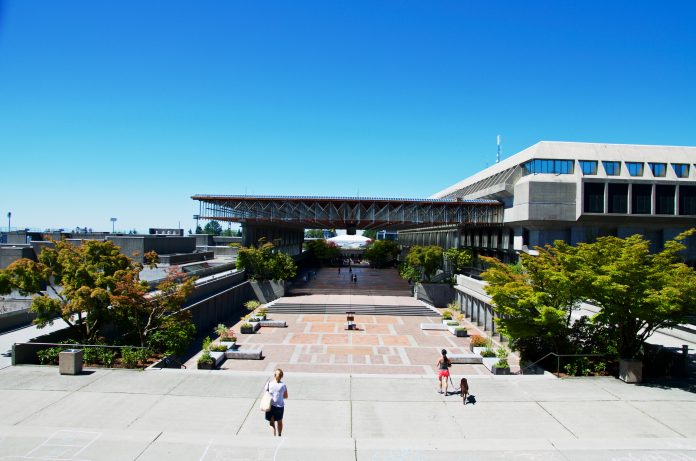
SFU architect myth false, but only technically

0

Although it is true that SFU architect Arthur Erickson did design prisons, the prisons that he designed were not the typical prisons that one might commonly associate with the word. He did not design the prisons in which Jeremy, a 19 year-old male arrested for marijuana possession, shares a cell with Ratchet — a three-time convicted murderer. No, as SFU administration loves to point out, Arthur Erickson never designed one of these prisons.

Instead, he designed what Erickson himself preferred to call “Prisons of the Mind.”

Psychiatric hospitals, mental Institutions, insane asylums, and “Prisons of the Mind” were burgeoning in popularity in the mid-20th century. Arthur Erickson, a renowned brutalist architect was often called upon to design these masterpieces of human achievement. His goal in designing a prison of the mind was not only to physically contain patients, but also to use a style that instantly and unavoidably reminded its residents of their physical containment. He wanted to use a style that trapped and controlled the mind just as much as it did the body.

When the founders of SFU were deciding on whom to choose to design the Burnaby campus, they thought that the qualities present in the works of Arthur Erickson were exactly what was needed for an institution of higher education. The minds of students just coming out of high school are often filled with creativity, dreams of a better world, making a difference, and thinking outside the box. Although SFU founders claim to support those values, they also believe them to be byproducts of what they call “the naiveté of youth.” As SFU was intended to be an institution of higher education, it was agreed that such naive thoughts must be kept under control. The brutalist architectural style of Arthur Erickson seemed to be the perfect fit.

In recent years, SFU administration has been trying to veer away from the founders’ image of an incredibly brutalist university. With the construction of the Saywell and Blusson halls, SFU admins are attempting to form a new aesthetic for the university. Rather than keeping the soul-sucking aesthetic of insane asylums of the ‘60s, they hope to move closer to the aesthetic of a friendly old folk’s home. With lots of exposed wood and a beautiful outdoor garden and a pond, the newer buildings on campus allow students to feel at least a little more at ease, while also acting as a constant reminder of their inevitable fate.

SFU undergraduates team up to fundraise for wildfire relief

0
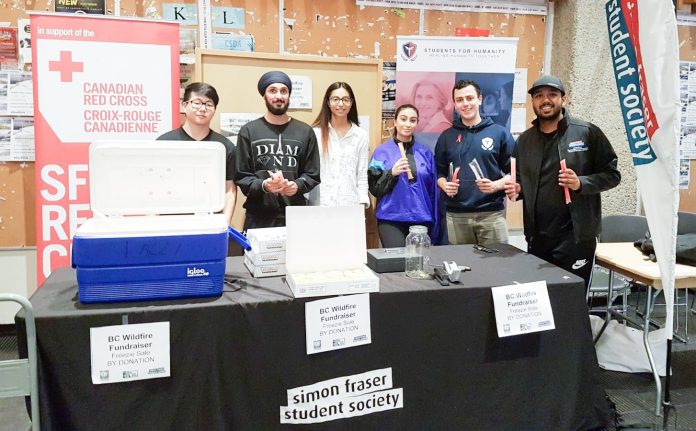
Members of the SFSS, the SFU Red Cross club, and UNICEF SFU offered up freezies to students in exchange for donations.

The Simon Fraser Student Society (SFSS) and student-run humanitarian clubs kicked off a fundraiser earlier this month in support of the thousands of people forced from their homes by raging wildfires in the interior.

The society, along with the SFU Red Cross Club and UNICEF SFU, is aiming to raise $5,000 in support of the wildfire relief fund by the Canadian Red Cross. Between a donation table set up on campus July 17–21 and an online donation portal, as of last week the organizers were still working toward their goal.

The president of the SFU Red Cross, Cheryl Hsia, said the fundraising has “gone well, better than I expected it to, just because it was very short notice.”  

The team has exceeded $1,500 in donations, according to Hsia.

Throughout the summer, the BC interior has been ravaged by dozens of forest fires and, as of last week, tens of thousands of residents were still unable to return home.

Hsia said she has witnessed an increased response amongst SFU students to the fundraising initiative, which she attributes to how close the crisis is to home, the ongoing press coverage of the events, and the number of SFU students who come from the province’s interior.

She mentioned that while they were selling freezies by donation, she was “quite delighted to see how many people were willing to drop in a $20 [bill] without taking anything.”  

The club had hoped to raise $1,000 a day over the five-day span they spent collecting in-person donations, but ended up around $1,400.

Hsia admitted the goal was ambitious, saying that it is “hard to do in person, with students.”

The SFSS vice-president of student services, Jimmy Dhesa, noted that the idea to fundraise was originally raised by society staff and the student board jumped at the idea.

“It was something that everyone agreed to right away and [we] thought [the] Red Cross [Club] was initially the right group to approach and then expand further,” explained Dhesa. “Red Cross was the one group that everyone knew that was already providing relief.”

Hsia stated that it was an initiative that was put together on very short notice.

“It was very quick. With the wildfires happening right now, we did want to raise funds quite quickly,” she said.

Dhesa also noted that the SFSS reached out to the university administration, who were eager to help. “They said that they would distribute the donation link and tell people, their colleagues and staff, to consider donating if they were able to,” he said.  

Hsia commented that the member overlap and close ties between the club and UNICEF SFU meant that it “seemed like a natural thing” to bring both clubs under the SFSS on board with the initiative.

The SFU Red Cross raises funds for a number of humanitarian efforts, assisted by having liaisons within the Canadian Red Cross.

“The work that a lot of these clubs do is tremendous,” said Dhesa. “They end up raising a lot of funds, and it just goes unnoticed.”

“They don’t do it to get appreciation for it, they do it because it’s in the goodness of their heart, they believe it’s the right thing to do, and they’re passionate about it.”

Hsia said that the door is not closed on further fundraising, but the club’s executive team has yet to decide on whether or not to continue live fundraising. They’d like to raise more funds, especially with the wildfires still ongoing. In the meantime, there is still an online donations page.

SFU library unrolls free access for local non-profits

0
Researchers who are not tied to a university can find it very expensive to access information.

Although scholarly research is readily available to students and professors, it remains highly inaccessible to anyone outside the university. A new program launched through the SFU library intends to change this.

The Community Scholars Program, offered in partnership with the United Way of the Lower Mainland and the Mindset Social Innovation Foundation, will give 500 individuals from non-profit organizations from across British Columbia access to the scholarly publications by six publishers as well as research support from the library.

Librarian Heather De Forest, who is coordinating the program, notes that many of these non-profits are doing their own research in the community and the program will help to strengthen that research.

She said that a single journal article can cost around $35.

“Participants have told us that without this program, they are not able to pay for the articles that they need,” she said. “It’s simply not affordable, so they are shut out.”

A successful pilot program was offered from January to December 2016, where 100 participants had access to the materials of two publishers. There has been interest and engagement from both high profile and local organizations, with many offering to support each other in finding and using research.

De Forest said she is excited for the expansion, which will offer SFU a chance to build deeper connections with the community.

Starting in September, the program, which is currently taking applications, will help non-profits that are engaged in work on various social and environmental issues, as well as those doing legal and human rights work and those working on projects in arts and culture.

In addition to access to scholarly publications online through a portal similar to the one students access, participants will have access to physical resources at the library, and consultations with a librarian.

The program also offers workshops, events, and journal clubs for participants if they are interested. However, De Forest says there are no expectations of participation in workshops, as they recognize “that our participants are very busy, and this program is meant to make things easier, not to add to their burden.”

Although she is unaware of any similar programs at other universities, De Forest says there are many initiatives to make scholarly research more accessible, such as UBC’s Downtown Eastside Learning Exchange, which make scholarly research and educational programming more accessible to Downtown Eastside residents.

She also noted that those without a university affiliation wishing to do academic research can access the majority of the SFU library’s collections on-site as a guest.

The current phase of the program runs until the end of the calendar year, but De Forest said it will likely extend beyond that with agreement from stakeholders.

Thus far, over 200 non-profit and charitable organizations have registered for the program.