Home Blog Page 649

Beyond Flanders Field: poetry from the First World War

0
(Photo courtesy of LX 121)

Compiled by: Gabrielle McLaren

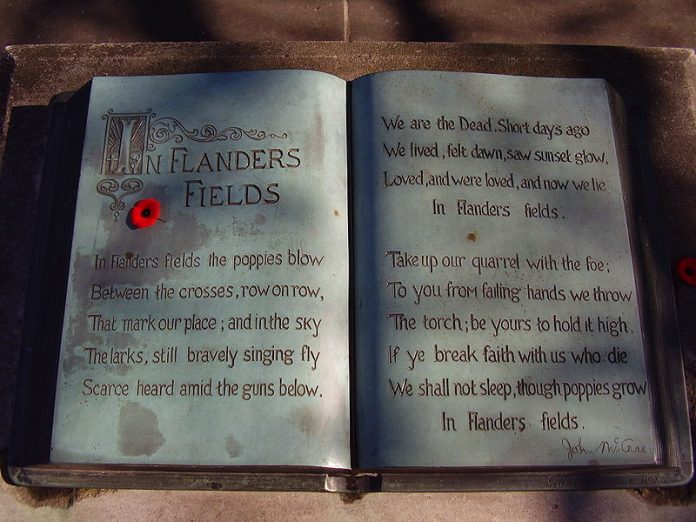
The sea of red poppies across Canada commemorating Canadian troops burst from a single poem. Though eyewitness accounts vary, Canadian medical officer John McCrae is thought to have written “In Flanders’ Field” while overlooking the field of poppies where he had recently buried his best friend. McCrae himself did not survive the First World War, but his poem continues to commemorate not just his best friend, but an entire generation of lost soldiers, the veterans who returned home from the war — and all veterans who came after his time. Poets on the home front and on battlefields commemorated and processed the trauma of the war through poetry. The following selection is incomplete, but reflects different poets and their realities.

Spring 1915

With that beautiful voice of yours

You insisted:

Will spring come again?

Will the leaves still grow?

War engulfs sky

Rivers, mountains, woods, earth.

But where does the rose rise?

Where is the brave bees’ honey?

Where do the brambles grow

The anemones bloom?

Where in the deep woods

Do Flora and Ponoma meet?

— Alas! Nothing blooms

But the fires in the sky,

Furious, threatening bouquets

Strewn across the horizon.

Alas! No more red splendours

But the mad bullets,

Splashing in great streaks over

Steeples, farms, huts and hamlets.

Everything is without joy, without pity;

The struggle spreads from plain to plain,

In great leaps of rage and hate:

This is our spring.

– Belgian poet Émile Verhaeren, on the atrocities committed on Belgian civilians

Vigil

A whole night long

crouched close

to one of our men

butchered

with his clenched

mouth

grinning at the full moon

with the congestion

of his hands

thrust right

into my silence

I’ve written

letters filled with love

I have never been

so

coupled to life

– Italian soldier, poet, and pacifist Giuseppe Ungaretti

The Soldier

If I should die, think only this of me:
  That there’s some corner of a foreign field
That is for ever England.  There shall be
  In that rich earth a richer dust concealed;
A dust whom England bore, shaped, made aware,
  Gave, once, her flowers to love, her ways to roam,
A body of England’s, breathing English air,
  Washed by the rivers, blest by suns of home.

And think, this heart, all evil shed away,
  A pulse in the eternal mind, no less
    Gives somewhere back the thoughts by England given;
Her sights and sounds; dreams happy as her day;
  And laughter, learnt of friends; and gentleness,
    In hearts at peace, under an English heaven.

– British soldier Rupert Brooke (killed in 1915)

Marching Men

Under the level winter sky

I saw a thousand Christs go by.

They sang an idle song and free

As they went up to calvary.

Careless of eye and coarse of lip,

They marched in holiest fellowship.

That heaven might heal the world, they gave

Their earth-born dreams to deck the grave.

With souls unpurged and steadfast breath

They supped the sacrament of death.

And for each one, far off, apart,

Seven swords have rent a woman’s heart.

– Canadian poet Marjorie Pickthall

Guard Duty

A star frightens the steeple cross

a horse gasps smoke

iron clanks drowsily

mists spread

fears

staring shivering

shivering

cajoling

whispering

You!

– German soldier, August Stramm (died in hand-to-hand fighting, 1915)

War

Why was I born into this age

In which mankind has exiled God?

With God departed Man, with rage,

now sits upon the throne of God.

And when man knew that God had gone,

To spill his brother’s blood he bore

His eager sword, and cast upon

Our homes the shadow of the war.

The harps to which we sang are hung

On willow boughs, and their refrain

Drowned by the anguish of the young

Whose blood is mingled with the rain.

– Welsh poet and British soldier Hedd Wyn. Six months after his death, he was awarded the prestigious bardic chair at the Welsh National Eisteddfod (an important celebration of Welsh culture). Instead of reassigning the chair to a living poet, it was draped in black cloth and remains a memorial to Wales’ lost soldiers to this day

The Last to Leave

The guns were silent, and the silent hills

had bowed their grasses to a gentle breeze

I gazed upon the vales and on the rills,

And whispered, “What of these?’ and “What of these?

These long forgotten dead with sunken graves,

Some crossless, with unwritten memories

Their only mourners are the moaning waves,

Their only minstrels are the singing trees

And thus I mused and sorrowed wistfully

I watched the place where they had scaled the height,

The height whereon they bled so bitterly

Throughout each day and through each blistered night

I sat there long, and listened – all things listened too

I heard the epics of a thousand trees,

A thousand waves I heard; and then I knew

The waves were very old, the trees were wise:

The dead would be remembered evermore-

The valiant dead that gazed upon the skies,

And slept in great battalions by the shore.

– Australian poet and soldier Leon Gellert

Perhaps (To R.A.L.)

Perhaps some day the sun will shine again,

And I shall see that still the skies are blue,

And feel once more I do not live in vain,

Although bereft of You.

Perhaps the golden meadows at my feet

Will make the sunny hours of spring seem gay,

And I shall find the white May-blossoms sweet,

Though You have passed away.

Perhaps the summer woods will shimmer bright,

And crimson roses once again be fair,

And autumn harvest fields a rich delight,

Although You are not there.

Perhaps some day I shall not shrink in pain

To see the passing of the dying year,

And listen to Christmas songs again,

Although You cannot hear.’  

But though kind Time may many joys renew,

There is one greatest joy I shall not know

Again, because my heart for loss of You

Was broken, long ago.

– British nurse and poetess Vera Brittain. The poem was dedicated to her fiancé Robert Audrey Leighton, killed by a sniper in 1915 (at the age of twenty)

My Boy Jack

“Have you news of my boy Jack?”

Not this tide.

“When d’you think that he’ll come back?”

Not with this wind blowing, and this tide.

“Has any one else had word of him?”

Not this tide.

For what is sunk will hardly swim,

Not with this wind blowing, and this tide.

“Oh, dear, what comfort can I find?”

None this tide,

Nor any tide,

Except he did not shame his kind—

Not even with that wind blowing, and that tide.

Then hold your head up all the more,

This tide,

And every tide;

Because he was the son you bore,

And gave to that wind blowing and that tide.

– English poet Rudyard Kipling. The poem was commissioned by the British Navy following a major loss. Years before, Kipling’s son was lost in combat  

Here Dead We Lie

Here dead we lie

Because we did not choose

To live and shame the land

From which we sprung.

Life, to be sure,  

Is nothing much to lose,

But young men think it is,

And we were young.

– British poet A E Housman

Board Shorts

0
Irene Lo / The Peak

Board passes bid to sell advertising space

The Simon Fraser Student Society (SFSS) has approved a deal with Rouge Media Group to sell electronic media space on campus. As part of the deal proposed by the marketing company, two vinyl murals will be installed in the Rotunda in addition to a potential charging station at the location and in an SFSS conference room in Maggie Benston Centre.

“It is a good opportunity to secure some revenue without a lot of commitment on our part,” said Chief Executive Officer Martin Wyant at the SFSS Board of Directors meeting on November 10. The SFSS will receive rental revenue for the spaces.

The SFSS does not currently have any other deal with an advertising company and the deal will also allow them to display some of their own advertisements in the spaces.

If the agreement is signed by November 15, the company has offered a $10,000 signing bonus to the student society. The projected annual revenue for the SFSS is $2,500 to $3,500 at each of the murals and $1,500 to $2,000 for the charging stations.  

In the future, it is possible to expand with more charging stations in other locations “if we think there is a good high traffic area where it would make sense,” noted Wyant.

Society approves temporarily withdrawal of money for Student Union Building

The board has approved a motion giving authorization to the Chief Executive Officer Martin Wyant and Build SFU General Manager Marc Fontaine to borrow money from the Build SFU Fund for building costs any time between November 2017 to December 2018.

Throughout the construction of the Student Union Building (SUB), the SFSS pays its monthly operating costs to the university, but the society is not able to borrow an amount less than $1 million per month according to its $44.3 million loan agreement with Scotiabank.

This occasionally requires the SFSS to borrow the amount from its internal account — the Build SFU Fund. When money is borrowed from the fund, it will be repaid within 60 days.

The Build SFU Fund is an account used by the SFSS to pay for operating costs and any unexpected costs associated with the project that may arise. The pre-authorization from the board of such payments was due to the short time-frame for payment on the invoices the society receives.

SFSS plans end-of-semester events

The SFSS approved money for a number of events on campus at the end of the semester. A carnival on November 23–24 will be taking place along the North Academic Quadrangle hallway.

SFSS has partnered with the SFU Women’s Centre, Out on Campus, Hi-Five for the event. These organizations, along with Puppy Therapy by SFU health and counselling, will offer students a break from studying, and a good way to relieve stress.

A dodgeball tournament where students can form teams will be held on December 4.

With a date sometime in the last two weeks of classes, a holiday celebration where students can take pictures with Santa and get food will be the last event hosted by the SFSS this semester.

University gains permanent ombudsperson

An update was received that Laura Reid, the current interim ombudsperson, has officially taken over the position in a permanent role. The ombudsperson office is supported by the university, the Graduate Student Society, and the SFSS which provides the office space.

How the SFU Sports Analytics Club has become a big player within the sports analytics industry

1
From the Vancouver Whitecaps to Canada Basketball, Dani Chu and the club have already made major connections. Arshika Chandranath / The Peak

Like any other industry, innovation has always been a key to success within the sports world. Whether it’s the NBA’s recent love of floor spacing (essentially wiping out the mid-range game), or Antonio Conte’s three at the back formation being adopted by soccer clubs across Europe, new tactics are always being implemented within professional sports.

While these new strategies are often a case of personnel (Golden State having two of the best three-point shooters in NBA history during their first title run; Conte having three fantastic centre-backs while managing at Juventus), their adoption by other teams points to something a lot bigger. As sports continually evolve, an emphasis on staying with and ahead of trends is arguably now more important than ever. This rapid evolution, in large part, can be tied to the ever-expanding industry that is sports analytics.

The movie Moneyball, starring Brad Pitt and Jonah Hill, was one of the first influences that put sports analytics within the mainstream eye. The truth is, however, that much of the work happens behind the scenes. It involves the collection and analysis of data within a certain sport or team, and using that data in an attempt to gain a competitive edge on other teams. Whether it’s tracking player movements or finding out certain lineups that work best together, sports analytics has something to offer every sport and athlete.

SFU statistics professors Luke Bornn and Tim Swartz were aware of this back when they started SFU’s Sports Analytics Club in 2015, and long before that. Bornn, an alumnus of the Harvard Statistics Department and Harvard’s Sports Analytics Club, wanted to create the club as a way to give students an opportunity to gain connections in the sports analytics world. It was not until the spring of 2017, however, when current undergraduate students Dani Chu, Abe Adeeb, and Lucas Wu became the presidents of the club that things really started to take off.

With no major connections with professional sports teams, and therefore few projects that the club was working on, they decided to look for something big. After successfully receiving a grant from the Canadian Statistical Science Institute, the club planned the Vancouver Sports Analytics Symposium and Hackathon (VANSASH), which was based off of the NBA Hackathon that takes place in New York City. Chu told The Peak: “We wanted a west coast sports analytics event that we could go to, and [there wasn’t one being planned] so we said, ‘why don’t we plan it ourselves?’”

The event took place this past summer, and its success is still helping the club to this day. By having this product to show, the Sports Analytics Club has been able to gain connections and projects with organizations as big as the Vancouver Whitecaps, the Vancouver Canucks, and Canada Basketball. Whether it’s helping the Whitecaps’ scouting department film games, or working on an exclusive project with Canada Basketball, these connections allow students to build relationships with major organizations.   

“We are trying to bridge the gap and give students access to the sports analytics industry,” said Chu. Doing so is important due to the intense competition that there is within the field, and barriers to entry that many face when trying to connect with professional sports teams. As Bornn told Dani, “You have to do the work first, and then you’ll get noticed later.”

The club also was a part of Canada Basketball’s first ever U19 gold medal this past summer in Cairo. As discussed by Chu, the club created a data scraper for Canada Basketball’s scouting department so that they would better be able to analyze data from the team’s box scores. After the medal, Canada Basketball’s performance analyst and database manager Phil Jevtovic sent the club a text with a picture of the gold medal saying, “U were a part of this! Thank you!”

More recently, the club submitted a project for Canada Women’s Rugby 7s under Dr. Tim Swartz and Dr. Dave Clark. The project was given to them by Ming-Chang Tsai, a performance and data scientist from the Canadian Sport Institute Pacific, who was very happy with the results.

Even with the success that they have had, the club still has major aspirations for the future. Tsai will now be moving the club to work with Canadian Women’s Soccer in the new year. They will be hosting VANSASH 2.0 in 2018, with hopes of it being “a little bit bigger and a little bit better” with “bigger projects, bigger conversion rate of people coming, and industry networking,” according to Chu. As for their projects with other organizations, Chu expects hours of work to be done over the winter break when school is no longer an issue.

This is not to be said that countless hours of work are not already being done. As Chu shows The Peak his schedule, every assignment, project, meeting, and extracurricular is in there: and the schedule is packed. While this high level of organization is an asset, he is adamant about the support team that he has (his parents, girlfriend, and friends) who “put [him] in a position where [he] can just worry about [his] work and studies” and “push [him] to be better and do more”.

As for what’s next for the club, they will be looking to deliver on projects in the next couple of months, and preparing to host their next VANSASH. On top of that, the club will be working with local high school basketball programs as the first sport analysts to work at that level in British Columbia. The club also hopes to expand their involvement with the SFU sports teams, beyond just working with SFU basketball on Peter Chow-White’s team as they have in the past.

With all this work, however, the club is looking to include more members. There is a misconception that the industry is only comprised of computer scientists, but people with communication skills and knowledge of a sport are highly sought after as well. Whether it’s coding, data scraping, organizing events, or establishing/maintaining relationships with other organizations, there are a variety of skills needed in sports analytics. With all three club presidents graduating in 2018, there is also a large need for people to step into leadership roles in the near future.

If you are interested in joining the Sports Analytics Club, you can email club co-president Dani Chu at [email protected]. State your full name, phone number, sports of interest, coding experience, coding languages, and all projects that you are interested in.

Is graduate school for you?

0


What do I need to do to apply?

If you’re thinking about grad school, the first thing to consider is the application. The application process will be different for every school, but here are some things that are important to think about before you apply:

  • Reference letters
    Along with your application, you must include a couple of reference letters. Although it can change from school to school, the typical number you need is three. Your referee must be capable of attesting to your academic abilities in great detail. The most common source of these letters are professors you have previously had, preferably ones that marked your work and/or knew you personally. When asking for a reference letter, it is always a good idea to ask early so that your referee has plenty of time to write it.
  • Grad school readiness exam
    This exam is not required for all schools (most schools in Canada do not require you take it). However, if you wish to apply to a school in the United States, it would be best to check if this is one of the requirements. This is a difficult exam. Like the Medical College Admission Test or the Law School Admission Test, it acts as an indication of your promise in grad school. If your school requires it, the mark you receive will act alongside your GPA as the first considerations when looking over your application.
  • Applying early
    Applications are often due between six months to a year in advance of your first semester. As the application itself takes time, this is not something to put off until the last minute. Start getting your application ready as soon as possible.


How is graduate school different from undergraduate?

  • Research
    One important thing to keep in mind is that grad school is about research. This is perhaps the biggest difference between the two forms of schooling. “During your undergraduate schooling, you’re primarily absorbing knowledge, but in graduate school you’re expected to create new knowledge,” explains Derek Sahota, a current PhD candidate in SFU’s physics department. Instead of having knowledge be given to you, and then being tested on your ability to absorb what you’re learning, you are responsible for adding  knowledge to your field in one form or another.  
    Regardless of the discipline, your time in grad school is mainly spent conducting research. If you’re in the sciences and social sciences, oftentimes it is in the form of experimental research. You design and run an experiment, followed by analysis and interpretation of the data. In other programs, such as the humanities and arts, research takes the form of reading, reviewing, and compiling current literature on your topic. You work towards becoming an expert on that topic, and start asking questions that have yet to be answered. Either way, both of these are very different from the way in which undergraduate school is designed.
  • Autonomy
    Another difference is that as a grad student your work is much more autonomous. You are responsible for your own time and your work is much more self-directed. This can act as both a blessing and a curse; it allows for much more freedom than can be found in undergrad, but it also increases responsibility. Depending on how capable you are of managing your own time, the autonomy can make grad school easier or more difficult.


What is the course load like?

Coursework in grad school is slightly different from that in undergrad. Firstly, while your undergrad is mainly coursework, this is generally only a part of being a grad student. Depending on the program, you may be required to take between four and six courses throughout your degree. Once those courses are done, you won’t need to take any more and can focus on your individual projects. Many grad students often finish up coursework in the first couple of semesters, then spend the rest of their degree just working on their main project.


What employment opportunities will I have during grad school?

Unfortunately, grad school is essentially a full-time job, which means it can be difficult to find outside employment to fund your tuition. Thankfully, there are multiple ways that you can still pay for school.

  • Grants, bursaries, and scholarships
    All of these sources of funding are common for grad students. You shouldn’t count on these sources to pay for all of your education, but it’s safe to say you will receive at least some outside support through one of these throughout your degree. However, receiving these awards is not a guarantee. Even if you receive one, it won’t be paying for all of your expenses.
  • Teaching assistant (TA)
    The most common form of employment as a grad student is being a TA. Being a TA is not a required part of grad school, but it is an almost guaranteed form of employment. The responsibilities include attending all of the classes you are a TA for, hosting tutorials once a week, holding office hours, and marking any papers, assignments, or exams that the students are assigned. If you are a TA, you’ll find it has a similar work distribution throughout a semester as in an undergrad. As a student who takes multiple courses, it is often the case that workload increases in the middle of the semester during midterms, and at the end during finals. This is the same for a TA. During those times, they are responsible for helping any students that need assistance in that class, and grading their papers and exams once handed in. Check out our story from last week on what it’s like being a TA.
    Salaries differ across universities, but with an average salary of $5,800 per semester and an average tuition of $1,800, being a TA at SFU generally leaves you with approximately $4,000 left to live off of for a semester. One issue is that if you’re going to SFU, chances are you live in Vancouver — the city with the highest cost of living in Canada. Although it is likely to have your tuition paid for in one way or another, being in grad school is not a prosperous time in life. Grad students are still students and, like undergrads, money can sometimes be an issue.


How long will it take?

Many undergrad students are under the impression that a master’s or PhD would take around two years. While it is possible at some universities, that is not what you should expect. At SFU, the average time it take for a student to complete a master’s is three years, while the average for a PhD is six.


What is it like to work so closely with a professor?

A very important part of grad school is that you are working under a supervisor. This supervisor is a professor in your field of study who acts as your first point of contact. When you are picking your grad school, you are also picking the professor you will be working under. This is an important decision, as the professor you pick — and the relationship the two of you have — can make or break your graduate experience. Every supervisor is different, which means that every experience can be different. Some are very hands-on, guiding you very directly on what you need to be doing, and taking a very close interest in what you are working on at any time. Others can be much more hands-off, letting you be responsible for your own time and work. It’s possible for either of these teaching methods to become harmful at one extreme or the other. If you’re interested in working under a particular professor for your degree, do as much research as you possibly can. One way to find out what working under any particular supervisor would be like is to ask their current or previous grad students. Grad students love to complain about their supervisors. If you want to know what they are like, this is the best source you’ll find.


What can I do to improve my chances of getting into grad school?

If you’re interested in grad school, find a way in which you can get experience in a more graduate setting. If you’re in an experimental field, volunteer in a lab. You get the opportunity to see what it is like to conduct a research experiment. If you’re in the arts and humanities, approach a professor and try a directed studies class. Often this is a much more self-directed method and is similar to the real grad school experience. In many programs it is possible to volunteer or work as a research assistant at the undergraduate level. If you’re interested, look up the opportunities in your program. They are a great way to get a taste of the graduate experience at the undergraduate level.

Something that can always help improve your chances is to establish a connection with the professor you hope to work with and have as your supervisor. The reason for this is to set you out from the mass of applications that a professor would receive in any given year. When a professor reads through the applications, they are much more likely to choose a student they know and can personally attest to their competence. If a professor knows who you are and has seen how well you perform, that is a very important factor in getting into grad school.


Do I want to go to grad school?

This is the most important question that you can ask yourself if grad school is something you are considering. More important than any of the previous questions, this is something you need to be sure of. Don’t choose to go to grad school just because you’re not sure what to do next. Grad school is difficult, and shouldn’t be considered lightly. Keep in mind, this article is far from an exhaustive account of grad school. Every school is different. Every supervisor and department is different. If you are interested in grad school, make sure to do the research. Research everything: the program, the supervisor, how long it will take, what kind of funding options you’ll have, what the cost of living is in the area, etc. If this is research that you don’t want to bother with, then grad school might not be for you. Because that’s ultimately what grad school is — research.

“It’s OK to wait a year,” says Jennifer Chutter, a PhD candidate in liberal studies at SFU. If you’re not sure, take some time off after you graduate. See what the working world is like, and what kind of job you can get. When you go to grad school, make sure that it’s what you want to do. You need to be passionate about what you are doing, otherwise, the experience can be painful.

Both men’s and women’s wrestling claim a gold medal in SFU Open

1
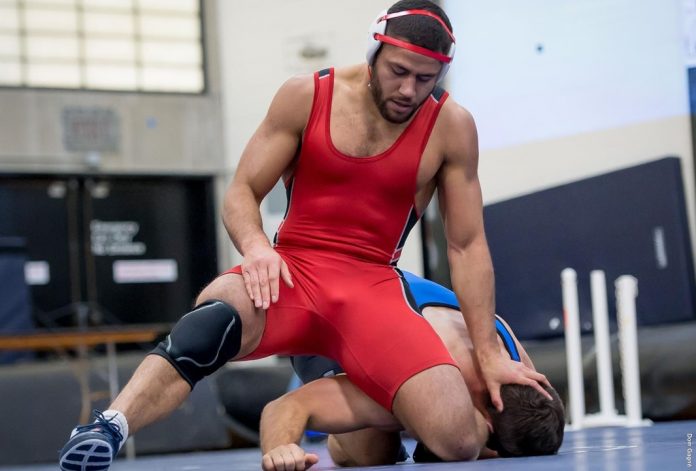
Morgan Smith came second to SFU teammate Nishan Randhawa in the 97 kg division. (Photo courtesy of SFU Athletics)

During the annual SFU Open wrestling tournament that took place over the weekend, SFU was host to 29 wrestling clubs from both the USA and Canada. For SFU, there were standout performances by Nishan Randhawa and Chloe Rogers who both finished first within their weight classes.

The men’s side saw and especially strong performance from Randhawa, who is a sophomore competing in the 97 kg division. Randhawa took a win over fellow Clan wrestler Morgan Smith in a close 2–0 match. Smith is a returning All-American with a 26–4 record from the prior season.

On the women’s side, Chloe Rogers, competing in the 65 kg division, led the way for the Clan by winning three matches in order to win the tournament. Rogers had a tough first match where she was able to defeat Megan Fendelet (Bears) in a 14–13 win by decision match. This was Rogers’ toughest match of the day. Her next opponent from Gray Harbor WC was not as tough an opponent to beat and Rogers was easily able to walk away with a 10–0 win. For her final match of the day, Rogers had to go up against fellow Clan teammate Alison Horne. The last win of the day allowed Rogers to win the gold for SFU.

Depending on the weight-class and the number of wrestlers signed up for the weight class, the tournament ran in a mix of bracket-style and round robin style matches, depending on the number of wrestlers competing in the given weight division.

The women’s 55 kg division ran in a round robin style tournament and saw two SFU teammates competing for the top spot. SFU’s Sunita Sewak won her first match in a convincing fashion as she dominated the match and won 10–0 over Warner Pacific’s Angie Sletten. However, Sewak fell short on the day as she lost to SFU freshman Brooklyn Bartleson in a close 4–2 match.

Senior wrestler Cruz Velasquez, opened up his tournament in a spectacular way with two back-to-back wins by technical fall (10–0 point difference). Velasquez’s winning streak ended in the final match when he fell to Edmonton’s Michael Asselstine.

“Just like any other tournament, it’s good to get in that competitive state of mind. It was a tough go in the final, but now I know what I need to work on in order to get ready for the upcoming competitions this season,” notes Velasquez. This is Cruz’s final year on the varsity team.

SFU’s Nolan Badovinac took second in his division. His tournament started off with a bye, and his first match took place against Clan freshman Connor Patterson. Badovinac won by decision over Patterson, who wrestled unattached for the tournament. Nolan lost to Hunter Lee from the University of Saskatchewan 12–7 in finals.

Logan Nelson also captured a silver medal for the Clan, winning three matches and only losing one within the 79 kg weight class. He wrestled his way to three technical fall wins before losing a close 4–3 match to University of Calgary’s John Fayad.

Wrestling head coach Justin Abdou was pleased with the performances from both the men’s and women’s team. “I’m pretty happy that both our guys and girls had the chance to wrestle. [For the women], they had the chance to compete two weekends in a row and they will be competing the next two as well, and that will give us a pretty good idea of what the team is going to look like later on in the season.”

The Clan men will host North Idaho College in their only home dual meet on November 10 at 7 p.m. in the West Gym. On November 11, both the men and the women will step on the mat in the Mike Clock Open taking place down in Oregon.

Aliocha Perriard-Abdoh is a member of the women’s wrestling team.

SFU men’s soccer season brought to shocking end by Cal Poly Pomona

0
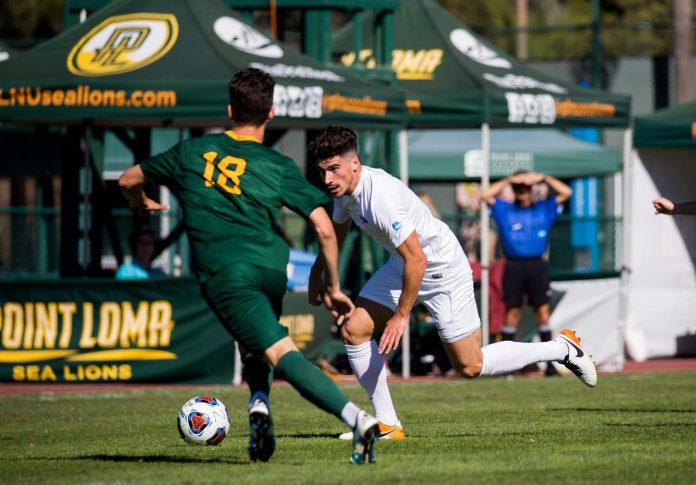
GNAC Player of the Year Marcello Polisi and the Clan will now have to look towards next season for a chance to win the NCAA Division ll title. (Photo courtesy of SFU Athletics)

For the second straight season, the SFU men’s soccer team were riding high after winning the Great Northwest Athletic Conference championship heading into the playoffs. Unfortunately, this was also the second straight season that Cal Poly Pomona played spoiler in the National Collegiate Athletic Association DII Championship, knocking out the Clan with a 2–1 victory. Last year’s match was decided by penalties, whereas this match was decided by a crucial goal in the 85th minute. While SFU was the favourite (ranked number three in the West Region) and certainly looked the more dominant team, an inability to finish opportunities ended up costing them their chances of competing for a national title.

The game got off to an exciting start, as the two teams traded goals within the first four minutes of play. Jimmie Villalobos got the first goal of the game, finishing off an assist by Matthew Perez only 2:10 into the game for Cal Poly. The Clan answered back 81 seconds later, by virtue of a Broncos own goal as Cal Poly keeper Jason Trejos fumbled the ball into his own net off of a free kick. The teams would stay at a one-one tie until the 85th minute, but there was plenty of drama in between.

SFU had the majority of scoring chances for the rest of the game, but were unable to capitalize. In the second half, left-back Michael North made a fantastic run past Broncos defenders but whistled his shot attempt just over the bar. A few moments later, the referee made a crucial decision that may have cost the Clan the match. An SFU player was tripped up going after a through ball in the penalty area — a clear foul — but the referee decided that the foul occurred outside the box. What could’ve been a penalty kick, a likely goal, instead turned into an off-angle free kick from the top-left of the box. Needless to say, the Clan was unsuccessful in their attempt.

In the 85th minute, Cal Poly Pomona made Simon Fraser pay. A pass from Sergi Monso sprung Dante Medina down the left side of the field on a counterattack. After two SFU defenders surrounded him on the edge of the box, the chance seemed to have been lost. Medina, however, found a way to sneak the ball through the defenders and past the outstretched hands of Miguel Hof into the bottom-left corner of the net. When the referee blew the final whistle only five minutes later, the Clan’s season was over.  

After the game, head coach Clint Schneider told SFU Athletics: “I thought we did enough to win the game, but if you don’t finish chances, eventually a team is going to create one. They did, and they scored on it.”

Matteo Polisi was the stand-out option on offence in this one, attempting six shots on goal with four on target, the only shots on target the Clan had in the game. Unfortunately for SFU, Trejos made up for his early blunder, saving all four shots.

With Simon Fraser’s season ending, it’s important to note the positives from the campaign. Nine players were selected to the GNAC all-conference team, with Polisi brothers Matteo and Marcello taking home Freshman of the Year and GNAC Player of the Year, respectively. SFU centre-back Magnus Kristensen was awarded Defensive Player of the Year for the second straight season. Winning the GNAC championship also marks the sixth time the Clan have won the conference in the last eight years. While Thursday night’s loss is certainly a disappointment, the SFU men’s soccer team will likely be national-title contenders for years to come.

New Music Friday

(Linda Shu / The Peak)

“No Peace” – Sam Smith, YEBBA

Edna Batengas: Sam Smith, constantly dropping romantic ballads. Love this one, downloading it as I type. I approve!

Neil MacAlister: I’ve heard nothing but good things about this new Sam Smith album, and honestly I’m pretty impressed by this. I couldn’t stand his old music, but this is beautiful.

Courtney Miller: Ew, Sam Smith. But YEBBA is chill, can we get just YEBBA?

Natasha Tar: Sappy garbage. I’m snoring.

“AIWA” – MC Solaar

EB: It has such a catchy beat. I mean, c’mon, who doesn’t love French music?

NM: Alright, this is actually a lot of fun. I’m into it.

CM: I mean if I have to listen to rap, this is better than most, but also general pass because of the weird breathy creepiness.

NT: It sounds a bit like a French-dubbed Batman monologue set to a generic beat.

“Garage Palace” – Gorillaz, Little Simz

EB: I was super excited when this song first came out, but after repeatedly listening to it, it’s not really my cup of tea, but it’s OK.

NM: This song’s pretty dope, honestly. One of the best things I’ve heard from Little Simz. I don’t know why Damon’s vocals are so absent from Gorillaz lately, though. It’s not the same without him.

CM: “Time is of the essence” so don’t waste it on this song. The beat is fairly chill, but it’s not enough to make me OK about listening to this whole thing.

NT: Did AI hijack this song? Everything about it is super stiff.

“I’m on Fire” – Ria Mae

EB: Nothing really new or special here. NEXT.

NM: This is fine. It’s a pretty chill song.

CM: I’m not going to add this to my personal Spotify collection, but as far as New Music Friday goes, this is pretty good for the first 30-ish seconds. Then it gets kind of boring.

NT: Good voice, but it sounds like four gazillion other songs I’ve heard before. The lyrics suck, too.

“Rap Saved Me” – 21 Savage, Offset, Metro Boomin, Quavo

EB: I mean, I have nothing against 21 Savage but I never understood the hype with him.

NM: This whole tape is excellent. There are far better songs on it, but this one is still pretty dope. Quavo can always bring a good chorus. 21 and Offset are such an unexpectedly amazing duo.

CM: The title is a lie. I’m further gone than ever. Also I really don’t like Quavo’s style so having him as the chorus is like the worst thing to happen to me today.

NT: Rap definitely is never ever going to save me.

“Santa’s Coming For Us” – SIA

EB: Eeeeppp, I downloaded this the minute Halloween ended. CHRISTMAS JAMS ALL DAY, EVERY DAY. Yes, yes, yes.

NM: Shoutout to SIA, but it’s still too early for Christmas music. Keep this away from me.

CM: I agree: it’s too early for Christmas music. But as far as Christmas music goes, I can dig it — once it’s December 22.

NT: NOOOOOOOOOOOOOOOOOOOOOOOO! Gross, gross, gross. Also, the cover for it is terrifying.

“Ghost Ride” –  Skepta, A$AP Rocky, A$AP Nast

EB: Such vulgar and juvenile lyrics. This song has MEME written all over it!

NM: I’ve been bumping since it dropped, this new Skepta EP is fantastic, and Rocky absolutely demolishes this song.

CM: Edna’s got this song down: vulgar and juvenile with no redeeming qualities. Skip it.

NT: Blah, blah, blah. Random fast talking and sounds. Big whoop.

“Customz” – Little Simz, Bibi Bourelly

EB: I don’t know how I feel about this one. I’ll be Switzerland here, I guess I’m neutral.

NM: Little Simz is honestly pretty dope, I really need to get around to listening to this album. I’m glad Bibi Bourelly is getting more placements, too.

CM: Nope.

NT: My favourite part was the airport sounds interlude.

“Broken” – Haley Smalls

EB: Meh, boring break up song. I haven’t heard this before . . .

NM: This is pretty generic, honestly. Nothing new here.

CM: Yeah, this is pretty boring from the melody to the track so I’m out.

NT: Is she saying “lozenge” or am I just imagining things? Is this a song about cough medicine?

“Lemon” – N.E.R.D, Rihanna

EB: RiRi rapping in this song just gave me life! I’ve got it playing on repeat already. How can you not love this song? “Lemon” all the way!

NM: This is one of my favourite songs right now. This is vintage N.E.R.D. Their new album is going to be legendary, and Rihanna absolutely goes in. She’s such an underrated rapper.

CM: Hey! I’m not a fan! Hey! It’s repetitive! Hey! Sorry RiRi, can’t do it. Hey!

NT: Waiting for Rihanna… Still waiting… waiting… WAITING… oh. OK then.  

“Bazi Asklar Yarim Kalmali” – Irem Derici

EB: I’m alright with this one. Don’t know what she’s saying, but she sounds like a goddess.

NM: This sounds like what I imagine Turkish musicals must sound like.

CM: I’m enjoying the Spanish soap opera vibes from these strings. Dancing with the Stars take note: this’ll be a good song to use.

NT: I love it. Sign me up, I’m going to Turkey.

“Kenya” – Fakear, Jain

EB: This was really weird. Hard to get through . . .

NM: I like the production on this more than anything else, but it’s all fairly underwhelming.

CM: Popcorn! The vocals are jazzy which is cool, but it morphs into something weird with the backtrack and I don’t want to listen to it anymore.

NT: I mean, I like the voice, but the beat is so boring.

Playing in the big leagues means spending big bucks: the financial reality of college football

0
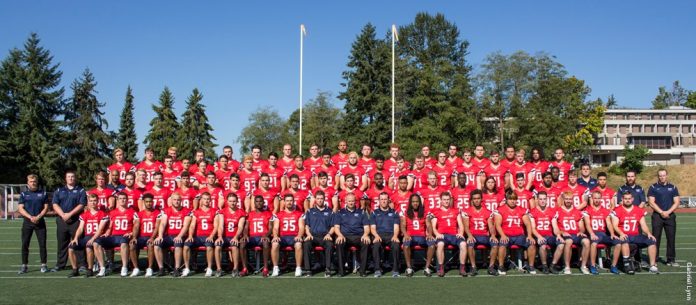
SFU is middle of the pack in terms of spending, but has struggled on the field in recent years. (Photo courtesy of SFU Athletics)

As SFU’s football season comes to a close, the Clan ranks last in the National Collegiate Athletic Association (NCAA) Great Northwest Athletic Conference, finishing the season with nine losses. It is no secret that SFU football has struggled in the NCAA, the team not winning a game since 2014.  When SFU switched over to the NCAA in 2009, the university’s president at the time, Michael Stevenson, embraced the fact that the switch would create “a high level of competition and challenge” for SFU athletes. But eight years later, SFU football is still struggling in the NCAA. The question now becomes: why?    

In an interview with CBC in September 2017, former Clan receiver Milos Zivkovic pointed out the Clan’s hurdle: playing in an American league meant playing American football. He said, “They had to start rebuilding and relearning a whole new system. It’s a whole new game. Different competition. Different set of rules.” As a result, the SFU football team has more American athletes than teams at UBC or at the University of Victoria. But playing in an American league also meant that the Clan played in an American context, which included playing in a country whose football culture is different than Canada’s — right down to the funding.

According to the NCAA’s financial research, the median total expenses for Division II teams with football teams was US$6,538,000 in 2015 (the last year for which data is available). However expenses ranged from US$1,594,000 to US$16,802,000 which constitutes (and creates) an incredible disparity between teams.

According to data shared by SFU Clan Athletics, SFU football’s total expenses range around US$8,052,23.44, putting SFU in the middle of the pack as far as spending goes.

Comparatively, the top-ranking Division II football team in the Great Northwest Athletic Conference (GNAC) is Central Washington University. Back in June 2011, Central Washington’s athletic department was given an additional US$230,000 to help the department emerge from nine years of operating on a deficit. Out of the department’s US$3,800,000 budget, US$295,000 came from ticket and merchandise sales while US$1.1 million came from student fees.  

Increasing costs for NCAA teams isn’t as much news as it is reflecting trends in universities across the United States. Between 2004 and 2012, total expenses have grown by 126.6 per cent with no sign of stopping. Out of 1,281 athletic departments that are members of the NCAA, only 14 made a profit or broke even in 2010.  

As a result, institutions across the board are reconsidering the role that football will be playing in their athletic departments including Humboldt State University, the second-highest ranking team in the GNAC. GNAC teams face the additional challenge of playing in one of the most geographically enormous leagues in the NCAA. The resulting travel creates additional budgetary strain for many Western teams, using up dollars that other schools can allocate elsewhere.  

Yet not everyone is feeling the same pains as the GNAC. The University of Texas’ Division I football team generated US$183.5 million in revenue, of which US$44.3 million was from donations, and US$62.9 million was in licensing rights. They could run SFU’s football program twice and still make a slight profit. In 2016, the team managed to outdo some NFL teams in terms of profitability.

An analysis by ESPN’s Outside the Lines found that the United State’s richest athletic departments pulled in four billion dollars more than all other schools combined in 2015. As a result, these teams can splurge on private jets and five-star accommodations while traveling, while other schools struggle to level the playing field often by tapping into student fees. The NCAA found that for universities operating with football teams, the majority of overall expenses come down to grants-in-aid (33%) and coaches’ salaries (31%).  

Though football coaches rank amongst the highest-paid coaches in the NCAA and institutions with football teams spend a lot more money on average, those numbers parallel the overall expenses of teams without football.  

Furthermore, though football programs have consistently generated more revenue than other sports programs, they also entail the largest expenses and breaking even is becoming increasingly hard. The line is still thin: in 2015, an NCAA Division II’s football team’s median total revenue was US$1,143,800, but median expenses were US$1,313,200.  

The NCAA does have some rules in place to cap spending. For example, the maximum allowance for football scholarships for Division II teams is the equivalent of 36 full grant-in-aid scholarships. SFU’s football team gives the equivalent of 18.08 full scholarships, valued at approximately $300,000. This is incredibly valuable in Vancouver, the 39th most expensive city in the world to live in according to The Economist’s 2017 cost-of-living index (the only other North American cities to rank above Vancouver are in other divisions of the NCAA).

But overall, business and economic experts are finding that the college football business model is starting to fail, as universities across the United States slip into debt or pull funding from other branches and faculties to keep up. Factors causing the hike in prices range from inflation across the economy, to the revenue generated from sports camps, ticket sales, and cash contributions going down.    

Karen Weaver, a sports-management professor at Drexel University, says that “leaders need to be very careful that long-term expenses and commitments cannot, and should not, be balanced on the assumption that these traditional media rights deals [a main source of revenue for many football teams] will hold up.”

This is still controversial: universities across the country are investing in infrastructure more than ever, hoping to increase ticket sales, and bettering their athletic teams, hoping to attract prospective students. Defenders of college football also point to the opportunities created by university athletic departments: they attract students (and extra tuition money) to campuses and communities, offer scholarships and aid to student-athletes, and increase a university’s prestige, visibility, and pride.

Regardless of where you stand on the issue, as SFU continues its journey within the NCAA and invests into the future by updating the school’s athletics infrastructure, the financial reality of college athletics cannot be denied.

Should your university get to ‘comment’ on your social media?

0

Masuma Khan, Dalhousie University student, came close to facing a disciplinary committee for her politically charged comments about Canada 150. Having moved the Dalhousie Student Union to abstain from planning or condoning Canada Day celebrations this year, Khan asserted that the event was “an act of ongoing colonialism.” Following that, Dalhousie graduate student in history, Michael Smith, filed a complaint to their university after her use of the hashtag #whitefragilitykissmyass.

Dalhousie originally acted to discipline Khan for her actions, but after notable public backlash against the school’s decision, they have withdrawn from that route and are now considering “ways to resolve the complaint outside of the regular senate disciplinary process,” as Arig al Shaibah, vice-provost of student affairs, told Huffington Post. This situation begs the question: do universities have a right to monitor and critique their students based on their social media?

With race being a very personal and political topic, does Khan, a Muslim, hijab-wearing woman, and a First Nations ally, have a right to be vocal about her political views? Does her university have a say in how she expresses her beliefs?

While Khan’s words were blunt and furious, they did not contain any active promise or threat to other students, specifically of any creed or race. Universities have no power to dictate how students ought to express their feelings, especially ones of injustice. To me, the only time a school should be censoring or censuring its students is when they jeopardize other students’ safety.

When I say that, I think of cases like Peter Cytanovic, a young male white student whose mid-protest photograph was the popular image for “Unite the Right” tiki torch protests in Virginia last August. As Quartz Media reports, the president of his university announced that while the university neither shares nor condones his actions, they “had no constitutional or legal right” to expel him, and they let him keep his job on campus.

It seems clear that political affiliations and after-school activities are considered off-limits grounds to some universities. But in Cytanovic’s case, his actions threatened the livelihood and atmosphere to students of colour. This ought to have been reported, not just to the university but to the police, to help protect those students.

If universities are to monitor their students’ media and expression, their primary motivation should be to help protect students, not to persecute them. Otherwise, universities have very little grounds to sift through students’ profiles.

These places of education need to promote learning, dialogue, and discussion. If or when they must intervene, they must look critically at the given situation and ask themselves how such comments negatively or positively affect their school environment. If schools were to really comb through social media profiles with pure intentions, would it incite any positive change, or would it result in more students on probation?

It appears to me that universities look for and penalize posts that may sully their image, rather than be attentive and listen to any truly critical comments. Students like Peter Cytanovic believe that their status as a student and pro-white protestor are separate, and conduct themselves as such, so the school turns a blind eye and does not assume responsibility for them.

Meanwhile, student council executive member Masuma Khan believes that her activism has a place within her school’s social commentary, so when she brings up uncomfortable dialogue and it is linked back to her university, she is punished. Unless universities are monitoring social media for benefit of their students’ safety and well-being, and not for their own sakes, they have little right to involve themselves in their students’ conversations.

Director’s Spotlight: Xavier Dolan

0
While Dolan’s films have been made for Francophone audiences up until now, his upcoming project will be in English. Plus, Jon Snow is set to star in it. (Photo courtesy of Georges Biard)

Québécois wunderkind Xavier Dolan is an extraordinary and prolific director. His fifth film, Mommy, won the jury prize at the 2014 Cannes Film Festival when he was only 25 years old. Two years later his film,  It’s Only The End of the World won the Grand Prix at the same festival.

     Dolan’s films are so compelling because he has a way of distilling the essence of human emotion in the most complex relationships and transmitting those feelings from screen to audience. Not to mention, his soundtracks are phenomenal.  

     His first film, J’ai tué ma mère (I Killed My Mother), is a partially autobiographical account of a young gay man’s troubled relationship with his mother. From this first film, Dolan’s preoccupation with mother figures has persisted, most predominantly in Mommy, but also in his most recent work, Juste la fin du monde (It’s Only the End of the World).

     Currently in production and set to be released in 2018 is Dolan’s English-language debut titled The Death and Life of John F. Donovan. Dolan wrote the script with Jacob Tierney, and the film is the story of Donovan (Kit Harington), an actor whose private life is exposed by a gossip columnist (Jessica Chastain). The film will also star Susan Sarandon, Kathy Bates, Jacob Tremblay, and Natalie Portman.