Home Blog Page 557

SFU women’s soccer battle hard for 1–0 victory against Central Washington University

0
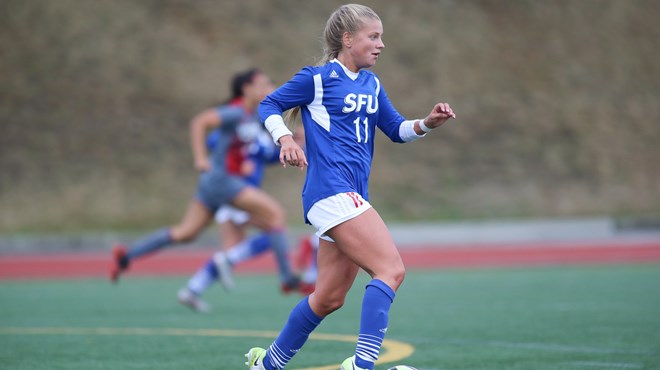
Jenna-lee Baxter leads the GNAC with 14 points. (Photo courtesy of SFU Athletics)

SFU women’s soccer team ground out a hard-fought win against the Central Washington University Wildcats at Terry Fox Field Saturday afternoon. SFU’s Jenna-lee Baxter broke parity and secured the victory with a brilliant finish four minutes into the second half. Saturday’s victory earned SFU’s women their first consecutive wins of the season after defeating Seattle Pacific University two days prior.

The first half was incredibly tight; both squads defended resolutely, with a raging midfield battle fiercely ensuing as neither team wavered. SFU goalkeeper Nicole Anderson impressively stopped a long-range effort from outside the box, diving to her right to parry the ball away from her net.

The match featured SFU freshman Teagan Mackay wrecking havoc against Central Washington’s defenders. Her relentless pressing and effective hold up play proved effective in the 28th minute as Mackay won the ball high up the pitch and tested the Wildcat keeper.

Immediately after the break, Mackay made her presence felt again. Wonderful close control and a burst of speed saw Mackay drive down the right wing and send a low cross into the box. Senior SFU midfielder Baxter met the cross, expertly controlling it, and with a swivel and strike, she banged the ball beyond CWU’s goalkeeper. Securing her fourth goal of the season, Baxter’s strike proved to be the game winning goal.

Mackay’s creative influence was essential to the goal, and head coach Annie Hamel touched on it post-game.

“Teagan McKay is getting better every single game,” said Hamel. “She is coming in as a freshman; it is tough. But seeing her grow and get better every game is amazing.

“She had an amazing performance, she is so strong and is starting to be less shy, making her presence felt out there, and it’s lovely to see.”

Immediately after going up 1–0, SFU came under immense pressure. An error at the back forced a goal line clearance from midfielder Hollis Roeske. Wildcat attackers swamped SFU’s penalty box as the ball trickled behind Anderson and towards the goal mouth. Roeske arrived in dramatic fashion to hoof the ball away from the unguarded net. This was the start of a good spell for the Wildcats as they went in search of an equalizer. Despite this near-goal, Anderson was composed for the rest of the match and kept a clean sheet.

As the Wildcats attempted to claw their way back into the match, SFU’s veterans stepped up to steer the team over the line. Katelyn Erhardsen had a motivated second-half display, oozing confidence on the ball while beating opposition players continuously with sumptuous skill. Her influence in the middle of the park was crucial as SFU maintained a strong shape while defending their lead.

Coach Hamel spoke of her midfield general’s performance after the match. “I directly addressed the seniors at halftime in the dressing room and they responded. Katelyn came out with a mentality of ‘I will help us and be the solution,’ and it was awesome to see. She was immense for us; her control of the midfield was significant. She has amazing feet and when she gets by somebody it’s typically fun to watch.”

SFU defender Carli Grosso was another standout performer on the day, Grosso offered a tower-like presence at the helm of the defence: rarely putting a foot wrong, tackling hard, and clearing everything that came her way. Grosso was calm and self-assured throughout the match.

Grosso, Erhardsen and Mackay were pivotal pieces to SFU’s success. When asked about positive takeaways from Saturday’s victory, Coach Hamel expressed delight at her team’s improvement and ability to grind out wins. “We didn’t play very well, and we were still able to get all three points. In the conference it is a massive result and we have had a tough stretch. I’m pleased with where we’re at right now, the girls have been getting better every week, it has been enjoyable to watch.”

Peak player of the game: Carli Grosso

Grosso was a key player for the Clan in this one, consistently preventing Central Washington University from getting scoring chances. She was definitely the best defender in the game, and was a major reason for SFU’s clean sheet.

What’s next:

SFU will be looking to ride their recent form into games against Concordia and Western Oregon on the road before returning to Terry Fox Field on October 11 for a clash against Northwest Nazarene University at 5 p.m.
Bringing dad jokes to the board: an SFYou with Samer Rihani

0
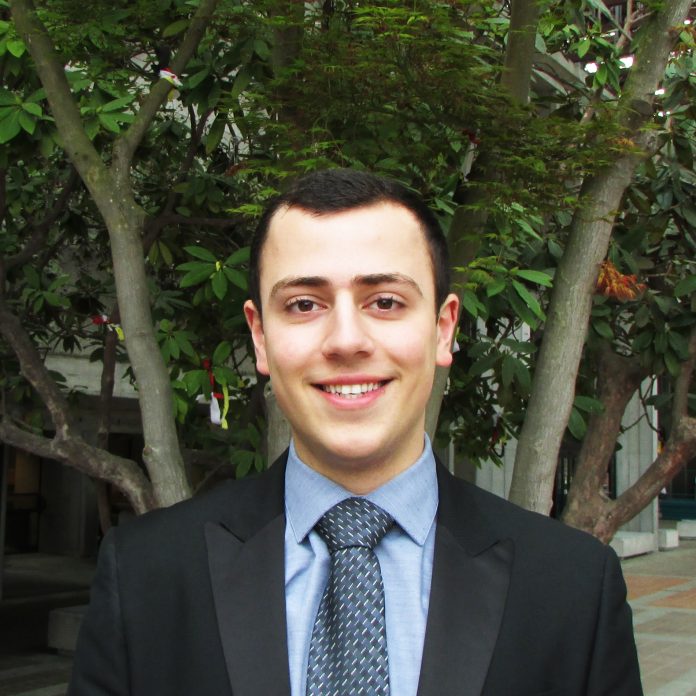
Samer Rihani, Image courtesy of the Simon Fraser Student Society

Fast Facts

Name: Samer Rihani

Pronouns: He/Him/His

Department Affiliation: Health Sciences (Populative and quantitative stream; fourth year)

Hometown: Surrey, B.C.

Hobbies: Self-described social butterfly. His brother is currently trying to teach him about Fortnite.

Fun Fact: Samer can cross one eye and flip his tongue.  


“Have you ever tried to eat a clock? As it turns out, it’s quite time-consuming.”

That’s what came out of Samer Rihani’s mouth when I asked him for his favourite joke, although he did have to think long and hard to pick his absolute favourite.

“[My clock joke] never gets a laugh, it never does anything, but it shows people I have really low standards for jokes,” Rihani explains. And there’s plenty more where that came from. Seriously: he has a note on his phone full of dad jokes.  Apparently, he’s that guy in the SFSS’ office.

This is Rihani’s first year on the SFSS’ board of directors. In his first year at SFU, Rihani ran for the SFU senate. He admits to having had no idea what he was doing, and was only known at the time as “first-year senate guy,” and was “decimated to a pulp” (his words, not mine).

“But I put myself out there,” Rihani says. “And I realised how fun it is to get to know people.”

“I [didn’t] want to graduate from school and just have academic knowledge,” Rihani explains. “I wanted to know that when you go into the real world this is what you expect.”

He ran for senate and lost again in second year, but had a much stronger campaign and presence. After getting the feel for what political participation on campus was like and getting involved in clubs, Rihani turned his attention elsewhere: the SFSS.

“I’d always had issues with the SFSS,” Rihani admits. He’d complain about the SFSS and get teased about joining them. And eventually, by his third year, he told himself: “Why don’t I go in and fix it? Why don’t I go and act on the things I complain about?”

Since the September 24 impeachment of Jas Randhawa, Samer Rihani is the acting president of the SFSS (according to SFSS by-law 4). But Rihani had originally been elected as the vice-president of student services.

One of the things that attracted him most to that position was that “student services” encompassed the health and dental plan for students. For someone who aspires to dentistry, this chance to work with insurance providers and healthcare professionals and consultants was alluring.    

“Before [I worked at the] SFSS I worked at Starbucks . . . I’d never had a chance to really see what it was like to be the lowest on the totem pole . . . I wanted that exposure to really challenge myself.”

Just last summer, the health and dental plan for students has changed. Rihani is proud to tell me that the SFSS has saved students over $300,000, but it’s no secret that things have in many other ways been turbulent for the SFSS, to say the least. Still, Rihani says he has reason to believe that there are good things on the horizon. He’s looking forwards to “a great team dynamic.”  

“We have a team now of people who have stuck it through the worst,” Rihani says. “We pushed through the hardest month of, arguably, our lives and came out of it. People stuck together, we’ve had challenges, and excruciating meetings, and all-nighters . . . but now we know that the people who are around are the people who want change to happen.”

According to Rihani, restabilizing the board is an integral part of the SFSS’ journey onwards. But after the AGM, the board is conscious that they’ve got hundreds of extra pairs of eyes on them. The SFSS’ to-do list, outlined by Rihani, includes getting in touch with the groups who spoke up at the AGM, and strengthening communication within the SFSS, as well as with its clubs, and student unions, and Council. The issue of the Student Union Building looms on the horizon as well.

“The name of the SFSS is mainly known for all the drama,” Rihani admits, well aware of the image the society has amongst students. He even has a favourite impeachment meme from the SFU Dank Memes Gang (which was fresh off the meme press, the morning of our interview).

“It’s so weird to see so much engagement from the student body, by just random people commenting the letter ‘f’ over and over and over again,” Rihani said. And while Rihani is a big believer in showing a sense of humour, these exemplify how “people have no idea what to expect from us now.”

“I like the light-hearted nature,” Rihani said. “Of course, when it comes down to student dollars you have to take it really seriously. But if you don’t know how to have some fun and take care of yourself and of the people around you, you get nothing done.”

Rekindling the SFSS’ relationship to the student body will be no easy feat, but Rihani has a slew of ideas: tabling, handing out food to people, asking people about their day, going to student union meetings, attending club events, mass candy distribution, coffee with board members and students . . . “We need our name to be known on campus.”

Rihani also thinks that students want to see transparency from the SFSS, especially those who are heavily involved in campus life. Rihani admits that the SFSS can do better in makings its committee and board meetings accessible and public to SFU students. He hopes that social media will be able to fill that role.

“For me, my big initiative will be telling people what’s going on,” Rihani says.

Still, it’s a challenge that Rihani trusts his fellow board members to embark on. He remains optimistic, citing the creativity of the memes and of the name submissions for the SUB as positive signs that the student body is engaged. While Rihani didn’t leak any hot details regarding name selections, he did share that “Subby McSubFace” came up as a suggestion “too many times.” He concedes that “maybe this is what the people want,” but his personal favourite? “The Highland SUB.”   

“I showed my Mom that one,” he says. “Whoever did it: kudos.”

And what will Rihani’s role be in this reconstruction process?

According to the SFSS’ by-laws, the duties of the SFSS’ presidency now falls on him. However, Rihani makes it very clear to me that the board is going to try something new and separate the president’s role amongst the VPs.

“There are a lot of people on that board who are more qualified in a lot of things than I am, and I want to take full advantage of that.” Rihani says.

According to Rihani, his new responsibilities will be redistributed to the most appropriate and qualified board member. He hopes that this will also help to build a sense of trust, communication, and camaraderie within the board as well. The board has already discussed this at length since the AGM, and students can expect a more concrete statement in the future.

For Rihani, being on the board was a humbling experience. “I’ve had a lot of chances to learn about myself and what I’m comfortable with and how to do things…” To students who may also be interested in running for a position on Board next May or who are new to SFU, Rihani recommends talking to Board members to find out more about the SFSS and opportunities on campus.

“Our office, right there, the door is open,” Rihani said. He acknowledges that in the past, the SFSS could be difficult to reach. But he’s hoping to change that, and make things easier. For Rihani, his unconventional presidency will be focused on getting back in synch with the student body.


What Grinds our Gears: Icebreaker activities in lectures and tutorials

1
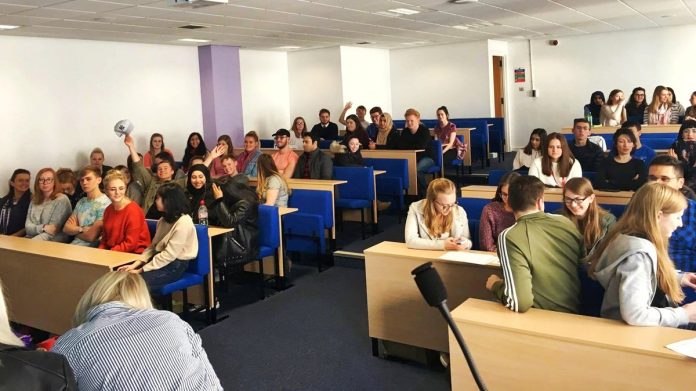
Photo by GCU Optical Society

I’m pretty sure that all SFU students have endured the painfully awkward icebreakers forced upon us by TAs or professors at the start of every semester. As someone who’s entering my third year, I’ve had enough of these repetitive, boring, and cringe-worthy activities supposedly helping you “get to know each other better.”

It always goes like this: “We’ll start from the left side. Tell us your name, major, and something interesting about yourself.” Once the time comes and my turn is fast approaching, I always groan inwardly and think: “Just kill me now!” For crying out loud, there are so many other ways to break the ice than these cookie-cutter introductory circles.

To illustrate how much better it could be, when I went to a co-op workshop, the advisors running it actually had us stand up, walk around, shake hands, and introduce ourselves to at least five different people. Even though the handshaking was more of an exercise on how to greet potential employers, doesn’t that sound a lot better than sitting in an uncomfortable chair with 20 or more people staring silently at you while you say yet another version of the exact same thing for the umpteenth time?

Why on earth do icebreakers for classes and tutorials need to be nothing but monotonous, unnecessary crap? Did it ever occur to university instructors that the traditional “icebreaker” is a euphemism for boredom and discomfort? Elementary schools use better methods! At this rate, I definitely won’t be able to handle one more icebreaker without screaming in pure frustration and sprinting out of the room like a madman.

Renowned Canadian author and storyteller Ivan Coyote begins new position at SFU

0
(Photo courtesy of SFU News)


Beginning this fall, Canadian storyteller and filmmaker Ivan Coyote took over as the SFU english department’s 2018–19 writer in residence.

Discussing their new role at SFU, Coyote told The Peak that they will be on campus each week to meet with writers and students and faculty to do one-on-one consultations. They will also be doing some classroom visits for readings and question and answer sessions.

Although the writer-in-residence position is based in the English department, Coyote explained to The Peak that anyone in the SFU community and beyond is able to access the one-on-one consultations with the writer in residence.

“All you have to do is send in a writing sample (10 pages max) and book a session with me by emailing Laura Walker, the English Department Head Organizer of Many Things,” Coyote stated.

On September 27, Coyote held their inaugural reading as the year’s writer-in-residence at SFU Downtown Campus.

Coyote has had a longstanding relation with SFU. “I did one of my first professional writer gigs up at SFU in about 1997, I think, just before my first book (co-authored by Zoe Eakle, Anna Camilleri and Lyndell Montgomery (Press Gang, 1998)). That was over 20 years ago, believe it or not,” wrote Coyote to The Peak.

Following their association with SFU in 1997, Coyote then taught as the non-fiction instructor in the Writer’s Studio at the SFU downtown campus in 2009/2010. In the fall of 2017 SFU awarded them an honorary Doctor of Laws and in February 2018, Coyote’s book Tomboy Survival Guide was selected as SFU Library’s One Book last February.

“So, in a way, I’ve had ties to SFU for a while now,” remarked Coyote.

Coyote has authored 11 books, created four short films, approximately six full-length live shows, and around three albums that combine storytelling with music. Over the last two decades Coyote has also earned widespread popularity and acclaim for being a seasoned storyteller in different continents.

“Live performance has always been a driving element of my work,” wrote Coyote, describing the main motivation behind their work. “Live performance ties me to constant learning and expanding the craft of writing and storytelling. I think storytelling is the single most powerful tool we have as humans to learn about and understand each other and build a better world to live alongside and with each other.”

Talking about what is next on their plate, Coyote mentioned that they are predominantly a live performer, a theatre artist, and a public speaker, and that they hope to keep touring in the future.

“I’m also going to start building a little cabin in the Yukon next June, after I finish my residency gig,” said Coyote.

Their new book is also set to be finished during their residency at SFU and bound to hit the shelves in the fall of 2019. Coyote told The Peak that they are working on a mystery novel and booking a national and then international tour of their new collaboration, a live show called Trader Time, with musician and composer Sarah MacDougall.


World News Beats

0


Mangkhut typhoon battered the Philippines and Hong Kong

Mangkhut, the super typhoon formed in the Western Pacific, recently ravaged the northern Philippines.

The mid-September typhoon, which according to statistics reported on CNN News is the most powerful storm in the world this year, first consumed the northern Philippines on its path to southern China, killing approximately 127 people and counting with winds that reached over 240 kilometres per hour. Almost three million people were affected by its direct hit, and another 11 million have been affected by the subsequent flooding.

Its strength was compared to that of a category five hurricane, uprooting trees and tearing apart buildings. There were reportedly four deaths in China, and long-term damage to infrastructure.

Over 889 delays and cancellations at the Hong Kong International Airport were also incurred as a result.

With files from The Washington Post , CNN News and Voice of America.


NAFTA deadline looms, negotiations drag on

The October 1 deadline for the North American Free Trade Agreement (NAFTA) is approaching rapidly, as negotiations between the United States and Canada drag on.

U.S. President Donald Trump has threatened numerous times to exclude Canada on the basis of what he deems to be unfair trade terms. Trump has instead proposed an alternative two-nation deal with Mexico.

The issues prolonging the current NAFTA negotiation between the two nations revolve around the Canadian tariffs on U.S. dairy products, and the proposed time-limit on the agreement. In terms of the time-limit, the U.S. wishes to have the agreement last only five years, whereas Canada wants at least a ten-year agreement.

Trump additionally refuses to recognize and acknowledge that the United States has a trade surplus with Canada. Whether the negotiations reach an impasse and Trump forges on with a two-nation deal remains to be seen.

With files from Global News, Global Trade Magazine, and Macleans.


Pound drops significantly after Theresa May’s statement

Negotiations between the European Union (EU) and the UK regarding the Brexit agreement are still ongoing. The pound declined after EU leaders asserted the need for UK to make “compromises” on the Brexit trade deals.

With UK Prime Minister Theresa May stating “no deal is better than a bad deal,” hopes of a faster finalization of the Brexit deal have been lost, leading the pound to drop one percent to 1.5% lower. As of September 27, the sterling stood at $1.3068 against the U.S. dollar.

May also used the term “impasse” to describe the current state between the UK and EU.

The comment is indicative how both sides are nowhere close to reaching an agreement that is satisfactory in a possible post-Brexit world.

With files from BBC News and Deutsche Welle.


Post-bailout Greece witnesses increased unemployment in young adults

After the European Union (EU) bailed out a bankrupt Greece, the nation was forced to cut government spending as a condition. These cuts to government spending have worsened unemployment in youth and further decreased job availability.

Due to austerity programs, the country is restricted in its economic growth and social programs. This has resulted in large-scale unemployment, especially among young adults.

Greeks in their mid-to-late twenties are emigrating out of the country in search of better job prospects. With the unemployment rate at almost 58% for those under 25, the future looks bleak for Greek youths.

Even in 2017, around four in 10 young Greeks were jobless.

With files from BBC News.


SFU Residence and Housing serves students’ needs amid housing crisis in Vancouver

0
SFU aims to increase on-campus residence capacity with its Housing Master Plan. (Azat Bayandin/The Peak)


While the housing crisis in Metro Vancouver is seeing on-campus dorms fill up and pushing students to look for housing elsewhere, SFU Residence and Housing is taking steps to provide more extensive housing for its students.

“A student may be more affected in the current rental environment that exists in British Columbia and particularly, the Lower Mainland, in terms of affordability as they may not have that extra added disposable income that someone who is working might have,” noted Leon Kalligerakis, marketing and communications coordinator at SFU Residence and Housing, in an email interview with The Peak.

In order to increase on-campus housing spaces, the Housing Master Plan was approved by SFU in 2015. The plan details the construction of new buildings and renovations to existing buildings which have been approved through consultation processes with stakeholders of the university such as students, staff, and university executives.

According to Kalligerakis, the first phase of the plan will be completed in fall 2020 and will provide two new buildings and an additional 482 rooms. 360 more rooms will become available by fall 2022.

Along with the housing options available on Burnaby campus, SFU also offers housing for 68 students in the Charles Chang Innovation Center in Vancouver, which was opened in 2016. The majority of residents are graduate students.

For off-campus housing, SFU Residence and Housing has partnered with places4students.com, an online resource that brands lists off-campus housing listings in partnerships with over 160 post-secondary schools throughout North America. The website links schools, students, and landlords in order to provide housing options for students to live off-campus.

Kalligerakis advised students to be cautious of the information they receive with regards to housing options. “Students should always focus on the sites and partners that both SFU and FIC partner with to help make an informed decision. Because there are a lot of different options out there, we cannot guarantee the authenticity of any organization, advertisement, or option that we have not partnered with,” he wrote.

Kalligerakis noted a number of benefits of on-campus housing for students, such as the meal plan and a community shaped by the student residents.

SFU Residence and Housing provides on-campus housing options for students, currently offering 1668 beds. In order to live on residence, a student must either be enrolled at SFU or FIC and be taking a minimum of nine credits. While there is a wait list, it “changes considerably depending on the date you ask,” wrote Kalligerakis.

Mishaa Khan, an international SFU student studying behavioural neuroscience, said she chose on-campus housing as it serves her needs as a student well. However, Khan noted it is difficult to get in because of the surge of students that apply every semester, especially in the fall. As she has seen friends have to move off-campus due to late housing applications, she always makes sure to apply as soon as applications open.

Khan noted that she chose residence over other off-campus housing options because it is convenient, allowing her to avoid commute times up and down the mountain for classes. As well, on-campus housing also provides an avenue for her to get to know other students. “Residence Life does a good job in creating a welcome atmosphere and it helped me integrate better into society as an international student,” said Khan.

Additionally, living on residence at SFU makes Khan feel safe due to the additional staff resources give an added sense of security. “Campus public safety and community advisors are only a call away and they often walk around, making sure everything is fine,” she noted.

Balqees Jama is another student living on residence who also opts for on-campus housing because of the convenience. “I leave campus once a week to do some things I need, but everything I need is generally here. I have my friends, job, and school in the same place. I’m on the 24/7 meal plan which saves me lots of time while allowing me to be social,” she said.

Like Khan, Jama felt that the the on-campus housing options are competitive and hard to get into.

“SFU has a first-come first-serve system, so I have learned to wait for the clock to go from 11:59 p.m. to midnight just so I can guarantee that I will get a spot.” – Balqees Jama, SFU student and on-campus housing resident

Jama also echoes Khan’s sentiments about feeling safe on residence: “I felt so secure that I did not even look for places to stay off-campus. [. . .] I feel so safe on campus that I don’t mind studying in an academic building alone until 2 a.m..”


With files from CBC News.

#1 ranked SFU men’s soccer now 9-0-0 with victory over Concordia

0
Connor Glennon now has eight goals this season. (Photo courtesy of SFU Athletics)

On Tuesday, the SFU Men’s Soccer team moved up the national rankings to take over the #1 spot across the entirety of NCAA DII. For the last two seasons, the Clan have been ranked as high as #3 nationally, but after starting the season 8–0–0 and outscoring their opponents 31–3 in those eight games, it is great to see SFU get the credit they deserve and be rewarded as the best team in the NCAA this season.

Fast forward to Thursday, September 27, as the clan looked to continue their winning streak as they hosted the Concordia Cavaliers on Terry Fox Field. A rare non-raining contest saw the Clan, who are atop the Great North Athletic Conference (GNAC) standings, face off against the Cavaliers who are in third place. Concordia has proven to be difficult in the past for the clan, as they are a team who is always well disciplined and look to pounce on the counterattack.

On Thursday, the Cavaliers’ game plan seemed to be no different. The first 30 minutes were quite hectic, neither team maintaining possession for extended periods of time and no concrete chances for either team, but most of the action took place in Concordia’s half. Despite a lack of clear-cut chances, the Clan were still able to keep Cavalier goalkeeper Grant Alcorn very busy on the day.

At the half, it was locked at 0–0, with SFU settling into a groove in the last 15 minutes, but Concordia yet again proving to be a disciplined wall on top of their own 18-yard box and something that the Clan found tough to break down. As the second half began, it kicked off right as the first half ended, SFU dominating possession around Concordia’s box.

This time, however, it only took sophomore forward Connor Glennon six minutes to score his eighth goal of the season for SFU. The goal came after extended pressure from SFU and the ball popped out to Glennon inside the box who was able to connect on the volley and blast it into the far corner to give SFU the 1–0 lead in the 52nd minute.

The Clan were determined to add an insurance marker, but the Cavaliers goalkeeper was not to give in so easily. Making a number of solid saves, and luckily seeing a beautiful curling effort from junior Rahid Rahiem bounce off the post, Alcorn would go on to put in a man-of-the-match performance to hold the lethal Clan attack to just the lone goal on the night while making 13 saves. Thanks to strong defensive performances from Michael North, Florian Langenegger, Joost Mangert and Eric De Graaf, goalkeeper Luciano Transolini would only be called into action once, making the save and preserving his sixth clean sheet of the season for SFU.

A 1–0 victory Thursday saw SFU extend their record to 9–0–0 overall and 3–0–0 in GNAC play.

Peak player of the game: Connor Glennon

The obvious choice, Glennon’s effort was the main difference in order to keep the Clan at a perfect record. With him, Matteo Polisi and Mamadi Camara as attacking options, it was always unlikely that SFU would be kept off the scoresheet.

What’s next:

The Clan heads back on the road next week as they visit Nampa, ID to face Northwest Nazarene on Thursday, October 4 and then Seattle Pacific on Saturday, October 6. SFU faces the Cavaliers again, this time in Portland on October 11 before returning home on October 14 to host their border rivals from Western Washington, that game kicking off at 7 p.m. on Terry Fox Field.

Recap of the SFSS AGM

0

Created by Melissa Campos

Board Shorts

0
Irene Lo / The Peak


Board changes signatory for banking resolutions

In light of the impeachment of the former Simon Fraser Student Society (SFSS) president Jas Randhawa, the board appointed vice-president student services Samer Rihani as one of the signatories on behalf of the student society in banking matters.

The other signatory is SFSS CEO Martin Wyant and, in the absence of Wyant, Build SFU general manager Marc Fontaine.


Financing regarding SUB provided

Vice-president Matthew Chow elaborated on the long-term and short-term loans the society has taken out to finance the Student Union Building (SUB).

He noted that the society is currently using three different types of loans for the project. For the duration of the construction, the society is engaged in a short-term construction loan, which they use to pay off the invoices they receive from the university every few months.

Once construction is completed, the society will switch over to a long-term loan on August 1 which will last for 25 years. The long-term loan will be used to pay off the short-term loan, which will also provide an interest rate swap for the society in the interest of saving the society money.

According to Chow, the long-term loan “helps our interest rate and it prevents us from paying too much [. . .] you don’t want to pay three years worth of loans in that period of time, you want to spread it out over 25 years.”

Chow noted that the society has currently borrowed $17 million to finance the SUB project, and project to borrow approximately $38 million it total by the end of the project. The SFSS has originally projected to borrow $43.3 million but due to the construction delay, they have received “a bit more leeway in terms of levy collection for the project itself.”


Publicization of board meeting times, agenda, and open-session items discussed

The Peak’s news editor, Amneet Mann, brought forward concerns regarding how board meeting times, agendas, and open-session attachments were not posted online or made available to the SFSS membership prior to the meetings themselves.

“[It] make[s] it a little bit difficult for the membership to come and engage when they don’t know that these meetings are happening or when they’re happening,” she said. Mann noted that, while SFSS by-laws 9(2) and 10(3) mandated that faculty student unions and department student unions hold “general meetings that are open to all of its members and gives it members notice of those meetings,” there was no analogous by-law for the SFSS board of directors meetings.

Vice-president university relations Jackson Freedman noted that a policy change at the level of a standard operating procedure would be possible to communicate board meeting times and agenda more broadly and with a more advanced notice.

He mentioned that the board was looking into the possibility of a recording feature for board meetings such as a live stream for students to watch.

Wyant noted that previous boards had set a regular biweekly time for meetings to take place, which was a possibility that this board could consider.


Structure of advocacy committee discussed

Vice-president external relations Jasdeep Gill raised concerns regarding the current function of student representatives on the SFSS advocacy committee.

She noted that the research done by student representatives often did not meet the standards of the province or other student unions and that so far, the board had been relying on staff members to do reputable research for the society. “We’ve been a lot more successful in getting research that’s actually reputable,” she said.

With the research roles being transferred to staff, Gill identified that student representatives did not have a significant role on the committee anymore, and suggested that the Advocacy Committee be put on hold on the fall term while the board discussed potential new roles for student representatives to have on that committee.


Board discusses bringing back Committee of Continuity

Applied sciences representative Kia Mirsalehi noted that this committee has been created the previous year by himself, Chow, and Randhawa. The purpose of the committee was to establish ongoing contact between current and previous board members to achieve continuity in terms of board initiatives and processes.

Chow noted that this committee had the potential to become a new advisory board for the SFSS. “We as board members are just students, we don’t have any formal training [ . . . ] and we all know our documentation is not the best so [it would help] if we could have a little bit of contextual understanding,” said Chow.

Long story short: The best SFU experience goes beyond the lecture hall

0
Image credit Tiffany Chan

I vividly remember navigating campus on the first day of my undergraduate career — running from class to class, frantic to find out which building I was expected to be in . . . Truth be told, I still catch myself viscerally experiencing the embarrassment and angst of showing up to lecture half an hour late, sweaty, and having the entire hall turn to see yet another hopeless first-year. It was a crazy first month, yet I was convinced I was going to do it all alone.

Weird, right? If there was ever a time to make friends and establish connections with other human beings, it was the beginning of my undergraduate program. But I didn’t do that. I didn’t care about any of the clubs that were tabling in Convocation Mall. I wasn’t interested in trying out for the sports teams. Not only did I lack the desire to be a part of the SFSS, but I didn’t even know what its acronym stood for!

As a teen, my three objectives while attending Simon Fraser University were: get into the courses required for my program, achieve good grades, and graduate. Like the corny antagonist on every competitive reality TV show, my mantra was: “I’m not here to make any friends. I’m here to win.”

Admittedly, that mantra didn’t get me very far. For the first two years of my undergrad, I would eat lunch by myself at the spare tables on the sixth floor of the AQ. Before class, I’d do my readings near the window at the library’s computer lab. After class, I’d get on the first available 145 bus, earphones in and eyes shut.

I willingly subjected myself to these mannerisms, keeping my distance from others in my attempt to remain focused on my goals. I didn’t feel alone, nor did I feel like I was missing out on anything particularly estimable. I got the grades I wanted, and I seemed to be content with that.

Yet I also felt cheated. As a kid, I always knew university would require refined discipline and hours of meticulous work. But I also knew that post-secondary school was a place where you could search your talents and ascertain where you wanted to go after you received your degree. By secluding myself from the numerous clubs and extracurricular resources that SFU provided, I realized that I was missing out on some excellent education administered outside of the classroom.

Shortly after I came to this divinatory realization (realistically, I was enlightened by a very passive-aggressive text from my mother), I came across a Facebook post a friend had made about writing their first piece for SFU’s The Peak.

After feeling slightly embarrassed in grasping that it was not, in fact, some pretentious hiking club at SFU, I decided to navigate The Peak’s website and browse through its content. I discovered that I too could get in touch with editors and have my own writing published in The Peak, too.

So, I started writing.

As much as I love The Peak, I’d like to clarify that this is not, in fact, a detailed advertisement for SFU’s main news-source. Rather, my motive in sharing my experience with The Peak is to ardently encourage any SFU student to take a leap of faith and join an extracurricular club or activity.

What started as movie and album reviews soon developed into heavier pieces that tackled national affairs and the global political climate. I became familiar with a number of talented editors. From what I gathered, many on The Peak’s staff seemed to share similar interests.

Whether it was taste in music, opinions on film, or even the experiences we lived on campus, I discovered that I had a lot in common with the writers and editors of The Peak. I had found my people, and as it turned out, they were just a minute away from the isolated areas I regularly inhabited on campus.

These periodic writing submissions soon lead to a job at The Peak when, after applying this past summer.  Now, I get the privilege of attending pitch meetings, closely communicating with editors, receiving regular feedback on one of my biggest passions, and hanging around an office. I’ve grown to vehemently appreciate everyone I work with, and consequently, I’ve found a home away from the perilous stress of lecture halls and tutorials. Cheesy, cliché, corny maybe, but true.

Sure, your student workload is already enough to leave you exceptionally busy throughout the semester. However, if you take the time to see what SFU has to offer, and if you take initiative in applying yourself to a particular group, you may just find that the most indelible experiences and invaluable lessons are waiting outside the classroom.