Home Blog Page 552

World News Beats

0


Secret service agent awarded medal of honor

Staff Sergeant Ronald J. Shurer II, a US Army Special Forces Medic, Secret Service agent, and cancer patient, has been awarded the US Military’s highest award for valor, the Medal of Honor.

Shurer II won the award for his actions in Afghanistan in April 2008 where he risked his life and sustained injuries to treat at least fourteen others –  four wounded US soldiers and ten Afghan commandos.

Shurer later joined the Secret Service in September 2009 and was diagnosed with cancer in 2017. He is the 12th person to win the Medal of Honor for bravery in the current war in Afghanistan.

With files from NBC News and The Seattle Times.


Yemen cholera epidemic worsens

The World Health Organization (WHO) reported that Yemen’s cholera epidemic, which began in April 2017, is worsening.

Data shows a rate of around 10,000 new infections weekly. The first week of September alone saw almost 11,500 suspected reported cases. 1.2 million cases and 2,515 deaths have been reported since the epidemic began, with 30% of the cases comprising children.

The WHO is distributing vaccines in areas susceptible to disease outbreak, with 387,000 people receiving initial doses. The WHO hopes to distribute vaccines to other parts of Yemen in the future.

With files from Reuters.


Ex-South Korean President convicted for bribery and embezzlement

Former South Korean President Lee Myung-bak has been convicted of bribery and embezzlement, among other crimes. The court has sentenced Myung-bak to 15 years in prison, and fined him 13 billion won.

Lee Myung-bak is believed to have accepted a 6 billion won bribe from the electronics company Samsung in 2009. In exchange for the money, Myung-bak pardoned their chairman, Lee Kun-hee, who had been imprisoned on charges of financial wrongdoing and tax evasion.

Myung-bak called the charges against him politically motivated and denies them. He served his term as president from 2008 to 2013. His sentence makes him the fourth former South Korean president to be jailed.

With files from DW and The New York Times.


Scottish independence march sees tens of thousands of demonstrators

Edinburgh saw tens of thousands march for Scotland’s independence on Saturday. The campaigners paraded the Scottish flag through the streets before assembling at Holyrood Park near Scotland’s Parliament for a rally.

The march is believed to have resulted from Scotland’s desire to remain in the European Union, while the rest of the United Kingdom voted for and is struggling with how to handle Brexit. All Under One Banner, the group which organized the march, reported 100,000 participants while the City of Edinburgh Council claimed that 20,000 took part.

A smaller counter-protest was held by those who wanted to stay in the UK.

With files from Reuters and BBC News.

People who are mad at me for not being satisfied with my grades

0
Photo courtesy of Study Breaks Magazine

We’ve all experienced the crushing disappointment of putting all your time into acing an assignment, only to get the class’s average grade. You feel relieved to have passed, but sigh over your unchanged GPA. What rubs in this feeling though is when someone gets annoyed at you because they got a worse mark. For some reason, anybody who got a mark better than them is not allowed to be upset by their own performance.

If I’m spending all week studying for a midterm and come out feeling like I pulled off an A, I should be free to feel disappointed at my unexpected B-.

Those of us who actually care about our grades have probably experienced this at some point in school. These grade-shaming dictators of emotion who can’t stand someone doing better than them need to stop, or at least study better. I don’t have to accept my mediocre grades as accomplishments just because they’re better than someone else’s underachieving standards. Sorry that I have higher aspirations in class than the bare minimum, I guess.

Grad Minutes

0
Illustration by @Reslus


The GSS partners with the SVSPO

Graduate student Council speaker Nathan Lodewyk announced that the Graduate Student Society (GSS) will partner with SFU’s Sexual Violence Support and Prevention Office (SVSPO) for Sexual Assault Awareness Month in January 2019.

The GSS and the SVSPO will be working together to create and run events directed towards teaching about what sexual violence looks like, as well as what resources are available for SFU faculty, staff, and students who have experienced it.

Lodewyk also noted that this collaboration between the GSS and the SVSPO may lead to a graduate research colloquium geared towards the distribution and presentation of research on sexual violence and its consequent effects.


GSS Open Access Award 2018 discussed

Anointing Momoh, GSS director of graduate services, announced that the number of GSS Open Access Awards (OAA) available this year has risen from ten to 35, worth $100 each, for 2018.

OOA is an annual prize presented by SFU to graduate students who have had work published in an open access journal. The award aims to give these publications more visibility and commend SFU graduate students’ contributions.

The deadline for this year’s OOA submissions is November 30.


SEI seeks graduate students’ feedback

GSS director of university relations Chantal Turpin reported that SFU’s Student Experience Initiative (SEI) is looking to hear from graduate students on how the graduate experience at SFU can be enhanced.

The SEI is a multi-year collaboration among the SFU community which aims to improve student experience at SFU in eight key areas, such as creating a healthier campus environment and improving communication with students. All SFU students are encouraged to share their perspective on how the project can improve student life at SFU.


SFU Equity, Diversity, and Inclusion Advisory Group discussed

Turpin reported that the SFU Equity, Diversity, and Inclusion  (EDI) Group had their most recent gathering in September. The group aims to respect, celebrate, and include all cultures and demographics within SFU’s community and ensure equal accessibility of resources and services.

According to Turpin, concerns were raised during the group meeting regarding what first steps must be taken in order for the group to make substantial changes. The group meeting also identified one of its priorities to be ensuring collaboration among itself and other SFU groups such as the Aboriginal Reconciliation Council and the Student Experience Initiative.

Turpin noted that the EDI group will continue to work together in ascertaining how these concerns can be addressed.

UPDATED: SFU student alleges university did not provide adequate aid following campus violence incident

6
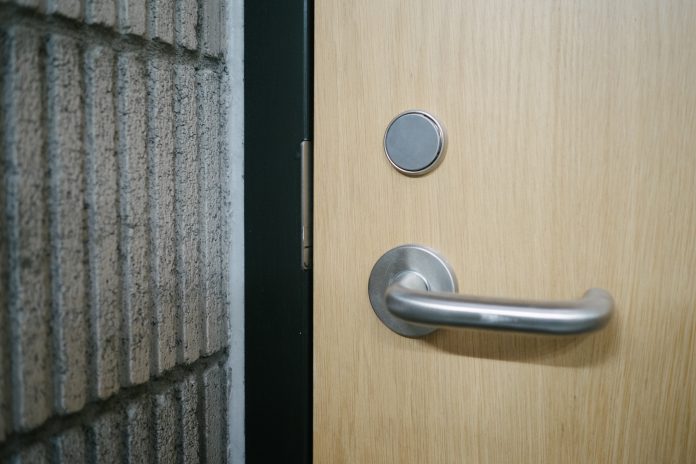
In her post, Lee raised concerns regarding the lack of locks on SFU classroom doors. (Chris Ho / The Peak)


Updated on October 13: This article has been edited since its original publication to include comments provided by SFU student Ashley Lee to The Peak.


A Facebook post detailing the campus violence incident which occured in Robert C. Brown Hall on Wednesday, October 3 alleges that the university did not assist the students who witnessed the event.

The post was created by SFU student Ashley Lee, who was in the room that the violent student eventually entered. At the time of publication, Lee’s post has gained approximately 2,500 Facebook reactions, over 1,400 shares, and over 700 comments. It has since been shared on the SFU subreddit.

In the post, Lee summarized the incident, which involved a student who became upset in his own class and then entered Lee’s classroom. The student began throwing tables and chairs at students, which left one student with blood running down her face and a concussion.

Between October 11 and October 13, The Peak corresponded with Lee about the incident. On October 13, Lee sent The Peak a more detailed account of her experience, noting that she had previously sent the information to a reporter from British Columbia Institute of Technology in an interview with them.

Lee wrote that her professor, Dr. Orion Kidder, had left their classroom to investigate when they heard someone screaming in another class. While Kidder attempted to talk the aggressive student down, he asked the students in Lee’s class to close and lock the doors, but the students were unable to do so as the door had no locks and it opened outwards, which made it possible for the violent student to enter Lee’s classroom.

“I have since discovered that there aren’t locks on any of the classroom doors at SFU (at least none that I have seen),” wrote Lee in her public post. Many of the classrooms at SFU, despite having locks, cannot be locked or unlocked without a key.

“Our prof told us to get out and run, which most of us did, except the girls who were hit with the chairs,” wrote Lee in the interview. “I was with the majority of the class who had to run up several flights of stairs to get out of RCB [to] where there was cell reception.” The students then flagged down a security officer who “smirked and didn’t think it was a big deal,” before attending to the situation.

According to Lee’s Facebook post, the class received a visit from a psychologist from SFU Health and Counselling and a security officer following the incident, upon request from Kidder.

“[They] basically told us the situation wasn’t that bad and we were all overreacting. They made us feel small and insignificant,” wrote Lee. During the interview, she spoke further to this, recalling that when the students asked the security officer to note issues like the lack of locks on the doors, “he didn’t even write anything down.”

Lee noted in her public post that since that visit, the students have not been contacted by the university. “It’s like they are trying to pretend it never happened.”

SFU has informed CBC News that “the student in question is no longer on campus,” and the RCMP has reported that the student has been apprehended under the Mental Health Act. An investigation into the matter is currently underway.

In an email interview with The Peak, Kidder wrote that Campus Security arrived at the scene after he had been talking to the violent student for several minutes. “Their priority appeared to be to secure the scene for the RCMP,” he noted.

Kidder noted that SFU had offered him counselling services that would not normally fall under his benefits package as an adjunct professor and a member of the TSSU, though they do fall under the benefits package of faculty.

Upon reaching out to Health and Counselling Services (HCS), The Peak was notified that communications around the incident are being managed directly by Tim Rahilly, SFU vice-provost and associate vice-president, students and international.

In an interview with The Peak, Rahilly confirmed that the university was aware of the incident. He noted that the university has been working with classroom instructors and department chair to have them provide information to the students who were affected by the incident.

“There were some classroom visits by staff from Health and Counselling and from Campus Security, but based on [student] feedback, we were concerned,” said Rahilly.

Rahilly mentioned that, since the university has noted the social media activity, it has begun reaching out to the affected students individually in an effort to match them with the support they need.

Rahilly responded to the portion of Lee’s post which commented that the student which sustained a concussion during the incident later took the bus home, saying that “it may not come as a surprise [ . . . ] that the university was not aware of the student who went home on the bus bleeding. That is not what we would want to occur.”

For students who have been affected by this incident, Rahilly noted HCS and My SSP as resources that could provide support.

Students are encouraged to visit HCS for in-person support. Students who indicate upon check-in that they were affected by the campus violence event will be given priority service, and HCS will attempt to connect them with support the same day.

For more immediate support, Rahilly noted that the My SSP app provides SFU students with 24/7 access to confidential mental support in various languages and platforms, such as telephone and messaging.

As of October 12, SFU has released a public statement on the incident. “I’m glad they are finally reaching out but it’s upsetting it took this long and required a bit of a fight, which has been even more draining on my mental health,” wrote Lee to The Peak.

“There is still a long way to go (we would like to know what safety measures are being taken and the girls who were injured should be apologized to and offered any help they may need) but we’re off to a good start,” she added.

The Peak has reached out to SFU Campus Security for an updated statement regarding the incident, but has not received a response as of this article’s publication date. More information will follow as this story develops.

With files from CBC News.

 

SFU volleyball sweep Northwest Nazarene University

0
The Clan are now one game above .500 with nine games left. (Photo courtesy of SFU Athletics)

On Thursday night, the SFU volleyball team played a strong game against Northwest Nazarene University, winning in three sets. The Clan pulled away from the Nighthawks in all three sets after some tight play in the first two sets. The win puts the Clan one game above .500, and the team will be looking to keep the momentum going so they can make the postseason.

In the first set, SFU faced their only adversity of the night, going down 11–8 early. However, a 10–2 run allowed the Clan to get the set back under wrap and they cruised to a 25–19 win. Betsie de Beer had five kills in the set, and was a catalyst for the mini-comeback.

The second set started off close as well, but again, a run by SFU would allow the team to cruise to a set win. This time, a 9–2 run was what seperated the Clan from their opponent, during which de Beer had three kills. SFU would go on to win the set 25–16.

There was never a question of who would win during the third and final set, as SFU got off to a hot start and didn’t falter down the stretch to their victory. They won 25–17.

“I thought we did a good job of staying focused and executing our game plan,” said head coach Gina Schmidt after the game, via an email interview. “NNU ran a different offensive system than the first time we played them but our block and defense did a nice job of neutralizing their hitters.”

The Clan now have nine games left on the season, and currently sit fifth in the GNAC with a 6–5 conference record. As to how the team can still meet their goal of making the postseason, Schmidt kept it simple: “Win games. When it comes to qualifying for the NCAA tournament, winning percentage is one of the most important factors for the regional and national selection committees. We got contributions from everyone last night and we will continue to need the help of every player on our roster to reach our goals.”

What’s next:

SFU will next host Central Washington University on Saturday, October 13 at 7 p.m. The Wildcats are currently 8–3 in the GNAC, good for second place in the conference.

Peak player of the game: Betsie de Beer

De Beer had a fantastic evening, leading the Clan with 15 kills and 16 points. “Betsie did an excellent job of moving the ball around tonight. She took advantage of what the NNU defense was giving her and found ways to score,” said Schmidt on her performance.

SFU women’s soccer extend unbeaten streak to five games

0
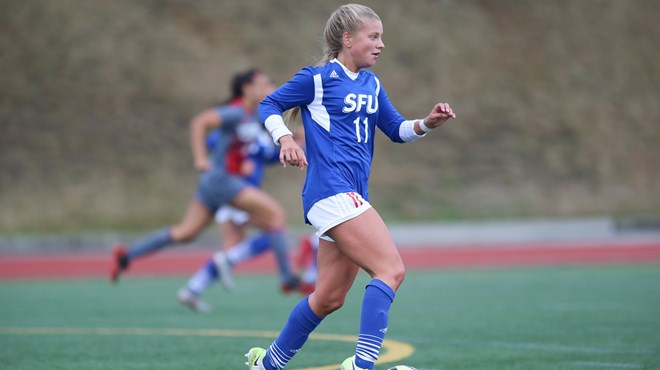
Jenna-lee Baxter's two goals and two assists now have her at the top of the GNAC in points with 20. (Photo courtesy of SFU Athletics)

The SFU women’s soccer team put on a masterful display Thursday night at Terry Fox Field. As the final whistle blew, they came off the pitch as 5–0 winners in a blockbuster game against Northwest Nazarene University. Coach Annie Hamel has her squad rolling as they improve to 5–1–1 in the Great Northwest Athletic Conference (GNAC).

The excitement levels were high from the start. SFU came close to going ahead, but couldn’t produce a decisive goal in the opening moments until Katelyn Erhardsen stepped up. As we have come to expect from her, Erhardsen produced a top-class move resulting in first blood. The 16th minute saw Erhardsen seize the ball in midfield and embark on a winding run through opposition defenders. NNU were quick to react to Erhardsen storming down the pitch but the midfielder’s graceful feet and tactile balance ensured possession was solely hers. Erhardsen picked a dangerous pass to striker Emma Pringle at the top of the box, who was clinical as ever: one touch to control the ball, and one to knock it in low, hard, and beyond the keeper.

Danae Robillard also contributed with her first goal of the season. Robillard scrambled SFU’s second goal over the line in the 32nd minute, after Jenna-lee Baxter showed great vision from the right wing, swinging a cross into the six-yard box which Robillard met: a memorable moment for the freshmen. Just moments later, Baxter was provider again, delivering a corner kick from the right wing which Emma Pringle headed home. This was Pringle’s eighth goal of the season and her second on the day.

Coach Hamel discussed her team’s thorough dispatching of NNU in a postgame interview, praising her senior players.

“It is not just the skill set. It is the leadership,” said Hamel. “Carli Grosso at centre back — the way that she commands the back line. Jenna-lee Baxter and Emma Pringle’s ability. Jenna can serve it anywhere and Emma will bag it. The twins, Christina and Alyson Dickson — same thing. They are fast and dynamic, and they cover so much of the field. I don’t teach that; they have that.”

With SFU holding a commanding 3–0 lead at half-time, Coach Hamel rotated her bench ensuring every player in the match day squad saw action in the trumping of Northwest Nazarene. It was valuable experience for fresh faces, combined with a sensational showing by SFU’s seniors.

Coach Hamel expressed her satisfaction with the team maintaining intensity levels while making substitutions.

“Trust and confidence were the two words we went into this game with and I thought they really stuck to the game plan. I thought we really exposed them,” said Hamel. “One of the awesome things about today was being able to get every single player on our roster into that game and have the level stay where it was and still dominate.”

The second half featured more of the same as SFU’s defensive game held firm. The rearguard held NNU to just three attempts on goal, none of which were any bother for Nicole Anderson who recorded a clean sheet.

After strong first halves, Erhardsen and Baxter’s influence on the game still grew noticeably. Baxter struck twice in the second half capping off the day with two goals and two assists. Her second was spectacular as Erhardsen found Baxter on the break. Eight minutes before the game ended, Baxter found herself alone against a single defender. She shifted the ball onto her right foot and released a powerful curling effort into the top left corner putting an exclamation mark on the 5–0 win.

After five consecutive games without defeat and tied for second in the GNAC standings, Coach Hamel spoke on her team moving forward. “We have had some misfortunes in the past, but this year, everything seems to be clicking and every game is clicking a little more. Now it’s about realizing how good they [the team] are.”

What’s next:

The SFU women play Montana State University on Saturday afternoon where they will be looking to extend their unbeaten run. You can catch the game at 1 p.m. at Terry Fox Field.

Peak Player of the Game: Jenna-Lee Baxter

Baxter scored twice and had a helping hand in two others. A four-point night for the senior and an all-round impressive performance sees her take the Peak Player of the Game nomination.


What If: Every student had free tuition for their first year

0
Photo by Gene Cole / The Peak

Think back to the days of being fresh out of high school. You never have to see your immature classmates again, you can enjoy the summer air for a few months, and you’ve got your most anticipated step of life on its way — paying several thousand dollars to start figuring out what you’re going to do with your life.

What? No? You actually just want time to find yourself without student fees breathing down your neck?

It’s unreasonable to think that a high school student can figure out what they want to do with the rest of their lives. Post-secondary should be a place to figure that stuff out more, instead of us needing to hit the ground running with debt and a life plan. With a free starting year, you can afford to make the time for things you wouldn’t normally do, like take an extra class, work a job, join a club, or even just make some personal time. You’d be able to make as much use of your young adulthood as possible.

Free first years for all those students would cost a huge amount of money of course, and that doesn’t come from nowhere. It’d probably come out of student fees and possibly government taxes, and realistically, some smaller healthcare and administrative fees might have to stick around. But once people have been given a mostly free year to figure out their life more, I’m sure that most of them would want to pay it forward to others.

How mentors are building a sense of community in SFU’s largest faculty

1
Image courtesy of OneClass

SFU is notorious for being a commuter campus where sad students come to school, attend their lectures, and leave with their heads down. It can be especially daunting to find a place to fit in and make friends during first year. Most students are coming to campus straight from high school, where they have had the same group of friends that they have seen every day for the past few years. Going through such a transition can be stressful, and most incoming students are not used to having to put themselves out there to meet people.

The Faculty of Arts and Social Sciences (FASS) Connections Peer Mentor Program attempts to fill this gap by helping new students meet new people while giving them mentors to count on throughout their first year. The program pairs up new students (mentees) with a more experienced student (mentor) to offer support, resources, or just a friendly face in the halls. It’s been running since Fall 2015.

Brian Fox, student engagement coordinator of FASS and the initiator of this program, explains a bit more about it in an interview with The Peak. For the first three years that the program was running, new students could sign up online and in the first week of school they would be paired up with a mentor – who are volunteers that apply, get interviewed, and go through training.

          Having had a difficult first year, I decided to become a mentor in my second year so I could help incoming students avoid my mistakes. It was a very positive experience for me, and I still talk to many of the people I have met through this program, including my mentees and other mentors! I would highly recommend that first years take full advantage of this program, and to return the favor by becoming mentors themselves later on.

Fox notices in particular that a lot of students come back and get involved with the SFU community in different ways after being a mentee. Whether it’s volunteering as a mentor their next year or getting involved in their departmental student union, mentees often return for that sense of community and to give back to the future generations of FASS students.

“There are lots of ways to feel more connected to this place,” Fox sums up. “Giving back will make your experience better.”

During the first few years, each student who signed up would meet their mentee either in a one-on-one meeting or at the welcome event held in September. Fox notes that the problem with this is that since students had to actively sign up for the program, they weren’t reaching as many students as they potentially could be, and they especially weren’t reaching the students who needed it the most.

For the first time this year, all FASS students who attended Welcome Day were automatically paired up with a Welcome Leader, who was also automatically assigned to be their peer mentor for the upcoming year. Students who were unable to attend Welcome Day also had the opportunity to sign up online to be included in the program.

Now that all Welcome Day students are automatically signed up for the peer mentor program, every new student gets to meet their mentor at least once, in a no-pressure environment, and it lets them know that they have someone they can always ask questions or hang out with. The program also hosts many activities throughout the semester that mentees and mentors are encouraged to attend, such as smoothie parties, outdoor movies, dodgeball tournaments, and more.

Fox explains that while all the mentors are trained to help their mentees and to direct them to the appropriate resources, the program is not only about that. A mentor is someone who new students can connect with, build a relationship with, and build a friendship with. It is not only about reaching out when you have a problem or need something, but also to have someone to say hi to in the halls, to meet up with to chat, or to do fun activities with when you’re stressed out. It’s about building a community.

Fox explains that many arts students do not choose a major for their first couple of years, and so it is often hard to find a community when you do not have a specific department to get involved with. It was for this reason that they chose to do one large mentor program for all of FASS, rather than for the individual departments. Not only does the program help orient new students and give them a sense of community, but it allows students to meet others from different departments and explore their academic options.

Fox’s vision is for every arts student to be connected to someone “where they actually feel like they can use this person as a resource and have a connection with them.”

“There are a lot of students who feel isolated and all it would take is to ask for help once or to say yes once. It’s about mental health and that stigma around feeling isolated. It is totally OK to feel isolated here . . . When we are able to connect new students with older students who already have a network at SFU, it provides a sense of community and connectedness. It helps students live in the moment.”

Staying In: The Five

0


Best for:

Crime lovers

Amateur investigators


The Five is an intense one-season series comprised of ten episodes, and is a cliffhanger-crazy mystery of a show that will keep you staying up late just so you can watch the finale. Harlan Coben, an American mystery and thriller novelist, is the creator of this British-produced miniseries. The basic premise of the series is as follows: four young friends (Mark, Danny, Slade, and Pru) go into the woods to play, and Mark’s younger brother, Jesse, tries to join them. When Mark convinces Jesse to go home, he never makes it and goes missing. A convicted sex offender claims he killed Jesse, but the body was never found. 20 years later, Jesse’s DNA is found at a crime scene.

     The complex and intelligent storyline not only deals with suspense and mystery, but also heartbreak and trauma. Little details are slowly revealed so the viewer can’t predict anything too far ahead. Even seemingly good characters carry suspicious secrets.

      The show also beautifully flashes back and forth in time as information is revealed. One scene of Jesse as a child reoccurs time and time again, and while I can’t reveal anything else without spoilers; all I can say is this show put in a lot of thought put towards the writing, filming, editing, and all-around production!

The Five is available on Netflix.


We don’t always need media to be good, it just needs to be reliable

0
Image by CW

Media has gotten better and better over the past few decades. Films budgets are swelling, TV content is way more diverse, and even mainstream video games are made with borderline cinematic graphics and writing. The best of what we can watch, listen, and read is always available for a wider audience than ever.

But quality is exhausting. I’ve started glazing over a lot of people recommending things as being important, and disregarding any sort of awards ceremonies to guide my media diet. I can’t remember the last time I’ve watched an Oscar-nominated movie, or watched a full series without diving into my phone during an episode and a half. It’s not abnormal for people to consume things much more casually, and people shouldn’t think about these things as guilty pleasures.

Something that fills this niche for me is pro-wrestling, particularly Monday Night Raw. This is a terrible television genre in a lot of respects: its entertainment value is often based on people putting themselves in physical danger, it can often be toxically masculine, and its scripted comedy often isn’t entertaining. There are a lot of good matches from incredible athletes to see every week, and instances of very good comedy, but its overall quality is quite low, to say the least.

These are all valid reasons to not watch Monday Night Raw in the first place, but the show has been on the air for 25 years and currently runs three hours of every week. Why? Because we know exactly what we’re getting each time: charismatic athletes trying to entertain a crowd. It doesn’t land every week, but it doesn’t have to, because it’s not the end of the world if a comfort-food show has a few rough episodes.

This is a quality that a lot of the higher-quality shows don’t really have. Netflix series like Stranger Things and HBO series like Westworld run on strict narratives that rely on each episode playing an integral part. Bad episodes hurt a lot harder when every episode is part of what the overall story leans upon. It’s the equivalent of going to a nice steakhouse where you’ve never had a bad meal only to be served an overcooked steak that you can’t get remade. To that end, media can just be junk food sometimes, and there’s no shame in a diet that consists of that most of the time.

As a student, culture is hard to keep up with between work, family, and most importantly school. A lot of the time, taking in a casual Netflix drama during our commute is exactly what we need. The superhero genre has definitely been filling this void for people lately outside of people’s homes, with three Marvel movies every year that all feature a consistent special effects and comical tones. These films rarely tend to be perfect, but thanks to their reputation they draw to the theatres a lot of people who usually just download movies once they’ve been out for a while. They don’t need to be perfect; they just need to be good enough for us to justify spending our time on them.

Of course, like junk food, it isn’t healthy for this to be your only type of media consumption. It’s important to try new things, experiment with other genres, and take in things that are topical. But there’s a reason so many people watch CW shows or play free games like Fortnite all the time: they’re easy to start up and don’t take a lot out of you. You’re allowed to be tired and not aware of what’s going on, and shouldn’t be ashamed to put personal enjoyment over quality.