Home Blog Page 334

Council Meeting — November 10, 2021

0
SFU Stadium with red seating
PHOTO: Krystal Chan / The Peak

Council elects new member for oversight committee on executive officers

Council asked for nominations of non-executive members to fill a vacant spot on the oversight committee on executive officers. 

According to the SFSS policies, the committee oversees the executive officers’ work, and holds them accountable to their duties.

Mathematics representative Ben Tischler and environmental science representative Chloe Homenuke nominated themselves for the position. Before the vote, council members had an opportunity to advocate for one of these candidates.

“I’ve worked really closely with him on the accessibility course practices campaign. And even though Ben joined relatively late to all the other members on it, after he joined the productivity increased,” said software systems representative Shashank Thanalapati in support of Tischler. “The knowledge he brought to the table in all our meetings was something that the other four of us had no clue about.”

Vice-president student services Matthew Provost spoke in favour of Homenuke prior to the vote. 

“I have a really big privilege of having Chloe on external and community affairs and they’ve shown nothing but really good work [ . . . ] providing really good feedback and ideas around how they want to support,” said Provost. 

Homenukes was appointed with 23 votes from council representatives. 

Council moves motion to make changes to SFSS COVID-19 in-person event guidelines

Vice-president internal and organizational development Corbett Gildersleve brought up the SFSS’ current guidelines for in-person events on campus to discuss with Council. Currently, events are restricted to 25 people following a guideline from this past summer. 

The motion called for SFSS to amend in-person event restrictions to align with the current provincial health orders, as well as “review and make changes to the in-person booking guidelines” for spaces in the SUB to accommodate for these changes. Specific capacities were not established.

“The SUB has been open for a couple months now, we’ve had a few updates to the provincial health orders [ . . . ] and students have asked us if these restrictions could be loosened,” said Gildersleve. 

He said some of these guidelines were due to operational constraints of smaller rooms and getting familiar with the SUB’s online booking system for use of space. However, he believes the SFSS in-person event guidelines need to be updated to align more effectively with the current event restrictions provided by the public health order.

According to the current provincial health orders, in-person event restrictions require proof of vaccination for over 50 guests and masks are required.   

SFSS president Gabe Liosis spoke in favour of loosening restrictions now that the vaccine card is being implemented and cases are lower. He emphasized the importance of providing messaging for students to host events safely. 

“I think heading into this direction, we need to put out some pretty strong communication and messaging around how to have safe events and really provide as much support to student groups as possible to make sure that these events don’t get out of hand,” said Liosis. 

The motion passed unanimously. 

Diwali should be given more attention

0
I should be able to celebrate Diwali on the day it’s meant to be celebrated. PHOTO: Udayaditya Barua / Unsplash

The end of October and the beginning of November mark the start of numerous celebrations all across the globe, most of which are religious. For example, the first week of November sees the start of Diwali, one of the most important and celebrated festivals for some people of South Asian descent. Many celebrate Diwali — about 500,000 Hindus in Canada alone partake in the celebration. This doesn’t even account for other communities who celebrate so it’s about time it gets the recognition it deserves. More specifically, universities need to give more importance and consideration to students who celebrate Diwali.

As an Indian who has celebrated three consecutive Diwalis in Canada, it’s incredibly disheartening to see the lack of attention it gets. This festival falls on different days every year, and includes praying at a certain time of day for Lakshmi Pooja (at least in the Hindu religion). However, Canadian universities do not give time off for these prayers. 

In India, Diwali is a multi-day extravagant celebration with family and friends. In Canada, I have seen relatives move their prayers to the weekend because they can’t get a day off work or school. This lack of understanding takes me by surprise — religious prayers shouldn’t have to be moved around because of work.

Christmas gets celebrated on whichever day it falls on during the week and is considered a statutory holiday. So if that’s the case, people should be given a day off for Diwali as well. Canada has Good Friday, St. Patricks’s Day, Labour Day, and Thanksgiving Day as statutory holidays. What is stopping them from making Diwali a statutory holiday too?

This year, SFU’s Indian Student Federation organized a Diwali Gala for South Asian students to celebrate Diwali. SFU’s Global Community organized a multicultural festival which included Diwali as well. Having student-run groups celebrate Diwali was a wonderful thing to see, but the lack of involvement from SFU was disheartening.

Since Diwali usually falls at the beginning of November, most students are unable to celebrate properly because it is the middle of midterm season. I could barely do anything for Diwali this year between work and studying. Not being given time to celebrate can often take a toll on those living with their parents and are unable to celebrate with them, or those living away from home and are forced to study all day instead of talking to family. 

More than 13 countries celebrate Diwali as an official holiday in some form. This makes me wonder why Canada, one of the more diverse nations of the world, can’t find space in its statutory holiday list for Diwali? 

Recognizing Diwali as a statutory holiday would not only be a sign of respect for the culture, but would also mean people all around the country can celebrate on the day it is meant to be celebrated. Making Diwali a statutory holiday might not seem like a major change, but to many South Asian Canadians, it would be incredibly significant. 

Students who use drugs deserve your support, SFU

0
Some post-secondary students use drugs, so why aren’t there more support services for them? PHOTO: Michał Parzuchowski / Unsplash

It’s an undeniable reality that some post-secondary students do drugs. Students may use drugs to keep up with a busy school schedule, due to social pressure, to manage stress, have fun at parties, or for other reasons. In a study of over 21,000 Canadian post-secondary students, 15% of respondents reported using illegal drugs, like cocaine or heroin, in the last year. Additionally, 15% reported misusing prescription medications, like pain-relievers or stimulants. 

So, why doesn’t SFU have better support for students who use drugs? The university offers support for many aspects of students’ lives like for religious needs, mental health, and sexual health. But, when it comes to substance use, SFU falls flat. The “Drugs and Alcohol” page on the SFU website offers resources to learn about drugs, overdose prevention, and suggests students see a counsellor or use MySSP if they feel their substance use has become problematic. 

The main advice is to call 9-1-1 or campus security if someone is overdosing. However, SFU security responses to health emergencies in the past have raised questions and some students might not feel comfortable relying on them when an overdose occurs. 

SFU Safety and Risk Services is expanding its current first aid course to include administering Narcan (medication for someone who is overdosing). But where are the drug testing sites? Drug testing resources? Support groups? 

UBC is a good example of a university supporting students who use drugs. Before Halloween weekend this year, UBC’s Social Justice Centre handed out fentanyl testing strips. Reportedly, they ran out of testing strips in two hours, demonstrating the need for such resources. UBC also has a Student Recovery Community which is a space for students in all and any phases of recovery, including harm reduction. UBC Okanagan has a Harm Reduction Team, which offers free and confidential drug-checking services to students. Other examples of support outside of a university setting include supervised safe injection sites and referrals to treatments like Opioid Agonist Therapy.

Support could be offered in two different pathways. Firstly, there could be support for students who want to stop doing drugs and recover — like treatment, counselling, and support groups. Secondly, there could be support for those who want to continue doing drugs and reduce harm while doing so — like drug testing sites, safe injection sites, and overdose prevention and response. Students deserve support regardless of whether they are trying to stop using drugs or not. 

Drug use is a highly stigmatized topic. More specifically, it faces structural stigma which is a form of stigma seen in large-scale policies, procedures, and opinions. An example of this is not providing high-quality services to people who use drugs, or not taking their concerns seriously. By recognizing and listening to the needs of students, the SFU community can fight back against such stigma and reduce potential harms individual students may experience.

Currently, SFU just isn’t doing enough for its students. Providing services and support to these students not only fights back against stigma and can reduce individual harm but is also a step towards making SFU a more equitable and inclusive community. Students who use drugs are students regardless, and deserve support from SFU.

Pandemic restrictions have lasting effects on childcare workers in BC

0
Box of crayon in foreground, a child in the background
PHOTO: Aaron Burden / Unsplash

SFU health sciences research associate Dr. Julia Smith recently published her findings on how social and governmental responses to the pandemic have overlooked childcare workers. In an interview with The Peak, Smith discussed her findings. 

Smith’s research looks at the initial school closures in BC from March to June 2020. She conducted interviews within the Vancouver Coastal and Fraser Health authorities with 16 female participants — eight childcare educators and eight mothers who used paid childcare. 

“What I heard very clearly from both [groups] was a real lack of recognition and support. Childcare workers felt unrecognized as essential workers,” said Smith. 

In 2020, when the initial restrictions and lockdowns were being put in place, “a coalition of early childhood educators requested that daycare be closed temporarily so they could get the right policies and programs in place to ensure the safety of children. And that request was denied,” said Smith.

Throughout the interviews, Smith noted, childcare workers expressed BC’s COVID-19 response would not have been possible without them, yet they weren’t given the same support from the government or the public. 

At the beginning of the pandemic public displays of appreciation for other essential workers were prominent as people took to the streets to clap them on, “but never mentioned childcare workers and they’re taking care of the children of the health care workers.” 

Smith said doctors and nurses couldn’t go to work if it weren’t for their access to early childcare workers. “I think the pandemic has really shown us how essential that work is, because none of us can do our job without it.

“Childcare has historically been neglected in terms of investments and development. And partly because it is a feminized profession that is seen as requiring few skills, and easy to do,” said Smith. “Because women do it, we do not value it as a profession.”

Childcare workers told Smith stories of their lack of access to personal protective equipment such as masks and other health necessities such as toilet paper in their environments. She also noted the importance of these things when dealing with children who are “not known for being super hygienic. Little kids [ . . . ] run around, they touch everything, and they want to be cuddled.”

The long term consequences of this pandemic response has severe implications for the health and well-being of childcare workers, according to Smith. She found childcare workers have lasting effects of trauma, such as high levels of stress and extreme anxiety. Smith said some women are not able to relax anymore and find themselves crying for no apparent reason. 

Their chronic mental health conditions are attributed to the extreme stress they have been under for over a year and a half, according to Smith.

Smith is calling on the government for more action. “We now have learned from COVID-19 we need to develop pandemic preparedness and response plans that include childcare so that when there’s a pandemic, childcare educators aren’t scrambling to come up with their own policies and procedures. They’re not public health specialists, they shouldn’t have to figure out the best way to prevent infection. There should be guidelines on that.”

For more information on the effects of the pandemic, Smith’s study can be found online. 

SFU launches gondola campaign for Burnaby Mountain

0
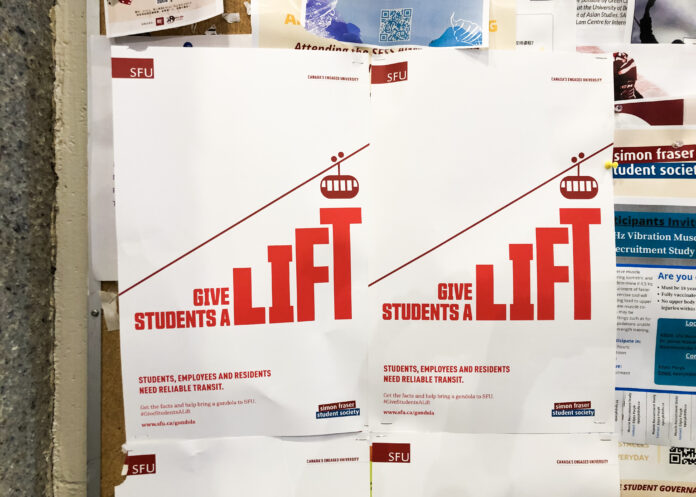
posters of the gondola campaign
PHOTO: Allyson Klassen / The Peak

SFU has launched a campaign in support of TransLink’s proposal to build a gondola from Production Way SkyTrain Station to the top of Burnaby Mountain. TransLink’s project plan is now complete and is awaiting approval by the Burnaby Mayor’s Council on Regional Transportation. 

SFU vice-president external relations Joanne Curry spoke with The Peak to discuss SFU’s support of the project. “Where we’re at now is a really important position,” said Curry. 

She reported SFU will likely present to the Council in January to confirm the Production Way route option. In order for the project to proceed, the preferred route and investment plan will need to be approved by the Mayors’ Council. 

Initial engagement for the project was started by Translink in January 2020. In September 2020, three route options were proposed for the gondola. TransLink conducted community surveys and found the route from Production Way to Burnaby Mountain was the most favourable. 

Curry noted this gondola would solve the transportation problems for staff, students, and faculty which have “gotten worse and worse over the years.” 

She noted the route from Production Way to Burnaby Mountain is one of TransLink’s lowest performing in terms of reliability, wait lines, and buses bunching up along the routes. 

“Over the years, this problem has been studied particularly by TransLink and the gondola is the very best transportation solution that’s been determined,” said Curry. It is an efficient, reliable, eco-friendly, and low-cost option for commuters, according to Curry 

The gondola would replace 50,000 hours of road time for the 26 fewer buses that would operate. This “would reduce greenhouse gas emissions by 1,700 tonnes per year,” according to SFU’s website. 

It could carry 3,000 people every hour and would be twice as fast of a commute from Production Way to campus. 

Curry is asking students, staff, faculty, and community members to share their stories so the Burnaby Mayor’s Council can see the degree to which the community needs this. 

“It’s much more meaningful if people give their personal story about how this will really impact their life and how the current situation negatively impacts their life. The more they hear from us, the more they realize this is important to the community and hopefully will feel that support,” said Curry.

Curry noted the gondola would have increased accessibility for people who require mobility accommodations. “This truly would be transformative,” she said. 

TransLink reports 25,000 trips are made via public transportation up Burnaby Mountain daily. Through their community engagement surveys they found out of 13,000 people surveyed, 84% showed support for this project. 

Burnaby City reports the 25,000 daily trips are “expected to rise as the campus and UniverCity community grow.”

The Peak reached out to the SFSS for a statement but did not receive a response by the deadline. 

More information on the benefits of the Burnaby Mountain Gondola can be found on SFU’s website. 

Contract Worker Justice campaign express concerns about SFU hiring Deloitte

0
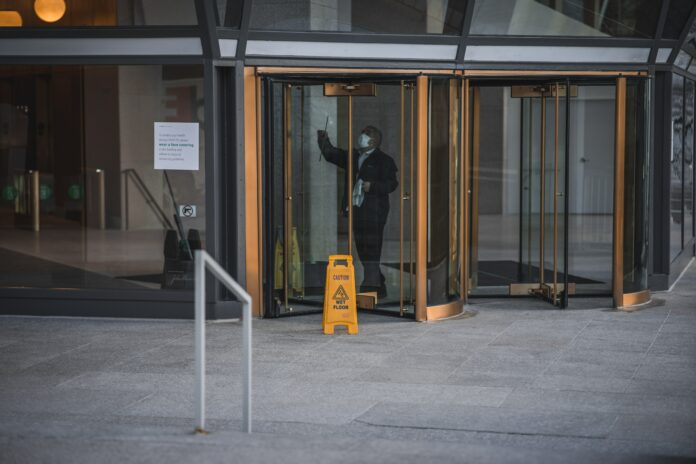
faraway shot of a cleaning worker wiping a revolving door with a yellow slip warning sign
PHOTO: Michael Cox / Unsplash

On September 10, 2021, president Joy Johnson announced SFU has hired Deloitte to analyze in-house versus contract-sourced food service and cleaning options for SFU. In response, the Contract Worker Justice (CWJ) released a press release stating their concerns with Johnson’s announcement. 

CWJ notes Deloitte is a private consulting firm which depends on outsourcing workers. The campaign group is “confused” by hiring the firm to do a study for a policy to end outsourcing work. They also note Deloitte’s “concerning business practices” such as tax evasion and tendency towards privatization. 

In their press release, CWJ stated they and the unions that represent the workers, Unite Here Local 40 and CUPE Local 3338, were not consulted about Johnson’s decision to hire Deloitte. 

The CWJ group is a coalition of workers, students, unions, and faculty members at SFU. Since April 2021, they have been campaigning for food and cleaning service workers to be hired in-house instead of being outsourced. Food and cleaning service workers are currently hired through Chartwells Canada, a third party company.

The CWJ’s open letter from April 2021 states outside contracting limits job security because job contracts are constantly re-tendered, meaning that contractors can’t guarantee employment to workers. Compared to universities such as UBC or UVIC who hire their workers directly, cleaning and food service workers’ wages at SFU are “significantly lower.” Contract workers at SFU have limited health and dental plans, no tuition waivers for partners and children, and no access to SFU recreational facilities.

The Peak interviewed CWJ campaign organizer Jade Ho and food service worker Mitch Hoganson. Hoganson said food and cleaning service work is highly precarious with low pay, as a result of being outsourced.

Ho said CWJ were encouraged by a meeting with Johnson in May 2021 to discuss their campaign. “Her response in the meeting was not very forthcoming,” Ho said. “But then after the meeting, she did talk about how she would like to move forward with cost[s] in the Fall semester.” Ho explained this discussion suggested changes to the food and cleaning service model were being considered, and CWJ would be included in the process. 

“It seems to us SFU is asking the question whether or not they should do in-housing, but we think that under all of the conditions we are in, the question they should be asking is, ‘How can we bring our workers in-house?’” Ho said.

“This is not a financial or economic decision to be made, it’s more of an ethical, moral issue,” Hoganson said. “If SFU is the supposed ‘engaged university,’ and the mantra and slogan of the university is ‘equity, diversity, and inclusion,’ by contracting out these essential workers, it’s a form of hypocrisy.” 

In an email statement to The Peak, Matt Kieltyka, SFU’s communications associate, media relations and public affairs, said, “SFU values our contracted workers and wants to ensure that they are treated fairly. The university also needs to do its due diligence and develop a full understanding of the value, risks, and impacts of such a major change.” 

Kieltyka said CWJ leaders would be a part of the stakeholder consultation and Deloitte would be scheduling an interview with them. In a follow-up email, Ho said CWJ have not heard from Johnson on whether they will meet. “It looks like we will only be consulted by Deloitte and will not be included in the process other than that. 

“We do not consider consultation a meaningful involvement in the process of something that concerns the workers. Workers should have full participation in every part of the process.”

Updates to the CWJ campaign can be found on their website. The CWJ can also be found on Facebook, Twitter, and Instagram, and interested parties can join their mailing list to find ways to volunteer or help. 

Community members call on SFU to take action against climate change

0
A climate protest with signage saying "there is no planet B"
PHOTO: Li An Lim / Unplash

SFU350 held a community panel on September 23, 2021 to discuss the importance of declaring a climate emergency and divesting from fossil fuels. The panel included SFSS vice-president of equity and sustainability Marie Haddad, GSS director of external relations Ruben Munoz, professor of mathematics Dr. Nilima Nigam, and chancellor at SFU Dr. Tamara Vrooman. Sonia Furstenau, leader of the BC Green Party. was the keynote speaker. 

SFU350 is a student-led club calling on SFU to divest from fossil fuels through a Climate Emergency Declaration Open Letter. The letter addresses seven demands that include decarbonization, divestment from fossil fuels, raising awareness, creating an SFU climate hub, climate justice, education, and discovering next steps. 

Vrooman noted during the panel “the one [demand] that speaks most to me is climate justice [ . . . ] If we are to think about a just transition, we must think about how it impacts those who don’t have the same privilege, decision making ability, and authority that we do.

“If it isn’t sustainable from an inclusive point of view, and if it’s not focused on the well-being of those who don’t have the same power to make decisions as we go forward but suffer the most at the hands of those decisions, it won’t be a sustainable solution.” 

Haddad agreed people in the community are being impacted by climate change every day. “We need to centre the most marginalized individuals who are being harmed, and amplify Indigenous folks [and] honour Indigenous sovereignty. The small steps to doing that [are] what’s outlined in the letter.”

Sonia Furstenau met with students at SFU for a meet and greet earlier that afternoon. She recorded opening remarks for the event which were played during the panel. “We know that the impacts of climate change are going to become increasingly severe, increasingly chaotic, and increasingly problematic. What we’ve seen decade over decade is a failure of leadership,” said Furstenau. 

Vrooman noted part of working towards divestment is being transparent about SFU’s actions so other institutions can interact with them. “It doesn’t matter if only SFU [divests from fossil fuels] if others don’t. So being transparent about the decisions we make gives confidence, information and insight to other institutional actors.

“When we talk about climate, we often talk about it being in opposition to doing the right thing for the economy, but it’s actually not. Time and time again, when we invest in things that are the future of our planet and our kids, chances are we future-proof and de-risk those investments.” 

Munoz discussed how climate change has affected him personally. He noted he comes from Colombia and remembers how the droughts affected the agricultural sector he worked in, which in turn became an economic problem. “I think about those people that did not have those resources, that cannot recuperate as easily as we did.

“It’s [interesting] to see how the Canadian government keeps promoting exploiting oil and keeps funding activities based on the exploitation of oil rather than making the switch,” said Munoz. Other Canadian institutions are switching to clean energy and divesting from fossil fuels but Munoz expressed his frustration at the government for their lack of action. “Even though foreigners and citizens are doing our part, [SFU is] not adding enough pressure for actual change.”

“The time for SFU to continue greenwashing is finished,” said Nigam. “It’s time that we declare the obvious, that we are in the middle of a climate emergency.”

Organizers and allies respond to SFU decision to hire 15 more Black faculty

0
SFU AQ outdoor staircase
PHOTO: Gudrun Wai-Gunnarsson

SFU Senate voted on September 13, 2021 to hire at least 15 Black tenured faculty. The new hires are to be made across various faculties to promote inclusivity and diversity of perspectives. 

Dr. June Francis, special advisor to the president on anti-racism, said in a statement to The Peak, “By voting in favour of this motion, the Senate of SFU is finally responding to what decades of Black students, staff, and faculty have been calling for — a university where Black intellectual lives matter.”

The motion was a collaborative effort by SFSS president Gabe Liosis and former SFSS president Osob Mohamed. Mohamed originally penned the motion which was later brought forward by Liosis.

In an email statement for The Peak, Liosis said, “Systemic barriers have for too long prevented Black folks from getting into faculty positions. We need to use all the tools at the university’s disposal to combat this systemic injustice. We cannot remove marginalization by using the same systems that marginalized folks in the first place — which is why the university [ . . . ] must be proactive in these fronts.”

The SFSS also provided unanimous support towards this motion, and Liosis hopes “SFU will prioritize this cluster hire to ensure its timely implementation.”

Students of Caribbean and African Ancestry president Balqees Jama told The Peak this motion was “a historic moment” towards a positive impact on SFU’s student life. Jama pointed to the positive impact of cluster-hiring of Black faculty, “Learning from Black academics is a chance for all students to be able to learn from experienced Black people about a wide variety of subjects. 

“This achievement is a direct result of Black students organizing and allies supporting. We made sure SFU is aware that we are watching and holding them accountable. We hope the university centres Black academics throughout this process to ensure this is implemented in an effective and safe way, and works closely with the SFU Black Caucus.” 

President Joy Johnson told The Peak, “Diverse perspectives, experiences and expertise strengthen our research, teaching and learning, and are a vital part of being a leading university. The motion approved by the Senate is an important step forward as we work to ensure Black faculty, staff, and students feel included.

“I am grateful to the students who brought the motion forward, and look forward to collaborating to deliver on these commitments.” 

This motion will be included in the 2022 faculty hiring plan. Francis mentioned that she, the SFSS, and Mohamed will be “holding the university responsible for swift action on this motion so that Black students, staff and faculty can begin to flourish.”

In a statement to The Peak, Marie Haddad, SFSS vice-president equity and sustainability, said, “To know that more students will be able to have Black leaders and professors in their department is touching, it has been a long wait and we cannot wait for much more to come — when marginalized folks win, we all win.”

Kristie Elliott becomes first woman in Canada to play and score in a college football game

0
Kristie Elliot in a SFU athletics t-shirt holding a football. Background is SFU stadium
Gudrun Wai-Gunnarsson

On September 11, 2021, Kristie Elliott became the first Canadian woman to play and score in a National Collegiate Athletic Association football game. Elliott, the SFU football team’s kicker, scored two points in the team’s game against Oregon’s Linfield University. This football game was the first game to be played in SFU’s new stadium. 

Kristie Elliot in SFU athletics t-shirt, holding a football on her left while wearing a helmet
PHOTO: Krystal Chan / The Peak

“I’m just going out there, playing football, doing something that I enjoy doing,” said Elliott to The Peak. “I guess it hasn’t really sunk in [ . . . ] I didn’t even know I was making history until after the game.” 

Theresa Hanson, senior director of SFU Athletics & Recreation, wrote to The Peak, “The atmosphere was so great on Saturday, and to perform well in front of friends and family is every athlete’s goal and to do it on this historic night in the opening football game of the season was pretty amazing.” She added, “I’m [ . . . ] proud of her ambition to break down barriers in sport, and her selfless dedication and commitment to her team and the program as a whole.”

Elliot shared she was unfamiliar with football before joining the football team in 2019. 

“Prior to 2019, I never kicked a football in my life,” said Elliott. “When I first joined the team, it was obviously a very overwhelming experience because I had never played football before, but the constant support from my team and from the coaching staff really got me to love the game.”

According to CBC, Elliott’s football career started in 2019 with a $40 bet she made and won with an SFU football player. She bet she could kick a 40-yard field goal and succeeded.

Kristie Elliot holding helmet and football
PHOTO: Krystal Chan / The Peak

Elliott added this historic achievement carries great personal meaning for her as well, beyond what the world sees. “I’m going out there, being the first Canadian female to score and play but for me, this is my first ever football game,” said Elliott. “[This] is a milestone for me personally just to go out there and know that I can actually do this.”

Elliott is the only woman on SFU’s football team with over 80 players on the roster. Six years ago, Hanson was the first woman athletics director to be hired at SFU. Hanson said although inequalities towards women in sports are improving, there is still a lot of work to be done. 

“We hire and/or attract qualified females in positions of influences across the sports platform to help lead the necessary evolution, where female athletic directors and football players are part of the fabric of sport,” said Hanson. “There are so many quality, accomplished, and brilliant women in sport, we need to continue to tell their stories and celebrate their accomplishments to inspire others to follow in their footsteps.”

Elliott said the coaching staff made the greatest impact on her by believing in and reassuring her every day. Elliott’s future goals consist of becoming the best player she can be, joining the Canadian Football League, and graduating with a degree in psychology and human development to help other athletes through mental hurdles the way her coaches did for her.

“I want to get into sports psychology [ . . . ] Kicking is a big mental game [ . . . ] I want to help other athletes with the mental aspects of their game,” said Elliott.

SFU football team’s next game is against Montana State University-Northern on October 16 in Havre, MT. More information on the SFU football team can be found on SFU Athletics’ website. 

Research assistants and TSSU rally outside Strand Hall

0
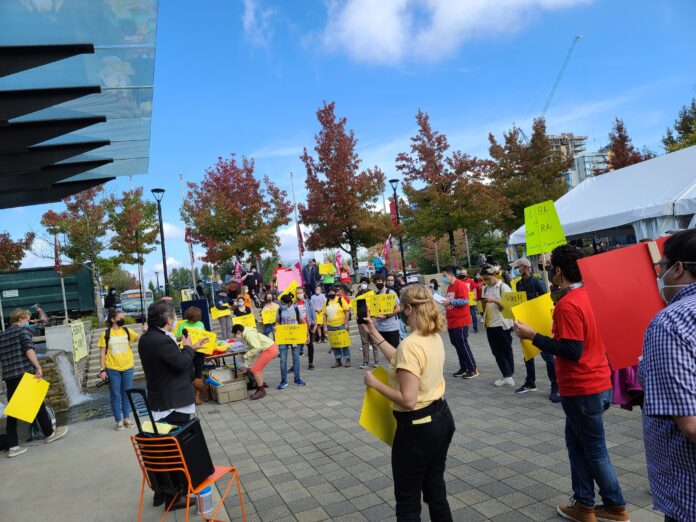
People wearing yellow shirts holding signs in protest
PHOTO: Yelin Gemma Lee / The Peak

The Teaching Support Staff Union (TSSU) held a rally protesting SFU administration’s continued delays with their research assistants (RAs) union contract outside of Strand Hall on September 23, 2021. 

In November 2019, SFU agreed to the voluntary recognition agreement that acknowledged TSSU as the union for RAs. Despite this, RAs have been without a contract for 677 days, and TSSU reported delays in the bargaining process. The Peak was present and observed the rally.

The rally began at Cornerstone Square on the Burnaby campus with introductory speeches by organizing leaders. After gathering everybody and handing out t-shirts, buttons, and signs, the group marched a short distance to Strand Hall. Protestors vocalized their agreement to testimonial speeches from RAs and covered the Strand Hall entrance with sticky notes and posters. 

The Peak interviewed Katie Gravestock, TSSU chief steward and chair of the TSSU contract committee. 

“SFU administration continues to delay bargaining by cancelling dates and showing up to the table unprepared to bargain. Recently, we’ve also seen SFU act in bad faith by going back on their word at the bargaining table. Their delays mean RAs are without critical protections and benefits,” Gravestock said.

RAs brought the following demands to the doors of SFU administration on Thursday: 

  • “inclusion of all RAs in the union, as was agreed in 2019, 
  • basic employment protections, many required by law, 
  • benefits and wages comparable to teaching staff, 
  • respect for the critical contributions that RAs give SFU.” 

Dugan O’Neil, vice president research and international, told The Peak SFU values its research assistant staff and bargaining for benefits and wages is underway. He stated SFU remains optimistic an agreement will be reached soon, and “if negotiations continue into November 2021, both parties have already agreed to seek the assistance of a mediator. 

“As current SFU employees, all RAs have basic employment protections. Negotiations for a first collective agreement is a very complex process, and in this case it has taken longer than anticipated for many reasons, including the diversity of job descriptions and contracts within this group, as well as delays related to the pandemic,” wrote O’Neil.

“While SFU depends on the labour of RAs and profits greatly from our work (SFU reports $167 million annually in research income), we don’t have the same rights and benefits that other workers at SFU have,” said Gravestock. “We’ve heard SFU’s administration say they want to do right by RAs, but blue sky promises don’t cover RAs prescription bills or dental costs. We need actual written rights in a collective agreement and we need them now.”

As a PhD candidate in human geography and an RA in labour studies, Gravestock is among the group of over 924 RAs who signed up as TSSU members back in 2019, and are still waiting for a contract. According to Gravestock, this initiative started when RAs realized unionizing was the best solution, and asked TSSU for support. 

Gravestock gave examples of many RAs having experienced late pay, no pay, or below legal minimum wage pay. She also said RAs have to pay $75/month out of pocket for International Student Health Fee while teaching assistants and tutor markers have it paid by SFU under their union contract. 

“TSSU is the largest union on SFU’s campuses. Our members do much of the face-time teaching and day-to-day research upon which SFU relies. Without these workers, SFU could not function as a university. SFU administration should remember our members’ willingness in 2012 and 2015 to take action when bargaining isn’t moving,” said Gravestock. 

“Until SFU abides by the terms of the Voluntary Recognition, until we receive the RA list data that we are legally owed, and until we reach a tentative agreement, we will continue to organize and put pressure on SFU administration to live up to their word!”