Home Blog Page 262

Local Chinese student bravely claims watching movies is therapy

0
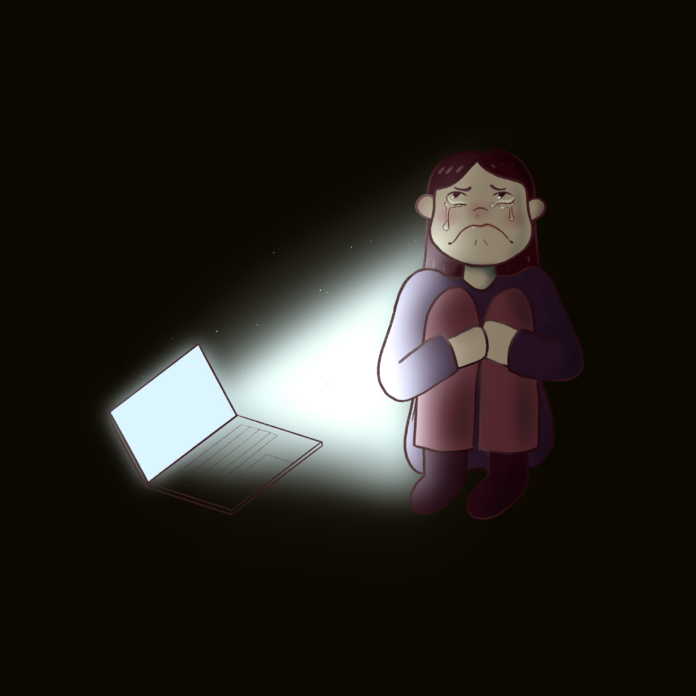
A person with tears down their face. They're sitting in a dark room lit with the glow of a computer screen. The computer/laptop screen can be seen in the foreground.
Or you could just talk to your parents. Hmm. ILLUSTRATION: Stella Nguyen / The Peak

By: Kelly Chia, Humour Editor

This week, The Peak scouted a student who was looking for an interview or a conversation about her experiences, “depending on our feelings and inclinations to heal.With a fond look towards Turning Red playing on her iPad, she confessed to watching the film in a “sort of marathon” to absorb the endorphins. She claimed the experiences as equivalent to three sessions of therapy. We asked her more about her experiences.

“Now, I know what you’re thinking,” the student began.“Your cultural experiences aren’t just generational trauma and it can be harmful to perpetuate that idea and pander our trauma to white audiences!” 

Kelly, or whatever her name might be, whipped a finger towards us. “You stop that talk right now, I’m not emotionally prepared for conversations about so-called ‘nuance.’” She turned her head back to her YouTube Movies playlist, where her mouse moves towards Everything Everywhere All at Once.

Another student, wishing to be anonymous, hurriedly approached us and whispered, “She’s been like this for ages,” they said, eyeing Kelly. “I’ve tried to ask her to just talk to her parents, but she says that eventually they’ll begin the process of emotional mitosis through movie watching,” they remarked. According to empirical evidence from our top sources, when a Kelly watches a movie with generational trauma, she gets an observable endorphin boost during the films’ infamous apology scenes — the hallmark of recent generational trauma movies featuring people of colour. 

“I’m just a girl, sitting in front of YouTube Movies, asking for Michelle Yeoh to personally apologise to me,” Kelly whispered reverently, as if on written cue.  

We ask if Kelly has considered family therapy, but Kelly waived the suggestion immediately, citing “Chinese parents.” The Peak declined to comment on the number of healing spaces available specifically for race and ethnicity, as she increased the volume of yet another musical number about being “free” from controlling parents. 

“This right here? This is all the therapy I need to fix the challenges I have with talking to my parents,” Kelly nodded decisively. “It’s so important that we have accurate representation,” she said, seemingly deciding to watch Crazy Rich Asians

“What do you mean it’s healthier to appreciate that parents and children can have vastly different experiences and understandings of the enormous sacrifice of immigration?” Kelly scoffed. “Oh, but I do have a pitch on my poems about offering sliced fruit as apologies if you’ll just listen—”

Do we need a “new left” after the Roe ruling?

0
Far-right court rulings, workers being abuse, and the impacts of climate change
Does a failure to address critical issues like abortion, climate change, and labour rights mean we need a new approach? PHOTO: Lori Jang, The Peak

By: Olivia Visser, Staff Writer, & C Icart, Peak Associate

The end of Roe v. Wade, the latest of a slew of rulings by a far-right US Supreme Court, underlines the need for a concerted, long-term effort by left-wingers to effect progressive change. Just like how right-wingers worked for half a century to construct a judicial framework willing to overturn Roe, the left might need a new movement to effect meaningful, long-term change on issues like labour rights, climate change, voting rights, and protections for minorities. 

Olivia: Ever since I found myself involved in politics, I’ve heard others stress the importance of civility. According to them, the “other side” won’t be as receptive to someone perceived as overly passionate about a social cause. My thoughts? Civility has gotten us nowhere. From politicians refusing to take solid action on crucial issues to social media “slacktivism,” it’s clear by now that the modern left is not working. There’s a trend of steadily increasing far-right ideology in Canada, and I don’t think a moderate approach will secure a healthy and happy future for our future generations. From climate change to democratic backsliding, western countries are suffering the consequences of left-leaning citizens getting too comfortable in their privileges while thinking they’re contributing to change through performative activism. And so it’s time the left stops relying largely on so-called “regular” civilians to champion progressive causes, day-in, day-out. 

The overturning of Roe v. Wade is a pressing example but only one of many that show our politicians aren’t getting the job done. We should have the genuine support of those with privilege and political power, instead of their performative and reactionary gestures. Don’t think abortion could ever be restricted in Canada? I’d say think again. One Conservative MP, Arnold Vierson, celebrated the Roe v. Wade decision and described abortion as “the greatest human rights violation of our time.” The silence from the rest of the Conservative party does not necessarily mean they disagree with the ruling, but perhaps that they’re waiting for a better opportunity to act against our country’s abortion rights. 

C: The overturning of Roe v. Wade is devastating. That being said, I think it’s essential to avoid a knee-jerk reaction about what the left should start doing because it obscures the work already being done. So many citizens have been doing the work for so long regarding abortion rights and many other social justice issues, like LGBTQIA2S+ rights and climate activism. I agree that we need to be patient, deliberate, and strategic. But to me, that means not attempting to reinvent the wheel every time something negative happens. 

The left consists of experts, activists, and community organizers working against existing power structures. Issues like systemic racism in politics can be part of the reason marginalized Canadians may favour non-electoral political activities. Marginalized leftists face obstacles getting into politics or feeling like they don’t belong once they get a foot in the door. For instance, in her farewell speech to the House of Commons, NDP MP Mumilaaq Qaqqaq said the racial profiling she regularly experienced from Parliamentary Protective Service made her feel unsafe. We need to pressure politicians, but we also need to recognize that systemic issues can get in the way of us having the politicians we want. 

Specifically touching on Roe v. Wade and what it means for Canada, we know that abortion is already decriminalized in Canada. The task is to keep it that way while improving abortion access. We need to stay vigilant against the creation of legislation that could open the door to politicizing and criminalizing abortion in Canada, but we have a decent legal framework for abortion in this country. That framework includes Section 7 (iii) of the Canadian Charter of Rights and Freedoms, which explicitly affirms Canadians’ right to abortion as part of their “personal autonomy and [ . . . ] ability to control his or her own physical or psychological integrity.” We don’t need a “new” anything. We need to start listening to activists and supporting their efforts.

Olivia: I’d argue that in many ways our government’s left is not representative of actual leftist values, and I’m sure you’d probably agree with me there. Activists have been doing hard work without recognition for a long time, and you’re right that marginalized people face significant barriers in politics. It feels like the left has gotten complacent by settling over and over for the “lesser evil,” which has contributed to systemic inequalities and poor governance. I, for one, can’t count how many times I’ve heard people say they’re voting for Trudeau because it’s the “safer” choice. 

By “new left,” I mean one that listens to the people who are already doing the work, so I agree with you there I just don’t think we have enough of that listening being done right now. I’m also not sure that leaving abortion legally untouched in Canada is necessarily a good thing. I do understand the argument that rights-based legislation might make it easier to restrict abortion in the long run, but I also think it could just as easily go the other way. By avoiding a clear stance on the issue, abortion remains a grey area in Canada, and we open ourselves up to even more difficulties in accessing the crucial service. Making abortion a legally protected right would help increase its accessibility, which remains a huge barrier. People often suffer when healthcare is left almost entirely up to the discretion of provincial governments. For instance, rural areas in Alberta, Saskatchewan, Ontario, and Manitoba have no public access to abortion. The R. v. Morgentaler case resulted in abortion being decriminalized, but we still have no legislation to protect fair and equal access to the service. 

C: You’re right. I agree that it is sometimes challenging to find leftist values represented. The deeper we dive into this conversation, the more I have a problem with the vague term “the left.” What is that? Right-wing reactionaries fear-mongering about “the left” and “the liberals” paints a far more unified picture of leftist politics than what it actually looks like. 

I think settling for the “lesser evil” is more of a centrist approach than a leftist one. Many leftists argue against that practice for the reasons you’ve named. The big way to fight the approach is through advocating for electoral reform, a failed Liberal promise. I think leaving abortion decriminalized is a clear stance; a clear stance that abortion is healthcare. By creating legislation, we separate it from other healthcare procedures by politicizing it. The Canada Health Act exists, and it promises universal healthcare. When that is not happening, that is not a policy failure or proof that we need legislation. It means that our governments are failing to enforce a regulatory framework we already have. We don’t need a new framework; we need consequences to be systematically imposed on provinces that do not uphold the Canada Health Act. Abortion should not be treated as a single issue. Many of the barriers that citizens face regarding reproductive justice are connected to other forms of marginalization. A legal rights framework is not the best way to address these inequities.

Olivia: Where we disagree is that I think abortion is already a political issue, and there’s no turning back from that at this point. It’s been made a political issue by the people who fight to criminalize our rights because of their personal beliefs. The US’ lack of federal legislation enshrining the right to abortion is in part what led to its overturning. Avoiding legislation in Canada to try and depoliticize abortion doesn’t make a clear stance, it opens it up to restrictions. Moreover, something being healthcare does not necessarily ensure unrestricted access. Abortion should be a single issue, just as other issues that are still healthcare-related are single issues. The process of Medical Assistance in Dying has its own legislation and understandably, its own restrictions. Someone going through the process must see two physicians and undergo a waiting period of 90 days after being cleared as eligible. If the same process applied to abortion, there would be serious humanitarian consequences. The Canadian Health Act does not do enough to protect equal access to healthcare because its very framework relies on the undefined phrase “reasonable access,” which counts on provincial interpretation. Decriminalization is not enough to make abortion accessible. To me, viewing it as the end goal of abortion legislation underlines a need for leftists to take bolder institutional stances. It’s very difficult to challenge corrupt systems with a non-systemic approach.

C: Abortion has been politicized, but it shouldn’t be. We don’t want the conversation to be about who is for or against abortion in the same way we don’t have conversations about who is for or against hip replacements. We agree that people need them, and we focus on finding better ways to provide them. I say that abortion is not a single issue because the folks with the most difficulty accessing abortion in Canada include those living in remote areas, people living in poverty, racialized, LGBTQIA2S+, disabled and undocumented individuals.

For this reason, I want to ensure we look at abortion as inherently connected to reproductive justice, gender justice, racial justice, and economic justice. This reminds us that the right to choose is not only about abortion. Even today, Indigenous women are being sterilized without their consent in Canada. Decriminalizing abortion does not inherently make it accessible, but neither does legislation. While the overturning of Roe v. Wade has brought this issue to the forefront, it is not a new issue. Sexuality and reproductive health (SRH) advocates across Canada have been doing the work and provide great insight into what still needs to be done. That includes increasing funding to provinces to expand SRH and implementing comprehensive health education in all Canadian schools. If you want to support them, I encourage you to read the BC Reproductive Justice Manifesto and reach out to your MLA and MP to ensure that addressing and funding SRH is a priority for them.

Experiences of older South Asian migrants in Hong Kong

0
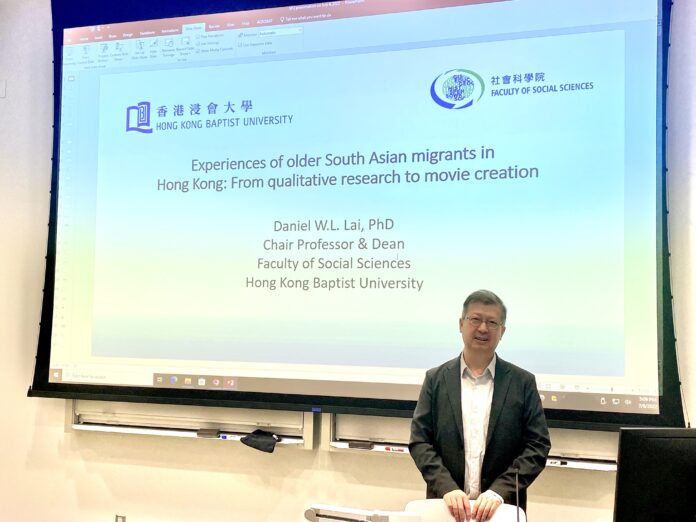
Professor Lai is standing in front of a projector screen that reads: Experiences of older South Asain migrants in Hong Kong: From qualitative research to movie creation. He is looking at the camera smiling.
Lai is the dean of the faculty of social sciences at Hong Kong Baptist University. PHOTO: Sarah Qiu

By: Nercya Kalino, Staff Writer

On July 6, SFU’s department of gerontology held a free public lecture presented by Dr. Daniel W. L. Lai, dean of the faculty of social sciences at Hong Kong Baptist University. Lai is also an adjunct professor in the department of gerontology at SFU. 

The presentation discussed the experiences of older South Asian migrants in Hong Kong. Lai’s mixed method research investigated ethnic Chinese and South Asian populations. Mixed method research is the use of more than one research methodologies such as qualitative and quantitative research processes. The topic highlighted ethnic minority groups whose needs are commonly ignored. Lai noted this is caused by the lack of attention to the systemic inequalities in Hong Kong.

The cost of private healthcare and the long wait times for access to public healthcare leaves people with few options. “Not seeking treatment is not just related to cultural norms but is also related to the systemic issue of cost. Hong Kong has a public health system, public hospitals, government funded community health clinics but unfortunately the waiting list is long,” Lai stated. 

He explained these limitations come from the wait for public healthcare and the cost of private healthcare, because older people are more likely to not have access to private family doctors. While the government has a health care coupon with limited appointments for private family clinics, those clinics will most likely not accept them to avoid the administrative burden that comes with getting them approved. 

Lai shared the process of the qualitative research which drew on the motivations of migration, challenges, and strengths of the aging South Asian population. This highlighted the experiences of the South Asian families in Hong Kong. The study involved 46 South Asian people who were 55 years and older. 

Lai explained the hindrances of the language barrier that is associated with accessibility of health care for immigrants. “Interpretation services in the health care system are very limited, most of the time people have to refer to finding family members and we all understand the difficulties of finding family members to do the translation [ . . . ] the time, privacy issues, those sort of things.” 

Lai shared the findings of the research that looked at the older South Asian minority groups, looking at their experiences and behaviors as well as stories told from their day to day living. He used an interviewing process that was conducted with the help of partner organizations to gain access to these South Asain minority groups. 

“Interestly enough, admittedly, I would say the majority of the medical staff work under high pressure because the people, the number of patients they deal with everyday, I think is almost triple or quadruple compared to the numbers of the rest of society,” Lai stated. He explained that due to the number of people seeking care, only a few minutes are spent with each patient, which is often not enough to understand the patient’s background. 

Another theme Lai discussed was the barriers in the healthcare delivery system. He noted most of the participants did not explicitly indicate racial discrimination within the qualitative section of the research. They indicated the medical services are not adequate and mostly unavailable due to the waitlist. They also suggested providing access to interpreters would be helpful. 

“When we are talking about social support, [there] are structural issues they are facing in terms of expanding their social network,” said Lai.

In conversation with Neha Sekhon on life cycle of a wildflower

0
Life of a wildflower photographed with a plant and a glass tiled wall in the background
Inspired by poets like Rupi Kaur and Atticus, Sekhon seeks to appeal to poetry enthusiasts of all levels. Photo Courtesy of Gudrun Wai-Gunnarsson / The Peak

By: Max Lorette, Peak Associate

SFU student and poet Neha Sekhon pours her heart and soul out in her self-published poetry book, life cycle of a wildflower. This book explores Sekhon’s coming of age story in an easily digestible way, all the while being heart-wrenchingly sad, celebratory, and hopeful. It features short form poetry and stylized letters reflecting upon various kinds of love, personal anxieties, and cultural identity. Inspired by poets Rupi Kaur and Atticus, Sekhon’s poetry appeals to both the seasoned and unseasoned poetry enthusiast. Upon reading her work, it’s apparent how much care, love, and vulnerability went into this collection, which prompted me to interview her and ask some burning questions.

Responses have been edited for concision and clarity.

P: I can tell from the way that you’ve written a lot of your poems that you put a lot of care into editing and revising them in order to get your ideas across. Could you walk me through your process of taking a poem from its first to final draft?

NS: Editing was the hardest part of this journey for sure. Because of how long the book has been in the works (over three years) a lot of them look very different from what they started out as, which is amazing to see because it’s evidence of how much my writing has grown. I am now in a position where I can get the same message across but in better words. Because it was self-published, the editing was very pressure-inducing; there was no professional editor to tell me that something was wrong — it was just me and my sisters reading it time and time again, hoping we weren’t missing anything. I will say that on a non-grammatical level there is comfort in poetry because almost every line can have a double meaning, so even if it might seem one way to one person, the next ten can read it and see something totally different. I guess that’s the beauty in this form of writing.

P: What was the process like in structuring the order of your poems and letters?

NS: I didn’t want chronological because I wanted everything to be mixed. I never wanted it to seem obvious that some pieces may have been written at a much younger age; I wanted it to flow. I also decided to stay away from the progressive chapter idea because it felt dishonest to an extent. Though I have been through and grown through many seasons of my life, I am not a fully formed being of full confidence and security. I can have a life-is-great day and then wake up the next morning feeling crushed by my anxiety and not knowing what I’m looking ahead at. I wanted it to come across as one giant letter, to flow as one piece, wavering in and out of different experiences and emotions.

P: A lot of your poetry centres around the concept of love, romantic love, heartbreak, familial love, and self-love. Could you walk me through what all these various kinds of love mean to you?

NS: This is an interesting question because love is probably the emotion I’ve struggled with the most in my life. My relationship with it has always been strange, I guess. Self-love was foreign to me for much of my childhood and adolescent years. They were so unfortunately shadowed by insecurity and shame and self-doubt that it left such little room for self-love. Familial love has always been so strong for me. It is in my programming, in my bones and blood, to carry family as my highest priority. My parents and sisters and onward extension have been central to my upbringing and, even now, continue to be so important to me. That definitely had roots from a cultural standpoint. When it comes to heartbreak, I believe that it can truly be caused by anyone: partners, family, friends, or yourself. So writing about those experiences and different forms of heartbreak helped me work through ones in the past and attempt to understand ones ahead of me. The book definitely helped me start to understand my relationship with romantic love; how I felt about it, how I wanted to feel about it, and how others feel about it. It helped me explore and see through my own fears and doubts about it.

P: What do you most hope that your readers will get out of your writing?

NS: I hope that they can relate to it. I loved writing these pieces because I knew that what was a letter to a version of myself could, to someone else, be an expression of their past relationships. I wanted to write something people felt. I wanted people to feel heard and understood because books and poetry did that for me. When a poem can put your loneliest moment into words — it’s so powerful. I hope at the end of the book they can feel something, whether understood or reflective; I hope they can walk away with a piece of the wildflower.

Currently, Neha Sekhon’s poetry collection is available for purchase on Amazon.

Federal government plans to move away from open-net pen salmon farming

0
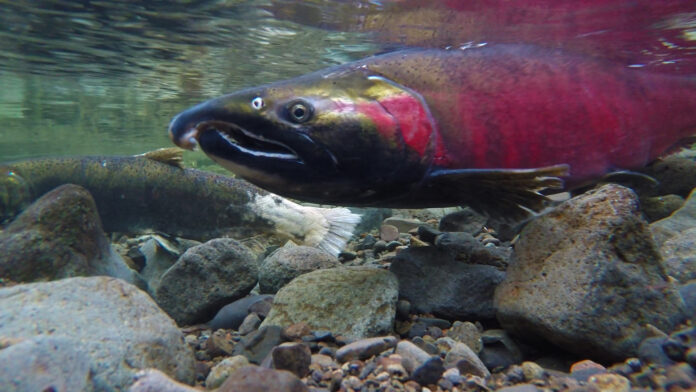
The photo is of a red salmon underwater. The fish is swimming in a shallow river above small rocks on the riverbed.
Proboszcz would like to see the farms phased out by 2025. PHOTO: Bureau of Land Management Oregon and Washington / Flickr

By: Chloë Arneson, News Writer

On June 22, Joyce Murray, minister of fisheries, announced the government of Canada has created a transition planning process to phase out fish farms in BC. 

In their press release, the Union of British Columbia Indian Chiefs (UBCIC) explained the Discovery Islands fish farm licences have been extended until January 2023. The extension was made to allow the government the ability to fulfill their “commitment to transition from open-net pen salmon aquaculture in BC’s coastal waters in a manner that protects wild salmon.”

The government will be working with First Nations title and rights holders within the industry, which UBCIC hopes will be a “concrete step towards the complete removal of fish farms from BC oceans.”

The Peak spoke to Watershed Watch Salmon Society science advisor, Stan Proboszcz, to learn more about open-net fish farms. 

“I think it’s a reasonable step forward,” Proboszcz said. “It’s the farthest we’ve ever gotten towards removing all salmon farms in BC. We’ve never had a federal government commit to doing that, and now they’ve limited their licenses to two years.”

Fish farms have been shown to have an extremely damaging effect on the natural salmon populations in BC. The farms contribute to the spread of pathogens among wild salmon. “Wild salmon across the board are not doing well,” said Proboszcz. “I think that the management and the oversight of the farms need to be a lot stricter, they have a lot of problems controlling their parasite levels.”

Proboszcz mentioned along with their importance to many Indigenous communities, salmon also play an important role in maintaining the health of local ecosystems. The fisheries manager of the Heiltsuk Nation’s integrated resource management department told The Narwhal the Neekas River saw only 750 salmon return to spawn in 2021, down from an average of 47,000 in 1970.

According to CBC, Fisheries and Oceans Canada will be sharing a framework for the transition within the next couple weeks. After the consultation period, they will release a final plan to phase out 79 open-net pen farms next spring. 

Proboszcz is hopeful about the future of BC’s salmon, noting this announcement will give the natural population a better chance of recovering. “What I would like to see is a staged transition of the farms out, and hopefully they will all be removed by 2025. I hope that next year we will see half the licenses aren’t renewed again,” he said. 

Watershed Watch Salmon Society will be releasing a seasonal forecast monitoring the health of local salmon species. To find it and keep up to date with BC’s salmon populations, you can visit their website or Twitter

Top 10 circumstances to get yourself in for an extension

0
Very calm, very cool. Nothing wrong here. Illustration: Siloam Yeung / The Peak

By: Isabella Urbani, Staff Writer

  1. Walk in wearing a full body cast

The least the teacher can do is help you actually enter the door of the classroom before granting you an extension. Heck, I won’t be surprised if they excuse you from the rest of your tutorials, and you shouldn’t be either. Go big or go home. Just make sure your story is tight. Worse comes to worse, go for the knockout and blame SFU. A lawsuit will kill off some time.


  1. Become Joy Johnson

This might not be the most time efficient plan, plus identity theft is a serious crime, but desperate times call for desperate measures. Who else could get you the extension than the prez herself? Visit your local party store, cop a blond pixie cut wig, pull off a stylish monochromatic jumpsuit, and instill the fear of God into your unsuspected TA.


  1. Kind-of-not-really tell the truth

Don’t lie, but make sure you fluff up the truth enough to leave your teacher in a difficult position to deny you. The rule of thumb is 10% truth, 90% exaggeration. But be very careful! There is such a thing as adding a little too much sympathy to your stories. Think odd, but possible. A racoon pick-pocketed your USB with your project on it!


  1. You’re hiding out

Oh no, there is a hit out on you! Tell your teacher that, long story short, you’ve got some bad blood with the library after you failed to pay the withstanding bill from that one textbook you borrowed and never returned months ago. Gwen Bird is out to get you! Last week, the library assistants threw a textbook through your window! Actually, maybe skip that part. Just tell your teacher you have to lay low for a week or so.


  1. Your house is haunted

Sorry, that paper proposal has to wait until the priest cleanses your house inside and out. Why can’t you head to the library? Well you see, these ghosts were rejected from SFU and hold a grudge against me from living out their dream, so they follow me everywhere I go. Really, I’m doing a favour by isolating myself. Seriously, SFU, just do me a solid and let them in.


  1. You’re stuck in a tree

As the good samaritan that only you are, you got stuck in a tree while trying to rescue the neighbourhood cat. Don’t worry, the cat’s fine, but you’re stuck and help isn’t on its way. Your phone died, but you managed to snap some selfies and send an email to your teacher. I guess you’ll just have to wait this one out.


  1. Reach out after the extension

Play coy. Say your internet has been acting up all week and you wanted to email your teacher to make sure they received the assignment. Perhaps even attach the assignment to the email, but forget to do so *wink wink* Double whammy. The turnaround time is pretty quick so be ready to pull an all-nighter to submit the assignment the next day. But an extra day nonetheless — score!


  1. You left your computer outside

HEY — HEY! WHERE ARE YOU GOING WITH THAT!?


  1. It’s the zombie apocalypse (only where you live)

You’re in your downstairs bunker fighting for survival, and yet you still made time to email your teacher. What a trooper. Make sure to update them by the hour. You don’t know how long you can keep these zombies at bay. I hear the antidote is an extension.


  1. Give yourself an extension

The project is only due as long as you think it’s due. This isn’t an excuse to completely write off your assignment, but take a good look at your calendar. This work is completely booked. Slot it for sometime next week.

Bugphobic person loves camping

0
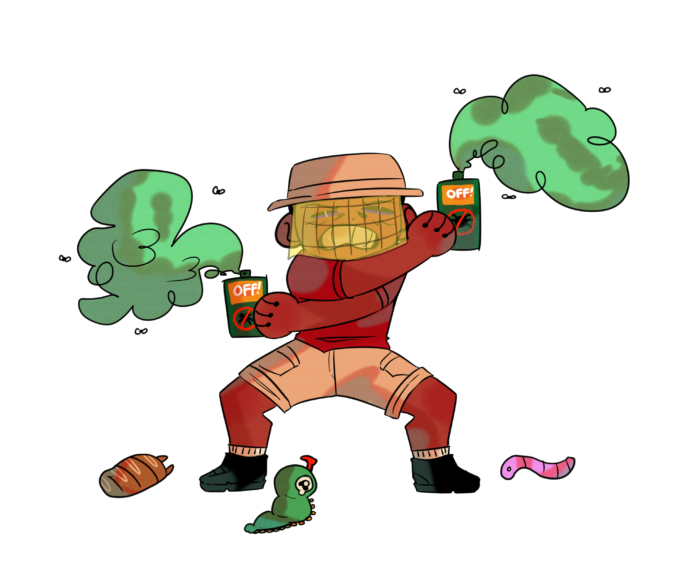
Illustration of a person in camping gear and a hat with netting around their face, in a fighting stance, carrying Bug spray in their hands
To flee or not to flee. ILLUSTRATION: Jiamin Bai / The Peak

By: Yelin Gemma Lee, Arts & Culture Editor

The best thing to do in summer is to go camping. There is nothing more peaceful than being out in nature with your phone on airplane mode and having deep soul-searching talks over the crackling fire. If only bugs would stop getting in the way of this pure unequivocal joy. 

As a person who experiences an intense case of bugphobia, there is nothing more terrifying to me than those . . . pests. I just don’t understand why they have to be all up in my grill. “LET ME ENJOY NATURE!” I remember screaming last summer when I met an earwig in the shower. I know what you might be thinking. If you don’t like bugs, don’t go where they live. That’s the thing though: those territorial motherfuckers live everywhere, even in my own apartment. 

But instead of cowering, I will teach you to fight back. The wanna-be-outdoorsy-Vancouverite edition.


Money can buy you courage

Last summer, my biggest purchase of the year was buying my own camping equipment from MEC, and now I can’t chicken out of going camping even if I wanted to. It would make no sense logically or financially. Did I build up my camp-fantasies by watching Laid-Back Camp, an Iyashikei anime? Absolutely! Who wouldn’t want to make s’mores by the fire with your unlikely friends? Did it make me have rose-tinted glasses about camping? A little bit. Nonetheless, investing in high quality equipment is the only thing giving me the courage to go camping sometimes. So, it works.


Study your opponent’s go-to moves

When you’re on enemy territory, you have to scope out the situation over there. You have to know the lay of the land, where their weapons lie, and what kind of soldiers they have coming to the front. 

Is there a body of water near the campsite you’re booking? Mosquito city. Look up the times in the day that are the worst for the mosquitos to be out and light a massive bonfire to kill those scrawly-looking Edward Cullens.

In fact, put your tent as close to the bonfire as possible to get the best effect. If your tent lights on fire while you’re in it, at least you will be free of those creepy little things leaving their mark on you. 

Mosquitos aren’t the only thing you have to worry about. The biggest concern is when you have to go to the bathroom or shower. When you’re in your most vulnerable state: naked and afraid. I take 5-minute military showers and somehow at least one bug gets all up in my grill WHEN I’M NAKED. Who does that? 

Campsite websites are never detailed about this critical information, they just say whether or not they have a bathroom and a shower. They don’t tell you if it’s an open concept with no roofs and a fluorescent fucking light attracting everything that flies, crawls, scatters, and sludges. Which in my opinion, is awfully suspicious of the campsite workers — whose side are you on? If you want to know, you just need to call. It works . . . sometimes. 

Unfortunately, my partner said the camp worker hung up on me because they thought it was a prank call. But I know better. She was on THEIR side, protecting top private information from getting out to their enemy. Well-played.


Emergency protocols 

If you’re in the trenches like me, the only advice I can really give you is to bring plenty of bug spray, citronella candles, blowtorches, bug traps, and holy water. If anything is swarming you or crawling up your legs, remember all bugs are scared of excellent dance moves. Proceed to aggressively Irish jig or tap dance, and may the hymns of death be your music. Whenever you open your tent flap to go in or out, make your body as straight as a pencil and torpedo your way inside, whipping around to zip the tent shut within split seconds! It takes some practice, but you’ll get the hang of it one day, young brave one. If you see me on your campsite this summer, sprinting like a track star, it is probably because a wasp is chasing me. I am pursuing nature, and running from it. Mind your business.

Parliamentary Budget Office declares TMX as non-profitable

0
The picture is of the TMX construction site. A construction digger is sitting in sand.
The TMX project is set to triple the carrying capacity of the existing oil pipeline. PHOTO: Adam Jones / Flickr

By: Pranjali J Mann, News Writer

The Parliamentary Budget Office (PBO) of the Canadian government declared the Trans Mountain Pipeline project (TMX) as non-profitable in its report on June 22. According to their analysis, the project will result in a net loss of $600 million. 

To learn more about this, The Peak interviewed Metro Vancouver’s Climate Convergence organizer, Alison Bodine. Climate Convergence is a collective of various grassroot climate justice organizations and activists working towards preventing climate change and protecting the environment from toxic pollution.  

As noted on the Government of Canada website, the TMX pipeline is set to triple the carrying capacity by twinning the existing oil pipeline, which originates from the Alberta tar sands. Bodine mentioned this expansion will increase tanker traffic in Burrard Inlet by seven times. The Rainforest Conservation Foundation reported this will have grave repercussions for marine and natural environments due to heightened risk of oil spills. 

Bodine pointed out this expansion is not fulfilling the Trudeau government’s 2018 claims in approving the expansion, where the Liberal government stated the project would help against climate change. “That has been exposed as a complete lie given the project did not create one penny to go towards so-called climate mitigation or climate action in Canada,” she said.

According to her, this public money could have been used for other public concerns. “People in Canada need money for real social justice, but that’s not only thinking about Canada divesting from oil and gas extraction projects. That’s also money for housing and health care and education, which I think is very critical at this time [ . . . ] so the money that’s going into building this disastrous pipeline is a losing proposition. And it’s really a complete waste.” 

PBO officer Yves Giroux said in an interview with CBC News that the report “does not take into consideration the broader benefits to the country.”

Adrienne Vaupshas, press secretary for the finance minister, told CBC News, “The Trans Mountain expansion project is in the national interest and will make Canada and the Canadian economy more sovereign and more resilient.”

The Canadian Association of Petroleum Producers believes the pipeline is now more needed than ever because of the global energy crisis which has been worsened by Russia’s invasion of Ukraine. 

Bodine explained the TMX expansion encapsulates and runs through the city of Burnaby. This poses both “human and environmental disaster and a great risk, especially to the 40,000 plus students that live up on Burnaby Mountain,” according to Bodine. 

Bodine called upon people to join the opposition and hold the government accountable. She commented, “We believe fully that this pipeline will be stopped. There is strong opposition from regular people across the Lower Mainland [ . . . ] And I just want to share that sense of hope with people, because I think a lot of this can seem really impossible, but change is possible. It is possible to stop these projects.” According to Research Co., a Vancouver-based polling firm, 55% of British Columbians are disappointed with the management of the project and 47% of people believe the pipeline poses health and safety concerns. 

She elaborated there are multiple opportunities to stand up for this cause. Climate Convergence and other climate justice organizing are great places to get involved in this “fight for our Mother Earth.”

You can find more information on campaigns and initiatives of Climate Convergence BC on their website.

Leaked Among Us movie script

0
ILLUSTRATION: Johanna Jucutan / The Peak

By: Kelly Chia, Humour Editor

Gentle readers,

The Peak received an exclusive sneak peek of a script we are afraid of . . . the Among Us movie.

Today is a sad day.

Nay, it is a sussy day.

Read and mourn the death of innovation, my friends.

INT. SPACESHIP — 20XX

The residence of six crew members. Once they were coworkers, even friends. Now, the pristine white walls reminded them they were among enemies.

    NARRATOR (VOICEOVER)

Space was supposed to be the next frontier . . . but it turns out we couldn’t overcome our greatest weakness: ourselves.

RED strides confidently into view. His bright neon space suit masks the horror on his face as he unmasks a death on the ship. Before him, GREEN laid face-first on the floor.

RED takes off his mask and flips his cropped hair, revealing . . . Chris Pratt.

RED/PRATT

Mamma mia! GREEN was meant to be the best of us! How could this happen?!

NARRATOR (VOICEOVER)

But deep down inside, CHRIS knew GREEN was weak. CHRIS and GREEN had a special relationship. When CHRIS had trouble swiping his ID card through the reader, GREEN would chuckle and help him. GREEN had human kindness. Perhaps that’s why they were the first to go.

Still, CHRIS knew what he had to do. He strutted suavely towards the emergency button and pushed down firmly! He’d be the HERO!

Three crew members slumped into the main office where RED was standing: YELLOW, BLUE, and PINK. Their identities are all obscured.

YELLOW speaks first.

YELLOW

What’s the big hoot, lil’ RED?

RED/PRATT

The “big hoot” is  death. GREEN’s gone.

NARRATOR (VOICEOVER)

With this serious revelation, YELLOW removed their mask to convey their shock and sadness. The unmasked? VIN DIESEL. The camera holds on DIESEL so the audience can cheer at his cameo. Unseen, he clutches a pendant in his pockets. The camera reveals text reading: Familia.

DIESEL does a conciliatory dab before speaking.

YELLOW/DIESEL

That’s not very pogchamp. Where’d you find the body?

NARRATOR (Voiceover)

At this, CHRIS despairs. He thought he knew the ship, but it felt like a maze at times. He vaguely points at the NORTHWEST corner of the ship. Nobody looks impressed.

BLUE

Um, Chris, that’s a bit sussy. What do you mean you don’t know?

PRATT tosses some finger guns at BLUE in response.

PRATT/RED

Sorry, I . . . I use finger guns to cope. Anyways, I saw a dash of pink exiting the bathrooms right after I found GREEN! Where were you four minutes ago, PINK?

NARRATOR (VOICEOVER)

PINK (19 to play 45) heaved a deep sigh. Somehow in that space suit, PINK made herself distinctive. She was like Jessica Rabbit but in space. PINK purrs at CHRIS’ accusation like it doesn’t even bother her.

PINK 

Fixing the Communications signal. You were right there at the body. Have a better answer than “I don’t know.”

PRATT/RED

Oof.

NARRATOR (VOICEOVER)

BLUE unmasks, revealing a surly hedgehog underneath. Out of the glove, a long, unlit cigar sits idly. BLUE is SONIC. He speaks with an uncharacteristically deep New York accent. He dabs.

BLUE/SONIC

So it’s you who killed our friend, eh? We don’t take well to liars on this ship.

PRATT/RED (EMOTIONAL)

GREEN was my friend first! I know I don’t know a lot out here, but neither do any of you!

NARRATOR (VOICEOVER)

Uh oh. CHRIS is in trouble. But what can he do against the legendary debating prowess of SONIC the HEDGEHOG? The crew seemed to descend into chaos, friends turned into enemies, enemies turned into imposters. Who was the killer?!

But it was sunset for the truth.

INT. SPACESHIP EXIT

The crew rounds up CHRIS, preparing to open the door seal.

NARRATOR (VOICEOVER)

Just then, CHRIS remembered there was another crew member who wasn’t present at the meeting! That white suit. Those sussy white paws! Why, he saw him snickering then. But it was too late.

RED/PRATT

Wait!

NARRATOR (VOICEOVER)

They did not wait.

CREW (COLLECTIVELY)

Hasta la vista, pal!

Red text beams across the ship, revealing CHRIS’s innocence. DIESEL takes off the sunglasses he was wearing underneath the suit.

YELLOW

No way . . .

Elsewhere, a WHITE suited astronaut cackled in the distance. Finally, they would have their star moment. All these years of being the school’s mascot and now they were the universe’s star.

WHITE/McFOGG

It’s time for the endgame. Welcome to the McFogg Multiverse (MFM.)

Comics

0
ILLUSTRATION: Sara Brinkac / The Peak

By: Olivia Visser, Staff Writer

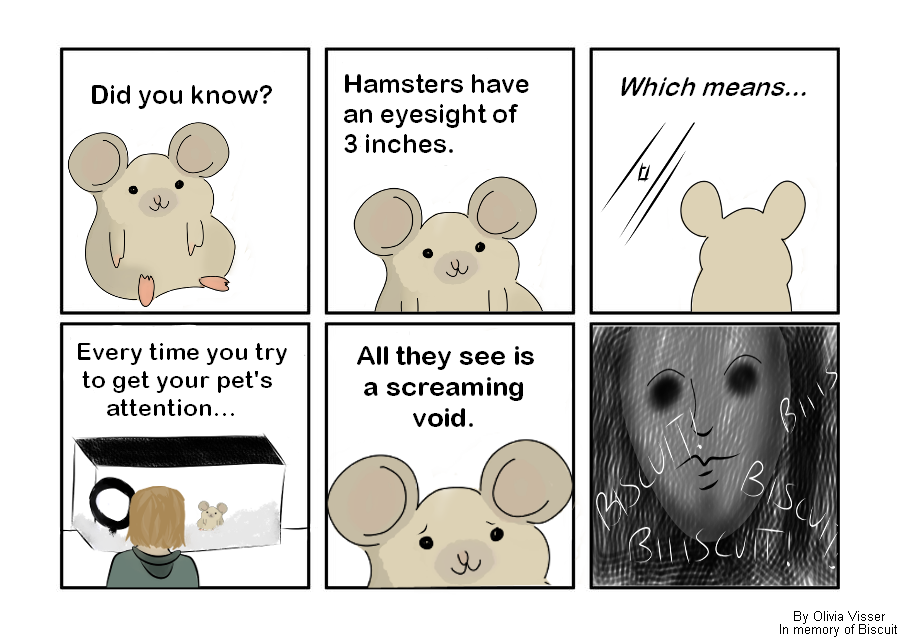
Panel 1: a round cream-coloured hamster with large ears sits in frame. "DID YOU KNOW" in big letters sits above it. Panel 2: The same hamster sits lower on the screen, with the text above reading "Hamsters have an eyesight of 3 inches" Panel 3: The hamster is seen from behind, looking out from behind glass. Above its head reads "which means..." Panel 4: A person with blonde medium length hair is seen from behind, looking at a glass tank with the hamster inside. "Whenever you try to get their attention..." is written above. Panel 5: The hamster's face is seen close up, with concerned looking eyebrows. The text reads "all they see is a screaming void". Panel 6: A sinister looking blurred grey face is seen amid a swirling black background. In the foreground is white text that reads "BISCUIT! BIIISCUIT! BIIISCUIT!
COMIC: Olivia Visser / The Peak