Home Blog Page 1129

Clan fall in West semis

0

WEB-W basketball-Adam Ovenelle-carter

The Clan women’s basketball season came to an end last week, following a 76–68 loss to the Montana State University-Billings Yellowjackets in the NCAA West Region semifinal.

It was the second time in as many years that the Clan made it to the semis, and though the loss to the #2 Jackets undoubtedly stings, it’s hard not to look at this season as a success.

After stars Nayo Raincock-Ekunwe and Kristina Collins graduated, the team was expected to regress. Though there were some struggles midway through the year, SFU still put together one of its best seasons in the NCAA.

“In a week, we’ll probably be pretty pleased with our season,” said head coach Bruce Langford, whose team was ranked third in the West, right behind MSUB. “There were a lot of high points, a lot of good points. We hit a bit of sickness in the middle and had a bit of a lull but we recovered from it and started to play pretty good basketball in the last three weeks or so.”

His captain agreed with him. “I think we had a tremendous season,” said Erin Chambers, the Clan’s leading scorer. “To get this far was great for the team.”

Chambers finished the game against MSUB with a game-high 33 points, but a 12–1 run by the Jackets to open the second half — which started tied at 35 apiece — put the Clan in a hole they couldn’t climb out of. But it wasn’t for lack of trying.

The deficit would reach 18 points with just three and a half minutes to play, but SFU went on a 10–1 run to close out the game, tightening up the score before time ran out on their season.

SFU finishes the 2013-14 season with an impressive 20–10 record. Though they must bid farewell to seniors Kia Van Laare, Marie-Line Petit, Chelsea Reist and Rebecca Langmead — all key contributors — they’re poised to bounce right back.

“In the next year, I’m really excited to watch this team get better,” said Chambers, who will enter her senior season next fall. “We’re going to go and we’ll all work on our game. We’ve got some good kids coming in and I think we’ll give it a good run next year.”

Enactus SFU sweeps the competition at regionals

0

enactus

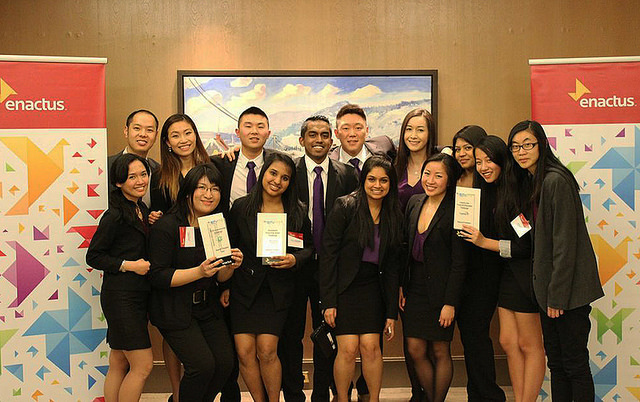
SFU made history at the recent Enactus Canada Western Regional Exposition, where the team swept the competition with their innovative entrepreneurial initiatives. For the first time in the group’s 22-year history, Enactus SFU claimed first place in each of the top categories.

Their Banner Bags initiative earned the number one spot in the Scotiabank Eco-Living Green Challenge; the entrepreneurial program Jumpstart landed first in the TD Entrepreneurship Challenge; and the Hunger Actions project seized the title in the Capital One Financial Education Challenge. SFU student Chantelle Buffie also won the HSBC Woman Leader of Tomorrow Award.

“This is a huge accomplishment, not only placing in the three categories but winning them all,” said Enactus SFU president Vanessa Lee in a media release. “We’re proud of the contributions all of our members have made to the community this year and look forward to riding this success into the national competition.”

Ben Hwang, a veteran of the competition, stepped behind the scenes to coach members of the entrepreneurial accelerator program, Jumpstart. The program supports aspiring entrepreneurs at SFU who may have a great idea, but lack the resources to put a project in motion.

Winona Bhatti also took the year off as a competitor to coach her team, Banner Bags, to a victory. The eco-friendly initiative teaches high school students how to transform old banners into bags and other fashion apparel.

Vameesha Patel, Manhei Lee, Mark O’Connor and Wendy Huang teamed up to bring their cause, Hunger Actions, into the spotlight. The program empowers low-income single mothers to budget for healthy lifestyles.

Despite Hwang and Bhatti having competed before, the team members told The Peak that the butterflies never really go away. “I think I had [my team’s] whole script memorized,” Bhatti said, laughing. “I was so much more nervous as a coach. I was nervous for them.”

Competitor or coach, it didn’t seem to matter: Jumpstart member Jason Monoharan  explained that climbing the stage, “you’re shaking. You’re pretty nervous. No matter how many times you practice, you’ll have nerves.”

Still, the team members expressed that the great pride that comes with presenting to the judges makes it all worth it. “Knowing that you did something special, it’s an amazing feeling,” said Bhatti.

The team is now preparing for the national competition in Calgary at the end of April, but Hwang said that the main goal is not winning: “We’re just really excited to see what other schools are doing, and to learn from them.”

The Right to Choose

0

muslim

Like every other middle class family in Pakistan, my house had maids — someone who cooked and cleaned, helped out with the household chores, and took care of us. My sibling and I developed strong bonds with these women, until they had to leave our house, and we said goodbye. We moved on.

When I was 13 years old, I had a maid named Parvati. She was named after the Hindu goddess who is considered to be the “ultimate source of power” by many practicing Hindus. I remember her fondly: chiefly for the fact that she was my very first student, instilling in me a passion for teaching that I have always held on to strongly. Every day after she had finished working, she would sit down with me, my star pupil, blissfully happy and eager to learn the alphabet.

One day, Parvati quit her job unexpectedly; her parents found out that she had engaged in premarital sex with her fiancé and gotten pregnant.

She stood at our doorstep one day, her childlike eyes filled with fear and sadness, as her aunt narrated what had happened, not letting go of a single opportunity to humiliate her or declare how the family’s reputation was now tarnished.

At first, my mother wasn’t sure how to react to the situation around me, torn between whether she should discuss it openly, or silently suppress the taboo my society had confirmed it to be. Meanwhile, I spent the following weeks asking myself: “Why didn’t she just abort it secretly and be done with it?” The answer, as I’ve learned seven years later, was never that simple.

What exactly is abortion? I remember my very first law class back in Pakistan, where my pro-choice, liberal, and exceptionally brilliant teacher had asked us the same question. “Killing of a child!” I replied instantly. She looked me in the eyes, saying nothing.

“So,” she finally replied, “Are you absolutely sure that it’s a child?”

Always an advocate for women’s rights and equality, I’d been stunned at my choice of words. It was an ironic, yet enlightening experience. If I, the pro-choice, liberal, yet naïve 17-year old feminist had just blurted out those words without a second thought, how much stronger could the responses be from those who were strictly anti-abortion, or “pro-life?”

No one has any right to deny a woman their right to choose.

···

“A medical procedure used to end a pregnancy and cause the death of the fetus.” This is, according to the Encyclopedia Britannica, the objective definition of an abortion. Naturally, our next question must be, what is a fetus? The same source defines a fetus as, “an unborn or unhatched vertebrate especially after attaining the basic structural plan of its kind; specifically: a developing human from usually two months after conception to birth.”

Most of us will recognize these definitions, but they do little to answer the key moral debate surrounding abortion: does a fetus count as a living “person?” This has been the drive behind discussions and arguments by pro-choicers and pro-lifers for centuries.

Judith Jarvis, in her article, “A Defense of Abortion” starts of with a compelling argument that the fetus has become a “person” before birth, but the right to life for the fetus is ultimately outweighed by the mother’s right to her own body.

Jarvis proposes a hypothetical situation. You wake up in your bed one day to find a famous, unconscious violinist lying next to you. He has been plugged to your body because he was found to have a fatal kidney ailment, and only your blood type can help him survive — if he stays plugged into you for nine months.

Are you compelled to agree to those terms? Of course not. However, if you say no, do you kill someone? Yes. Jarvis argues that, “You are not morally required to spend nine months in bed, sustaining the life of that violinist, but to say this is by no means to say that if, when you unplug yourself, there is a miracle and he survives, you then have a right to turn round and slit his throat.”

In this example, she illustrates a potential distinction between abortion and murder — one should be permissible, she says, while the other should not. Her argument is unique in that it recognizes the personhood of a fetus, but still argues that, morally, a pregnant woman has a right to choose.

Jarvis’ argument is reflected in an image macro I saw circulating on the Internet a while ago. It asked the reader to imagine a scenario where he/she has a baby in one hand, and a petri dish with an embryo in the other. If the reader was forced to drop one of these two, which would they choose? I think this puts things into perspective, and eventually forces a person to acknowledge the difference between the two — after all, which would you choose?

···

Since abortion was not a common practice in the time when the Holy Qu’ran was introduced, Islam offers no specific instructions forbidding the act as a whole. However, most Islamic scholars agree that abortion is impermissible after four months of pregnancy, as they believe that it is then when the fetus starts possessing a “soul,” and a life is blown into the fetus.

Seyed al-Sabiq, in his book Fiqh al-Sunnah, summarizes the differing views on abortion held by Muslim scholars. He cites the theologian Al-Ghazali, who argues that “when the sperm enters the ovaries, mixes with the ovum and acquires potential of life, its removal would be a sin [. . .] the graveness of the sin increases very much if one does so after the stage when the spirit is blown into the fetus and it acquires human form and faculties.”

Even in the case of rape, many Muslim scholars believe that abortion is not permissible after a period of four months, arguing that a child conceived in this way is still “legitimate.” While Islam does provide women rights when it comes to many other things, such as education, property, and marriage, it overwhelmingly restricts a woman’s right to choose when it comes to abortion, imposing rules and regulations at every turn.

Pakistan is a country where women are still fighting for basic rights, a country where women are burnt, tortured, and killed in the name of honour, a country where the Hudood Ordinances — proposed under the dictatorial rule of Muhammad Zia-ul-Haq — demand that for a woman to be considered a victim of sexual assault, she must bring in four eyewitnesses.

Pakistani women are constantly placed in submissive roles, and their ability to take control over their own bodies is an inevitable consequence of these conditions.

According to the Guttmacher report, out of every 100 pregnancies in Pakistan, 14 result in abortions. The report concludes by saying that “under current circumstances, many Pakistani women are paying with their health — and even their lives — to avoid births that they cannot afford or do not want.”

However, there is another side to this story. On a trip back home, I asked some of my Muslim friends what they thought of abortion. “I honestly don’t have much religious knowledge on the topic,” one began. “However, I believe that it’s something that should be exercised as [little] as possible. It truly is a sin. It’s hard to imagine legalizing it fully, as that probably means ending so many lives that one day could grow and prosper.”

I was surprised to see how different my friends’ views on the subject were from my own.

I set up an interview with Humza Khan, the president of the Simon Fraser Student Society, in order to ask him for his thoughts on abortion. Being raised in Pakistan and having his roots traced back to the Pashtun culture — a culture whose people are known for their warriors, hospitality, and sportsmanship — I was eager to see if his experiences, as a Muslim living in Canada, would match mine.

“I believe that a person, whether man or woman, possesses the right to do whatever they want to do with their body,” Humza told me during our interview. “It’s not for me to decide what a woman should or shouldn’t be doing with her body. We need to destigmatize it.”

I asked him how he reconciles these views with his Muslim faith. “The basic argument for anyone who is pro-life would be that you are basically destroying a life,” he began. “However, at the same time, is it fair for us to bring a life into this world, knowing fully well that they may not have the resources to survive?”

I breathed a sigh of relief as I walked out of his office that day. I now believe in my heart that many of my schoolmates — be they Pakistani Muslim, or otherwise — actively accept and support a woman’s right to choose, no matter what their social, cultural, or religious background may be.

···

A much less tolerant society than ours at SFU exists in India, the second most populated nation in the world. Eighty per cent of Indian women disapprove of abortion, and 56 per cent consider it to be a heinous crime — the sacred texts of Hinduism, and therefore those who practice it, forbid abortion at any stage. Unlike Islam, this doesn’t leave much room for discussion.

Many Indian women live in fear of torture and rape from the minute they step into the public sphere. For those living in a country defined by its harsh stances against a woman’s right to choose, the fear of violence and sexual assault pervades all aspects of daily life.

The 2012 Delhi gang rape case — in which a 23-year old student was raped by a bus driver and five other men, later dying from her injuries — resulted in widespread protests, both in India and abroad, against a perceived lack of women’s rights in India. In the aftermath of this traumatic case, I discussed abortion with an Indian student at SFU. “My religion considers it to be a sin,” she told me. “I believe that if a woman has the money and the resources to look after the kid she’s going to have, she should never abort.

Even though I wouldn’t get an abortion personally, I still strongly believe in others’ right to have one.

“On the other hand, I’ve witnessed the poverty in India, which is why I’d say that if she cannot take care of it, she should abort it. It’s better for the child.”

In the United States, the nation with the second largest Christian population of the world, Roe v. Wade (a milestone decision reached by the Supreme Court in 1973) established that abortion should be legal in all the states early in pregnancy, and should be prohibited later on according to the states’ discretion. According to a 2011 poll conducted by Gallup, 45 per cent of Americans were pro-life, 49 per cent pro-choice, and the rest were undecided.

I googled the word “abortion” and found a wide range of viewpoints, most of which were expressed in the realm of social media. The anti-abortion pictures and images that I came across were truly surprising.

One of them read, “Last year Obama supported the “right” to murder 1.2 million unborn children.” Another featured a picture of baby and the text at the bottom said, “Baby saved from late-term abortion when car dies on the way to the clinic.” Another read, “My baby is not a tumour or a toenail to be removed, a baby is a person.”

If a country with women like Wendy Davis and Hillary Clinton has people whose mindsets dictate thoughts like these, how can my staunchly religious republic hold onto any hope for women’s rights?

Even Pope Francis, whose liberal viewpoints have gained him widespread acclaim, recently spoke against abortion, saying: “It is horrific even to think that there are children, victims of abortion, who will never see the light of day.”

This is the same Pope who recently argued that it’s time for the Catholic Church to get rid of its “obsession” with homosexuality, premarital sex and contraception. However, after being pressured by the Church, Pope Francis exposed the limits of his progressive views: he may be tolerant of the LGBT community and the poor, but he’s not yet ready to take a stand for a woman’s right to choose.

No matter how liberal the Pope may seem, and no matter how beloved he is by his followers, we must be critical of the fact that he was not even willing to clarify whether abortion may not be immoral in the cases of sexual assault, or when a pregnancy endangers a woman’s life — something Islamic scholars have openly discussed and debated, with most reaching the conclusion that the woman’s life is worth more than that of the fetus.

It’s interesting to note that Islam, a religion that’s often misunderstood when it comes to the rights of women, and often considered oppressive and patriarchal, is significantly more tolerant of abortion than Catholicism or Hinduism. Still, from a religious perspective, it seems there’s little room for pro-choice arguments.

···

So, what does it mean to be pro-choice? I once had an open discussion with a few friends in order to undermine the social taboo of talking about abortions in public. We asked each other, “would you ever do it?” in order to question our beliefs and put our presuppositions to the test.

Would I ever get an abortion done? I’d been asked this question before, but I’d never really considered it. After weighing the options, I decided I would probably never do so myself.

“I believe that a person, whether man or woman, possesses the right to do whatever they want to do with their body.” – Humza Khan, SFSS President

Do I still believe in a woman’s right to choose? Of course! I feel everyone has as much a right to their own personal choices as I do to my own. Even if I wouldn’t get an abortion personally, I still strongly believe in others’ right to have one — whatever the reason. Pro-choice doesn’t mean pro-abortion, but it does support the idea that we all should be able to make our own choices about our own bodies.

Another poll conducted by Gallup suggests that only 35 per cent of the American people believe that a woman should abort if she or her family cannot afford to raise the child. Here comes the concept of abortion actually being ‘pro-child.’ I come from a country where abortion is not even an option for thousands of women in poverty, as they have no access to the proper medical care.

Do you know where their kids end up? Madrassas, fundamentalist religious schools where they’re clothed and fed, but taught to hate anything remotely un-Islamic. If they don’t end up there, these kids end up on the street, sold as prostitutes or used as drug mules for people too cruel and uncaring for you and I to ever understand.

I believe that there are children who should never have been brought into this world, because they are living a life full of suffering. This is one of the reasons I identify as pro-choice. Hopefully one day we will live in a world where children don’t face this adversity — but time and again, this proves to be more fiction than reality. Our world is still plagued by poverty, disease, and famine. How can one be expected to bring a child into such a world?

···

Canada is one of the few nations in this world that has laws that place no legal restrictions on abortions. According to Statistics Canada, the ratio of live births to abortions is 100 to 30.

The main decision that defined abortion laws in Canada was made by the Supreme Court in 1998 in the historic R. v. Morgentaler case, where the court stated, “The decision whether or not to terminate a pregnancy is essentially a moral decision and in a free and democratic society, the conscience of the individual must be paramount to that of the state.” Since then, abortion has been a right guaranteed to all Canadian citizens, and procedures performed here are among the safest in the world.

Still, there isn’t much difference between us and our neighbours to the south when it comes to public opinion. In a Léger poll conducted in September 2001, 46.6 per cent of the respondents said that they were personally for abortion, while 37.6 per cent said that they were personally against it.

However, that same poll dictates that 54.5 per cent of those respondents agreed that it’s a woman’s choice when it comes to her fetus and her body — regardless of their own personal views. This is a defining factor of our view in Canada, as opposed to the rest of the world. Even if you don’t personally agree with abortion, no one has any right to deny a woman her right to choose. Oh, Canada.

Finally, the Guttmacher report, last conducted in 2009, effectively subverts many myths we often hear about abortion, and proves to be a fitting conclusion to my argument.

The report states that a woman’s likelihood of having an abortion is statistically similar whether she lives in a developed or a developing region. In addition, once legalized or criminalized, abortion rates on national and state levels do not change. Legalizing abortion will not, as some argued, encourage more people to have them — it will, however, make sure that those who do are given the option to do so safely.

No matter where you stand on the ethics of abortion, consider this. Once we deprive certain people of the opportunity to make their own choices about their bodies, how can we claim to extend all people fair and equal rights? There is a difference between opposing abortion and opposing a person’s right to have one. In the end, the person whose body it concerns should have the final say, and no one else. We should all have the right to make our own choices.

SFU cracks down on academic dishonesty

1

A recent CBC survey has shown that SFU punishes over ten times the number of cheaters as UBC.

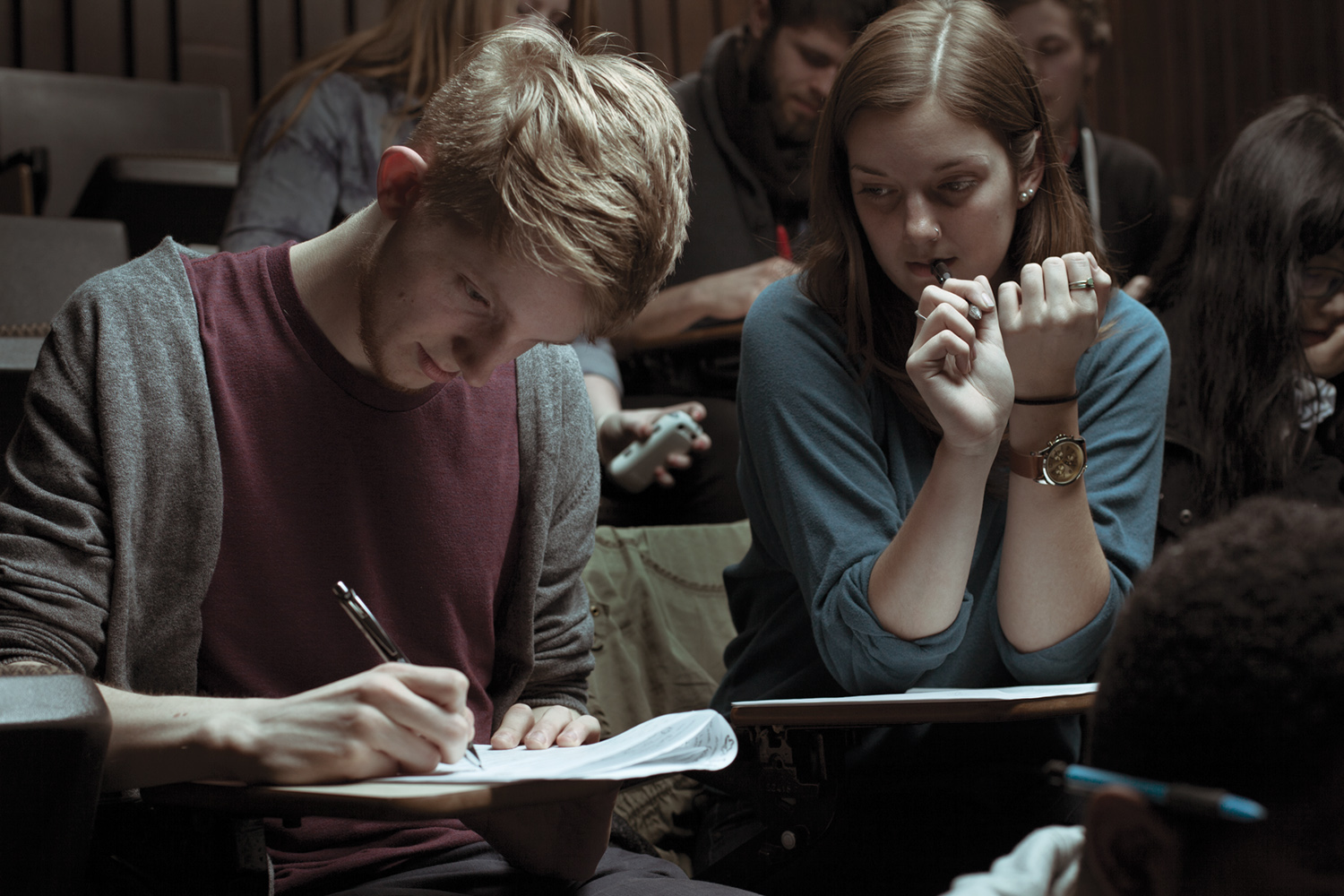
Rob Gordon, criminology professor at SFU, explained that the survey results, based on the 2011/2012 school year, measure the level of faculty reporting, not the actual occurrence of academic dishonesty. In total, over 500 SFU students were disciplined for cheating during that period.

“Our faculty members are much more active and aggressive with respect to academic integrity issues than our colleagues at UBC,” says Gordon. He adds that what was reported by the 42 post-secondary institutions surveyed across Canada doesn’t necessarily reflect reality, but reporting behaviour — something that SFU has been actively working to increase.

Since 2009, SFU has been keeping a record of all reported cases of academic dishonesty, enabling faculty to check a student’s history when determining a suitable punishment. SFU is the only Canadian university with an FD (failure due to academic dishonesty) grade, which Gordon says follows students throughout their professional lives and is reserved for severe cases, such as repeat cheaters.

A growing inter-faculty network, made up of academic integrity advisers and a university-wide academic integrity committee, is in place to educate students on the new policy and encourage staff participation. Gordon sees SFU’s high reporting statistics as an indication of how seriously the university considers issues of academic dishonesty.

“I don’t think any faculty member really wants to be a policeman around this stuff,” Gordon admitted. “They would rather students came here to study, to acquire knowledge, and all those other good things — but there are a proportion who come just to try to get a degree.”

Despite the fact that students face punishment for academic dishonesty, Gordon says that student interest is in favour of the university’s increasingly aggressive stance on cheating. SFU’s academic integrity policy was updated in 2009 in response to student concerns about degree devaluation.

Gordon claims that the university’s active approach to academic dishonesty and high reporting behaviour will keep a degree from SFU in good standing with prospective employers or graduate schools. He hopes that increased awareness and communication will deter students from risking their academic careers.

And when cheating does happen, Gordon said, “It’s actually easier to uncover than people might think.”

The Internet has proven to be both a blessing and a curse when it comes to countering academic dishonesty. While there are countless websites offering custom essays, written to order (and ready in only three hours if you’re willing to pay over $150, according to one website), anti-plagiarism search engines enable instructors to efficiently review suspected cases of cheating.

Plagiarism and cheating on exams were the two most reported infractions at SFU. The university is currently combatting essay writing companies, most of  which are unaffiliated with SFU and can’t be stopped by the university directly. While SFU continues to enforce its academic dishonesty policies, Gordon says government prohibitions are necessary to stop these companies from operating.

SFU’s policies are designed to reduce academic dishonesty to a minimum, though Gordon says he isn’t naïve enough to believe it can ever be completely eliminated.

If students are unsure about the scope of academic dishonesty, the library offers an online quiz that outlines unacceptable behaviour. Gordon adds, “I’m happy to say that I took it and I got a hundred percent. And I didn’t cheat.”

SFU needs better snacking options

1
WEB-SFU snack options-Mark Burnham
It seems all of SFU’s residents are tempted by our easily-accessible junk food.

“That’ll be on MasterCard,” — a phrase many students sheepishly mutter to the Tim Horton’s attendant on a daily basis. Overspending on convenient, quick (and usually, not-so-healthy) food is a common theme for SFU students.

At a university that prides itself on sustainability, why is it impossible to find a 50-cent banana to grab between classes? Why is it that even if you do remember to grab those leftovers before leaving the house, you have to descend to the depths of somewhere out of the way, like TASK 2, to find a microwave?

When taking a closer look at the structure of the school’s dining options, one can conclude that daily indulgences in quick, pricey snacks can be attributed to more than a little laziness on a student’s part. Is SFU setting us up for failure when it comes to our meal options on campus?

The most effective way to ask for something is with your purchasing power.

We all want convenience, and convenience they have given us. But the convenience that students are being provided with seems targeted at benefiting SFU financially in the long run, as opposed to the bank accounts and bellies of the student body.

Taking a look at recent initiatives implemented in the school, ulterior motives appear to be behind the scenes. Look at the (recently added) ATM availability, for example. You don’t have to look far to find an ATM conveniently sitting beside five vending machines full of chips and pop.

The suggested transaction here is undoubtedly convenient, but good luck finding something that will provide you with the nutritional value your body actually requires.

It is no wonder that students gravitate towards daily indulgences of chips and pop. Who wouldn’t when you only have 10 minutes between classes and a dollar in your pocket? The school is structured around an awareness that students often need to grab a quick snack between classes, but is not making healthy options nearly as available as sugary snacks.

If, by some miracle, you are lucky enough to find the last bruised and neglected banana at Starbucks, I hope you enjoy a nice big markup because that’s what you are going to get. Any new innovations of “fast fruit” for students are coming at a price.

When examining the services that are conveniently provided at SFU, a less than subtle bias is encouraging students to spend, spend, spend on foods that are getting them nowhere fast. By making use of these services and not demanding better, we are perpetuating the problem.

If we, as students, want better options while keeping our bank accounts out of the red, then we are going to have to ask for them. The most effective way to ask for something is with your purchasing power; so don’t buy things that you don’t want to see stick around.

If you want to keep off the freshman 15 and not see deficits by April, you best BYOB (Bring Your Own Banana), because SFU apparently isn’t going to sell you one easily.

Healthcare should cost more

0

The loonie I have in my pocket today is 1.48 per cent less valuable than it was this time last year. Such is the reality of inflation. Fortunately for me, as part of the CUPE 391 union, I don’t need to worry: my wage increases each year in order to factor in inflation.

This is generally referred to as a Cost of Living Adjustment (COLA) and is often written into collective agreements for unions. The COLA clause makes sense: if you’re working the same job, providing the same value to your employer, you should be paid the same real wage (factoring inflation).

SFSS’s upcoming referendum concerns essentially that — the students act as the employer, while our health and dental provider, Desjardins, is dealing with inflation and asking for something like a COLA clause.

If you’re not familiar with the referendum, let me explain. It asks two questions. The first  concerns offering an Enhanced Plan, which is $255 (includes a 10 per cent increase in basic dental, 10 per cent increase in prescription drugs, etc.) alongside the current Basic Plan at the price students currently pay ($198).

Well, obviously, we’re all in favour of freedom of choice. The tricky thing here is that if/when this first question passes, everyone will automatically be switched to the Enhanced Plan as a default. It will then be up to us to revert back to the Basic Plan if we want to.

The second question is where the COLA-esque clause is proposed. It asks if we are okay with the prices of our respective health and/or dental plans rising by a maximum of five per cent per year for the indefinite future, starting in the 2015-2016 school year.

When the Health and Dental Plan launched in 2008, we paid $198. Today, we still pay $198. Something had to give, and it did. Our plans have actually been scaled back three times, so our current plan covers less than it did in 2008. Now, while inflation historically hovers around two per cent, this yearly increase is also said to cover the projected increase in claims that Desjardins has to pay for.

If you’re okay with COLA clauses, then you should be okay with paying the two per cent inflation tax each year for your health and/or dental plan. When it comes to paying the other possible three per cent, it depends on whether or not you trust the intentions and the increased claims projections made by Desjardins.

If you choose not to pass this second question, our respective health and/or dental plans, whether they be Basic or Enhanced, will most likely be scaled back yet again in the near future.

We have to make due with what we have in this plan. At the end of the day, price increases are a result of our inflationary economic system. We’re angry when we see coffee costing us a dime more than last year, but it’s all relative. The referendum asks us to address this. Either you want to pay a little more to receive the same, or pay the same and receive a little less.

The choice is up to you, the members of the SFSS (all 25,000+ SFU undergraduates). We can vote from March 25 to 28 with ballots being sent to our SFU Connect emails. And, if you’re going to complain about the results, just make sure you’ve voted in the first place.

What are the Liberals smoking?

0

On March 5, Justice Minister Peter Mackay arose to announce that the Conservative government is considering a reform of our nation’s marijuana laws. The Liberal Party immediately took to Twitter, writing that “having shown poor judgement long enough, @minpetermackay finally agrees with @JustinTrudeau: time to reform our marijuana laws.”

The following day, a second tweet linked to a comic detailing the five Conservative stages of grief, accusing them of co-opting Liberal policy and counting it as cooperation. Neither of these tweets are true.

In claiming that Mackay agrees with Trudeau, one has to completely ignore the Minister’s own words, as he stated explicitly, “We’re not talking about decriminalization or legalization.” Far from the law being looser, this proposal will make laws concerning the possession of marijuana more enforceable for police, exactly the opposite of the current Liberal’s position to decriminalize and eventually legalize the drug.

More comprehensive enforcement is the opposite of legalization.

Under the Criminal Code of Canada, anyone convicted of possessing small amounts of marijuana, up to 30 grams, can be jailed for up to five years, with first-time offenders facing fines up to $1,000 or up to six months in jail.

However, many times when police officers recommend charges, Crown prosecutors tend to not follow through if the amount is under this limit. Though it may not seem like it, 30 grams is quite a substantial amount of product. This in turn has led to police officers turning a blind eye to marijuana use, as the most they can usually accomplish is confiscation of the drug.

Mackay’s proposal, which has not been drafted but which has the support of the Canadian Association of Chiefs of Police (CACP) and the Prime Minister, would give officers more enforcement options to deal with those caught in possession of marijuana.

It is likely that the ability to give formal charges would remain on the books, as there will continue to be cases where charges are appropriate to the situation, but it is the belief of the CACP that the large majority of possession cases could be more efficiently dealt with through tickets, rather than a lengthy legal process.

Some critics have said that this ticketing system is a half measure at best, and that a ticketing system muddles whether or not it is acceptable under the law to carry small amounts of marijuana.

I don’t see how this is the case. Ticketing systems are already in place for a variety of activities that are illegal, such as jaywalking, drinking in public, and speeding. It is difficult to cast doubt on the acceptability of these activities from a legal standpoint, though I’m sure all of us have done at least one of those three things, and maybe even been caught. This is not a half measure, it is a method of ensuring compliance with the law as it now stands, whether we agree with that law or not.

This proposal is not a co-opting of Trudeau’s legalization policy, nor is it a step in that direction, and it is difficult to see how one could think that is the case. More comprehensive enforcement is the opposite of legalization. It is a step to make the current law more functional not a step towards abolishing it altogether.

This proposal is a step in the right direction, showing that we want consequences for those who break our country’s laws.


SFU hockey upset in semis

0

After opening the BCIHL semifinals with a loss to the Trinity Western Spartans by a score of 3–2 at the Langley Events Centre, the Clan hoped to bounce back Friday when they faced them again at the Bill Copeland Centre.

The Clan did just that, with goaltender Ryan Parent notching a shutout in a 2-0 victory. Special teams were in SFU’s favour with an effective penalty kill, thwarting all seven Spartan power plays, and also scoring one power play goal.

SFU started out with the offensive edge, however an early penalty to the Clan evened up the momentum, and TWU goalie Silas Matthys made some key saves on SFU chances. Parent was not to be outdone, however, making a brilliant save with just a minute left to keep the first period scoreless, with the shot count slightly favouring the Clan at 11–8.

However, the Clan dominated the second period, holding TWU shotless for nearly seven minutes. Before the Spartans could even muster a shot, second year Clan forward Nick Sandor opened up the scoring on the power play with 16:04 left in the period, which would end up being the game winner.

A series of penalties for the Clan nearly resulted in a goal for TWU with Spartan forward JP Villeneuve deking past everyone, only for his shot to get blocked before it hit the net.

Fresh off the penalty kill momentum, the Clan’s Kale Wild set up a backhand one-timer goal by rookie Yan Kalashnikov with a nice feed, putting SFU at a comfortable 2-0 lead which would hold for the rest of the game. Defenceman Jared
Eng also notched an assist on the goal.

After being dominated offensively in the second period, TWU mounted a pushback in the third, taking the shot count from 26–13 in SFU’s favour to 31–29 after the third, still in the Clan’s favour. However, neither side generated much offence in the third, keeping victory hopes for the Clan in tact.

A lacklustre power play by the Spartans at the end of the period and a poorly timed penalty with only 1:34 left ensured Parent’s shutout and the Clan’s victory in a mostly dominant game for SFU.

However, the Clan went on to lose Sunday night in the pivotal game three by a score of 4–1, despite out-shooting the Spartans 41–17.

An inability to capitalize plagued their Thursday loss, in which they outshot TWU 43–18, and was noticeable even in their 2–0 win Friday; it came back to bite once again, causing a disappointing upset in the best of three series.

The Trinity Western Spartans, who have never placed higher than third, will face the reigning champions, the Selkirk Saints, in the BCIHL finals, while the Clan head home early.

Wake up and smell the bacon

0

WEB-smell app-Mark Burnham

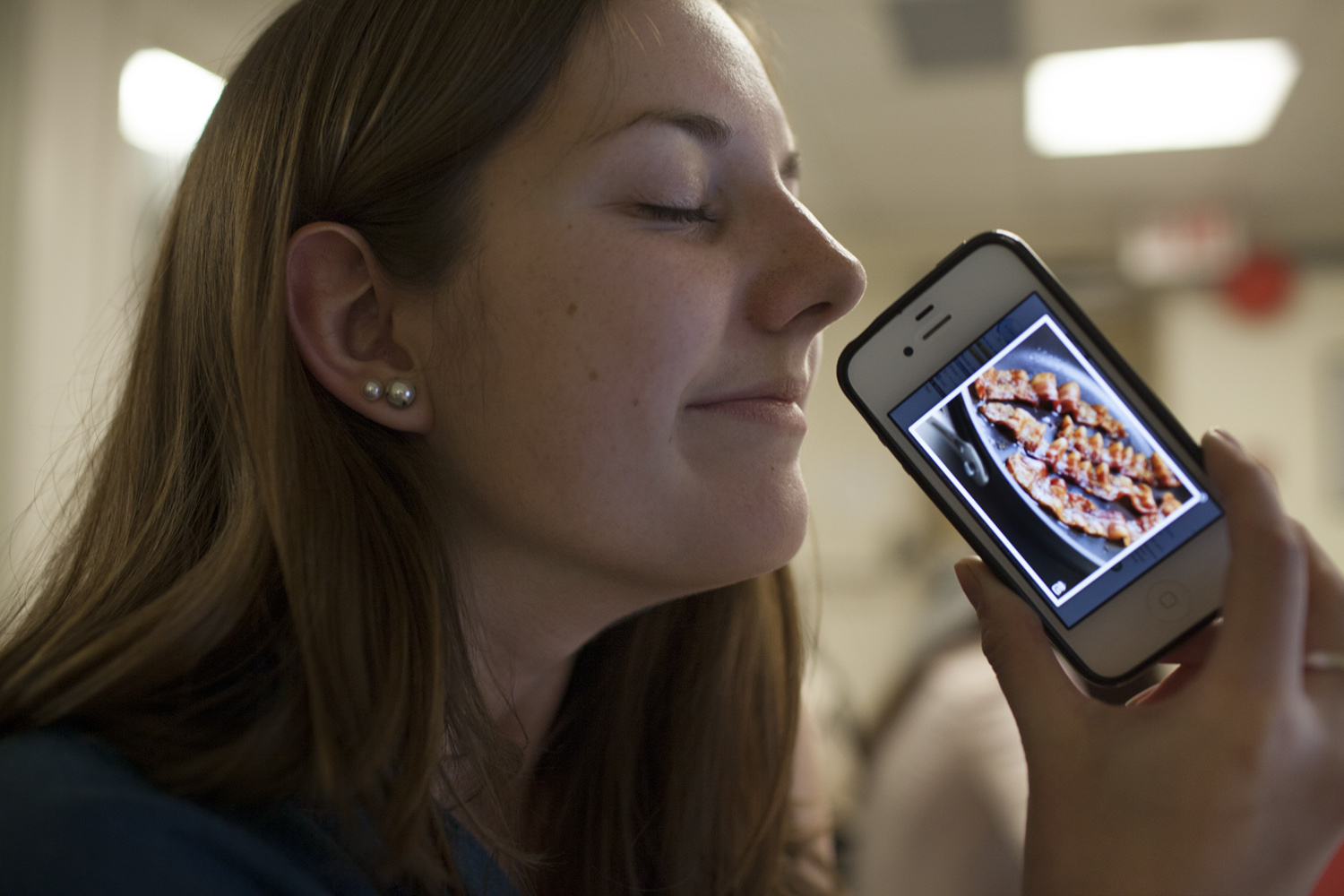
Apparently, the time for sniffing our iPhones has arrived. “Scented” mobile apps are an emerging product, along with their small mobile accessories which plug right into the headphone jack. The accessory emits a puff of scent in accordance with whatever actions are being played out on the iPhone screen.

I have to say, the more I ponder this concept, the more I dislike it.

With mobile apps such as “Scentee,” an app based out of Japan, users can now send these smells to each other all across the globe. “Scentee” comes with over 100 different scents, such as coffee, roses, chocolate and even corn soup (yuck?).

When I finally wake up, I will groggily wander into the kitchen only to realize there’s actually no real bacon?

Koki Tsubouchi, CEO of “ChatPerf” and creator of “Scentee,” claims that the new dimension of messages that scented apps provide can bring people closer together.

Alright, I understand how this may be intriguing at first. Receiving a pleasantly-scented message from a friend or loved one may add a nice touch to text messages. But I think we should seriously consider the negative aspects of scented apps. And trust me, there is a plentitude.

Apart from the potential for scents to become old very quickly, a downfall of an app such as “Scentee” is that it’s currently only able to hold one scent at a time. The user would have to reload the plug-in accessory with a new scent-chip in order to receive a different smell.

In other words, there are no surprise smells here. If a lover is going to send you roses, they’re going to have to notify you first. Otherwise, if you have “asparagus” plugged in, your Valentine’s Day might not turn out so hot.

Additionally, I have a beef with food-scents (pun intended). I’ve noticed that most of the scents one can buy are various types of food. This is a bit of a tease. I’m even more irritated when I read about apps, such as “Poptopia,” where bursts of popcorn scent are puffed into your face as you pop the kernels on screen. I enjoy junk food as much as any other guy; if I’m going to smell it, I’ll also to want to eat it.

But what bothers me the most is an Oscar Mayer app entitled “Wake Up and Smell the Bacon.” Mayer gives us a supposedly ingenious alarm clock that awakens you to the sounds and smells of “fresh, sizzling bacon.” Now, I think I speak for many when I say that as a Westerner, bacon is life. There is no experience equivalent to that of crispy, greasy, salty bacon, especially first thing in the morning.

Considering this, I’d like to know what Oscar Mayer was thinking. Why would you tease your consumers with the illusion of bacon in the morning? What an abysmal misuse of food-scented mobile technology. It’s already difficult enough for me to wake up. When I finally do, you’re going to make me groggily wander into the kitchen only to realize there’s no actual bacon? Bullshit! That would offset the mood of my entire day.

If you think scent accessories are a good idea, think again. Prepare to be underwhelmed by boring, artificial scents.

Do you really love the smell of flowers? Pick some. Love the smell of food? Learn to cook. Nothing, especially not scented apps, can come close to the real deal.

The dark Underbelly of the Beat Generation

0

Underbelly

William S. Burroughs, Jack Kerouac, and Allen Ginsberg represent the Beat Generation in American Literature. Full of drug-induced episodes, a rejection of authority, and spontaneity, their works have influenced and inspired artists of all genres.

“They’re like the Three Musketeers,” said Jayson McDonald, “flinging themselves headlong into calamity.” McDonald embodies William S. Burroughs in his one-man show, Underbelly. Kerouac and Ginsberg also have cameos, but Burroughs is the star.

In order to emulate his style, McDonald dove into the mind and literature of Burroughs. “It’s a lot of me trying to inhabit Burroughs’ headspace,” he said, “it’s not an enormously pleasant place to be. If I inhabited that world completely I would be putting my health at risk.”

McDonald also explained that it’s hard to know who Burroughs really was because everything about him is half myth, and he would invent stories about himself.

To get into character, there are a few essential things McDonald does: “I age myself a bit, put on a rumpled brown suit, and pop a couple of imaginary bennies [Benzadrine]. I also wear strong prescription glasses — the world looks a bit trippy.” That trippy perspective on the world is just what McDonald needs to feel the drug-induced blur of the Beats.

McDonald also likes to get very involved in the text; he spent a lot of time reading and listening to Burroughs’ work, which includes prose, poems, novels, and audio recordings. “You kind of lose yourself a bit in his work — it’s kind of a trip. Listening to him read it is even more of a trip,” said McDonald.

“They’re like the Three Musketeers, flinging themselves headlong into calamity.”

Jayson McDonald, actor and writer of Underbelly

The words in the show are all his own, but he said the most common question he gets asked is ‘how much of the text is yours and how much is Burroughs?’ “It’s flattering, but also a little aggravating,” he said. The show is so influenced by Burroughs’ work that McDonald seems to have succeeded at emulating his style, which people are recognizing: “I’d say that’s mission accomplished.”

The character in Underbelly is very close to Burroughs himself, but a bit more energetic and with a different voice. “I’m doing an interpretation of Burroughs,” said McDonald. “He had a monotone, drugged, nasally voice, so I couldn’t subject an audience to that for an hour.”

McDonald first performed this character as part of Uno Fest in Victoria, a solo performance festival hosted by Intrepid Theatre. McDonald did a four-minute monologue of Burroughs, and the artistic director of Intrepid suggested that it would be great as a full show.

“I’ve always been interested in these artists from the 50s,” said McDonald, “It was a very interesting and charged time that forged some strong, angry artists.” He said that in the aftermath of World War II and with the threat of nuclear Armageddon, it was a frightful time: “I’m interested in what that does to an artist.”

Along with McDonald’s extensive research, director Jeff Culbert provided invaluable dramaturgy and helped McDonald find the emotional narrative arc. “The show will appeal to you if you’re interested in language and its versatility,” said McDonald, adding, “it requires a great deal of you as an audience member.”

The show has had a good reception on the West Coast, and McDonald said that Vancouver was the most receptive audience when he performed the show as part of the Vancouver Fringe Festival in 2012. The show won that year’s Cultchivating the Fringe award, which entails a run at The Cultch, so he’s back to share Burroughs with us again.

Burroughs’ world is all in the mind. “It’s just me and the stage and the lights and sound that create the world,” said McDonald. “It’s jumping all over the place, and a set would anchor it too much. The less we show you the more your mind can fill in the blanks — that’s always been the appeal of his literature for me.”