Home Blog Page 1113

SFU robotics club gives competition the gears

0

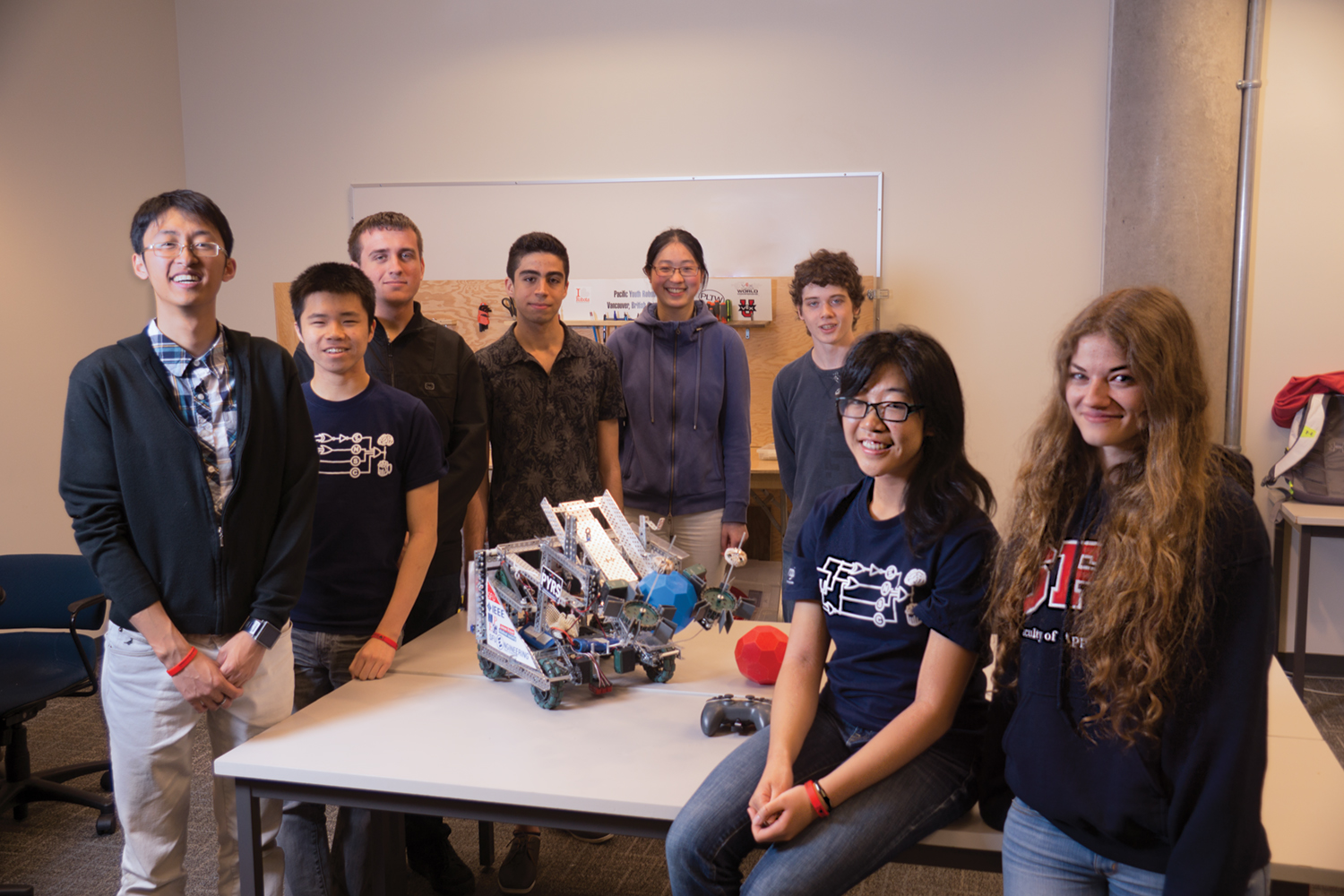
WEB-RGB-Robot-AndersonWang

SFU phasers were set to win at the 2014 VEX Robotics World Championship in Anaheim, California earlier this month, which invited top robotics teams from around the world to compete against “the best of the best.” Founded just last year by engineering student Gordon Ho, SFU’s VEX Robotics team was the only Canadian university team to compete.

The VEX Robotics World Championship included nearly 700 teams which qualified during competition tournaments held throughout the year. Midway through the season, SFU’s team was ranked #1 in the world in the skills challenges component and had earned enough points to be included in the top 30 university teams around the world.

Each year, the World Championship presents a different challenge to the competitors. The object of this year’s game was to attain a higher score than the opposing team by moving multiple coloured balls from around a field of play and transporting them to the goal areas. 

The team began working on their robot last September. After many brainstorming sessions and team exercises, the group finally came up with a viable design. After that, Ho explained, “We actually drew the robot in a 3D CAD program called Google Sketchup. Then we printed out each subsection — drive, arm, and the manipulator — then members could pick up a piece of paper and start building it right away.”

The club met once a week in the Applied Sciences wing to work on their automaton, but limited space meant they had to improvise to reach the top. “We don’t actually have a field set up at SFU. We don’t really have a room. We just have a cabinet,” said team member Joanna Che,  laughing. “That proved an extra challenge because we had to go all the way to Gladstone to borrow their playing field just to program our automatons.”

When designing their ‘bots, the team had to be conscious of the fact that they would have to transport both smaller BuckyBalls and Large Balls to different goals of varying heights. All this would have to be accomplished in just two minutes, while avoiding obstacles like speed bumps and going under 12-inch tall bridges.

Midway through the season, SFU’s team was ranked #1 in the world in the skills challenges component.

SFU’s robot was designed with standard four-wheel drive and a flexible mobile arm which can manipulate the different balls. Ho explained, “When the robot starts, it’s really compact because we needed it to fit in the 15 inch [limitation], but once it expands it can reach the full 24-inch goal.” The intake manipulator involves two rollers with rubber flaps which can adjust to the size of the ball to control it, and then another roller on top to adjust to and control the large ball.

“Mostly the balls are away from the goal area, so you have to collaborate with your partner [robot],” explained Che. Due to funding limitations, the SFU team ended up partnering with UBC’s robotics club in order to field the required team of two robots.

For the first minute of the game, a team is not allowed to directly control its robots. Instead, they have to rely on complex programming so that their robots can sense the boundaries of the space, find where the balls are, and drive to their destination. The second minute sees a driver controlling the robot directly.

“If you have a really good programmer, you can really get ahead of the game, because half of the game is programming,” said Ho.

Although the team placed 16th overall out of the 60 programming and driving teams, they dominated in the programming skills challenge. During this portion of the competition, teams have two robots on the field with no opponents and have to score as many points as possible in 45 seconds. The rub: the challenge is completely pre-programmed. With careful and precise preparation, the team took 4th place.

The team is already brainstorming for next year’s World Championship, which will task competitors to move and manipulate wireframe cubes into goals of up to seven feet. However, the team is ready to take off on their own — without UBC’s partnership. “For the next year, if we get enough funding, we’re hoping to have two teams going to the World Championships. So, we’ll have more teams from BC and Canada to represent at the World Championships,” Ho concluded.


Trend shows students return to nest

0

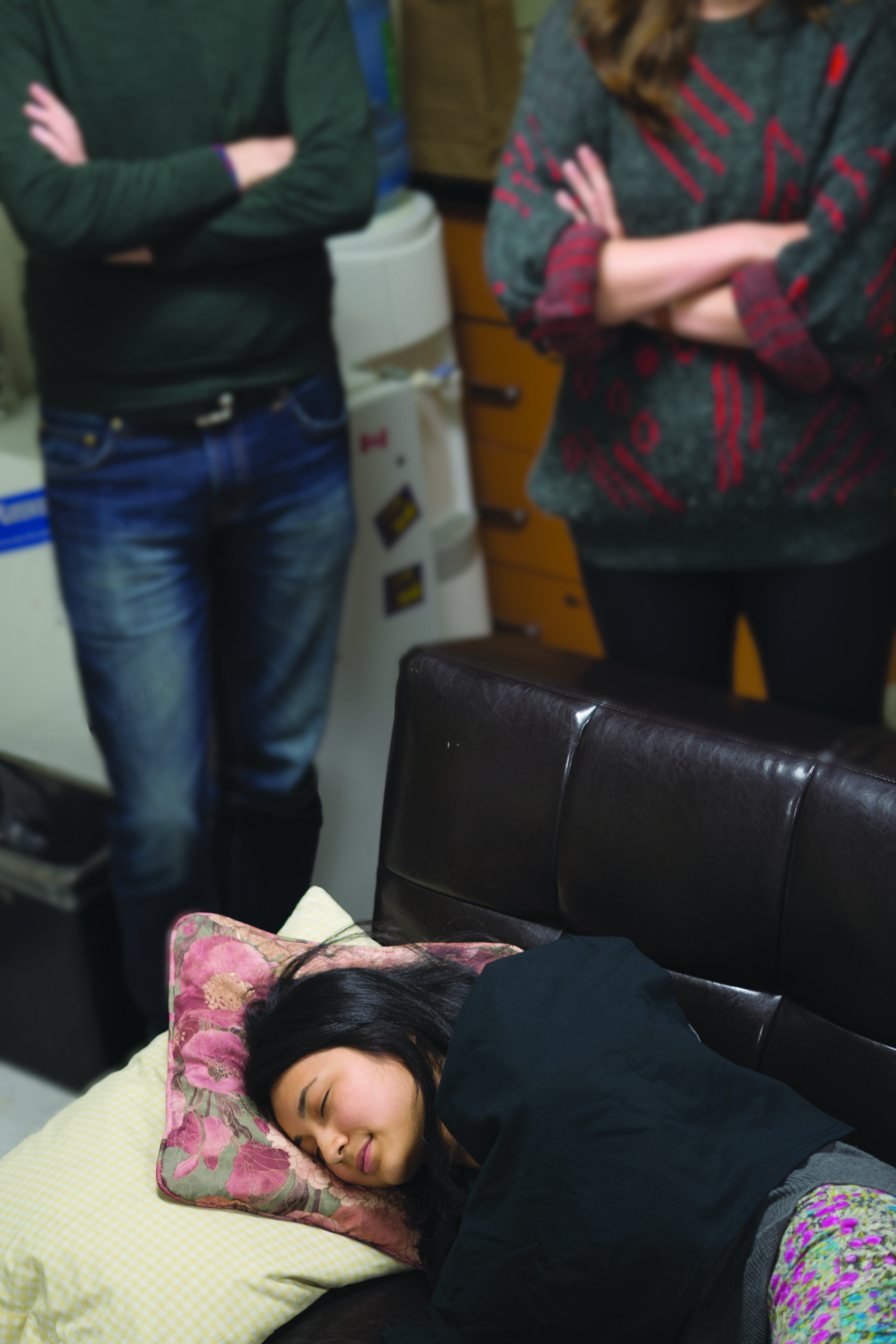
CMYK-Mom rommate

Recent statistics have shown that almost half of Metro Vancouverites in their 20s still live at home — the second-highest rate in Canada.

Barbara Mitchell, SFU professor of sociology and gerontology, explained that “returning home is quite common these days, with one third of Canadian young people aged 20 to 30 returning at least once.”

Mitchell calls this period of life the “Boomerang Age.” The name borrows from the idea that young adults are returning home after leaving for university or college, producing a similar trajectory to that of a boomerang.

According to Statistics Canada, many university students have to work double, triple and in some cases six times the number of hours at minimum-wage jobs to afford tuition costs compared with 40 years ago. On top of tuition, other costs for students include rent, food, and other basic necessities. All these factors considered, for many, it makes financial sense to live at home.

Many young adults quickly discover that even with a university degree, it isn’t easy to secure a job after graduation — especially one within their field with a reliable income.

“The labour market has become more precarious and less stable relative to recent time periods,” Mitchell told The Province. With better healthcare and a longer lifespan, some older employees are opting to remain in their positions for longer periods, as they postpone their retirements.

According to a survey conducted by Harris Poll, employers are hesitant to hire the newly graduated because of three reasons: first, they feel there is too much emphasis on book learning instead of real world learning in post-secondary education; second, the company may require a blend of technical skills as well as the soft skills gained from liberal arts; and third, entry level roles are growing more complex.

Returning home can be difficult, Mitchell explains. Some young adults might feel a lack of privacy and independence — they feel monitored and “subjected to parental rules and regulations,” and feel as if they are developing a dependency on their parents. The difference in personality and lifestyles may also affect day-to-day living, leaving both parties feeling stressed and frustrated.

 Nevertheless, living at home can have advantages. Many people have stated that living in Metro Vancouver is expensive and oftentimes unaffordable. It is therefore cheaper to share the burden of cost by pooling the family resources.

When living at home, money normally spent on tuition or living expenses could be put towards paying off student loans or saving up for future investments, such as a condo. Home can additionally be an environment that is safe and familiar and could help reduce stress and anxiety. 

Despite the stigma surrounding living in your parents’ basement, Mitchell feels that the choice to return home doesn’t have to be shameful. The home-life can be an opportunity for young adults to explore their individual identities and roles, before taking on the full responsibilities of adulthood.

Province shifts funding from liberal arts to trades training

0

Petter copy

Last month, SFU President Andrew Petter addressed the Vancouver Board of Trade regarding the value of traditional university education — specifically, liberal arts degrees — in today’s ever-changing global economy. 

The BC Liberals have recently begun “re-engineering” the education system and choosing which specific post-secondary programs will be funded and which will not according to labour market needs. This motion is currently encouraging students to pursue careers in skilled trades that are faced with a shortage of workers.

Beginning this September, $160 million currently in the post-secondary education system will be redirected toward programs the Liberals feel are important for BC’s economy. In four years, they will have redirected approximately $400 million.

Despite this overhaul, SFU’s president does not believe this “re-engineering” will majorly affect the university.

Petter dismisses the “barista” argument — which claims that every coffee shop has an over-educated university graduate employee — as an urban legend by presenting the bare facts. According to a provincial study, 78 per cent of jobs in the next decade will require post-secondary education, and more than 45 per cent of those jobs will require university education.

In fact, Petter told The Peak that he was encouraged by the Liberals’ announcement, because although their plan focuses on “priority job areas,” it was not limited to the trades. Furthermore, it did not claim that the labour market’s needs should be the only criteria for education. He mentioned that the current education system was already progressing along with the labour market by offering more programs in engineering, health sciences, and business.   

The liberal arts, according to Petter, also plays an essential role in today’s economy. “Liberal arts is not just for liberal arts students. It’s important in creating the writing and creativity and problem solving abilities that inform all students [. . .]” He also believes that the provincial government’s “re-engineering” will reflect this in the coming years.

Petter also noted that businesses are not looking to hire people pre-trained in their industries, but for individuals with intellectual skills, creativity and writing abilities, which are provided by liberal arts education. In the end, he said, it all comes down to striking a balance between filling presently vacant jobs and planning for the future.

Despite this overhaul, SFU’s president does not believe this “re-engineering” will majorly affect the university.

“We’re in a ‘global knowledge’ economy now, where knowledge is the main currency, and what that means is, yes, we can prepare people for jobs that exist today, but in many cases the jobs that exists today won’t exist five years from now,” said Petter. 

“And if we want to be competitive we’re going to have to create new jobs and new opportunities and have people who can think creatively outside the box, and can problem solve, and [who] can create the opportunities of the future.”

Petter used the example of the liquefied natural gas industry to illustrate that an overwhelming emphasis on the trades is not necessarily required. Although such an industry certainly requires skilled trades workers, it also needs scientists, engineers, business people with managerial, marketing, and human resources skills, and those who can assess the industry’s social and environmental impacts. 

Communities built around the liquefied natural gas industry will also require doctors, teachers and a multitude of other service providers, all of whom would require university educations.    

Petter stressed, “To think, even in the natural resources area, that we don’t need people with university education generally, or liberal arts in particular, is simply wrong, and thankfully the labour market studies that have been done validate that.” 

He continued, “It is really important that we remember that university education, as much as it is about getting a job and being successful, it’s also about developing one’s capacities as a citizen. And one of the great things about university education is that it does both.”


Tortorella, what a fella

0

3446290571_b7fc499b5f_o

On May 1, Vancouver Canucks head coach John Tortorella was fired with four years remaining on his contract.

I like Torts, and back when the talk started that he might be fired I was strongly against it. As a matter of fact, I wrote an article called “Canucks face a season of change,” more or less an evaluation of the 2013-14 Canucks, which featured my opinion that Torts should stay (at the expense of GM Mike Gillis — who was fired as well).

Torts’ strengths, as I’ve said before, are quite well suited to where the Canucks are going. He has a good track record of developing prospects and youth during his previous stints on the New York Rangers and the Tampa Bay Lightning. Zack Kassian has already taken strides this season, and with prospects like Bo Horvat and Nicklas Jensen, who shined during the last stretch of games, the Canucks need a coach who can develop youth.

In addition, he took the Lightning from mediocrity to a Stanley Cup during his tenure, and guided the Rangers to four playoff appearances in his five seasons with them, including making it to the conference finals. The year he was let go he took them to the second round, and was only a year removed from the conference finals.

The Heritage Classic Luongo snub was probably the one definite error in Tortorella’s short tenure.

If anything, his season with the Canucks is an anomaly on his resume, and with factors such as injuries, an aging core, and a team that has been down trending since 2011, it would be easy to excuse his performance.

Many players, though, also had a noticeably weaker year. This includes the Sedins, who in hindsight, may have been a mistake to put on the penalty kill, with Henrik breaking his ironman streak of 679 games.

The Heritage Classic Luongo snub was probably the one definite error in Torts’ short tenure. He not only forced Gillis to trade Roberto Luongo, but this also appeared to contribute to the continuing early 2014 tailspin that cost the Canucks the playoffs (although of no fault to rookie goaltender Eddie Lack).

All in all, I probably would have kept the coach at least until the next season, only to consider his dismissal if the Canucks got off to a miserable start.

But I do respect that this is a new regime making new decisions, rather than Gillis just trying to save his job. It seems that with the amount of time it took to fire Tortorella that some serious thought went into it, and with new president Trevor Linden’s prior experience as a player, he can probably pick up things in the dressing room, things that we might not necessarily see on TV.

In addition, whoever Linden picks to be his GM can now truly put his own stamp on the team, starting with a new coach.

No matter what happens, good or bad, next season will be an exciting one for the Canucks. If in the end there is only one winner in this, it will likely be player David Booth, who has probably avoided a buyout on the account of two pricey firings.

The modern mom is only human

0

WEB-Peaches Geldof-Flickr-LGEPR

Model and TV host Peaches Geldof was infamous in the British tabloids from a young age, dabbling in drugs and flirting her way through the London party scene. Her image, though, changed when she became mother to two young boys in her early twenties. She was an advocate of “attachment parenting,” an overly attentive parenting style involving, for instance, letting your child share a bed with you, or continuing breastfeeding until the child is much older than usual.

Most assumed Peaches had turned over a new leaf . . . until she was found dead at home with her nine-month old son on April 7. The official coroner’s report revealed that she had died of a heroin overdose.

The media was quick to judge her. Unfair, patronizing headlines such as “Peaches Geldof Cared More About Heroin Than About Her Children,” (Mirror UK) quickly emerged. While she comes across as overbearing and irritating in her much publicized parenting debates, one thing is clear: she cared about her children. This woman was suffering from a disease, one that she lost her own mother to at a young age.

If her husband, equally outspoken about the “right” way to be a parent, had died, the media would not have been shocked. Fathers, however devoted, are expected to have a life outside of their children. We can equate a father who dabbles in drugs with being a loving guy when he’s home on the weekends.

The public notion is that there are more men who have, to use tabloid terms, “illicit double lives” outside of their family lives. Men are the ones who slip up with affairs and addictions, while women who do the same are home-wreckers and bad mothers. Peaches’ death is proof that addiction doesn’t discriminate and can befall even those who are in a role of extreme responsibility.

Peaches had the means to pay for childcare, but she chose to take drugs while she was alone with her son. We can pity her for being unable to resist heroin, but why would someone who has the money to pay for a babysitter think getting high with her child was a better idea?

Peaches’ overly-attached style of parenting could be to blame for her son’s tragic proximity to her death. She used her role as a mother as a lifeline separating her from the party girl image that seemed to haunt her. This is a woman who associated being a good mother with being a constant presence in her childrens’ lives.

The very notion of motherhood is put under a microscope in modern day society. Motherhood is expected to be central to a woman’s life, with all that came before it being abandoned for breastfeeding and grinning while elbows-deep in poop. We expect mothers to be more central to a child’s upbringing and more devoted than fathers, as reflected most clearly in Peaches’ own parenting style.

The fact that a way of parenting can even be critiqued as right or wrong is ludicrous, but exemplifies the extreme pressure that women are put under to perform to their very best feminine ideal. The pressure of being the ultimate figure in her sons’ lives, which Geldof took on publicly with such vigour, did not leave room for taking the personal time required to fight her addiction.


Loser parents still living at home with adult kids

0

BURNABY — In a trend which has become all too common in recent years, a local family with three grown children currently in university has opted to remain living together, a decision which has garnered ridicule for the nearly 50-year old parents.

Although believing when they first had kids that they would be completely independant by the time they reached 45, Mary and Herbert Winfried say their transition into autonomy hasn’t been as smooth as they thought.

“Oh man, when I was 34, I was sure I would be living away from the kids by this point,” explained Herbert, thinking back. “I pictured us being totally independent, being able to just buy like one carton of milk a week and only doing a load or two of laundry, I couldn’t wait.”

Unfortunately, things just didn’t work out as planned and the couple remain under their own roof with the kids, a reality that they claim has put a real damper on their social life.

“We can’t stay out late, or have wild shindigs and worst of all our friends won’t stop making fun of us,” Mary explained. “Everyone we raised kids with is off travelling the world or taking sailing lessons and we’re stuck here like losers.”

While the Winfrieds do admit that there are some perks to still living at home, like not having to pay for their kids to live in residence, they say they’re really hoping they can get out soon, or at least get rid of their kids.

“My friend Marty lives in a retirement plaza in Florida and says he can totally hook us up with a place there” Herbert said. “I don’t know if I want to do it though, I mean I still kind of like it at home, not that I couldn’t live alone, I’m just waiting for the right time.”

Despite what their friends might think of them, the Winfrieds say that at least they have the support of the kids they support.

“I do think its a little pathetic that they still live with us, but if they’re not going to kick us out that’s okay, they just need a little more time than some parents,” the couple’s oldest child, Bill, who just celebrated his 29th birthday, told The Peak. “They probably would just be lost without us though, I don’t know what mom would do if nobody was asking her to make lunches every morning.”

Although they continue to look at themselves as losers who will probably live with their kids forever, there is hope for the Winfrieds. While statistics show that almost half of parents in their 50s still live with their kids, the number takes a dramatic dive when they reach their 60s.

“No matter what people might think, our situation is fine for now,” Herbert concluded. “Maybe I could just ask my parents to move in, then at least we’d be cooler than them, I mean can you imagine, still living with with your kids at 80! They’d be such losers!”

HIV continues to adapt to human hosts

6

amoeba-JerryGuoUsing evidence from HIV evolution in North America, SFU researchers have discovered that the virus is slowly adapting over time to its human hosts. Nevertheless, assistant professor of health sciences at SFU and lead author of this study, Zabrina Brumme asserts that the evolution is not progressing fast enough to be a danger to humans.

Brumme explained, “The purpose of our study was to investigate the adaptation of HIV to immune selection pressures in the North American population. To do this, we studied HIV specimens dating back from 1979 to the present day. From these specimens we extracted human immune information as well as virus sequence data and looked for evidence that the virus was adapting to our immune systems over time.”

With funding from the Canadian Institutes of Health Research (CIHR) and the Michael Smith Foundation for Health Research (MSFHR), Brumme’s lab was able to collaborate with scientists at UBC, the BC Centre for Excellence in HIV/AIDS, and sites across the US.

Although HIV-1 specimens used in the study were from 1979, the oldest specimens sequenced date back to 1959 and 1960.  “Both are from Central Africa. With respect to North America, the oldest sequences date back to 1979 and were collected as part of our study.” Brumme said.

The findings of the study, she stated, were evidence that the virus is indeed slowly adapting over time to its human hosts. However, Brumme says there is no need to panic: “This change is so gradual that it is unlikely to have an impact on host immunity to HIV — or vaccine design — on a relevant timescale.”

She continued, “Basically, we’ve got the tools now, in the form of potent anti-HIV drugs, to turn the tide of HIV globally. These drugs do two things: a) they save lives and b) they reduce the risk of HIV transmission essentially to zero.”

The research team hopes that by collecting and sequencing historic HIV-1 isolates, they will be able to achieve a deeper understanding of how HIV has spread around the world. “Understanding how HIV evolves in infected persons and host populations is also relevant to HIV prevention, notably development of an HIV vaccine,” Brumme said.

Although the evolutionary side of HIV is just one piece in a much larger puzzle, the team says they have reasons to be hopeful. Brumme explained, “A major global priority is the delivery of HIV treatment to the millions of people worldwide who need it — to save lives and eliminate new infections. While we do the above, we also need to continue to invest resources and scientific efforts towards finding an HIV vaccine and an HIV cure.”


Board Shorts

0
10322451_870130803004330_2358523515364909558_n
The old Board made way for the new during orientation at the start of May.


Committee Appointments

With a new SFSS board now in place, the first order of business was to appoint members to the society’s various committees. The new committee chairs and members were ratified at the last board meeting on May 6. However, there were issues in regards to committee appointments arising from the recent restructuring of the board.

The Internal Relations Officer (IRO) position no longer exists, leaving that spot open on several committees. While the President is to assume all responsibilities of the IRO, the President must already sit on every committee.

The other concern is that of the Member Service Officer’s (MSO) committee seats. The MSO position has now been split into that of VP, Student Services and VP, Student Life. The board proposed recommendations as to how the seats should be divided among the two positions, but this matter — as well as that of the IRO vacancies — will be addressed by the executive members at their next meeting.


Studentcare Health and Dental Stakeholders Conference

The board has decided to send both President Chardaye Bueckert and VP, Student Services Zied Masmoudi to an upcoming Studentcare Health and Dental Stakeholders Conference this May 21 to 23. “The SFSS would not be incurring any costs on this trip beyond the per diem,” said Bueckert, the per diem being $35 each.

Moe Kopahi, VP, University Relations attended the conference last year and called it, “a really good opportunity for us to see what Studentcare will provide in the student plan.” He added that the conference is a place for sharing ideas, one example coming out of last year’s event being a Health and Dental Plan smartphone application.

Batman vs. Gotham

0

6910971608_17e761a42f_bWoohoo: Batman

I didn’t want to write about this. Saying Batman rocks is like saying umbrellas keep you dry. I know it, you know it, and even Marvel fans can admit it.

It’s not just the character. Not just his being the classic young person who devotes his life to avenging his parents, and who uses his every means to make the world a better place, and separate good from evil.

It’s also the stories that ask us what good and evil are, and how one person can define them in the real world. They ask what it means to be a hero, and often, what it means to stand up for what one believes in.

We, as students, are all Batmans, aren’t we? We all similarly struggle to find, define, and do “good.” (I like to think.)

But sometimes it’s more interesting to watch this expressed in its most physical form, one that fights, grows old, and faces death head-on, in its full force.

Boohoo: Gotham

No, I’m not talking about Batman’s city. I’m talking about a new Fox prequel Batman series titled Gotham. I’m also kind of talking about the suspected Batman vs. Superman movie.

Prequels are usually nothing but a means to mentally masturbate over a beat-down concept of a show, especially one as fetishizable as Batman. If companies are so hell-bent on making superhero franchises, where are the new ones? Does the comic book remain the only medium acceptable for superhero experimentation?

If you agree, you might be interested in the countless other Batman prequels that have already been published as comics, and that Fox was not involved in. Cough.

Frankly, I think we’ve had enough Batman in general. The Batman of today probably won’t differ much from the Batman of two years ago.

And damn it, if you agree with me, then don’t watch the movies or series. Don’t talk about them. Preserve the concept of Batman.

New rEvolutions in theatre

0

CMYK-off key-revolver fest-in photo alison chisholm, evan thompson, jennifer pielak, jamieson mccormack, sam mitchell, kasia gabinska, peter abando. photo credit jonathan kim

Now in its second year, the rEvolver Festival showcases new works by emerging artists from all over Canada during two incredible weeks of theatre performance. As managing artistic producer Daniel Martin explains, this is “not your grandma’s theatre.” 

The works featured are relevant and modern, fostering discussion and debate among spectators. Hosted at The Cultch, a gorgeous playhouse in Vancouver, the wonderful atmosphere sets the stage for the rEvolver Festival.

In a city such as Vancouver, art is integrated into everyday life, so what sets the rEvolver Festival apart? As Martin says, a big distinguishing factor is that rEvolver Festival is curated; “There is a performance guarantee,” said Martin, “[it’s] not a lottery system.” 

This baseline allows the rEvolver Festival to set high standards for quality, ensuring thought provoking and entertaining pieces are delivered to the audience. 

The performers, writers, and directors participating in the rEvolver Festival consist of emerging artists. The reason for this is “partly biographical,” Martin explains, as there were few opportunities to showcase his work when he was a recent graduate of acting school. 

Not having “the necessary connections as new artists, we made the opportunity,” Martin says, starting with the Walking Fish Festival. Opportunities such as these, Martin says, are “important, they give young people exposure” allowing them to “nurture their talents, which helps them grow as artists.” 

The performers, writers, and directors participating in the rEvolver Festival consist of emerging artists.

Every year, certain topics and styles help to unify the festival, and this year is no exception. Plan to experience lots of music in the various performances, along with an emphasis on creation-based works, instead of the more commonly encountered play-written works. A theme of self discovery runs through the festival, Martin says, as each work has an element that addresses “issues about being in the world.” 

“Expect everything EXCEPT the kitchen sink,” says Martin, as performances will not be about “a family working out their issues in their living room.” Instead, the works featured in the rEvolver Festival will be “stories and presentations that only work in a theatre setting.”  

This festival accents variety, as Martin says that the “variety of genre[s], variety of style[s], [and] variety of artists” will keep all audience members interested. The rEvolver Festival promises to be a place that offers “opportunities for engagement with the arts.”

Those who like “exciting, relevant, risky” works will love the rEvolver Festival, says Martin. Audience members should expect to witness performances that “push outside comfort levels” and “do new things.” There will also be pirates, for any Blackbeard fans out there. 

The artists featured at the rEvolver Festival are those who “are starting to do important work” says Martin. Supporting them, Martin says, allows for a “healthy ecology” of the theatre scene in Vancouver, giving artists continuity in artistic opportunity as they “graduate to the next level.”

Especially relevant to the SFU community are those performances that feature current students and alumni. 

Such performances include Caezr: 33 Cuts, featuring SFU theatre program graduate Victoria Lions, and Off Key: An Improvised Musical, which is a collaboration by various SFU graduates. Catch Emily Pearlman, who graduated from SFU’s MFA program in REVISED From The Belly of a Whale, and recent SFU grad Minah Lee in the performance art piece We’ll Need A Piece of Cake Before We Die. 

The rEvolver Festival is presented by Upintheair Theatre May 13 to 25 at The Cultch. For more information, visit upintheairtheatre.com.