Home Blog Page 1093

Enbridge approval spurs opposition from BC residents

0

CMYK-Enbridge-April AlayonOn Tuesday June 17, the federal government approved Enbridge’s proposal for the Northern Gateway pipeline, subject to further talks with aboriginal communities and 209 conditions as recommended by the National Energy Board.

Despite Stephen Harper’s approval, both Tom Mulclair, leader of the NDP, and Justin Trudeau, leader of the federal Liberal Party, have said that they would reverse the approval if they were elected in the next election.

The pipeline still needs to be approved by the provincial government, but four of BC’s five conditions for heavy oil projects remain unsatisfied. According to BC environment minister Mary Polak, the federal decision does not affect the provincial government’s stance on the project. “Our position remains unchanged: It is no,” Polak said.

The pipeline has been met with much resistance, not only from environmentalists, but the majority of British Columbia’s residents. Several of British Columbia’s municipalities and First Nations groups have passed resolutions opposing the pipeline, as have both the provincial government and major NGO’s within the province.

Tom Gunton, director of the Resource and Environmental Planning program at SFU, has been examining the potential environmental risks of moving forward with the pipeline over the past few years. He told The Peak that this outcry is not surprising, considering that 65 per cent of BC residents disapprove of the pipeline, according to recent polls.

“The federal government called critics of the Northern Gateway Pipeline radicals supported by foreign interests, and of course 65 per cent of of British Columbians oppose the Northern Gateway Pipeline,” Gunton said. “You sort of can’t consider 65 per cent of British Columbians radicals. The British Columbia government opposes the Northern Gateway Pipeline, and it’s hard to define them as radicals!”

Although support and opposition to the pipeline is split more evenly across the country, Gunton explained, “It’s largely because of a lot of Canada won’t suffer the consequences and the bills associated with the Northern Gateway Pipeline.”

Opposition to the pipeline is largely due to the high risk of oil spills as well as the overwhelming cost of the project, according to the report. Communities in BC have hosted a number of petitions and protests since the pipeline was proposed and even more have emerged since its approval.

The announcement has also elicited reactions from the SFU community. The City of Vancouver and SFU’s Centre for Dialogue held an open discussion on June 24 so that people could exchange ideas and learn about the project.

On June 25, Jessie Russell, member relations officer on Sustainable SFU’s board of directors and secretary for SFU 350, approached Council, a monthly cross-campus dialogue composed of representatives from each department and SFSS constituency group, to recommend to the board of directors that they take an official position against both the Enbridge and Kinder Morgan proposed pipeline projects.

A group of academics, led by SFU ecologist Wendy Palen, has already taken a stand against the projects. On June 19, they wrote in the British journal Nature that Canada and the US should halt project approvals until oil sands developments are consistent with the government’s commitments to cut carbon pollution.

For Gunton, the reactions from the community are what he would have expected: “It’s one of the most significant projects ever proposed in British Columbia in terms of size and potential impact. Secondly, it’s going to result in major controversy in BC with court cases and protests.

“Consequently it’s going to have major repercussions, both provincial and national, and likely international issues,” he concluded.


Moment of Zen

0

During the discussion on whether or not to appoint a board chairperson or to postpone the decision for another week, president Chardaye Bueckert passed the chairship to VP university relations Moe Kopahi in order to be able to discuss the proposed amendments herself.

Wary of the amount of time already spent discussing the motion, Kopahi said to the board members on the speakers list, “Please keep it short, 30 seconds maximum, or I will cut you.”

We got Desjardins!

0

After many weeks of speculation, Willie Desjardins has been hired as the Canucks’ new head coach; many had pegged him as the next coach after John Tortorella was fired in May.

For a brief time, it looked like the Pittsburgh Penguins had scooped him from right under us, with TSN analyst Darren Dreger reporting that he was going to sign in Pittsburgh, dashing many a Canucks fan’s hopes and dreams.

Aside from the quality coach, it’s nice to see the Canucks win one of these races for the best candidate or player again. For now, it looks like a huge victory for the Canucks and perhaps a loss for the Penguins, who, in the end, chose Mike Johnston, Vancouver’s plan B coach.

The 57-year old Desjardins is fresh off winning a Calder Cup with the Texas Stars, the Dallas Stars’ AHL affiliate. Prior to that, he ran the WHL Medicine Hat Tigers as both coach and GM with consistent success, including two WHL championships. It should also be noted that he drafted Canucks prospect Hunter Shinkaruk in the WHL.

With his strengths as a good communicator and successes in both the junior and minor leagues, Desjardins offers the Canucks a fresh start, and will help them usher in a youth movement.

Desjardins’ communication abilities may help players who suffered under the Tortorella regime.

Whether this year is actually a rebuild or not, they are likely to start introducing prospects such as Bo Horvat into the lineup, and increasing the roles of others such as Nicklas Jensen, especially with a possible Kesler deal. Not only will Desjardins benefit prospects who are looking to make the team, but also young players who are already on the roster such as Zack Kassian (assuming he will be re-signed as a restricted free agent).

His communication abilities may also help players who suffered under the Tortorella regime. Look at Alex Edler, for instance: as Torts admitted, the two were never on the same page. In addition, despite being a rookie head coach, Desjardins was an associate coach with Dallas from 2010-2012, ironically under current Canucks assistant Glen Gulutzan. 

Contrary to Torts, Desjardins is known for a more offensive game, which will be a nice contrast to last year. I also like the route of hiring a coach new to the NHL, as opposed to other coaching candidates, such as Dan Bylsma, who is fresh off of failure. The recent retreads have been pretty bad: look at Torts, and Randy Carlyle so far.

However, that’s not to say that experience is bad: experience is what it takes to make you better. Actually, that is one of the big question marks hovering over Desjardins’ head. Why, at 57, has he not coached an NHL team yet? He is pretty old for a first time coach.

And what if he is another Dallas Eakins? That’s not to say Eakins won’t turn things around in Edmonton, but so far he serves as a reminder that success in other leagues does not necessarily equal NHL success.

For now, though, it’s safe to say Desjardins is a much needed fresh face for this team.

(A)side Jab: Many analysts are shocked that Desjardins chose the Canucks over the Penguins, since they have two of the NHL’s biggest stars. However, despite their supposed superiority, they’ve won very little. Although this is easy to blame on the outgoing coach, it is possible that they just don’t have what it takes to win. Besides, where would you rather live, Vancouver or Pittsburgh?

DNA in video games: no thanks!

0

The hoopla surrounding our lack of privacy in the digital age is about to reach an all-time high. While the Internet has increasingly provided authorities with ways to rob us of our privacy, mainly in the form of online spying, soon there may be a way to steal information on our genetic make-up.

An article from The Escapist by Josh Engen was recently brought to my attention, and to my shock and horror it states that DNA Diagnostic Center Inc. is engineering a new videogame experience — one that will allow us to essentially put ourselves into a videogame. The technology, titled “Helix Profile,” will use genetic testing to analyze the user’s DNA. “Once a genetic profile has been created,” the article reads, “the data could then be imported into a videogame.”

Sure, some people may find this rather exciting. In fact, just this afternoon a friend of mine immediately stated “wow, that’s actually pretty awesome,” upon hearing the news.

Submission of our DNA will allow people access to our physical, unadulterated selves.

“Awesome?” I replied. “Are you joking?” In a time when infringed privacy runs around us like angry chickens? Think of the ethical problems this could cause.

Privacy is a hot topic these days. After the NSA revelations were released, the stir that resulted sent shockwaves across the globe. It’s clear that our personal information is an easy swipe for almost any company on the net. It’s also clear that they provide an inviting entryway for authorities to walk in and steal our data from us without our knowledge.

The Internet is increasingly finding ways to take our personal information and use it to spy on and manipulate us. But this thievery has only been of our outward actions: text messages sent, pictures taken, personal information that has been created by moving fingers. While still a violation of our digital rights, this privacy breach is only of actions we have the power to manipulate.

DNA is something that we can’t manipulate. DNA is solid, concrete, a part of us. The Internet believes it can get to know us through what we do online, but these actions may or may not be who we actually are. Submission of our DNA will allow people access to our physical, unadulterated selves. It is the ultimate in privacy invasion.

I cringe to think of the unethical things that could occur should this information fall into corporate or even government hands. Words such as “fraud,” “identity theft,” and even “cloning” come to mind. If the wrong person had this information, they would have access to all of our medical records. Wrongful impersonation would reach a new high.

The sad thing is, no matter how unethical a technology may be, it will always be expanded upon and developed for use, even in private. And when the government is involved, the concepts of ethics and morals seem to go awry; they blur unapologetically with the the concept of power.

Sure, DNA Diagnostics Centre Inc. can claim that genetic testing is for entertainment purposes, but half of us know that it could, and probably will, be used elsewhere. Sadly, the other half will fall into the capitalist trap, responding to it with, “Whoa, this is really cool!”

Put simply, there are some technologies that should not be produced or further developed. Those who wish to explore this technology must stop and realize that our DNA belongs solely in a medical facility and not in the capitalist market. I, for one, will not allow my DNA to float about the web.

Bull$#!+: Unspecific SFU diplomas and reality TV

0

Unspecific SFU diplomas

David Ly

The end is near. After four years and 37 courses, convocation is just around the corner. Finally, I’ll get to walk the stage in recognition for the immense debt I put myself in. I’ll shake Petter’s hand, receive my diploma, and maybe even shed a tear looking at it. A tear of disappointment, that is.

Don’t get me wrong, I’ve loved getting my Bachelor of Arts. However, my diploma apparently won’t state the focuses of my studies, only the vague title of Bachelor of Arts that encompasses 23 programs, clumping the study of Sir Gawain and principles of economics under the same umbrella.

Further, some friends and I were a bit irked noticing that the diplomas don’t state majors or minors. They’re stated in the program book, but who wants to frame a page with your degree’s specificities in size 10 font, squished between hundreds of other names?

To many, my degree may appear peculiar (i.e. useless in the ‘real world’). With a major in World Literature and an English minor (no, not the same as World Literature), and creative writing courses sprinkled throughout for kicks, I’m proud of the subjects I studied.

Yes, this ‘degree in subjective bullshit,’ makes me proud. University is a time during which people create an identity, or multiple ones, to differentiate themselves from others. Our majors, minors, certificates, or focuses speak profoundly to who we are. It seems a bit ironic that when we leave, we receive recognition to who and what we are in a very vague form, placing us back in an indistinguishable sea.

As prestigious and pretty the script of Bachelor of Arts is, it doesn’t make up for the lack of specificity in what our education results in. Surely, the printers can handle the cost of extra ink . . .

Current television

Katrina Trask

These days I only watch television about three hours a week, and most of what I watch is the news or movies. The reason that I watch so little is because the majority of aired shows are reality shows.

I remember when specialty channels such as TLC and Discovery aired programs relevant to their channels, dealing with science, history, etc. I remember when television consisted mainly of scripted shows with actors and fictional storylines, before it was dumbed down to its current level. 

Television executives fail to see the lack of value in these exploitative reality shows. Look at TLC’s Here Comes Honey Boo Boo: it plays on redneck stereotypes for ratings, and its ‘actors’ don’t realize they are being exploited. 

Worst of all, reality shows act as a platform for people’s personal beliefs, which can promote exclusion and intolerance, like the anti-gay Christian rhetoric in Duck Dynasty.

Why are these shows still on the air? It is because of us, the viewers — those who watch whatever is on. 

However, some channels, such as Netflix, AMC, HBO, and PBS, do produce quality programming, consisting of shows such as Game of Thrones, House of Cards, Mad Men, and Downton Abby. These shows, unlike reality television, have huge online fanbases, as suggested by reviews, video art, and memes; the trend of binge watching these shows is also proof of their popularity. 

Fans of these types of shows, make your opinions heard to the execs by refusing to watch reality shows. Tell them that we want to watch more scripted shows. At the very least, they need to change the names of their channels to reflect the reality-based programming that they offer. Give me the chance to avoid seeing a second of a day in the life of Kim Kardashian.

Big impact on a Small Stage

0

CMYK-Tariq Hussain - photo by Wayne Hoecherl_resized

Small Stage Point 5 takes the glamour of interdisciplinary performance to a tiny stage — on July 4 and 5, big names and bigger talents will light up The Emerald with incredible music and dance collaborations. Five performances, each one composed of a pair made up of one dancer and one musician make up the cast. All local artists, these are professionals who record, write, and perform music in Vancouver.

Tariq Hussain is one of these stellar talents, known for his role in the Vancouver-based band Brasstronaut, his Juno nominated album The Basement Songs, and his recent The Moonwalker EP. In Small Stage Point 5, Tariq plays two roles, that of co-curator and performer. This dual role has given Hussain a unique perspective on the performance. In curating the show, his job included finding the performers, and making the contacts. The process involved first choosing five musicians, and then his co-curator Julie-anne Saroyan found five dancers. 

As a performer, Hussain has had to develop a five to seven minute piece that “integrates music and dance on an 8×8 stage.” Seeing the pairings come together and develop their art has been a highlight for Hussain. Working on the piece, and seeing the results has been another, as he said, “you start with nothing and you have to come up with something.” 

Hussain explains that the performance has a broad appeal, as it crosses over into both the dance and music worlds. The artists come from varied backgrounds: from contemporary dance, to pop and indie rock, to hip-hop, and R&B. There is even an electronic musician paired with a burlesque dancer. 

The musicians joining Hussain in this show are Christopher Smith, Tonye Aganaba, Loscil, and Andrea Lo. Paired with Hussain is dancer Farley Johansson, and the other four musicians are paired with Karissa Barry, Stewart Iguidez, Burgandy Brixx, and Jennifer Bishop respectively.

This is ‘round two’ for Small Stage Point 5; the show has been revived because  “it was successful, the performers enjoyed doing it, [and it was] packed every night,” said Hussain. This version takes place in a slightly larger room at The Emerald, one with a different feel. In the last performance there were live dance transitions that were quite the “comedic interludes,” described Hussain. This version has transitions, but they will be presented in a very different way. However, the essence of the show is the same, with the same number of pairings. 

But why the small stage? Hussain explained that it’s purposeful. On a big stage there is a separation, the small space avoids the traditional setup of distance and disconnect. Hussain said that when you “physically force people to share the same space [there is an] interaction, connection between the two people” which develops, allowing them to “create something that allows them to work in the space.”  

The “parameters are good to work with” continued Hussain, as they grant the performance an “intimate, immediate connection between audience and performer,” developing a “special, unique kind of energy.” The Emerald allows this, as it’s a tight, intimate space that gives the curators exactly the kind of feel they want. 

The collaboration process has put the performers to the test, especially figuring out the technical side of it. “In a live context, there’s a lot of logistics you never considered,” said Hussain. They are “learning as [they] go,” and thinking about “staging, sightlines, costume, and lights.” 

Hussain assured that audiences can expect a “bang-up show considering the skill level of the people,” adding, “expect great things.”

Small Stage Point 5 will be presented July 4 and 5 at The Emerald. For more information, visit movent.ca. 

Potential benefits of Middle Eastern radical groups

0

In recent weeks, the media firestorm surrounding the rise of the radical jihadist group the Islamic State of Iraq and al-Sham (ISIS) has been intense. No surprise. The story of ISIS’ rise has all the right elements to make for sexy headlines to feed the insatiable 24-hour news circuit: an elusive mastermind, an abhorrent ideology, medieval brutality, and a series of rather fantastic victories under its belt. Not to mention, its rise gives opportunity for liberal and neocon pundits to sling blame for the crisis at each other. 

Above all else, though, these stories provoke fear and anxiety, captivating media attention as world audiences shudder at the prospect of a jihadist caliphate spreading its tentacles across the heartland of Middle East.

Indeed, there is a strong basis for these fears. In the chaos of the Syrian civil war, ISIS has emerged as one of the most organized and effective opposition groups to the government of Bashar al-Assad, eclipsing many secular and more moderate Islamist militias. 

But its power has not stopped here. Taking advantage of widespread discontent among Sunni Arabs in Iraq with the bumbling Shia government in Baghdad, ISIS struck across the border bringing broad swaths of the country under its banner. Most stunningly of all, it unexpectedly managed to capture Iraq’s second largest city, Mosul, rich with plunder. The levels of violence administered by ISIS in its captured territories have been extreme, even leading Al Qaeda leaders to condemn the movement for its excesses.

Just as Hitler pushed Stalin and Churchill to work together, so can ISIS with today’s Middle Eastern powerbrokers.

But amidst all this, ISIS’ rise may prove to be a crucial catalyst for peace. It has managed to present itself as a mutual villain to nearly all of the Middle East’s major powerbrokers. The development of common enemies can be critical in bringing together people that would be otherwise hostile to each other. 

Just as Hitler pushed Stalin and Churchill to work together, so can ISIS with today’s Middle Eastern powers. Iran does not want to see its fellow Shias in Iraq fall under intolerant Sunni rule, or its Iraqi ally troubled. America abhors the idea that the Euphrates Valley could become a safe haven for jihadists to launch transnational attacks. Even Saudi Arabia, perhaps the government most supportive of ISIS’ rebellion in Syria, has been alarmed by the group’s destabilizing venture into Iraq, and its expansion to the doorstep of the Kingdom’s own borders.

But as policymakers scramble to push back ISIS, they are realizing their limitations. Few Americans have an appetite for resuming a military role in Iraq. Neither Tehran nor Washington can be seen to be working with each other, lest they face domestic political objections. The government of Iraq has an army with infamously low morale and polarizing leadership detested in the country’s north. Thus ISIS is likely to remain a thorn in many countries’ sides for years to come, sapping the fuel from older rivalries.

However it is difficult to imagine ISIS managing to maintain its rule over conquered territories in the long term. Sooner or later economic malaise, international isolation, aggressive moral legislation, and a poor administrative infrastructure will undermine its hegemony in the upper Euphrates Valley. 

But during its moment in the sun it may do what no diplomatic intrigue has managed yet –— drive Iran and America (and maybe even Saudi Arabia) closer together into a common front to preserve the status quo.

Accepting my introversion

0

WEB - Reading - Vincent Brassinne Flickr

One of the principal differences between introverts and extroverts lies in where they draw their energy from. Extroverts are energized by external sources making them, on the whole, social beings — but this doesn’t necessarily mean they are outgoing. 

Meanwhile, more introverted people, while they can be social, are recharged from within; I find myself fitting into the second category. I need time to recharge my batteries away from others, but, as a fairly social person, I tend to deny myself this time. 

Instead, I opt to fill my social calendar, often feeling the need for company wherever I go. For a long time, the idea of going to the mall or the movies alone truly terrified me. I lived in a peculiar and somewhat sad contradiction — I was an introvert that didn’t want to be alone.

Discovering how to love the time I spend by myself has been one of the most important lessons I’ve learned — a lesson from which anyone could benefit. Coming into my own has been about doing things for myself, by myself.

In our ‘alone, together’ society, you may not be with somebody, but you are never without company.

I still find that I rarely make plans with myself. At this point in my life, I have the luxury of centering my schedule around myself entirely, yet I constantly fill my weeks with plans to meet this friend or that relative — a habit that leaves me exhausted.

But, a funny thing happened when I started to commute a lot by transit. I hated it, but only at first. Then the realization came to me that the many hours a day I spend on the bus is prime ‘me’ time. I could make the most of this.

I hear people cursing our place in time and the lack of unity in our community, something which may seem prominent on the bus. You can stand within a few centimetres of another human being for an hour on the 135 without interacting at all. We live in the great anomaly of being ‘alone, together.’

For some, this is a shame, but I call it a beautiful gift. You can be in a highly social and stimulating environment, but be left entirely to your own thoughts. It creates a sort of liminal headspace. You may not be with somebody, but you are never without company. 

Alone on transit, I think deeper, I look around more keenly. You can get a lot done in your own head on the bus. You could perfect a thesis, make a day plan, perhaps be struck with inspiration for an introspective editor’s voice. The possibilities abound.

If not for my cross-zone travels, I might never have noticed how striking the outline of the North Shore is at dusk. I might not have laid eyes on that rapier duelling school on Hastings St. that my friend and I need to go to in order to fulfill our dream of reenacting the final scene of Hamlet in the style of Kenneth Branagh.

I’ve found that when I’m out and about on my own, the world seems like a place of opportunity and I’m free to make what I want of it.

So, I implore you: don’t let the fear of awkward loneliness keep you from things you enjoy. Take that solo walk around the seawall. Go to that new Tom Cruise movie that you’ve been too embarrassed to ask anyone to come to. Why deny yourself that sweet Tom Cruise action because no one is free on your day off?

It’s about time Archie had a disabled character

0

CMYK-ARchie-LilyLi

Originating in 1939, Archie comics have been beloved by children and people of all ages for decades. Featuring beloved characters such as Archie, Betty, Veronica, Jughead, and Reggie, the comic series has been a presence for generations, though less so now due to the popularity of the Internet and decline in comic book readership.

These comics have been around since our grandparents were children, their values and characters originally written to suit the social norms of that time. However, the beliefs our grandparents had, and those we have today — in regards to marginalized social groups and people who stand out amongst the crowd — are very different.

Archie comics have always pushed the envelope when portraying sexual attraction with their teenage characters, but have only recently begun taking steps to address the acceptance of people with any kind of differences in appearance or sexual orientation.

In 2010, Archie comics introduced Kevin Keller, the series’ first openly gay character. Writer Dan Parent said in an interview, “It shows that Riverdale is in the 21st century.” This character was greeted with almost completely positive appreciation, as readers felt the character signified genuine inclusion rather than a stereotypical addition.

For a comic as popular as Archie, the writers should have paid attention to who their readers really were.

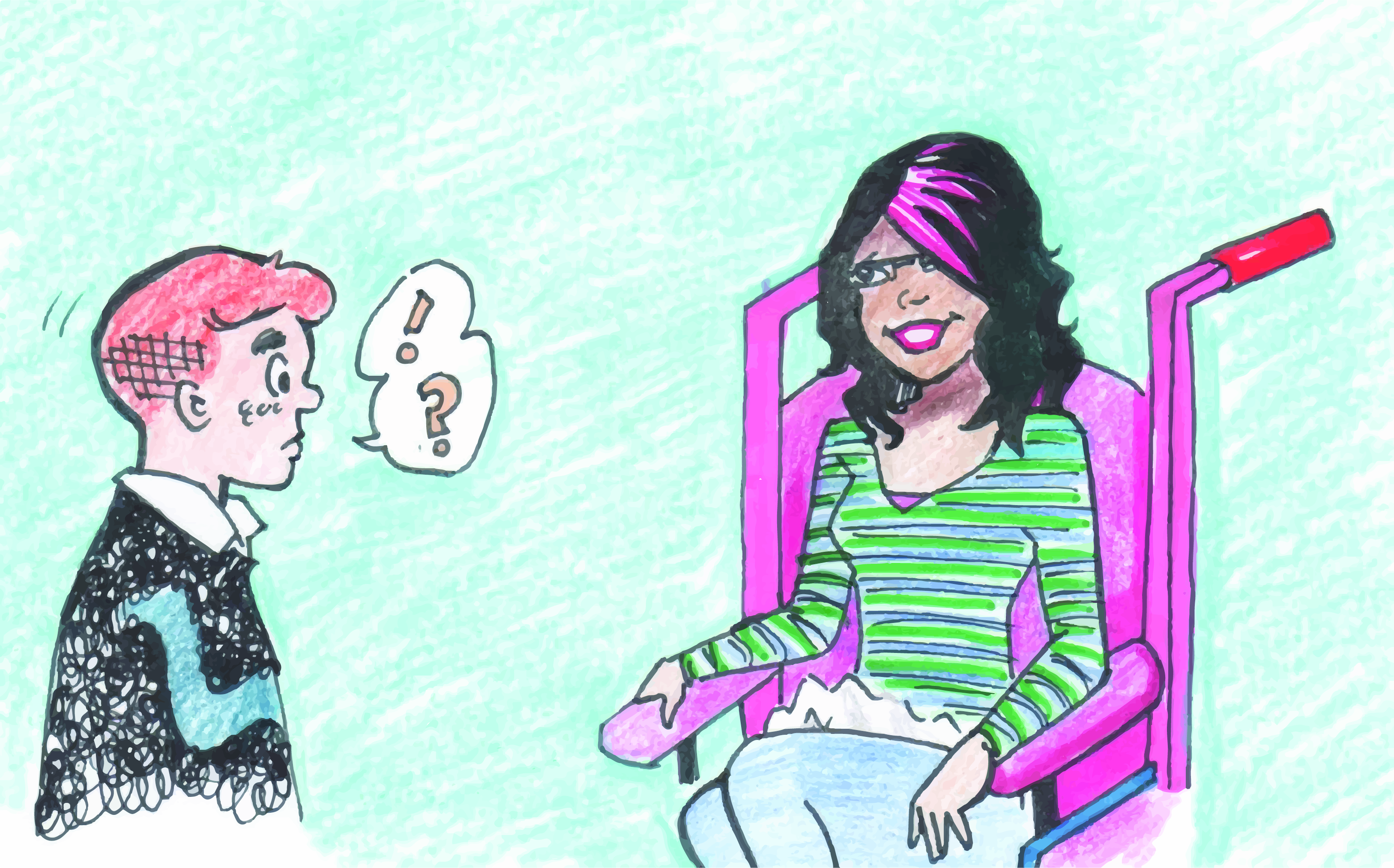
Most recently, Archie comics have come back into the spotlight with the popular addition of Veronica’s cousin, a new character named Harper. Based on Toronto author Jewel Kats, Harper is the first character to appear in these comics in a wheelchair. This new character further illustrates, as Kat said, that “everybody knows someone with a disability, whether it’s a co-worker or a student in your class or your neighbour.” With this newest addition, Riverdale seems to be better representing today’s reality.

Still, this begs the question: why are these changes only happening recently? Sure, when our grandparents were growing up, LGBTQ people were not as accepted, and people in wheelchairs were not always seen as fully-functioning individuals. But, why is a character in a wheelchair only being added this year, instead of 10 or even 20 years ago?

No matter what, people may not be comfortable with the idea of certain types of people — that cannot be changed. But today, it should not be excused. For a comic with as many readers as Archie, the writers should have paid attention to who their readers really were sooner.

Hopefully in the future we will see more diverse and realistic characters appear in Archie and other comic book series. People of varying abilities are part of the diverse and accepting culture in which we live, and it’s time to start illustrating as such.

Notes from this month’s board of governors meeting

0

Community Trust Endowment Fund extension

At the most recent SFU board of governors meeting, held June 26, the board unanimously carried a motion suggested by the Community Advisory Committee to extend the Community Trust Endowment Fund.

The fund, according to the university website, “channels revenue from the UniverCity development into the seven major [research] initiatives outlined in the University’s Strategic Research Plan,”

VP research Mario Pinto said the fund has had “resounding success,” with an, “overall tremendous return on investments.” He continued, “More importantly, it brought together researchers in discussion groups as they formulated their proposals. [. . .] It let them develop more mature proposals than as individuals.”


New responsible investment proposal

The second motion passed by the board during open session was a proposal regarding responsible investment practices, an initiative that is geared towards improving transparency in the university’s investments.

VP finance Pat Hibbits explained that there were two prongs involved in the proposal: the first is that the university joins with the United Nations Principles for Responsible Investment; the second requires all investors to engage in environmental, social, and governance factors.

President Andrew Petter explained that the main effect this policy will have is cultural: “It does provide a forum and a mandate for us to be much more deliberate and transparent in the way we go about oversight of our investment strategy.”