Home Blog Page 1008

What’s next for the Build SFU projects?

1
Marc Fontaine, Build SFU general manager, looks down as the debenture question fails to pass by a 10 per cent margin.

Earlier this month, the Simon Fraser Student Society (SFSS) did not receive permission from the students present at their Special General Meeting (SGM) to pursue a loan for Build SFU’s Student Union Building (SUB) and Stadium projects.

The motion only garnered 65 per cent of the 75 per cent of votes needed to pass, which means that the board cannot obtain a loan and begin construction on the SUB.

Instead, the board must now consider alternative ways to move forward, as they still need the permission of the membership to obtain a loan.

At their latest meeting, at-large representative Rebecca Langmead began the discussion by questioning the dedication of the board to the project.

“I have noticed that without me, board and executive timesheets [from January 7] only mention SGM outreach and SGM a total of 13 times. From everybody,” she said. “My timesheet mentions SGM outreach 20 plus times.”

With reference to the sentiment from some students that the SFSS had been acting as the official ‘yes’ campaign for the Build SFU project, Langmead then asked a pointed question of the executive members:

“Do our executives agree that the board should be in support of a project that is their own and a department that has been created through the SFSS? And I would like an answer from each and every one of you.”

The executives voiced their support for the project, after which several members claimed that they had intended to speak on the project’s behalf, but the question was called too early.

At this point, VP university relations Moe Kopahi questioned why there had been so much confusion as to whether or not they could pass the debenture at an AGM versus during a referendum.

“We have an entire department allocated to this. How could this happen?” he exclaimed. “I want to know whose duty was this, to do this digging and let us know, because under my impression, [. . .] the AGM or SGM was the only option.”

Marc Fontaine, the general manager of Build SFU, asserted, “I was quite surprised to hear at exec the other day that there was such confusion because I have never been confused.

“I do not believe that I ever stated that it was the only option, that it was not possible to hold a referendum,” he continued. “But it seems to have been inferred that way.”

“It’s the safe answer, to be opposed to something.”

Marc Fontaine, Build SFU general manager

The board then moved to a private in-camera session to discuss the matter. Upon returning, the board had made no decision as to the next steps forward. Bueckert said they would be discussing the matter offline.

The Peak spoke with Fontaine after the meeting to hear his thoughts on the SGM.

“I’m disappointed by the results of the SGM because I think there was a lot of misinformation in the weeks prior to the meeting,” he began. “I think a lot of the claims against the project were not the full story and were taken piecemeal.”

When asked what he thought about the support for NoToBuildSFU, the campaign against the project, he replied, “It’s the safe answer, to be opposed to something. Change is difficult and change costs money.”

Fontaine estimates that because of the failure to pass the debenture, the project will be delayed by at least six months, and the board will likely have to hold a referendum regarding the projects. In addition, the Build SFU team will begin further outreach this week.

“I think it’s really important that we step back at this point — the Build SFU department and the student society — we step back for a while, talk to students, and listen to students,” he said. “So that we can, if necessary, take steps to adjust the project to make it what students are looking for.”

Fontaine added, “And perhaps we will end up with a better building at the end of it.”

Men’s basketball close the month with a loss

0

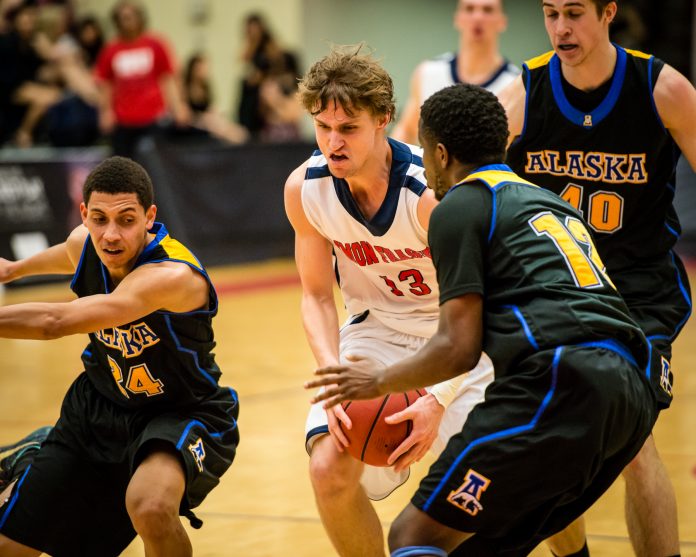
The men’s basketball team closed January with a loss Saturday evening. The team fell to the Alaska Anchorage Seawolves by score of 115–98, ending a two-game winning streak.

Clan guard/forward Roderick Evans-Taylor opened up the scoring with a good layup, but the Seawolves would respond quickly with two straight three-pointers — a problem that plagued SFU all night.

Alaska Anchorage could seemingly shoot from anywhere, downing 20 three-pointers in all and shooting 62.5 per cent.

“They’re a very good three point shooting team,” explained head coach James Blake. “Our game plan was to get them off the three point line — I know it didn’t look like it — but that was our job.

“We just didn’t commit to what we do defensively, and that was disappointing.”

Despite this, SFU spent much of the first half neck and neck with Seawolves — often down only two points. The continual three-pointers wore on the Clan though, and they ended the half down 62–43. The gap had started to grow in the last six minutes, when SFU was outscored 20–7.

The gap only widened from there, as Alaska Anchorage scored 10 straight points to open the second half, earning a 29-point lead.

Clan guard Daniel Deflorimonte broke the vicious cycle with a layup. SFU eventually cut the gap by nearly half — ending the game down 17 points — but the result was the same: a loss.

“We just got a little too high on our horses from our two wins,” said coach Blake. “We haven’t really been playing very well offensively. It’s been our defence, guys buckling down and committing to trapping [that won those games]. We went away from that for some reason.”

Blake also cited the high amounts of three-pointers as being demoralizing to the team: “When teams make shots on you [. . .] the heads go down, the bad attitudes rear their ugly heads, again it’s been a while since we’ve seen them but we’ll clean that up for next week.”

Despite the loss, this was SFU’s highest-scoring game since their 107–103 loss five games ago. The Clan aims to rebound on the road Thursday against the Montana State Billings Yellowjackets, who are currently tied for last in the Great Northwest Athletic Conference.

SFU

Points: 98
Field Goals: 37–75 (49.3%)
3 Pointers: 12–31 (38.7%)
Free Throws: 12–15 (80.0%)

UAA

Points: 115
Field Goals: 35–58 (60.3%)
3 Pointers: 20–32 (62.5%)
Free Throws: 25–32 (78.1%)

Player of the Game: Sango Niang

Image Credit: Sango Niang

For the second night in a row, Sango Niang was The Peak’s player of the game. Topping Thursday’s match with a game-high 24 points, Niang was one of the few bright spots of an otherwise disappointing game. Although the story of the night was the Seawolves’ ability to drop three-pointers, Niang was respectable in his own right, going four for nine.

Points: 24
Assists: 5
Rebounds (Off-Def): 2–3

SFU Hockey snaps losing streak in 5–4 victory over the Eagles

0

After four straight losses, the Clan needed a win in the worst possible way, and their Saturday game against Eastern Washington University (EWU) Eagles seemed to be a match made in heaven.

Coming into the game, the Eagles had let in a league-high 95 goals this season, close to five a game. They had also scored the least amount of goals — 48 in total — and held the worst record in the league at 5–13. But as the Clan were soon to find out, the Eagles were no pushovers, as they had to fight to the bitter end to get a 5–4 win in the shootout.

“I thought we played well,” head coach Mark Coletta told The Peak. “Obviously when you get a win after four games it’s a good feeling, so we had to battle for everything we got and we found a way to win.”

The first period started with an early SFU powerplay, which generated some good chances. However, Eastern Washington would strike first when Eagles forward Ricky Doubrava was left all alone in front of Clan netminder Dominic Stadnyk, and out-waited him to slide it underneath his outstretched glove.

SFU scored two before the end, with goals by Mathew Berry-Lamontagna from the point and Jono Ceci from the side of the net to make it 2–1. Both came on the powerplay, which became a recurring theme throughout the evening. After a scrum in the corner, the Eagles’ Beau Walker and Berry-Lamontagna ended the period with offsetting unsportsmanlike conduct penalties. The Clan peppered the opposing goalie with 21 shots in the opening frame.

The Eagles dominated the second period, using four-on-four play to control the puck and generate the most scoring chances in the period. They were rewarded with the tying goal at the 14:55 mark. EWU Defenseman JR Strait blasted one by Stadnyk, a one-timer from just under the right faceoff dot. They added another one courtesy of Jason Shuck, an easy tap in after a defensive gaffe from SFU. The shots in the second favoured the Eagles, 13–5.

SFU got off to a perfect start in the third, scoring eight seconds in. Ceci passed it cross crease to Nick Sandor who had a wide open cage to bury the puck in another powerplay goal. They took back the lead at the 7:02 mark on the powerplay, with Graham Smerek whacking away at the puck in the crease and getting a greasy goal to take back the lead.

But just as soon as the Clan got the lead, it was gone — the Eagles tied it up a minute later, with Tanner Hawes beating Stadnyk from the point to tie up. The rest of regulation and overtime solved nothing, so the game went to a shootout. Berry-Lamontagna scored the shootout winner, and SFU were awarded the two points.

Forwards Nick Sandor and Ceci had a strong night, and that was a crucial reason why the Clan were able to break the losing streak. “They’ve been struggling a bit so they have to find their way to get on the scoring sheet,” said coach Coletta. “They finally did tonight, and I thought that was a good thing for them because we’re going to need them down the stretch. They’ve been our big guns for the past two years so they’ve got to keep going.”

Past and present collide in groundbreaking Musqueam First Nation exhibits

0
Photo courtesy of Larissa Grant.

A joint project between the Museum of Vancouver, the Musqueam First Nation, and the Museum of Anthropology, c̓əsnaʔəm, the city before the city is an exciting and important series of exhibits. An exploration of the historical and living culture of the Musqueam peoples, this three-site project is a groundbreaking exercise in cooperation between the academic and First Nations communities.

The continuity and uniqueness that each of the sites brings to the overall project is astounding. Each site by itself plays an important role in the community, showing the belongings, the voices, and the experiences of the Musqueam peoples.

The portion of the exhibition at the Museum of Vancouver (MOV) primarily shows the ancient artifacts of the Musqueam First Nation. In an attempt to dismantle the cultural barrier, the belongings have been organized by the Musqueam, with each artifact identified by its use along with its name in the Musqueam language, hən’q’əmin’əm’. At each display, an interactive screen with the faces and voices of living Musqueam peoples discuss the belongings in the case and highlights the importance of oral history in their culture.

Photo courtesy of Larissa Grant.

The use of multimedia in the MOV exhibit adds to the exhibit’s visual and cultural appeal, with an animation projected on the back wall depicting the Musqueam founding story. This modern-day portrayal of the ancient story is only one example of the seamless joining of the present and the past in the exhibit, showing that, as asserted by Councillor Morgan Guerin, spokesperson for the Musqueam First Nation, the “Musqueam are not gone, we never went away.”

The MOV display also depicts the region’s history of colonialism, and the part the museum itself played in this history. A series of maps, a detailed timeline, and community photographs show the effect of colonialism on the Musqueam First Nation. Before this exhibit, the museum had a history of claiming First Nations artifacts, and displaying them without the permission of these groups — in some cases, misrepresenting them. Susan Roy, co-curator of the MOV exhibit, says the museum is now attempting to “bring back objects that are in different museums around North America and the world.”

At the Musqueam Cultural Centre Gallery, the display focuses on the comparison between ancient and modern knowledge, and the continuation of the culture into contemporary times. Councillor Guerin lead the tour, saying “there is a connection between past and present, a working knowledge of how it was.”

This connection can be seen in the displays, shaped like Coast Salish looms, with ancient belongings in the top of the case and their contemporary equivalents at the bottom. The collection is completed with the traditional stories of the people engraved in the windows overlooking the river delta, giving a narrative to the land and highlighting its connection to the Musqueam peoples.

The final portion of the exhibit is at the Museum of Anthropology (MOA) at UBC, with a focus on the voices of the people and the sharing of cultural knowledge. This experimental exhibit has no belongings, only the oral tradition of the Musqueam written on the walls, and interactive multimedia centres to encourage learning. The entrance of the exhibit is styled like a contemporary longhouse, inviting all who enter to learn about the connection between past and present, and “what it means to be Musqueam,” according to Jordan Wilson, co-curator of the exhibit.

This series of exhibits is a breathtaking example of cooperation between museums, and a triumphant return of autonomy for the Musqueam First Nation. A learning experience like no other, these exhibits display the historical and ongoing struggles and successes of the Musqueam peoples. As Guerin says, “we are very much a sharing people. Welcome, with arms open wide.”

c̓əsnaʔəm, the city before the city is on display until January 28, 2016. For more information, visit thecitybeforethecity.com.

Sports Briefs

0

Lacrosse

SFU Lacrosse will open their season at home on the Terry Fox Field on Sunday, February 8 at 2 p.m. The team is coming off a year where they went undefeated in their division — the Pacific Northwest Collegiate Lacrosse League (PCNLL) — and won the PCNLL championship. Though they lost to the Colorado State Rams in the first round of the Men’s Collegiate Lacrosse Association (MCLA) national championship, they appear once again posed for success with key contributors returning including team goal scoring leader Tyler Kirkby — who ranked seventh in the whole MCLA with 65 goals.

Wrestling

Last week, the men’s wrestling team competed in two tournaments. The first — the Boxer Open — was held Sunday in Forrest Grove, OR, and resulted in a Clan victory, with Josh Kim claiming first in the 184 lb weight class. Then, on Wednesday, the team team traveled to Oregon, City, OR to compete in the Clackamas Open, where both Kim and redshirt freshman Ben Smyth achieved a fourth place finish in their respective weight classes.

Whitecaps

The Vancouver Whitecaps announced Friday morning that they have hired Clan men’s soccer head coach Alan Koch to coach the Whitecaps FC 2 — their newly formed USL Pro affiliate, which will serve to develop young Whitecaps talent. “[Leaving SFU] was not an easy decision,” Alan Koch said in an SFU Athletics press release. “But I’ve always wanted to coach in the professional game, and to do that without having to relocate is an opportunity I could not pass up.”

With files from SFU Athletics

Meet the Clan: Rachel Fradgley

0
Although the London, ON native was homesick at first, a trip home gave her the perspective she needed to carry on. Image Credit: Brandon Hillier/ The Peak
Although the London, ON native was homesick at first, a trip home gave her the perspective she needed to carry on.    Image Credit: Brandon Hillier/ The Peak

Screen Shot 2015-02-07 at 4.49.57 PM“During Christmas, it’s weird because there’s not as much snow,” muses London, ON native Rachel Fradgley about her new home in the Lower Mainland. “But the weather here is so much nicer than Ontario. It feels like spring. I really like that.”

The 6’2” forward seems to have adjusted to her new surroundings quite well. Only in her first year, she is already a starter on the women’s basketball team — often playing with senior star Erin Chambers. Notably, she led the team in scoring once this season, in a game against Saint Martin’s University.

However, despite her strong start in SFU athletics, it was tough for the young athlete to make the trip across the continent. “First semester I was really homesick — I didn’t think I’d be as homesick as I was,” she admits.

It took a trip home to give Rachel the perspective she needed. “Once I went back for Christmas and I came back, I just felt a lot better because I realized that this is where I want to be.”

Being so far from home was hardly the first hardship that she had to endure, and overcome. In her grade 11 year, Rachel tore her ACL, which some thought could be career-ending for the high school junior.

“It [was] a challenge,” Rachel says about having to watch her teammates play without her. “It made me really upset a lot of the time, but my teammates were really good about it. They all tried to include me and they tried to make it a super positive experience, rather than a negative one.”

Her injury did end up having a silver lining — it gave her time to think about the sport she loves, and what it means to her.

“I learned a lot about myself, tearing my ACL. I think you learn how much you like the sport and how much adversity you’re willing to go over to get back.”

The idea of turning this negative into a positive, and persevering through it, also influenced Rachel academically, causing her to study the mind. “When I got injured [. . .] there’s a big mental part about it, so I think getting over that mental aspect drew me into psychology.”

In truth, she admits that she’s still “keeping her options open” academically and “trying to explore a bit.” But athletically, there is no question — basketball is her sport. Having started playing in grade five, Rachel says she initially chose basketball because of a family friend.

“One of my dad’s friends ran a basketball program in London, and I have always been really tall, even as a kid. So he noticed that and was like, ‘You should come out to our house leagues and just see what it’s like,’ and I just really enjoyed it.”

However, it wasn’t until later that she became a full-time basketball player, having initially split her time between two sports.

“For three years I was doing both dance and basketball,” she explains. “Then in grade eight, I decided to quit dance and focus solely on basketball.”

Was it a tough decision to quit dancing?

“No,” Rachel says bluntly. “Towards the end of my dance career, my heart wasn’t in it anymore. I wasn’t practicing. I wanted to focus more on basketball.”

This focus on one sport soon paid off for Rachel. Her talent was quickly recognized, and even though she missed a significant portion of prime playing time with her injury — missing the initial tryouts — she made the Canadian national team in her senior year.

She represented Canada at the FIBA Americas U18 Championship for Women held in August 2014, facing international teams from both North and South America. The team finished with a silver medal.

Although she struggled with the distance away from home, her international experience made the transition to university basketball relatively easy.

“The jump from high school to national was a big jump, [but] from the national level to university was a bit of a smaller jump, because I was already used to playing at a bit of a higher level,” she notes.

Still in the midst of her first year, Rachel is looking forward to where she — and her team — can grow. “I think there have been points where we can be a little bit better, but we’re a young team.”

FUN FACT:
Favourite Food:
“Ice cream.” Need she say more?

Clan outwit Nanooks in low-scoring affair

0
Guard/forward Michael Harper. Image Credit: Hamed Yaghoubi Shahir/ The Peak
Guard/forward Michael Harper. Hamed Yaghoubi Shahir /The Peak
Guard/forward Michael Harper. Image Credit: Hamed Yaghoubi Shahir/ The Peak

The year 2015 has not been kind to the men’s basketball team  — their last game was just their first win of the year. However, Thursday night against the Alaska Fairbanks Nanooks, the men’s basketball team were able keep up the positive momentum, putting up their second straight win.

The Clan came out firing on all cylinders. Guard Sango Niang scored the first basket, and his team then managed a quick 10–1 run. Midway through the first, Alaska was able to cut the lead down to 7, but the Clan answered back, this time by going on a 9–2 run and restoring their big lead. The half ended 45–37 SFU, led by strong performances by both Niang and guard Hidde Vos.

The second half started with a commanding lead for SFU, who were up by 17 just two minutes in. But after that, the team’s offence dried up and the shooters began missing the mark. This allowed the Fairbanks to slowly get back into the game, eventually cutting the lead down to two points. Ultimately, the Clan were able to restore a bit of a lead, and the final score was 79–71 SFU.

The win was SFU’s lowest-scoring victory this season — their only win while scoring under 100 points — as well as their second-lowest score.

Despite the lack of offence and sloppy defence that plagued the Clan’s second half, head coach James Blake was pleased with the win — their second in January, a feat the team has not accomplished since joining the NCAA.

“I’m very proud of how my team has responded,” said the coach. “This team has responded to a tough January, and now they’ve got two wins in the month of January, which my teams in the past haven’t done.”

With the win, SFU moved out of a four-way tie into sole possession of seventh place in the Great Northwest Athletic Conference (GNAC), one spot short of sixth place — the final playoff spot. Though tied with Western Washington for conference wins, they have the edge because of more overall wins. An NCAA playoff appearance would be a first for the Clan.

SFU

Points: 79
Field Goals: 27–74 (36.5%)
3 Pointers: 11–47 (23.8%)
Free Throws: 14–18 (77.8%)

UAF

Points: 71
Field Goals: 23–60 (38.3%)
3 Pointers: 5–22 (22.7%)
Free Throws: 20–30 (66.7%)

Player of the Game: Sango Niang

Niang was a key contributor to the Clan’s impressive performance in the first half. Near the end of the half, he assisted on a highlight reel alley-oop to Roderick Evans-Taylor, which sent the crowd of 245 into a frenzy. Always the crowd-pleaser, Niang nabbed the ball again a few seconds later, and stepped back for a long distance three-pointer. He finished with a game-high 23 points, including going perfect from the line and three assists.

Points: 23
Assists: 3
Rebounds (Off-Def): 2–5

SFU softball team ready to fight back

0
Photo courtesy of SFU Athletics.
Last year, the Clan had only four wins.  Photo courtesy of SFU Athletics.
Last year, the Clan had only four wins. Photo courtesy of SFU Athletics.

Following a difficult 2014 season, the Clan softball team has set their sights on improved results and strong team unity.

The women will put a tough campaign where they finished with only four wins in 39 games behind them, but will take the experience and adversity into a fresh start under head coach Mike Renney.

Injuries hampered the entire campaign for the Clan, often forcing young players into unfamiliar positions in order to play for survival. Despite this, the coach is confident that his younger players have benefitted from this playing time and versatility for future games.

“Last year was a perfect storm, said Renney. “We had some unforeseen injuries, and had lost some key veterans we were relying on. That, combined with the losing a good graduating class from the year before meant we were really young. [. . .] The flipside of that is that a lot of the young athletes who normally wouldn’t have got the playing time were battle-tested, and certainly should be better for it with experience moving forward.”

Returning for the Clan is key pitcher Kelsie Hawkins who will surely provide some much needed veteran presence — Hawkins was redshirted last season because of an offseason injury. The Victoria native led the Great Northwest Athletic Conference (GNAC) in shutouts during her 2013 season, eventually being named a GNAC first team all-star. 

Also returning from an injury-shortened season is starting shortstop and team captain Danielle Raison, who was given an honourable mention for the 2014 GNAC all-star selections.

“[Danielle] went down with a key injury halfway through the year, and she’s returned to form for her starting position,” added Renney. “But we’ve got added depth now because of the players that have had experience. [. . .] More time in different positions for certain players has given them more of a repertoire and versatility off the bench.”

Just two wins in conference play during 2014 spells another challenge on the horizon for the Clan, but recent additions to the team will surely bolster their available options. Samantha Ruffett (Brampton, ON) and Jessica Tate (Georgetown, ON) will join the Clan from the Brampton Blazers as catcher and left-handed pitcher, respectively. Also among the Clan’s new faces are the local talents of outfielder Sierra Sherrit (Richmond, BC), and power hitter and utility infielder Brooklyn Smith (North Vancouver, BC).

Renney believes that minimizing runs against the Clan will be crucial to their goal of reaching the top four and ultimately the playoffs.

“Our conference is a very competitive one, and there are no games you can take lightly,” he said. “We have to climb a bit to get into the top four, and everything is up from here on out.”

Mid-season NHL Draft checkup

0
Image Credit: John Quackenbos - Boston College

Back in October, I pointed out some players to watch out for (not named McDavid and Eichel.) These two players were positioned to battle it out for the top two spots, and that hasn’t changed. Now with the season at the halfway point, it’s time to re-evaluate our draft predictions and see how right  — or more likely, wrong — I was.

Oliver Kylington (Färjestad BK, SHL):

Image Credit: Anders Henrikson

Back in October, I said his draft stock would depend a lot on his performance in the World Juniors (WJCs). Unfortunately, he missed the tournament due to injury, so he wasn’t able to make an impact on a Swedish team that was eliminated in the semifinals. Now he risks being buried under a strong crop of US defencemen. Kylington has regressed; however, I figure he’ll still go in the top 10.

October Prediction: 4th Overall
Mid-season Prediction: 7th to 9th Overall

Dylan Strome (Erie Otters, OHL):

Image Credit: Matt Mead Photography

Playing on a line with McDavid, the question was: can he score without McDavid? Well, McDavid’s injury may have been the best thing for Strome, as he was able to show he is an elite talent in his own right. Even with McDavid out, he was able to produce a pace of over a point per game, and sits on a ridiculous 85 points in 45 games. I said in October that there’s too much uncertainty in where he will be drafted, but now I’m almost certain he will be in the top five.

October Prediction: 7th to 11th Overall
Mid-season Prediction: Top 5

Mitch Marner (London Knights, OHL):

Image Credit: Claus Andersen, London Knights & Getty Images

Marner is putting up incredible numbers so far this season, with 93 points in 45 games for the London Knights. In fact, since the end of the WJC, he has actually outscored Connor McDavid in the OHL. This season, Marner has had plenty more ice time, and has shown no sign of slowing down his torrid scoring pace. Marner is an elite offensive player, and will surely make it in the top five this year.

October Prediction: 8th Overall
Mid-season Prediction: Top 5

Travis Konecny (Ottawa 67’s, OHL):

Image Credit: Valerie Wutti

Konecny may be the player whose draft stock has dropped the most since October — so much so that TSN expert Craig Button has him ranked 30th. One year after winning the OHL rookie of the year, Konechy has had a rough season, and is on pace to end up with fewer points than he had last year. However, he did have a good Ivan Hlinka Memorial Tournament, which is usually a good indication of future point production. He had six points in five games, and while he probably won’t be a top 10 pick, I don’t believe he will drop as far as Button is predicting. He could be a good consolation prize for a team bounced out in the first round of the playoffs.

October Prediction: 5th to 8th Overall
Mid-season Prediction: 16th to 22nd Overall

Noah Hanifin (Boston College, NCAA):

Image Credit: John Quackenbos - Boston College
Image Credit: John Quackenbos – Boston College

Hanifin has had a great start to his collegiate career, with 14 points in 24 games for Boston College as a defenceman; he also had a solid WJCs. Originally thought to be the bona fide number three pick, his position may have fallen because of the solid play of Marner and Strome. He could slip to fourth or even fifth if a team has a more pressing need for a forward than a defensemen.

October Prediction: 3rd Overall
Mid-season Prediction: Top 5

Lawson Crouse (Kingston Frontenacs, OHL):

Image Credit: Kingston Frontenacs Hockey Club

Crouse wasn’t included in the October list, but he deserves to be discussed this time around. One would think his 6’4” and 220 lb frame would transfer nicely into the NHL, but his relatively low point total (23 points in 32 games) leaves some questions. He should be a quality NHL player, but not good enough for him to be picked ahead of guys like Strome or Marner.

October Prediction: Not ranked
Mid-season Prediction: 10th to 12th Overall

Senate and Board of Governors Elections Rundown

0

It’s that time of year again, when student politicos vie for your vote to represent you on two of SFU’s highest governing bodies: the Senate and the Board of Governors.

Senate

Students elected to Senate are responsible for making decisions related to SFU’s academic governance. These include issues related to teaching and research, the development of new initiatives, the formation of priorities, and the consideration and approval of policies. Here are the Senate candidates who submitted a response to The Peak by our deadline:

Senate4

Iman Baharmand

First Year, Molecular Biology and Biochemistry

When I ask students: “Do you know what the Senate does?” I typically get the same response and confused look. Most people just don’t know!

I am shocked by the fact that some people think they have the power to lower tuition or make commuting to school easier, when the senate only deals with Academic and Research governance! I believe this is because of the lack of exposure!

If elected I plan on creating summaries of each meetings 270 word Open Senate Agenda Minutes, to be sent to the different Departmental Student Unions within the faculty. In hopes that the DSU’s will pass on the information to undergraduate students. This along with opening a blog where students can submit questions to be brought up through me and more! Please check out my full platform or Facebook event for more details!

—

CMYKIMG_6943Dion Chong

Third Year, International Studies

Over the last three years of my SFU career, I’ve had the pleasure of helping build up the Society of Arts and Social Sciences, which has become a platform for the advocacy of student issues within the FASS. As its current President, an incumbent Senator for the Arts and Social Sciences, and a member of the Senate Committees for University Priorities and Undergraduate Studies, I’ve had the opportunity to be a resource to students seeking to enhance the state of university academia, whether it be through enhancing course availability, reconsideration of the university grading policy, or actively advocating for the university to take a holistic approach to academics through integration of experiential learning.  Through your vote, I will continue to work towards promoting integration of student consultation into the university’s decision making processes, alongside the incredible work our DSUs and student groups already do.

—

AM SenateArjan Mundy

Third Year, Communications Major, Philosophy Minor

My major is communication and my minor is philosophy; an absolutely horrible mix of subjects to devote yourself to. You see – I have this insatiable need to attempt to communicate everything in the best possible way imaginable, and I have the undesirable urge for everything to make logical sense once it has been communicated. These skill could stand some improvement at Senate, and I hope to help with that.

My three main focuses are:

  •  Engaging Community
  •  Improving Communication
  •  Supporting Innovation

These three work in conjuncture on many levels. If we support innovation at the Senate level (innovative teaching and learning alternatives, for example) then we stand a much better chance at engaging the community involved. Furthermore, by improving communication we can spread these innovative passions to the rest of the student body; I truly believe this will go a long way to mitigate miscommunication, and optimizing

—

10702043_10152663116422415_3204855357373902623_nAli Najaf

Third Year, Business Administration

Dear SFU Students,

I have been an extremely active student on campus within the faculty, residence, and the greater campus community.

Selected Experience at SFU:

-Elected as a McTaggart Cowan Hall Representative.

-Community Advisor at SFU Residence.

-Member Senate Committee on Disciplinary Appeals.

-Commissioner, Independent Electoral Commission, SFSS.

-External Relations Coordinator UNICEF SFU and Enactus SFU.

-Member Student Advisory Committee, Build SFU.

If elected as a Senator, I will:

-Make sure that your voice is heard.

-Work alongside other SFU Senators to strengthen the relationship with SFU community to increase engagement on campus.

-Work with other SFU Senators to have a strong say against increased tuition fees at Simon Fraser University.

-Provide students with the opportunities and will consult with them on the various issues.

-Advocate for more courses to be offered in Summer Semester.

I am passionate and have past experience to serve you and make your experience better.

—

IMG_1095Dorothy Ng

Second Year, Political Science

Since becoming a student at SFU, I have actively sought opportunities for leadership development – in others and in myself – and community engagement. Serving as an executive member in various clubs, a Welcome Leader, and a Frosh Captain has given me the opportunity to better understand the needs of the students who shape SFU. In turn, I would like to apply this knowledge in a practical and influential manner: as a member of SFU’s Senate.

If elected, I will be committed to keeping students informed of Senate and committee matters and to answer any questions they may have. I also hope that through social media, students will be able to voice their concerns effectively and conveniently, through the SFU Student Senators Facebook page. Finally, I will serve as an advocate for those seeking bursaries and scholarships offered by the university and private donors.

—

10947472_10152806086209821_2133675052_nBrady Wallace

Third year, Political Science major, Development and Sustainability Minor

My name is Brady Wallace and I am a third year Political Science major and Development and Sustainability minor. As a current Student Senator, if re-elected I have three goals. First, I would use this position to establish dialogue between Senate and the Faculty of Arts and Social Sciences Faculty Student Union, the Society of Arts and Social Sciences (SASS). Second, I will continue to advocate for SFU’s involvement with the BC Open Textbook Program (an initiative I am currently working on with the Simon Fraser Student Society’s Advocacy Committee,) which aims to provide free course materials for undergraduate students. And third, I would like to work with the 15 other student senators to plan ways in which our Student Senate Caucus can effectively communicate with students at both the undergraduate and graduate level at all of SFU’s diverse campuses.

Thanks for taking the time to make an informed decision.

—

Enoch Weng HeadshotEnoch Weng

Fourth Year, Business Major, Intended Music Minor

“Ohana means family. Family means nobody gets left behind.” – Lilo & Stitch

The SFU community to me is my Ohana — full of life, and of excitement; a place where we can celebrate differences and enjoy each other’s presence. I wish to see our community continue to grow and stay magical.

My platform is focused on bridging the communications and knowledge gap between the University and students, and to provide an accurate and honest representation of the student population during our governance meetings. I aim to create greater transparency within the proceedings, and to ensure that the education and well-being of students are seen as top priorities.

To be a Senator, I will strive to be as swift as a coursing river, with all the force of a great typhoon, with all the strength of a raging fire, and to be as mysterious as the dark side of the moon.

—

brandon wongBrandon Wong

1) Open Communication

Miscommunication is commonplace at SFU. Things would run more efficiently if we could talk to one another without bias or preconception. As a Senator, I would seek out students who have issues of concern, and push to resolve them to the best of my ability.

2) Build Community

SFU is not a commuter school. We have access to a great amount of resources, and rated one of the best in the world. Unfortunately, many students feel disconnected from administration. Our progress as a leading academic institution can be improved, proportional to the efforts of students and administration working hand-in-hand.

3) Engage Academic Passion

Studying should be a passion. At the very least, a student’s accomplishments in their fields can be more than just grades on a paper. Students should partake in extracurricular academia, such as research or experiments, to set themselves aside from competition in years to

—

rudo_senateRudo Zaranyika

Fourth Year, Business Administration

Why am I passionate about advocating for the student body’s academic and financial concerns? Having lived on the mountain (Residence & Univercity) since moving to Canada, 4 years ago – the friendships & connections I’ve made through Residence, YWiB, African Students’ Association, the Alumni Appeal & Beedie have made SFU feel like home to me. Thus, fuelling my passion to be more involved in this aspect of the University, that affects us all.

As a part of the Senate my goal is to, increase the communication of policies discussed, succinctly; so that this information is readily accessible on multiple interactive platforms. I will actively advocate for an increase in support for students through the Senate Policy Committee on Scholarships, Awards and Bursaries (SPCSAB), to alleviate the high tuition costs.

Thank you for your time. If you have any questions regarding my goals as an SFU Senator, please contact me: [email protected]

—

Board of Governors

Students elected to the Board of Governors (BoG) are responsible for decisions made at the highest level of the University. As the senior governing body at SFU, the BoG makes decisions regarding the business of the University (property, revenue and policies). Here are the BoG candidates who submitted a response to The Peak by our deadline:


Deven Azevedo Pic for PeakDeven Azevedo

Second Year, Environmental Science

If re-elected, I will use the relationships I have built on the Board, as well as a firm understanding of Board protocols and processes, to continue to push the university to live up to its proclaimed vision of pursuing “ecological, social and economic sustainability through its programs and operations.” This will firstly include working to minimize the impact that the proposed international student tuition increases will have on financially strained students and, if concessions are not made by the university, opposing these increases entirely. Secondly, I will continue to campaign for increases in the transparency of the university’s investments and for the reduction of the university’s carbon risk. Lastly, if re-elected, I will continue to seek input from students on their ideas and interests and represent them at Board meetings. Thank you, and all the best with your studies.

—

DSC_0189Katelyn McDougall

Masters of Urban Studies

I’m running for the Graduate Student Member position at the Board of Governors because I want to help the University become a more sustainable, accessible, open, and engaging space.

If elected to this position there are several things that I hope to work towards, including:

  • Working in consultation with the SFU Graduate Student Society to better align our collective goals;
  • Recommending that any fees for approval do not create further financial barriers for students;
  • Working towards divestment from fossil fuel industries;
  • Ensuring smart, sustainable capital planning, construction and maintenance, including strategic opportunities to build a gondola to campus;
  • And, enhancing SFU’s community engagement strategy.

My experience working with the GSS has given me a strong understanding of the diverse opinions and needs of graduate students, and your vote will ensure that we have a strong voice representing us at SFU’s most senior governing body.

—

DSC_2143David Weston

PhD Student, English

Hello fellow graduate students! I am running for SFU Board of Governors and would appreciate your support. My enthusiasm for graduate studies, paired with my experiences in university affairs and the GSS, has illustrated the important role graduate students have in shaping this university. I would be honoured to represent the graduate community and advocate for our interests to the president, chancellor, and board members.

On our three campuses, graduate student space, and support must be developed with a special focus on maintenance and safety. More funding opportunities and the need for provincial support should remain a focus for SFU. Tuitions fees, both for our international and domestic students, must be watched and kept inline with funding and living costs. All three of these major issues affect graduate satisfaction, time to completion, and ability to research successfully. I will ensure these concerns are brought to the Board of Governors’ attention.

—