Home Blog Page 913

Tokyo Police Club provide high energy fun at The Imperial

0

Upon walking to The Imperial, I saw the line for Tokyo Police Club — people buzzing, excited to be with their friends for the show. I had never been to The Imperial before, as it is hidden away in the East Hastings area; it featured two bars, pumping music, adequate seating, a subtle green glow from the stage, and a large Tokyo Police Club banner on it.

Van Damsel, a band from Kamloops, kicked off the show with a high energy vibe. The crowd was just beginning to move, with more people flowing into the venue throughout their set. As the set progressed, Van Damsel’s lead singer, Sebastien Ste Marie, kept the audience engaged. About mid-set he asked, “who here is from Kamloops?” and the crowd roared, a response the band didn’t seem to expect as they followed with, “is anyone here actually from Vancouver?” As a lesser known band, they really started the night off right, maintaining their high energy with pulsing beats and heavy bass lines.

The last time I saw Tokyo Police Club was shortly after they released Elephant Shell in 2008. It had been a while, and I had recently been getting back into some of their older albums and EPs. I was ready to hear some of their new songs; I was ready to hear them live. As the band made their appearance on stage, people pushed their way into the main standing area. Continuing Van Damsel’s high energy, Tokyo Police Club danced along to their music as they played.

As an indie rock band with an underlying pop tone, they certainly knew how to keep the crowd moving. Most of the setlist were songs I didn’t recognize, but from what I can tell they’ve kept up with their pop synths and off-beat melodies. The vocalist, David Monks, is the factor that differentiates the band from others in the genre. His oddly catchy flat tone works well with their sound.

With a good mix between old and new songs, Tokyo Police Club surely managed to please all of their fans. Their set featured songs like “Nature of the Experiment” and “Be Good” in between newer songs, and kept the lively crowd going.

As part of the encore, the band covered Kelly Clarkson’s “Since U Been Gone” as nothing more than a crowd pleaser. I wouldn’t say it was the best cover of the song, but it definitely caught everyone’s attention, as the room echoed with the crowd singing along. To finish off, they played “Your English is Good,” one of their most well-known songs.

NCAA should scrap its soccer rules

0

Last year around this time, I started contributing to The Peak, and one of my first articles was covering a men’s soccer game. Growing up playing and watching soccer from a very young age, I was very excited. I felt that I could write an excellent article and tell a great story.

As I got there and set up, I looked up at the scoreboard and noticed that it was set at 45 minutes. At first I thought it was a mistake. But no, the game started with the clockgame counting down from the 45 minute mark. This caused all sorts of problems for me marking chances and goals. I was used to just looking at the time and writing down the minute, but now I had to do math (and who likes that?). Later on in the half, the team substituted three players at once. The coach used all three substitutions in the first half, which I thought it was quite odd; it turned out, though, teams are allowed to make 11(!) substitutions per game.

While the game was quite exciting, the rules made it hard to watch. SFU took a 3–1 lead into the second half, but surrendered two goals and the game ended 3–3. Or so I thought. As I got up to go home and write the article, I heard over the speakers “We will now start overtime!”

I panicked. Did I miss something? Was this some sort of playoff game? As the overtime came to a close and the game finally ended in a 3–3 draw, I half-expected it to go to a penalty shoot-out to decide it.

The NCAA’s soccer rules are idiotic. They are offensive to anyone who enjoys the beautiful game, and are an affront to God. They are also incredibly confusing, weird, and foreign to fans who are watching their first NCAA soccer match. The rules are, quite simply, a terrible attempt to ‘Americanize’ soccer.

This attempt to Americanize soccer was ventured by Major League Soccer in its early days, and it failed miserably. The rules in the early days of MLS were similar to the ones now used in the NCAA. They used a countdown clock starting from 45:00 and ending the half at 00:00. They also used a shootout to decide tied games, with the winner only getting one point instead of the customary three.

What the MLS realized is by using these rules, they were alienating not only traditional, European soccer fans, but were also failing to draw out new soccer fans. Suffering from poor attendance, the league scraped the rules following the fourth season, and MLS learned a valuable lesson. People want to see the soccer they see on TV from Europe, not a weird variation.

The NCAA could learn a valuable lesson from this. Americanizing soccer does not work; it has been tried before and it failed. If they simply used rules that are intuitive to the average soccer fan, they could improve what is already a pretty good product on the pitch into an even better one.

Clan Women’s Soccer Suffer First Defeat of the Season

0

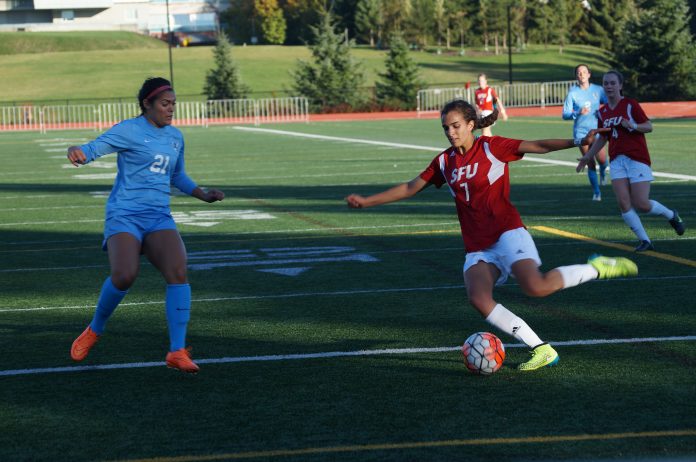
The SFU Clan Women’s Soccer Team suffered a 5-0 defeat to the Western Washington Vikings this Saturday at Terry Fox Field. The team’s start was their undoing, with all five Western Washington goals coming within the first fifteen minutes. It was the first loss of the season for the Clan who are now 3–1–2 on the season, and 1–1–1 within the GNAC conference.

Western Washington was stiff competition entering the contest with a 6–1 record and a #5 national ranking. Despite the Clan exercising great ball possession, the Vikings were able to strike quickly, with the first goal coming within the first three minutes, and the second goal coming just a minute later. By the time it had reached the 15 minute mark, the game was 5–0, and it was out of reach. Elise Aylward had a hat trick for the Vikings with Catherine Miles chipping in the other two goals.  

The Clan settled down in the second half and had several chances to get on the scoreboard. The highlight was Goaltender Priya Sandhu’s (Surrey, BC) exciting diving save on a Western Washington penalty kick. Coach Annie Hamel identified Katelyn Erhardsen (Maple Ridge, BC) as the top Clan player in the match in an otherwise poor effort from the team.  

Coach Hamel also stated that, “the biggest positive is that we get to play them again and let them know that an 18 minute span doesn’t define us as a group.” Coach Hamel also expressed pride in her squad for “respond[ing] very well after our half time talk.”  

Moving forward, the team will be at home on October 1 to take on Montana State University Billings. Coach Hamel stressed that they need to focus on decision making in their next game. “We need to play smarter, [and] make the right decisions quicker so we move the ball at a much higher pace and play to our strengths.”  

Vancouver Canucks season preview

0
Photo Courtesy of WayneRacine (Flickr)

Last season was one of mixed opinions for Canucks fans such as myself. New General Manager Jim Benning and President Trevor Linden revamped the team, trading Ryan Kesler for Nick Bonino, a first round pick that ended up being Jared McCann, and much-maligned defenceman Luca Sbisa. They also traded away Jason Garrison at the draft for a second round pick, which they flipped for Linden Vey. Forsling for Clendenning was an interesting trade, and acquiring Sven Baertschi from Calgary may turn out to be a great move.

It’s hard to see where the team has improved over the offseason.

The Canucks finished second in the division last year with 101 points. It looked like Benning and Linden were geniuses, and built up a lot of good will with fans after most pundits picked them to miss the playoffs. Unfortunately this was short-lived, as the team lost in the first round to a vastly inferior Calgary Flames side, including blowing a 3–0 lead in game six to be eliminated.

With a new season, though, comes new expectations and fresh optimism. Let’s take a look at each facet of the Canucks team and see whether they have improved or gotten worse.

Forwards

The forwards and the entire team once again will be led by the Sedin twins. They had another strong season last year, with Daniel finishing with 76 points and Henrik with 73. The reason for the points-increase for the twins was the addition of Radim Vrbata to their line. His 31 goals boosted a Canucks offense that looked anemic at most points during the Tortorella regime. The team will have to make a decision at the trade deadline though, as Vrbata is on the last year of his contract. Do they trade him away and perhaps get a pick and prospect from a contending team? Or keep hold of him for the potential playoff push and lose him for nothing in free agency?

The trade for Brandon Sutter is extremely hard to justify any way you look at it. He’s never scored more than 50 points in the NHL, despite playing on an offensively gifted Pittsburgh Penguins team for the past three seasons. A better choice for second line centre would have been Bo Horvat. He has a lot more upside than Sutter, plus played very well down the stretch run and in the playoffs. Trading away Zack Kassian and giving up a fifth round pick for Brandon Prust is highly conflicting, considering Benning’s messages about making the team younger.

Miller at his age is now an average starting goaltender in the NHL.

Forwards such as Chris Higgins will still have a place, but will have to battle youngsters such as Jake Virtanen, Jared McCann, and Sven Baertschi for playing time now. As well, the loss of Shawn Matthias and Brad Richardson in free agency may severely hurt the scoring depth if none of the aforementioned players can step up and contribute.

Defence

The most noticeable loss from a fan’s perspective was Kevin Bieksa getting traded to the Anaheim Ducks. From the team’s perspective, it’s not that big of a loss. Kevin Bieksa and Luca Sbisa were a terrible defensive pairing last season. Replacing Bieksa with free agent Matt Bartkowski and getting a second round draft pick from the trade was good business, but having Luca Sbisa for three more years still scares me. The untimely turnovers and terrible defensive coverages were the only “highlights” of his first season in Vancouver, and the Canucks stand to give up a significant amount of goals when he’s on the ice.

On a positive note, Alex Edler and Chris Tanev are looking like a solid pairing that can go up against the opposing team’s top line. Tanev in particular, while not great at putting up points, is a great shutdown defenceman and has great underlying advanced stats, such as his 55.4   Fenwick for percentage, a statistic that measures the percentage of scoring chances a player is on for. Frank Corrado will hopefully be given more of a shot, and with Yannick Weber and potentially Jordan Subban at some point, the defence looks like it will be able to produce at the same level as last year at the very least.

Goaltending

By far the biggest question mark heading into the season will be in net. The trade of Eddie Lack angered many in the fanbase, including myself. Not only was he proving himself to be an excellent goalie, his personality was perfect for this market. Lack’s fate was sealed though, when, after a poor game four, coach Willie Desjardins decided to start a not full fit Ryan Miller for the next two games.

Miller at his age is now an average starting goaltender in the NHL, making six million dollars a year. Without Lack, there is no safety net if he falters or gets injured like last year. While the Canucks believe in Jacob Markstrom, I frankly don’t. True, he has been an outstanding goalie in the AHL, but in the NHL his numbers are not so great, and his three goals on four shots performance against San Jose last season is still fresh in my mind.

. . .

“Change is coming” has been this regime’s mantra, and indeed there have been big changes to the team, but they haven’t been positive. From the resigning to Luca Sbisa, to the trades of Eddie Lack and for Brandon Sutter, it’s hard to see where the team has improved over the offseason. With LA, Edmonton, Calgary, and Dallas all getting better, the Canucks will be in tough to have a good of a season as last year. I’ll be surprised if they make the playoffs this coming season.


Is Chitter the new SFU Confessions?

0
Photo Credit: Lisa Dimyadi

As a busy student, one must explore various avenues that can aid in taking the edge off of university life. If all else fails, however, you can always count on a Facebook confessions page to release your frustrations.

For some time now, the SFU Confessions Facebook page has offered solace to students wishing to express major grievances as well as lighter sentiments, such as ‘bae goals,’ anonymously. Recently however, an alliance from various Canadian universities consolidated the demand for anonymous posting by producing a new app called Chitter.

Having used Chitter for about two weeks so far, I couldn’t help but question whether this new development would maintain the experience many students seem to yearn for on confession pages. Is introducing Chitter pointless? Or are there aspects that will enhance the juicy experience of university chatter?

The new application boasts merits such as a self-moderated forum via a voting system, ensuring only the posts appealing to the majority of the users appear. This implies that users don’t have to send their confessions to a moderator, instead they can go straight to the Chitterverse for approval. I personally find that this feature happily democratizes the experience of anonymous posting.

Secondly, it helps that there are different sections for different interests on the app. This particular feature is reminiscent of Reddit, making the app organized and relatable. With the various sections also comes a separate window where the top anonymous posts from the involved Canadian universities are highlighted — of which the University of Alberta seems to lead often, given that it was created there.

Overall, I find that the app is a more unified way to foster a Canada-wide sense of solidarity among university-goers who can now see just how similar their struggles are compared to other campus dwellers.

Despite these positive aspects, think about the larger picture.  The app is not SFU-centric, so it gives a sense of detachment. Furthermore, despite different universities not being able to comment and vote on each other’s pages, students from different institutions could be inclined to compete with eachother, rather than be genuine.

In addition to all this, the self-moderation feature of the app now gives a platform to an excess amount of mundane posts crowding the space, sometimes trolling or otherwise. This waters down the value people may place on posting via Chitter. SFU Confessions, on the other hand, provides a platform for a select number of posts which subsequently catches the attention of hundreds, maybe even thousands of eyes to each post.

Although I stand firm in my skepticism, I acknowledge that it is indeed just that — skepticism. My views are also based on only two weeks of usage. There is no telling what Chitter will do for the wider student community in the long run.

Currently, the SFU Confessions page still exists so students now get the best of both worlds. With time we shall discover how much ‘chit’ we’ll get into. Until then, chit away!

Woohoo, Boohoo

0
Photo courtesy of Flickr

Woohoo: The compass

Ah, the compass; the old-school equivalent to an iPhone and the number one choice of swag for the ever-so-extravagant pirates and buccaneers of the seven seas. Who would have thought a little magnet adrift in a small saucer of water would become so intrinsically valuable in the fine art of navigation? What started as an occultist contraption dating as early as 206 BCE has now become the saving grace of novice hikers everywhere.

Though we live in an age of google maps and GPS, it is hard to deny that this meager and archaic device is still pretty damn cool. While camping and hiking gear becomes more and more high tech, a certain level of nostalgia will always be prevalent for the historically invaluable piece of technology we have come to know as the compass.


Boohoo: The Compass Card

From the same corporate nitwits who brought you inopportune track maintenance times and putridly prolonged commutes to university, I present to you the Compass Card, the most worthless piece of plastic since your maxed out credit card.

Behold TransLink’s ductile blue travesty, guaranteed to make tumultuous travel all the more odious and nonsensical. Prepare yourself for the caterwaul of conspiracy theorists as they moan that Translink is monitoring their prosaic movements throughout the lower mainland.

And accumulate a lovely grab bag of bacterial sediment as you swipe your unprotected compass card on a turnstile that has been tapped more than a promiscuous bongo drum. However, there is one bright side to all of this: you are now in the possession of something that will make your Rattata Pokémon trading card seem like a treasurable gem by comparison.

SFU women’s volleyball score two big wins to start conference schedule

0
Hamed Yaghoubi Shahir / The Peak

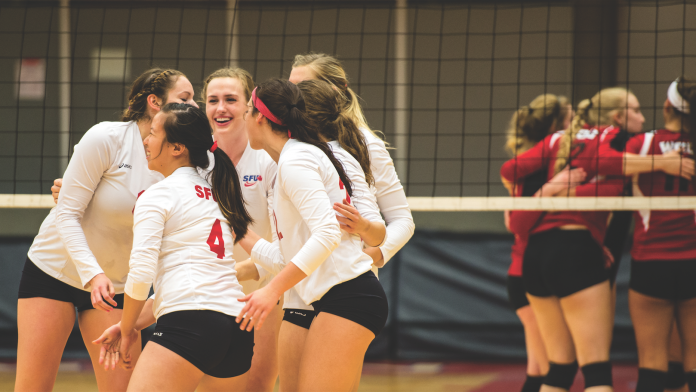
The SFU Women’s Volleyball Team is now 2–0 in conference play after defeating Seattle Pacific three sets to two on Thursday, September 18, and Saint Martin’s University three sets to zero on Saturday, September 20. The latter game was action-packed, as the Clan won two close sets 25–23 and 28–26 before pulling away 25–14 to seal the victory.

In last Thursday’s victory, Christine Howlett (Delta, BC) and Devon May (Robert’s Creek, BC) led the attack with thunderous hits that the Seattle Pacific frontline were unable to handle. Howlett had 18 kills and six blocks, and May added 17 kills. In Saturday’s game, May led the way with 12 kills and four blocks.

Part of the reason the team was able to win such close games is due their pre-conference play experience in Hawaii. On the impact of this experience, head Coach Gina Schmidt stated that “it was very beneficial.  We also did a team trip to Whistler earlier in our preseason, just to spend time together and get to know each other. [. . .] The biggest thing is we got some really great competitions there. Three of our four matches went to five sets, and what helped us on Thursday night was just those experiences of being in fifth sets and close games.

“Just the weekend before, we had a match against Hawaii Pacific that went 39–37 and 34–22. We’ve been in these long battles before and those experiences helped us on Thursday.”

The atmosphere at Thursday’s game was electric. There was a large group of shirtless football players with their chests painted who were chanting, singing, and stomping. Coach Schmidt described the atmosphere at home games: “We were lucky. It was our Red night and we had a good crowd on hand. It wasn’t a typical crowd; that group was the football team. Across the athletic department the teams try to support each other.

“We appreciated the support and the noise and we always have Cedric [who leads the chorus], a loyal SFU supporter of all sports who is always good for some energy in the gym.”

The Volleyball team is on the road its next four games with a match against Northwest Nazarene University in Idaho on Thursday, September 24. This is followed by Central Washington on Saturday the 26th and Western Washington on the 28th. The latter two games are really going to demonstrate how far the relatively inexperienced Clan have developed their team cohesion.

“We play two of the teams picked to finish at the top of the conference,” Coach Schmidt noted. “Last year we did a good job of beating all the teams below us but we couldn’t get over the hump against the three above us including Western Washington who we have not beat in my time here. One of my goals is to get over the hump against some of those teams. Central Washington we split with last year, but they are strong and have the exact same team coming back. We lost five starters [. . .] we have a solid core of returners but not who have played together a ton.

“The question is how fast we can gel together as a team.”

Branding a human body with UV ink is ethically irresponsible

0
Photo Credit: Alfred Zhang

The date was 2011, in the heyday of the Occupy movement which called for an end to social and economic inequality. In a knee-jerk reaction to a protest, police forcibly removed a group of Occupy protesters in Montreal who handcuffed themselves to an outdoor kitchen outside a public square.

Without being charged of any crimes, the protesters were detained, then released shortly after without charge, bearing a number marked on their hands in invisible UV ink, penned without their consent or foreknowledge. This month, the Quebec Court of Appeal concluded — wrongfully, in my opinion — that the rights of these squatters had not been violated.

Beyond being ethically questionable, this method is a dehumanizing yet increasingly familiar experience in the Western world of ubiquitous surveillance and antagonistic police-citizen relations.

I can attest to a human application of this method in history: notably the slave trade in colonial United States, where they branded slaves to signify ownership and control, and more recently the Holocaust, where those in Nazi death camps were similarly branded. This procedural method for future identification has implications of control, highlighted in this very grim history.

While our freedom of liberty and security is guaranteed in the Canadian Charter, unfortunately, marking citizens with invisible ink skirts a loophole in the law. As Quebec court judge Sylvain Coutlée pointed out in the trial, this process neither harms the person, nor explicitly contravenes any legal rights. As a matter of analogy, he compared the process to ‘being stamped’ upon entry to a nightclub; an innocuous process for easier individual identification.

There are obvious holes in his analogy. Contextually, a public square fundamentally differs from a nightclub in that the public space is open for wider citizen benefit, whereas a nightclub is in the business of making money from clients. The nightclub entry-stamp functions to differentiate paying clients from non-paying; in the police procedural, the intent is to differentiate innocent citizens from demonstrators.

Police tag identification stresses power relations between state and citizen, and has covert suggestions of threat as a message.

This method becomes even more ethically questionable when the question of consent enters the discussion. The body is personal property in the strictest sense of personhood. The police have therefore little right to violate this property. As police require a warrant for access to private property, and to administer DNA tests, the non-consensual marking of the protestors indicates a level of distrust and power abuse. Especially so when the purposes are for future identification on charges of suspicion.

Since the ink is clearly visible at the right moments — the moment of inspection by authority — the mark plays part in a dehumanizing process that reduces the person to a possible offender. What makes the mark worse is its durability. According to the news website Salon, one protester stated that the mark would not wear off with extensive rinsing and soap. The mark persists, both physically and mentally.

While I feel these protesters were indeed violated, encouragingly, I have not read testimony of further usage of invisible UV ink. However, as a one-time method introduced in the context of our surveillance society of NSA revelations, radical Occupy movements, and cop-community tensions, this procedural misconduct fits our constantly surveilled time period like a piece of the puzzle.

BoG-GLED

0

Residence Rates Increase and Louis Riel House Report

It was reported by Finance and Administration Committee chair David Poole that for 2016 and 2017 the monthly residence fees will be raised by 2.1 per cent.The university conducted a market analysis that looked at factors such as the location and condition of units to help arrive at this number. Noted Poole, “This is line with market rates and The British Columbia Residential Tenancy Act that has set the allowable rent increase for that period as inflation, plus two per cent.”

Later on in the meeting, the August closure of the Louis Riel House residence was discussed in VP Academic Jon Driver’s report to the board. Said Driver, “I have not heard any concerns expressed since the formal closure of that building, so I think that people are satisfied with what we did, even if they’re not particularly happy.”

President Andrew Petter added later on that UniverCity may be considering the development of low-end market rental housing that “would be built with needs of graduate students and students with families in mind.”

Fossil Fuel Divestment

In the report from the Responsible Investment Committee, which just had its third meeting, it was noted that the last session featured a presentation by Raj Chatterjee and Leena Hasan of SFU 350, a student group devoted to advocating for the university to divest from fossil fuels.

The presentation prompted “robust discussion” in the committee and included information such as a history of the divestment movement. Concerns were expressed about shareholder engagement as a strategy by the group and using a negative screening strategy was instead encouraged by SFU 350.

Petter noted that no decisions were made at this session: “This information was taken to help inform the committee’s ongoing deliberations to better understand what the [strategies] are, so at future meeting we may be in a better position to consider some options to make recommendations back to the board.”

How freshmen can make the most of their time in university

0
Photo Credit: Alfred Zhang

In hindsight it’s all so clear, but looking forward, it’s as cloudy as a November morning in Vancouver. University is somewhat of a big deal, and as you go through it you become better at it. But for the newcomers who are scared or hesitant, I have some advice on how you can conquer it.

First things first: majors. Deciding on a major is a big deal, but it doesn’t have to eat away at you during your first year. While all of your credits ‘count’ in university, you can spend a little time figuring it out at the start. Since you’ll have to complete 120 credits regardless of your major, and since most majors only consume roughly 80–90 credits, you have some leg room for other courses.

This isn’t to say you should just write your first year off by taking every random course there is. But you shouldn’t sweat those first two semesters. For your first year, take some courses towards what you think you might major in, and take a few outside that particular field. Also, remember that no one ever said you could only have one major.

Secondly, how do you snag all the As? Before I flat out say “work your butt off,” I want to address this: there is more to getting great grades than endless studying. I’ve found through my own studies that what is most important is studying strategically.

In regards to this, there’s a hard and fast pointer here: go to every single lecture and tutorial. No if, ands, or buts. Not only do you learn the material, but you’ll always gain subtle hints about the test through lectures and tutorials. Professors, TAs, and sessionals usually drop hints about certain aspects of the tests, assignments, or papers that aren’t specified on the syllabus or handout. Do otherwise and you’ll end up studying the heck out of some minute details which, in lecture, the prof had excluded.

Thirdly, get to know your professors and TAs. You’d think that university tests would be highly standardized and would not reflect the interests of the profs or TAs. Wrong. And some of you science majors may think, ‘well, science professors don’t insert their own interests into their tests.’ Wrong.

While there are always going to be reoccurring questions based on the course fundamentals, profs and TAs can put more or less emphasis on certain aspects. So, ask a lot of questions, probe your TAs, and basically know as much as you can about your instructor’s interests and what they find important about the material.

Lastly, become involved. As much as course work can drag you down, it’s in your best interest to be engaged in extracurricular activities. Join clubs, get involved with a laboratory or with Build SFU, or write for the student newspaper. The more you throw yourself at university, the more you’ll get out of it.