Home Blog Page 859

Heathers hits the spot, In a Blue Moon comes close

0
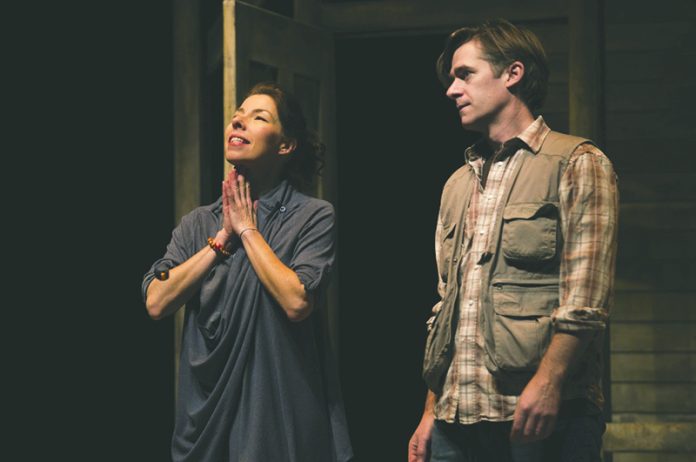
Anita Wittenberg and Brett Christopher star in In A Blue Moon.

Based on the 1988 cult film Heathers, starring Winona Ryder, Christian Slater, and Shannen Doherty, this dark comedy musical about high school life is over-the-top and deliciously daring.  Think Mean Girls, with a lot less pink and a lot more murder.  

Veronica Sawyer (the hugely talented Christine Quintana) is a nerdy teenager with a middle-of-the-road social status. She dreams of having the power and untouchable quality of the Heathers, the three most popular and cruel girls at school — all named Heather. After they learn of her excellent forgery skills, they bring her into the group to use and abuse her.

Meanwhile, Jason “JD” Dean (Kamyar Pazandeh), the mysterious, trench coat-wearing new kid, has Veronica preoccupied. He notices that Veronica doesn’t really like her three new friends, and decides that a little justice is in order. Before she knows it, Veronica is an accomplice to murder and things get way out of hand.

I never thought a show with so much inappropriate, disturbing content, like suicide, sexual abuse, and brutal violence, could be so entertaining, but Heathers has catchy songs, sharp dance numbers, and a stellar cast that gave this little-known ’80s film a new life at the York Theatre.

Arts Club’s new production In a Blue Moon by Lucia Frangione is touring the Lower Mainland until January 30. This show is a much more serious family drama, and though I felt satisfied by its end, it took a while to pick up speed.

After being widowed by her diabetic husband, Ava (Anita Wittenberg) decides to move to a family cottage near Kamloops with her Vancouverite daughter. When they arrive, they find that her husband’s brother, Will (Brett Christopher), has been calling the place home. Frankie (Emma Tow) is only six, and she and Will develop a cute relationship while Ava struggles to find her feet and open her ayurvedic massage clinic.

All kinds of tensions between the three characters brew throughout the first half of the show, but are only hinted at; it is during the second half that the story picks up steam, conflicts come to a head, and we learn a bit more about each character. This is where I felt the show really came together.

Ava and Will develop an attraction for each other, but they both agree it’s probably best to avoid that complication. Not to mention the fact that Will has an on-again-off-again girlfriend, as well. My favourite scene features Ava chugging a bottle of wine and trying to calm down while she waited for his girlfriend to leave.

Although it took me a while to become invested in this story, it wasn’t any fault of these actors, who all gave very sincere performances. I was especially impressed with Emma Tow who played Frankie at both age six and 13, switching between the two with ease. The photos projected on the giant moon behind the cottage also added a nice, nostalgic feel to the show — they were used to fill in some plot details and were effective at shifting between scenes.

With strong writing and characters, In a Blue Moon is a complex, authentic story about three people learning how to live with each other after such a profound loss.

Irish Heather Gastropub breaks down stereotypes

0
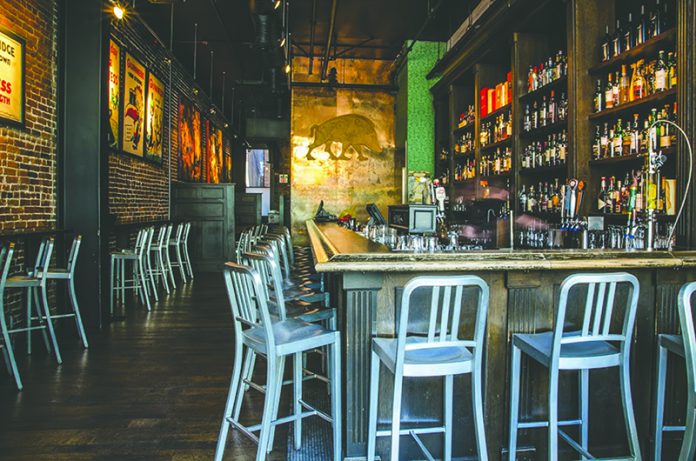
Come see a sliver of the UK and Ireland in Vancouver’s Gastown neighbourhood.

Whoever says that the cuisine of Ireland and Britain is boring must have some other deep-seated issues they need to work through. Irish Heather Gastropub, on Carrall St. in Vancouver, has a menu and overall feel that is strongly inspired by these locales, and the food is anything but bland.

While the menu is not fully Irish or British — it features an amazing perogie poutine — the influence can be felt throughout. This came through strongly in their charcuterie board. Featuring both local and imported meats and cheeses, along with warm crostini, fresh baked bread, and a perfectly cooked Scotch egg, the overall feel of the board was that of the traditional ploughman’s lunch.

The size of the board may have been smaller than that of the traditional ploughman’s, but the flavours were not lacking. The condiments, while bold, did not dominate, they worked to create balance – something I always welcome with any charcuterie board. Aside from the Scotch egg, the Irish sting and duck prosciutto were standouts on the board.

An Irish sting is a toast point — made of the same fresh baked bread — that has a white Irish cheddar drizzled with truffle honey. While the truffle flavour of the honey was not strong, it kept the honey from dominating the medium flavoured cheddar. Proscuitto is typically made from pork, but the decision to make it using duck breast is ingenious. The lean meat of the breast coupled with the fat cap makes for an improvement over the traditional pork.

While some restaurants only have either a strong appetizer or entrée section, Irish Heather has both. The entrees are just as diverse as the appetizers and the influence of Irish and British cuisine is prevalent in the selections of a steak and ale pie, fish and chips, and bangers and mash.

I knew that these menu items would be amazing based on how delicious the appetizers were, so I chose the mac ‘n cheese with pulled lamb. I will be the first to admit that I am insanely picky when it comes to mac ‘n cheese. The toppings are either too soggy or a brick-like layer of cheese, the sauce is never cheesy or creamy enough, and the pasta is often overcooked. Irish Heather addressed all of these issues to create hands down one of the best mac ‘n cheeses ever.   

The bread crumb topping was made using the same fresh bread that was feature on the charcuterie board. It was crunchy, buttery, and tasted like bread instead of sand like most bread crumb toppings. The pasta was perfectly al dente, and the sauce was cheesy and creamy without being too much of either. It didn’t overpower the bites that had lamb, but held-up solidly on it’s own.

The Irish and British inspiration could be felt in the overall decor of the restaurant and food menu, but also the drink menu. They feature one of the best offerings of cider that I have come across — including BC’s own Left Field Cider Co.’s The Bunk House dry hopped cider — as well as one of the most comprehensive whisky offerings that I have seen.

Irish Heather Gastropub does all that it can to dispel the myth that Irish and British food is bland and boring. It is one of the best restaurants that I have been to in Vancouver, and as a bonus to the amazing food, it features friendly and knowledgeable staff to round out the dining experience.

CINEPHILIA: TIFF’s Top 10 showcases the best in Canadian film

0
Our Loved Ones captures life in a poetic manner.

Since 2000, the Toronto International Film Festival has selected the top 10 Canadian films of the year, touring them across the country and giving Canadians another chance to see our best cinematic offerings. These are the three best feature films that were showcased at this year’s festival.

Hurt

Alan Zweig’s documentary about the infamous Steve Fonyo, a former national hero who has since been charged and convicted for various crimes, is a testament to the continual power of cinema vérité — the camera’s unique ability to document and engage with spur-of-the-moment reality.

Hurt is an empathetic portrait of Fonyo’s mundane routine, evoking complex and heartbreaking psychology in the process: his hunger for attention, complex feelings towards the Canadian public, and the cycle of dysfunction within which he appears trapped. This is a pure film. The camera looks without judgement, asking us to empathize with Fonyo before forcing us to engage with any of our own conflicted sentiments towards him.

The Demons

Some parts of The Demons are so uncomfortably tense, so masterfully conceived to provoke unease, that they are nearly unwatchable. The fears of a paranoid young boy, the detached visual style, and the ominous narrative about child abductions in a suburb of Montreal, come to a quietly harrowing conclusion.

First-time director Philippe Lesage has crafted an assured and meticulous coming-of-age thriller where almost every formal choice is horrifyingly evocative: the slow zooms on kids playing in a swimming pool, the lengthy takes after a child has been abducted, and a masterful dolly shot at the end of the film, which teases a tragic event off-screen.

Similar to the great Michael Haneke, whose work profoundly influenced this film, Lesage is nearly flawless at deciding what to depict and what to leave to the imagination, what to linger on, engraving the ideas in our mind, and when to quickly cut away, transmitting only a shocking impression.

The Demons is a wrenching film you will immediately want to forget — it’s too disturbing, upsetting, and unnerving — but by the quiet and unresolved coda, it has slowly engraved itself into your long-term memory.

Our Loved Ones

A delicate portrait of a father’s shifting relationship with his daughter as she matures, and an epic narrative about depression in a family over decades, Our Loved Ones is at once small and colossal, a film so grounded in little moments of the present that also considers their impact over an extended period of time.

By observing milestones big and small, the film isn’t structured loosely like Boyhood or rigorously like The Place Beyond The Pines, striking a perfect balance between being a realistic slice of life and a timeless lamenting poem. In terms of experimental and empathetic storytelling, Our Loved Ones is the strongest Canadian film of the year.

This year’s Canada’s Top Ten film festivals provides insight on a diverse range of Canadian history: documentaries about the rise and fall of one of our national heroes (Hurt), a pivotal incident that changed the course of race relations in our country (Ninth Floor), and the recent scandal over Omar Khadr’s release from prison (Guantanamo’s Child).

Ironically, the weakest films in the festival come from acclaimed veterans: Guy Maddin’s tiresome The Forbidden Room, Philippe Falardeau’s repetitive My Internship In Canada, and Patricia Rozema’s contrived Into The Forest.

The most subversive films on the list — Sleeping Giant, Closet Monster, and The Demons — are all coming of age stories from first-time directors, who draw from a wide range of influences to express similar stories about the suppression of childhood and adolescence.

Fittingly, these films also hint at a coming of age for Canadian cinema, a group of spurting, young filmmakers that are quickly evolving into world-class talents.

Brendon Urie becomes Panic! at the Disco

0
Panic! showcases excellent musical ability

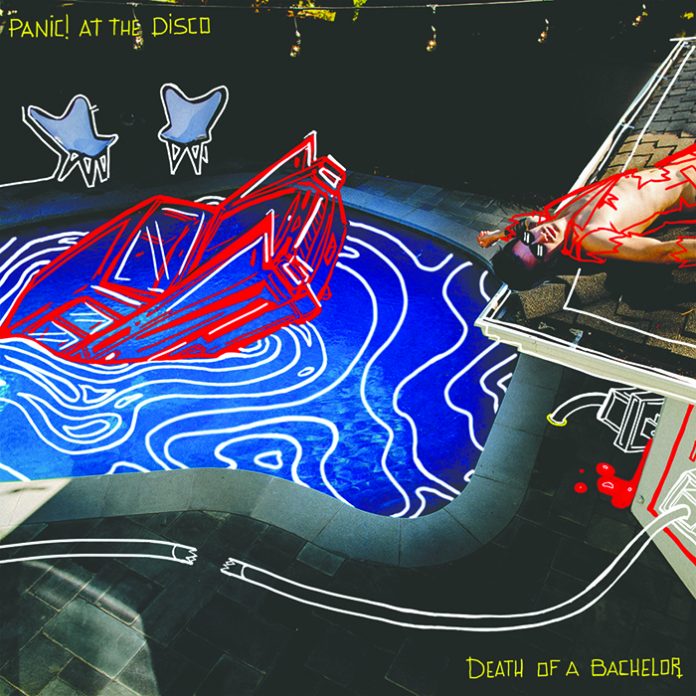
Death of a Bachelor is Panic! at the Disco’s fifth album, and the only one so far to have the band consist solely of lead vocalist Brendon Urie. Urie plays all the instruments and sings all vocal parts on this record, harkening back to his youth where he played any instrument he could get his hands on.

While Death of a Bachelor is more of a lateral move from 2013’s Too Weird to Live, Too Rare to Die, Urie has held his word to not get comfortable or repeat sound and content. To that end, Urie cites Frank Sinatra as inspiration for the entire album, as is discernible from the horns and melodies throughout.

The Sinatra sound is especially notable on “Impossible Year,” which is full of rounded Ol’ Blue Eyes vocals — it’s pure Sinatra magic — and the title track. Urie described “Death of a Bachelor” when it came out on social media as “the bittersweet (but mostly sweet) end of an era. . . an It’s a Wonderful Life-esque look into a possibly different future.”

The Sinatra vibe is dulled down and mixed with others for “Crazy=Genius.” It’s almost the album in a song, going from swinging jazz to the more contemporary feel of Panic! at the Disco’s style.

There are more than just the tributes to Urie’s hero, with the chorus of “Victorious” posed to become a sports-arena refrain: “Tonight we are victorious/Champagne pouring over us/All my friends were glorious. . .”

“Hallelujah” is in a tie for my favourite song on the album. It’s rooted firmly in gospel, but the message very much reflects past work, like Too Weird to Live, Too Rare to Die’s “This is Gospel.” It’s all about being who you are, embracing it, and not changing for others, “All you sinners stand up, sing hallelujah.”

Its competition is “The Good, the Bad, and the Dirty,” a composition full of swaggering attitude with a healthy dash of “I dare you” to boot. It’s super catchy, “If you wanna start a fight/You better throw the first punch/Make it a good one,” and an apt anthem anytime someone’s trying to show you up. I guarantee that if you launch into this song, your foe will hightail it in the opposite direction.

Another song worth mentioning is “LA Devotee,” an up-tempo power pop track that’ll get your head bangin’. The harmonies on it are amazing, too. Pro-tip: great harmonies make great songs.

All in all, Death of a Bachelor is an excellent showcase of musical ability. From sweeping jazz and ‘50s/’60s swing, to the anthem rock of Queen, and Panic! at the Disco’s more contemporary work, the latest record from the band is full of an appreciation for the present.


Whether you’ve lived a life similar to Urie’s youth, full of breaking the rules and first-hand experimentation, or not, there’s something personally relatable in their music.

Rising sea otter population signals major ecological changes

0
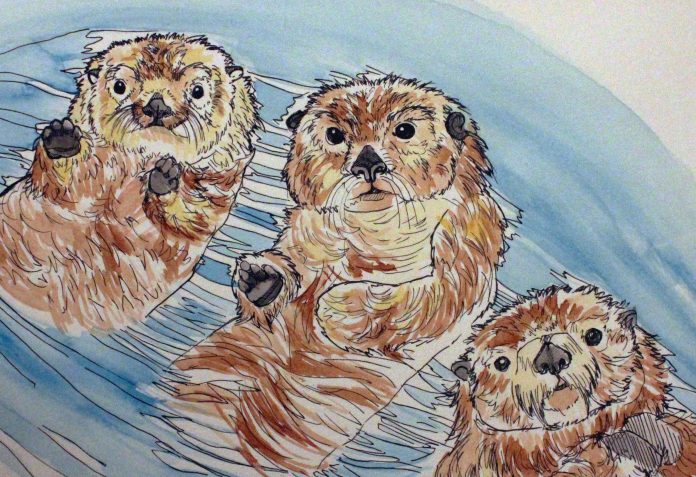
ILLUSTRATION: Janis Mcmath / The Peak

Sea otters are returning to the coast of British Columbia and that means that dramatic ecological changes are about to occur. A research initiative has been formed to study those changes.

One leading scientist on the project is Anne Salomon, an Associate Professor in the School of Resource and Environmental Management at Simon Fraser University. She, along with her students, has studied kelp forests since 2010 to learn about changes to these forests over time.

With this information, they hope to make predictions about how the kelp forests will change in the future with the return of the sea otters, and in particular how this will affect coastal communities that depend on these resources.

However, the reestablishment of the sea otters along the coast is not a simple conservation story. According to Salomon, “it’s a conservation conundrum, and yet it is also something that people have been worried about and thinking about for thousands of years.” The documentary Coastal Voices: Navigating the Return of the Sea Otters showcases a workshop in 2014 that brought together indigenous leaders, elders, resource managers and scientists to discuss these complex challenges. These include fundamental issues of food security, food sovereignty, along with issues of indigenous rights, title, and self-determination.

Human interactions with sea otters and kelp forests span millennia. This is evident in the archeological, ethnographic, and oral histories that persisted through time. However, the species was almost eliminated by the Pacific maritime fur trade in the 18th and 19th century and the effects of colonial settlement, both of which changed the way coastal systems were managed.

The elimination of the sea otters resulted in an increase in their prey including sea urchins, abalone, clams, and crabs. Since these are popular food sources for humans, the return of the sea otter means taking into account the decline of these shellfish for food, and subsequent impact on local economies.

As outlined in a media release, a rise in sea otter populations will indirectly decrease the number of sea urchins, a decrease which aides in the recovery of kelp forests as sea urchins are voracious grazers. Therefore, sea otter recovery has been associated with increased catch rates of fish that feed off of kelp, and enhanced settlement of baby rockfish. However, Salomon went added that their return also means that the endangered abalone will be preyed upon.

The media release also explained how before colonization, the interactions between humans and sea otters were more balanced; indigenous people maintained sea otter populations at numbers that allowed them to thrive, while also protecting their food sources.

Salomon shared that based on these complexities, there needs to be collaboration between individuals from a diverse range of backgrounds and experiences working together to manage the return of sea otters. This project hopes to give coastal communities and policy makers the resources and shared knowledge required to manage the reestablishment of sea otters from an ecological, socioeconomic, and cultural perspective.

Salomon and her partners will carry on this project into this summer to continue helping coastal communities to prepare for the sea otters’ return.“We all view systems through different lenses, and we all have different ways of knowing, so when we put that together we can only learn more.”

FOOD FIGHT: Brunch at The Templeton falls flat

0
The retro diner experince couldn’t make up for the bland food.

The Templeton is a nostalgic diner that functions as a novelty museum exhibit for the ‘50s and ‘60s. Their motto is “Quality Food, Snappy Service,” and they’re known for serving up organic comfort food with lots of vegan and vegetarian options. My friend and I met up here for brunch — our meal of choice — and left entirely full of regret.

Their menu is extensive and impressive, and I applaud their effort to make it a vegan-friendly restaurant with options such as veggie bacon, veggie ham, and tofu scramble. It’s too bad that it was downright awful.

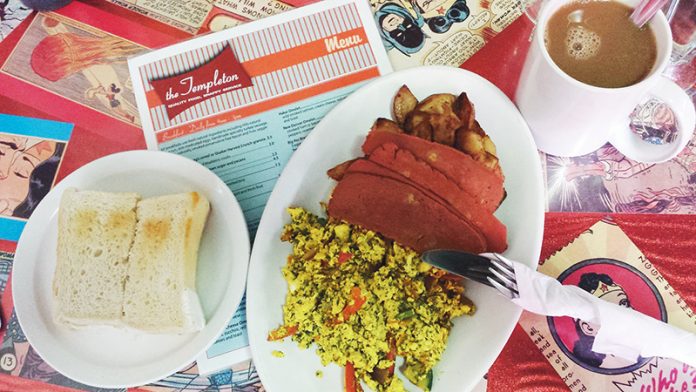
I ordered the Tofu Scrambler with veggie bacon. The dish including the veggie bacon was $12 and not worth it in the least. Its description on the menu is “medium tofu sautéed with veggies, lightly seasoned with curry and nutritional yeast, rosemary potatoes, and toast.”

How do I put this. . . the tofu was more “food processed” than “sautéed.” The end result was something that visually resembled luminescent yellow eggs and tasted like mushy wet sand. I can’t forget about the awkward hint of curry in there — even if I wanted to — which wasn’t entirely enough to be effective in annihilating the horrifying texture and blandness of the tofu. All in all, the Tofu Scrambler portion of this dish was offensive to the senses.   

The veggie bacon was just plain uncomfortable to eat. I felt that it could have been cooked better, but that could just be my general pickiness with fake meats. The rosemary potatoes and toast were alright, nothing to praise or to complain about. My friend ordered the Blueberry Banana Pancakes, which she said were very bland. Again, not enough care was taken to make the dish presentable in any way. The pancakes were slightly burned, “charred” if you will, and she had no will to finish eating.

The restaurant itself was styled in a charming retro theme. However, I feel like they try a bit too hard to keep it “vintage,” resulting in booths that are falling apart and tables that are a little too sticky for my comfort. If they renovated a little bit, it would be a more successful escape to the ‘50s and ‘60s, and add to the feeling that you have turned back time and entered into a retro diner.

The Templeton may be worth the gamble if you are strolling Granville Street, but steer clear of the scary tofu.

XXXX Topography will be an interactive performance

0
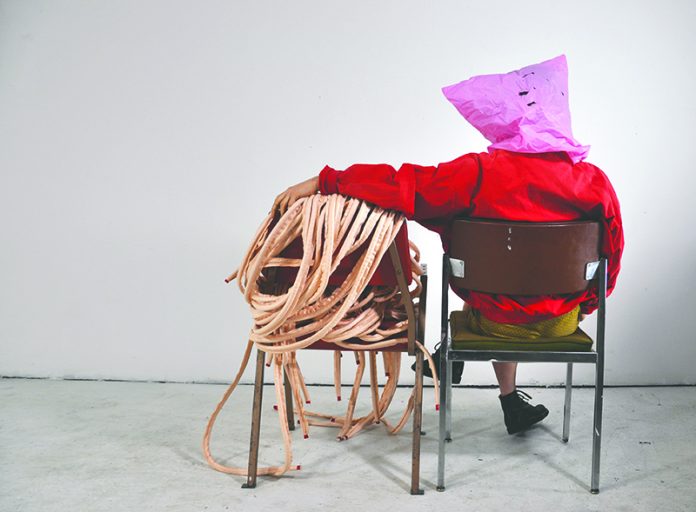
The Party, an experimental art collective, explores the agency of objects.

XXXX Topography, pronounced “sexy, sexy, sexy, sexy topography,” is a new work by The Party — creators of imaginary theatre — that transforms a familiar space into a bizarre and immersive environment. Where a bar is readily at hand, and the exploration of the “perceptions and sensations of objects” is encouraged and, unavoidable.

Kyla Gardiner and Layla Marcelle Mrozowski, co-creators of The Party, are both current Master of Fine Arts students at SFU. They build all their work collaboratively — the entire creation process from beginning to end, the writing, directing, design elements, and choreography. Together they have created a strange world of objects, exploring the idea of assemblage and the subjectivity of objects and gender, using elements from within the realm of science fiction.

Divided into two portions, XXXX Topography will begin with a fixed length improvisation by the performers — Andrea Cownden, Emmalena Fredriksson, Deanna Peters, Rianne Svelnis, and Lexi Vajda.

Through this bizarre and improvised beginning, a special space bar owned by Beta Pink (a.k.a. Andrea Crowden) is convinced to pop into existence for two days.

Objects that were not there before, along with several high-top tables, materialise to fill the space. It would not be surprising to find objects that can move, or have a voice, a sound, or a narrative attached to them. Imagine “a pillow telling bedtime stories, or a sarcastic couch misunderstanding the talking cure, or love letters that go missing.”

In this second portion, the audience is invited to take part in this world for a while. They are free come and go, to mingle and interact, and to discuss the ideas, the same way you would if you were going to a bar.  

Enriching the same space is Paul Paroczai, a fellow MFA student and sound creator, who will be improvising a soundscape throughout the evening to suit the shifting atmosphere of this eccentric bar.

“We’re working really hard to do something kind of impossible,” said Gardiner, “which is to get inside of object, inside the agency and the subjectivity of objects [and] we’re doing that through the approach of assemblage.”

Assemblage, which can include human subjects as well, describes objects in relation to each other that have a certain kind of agency that an individual object does not.

From the ideas of assemblage in Jane Bennett’s book, Vibrant Matter, Gardiner brings up the author’s use of an electrical blackout and all the different elements that have to be in play, or rather required to “go wrong,” before a blackout could actually happen.

“The performance [of XXXX Topography] stages this kind of world-building that our performers do, through a language of improvisation,” Gardiner explained.

The Party was created by Gardiner and Mrozowski back in 2014. They have since then created several works together, including “How I learned to stop verb-ing and blank the object,” in which they explore a world where gender is entirely absent; “Fake Gems,” presented at the Interurban Gallery in August 2015; and most recently, a published ‘performative theoretical text’ called The Party Manual.

After two years in the creation process, XXXX Topography continues its exploration over the course of two days.

You can purchase tickets in advance at www.sfu.ca/sca/events as well as at the door. For more information about The Party, visit their website at www.theparty.work.

Colour me super fucking stressed out

0

The colouring craze

[dropcap]I[/dropcap]f you asked me a year ago how I felt about colouring, I would have said it’s a pastime for kids and nothing more. But a few months ago, I gave in to what I consider the biggest fad of 2015, and bought an adult colouring book. I was almost embarrassed, being a 21-year-old woman, walking up to the checkout at Indigo, and buying a colouring book from another grown woman.

Since then, however, I have been colouring my woes away, using bright blues and rich reds to fill in the lines of mandalas and intricate patterns. And I’m no trailblazer by any means. In fact, I joined this trend quite late. I wouldn’t be surprised if half the students in your early morning lecture have been going home after class, only to open up one of these books to a partially-coloured swirly cloud.

I worked at a bookstore over the holiday season, and I can attest to how fast these books flew off the shelf. There were multiple instances over the course of the holiday season where we nearly sold out entirely.

Art as therapy

[dropcap]I[/dropcap] love my colouring book, but it has helped me deny the fact that I am too tightly wound and that I need professional help to get my emotional health back on track. Colouring is, and has been, a way for me to temporarily subdue the tension that I carry day to day. But as soon as I put the pencil crayons away, I’m left to deal with the problems from which I’ve been hiding.

And I refuse to believe I am the only one that has had this experience. Some of the most popular titles of these books read Colour Me Calm and Colour Me Happy. One of the reasons these colouring books have become so popular is that they have branded themselves as a way for adults — young and old — to relax, and find some peace of mind. But this branding should raise some red flags for us.

Adult colouring books, while a fun pastime, are masking the real problem we should be talking about: an alarming amount of young adults are suffering from high levels of stress and anxiety.


I have used colouring to avoid confronting my growing stress and anxiety.


Colouring between the lines

[dropcap]W[/dropcap]hile colouring may seem like nothing but a hobby, there is more to this fad than meets the eye. I couldn’t help to think to myself, one afternoon while I was shading some leaves green with quite a bit of force, that I colour when I feel anxious. And in a way, I have used colouring to avoid confronting my growing stress and anxiety.

If this were the case for me, I couldn’t help but think that there are others sharing my experience. Maybe there is a whole generation of people turning to soothing designs in order to avoid confronting the real problem: that we are all super fucking stressed out. A few years ago the Canadian Organization of University and College Health conducted a survey and found that 90 per cent of students felt overwhelmed and 50 per cent reported feeling hopeless within the past school year.

I wanted to be able to report more recent, SFU-centric numbers, but after having a short conversation with a woman from SFU Health and Counseling, I’ve discovered no such report exists. SFU students were last surveyed about their mental health in 2010, and were left out entirely in the 2013 national survey conducted by the Canadian Organization of University and College Health. Simply put, we have no idea just how stressed out SFU students are. But historically speaking, we’re a pretty stressed out campus. In 2010, nearly 84 per cent of students reported feeling overwhelmed.

The Simon Fraser Student Society (SFSS) tried to gauge how comfortable SFU students were with accessing health and counseling services on campus, and if that we as students felt that SFU was creating a supportive environment in their 2014 survey. While a majority of students felt comfortable taking advantage of the services offered at SFU (63 per cent), only 46 per cent of students felt that SFU was creating a “supportive environment” to minimize stress.

Colour on, but don’t be afraid to seek help

[dropcap]A[/dropcap]fter my realization that I may have to actually confront my stress, rather than just hide from it, I was without direction. It was tough for me to ask myself what to do about my anxiety, even tougher than asking others.

I decided ending my relationship with my colouring book probably wasn’t the answer. It is, after all, a pastime I enjoy.

The advice I gave myself is what I want to relay to all you other extremely anxious colourers: don’t be afraid to ask for help. There is only so much these activity books can do for us. Take a step back and evaluate your stress level. Letting fads like adult colouring books mask this growing social crisis won’t do us any favors. Young adults today are way too stressed out. We should be able to enjoy our youth, and not live in a constant state of panic.

While SFU may not be able to provide us with the numbers, they have in recent years been trying to develop the services available to students. There are a variety of online tools that can help students learn about how sleep and diet would improve their mental health, and of course in-person service such as counseling, which are free for students.

There is nothing wrong with acknowledging you need help dealing with your anxieties. Don’t be afraid to speak up.

Universities shouldn’t teach discrimination

8

[dropcap]T[/dropcap]he BC Supreme Court recently overturned the Law Society of BC’s decision to exclude graduates of Trinity Western University (TWU) from reaching the provincial bar. The original decision came on the heels of controversy over TWU’s community covenant, a document that incoming students are required to sign, which, among other requirements, calls for students to refrain from all sexual relations outside that within heterosexual marriage. 

The decision, which was was mainly due to issues of procedure that led to the Law Society’s ban, has just been appealed. The issue is likely to reach the Supreme Court of Canada, and it wouldn’t be the first time. In 1997, the university filed suit in the Supreme Court of Canada over the BC College of Teachers refusing the university accreditation for similar reasons. The court sided with TWU.

Law societies around Canada have revolted against accreditation applications for its future law school — and for good reason. Homophobic policies belong in the dustbin of history along with Jim Crow laws, and not in 21st century Canada.

TWU’s supporters often argue that the university’s policy has no impact on the quality of their graduates or their preparedness to enter the job market. They’re dead wrong. Teachers who graduate from a school that punishes LGB students cannot be expected to create a safe environment for these students in their own classrooms.

Similarly, we cannot expect lawyers who graduate from TWU to have respect for Canada’s Charter of Rights and Freedoms when their own school goes against its basic principles of equality and non-discrimination. The Law Society’s mandate should be to protect the integrity of their profession and this is, no doubt, threatened by TWU’s homophobic policy.

We cannot expect lawyers who graduated from TWU to have respect for Canada’s Charter of Rights and Freedoms.

What troubles me the most is the message TWU sends to its students, young adults, many of whom may be struggling to accept their sexuality. What TWU says to youth is that their moral code represents the highest standard of integrity, and that LGBTQ+ individuals are precluded from that standard by virtue of their nature. That message is not only a blatant lie — it’s also dangerous.

The claim that TWU is legally exercising its freedom of religion is as morally vacuous as asserting the personhood of corporations; institutions should not be able to claim freedom of religion.

Let’s be clear: TWU is not a church nor is it a theological seminary. It is a place of higher education. The charter grants freedom of religion so that citizens can feel safe from religious persecution. However, TWU enforces a theological regime against its students, ignoring not only the religious beliefs of many students who are not Christian but also those Christians who do not share TWU’s homophobic views.

TWU argues that students affirm their support for beliefs by simply enrolling as a student. Since when does wanting a university degree mean that you have to subject yourself to religious beliefs that aren’t yours?

BC and the Supreme Court of Canada should follow the example of an Ontario Superior Court in 2015, when they approved TWU being excluded from the Ontario Bar. Said the court, “One of the central issues that arises from the Community Covenant is the prohibition [. . .] against (quoting TWU) “‘sexual intimacy that violates the sacredness of marriage between a man and a woman’ [. . .] Despite some efforts by TWU to contend that the Community Covenant does not operate in a discriminatory fashion, it is self-evident that it does.”

I couldn’t agree more.

Former SFSS president wins prestigious Chinese scholarship

0
Buckert (pictured) was the SFSS president from Summer of 2014 to Spring of 2015. - Photo courtesy of Charade Bueckert

Former SFSS president and SFU alumna Chardaye Bueckert has been selected from among 3,000 applicants to receive a Schwarzman scholarship to study at Tsinghua University in Beijing. The scholarship, which has an acceptance rate of 3.7 per cent, will fund a one year master’s program in geopolitics. The Peak sat down with Bueckert to discuss the scholarship, her time at SFU, and what advice she has for SFU students.

The Peak: Why did you apply for this particular scholarship?

Bueckert: I applied for the Schwarzman Scholarship to gain a better understanding of China, while also receiving a high caliber graduate education.

P: For those who don’t know, what is geopolitics and why does it matter? 

Bueckert: Geopolitics can be used as a synonym for international relations, or more specifically, as the study of political events and foreign policy in relation to geographical regions and their history. These regional relationships impact economics, military arrangements, and diplomacy between and within regions. Geopolitics is therefore important to understand if one is interested in participating in efforts towards global peace and prosperity.

P: Regarding the Schwarzman scholarship, what was the selection process like?

Bueckert: I submitted an online application which included an essay on the state of Canadian cyber-security, an introductory video, and a personal statement discussing my interest in developing further relations between Canada and China as a young leader. Based on my application, I was one of 300 selected for an interview from amongst 3,000 global applicants.

P: Having already accomplished so much, what are your plans for the future?

Bueckert: That is a big question. My primary goal is to ensure that all Canadians have access to resources like clean water, food, and shelter. Canada is a wealthy country with more than enough to go around: we have an opportunity to ensure everyone has their basic needs met. There are obviously complexities involved in doing so, but I plan to always keep this simple truth in mind.

P: Why did you choose political science as your major? Were you set on this major going into university, or did it just naturally develop?

Bueckert: I knew I was interested in politics coming into university, but took a wide variety of classes at first. After completing Poli Sci 101, I knew I wanted to pursue it as a major, even though I received my lowest grade of the term in that class!

P: For students looking to get the most out of university, what would you recommend?

Bueckert: Get involved in extra-curricular [activities] as much as possible. I am biased towards student government and debate, but there are so many different options available at SFU to suit any interest. I know it is hard for many students who brave two hour commutes, have jobs to pay their way through school, and/or are raising children.

But even an hour or two a week volunteering at the SFU Women’s Centre, sitting as a Department Student Union Representative on Council, or getting involved with the SFU Anime Club could mean meeting your best friend or gaining the experience and connections that will help you land your dream job