
Home Blog Page 841

CENTRE STAGE: In review: Winners and Losers, Trevor Noah at JFL Northwest, and dance at Chutzpah!

0
Trevor Noah is hilarious and just plain adorable.

Winners and Losers

Feb 16–27; The Cultch

This show has been gaining plenty of critical acclaim, from being nominated for a 2015 Governor General’s Literary Award to rave reviews from critics, but it didn’t work for me. While there were many interesting concepts discussed through a capitalist lens, I felt like I was essentially eavesdropping on an interesting conversation between two friends.

I’ll admit that the conversation was at times engaging, funny, and entertaining, but there were also an equal number of moments when I wondered what the point was. Based on conversations between the performers, Marcus Youssef and James Long, the show situated the two at opposite ends of a long table, a bell in front of each, while they debated whether something was a winner or a loser in the face of capitalism.

They discussed Mexico, Canada, microwaves, Pamela Anderson, their own parents, and each other. As the topics of discussion became more personal, their conversation became heated. They were brutally honest with each other — as any true friend should be — and they shared anecdotes from their childhoods while struggling to reconcile their economic backgrounds.

After throwing arguments at each other for a while, the show abruptly ended. “I think we’re done,” said Youssef. “Until tomorrow night,” replied Long.


Trevor Noah

JFL Northwest

Feb 19; Queen Elizabeth Theatre

Trevor Noah made his first stand up appearance in Vancouver for the JFL Northwest festival and entertained a sold-out, appreciative crowd. We laughed until our faces hurt, and reveled in Noah’s cultural commentary.

Noah casually took the stage and soaked up the love from a cheering audience. This being his first time in Vancouver, he shared his observations that “Vancouver is a lot more Asian than I expected,” and that, “it’s like bizarro America: everything seems the same, but people are polite.”

Before the show, Noah took a walk around the city and described his hunt for the best poutine and his perspective on Chinatown. He said that if he were to be dropped off there, he would just assume he was in China and not think that perhaps a few blocks away he would be in Vancouver — there are no Chinatowns in South Africa, he explained. 

The hilarious cultural comparisons and gestural acting continued with his assessment of communications between drivers on the road. In America, he said, everyone honks all the time and it’s impossible to know what they are trying to say, whereas in South Africa, they hoot and this sound can be modified to suit many purposes. His story of getting tacos for the first time was capped off with a wonderful miscommunication in which napkin was taken to mean diaper, as it does in South Africa.

Noah now knows that there could never be a black James Bond thanks to a visit to Scotland, where there are no black people, and he made his case for a Russian accent being the scariest of any accent. These kinds of observational stories about race, nationality and cultural differences, acted out and described with wonderful pacing and humility are what gives Noah his trademark likable style.

I love Noah’s brand of humour, which doesn’t rely on tired clichés. He is able to tell lengthy stories without losing the audience’s attention, and he has the respect of his fans. Everyone in the Queen Elizabeth Theatre left the show laughing, and I hope Noah is able to return soon to do it all over again.


Shay Kuebler Radical System Art: Telemetry Vol. 1 and MADBOOTS DANCE: (SAD BOYS)

Chutzpah! Festival

Feb 20 – 22; Norman and Annette Rothstein Theatre

The first version of his full-length project being developed over two years, Telemetry Vol. 1 is a beautiful piece of choreography mixing swing, bebop jazz, house and contemporary dance and music styles and incorporating Danny Nielsen’s stunning tap mastery. The choreography seems to have an air of maturity about it, and this may be Kuebler’s best work yet.  

The show began with Neilson tapping across the back of a dark stage, as lights were activated based on the intensity of his tapping. This was an impressive effect, and Neilson was then joined by Kuebler and five others who moved surreptitiously across a dimly lit stage, a single light swinging back and forth to show us bits and pieces of their movements.

The group moved in a flowing unison, reacting to each other and always anticipating their next move. They ebbed and flowed around the stage as Neilson continued his tapping, his rhythms complimenting their trademark Kuebler movement style.

Neilson was spotlighted a couple of times; coming to the front of the stage to show off his footwork, and then later, on set off to one side as the other dancers riffed off of his moves. I also enjoyed an emotionally charged duet between Kuebler and Lexi Vajda that showed off a new side to Kuebler’s work I hadn’t seen before.

The second half of the double bill was an all-male troupe from New York, MADBOOTS DANCE, performing (SAD BOYS). Four dancers in tight pants and strange harnesses around their shoulders presented a rather aggressive, bold work that seemed to be a portrayal of what it feels like to be gay and be ridiculed by words such as “faggot,” “beast,” and “sissy” (these were all projected onto the stage). As the piece went on, they moved through a few phases, some emotional and contemplative, others urgent and angry.

A pile of sand at stage right served an unknown purpose, and the meaning behind the quasi-nudity at the end with one of the dancers covering his penis with only his hand was also lost on me. I’m not sure that I understood the message these dancers were trying to convey, but the piece presented some bold choreography that did elicit feelings of concern and uneasiness. Perhaps that was what they were going for.   


Coming Up: Vancouver International Dance Festival

The 16th annual VIDF will be presented at various venues around the city from February 28 to March 19 and includes world premieres from Vancouver’s Company 605 and EDAM, a Canadian premiere and co-production by Sweden’s Memory Wax and Cuba’s Danza Teatro Retazos, along with performances by Quebec’s Compagnie Virginie Brunelle and Japan’s Natsu Nakajima. Always presenting a variety of dance styles ranging from butoh to hip hop, the festival is sure to have something for everyone’s tastes. There are even some free performances taking place in the SFU Woodward’s atrium, so be sure to check them out.

Vancouver Whitecaps Season Preview

0
Blas Perez, seen here in action with Panama, was acquired from FC Dallas over the offseason.

As the NHL season begins to wind down and the hopes of any Canadian teams making the playoffs continues to dwindle, it’s the perfect time to look forward to new possibilities. March 6 marks the beginning of a new season in Major League Soccer, which means that the Vancouver Whitecaps will return to BC Place in hopes of building off of last year’s successes.

This will be the Whitecaps’ sixth season in MLS play and the team has grown better with every passing year. Many people aren’t even aware of the soccer culture in the city, but with an average of over 20,000 fans per game and a record 11 sellouts last season, the Whitecaps have a higher attendance than the Vancouver Canucks and fall just shy of the BC Lions.

Supporter culture surrounding the team is at an all-time high with Curva Collective, Rain City Brigade, and the Southsiders all having record membership numbers. During the final game of last year’s playoffs against Portland, a number of fans marched down the street to the stadium drumming, singing, waving flags, and lighting flares. The procession was four city blocks long, and while the Caps lost the game and were knocked out of the playoffs, it hinted that the best was yet to come.

The new season brings new promise, with the core of team remaining intact and many players being resigned to multi-year contracts. As for new additions, coach Carl Robinson has looked to build his front line and bolster the team’s scoring, which was limited at times last season. Masato Kudo was brought over from Japan where he was the all-time leading goal scorer for Kashiwa Reysol of the J1 League. Also joining the team is Christian Bolanos, a Costa Rican who has played over 60 international matches and appeared in two FIFA World Cups.

Finally, striker Blas Perez was obtained from FC Dallas. Perez, who was always a thorn in the side of the Whitecaps, will hope to transfer his skill of scoring goals against Vancouver to scoring for Vancouver. He is tied for third in goals scored against the Whitecaps since they joined the MLS. Over the last couple seasons, the Whitecaps have put a strong focus on building their team from within, dedicating a lot of time and resources into their residency program and lower division affiliate Whitecaps FC II.

New additions and residency players will play a huge roll in the coming season as the depth of the team will be put to the test through three competitions, The Voyageurs Canada Cup, CONCACAF Champions League, and regular season MLS play. Last season the Whitecaps were knocked out of the Champions League in the group stage, however it was clear that focus was being put on the team’s playoff positioning and Canada Cup.

This year might tell a different story as the Caps will have more team depth to fully commit across all competitions. As for the Canada Cup, Vancouver enters the tournament as the top seed after having won the competition last year with a 2–0 victory over Montreal in the final game. Ironically, it will be Montreal against whom the Whitecaps will open their season on March 6. With the team that is being assembled, this season is looking to be something special.

CINEPHILIA: Triple 9 is unconventionally stunning

0
Director John Hillcoat leaves classic cinematic beauty behind.

Grimy, dark movies don’t get enough credit. Examining this year’s best cinematography nominations, including Carol, Mad Max: Fury Road, The Hateful Eight, The Revenant, and Sicario, there seems to be a widespread misconception that traditional beauty defines the worth of a film’s cinematography.

But great cinematography is about feeling; about how the camera’s movement, the texture of the image, the composition, and the lighting evoke a mood and psychology. Planting a camera in a forest during magic hour or whizzing it around in a long take can be dazzling and impressive. But what does it make us feel about the characters and the world they live in?

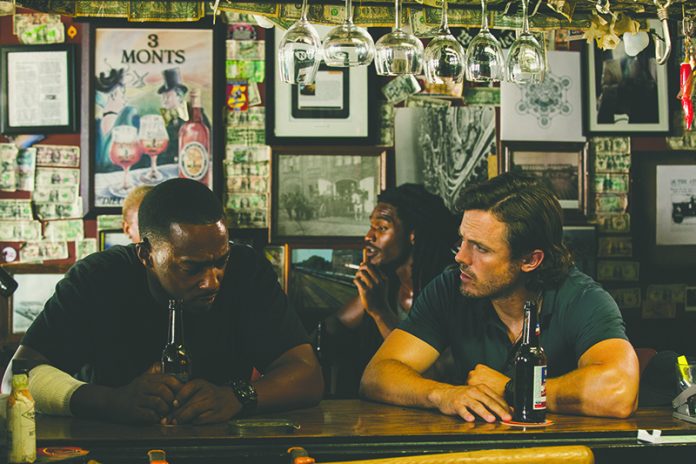
Starring Casey Affleck, Chiwetel Ejiofor, Anthony Mackie, Aaron Paul, Kate Winslet, and Woody Harrelson, the A-list cast in John Hillcoat’s Triple 9 are extras next to the under-lit bars, abandoned housing complexes, and eerie underground parking lots; the surroundings are more telling and profound than any of the characters themselves.

Following a group of dirty cops turned bank robbers who are involved in a transaction with a Jewish-Russian mob, two investigators begin to look into the bank robbery as well as a homicide in a Latino neighborhood on the outskirts of Atlanta. Confused yet? Triple 9 is incoherently plotted, juggling too many strands and characters. The screenplay by Matt Cook relies on simple motivations, two-dimensional characters, and derivative beats. But Triple 9 is the rare movie where none of this seems to matter all that much.

Crime films, which often function as institutional critiques, are engraved with subtext, whether intentional or not: the economic causes of crime, the unjust investigations of them, and the societal paranoia inflicted by homicides linked to drugs, global conflicts, and domestic politics.

Triple 9 has allusions to the Iraq war, the economic crash in 2009, the prominence of gun culture in the United States, the renewed fear of Russians, and the racial profiling of Latinos for crimes they didn’t commit. None of it coheres, except as a wild pastiche of entrancing images: a police officer hiding three decapitated heads from nearby neighbors with a white sheet; a condemned apartment building that houses the homeless; a neon-lit bar that reeks of stained liquor and loneliness.

Almost every scene is concerned with a space; the political cause for its decrepit status and the impact it has on those who live within it. During the film’s most taut sequence, a group of police officers raid a low-income apartment complex, avoiding the residents during a lethal firefight. A woman opens her front door and sees dozens of cops heavily armed with guns about to open fire steps away from her home. In the middle of his riveting action set-pieces, Hillcoat stops, considers the surroundings and contemplates the impact of violence.

The messily plotted, terribly disjointed, and thematically undercooked Triple 9 is wonderfully grimy, and by all means a beautiful-grimy movie. As a film concerned with environments, not plot, and a portrayal of a world on the brink of collapse, not a study of individual characters, it mostly works. In his first film set in a contemporary period, John Hillcoat (The Road, Lawless) makes a film that is a beautiful to behold only because it’s willing to embrace the polluted: the underrepresented underbelly of city life.

ALBUM REVIEWS

0

Basia Bulat – Good Advice

Good Advice is the fourth album to be released by Canadian singer-songwriter Basia Bulat. The album showcases the amazing vocal talent that Bulat has without going over the top in regards to production — it sounds like it is somewhere between a live and studio recording.

It does not sound like your average singer-songwriter album, as the majority of the songs are pop-tinged — but this is not a fault. If anything, it adds to Good Advice being an exceptional album. By still staying true to the ethos of the singer-songwriter genre, it stands out as a mix between traditional singer-songwriter and pop.

Highlights from the album include: “La La Lie,” “Infamous,” and “The Garden”


Foxes – All I Need

All I Need is Foxes’ second album. It follows up on the success of “Clarity” — Zedd’s Grammy-winning song on which she was the featured singer — and her debut album Glorious.

This is definitely a modern pop album. The focus of the album is Foxes’ vocal ability, but at points it becomes overshadowed by the synth heavy backing tracks. That being said, it is highly danceable, and could be fun to sing in the car, but if you are looking for something to just chill out and read a book to, I might skip this one.

Highlights include: “Cruel” and “Scar”


Majid Jordan – Majid Jordan

This is Majid Jordan’s first full-length album. The group — composed of members Majid Al Maskati and Jordan Ullman — are building on the success that they have had by being producers and being featured on Drake’s “Hold On, We’re Going Home.”

Aside from the Drake feature on “My Love,” there is nothing exceptionally notable about the album. It is beautifully produced, and every song is very clean-sounding, but lyrically there is room to grow. I wouldn’t count Majid Jordan out just yet, though. They have potential, but don’t listen to this album expecting a fully-developed sound.

The highlight is:

“My Love”

Sports Briefs

0

Women’s Basketball

SFU won their 14th straight game against Alaska Anchorage Thursday night with a score of 83–68. Elisa Homer finished with a team-high 25 points, and senior Alisha Roberts had 24. Rachel Fradgley finished with nine rebounds on the night. The team begins its quest for the GNAC title on March 3.

Men’s Basketball

The Clan lost to Saint Martin’s University 87–58 on Thursday night. The loss drops the team to 2–23 overall on the season. Due to injuries, SFU was only able to field six players on the night, which meant a lot of minutes for very few players. Andrew Williamson led the team with 18 points on the night.

Swimming

Ten SFU athletes have been selected to participate in the 2016 NCAA Division II Men’s and Women’s Swimming and Diving Championships. Adrian Vanderhelm leads the Clan in nominations, being nominated in five different events.

Softball

SFU competed in two games over the weekend of February 21, winning one and losing one. The first game was against Eastern Oregon, which they lost 10–8. The second game the Clan were able to come back from a seven-run deficit to win the game 8–7.

BC Budget adds $25 million to post-secondary funding, elicits criticism

0
The BC Budget, passed at the BC Legislature pictured here, was released to criticism this week

The BC Liberals have emerged with a new budget for this fiscal year. On February 16, the provincial government released the 2016–2017 Budget, a document that pinpoints multiple government sectors that will be impacted in the upcoming fiscal year.

In his speech to the Legislative Assembly of British Columbia, Finance Minister Mike de Jong stated that 2016 is the fourth consecutive year the provincial government is presenting a balanced budget, including a potential $264 million surplus.

The projected budget surplus has been achieved through various means. Some tactics include cutting public spending, such as removing the transportation subsidy for people with disabilities, and increasing costs to taxpayers in a number of ways, including raising MSP premiums for seniors, childless couples, and people making more than $51,000 per year.

While some people will be paying more, many of the top earners will be paying less; the temporary top income tax rate on taxable income over $150,000 has expired after being introduced in 2014.

In an email correspondence with The Peak, Dr. Krishna Pendakur of SFU’s Department of Economics wrote, “roughly speaking, this budget is of apiece with the last 16 years of BC Liberal budgets.

Screen Shot 2016-02-26 at 11.50.43 PM“It is a low-tax, low-expenditure regime, wherein keeping taxes low even at the price of mediocre publicly provided goods and services is thought to be the right choice.”

Post-secondary institutions lie under the umbrella of public services, and so amongst those impacted by budget decisions, students will also be affected.

The provincial government is adding $25 million in funding to the Ministry of Advanced Education in 2016, or two percent from the previous year’s budget, an increase from the previous cuts of 16 million in 2014 and 11 million in 2015. According to the official budget report, however, the majority of the additional funding is meant for continuing to honour wage increase agreements for public sector employees in the Ministry of Advanced Education. Despite this year’s budget increase, it appears to be going less to students and more to administration.

When it comes directly to students, per-student operating grants have been dwindling over the last 15 years, claims the Federation of Post-Secondary Educators of BC. According to Kathleen Yang, VP External for the Simon Fraser Student Society, “operating grants from the provincial government to SFU have also been in decline since 2010.” It is unclear as of yet how much funding SFU will see from the budget’s post-secondary investment plans.

However, the Minister of Advanced Education, Andrew Wilkinson, has a positive outlook on the BC Budget and its intersection with post-secondary institutions.

Screen Shot 2016-02-26 at 11.50.27 PM“The system is actually working very well,” said Wilkinson. “We have, as you know, a two percent cap on tuition growth. We are very comfortable with this cap of two percent growth on tuition, even though the universities and colleges would like it to be significantly more.”

That tuition cap in BC is for domestic students, who pay the fourth-lowest tuition in Canada. However, according to a recent media release from the Alliance of British Columbia Students (ABCS), BC charges the highest interest rate on student loans in the country. What that means for students is that the provincial government earns about $10,000 in interest off the average student loan debt of $35,000.Screen Shot 2016-02-26 at 11.50.13 PM

In the same media release, ACBS chairperson added that on top of this exorbitant interest rate, BC is also the only province to not provide grants on the basis of financial need.

The province is focusing its post-secondary infrastructure budget of $2.5 billion on brand-new buildings rather than upgrading and maintaining pre-existing ones. Some notable additions are a new 123 million dollar campus for Emily Carr University and a 19 million dollar trades facility at Selkirk College in Nelson.

“The 2.5 billion in investments over three years for post-secondary education is going to increase capacity in the long run,” said Dr. Steeve Mongrain, professor in the SFU Department of Economics. “In the short run however, it will have no impact. The current crop of undergraduate students are unlikely to see any benefit.”

When asked about SFU maintenance and upgrades, Wilkinson could not supply any examples of how our school will be aided with this $2.5 billion infrastructure plan, though Mongrain indicated that SFU may see a small amount of funding.

In the wake of Ontario’s recent announcement to offer grants to low-income students that are expected to fully cover the tuition costs of most students, BC’s changes to education funding may, as some critics argue, prove anemic.

New MLA makes history in BC legislature

1
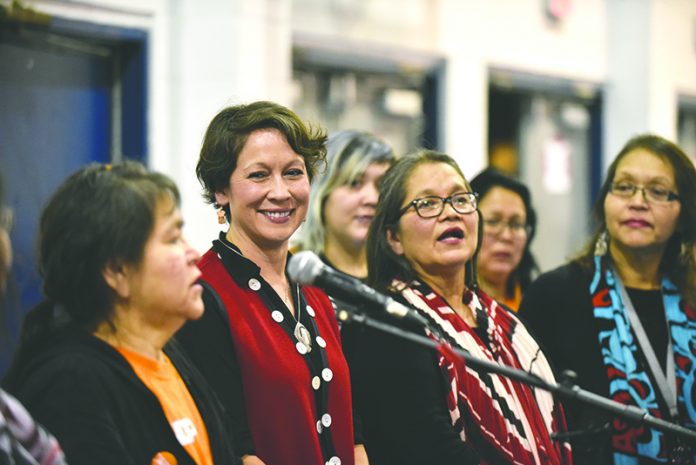
Melanie Mark (centre) is the first female Aboriginal MLA in BC history. - Photo courtesy of Melanie Mark Campaign (Flickr)

Melanie Mark always knew that she was a fighter.

February 2 proved to be a big day, not only for Mark, but also for the province. With 61 percent of the vote, Mark won the by-election for the riding of Vancouver-Mount Pleasant. She is the first First Nations woman to be elected into the BC Legislature — Mark is Cree, Gitxsan, Nisga’a, and Ojibway.

“It’s about time,” Mark said in an interview with The Peak. “The high from the past two weeks has been incredible.”

An alumna of SFU, Mark holds a degree in Political Science with a minor in Sociology. Despite the fact that she was determined to finish her degree quickly, Mark remembers her time at SFU with fondness, calling it a “great opportunity for friendships and networking.” She spent most of her time studying so that she could get on with her career as well as raise her daughter. “I always in a hurry,” Mark recalled. “I wish I had more time to get things done.”

It was this strength and determination that pushed Mark to run for the NDP nomination after then incumbent Jenny Kwan resigned and ran in the federal election. Initially, Mark was planning on running in May 2017 so that she could build up her exposure. But once the position was vacated, Mark saw this as a “push to do it now.”

“It’s now or never,” she said with a laugh. “Put your name in the hat, and do your best.”

Running in the by-election a year earlier than anticipated proved to be a learning curve. Mark compared her experience of meeting people and knocking on doors to “going into a different job interview with each person [she] spoke to.”

“I had to explain what skills I had and what I had to offer to them,” she said. “The more I connected with people, the more I felt that I could be a person that could help them overcome their difficulties.”

Mark’s advocacy work includes being the president of the Urban Native Youth Association, working at Save the Children Canada and Covenant House Vancouver, and more recently as the Associate Deputy Representative for Advocacy, Aboriginal and Community Relations, and Youth Engagement.

It was through this position that she saw how the government system was failing the province’s most vulnerable demographic: children.

“Children have no say in the budget, public policy [. . .]  they are the recipient of what adults decide,” Mark said. “We need to be strong advocates for children’s rights: their ability to practice their culture, their right to safety, and the right to be free from exploitation.”

Mark’s First Nations heritage was an integral part of her campaign and life, though this had not always been the case. Growing up, racism, especially towards people of Aboriginal and First Nations heritage, was extremely prevalent. “I didn’t grow up with a lot of pride [for my culture],” Mark said.

One of the reasons why this was the case was because of fear. Her grandparents, out of fear of discrimination and racism, did not share the First Nations culture with her. “I didn’t learn about residential schools until I was in college,” Mark admitted. She attributes this lack of understanding to a lack of Aboriginal education.

“Many people say that just because I am First Nations, I will only fight for issues pertaining to Native people. I am here to fight for justice and fairness for everyone.”

But none of this would be possible, Mark says, without the support that she has had throughout the campaign and ultimately her life.

Mark’s mother, who had suffered from alcoholism but has since been sober for 10 years, was a prime example of this in her life. “Our family was there to support and embrace [my mom] when she was ready,” she said. In the same way, Mark says that we need to have a society that will be there for people when they are ready to make a change

“We [as a collective society] are strong, and we can move mountains. We sometimes just need the opportunity.”

Mark reminds students that the road may not always be easy, and that people may be there just to “deflate you” in life. “Don’t let anyone tell you that you can’t do something,” she said. “If you want to create change, don’t wait for it to come to you. You have to go to the change.”

TransLink shouldn’t add signage for invisible illnesses

3

[dropcap]I[/dropcap]’ll admit that I mindlessly sat in one of the fold-up disability seats on the SkyTrain the other day. I don’t have a disability, I just saw the empty seat on what looked to be a fairly full cart, so I went in for the taking — mindful that I would give up the seat to any transit-goer whom I knew would need it more than myself. In other words, any transit customer who is either elderly or uses some form of apparatus to help with their mobility.

However, after clicking through CBC’s website last night, I was given a small dose of reality, and perhaps a little guilt. I read a story about a young woman with severe epilepsy who uses the disability seating on Vancouver’s public transit amid the dirty looks from bystanders who are ignorant to her invisible condition. She states that while there’s not enough room in the back to have a seizure without getting hurt, she’s now calling on TransLink to provide proper signage for people with invisible illnesses, such as hers.

The numerous times I’ve sat in a disability seat, I don’t recall ever being given dirty looks, but perhaps I haven’t been paying proper attention to those around me. This might be a fault on my behalf. However, I do see a sadly difficult circumstance when it comes to asking TransLink to ‘properly’ accommodate all customers on public transit.

The fact of the matter is that invisible disabilities are just that — invisible. Unfortunately, the general public is ignorant of these issues, and that’s just the way it is. After all, how could they know? To ask TransLink to update their safety signage to include those with invisible problems is a safe request, but it’s equivalent to asking people to ‘be considerate’ of others when using transit services, something TransLink already does.

If the transit-goers don’t notice there’s a problem, then the problem won’t be solved.

And while this is a fair use of sign space, I’m saddened to say that many perfectly healthy people don’t take it to heart. The public in this city like to keep to themselves while they travel; most won’t be bothered to keep an awareness of others while on transit, and most don’t want any part in drama should it occur.

The unfortunate truth is that if the transit-goers don’t notice there’s a problem, then the problem won’t be solved. If you have an invisible disability, it’s best that you, yourself, make others aware by using your own signage — whether it be a tattoo, a paper sign, or some other indicator. Yes, I understand that many disadvantaged people may feel ‘branded’ or ‘outcast.’ They may not feel comfortable publicly displaying their personal problems, and they probably don’t want to be reminded of them each time they use transit.

However, it’s sadly out of TransLink’s reach to help these people. Invisible disabilities are a tricky subject to navigate when it comes to public spaces. In fact, I’d go so far as to say that when these issues meet the need for public recognition, they’re impossible to solve without somebody feeling violated or isolated in the end.

While I’ll be sure to leave the disability seat to someone else from now on, if I’m sitting in another space and you indicate to me that you need it more than I do, I will respect those needs. But you can’t expect TransLink to influence people to do this for you.

Lauren Swistak swims through life with purpose

0
Swistak currently has the fifth fastest time in the 200 metre butterfly this season.

A third-year criminology student, Swistak is at the top of her swimming game. She’s helping the SFU Clan to recent victories over the University of Victoria and Seattle University in dual swimming meets. She currently holds the fifth-fastest time in the 200 metre butterfly in the NCAA D2 in this season, and was honoured alongside Adrian Vander-Helm as College Swimming’s National Swimmers-of-the-Week for Division II the week of January 20.

Despite a rough start to her university swimming career, Swistak has shown that determination and hard work pays off in the pursuit of greatness. “I’m happy that my training is clicking,” she says.

Swimming came into Swistak’s life at the age of nine, when she began taking part in summer club. She would swim during summer, alongside playing soccer. What pushed Swistak towards swimming was a conversation with her soccer coach on priorities. “He basically sat me down and told me that I had to choose,” Swistak recounted. In the end, she moved bravely into the swimming world, for its individual nature. “It’s a bit selfish, I guess. But I get to be in control of my own fate.”

What ultimately pushed Swistak to go the competitive route with her swimming was the fact that she wanted the chance to compete against others. During her time in Swim Kids, the Red Cross swimming lesson program, “I wasn’t really learning the strokes; I just wanted to race people,” she said.

It was this competitiveness and talent that drew Simon Fraser Aquatic (SFA)’s Head Coach Liam Donnelly to Swistak. She swims the 200 metre butterfly, and also does distance freestyle. When asked why she chose to pursue butterfly as her stroke of choice, Swistak says that it’s “more glamourous” and that it makes her feel “tougher.” While she would prefer butterfly over distance freestyle, she says that ultimately will do whatever helps the team.

“I can’t think of myself not swimming. It’s a part of me.”

During the regular season, she competes in the NCAA with the SFU Women’s team and with coach and Cory Beatt, whom she affectionately calls her “second dad.” During the off season, she trains with the SFA team, under the coaching of Beatt.

This strong relationship that Swistak has built with Beatt, as well as her fellow teammates, is a big reason why Swistak feels that her swimming is finally clicking. She discussed how the women’s team, after a heartbreaking loss to Seattle University in October, banded together to beat the team in a dual meet in January. Through their teamwork and motivation, the women’s team got the comeback they wanted. “We felt so connected [after that win. . .] it’s one of my highlights for this year, and my best memories with the women’s team.”

Swistak’s sights, like many other athletes, are set on the Olympics. Her proudest moments are reflective of her talent and dedication towards that goal: at 10 years old, she received her first provincial qualifying time in 100 metre freestyle that put her through to provincials. Eight years later, while she was in grade 12, Swistak made the B finals for World Trials for the very first time.

Sandwiched in-between an intense water training and voluntary dry land training schedule, Swistak says that ultimately time management is a must in order to be able to complete everything she needs to do to be successful, from studying to taking time off to relax. Between juggling the many different aspects of her life, she has resigned to the fact that her criminology degree will take her five years, but she enjoys her classes and is taking life day by day.

But taking swimming out of Swistak’s life, she says, would be “sad.” Swimming has helped her to develop important values, such as setting goals, good time management, and commitment. “It’s provided me with a lot of structure. [. . .] I can’t think of myself not swimming. It’s a part of me.”

With this path and her determination, Swistak’s optimism for her future is refreshing, and she shows no signs of slowing down anytime soon.

Fuck it. I am a procrastinator.

0

[dropcap]I[/dropcap] love learning. It has always been a huge part of my life. Most of my earliest memories involve learning in some form. . . books, documentaries, and personal experimentation. But where I’ve learned the least is the same place I should have learned the most at — school.

I could lie and say that I was too smart, or that the system failed me. I could look at myself in the mirror and say both of these things with a straight face and an air of sincerity, but I know that it would only be partly true. The real truth is that I am a procrastinator.

I have been one for my whole life. My mom has told me that I’ve been doing it since preschool. Let that sink in for a moment — preschool. At the tender age of three, I was fucking around with the system to see how much I could get away with. It was less calculated at that age, but knowing how I am today, I can assume that’s exactly what I was doing.

Procrastination at that age had fewer consequences — there were no sleepless nights finishing papers or missed job opportunities — it was mostly in the form of a trivial classroom exercise.

I’ve been doing this since preschool.

This progressed all throughout kindergarten and elementary school. Except it was a form of reverse procrastination — I wanted to finish everything as fast as I could and get back to the distractions. As soon as I learned that the faster I worked and accomplished things the sooner I could do what I wanted. . . I was hooked.

This was my life. I produced slightly above average work that I could not call my best, but once that work was done, I could get back to my distraction of choice — alternative learning.

Books fuelled my life. I was reading multiple novels a week plus random non-fiction works that focused on something that wasn’t taught in school. I also would be watching mostly educational things on TV, absorbing knowledge from multiple sources at the same time.

Organized education didn’t quite live up to my expectations of what learning should be. Middle school and high school rolled around, and the problem just got worse. There was more freedom and there were more distractions. This was also when I started to fall into the regular patterns of procrastination, and it was exacerbated by the teenage “I don’t give a fuck” attitude.

I got homework done, and I got good grades. While I was skipping classes, getting distracted (when I actually bothered to show up), doing homework on the bus, I was admittedly getting the work done — but not because I was on top of things.

My mom saved my proverbial ass. She was on top of when I had things due and would nag me to get my homework done. She sacrificed her relaxation time to make sure I was actually doing my homework at the dining room table or on the living room floor. She would sit with me and watch me work.

Fast forward to September 2012. I was heading off to university. It would be my first educational experience where my mom wouldn’t be there to visually confirm that I was doing my work.

During my first two weeks of class, before I really got to know anybody other than my roommate, I was a good student. I was getting readings done with time to spare. I was able to get to sleep at a regular time and have some spare time to read ahead for the next class.

I wasn’t getting any “learning” done but I was happy.

Looking back, it was all an act. I was doing what I thought a good student was supposed to do. I wasn’t exactly happy acting that way, but pretending to be a good student was getting the job done.

This all ended when I actually branched out and embraced my burgeoning social life with open arms. “Studying” became a euphemism for drinking multiple cups of overpriced coffee, eating second dinner, and fucking around for eight hours with my friends, and usually going to bed around 4 a.m. It was strange, I wasn’t getting any “learning” done, but I was happy. I was learning what I wanted to. I was choosing what I wanted to learn, and how I wanted to learn it.

It put structured learning on my terms. I was doing what they wanted me to do (barely), but I was doing it my way. I was learning more about myself than the poetry of the Romantics, or the art of the Ancient Greeks and Romans. I began to challenge myself — much like in preschool — to see how far I could push before the system pushed back.

The system has pushed back, and I’ve gotten abysmal results on things that I have put off. I always tell myself that I will do better next time and get it done with enough time to revise. Surprisingly — or not, given my past — I don’t. I write things down so I don’t forget them, but I never do them early. I do them at the last possible minute.

You’re probably expecting me to come out with some sort of spiritual revelation about procrastination and wanting to make myself a better person, but I’m not. I am a procrastinator, and after 22 years I doubt that will change. So, when I am 100, in the old folks home and someone asks me what my secret to longevity is the only response will be, “I don’t know. I am procrastinating dying.”

So fuck it. Fuck the system that forces structured learning. You can learn from anything, learn anywhere, and learn any time. Fuck not procrastinating. It might prevent some sleepless nights, but if you are enjoying what you are doing in that moment embrace your happiness. So fuck it all. I am a procrastinator and that won’t ever change — no matter how many Moleskine agendas that I own.