
Home Blog Page 820

CINEPHILIA: Chi-Raq’s vignettes are filled with human worth

0
Lysistrata (Teyonah Parris) unites the women on both sides of a gang war by starting a sex strike.

In the opening minutes of Chi-Raq, a title card informs us that since 2001, more Americans have died on Chicago streets than in the Iraq War, the results of gang violence perpetuated by poverty and a government that has neglected a ghettoized part of the city.

Spike Lee has never been known for subtlety. If his films are overly didactic, they make up for it in passion, energy, and earnestness. They’re angry only because tears are too passive to motivate change.

Spike Lee’s latest joint is a sermon, a comedy, a tragedy, a musical, a poem, and a modern adaptation of Aristophanes’ play Lysistrata. Nearly the entire film is written in verse with the majority of the dialogue delivered as couplets — “This situation is out of control / ‘cause I’m in front of an empty stripper pole.” The film is structured as a series of vignettes — some funny, some sad, some both at the same time — that revolve around all the parties involved in a gang war.

On the southside of Chicago, firefights and stray bullets from the Trojans and the Spartans kill innocent bystanders along with the young black men initiating the violence. Chi-Raq (Nick Cannon), the nom de plume of the Spartans leader, is in a war with Cyclops (Wesley Snipes), the one-eyed commandant of the Trojans.

Following the death of an innocent teenager on a botched drive-by shooting, Chi-Raq’s girlfriend Lysistrata (Teyonah Parris) unites the women on both sides in a sex-strike. “No peace, no pussy!”

This may make Chi-Raq seem like a bore, a passive exposure to Lee’s ramblings on gun culture and racial inequality in Chicago and America at large. Chi-Raq is motivated by beauty and sympathy; its luscious widescreen frames transform the underbelly of Chicago into a stage decorated with life and colour. Human worth is implicit in nearly every film, yet so few feel quite as alive as this one.

Most of Lee’s films are theatrical, and in Chi-Raq the screen often feels like a proscenium. The compositions and blocking often place the viewer at the other end of the dialogue, as if we’re sitting at the front row of a play. The audience is always the most important character. During a sermon at a local church, the camera sits in the pew. A peace accord in the denouement faces the spectator, as though we too are signing the contract. And as is customary with ancient Greek plays, the film has an omniscient narrator who addresses the audience directly — played by, of course, a very funny Samuel L. Jackson.

Chi-Raq functions under a similar, albeit more erratic, mode as Lee’s 1988 masterpiece Do The Right Thing. It glides between disjointed scenes, characters, and scenarios with no narrative momentum but an internal logic, which in the case of Chi-Raq is a no-rules kind of consistency.

Lee’s preaching has rarely felt as organic, because by wrapping his lessons in a sheen of elaborate artifice, he has made a film as stunning to look as it is politically engaged. It’s a dance of conflicting forms where somehow all the movements feel just right.
A dream come true: Jason Hayward’s road to professional musicianship

1
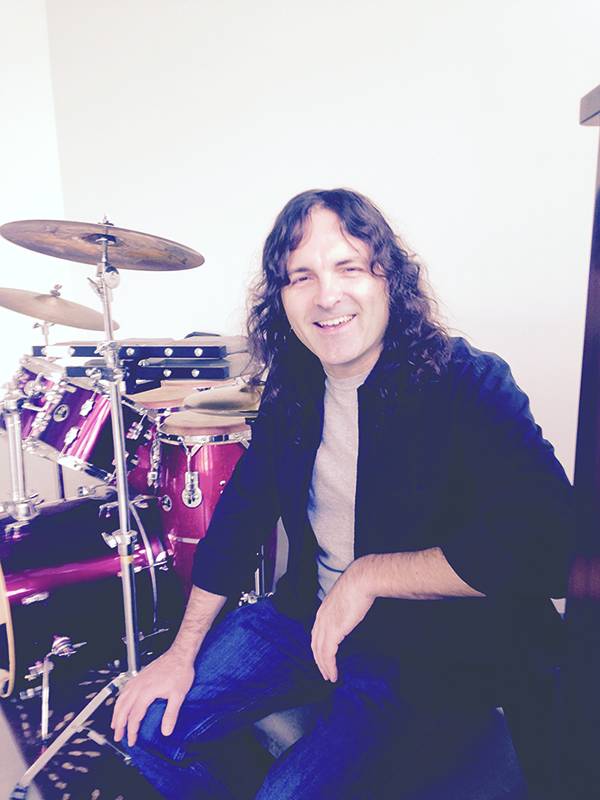
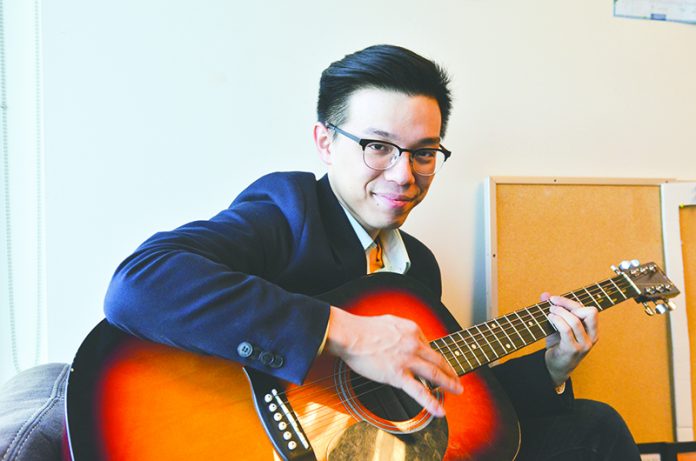
SFU student Jason Hayward looks to channel his passion for music into further studies to become a music professor.

The allure of music had always given Jason Hayward something to dream about. Little did he know that his life journey would take him across the country and even to the other side of the world in the pursuit of something once described by him as a “fantasy.”

Initially, Hayward’s cards pointed in a completely different direction. Growing up in Newfoundland, he was raised in a household that was by no means musical, though he took private saxophone lessons in his youth. Despite his dreams of becoming a musician, lack of insight into the world of the music industry influenced Hayward to not pursue his passion. Instead, he studied business, something that he decided to study through a process of elimination.

“It seemed like a viable choice, since I knew I didn’t want to be a doctor,” Hayward said with a laugh.

But music called to him throughout pursuing this degree in business. Hayward recounted how he would always pass by the music wing of his school during first year; it was then he realized that music could be studied professionally, and he yearned to be there with the other musicians and artists. Despite how long it took for him to get to that point, Hayward appreciated the time he had to explore who he was. It was also then that he learned “business was not for [him]” and that it was time to dive head-first into something about which he had always dreamed.

After his undergraduate degree, Hayward went to Toronto for two years to study jazz music before returning back to St. John’s to focus on performing, teaching privately, and composing music for different jazz combos in the city. It was during this time that he also tried out graduate music studies at Memorial University. But Hayward said that the more he added to his plate, the more “disillusioned he felt with the music scene.”

“It was a time of crisis, on two levels,” Hayward said, describing his return to St. John’s. “I felt like I was trying to do too much and then burnt out, but I also felt like I didn’t fit in. I was too classical for the jazz world and too jazzy for the classical world. I wanted to do my own music and experiment with my own creativity.”

Instead of staying in St. John’s, Hayward packed up everything and went to Korea with the intention of staying for a year to teach English. Hayward took that time to channel his creativity and experiment with electronic music, which led him to remain in Korea for three years before returning back to Canada.

With a newfound sense of enthusiasm for music, Hayward brought his experiences and electronic music back to Canada. Upon his arrival, however, he experienced what he described as a “reverse culture shock” and felt like he once again “did not belong.” Hayward then packed up his bags and went to Calgary, where he met up with a ska reggae band and toured with them across Canada as a keyboard player. This, according to Hayward, was one of his fondest memories performing.

Hayward returned back to St. John’s one more time, this time meeting his current partner in a writer’s group. With her by his side, they went to stay in Belgium for six months before moving to Vancouver, where they currently reside. Hayward is finishing up his post-baccalaureate diploma in contemporary arts, set to graduate after this semester.

Throughout his travels and experiences, Hayward has come to call himself a jazz and contemporary classical musician, experimenting with different genres and being influenced by artists such as Sonny Rollins and Charlie Parker.

Hayward also enjoys the singer-songwriter genre, citing musicians like Paul Simon and Sting as influences that have pushed him to try something new and to write his own music and lyrics. With his post-baccalaureate diploma, however, one of his group projects requires him to compose music for a short film. For this type of music, Hayward looks to the likes of John Adams for influence, while taking some of his own elements of creativity to add to the sound.

When it comes to finding inspiration, Hayward says that he draws on many different sources, such as literature, poets like Sylvia Plath and Charles Bukowski, and visual art. But beyond these muses, Hayward is a strong advocate for “doing the regular work.”

“I am a firm believer that doing the work is the most important part of anything,” Hayward said. “The inspiration will come when you do the work and see what comes out of it.”

Most importantly, Hayward is a big believer in passion and creativity.

“My main muse is my creative drive,” Hayward replied. “Creativity is most important to me, and definitely what gets me going every day.” It is this love that Hayward feels for his music that he hopes other people feel every day for their own passions, regardless of what they are.

Looking ahead, Hayward would like to continue his studies in hopes of one day becoming a professor of music while composing and performing his own works professionally. With his passion, experience, and creative drive, Hayward most certainly is someone to watch out for in the Vancouver music scene and beyond.

Enoch Weng reflects on his year as SFSS President

0

The Peak: Reflecting back on the year you’ve had as SFSS President, what is the thing you are most proud of?

Enoch Weng: I think its really living up to the whole “Ohana means family” quote. The biggest thing I wanted to change was the culture and the way people interacted both within and outside of the SFSS. I’m really proud, not really [of] what I did, but what I and my team and the staff were able to do. We created a whole culture change and we did a lot of restructuring with staff and the with organization, with policy changes — we completely revised our governance, we’re creating a new strategic plan. And all of these are huge things that are going to make our organization such a better place.

P: Okay, so now for the opposite of that question: What’s one thing that you would’ve done differently?

EW: I’ve sacrificed so much for this place: friends, family, my time, my health, all to just make sure this place is running, to make sure that students are going to get the best, and that we live up to those standards. And along the way too, because I’m always investing in people and investing into this place I’ve given them so much. There’s times where I could’ve got something for myself or I could’ve, you know, pushed forward an idea, but I gave those up to help the team along, for unity, all that jazz. So sometimes I feel like if I pushed a little bit harder for my own agenda I could’ve done more.

P: One of the big issues of your presidency was the Build SFU project. Do you have anything to say about how the project was handled, if things could’ve been done differently or how things are going to be done differently from here on out?

“For me it’s all about seeing how I can help the world” – Enoch Weng

EW: I think it’s definitely something that needs to be changed. Not just our elections or AGMs or whatever, but our entire organization is antiquated. Were running on policies 30 or 40 years old. Were running on infrastructure 20 or 30 years old. Heck, even the way we run our meetings are decades old. And that’s kind of why I wanted to do governance change to look into ways to fix things up because past practices are not reflective of our modern day needs.

Our issue was that we were faced with so many constraints. We were faced with time constraints, monetary, budgetary constraints, and even just in infrastructure [and] resources needed to support it. One thing I do encourage next year is to [find] how to get more students [. . .] involved or how to make sure everything is more fair. It is legitimate process that we have now because it is outlined, its detailed and everything. At the same time it’s not best. [. . .] It needs to change. And unfortunately in our year we weren’t able to tackle that because we were dealing with so much more.

P: Going right off of that, we have a newly-elected board. What are your hopes for them?

EW: Well one thing that is exciting is that the VPs are all returning members. They’ve all been with us through thick and thin. [ . . .] They have actually been part of the change. They’ve been actively engaged whether its governance or strategic planning and so they are the ones who have institutional knowledge and they’ve done the work. So I’m really happy and I’m really excited to see what they’ll do to continue that work.

P: What is one lesson you’ve learned during your time as president that you’ll take with you?

EW: One of them is to take care of yourself. To make sure that you have self-care, make sure you have the work life balance. For me, I put in 50–60 hours plus a week. I burnt out many times, but you hide it, you don’t let it show. So I go days with two hours of sleep and just grind through. And so people would be like, ‘Wow Enoch, you’re so energetic today,’ and I’m like ‘Yeah, cause I’m running on empty.’ So that’s one of the lessons: to find balance and spend time with family.

P: So what are your plans now?

EW: Well, the first thing I’m going to do is spend some valuable time with friends, family, and God. Like these three things have been neglected and I’ve sacrificed them so I’m really looking forward to spend time with my important ones. I’m going to be doing maybe one last co-op. I’m going to try to get through school. And really going to look for the next challenge. For me it’s all about seeing how I can help the world. Whether it’s to help one student at a time or help many. I just wanna find something I can help with. [. . .] I’ll be helping out with some non-profit music groups but at the same time near the end of school I want to do more. This is just a start. So that’s kind of where I am at

P: If you could pick a Disney song to summarize your last year as president, what would it be?

EW: I knew you were going to ask something Disney-related! Oh man this is hard. Shoot! Do you mind if look through my song list?

[Weng looks through the collection of Disney songs on his cellphone and chooses “Go the Distance” from Hercules.]

I like that one. Because it defined my year you know like I’ve dreamed about this, I’ve went on the road, and yeah, it’s an uphill slope.

SFU should become a smoke-free campus

0

[dropcap]T[/dropcap]here is a growing trend among university and college campuses in North America to ban cigarette smoking completely, and as far as I’m concerned, SFU should follow suit.

About a dozen Canadian campuses, such as Memorial University in St. John’s, Dalhousie in Halifax, and the University of Alberta in Edmonton, have already implemented bans on smoking, and according to the American Nonsmokers’ Rights Foundation, at least 1,475 campuses in the United States are now smoke-free. So why hasn’t SFU joined them?

From 2013–2014, a campaign was underway on campus, Tobacco-Free SFU, supported by the Faculty of Health Sciences. Over the course of about six months, the group started a petition, held some events, and lobbied the administration to make SFU smoke-free. Their goal was to change the current university policy to ensure that there would be no cigarette smoke or cigarettes on campus, and to add clauses relating to the divestment of tobacco company assets and the refusal of funding from the tobacco industry.

That initiative seems to have fallen by the wayside, but it’s time to take up this cause again and clear the air once and for all on our campus. 

While some may say that banning an activity will only make people want to rebel against the regulation, with the right enforcement and education, this could easily be overcome. Smoking is also on the decline in Canada, which might beg the question of whether a ban is necessary, but there are many places on campus where you can be met with clouds of unwelcome secondhand smoke simply when trying to get from point A to point B.

A 10-metre smoke free zone simply isn’t enough, and isn’t currently well enforced.

The walkway above Convocation Mall is notorious, as are the areas outside many of the main entrances to campus buildings. A 10-metre smoke-free zone simply isn’t enough, and it isn’t currently well-enforced, either. 

There is plenty of research showing that second-hand smoke can be hazardous to our health, and for this reason smoking has been banned in a multitude of public places such as restaurants, patios, beaches, parks, and bus stops. I don’t see why our public university campus should be any different.

It’s true that smoking remains a legal pastime, and it is a personal choice. If people choose to smoke, that’s their business. However, that business happens to also create airborne toxins that are dangerous when inhaled by others, so it would be best if smokers kept their bad habit away from the public.

In addition, the litter created by hundreds of cigarette butts, aside from being an eyesore, is toxic and detrimental to the environment. Butts are not biodegradable and they contain heavy metals and other harmful materials that can leach into the soil and water.

SFU Health Sciences Professor Kelley Lee has suggested that tobacco companies should be responsible for the toxic butts, and the mayor of North Vancouver would like to see a deposit placed on them.

We don’t need these pollutants on campus, and we would all be better off if SFU and all other universities were smoke-free, so that nobody would have to walk through a cloud of cigarette smoke to get to class.

Prank YouTubers need to stop

0

[dropcap]T[/dropcap]his January, I was in Toronto with a friend, walking down Yonge street at 1 a.m. We wanted to explore the city and get some fresh air, but instead our calm stroll became an uncomfortable run-in with a wannabe prank YouTuber. He was a tall, stocky man, early-to mid-twenties, with a slight, possibly drunken swagger to his step, crossing the street towards us.

“Hey,” he said, smiling, “where are you girls headed?”

As soon as the walk signal on the street-light began flashing, I was ready to bolt, but my friend was too polite for her own good. She replied, “We’re just exploring the city.” I attempted to drag her arm towards the crosswalk but the mysterious man continued talking to us.

I don’t remember what his exact words were, but it ran something along the lines of “I just broke up with my girlfriend, I’m so sad, blah blah blah.” I tugged on her jacket a bit harder, but the light had already betrayed me and the cars now blocked my escape route. The guy could sense my apprehension and will to leave, but attempted to keep the pity party going.

“I have a sexual disease. My life is so hard, I just need a hug.”

No. Why would I ever want to hug a strange man, probably drunk, detailing the intimacies of his life? My sweet, naive friend, hesitantly hugged him. Unlike her, I tried to be as cold as possible, replying to his inquiries with, “No, sorry, I have a boyfriend, I’m not interested, we should go now.” But he persisted, and I gave him a handshake as a compromise, which he tried to turn into a hug. I caved since it was easier to cooperate than make him angry.

In that moment, I actually felt like we were in danger. I wanted to run, but I couldn’t.

“Wait, could you please just, have a moment for me? Pray for me, please.”

The more prank channels keep popping up, the more unregulated harassment becomes the norm.

My friend was too kind to reject him, and I couldn’t leave her, so there we stood, the three of us holding hands in a circle on the corner of Yonge and Dundas, shivering in the brisk winter air as he made us repeat a prayer for him.

“Dear God, please help [blank], he is conflicted with sexual disease, and a broken heart, and just wants a hug from two beautiful young ladies.” I wanted to vomit from saying those words, but I hoped once this odd prayer circle was finished he would let us go.

“Okay, bye.” I said, rushing to leave, when he says, “Wait, I’m a YouTuber, I want to know if I can use you guys in my video! See, across the street, those are my friends they were filming the whole time!”

What did he just say? I wanted to punch him. I had legitimately thought our lives were in jeopardy, and it turns out it was all one big prank.

“Uhm, I don’t know about that. . .” I replied, tugging on my friend, who I noticed was also uncomfortable with the idea of using us in his video. In the end, we obliged, and promptly left.

The point is, regardless of that YouTuber’s popularity or status, I don’t want to be a part of another prank video, I don’t want to be approached randomly by strangers on the street, and I definitely don’t want to feel like my life’s in danger in an unfamiliar city.

We keep feeding the egos of these prank YouTubers, and in turn we create more of a thirst for fame. The more prank channels keep popping up, the more unregulated harassment becomes the norm under the guise of a fun YouTube video. Please stop supporting these pranksters who coerce their victims into letting them use their footage.

Pranks cease to be pranks when no one is laughing.

Sorry, trigger warnings do not hinder free speech

1

[dropcap]T[/dropcap]yler Knoll’s article entitled, “Trigger warnings are not an excuse to censor free speech” could not have gotten it more wrong. Trigger warnings don’t censor or stifle free speech. They’re simply warnings — like online pieces of courtesy to the faceless people on the Internet. A person who writes something for the web has no way to judge or adjust their tone in accordance with the audience’s response.

In person, if you’re conversing with someone and they begin to get uncomfortable, most people wouldn’t just shrug and keep going because it’s their right to say what they want (well, a few might). But most people would pause and adjust the discussion, ask if their counterpart is alright, and maybe even say “If you’re okay, I’m going to talk about _____ and then I’ll move on, all right?”

A trigger warning doesn’t have anything to do with the presenter or the person writing. The writer can say what they want — nothing stops them. The right to free speech is not the right to be heard. The trigger warning is just the pause; it’s the “this potentially sensitive material is going to crop up, so prepare yourself accordingly.” It’s like a movie rating. Rated PG-13 for some violence.

Why can’t we have trigger warnings for content that could trigger damaging, traumatic experiences? Who does it hurt? Not the lecturer, and certainly not the students. To assume that the people who need trigger warnings would skip past an online post or an entire lecture simply because a small warning has been shown is inherently flawed.

Instead, people can now read through an article or blog, or attend a lecture in an informed way instead of being slapped across the face with it midway, caught completely off-guard. When that happens, people freak out and stop reading, or get up and leave.

The right to free speech is not the right to be heard.

In regards to the article’s example about the English class discussing terrible things First Nations peoples had to face, I’d like to say that just because a trigger warning was shown doesn’t mean that students are ignorant about what happened to First Nations peoples at the hand of the Canadian government. The trigger warning clues students to the intense and horrific natures of the things our government has done, and most of the people who need the warning can then sit through the class.

If people leave after having been exposed to a trigger warning, I find it presumptuous to assume that they left because of it. This is especially if a large contingent leaves. Those are probably just people who skipped class for the heck of it.

My other problem is the claim that “any psychiatrist will tell you the only way to face your fears is to confront them directly.” No, they won’t. Many of them will, as desensitization is a prolific form of therapy when dealing with fear and anxiety. However, the opposite effect — sensitization — can also occur. The added pressure to ‘face your fear’ can further add to fear and anxiety instead of alleviating it.

This isn’t about students being fragile. This is about realizing that you can never know the stories of all people. If one sentence at the beginning of a lecture or an article can prevent extraneous emotional turmoil — why not? It takes all of three seconds to write or say, and it could be the difference between a captive, engaged audience and an audience that leaves before you can finish your free speech.

Peak Sports Stanley Cup predictions

0

Nick Bondi, Sports Editor

Anaheim Ducks vs. Washington Capitals

Winner: Washington Capitals

CMYK-Nick BondiAfter a tough start, Anaheim has certainly turned it around. They lead the league in both power play percentage and penalty kill percentage, and look like they will be the first team since the 1984–1985 New York Islanders to end the season with both distinctions. However, Washington has been a dominant team all throughout the season. At the time of writing, they’ve already clinched the President’s Trophy before any team in the Eastern Conference has clinched a playoff spot. Anaheim will have a tough time coming out of the West, having to face the likes of LA, Chicago, Dallas, and the Sharks to get to the final. They might be a bit tired by then. However, Washington’s path is a bit easier, with no real true Cup contenders other than themselves in the conference. Plus, they finally have a true number two centre in Evgeny Kuznetsov. I firmly believe that Washington will be taking home their first Stanley Cup come June.

MuhammadQasim Dewji, Digital Strategist

Anaheim Ducks vs. Washington Capitals

Winner: Anaheim Ducks

My Stanley Cup pick goes to the Anaheim Ducks. Over the last three seasons, the Ducks have been getting closer to the Finals every year, losing out on a shot at the Cup in the third round last season. With the additions of Kevin Bieksa on the back end and John Gibson coming into form, the Ducks are a well-rounded, competitive team this year. Their early season struggles brought them together, making them a strong cohesive unit and a formidable opponent. They are first in both power play and penalty kill percentage, and have the depth needed to make a real push in the playoffs. The biggest problem Anaheim will face against the Capitals is containing Ovechkin, and they have the right man for the job, Ryan Kesler, a true shutdown centre who can get under people’s skin and even put points up on the board.

Nathan Ross, Associate News Editor

Nashville Predators vs. Washington Capitals

Winner: Washington Capitals


Screen Shot 2016-04-01 at 8.19.54 PMNashville is my dark horse for the Western representative for the Stanley Cup final, as they’re going to sneak by as the wild-card team in the Pacific division while the Central tears itself apart. With Pekka Rinne rounding into above-average form (not elite) and Ryan Johansen finally settled into Peter Laviolette’s system, their incredible blue line will be enough to push their middling offence into the final. However, once they’re there, they’re going to get steamrolled by the Capitals. This isn’t the Washington Capitals of old, who relied on Ovechkin, Backstrom, and the now-departed Mike Green to carry the load. This team is incredibly deep, and that’s not even mentioning Braden Holtby quietly going about setting the record for most wins in a single season by a goalie. As long as the team doesn’t run into any key injuries, this is their Stanley Cup to lose.

Austin Cozicar, Peak Associate

Chicago Blackhawks vs. Florida Panthers

Winner: Chicago Blackhawks

CMYK-AustinNormally, I’d go with the homer option, and say inexplicably, against all odds, that the Canucks will win it. Fortunately for my chances of being right, the Canucks are out of the playoffs. Barring any massive rule changes, this just isn’t their year. Instead, this year I predict the cup winner will be one of two teams — you guessed it: Chicago or LA. The pattern is on LA’s side this year, but Chicago just seems so good. Anaheim is looking like a good choice too, but I think they will find a way to mess it up second round or sooner. Ditto with St. Louis. The obvious choice in the East is Washington, but it’s not too often that the best teams from both conferences make the finals. The rest of the East is wide open, so why not Florida? They’re as good as anyone in the East, except for maybe Washington — but they’re certainly not as good as anyone in the West, so I believe Chicago will win it all for the second year in a row.

Erik Pinto, SFU Student

Chicago Blackhawks vs. Washington Capitals

Winner: Washington Capitals

The reigning Stanley Cup Champions, the Chicago Blackhawks are looking like promising contenders once again. Patrick Kane has taken his game to another level and the addition of Andrew Ladd gives me every reason to suspect they are going to make it back to the Stanley Cup finals once again. However, the Washington Capitals look to be unstoppable this year. Alexander Ovechkin leads the league in goals, Holtby in wins amongst goaltenders, and the fire power of Kuznetsov and Backstrom have combined for a total of more than 80 assists. They have absolutely dominated this season and I don’t see why their success won’t transfer over into the playoffs and into an eventual Stanley Cup.

Bartosz Wysocki, Peak Associate

Dallas Stars vs. Florida Panthers

Winner: Florida Panthers


Screen Shot 2016-04-01 at 8.34.28 PMWhen it comes to historic NHL powerhouses, the Dallas Stars and the Florida Panthers are not teams that immediately spring to one’s mind. They only have one Stanley Cup between which Dallas won way back in 1999. However, 2016 has definitely been a defining year for both of these teams. In the west, the Jamie Benn-led Stars have been ruthless, and I’ll make the bold prediction that they won’t lose more than three games in the first three rounds. In the east, Florida has had a resurgent year, led by two absolute legends of the game, Jaromir Jagr up front and Roberto Luongo in net. In the Finals, the Stars will choke under pressure and the veterans in Florida will take the wheel, winning the series 4–2.

Woohoo, Boohoo

0

Woohoo: Ponytails

Fun, flirty and flouncy — the ponytail is a hairdo classic. Yank that mop up into a high ponytail and you’ll look like an adorable helicopter, ready to take off into a clear sky of sassy fashion. Try a low ponytail to resemble a sweet and secret seductive baker’s daughter from the Renaissance — you’ll woo knights and stable boys everywhere, and your father will make a ton of cash selling you for marriage.

The side pony-tail alternatively offers the look of an ’80s babe; try that baby out and you’ll be in for a night of Dirty Dancing and extravagantly dirty spandex. Why stop at one pony tail? Cover yourself in them! Become a contemporary piece of art by tying up your hair into multiple tiny ponytails, imitating the stark and bold fashion of a chia pet. There’s no way to go wrong with this baby. Go on, girl! Tie that hair up and look as charming as the ass of a pony.

Boohoo: Buns

What the hell is that? Is that a poorly made IKEA cinnamon bun plastered mistakenly to the top of your head? Did you actually put a sock on your fucking head? Do you have any respect for yourself? Probably not, since it looks like a dog turd curled up on top of your head to dry up and die and you still seem to think you look cute and ‘librarian-esque.’

The bun is the Greek tragedy of hairstyles. It’s a real ‘let’s kill pops and accidently get it on with mama’ sort of deal. Even the nursery rhyme “Hot Cross Buns” is weak, paling in comparison to the all-time classic “Twinkle Twinkle Little Star.” Please do yourself a favour and abandon any form of spherical hair, and graduate to other more impressive geometric shapes — try a hexagon.

My anaconda don’t want none if you’re wearing a bun, hun.

SFU beats UBC in Achilles Cup

0
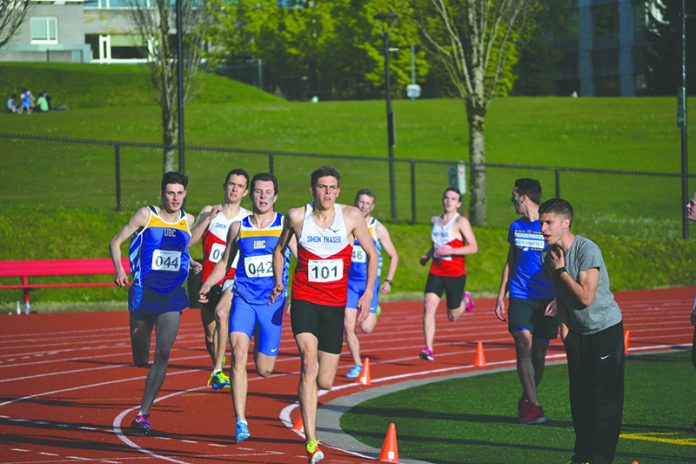
Cameron Proceviat (centre) finished second in both the 800 and 1,500 metre run.

SFU’s track and field team came out victorious in the Achilles Cup on March 25. The yearly event is held between SFU and UBC, and was the first outdoor meet for the Clan this season. SFU came out victorious on both the male and female side, increasing their lead in the overall series to 8–5–1.

“I’m really happy with the meet,” said Head Coach Brit Townsend. “We were uncertain going in.

“We don’t have a lot in the field events right now, so it ended up that we were way ahead [with] the women, and the men came down to the last couple of events. So it was pretty exciting.”

This marked the first outdoor meet for the team this year, a big adjustment from the previous indoor meets.

“We’re just coming off of a competitive season indoors, and we didn’t have much of a break,” said Townsend. “The kids who went to nationals didn’t have much of a break had less than two weeks, while other ones that just ran at the conference had five weeks.

“Outdoors is tough. There’s even more schools vying for those top spots [. . .] Outdoors, we end of having to travel quite a bit and it’s right through exams so that’s stressful. We start a couple of weeks later than most schools in the NCAA Division II, partly because of travel costs and partly because of school. They need some time to get through their exams.”

Standout performers in the meet include Cameron Proceviat, who finished second in both the 800 and 1,500 metre run, and Dylan Freinhofer and Marc-Antoine Rouleau, who finished first in the 800 and 1,500, respectively. On the women’s side, Valda Kabia won the 200 meter, and Addy Townsend finished second in the 1,500 meter.

Looking forward, Townsend expects to see a number of familiar names competing from indoors to repeat the same success outdoors, as well as some of the more competitive events. 

“We’re looking at the same people who went to indoor nationals to repeat,” said Townsend. “We have Marc Antoine [and] Cam Proceviat. [. . .] On the women’s side we’ll have the same people repeat, and hopefully add one or two more.

“It is more difficult to make the national championships. We don’t have the distance medley relay, so those people now have to try and make it as an individual which is a lot harder. We may not have the same numbers, but we hopefully will have the same amount of individual events.”

The Vancouver Canucks need a change

0
Auston Matthews is the prize of this year's draft, and the Canucks have to do everything they can to get him.

It’s been a rough season so far for the Vancouver Canucks. Being one of the bottom three teams in the standings is not a place where any team wants to finish the season, but that’s exactly where the Canucks are headed. Injuries, inexperience, and inconsistent goaltending have all played a role in the downfall this season. Several steps need to be taken within this franchise to get back to being winners and, eventually, Stanley Cup contenders.

First of all, the Canucks need to get younger. Trades need to be made for draft picks and young prospects, ultimately leading to the departure of veterans. That includes the Sedins.

Realistically, it is unlikely that the twins will be moved prior to next season. But in order to speed the process, it must be done. Some argue they are Canucks for life and should stay for the rest of their careers, but in the end, it’s a business. In order to be successful, they must get out with the old and in with the new, bringing the opportunity for the future of this team to grow and develop.

Part of the process of rebuilding a franchise includes the concept of ‘tanking.’ The Canucks have to lose games, and a lot of them. The more games they lose, the better the chance they have at acquiring the number one pick in the draft. Riding a nine-game losing streak with less than 10 games left, they seem to already be on the right track.

This is important especially in this year’s draft class because this year’s projected first overall pick, Auston Matthews, is a highly touted, talented goalscorer, who can seemingly turn a franchise in the positive direction singlehandedly.

Finally, a change in management is necessary. General Manager Jim Benning has made more than his share of mistakes in his tenure as GM, most notably in his inability to deal two of the top free agents at this year’s trade deadline. Dan Hamhuis and Radim Vrbata are two veterans who will be on the free agent market by the end of the season, and because of Benning, the Canucks will be getting nothing out of them.

However, the one move Benning made had Canucks fans scrutinizing his actions. He dealt away a former first-round pick in Hunter Shinkaruk. This came as a shock and angered many because Canuck fans feel that it’s time to rebuild. Ultimately, trading away the top prospect isn’t going to help the cause.

This team needs to become younger, and Benning doesn’t seem to recognize that. He needs to go, too.