Home Blog Page 771

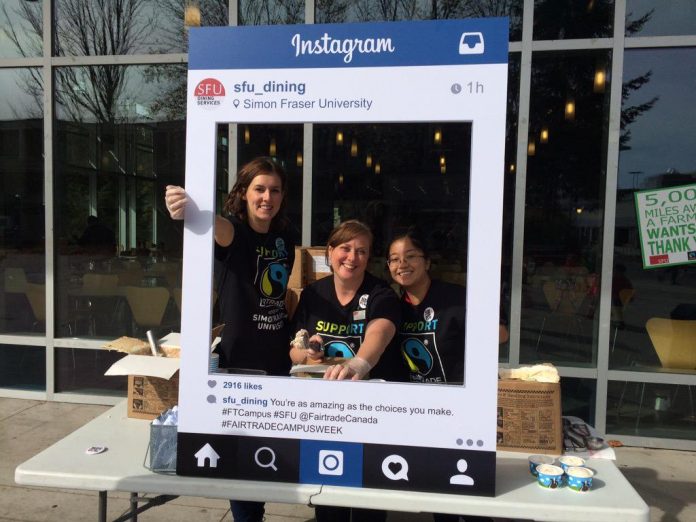
SFU kicks off Fair Trade Campus Week

0

Since 2012, SFU has been a part of the fair trade movement. The SFU Bookstore sells fair trade merchandise across its stores, while SFU Dining Services provides Ethical Bean coffee and other ethically traded products. SFU Burnaby’s Starbucks was also the first to offer fair trade espresso in Canada; SFU received Fair Trade Canada’s Campus of the Year Award in 2014 following this decision.

According to fair trade programs coordinator Torrye Mckenzie, over 18,000 pounds of fair trade coffee has been sold at SFU, and has inspired other universities to follow the fair trade movement.

“The fair trade growth across Canadian campuses is a reflection of the changing student values,” Mark McLaughlin, executive director, Ancillary Services, told SFU News. “More and more, students now expect the products they purchase to drive positive international social change. They aspire to improve the lives of small-scale farmers globally and we are at their side in this engagement.”

According to Fair Trade Canada, fair trade products originate from small farms and plantations. The definition of “fair” trading includes adequate premiums on cost of production, a minimum cost for all products, and fair and protected workers’ rights. Producers of these farms and plantations also own 50 percent of their fair trade markets, which allows them to maintain their standards and rights as workers.

“SFU is one of the 45 campuses across Canada who are celebrating fair trade products and businesses during Fair Trade Campus Week from September 26–30. We can take pride in the fact that we are part of a national movement dedicated to bettering the lives of people in developing countries across the world,” said Mckenzie.

Throughout the week, SFU Dining Services, Renaissance Coffee, and the SFU Bookstore will host various events across campus including discounted coffee and chocolate, trivia contests, coffee sampling, and a banana giveaway.

Students are invited to engage with the event on social media, using the hashtag #FTCampusSFU.

Protesters march against pipeline in Vancouver streets

0

“Can’t drink oil, keep it in the soil!”

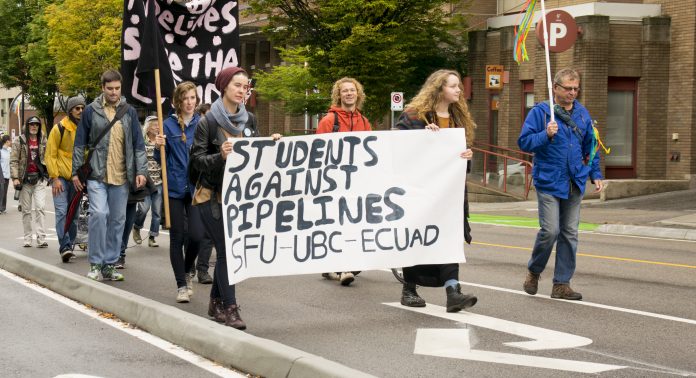
Vancouverites heard this and other chants on the morning of September 19, when about 20 protesters made their way through the downtown core protesting the construction of a Trans Mountain Pipeline in BC.

The proposed project would be an expansion to the existing pipeline and has been a controversial issue for Burnaby residents, SFU students, and local governments for the past five years. The project saw the Edmonton to Burnaby pipeline tripled in capacity, dramatically increasing the number of tankers being loaded in the Burrard Inlet and exporting oil from the tar sands to international markets.

Before the march left its rallying point from BC Place, several activists explained to a crowd of listeners why they were so vocal.

Audrey Siegl, a prominent local activist who has spoken at many anti-pipeline events, explained that although the Trudeau government is conducting more public consultations about the pipeline, the councils don’t reflect popular opinion.

“When this government [. . .] consults with the electeds, they’re consulting with themselves,” said Siegl, referring to the First Nations elected officials. She and other speakers accused the consultations of being used as an excuse to push through the pipeline despite vocal opposition.

At the Vancouver protest, Ariel Martz-Oberlander spoke about how concerned citizens should seize the opportunity to tell the government what they thought about the project. “I think we should celebrate our ‘no’!” she said to cheers, adding that “we’re in the right place and we’re the right people to stop this pipeline.”

The hopeful spirit stems from a pipeline project being blocked earlier this year. Enbridge’s Northern Gateway was rejected by the Federal Court of Appeal after it was found that Ottawa had not sufficiently consulted with indigenous peoples who would be affected by the pipeline. The federal government has chosen not to appeal the court’s decision.

Proponents of the Trans Mountain Expansion Project say that it will result in economic benefits for British Columbia and Alberta, but critics hotly dispute the cited figures. A report from 2014 by SFU’s Centre for Public Policy Research found that the project would only create one-third of the jobs reported by Kinder Morgan.

The Vancouver protest comes hot on the heels of reports indicating that Trudeau is likely to approve the Trans Mountain Expansion. The National Energy Board recommended its approval on May 19 with 157 conditions, and a final decision from the federal government is expected in December.

Sports Briefs

0
Tamara Nipp (#13) was named GNAC Offensive Player of the Week after her 63 assist performance.

Women’s Soccer

SFU won its first Great Northwest Athletic Conference (GNAC) game of the season, beating Central Washington 2–0. Both goals came in the second half, with Emma Pringle scoring just one minute in, and Olivia Aguiar scoring in the 74th minute.

Volleyball

SFU volleyball was named Red Lion/GNAC Team of the Week. The Clan was named Team of the Week after a seven-game winning streak that included beating conference champions and Division II semifinalists Western Washington. Setter Tamara Nipp was also named GNAC Offensive Player of the Week after recording 63 assists in the game against Western Washington.

Cross Country

SFU women’s cross country finished fourth at the Sundodger Invitational at the University of Washington. Senior Rebecca Bassett finished ninth in the field. Their next meet is the Stanford Invitational on October 1.

World Cup of Hockey showcases the youth movement

0
Connor McDavid is the perfect example of how hockey is now played.

I’ll be the first to admit, I was very skeptical of the World Cup of Hockey format when it was first announced. Aside from the whole thing being an obvious cash grab and a way to leverage the International Olympic Committee, the announced teams were odd. Team North America Under 23’s seemed an obvious point to criticize: the fact that a geographical and age group was competing against established hockey nations such as Russia was just laughable.

However, Team North America has won me, and many other hockey fans, over. Even though they’ve been eliminated from contention, they’re showing how hockey should be played in the future.

The style of hockey that they play is remarkable: extremely quick up and down the ice, with no chance for the other team to respond. Ever since the lockout of 2005, the game of hockey has been transitioning from a game of grit and physicality to one of speed and skill. Despite hockey being played in this vein for over a decade, it’s taken this long for a generation of players to grow up playing with these new rules to showcase the new age of hockey.

Players like Connor McDavid exhibit this new style of hockey perfectly. He may already be the fastest skater in the NHL, and he’s only 19. The speed at which he plays the game is incredible, and you can make the case that he’s already the second best hockey player in the world right now.

Johnny Gaudreau is another fine example. Only 5’9” and 157 pounds, he was looked over in his draft year and taken in the fourth round.

Ten to 15 years ago, a small player probably would not have worked out. But with his speed and dynamic play, he can avoid dangerous plays on the ice despite his size. As he so eloquently put it, you can’t hit what you can’t catch. The fact that they beat Finland, the 2014 Olympic Bronze medalists, further cements the point that the youth movement is alive and well in today’s game.

For ages, traditional hockey minds have always preached about experience. The notion goes that you need some veteran presence within a team to achieve anything, and that too many young players need to learn “how to win” in order to succeed. Team North America has destroyed this age-old convention. The fact that a team of players under 23 years of age performed admirably in the group stage should make NHL GMs take notice.

No longer should teams feel the need to sacrifice youth for experience; it’s proven to be nothing but smoke. Even though it’s a meaningless preseason tournament, Team North America is showcasing the future of the sport — one that is focused on youth and skill.

COMIC: Peers

0

Baskerville: A Sherlock Holmes Mystery is full of farce and imagination

0
Alex Zahara (left) who plays the titular Holmes and Mark Weatherley (right) who plays the ever faithful Watson are the only two actors who remain in the role of a singular character for the entire play.

Based on Sir Arthur Conan Doyle’s The Hound of the Baskervilles, this play by Ken Ludwig is full of corny lines and all the idiosyncrasies that we have come to love in both Holmes and his trusty assistant Watson. The script, set, and costumes all impressed, but the fancy technical additions such as moving screens, scrims, projections, and puppetry only served to distract and pull me out of the story.

Despite all the fancy technical wizardry involved, the most impressive thing about the play is that the vast number of characters are played by only five actors.

Sherlock Holmes (Alex Zahara) and Watson (Mark Weatherley) remain in their characters throughout the show. The other three actors (Lauren Bowler, Kirk Smith, and Mike Wasko) play 40 roles, including the Addams family-inspired servants at the Baskerville mansion, an American from Texas with an accent dripping in ignorance, a cunning brother and sister who live on the moor, and a Spanish hotel clerk.

Their frenzied attempt to change back and forth from one character to another mid-dialogue only added to the farcical fun.

What begins a bit slowly as we learn of the infamous hound of the Baskervilles does become more intriguing, but with a tenuous grasp on my full attention, the technical trickery in this show didn’t help. Holmes had moments of the bravado and cool calculation that he is known for, but I thought the performance was a bit unpolished and could have done more to make me relate to him.

As the hound is never during the course of the show, the play requires the audience to exercise a bit of imagination. This works well to build the mystery and legend of the hound, but there were a couple of scenes with an imaginary hound attacking a character that seemed less than realistic. If we had only heard the action or been told about it afterward, the suspense would have been heightened instead of diminished.

Aside from some technical distractions and a slow start to the action, this is an entertaining and farcical fit for any Sherlock Holmes fan. Join the detective and Watson as they uncover the secrets behind the legendary hound of the Baskervilles and meet many colourful characters along the way.


Baskerville: A Sherlock Holmes Mystery is presented by Arts Club and runs from September 25 to October 9th on the Stanley Industrial Alliance Stage. Tickets can be purchased here.

World News Beat

0

EGYPT: Refugee boat carrying hundreds capsizes

A refugee boat carrying 600 people — including Syrians, Egyptians, and Africans — capsized earlier this week on the coast of Kafr el-Sheikh. This capsize led to the deaths of 43 people; 154 were rescued. The boat was allegedly heading to Italy, as an increasing number of people from Libya and Egypt are attempting to flee to Europe. Approximately 206,400 refugees have migrated through the Mediterranean in 2016, with 2,800 deaths occurring due to at-sea risks.

With files from Al Jazeera


NIGERIA: Boko Haram and Nigerian military in Borno

The military army of Nigeria and regional troops engaged in battle on the Nigerian terrorist group Boko Haram to gain possession of Malam Fatori, a town to the northeast of Borno state. The terrorist group has caused destruction throughout Borno. The group had pledged allegiance to ISIL in 2015, and has displaced two million or more within the country over the course of seven years. The Nigerian army’s spokesperson reported that the operation of taking control of Malam Fatori is ongoing.

With files from Al Jazeera

US: Racial tensions call for state of emergency: North Carolina

Adding to the list of police brutality in the US is Keith Lamont Scott. The 43-year-old man was shot dead by a black police officer in Charlotte, North Carolina on September 20. This death has mobilized mass protests, which have resulted in a shooting and injuries. Governor Pat McCrory called for a state of emergency due to violence between the police and the citizens, and requested stabilization with the assistance of the National Guard and Highway Patrol.

With files from Politico


Funding from province boosts DNA technology project

0

An SFU project recently got some new funding from the provincial government.

The Ministry of Technology, Innovation, and Citizens’ Services announced on September 9 that SFU has received nearly $525,000 from the BC Government through the British Columbia Knowledge Development Fund (BCKDF). The funding is meant to help the iReceptor Data Integration System “support early disease detection and action.”

The initiative is led by SFU biology professor Dr. Felix Breden and health sciences professor Dr. Jamie Scott. It allows researchers at different institutions to share “massive sequence databases describing the immune response” and information gained through “fast-paced DNA sequencing technology,” according to the press release.

“[With] this investment in iReceptor, we are enabling significant breakthroughs in precision medicine”

This ability to share data with institutions worldwide will aid researchers in designing vaccines against diseases such as HIV/AIDS. There will also be capabilities to develop new therapies and drugs for diseases like Type 1 Diabetes, and therapies against certain cancers.

With this new funding, the project is expected to be operational within a year.

VP research Dr. Joy Johnson said that receiving this funding will help expand “opportunities for research at SFU.

“[With] this investment in iReceptor, we are enabling significant breakthroughs in precision medicine,” she added in the BC Government’s press release. “This initiative builds on SFU’s big data expertise and computing power to network and collaborate with partner institutions across Canada in ways that haven’t been possible before.”

Minister of Technology, Innovation, and Citizens’ Services Amrik Virk was quoted in the press release emphasizing how this research “clearly positions SFU and BC as national leaders in the life sciences technology sector” through the “talent of highly skilled and creative British Columbians.”

Currently, the BCKDF has granted SFU several million dollars towards SFU-led projects. Earlier this year, the university was granted more than $13.9 million for five projects, including $11.85 million towards the Cyberinfrastructure: Compute Canada initiative according to SFU News.

Among all post-secondary institutions in the province, $55 million has been invested into more than 70 research projects since April 2015 as part of the #BCTECH Strategy.

According to the press release, the strategy “includes a $100 million BC Tech Fund and initiatives to [. . .] drive innovation and productivity throughout the province.”

With this money going towards different SFU-led initiatives in the field of health science and technology, there are many possibilities for national benefits to come out of some SFU-led research initiatives.

Six people who changed SFU forever

0

SFU is the “instant university” that has been educating makers and movers since 1965. Its halls have seen some brilliant minds, but these six people in particular have helped shaped SFU as we know it today.

There’s one question students are consistently asked: “Are you SFU?”

This is a question I have struggled to answer. I don’t know if I am SFU, if I’ll ever be SFU, and if I will ever contribute to this university the way some have. And the truth is, a lot of us won’t. But these six people are all students or faculty who have given themselves to SFU, and who have become SFU in one way or another. They are all people we should turn to for inspiration, for courage, and for motivation. These six people are SFU.

1. Maggie Benston

A chemistry professor in the late ‘60s, and later a faculty member of the computer science department, Maggie Benston’s impact on SFU is one that can’t go unrecognized. She may have never been an SFU student, but her work on campus changed the way people looked at SFU. While she was a scientist by trade, she was also a profoundly influential women’s rights activist. In the mid-‘70s she co-founded the women’s studies department at SFU. She lent her voice to women everywhere by unapologetically pushing for equality. Her ideas about women in the workforce inspired many. An article she wrote in 1969, titled “The Political Economy of Women’s Liberation” was one of the groundbreaking pieces that highlighted the amount of unpaid labour women were doing at home and how that unpaid labour was creating mass economic inequality. Benston was a leader at SFU and an inspiration for women everywhere. Her contributions to the school and to gender equality only bettered our reputation as a radical university that was determined to better the world around us.

2. Mobina Jaffer

The Honourable Mobina Jaffer was born in Uganda to a South Asian family. She studied in the United Kingdom and later came to SFU. What makes Jaffer stand out from others is that she is the first South Asian woman, as well as the first Muslim and African-born person, to be appointed to the Canadian Senate. Jaffer already held a law degree from the University of London when she came to SFU to study executive development, but her ambition was endless. After years of practising law in BC, and a few campaigns for office, she was made a senator by prime minister Jean Chrétien in 2001. She was later appointed to the Special Envoy to the Peace Process in Sudan in 2002, all the while chairing the Canadian Committee on Women, Peace, and Security that same year.

SFU has fought hard to be recognized as a top Canadian university, and these are some of the people we have to thank.

3. Roy Miki

Poet and writer Roy Miki has been an influential voice in the Japanese community. Miki had studied at the University of Manitoba, as well as the University of British Columbia, before coming to SFU. His poetry has largely focused on questions of race and identity, and what these two concepts mean in the context of modern-day Canada. Miki was a faculty member of the SFU English department before his retirement, but his heart was with the activist work he did to empower Japanese-Canadians. Miki reminds us that not all great contributions to SFU need to be flashy. Through his art and thoughtful criticism of race and identity in Canada, he has added to SFU’s reputation of being a university that fosters equality.

4. Elaine Bernard

In the ‘80s, PhD student Elaine Bernard began to make big waves. She was director of the labour program during her studies, which was a challenge she was up for because of her experience as a labour historian for the Telecommunications Workers Union and for the Brewery, Winery, and Distillery Workers Union. She stayed in her role of director until 1989, when she became the executive director of the Harvard Trade Union Program. Bernard has since spent her life advocating for workers’ rights. In many ways, Bernard has embodied the radical ideals that SFU has prided itself on. SFU was once known for its protests and fierce rejection of educational norms, and Bernard was a part of the era of radicalism on campus. In recent years, her contributions to organized labour have included many published works as well as lectures.

5. Terry Fox

Who would have thought that a kinesiology student at SFU from Port Coquitlam would become one of Canada’s national heroes? Diagnosed with cancer at 18 and running his Marathon of Hope at 21, Terry Fox proved that nothing was going to keep him down. His run across Canada, beginning in St. John’s and ending in Thunder Bay, has inspired events around the world that have helped raise money for cancer research. To date, it’s estimated that his determination has led to over $650 million raised for cancer research. While Fox is largely known for his Marathon of Hope, he exemplified perseverance in other parts of his life that made him a student worth recognizing. Fox had always dreamt of being a basketball player, but he wasn’t the tallest and coaches felt he would be a better fit for other sports. But he worked tirelessly to became a great player. He worked his way up the bench and made up for what he lacked in height with hard work. During his time at SFU, he played on the men’s junior varsity team. After he lost part of his leg to cancer, Fox again proved nothing could stop him from doing what he loved and played on a paraplegic team.

6. Margaret Trudeau

Before marrying Pierre Trudeau and becoming first lady of Canada, Margaret Trudeau walked the halls of SFU. She’s been active in politics, but it’s her work in mental health advocacy that deserves the most recognition. Living with bipolar disorder, Margaret Trudeau has worked tirelessly to ensure that we all have a healthy body and mind. Having published books that document her own experiences, her push to end stigma surrounding mental health issues has made her one of SFU’s finest.

COMIC: Mystic Man 18- Stomping on Evil

0