Home Blog Page 710

Vancouver Voted Snowiest City By Local Residents

0
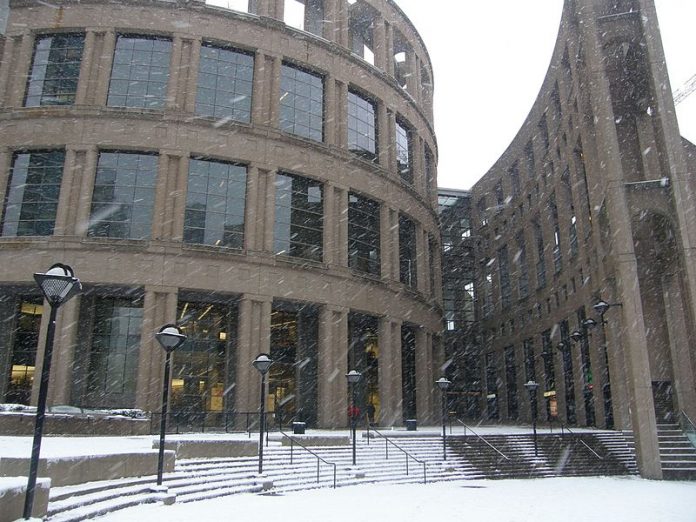
Photo by altoclef

Following the recent snowfalls, Vancouver residents have voted the city as the snowiest city in Canada.

This comes in the wake of a four-month onslaught of snow that has left Vancouverites without warmth or shelter — other than the shelter of their own warm homes — and unable to attend their Moksha yoga classes, throwing their “centre” dangerously out of balance.

“It’s just too cold,” commented one resident. “I had to put on all three of my North Face jackets each time I wanted to go jogging this morning.”

Coffee shops, including Canadian treasure Tim Hortons, have also been impacted by the extended dip in temperatures. Recent studies have shown that purchases of iced coffee beverages in the Vancouver area have risen by 395%, five points higher than the seasonally expected 390%. “All these layers of warmth make me too sweaty,” explained one customer. “I like buying something that cools me down.”

Meanwhile the city continues to enforce their new “Hold the Salt” initiative, asking local restaurants to empty their salt shakers onto the streets to help the city’s lone, overworked snow plow. Residential roads and sidewalks continue to be mostly uncleared.

“This is unsafe! The city should do something about this,” said one resident about his own unshoveled sidewalk, as he stomped on it until it turned to ice.

Additionally, members of local hate groups continue to be rushed to hospitals to undergo treatment for hypothermia and exposure. According to witnesses, the individuals had spent several hours shouting at the sky in unprompted anger at the falling snow. One member was heard repeatedly insisting that he was “stronger than the weak leftist beta cuck snowflakes” shortly before passing out.

Meteorologists say that Jack Frost will continue nipping at our ankles, with forecasts calling for at least 28,000 acres of snow before the end of 2019, primarily focused on areas between where you are and where you need to be, and on the sidewalks of assholes.


The organic revolution: Vancouver’s search for cleaner, healthier skin

2

Beauty is skin deep — and that’s why the organic cosmetic revolution is on the rise. People are more conscious of the chemicals they are letting their skin absorb.

The devil is in the details

Have you ever tried to read a label of face wash from the drugstore? A lot of common, brand-name products are loaded with toxic fillers and chemicals such as synthetic fragrances, parabens, a handful of other concerning compounds of which you can hardly even read the names.

To make matters worse, it’s likely that you will probably never use the poor-quality plastic bottle that it comes in again and it will likely end up piled in the landfill forever. Chemical-filled products are not healthy for us, the environment, or animals. Fortunately, it is becoming increasingly easy to find a plethora of more natural options.

Businesses are beginning to cater to these concerns as international companies such as Lush, bareMinerals, and Tarte Cosmetics quickly grow in popularity in the beauty and body product industry.

Lush takes it one step further, as they sell unpackaged products such as shampoo bars to reduce packaging and therefore lessen harm to the environment. Needless to say, opportunities to help your own body and the environment are arising in the marketplace, and Vancouver is catching on with a collection of local companies catering to the health- and environmentally-conscious consumer.

Be good to your body

Helena, owner of The Soap Artisan, has been selling her natural soaps in Vancouver for over five years now. She explained that skin is like a sponge: “Whatever you put on your skin gets absorbed into your bloodstream through your pores in just a few minutes.” This makes me think twice about the kind of crap I’m slathering on there.

“The soaps I make are actually good for us. The essential oils I use are antimicrobial, antiviral — you know, they’re wonderful!” Helena told The Peak. By using natural products, you not only deter unhealthy repercussions to your body, but you are also putting good and healing properties into your skin.

Natural products free of toxins can actually make a huge difference in the condition of your skin. Helena sees this constantly, “People are telling me that they’re seeing changes in their skin [from using her soap], and it’s makes me super happy. I’ve seen people with eczema, cracked skin, and bad skin, and have watched as their skin healed — it’s a very rewarding feeling.”

Linh Truong, the owner of the Soap Dispensary, Vancouver’s first refill shop that supports low impact and natural living, shared a similar anecdote. “I had a customer who had eczema for about five years. She couldn’t really find products that really worked for her. We recommended this cream and she came back a couple weeks later, she bought more [. . .] we’re just a little retail store, but we’re helping to make people’s lives better; that feels good.”

Why not DIY it?

Purchasing pre-made natural alternatives to your daily bath, body, and beauty products isn’t the only way to find and use such products. Making natural products at home is a growing trend, but it’s made simple in Vancouver. Due to easy access to raw, organic, and natural products, you can mix and match to make your very own custom deodorant, lotion, or whatever else your heart desires.

Truong wholeheartedly supports DIY products — in fact, her store caters to the activity as well. They sell raw products as well as host DIY workshops where attendees can come and learn how to make natural soaps, bath bombs, scrubs, and more.

“Once people see how easy it is to make your own products, it’s kind of a no-brainer,” Truong explains in reference to her workshops. “It’s cost effective, empowering, fun, and as easy as baking.”

“You don’t even really have to attend one of these workshops to make your own products, as there are resources strewn literally all over the Internet — which is perhaps what makes this trend so prominent.”

SFU student, Justine Crawford, embraces making her own products and has crafted a wide variety of natural products, including deodorant, lip balms, lip and body scrubs, face and hair masks, and makeup remover.

“While not necessarily my primary reason for making my own products, I do feel happy knowing that my products will produce a lot less waste than buying multiple containers of other products — as I am able to reuse the jars over and over again,” Crawford explains.

“There are so many things around the house that work amazingly well for a variety of uses — especially coconut oil. I found it kind of nuts in what I’m putting on my skin and hair.” Crawford is all about making effective use of what she already has around the house and reusing her containers, which all contribute not only to her own health but the Earth’s.

The Earth needs some love too

Diverting from the landfill is crucial in this day and age. Natural products and awareness of product packaging are both big parts of reducing waste, and therefore, our ecological footprint.

Products loaded with chemicals and toxins can be very harmful to the Earth and wildlife — it’s definitely something to consider when reading a product’s ingredients list, as it could cause irreversible damage in the natural environment.

The Soap Dispensary is a huge advocate for biodegradable products. Truong tells The Peak, “There are chemicals that you wash out down the sink or shower, and it goes through our water system and gets flushed out into the ocean, streams, or lakes. If it’s not biodegradable, it stays in the water and it can poison marine life or create algae blooms — which eventually will suffocate the living organisms in the water. You may use a product and it disappears from your life and your home, but it’s still creating a negative effect down the stream.”

Remembering that once something is gone from your own life, it does not mean it has been removed from the Earth, is a good principle to follow when thinking about reducing waste.

Helena agrees: “Anything that is toxic for us is also toxic for the environment.” Reducing and reusing the containers used for personal products can contribute to diverting a substantial amount of waste from the landfill. This notion is the whole inspiration behind Truong’s decision to open The Soap Dispensary. Moving to Vancouver in 2009 from Victoria, she was surprised to find that there were limited options for refilling her soap and body products in Vancouver.

“We used to lug our containers back to Victoria when we were visiting friends, or going camping on the island, or something. We weren’t making a special trip just to do that, it was more [that if] you were there, [you] might as well stock up. It just didn’t seem very sustainable to have to wait every time we wanted to go there to refill. So I started thinking Vancouver really needed its own dedicated refill shop. I really needed a place to refill all my containers and [the idea for The Soap Dispensary] kind of came from there. I just had hoped there were like-minded people looking for the same thing that I was.”

Her positive impact on the environment, since opening her store, is actually quite evident. The Soap Dispensary recently reached a diversion milestone. “We did our five-year plastic diversion count back in October. It was a nice proud moment for us that we had counted and diverted over 88,000 containers in the five years that we’ve been open. That meant that all those bottles that we diverted, people brought back to the store to refill. It was a collective effort.” Truong says it best — it’s a collective effort to keep waste at bay, and protect the environment.

Reducing harm on your body and saving the environment does not happen overnight. But with every small buying decision, you are putting your votes toward what you want the world to look like in the future. With a wide range of local options, health and sustainability appear to be on the near horizon.

Inpower: the online forum empowering women across Vancouver

0

You haven’t seen what girls can do — and what they’re most passionate about — until you get 30,000 of them together in one online space.

Dreaming of a more empowered tomorrow

21-year-old Rozan Talevian started this Vancouver-based online space, Inpower, in 2014. It started off innocuously, a small Facebook group centred on Vancouver’s North Shore that encouraged self-identified women and non-binary people to come together and share advice, stories, and questions among themselves. Two years later, the group has the population of a small city — but Talevian isn’t surprised. She saw the need for a communal space for young women like herself, and it was only a matter of time before she would create one herself.  

It’s called ‘Inpower,’ an open forum for anything from memes, to relationship advice, to serious discussions on race, gender, relationships, and mental health. Are you curious enough to search it on Facebook? You won’t find it.

It’s a ‘secret’ group, invite-only, and at any given moment there are at least a thousand girls waiting for their invitation to be approved. Want to be added in? Ask around — one of your friends is surely a member.

The invitation-and-approval process may sound elite, like an after-hours club, but it’s this way simply because of the limited (wo)manpower that runs it.

I am one of five administrators (admins), girls who are on-call 24/7 and have the ability to monitor content, delete harmful posts, remove members, and check each requested profile for catfish-like qualities. I was added a few months after Inpower first began and, as an introverted person, I found that this online community was an easier outlet for me to voice opinions that I had always wanted to talk and learn about.

None of us five admins of this group have ever met in person. Though we’re from the same city, technologies like Facebook have collapsed the physical space that was once needed to debate, implement ideas, and maintain friendships.

Ask and you will receive the help you need

Rachel Carrier, a joint SFU English and communication major, has been a regular contributor for almost a year. She knows that there are bound to be clashes in a group so large and diverse. However, what she finds most gratifying is that there’s always help for those who need it, whether that’s “guys, I’m stranded downtown and have no way of getting home. Is anyone awake and can pick me up” or “I just found out my boyfriend has been cheating on me and I have no idea what to do” or “I’m thinking of going vegan – any advice?”

“I love following up on the crazy stories and seeing the girls encouraging the others to be happy,” Carrier adds. “For me, it’s like having a big sister or cool aunt always to ask for advice.” So how about 30,000 big sisters? This kind of mentorship and community has surely helped many find the support they’re looking for.

Talevian stresses the need for empathy and empowerment in the group. As it gets bigger, she hopes that members will keep the core mission of the group in mind: to connect women through positive relationships. “I’m a firm believer that we become who we surrounded ourselves with,” she explains. “I wanted to create a space where positive relationships could spread like a domino effect.”

Any and all topics are welcome for discussion on Inpower, within the basic rules of thumb: no cyber-bullying or personal attacks. No selling of drugs or alcohol. No nudes. But then there are the trickier, subjective situations that open up questions about inclusivity and free speech.

Mounting pressure to moderate the group

When the admins face popular pressure to kick out members who openly endorse Trump, do they have that ‘right’? When they delete abrasive comments on a post about whether white girls should get dreadlocks (the general consensus: they shouldn’t), are they perceived to be silencing women of colour? How does the language used in relationship posts inadvertently alienate gay, trans, and non-binary members? And, most importantly, at what point does free speech become harmful?

It’s questions like these that Jana Ghimire, full-time admin and SFU visual arts major, often muses on. Ghimire has been a member for three years and an admin for almost a year. Her presence in the group is measured and low-key, and she’s most fascinated by the topics that reveal the stark differences in people’s personal views.

Every hour of the day, issues that young women face in every area of their lives — and don’t always have a comfortable or communal space to discuss IRL — are unabashedly talked about. Wherever it is that you stand on issues like sex positivity versus slut shaming, cultural appropriation versus cultural appreciation, or feminism versus ‘equalism,’ one thing is for certain: when it comes to the issues that matter to them, these young women refuse to stay silent.

They’re vocal, but are they informed? A majority of Inpower’s membership base are young women at high school or post-secondary age, and it’s evident that they have been desperate for a place to ask some very pressing and personal questions. Many of the submissions to Inpower’s anonymous posting system ask about things like birth control options, STI diagnoses, abortions, and sexual abuse help. Ghimire says this content shows a “concerning lack” of sexual education and resources available to young women.

“We try to provide legitimate resources to these questions, but since it’s basically an open forum, misinformation can be shared as well,” she says. “I can’t help but find it worrisome that these young women don’t feel like they have anywhere else to turn.”

In the future, the admins plan to host live streamed question and answer sessions with qualified health professionals to address some of the more common questions.

Inpower is bursting at the seams with potential to become something bigger than a Facebook group. Talevian, an aspiring musician and entrepreneur, has planned charitable events for female artists under the Inpower banner. Her end-goal is to trademark the name and start a non-profit. Talks of creating an app is also in the works, to the end of moving the group onto an external, less restrictive platform. Finally, local hair, makeup, and tattoo artists offer special Inpower giveaways and discounts for members of the group.

A group not immune from problems

Perhaps even more meaningful are the safe spaces for intersectional communities that have followed in Inpower’s wake. Unfortunately, SFU sociology student Mariyah Ali has noticed a disturbing trend for young women to be dismissive or uninformed of the issues that people of other races, cultures, and religions face.

When comments like, “There’s no racism in Canada,” or “Stop being so sensitive,” crop up in the threads, Ali does her best to reach out to the commenters to make them aware of how their attitudes are harmful.

Still, this constant obligation to educate can be emotionally tiring. That’s why, for Ali, a spinoff group called WOCpower (“Women of Colour” Power) has become her go-to group. Smaller and more tight-knit, it’s a place for girls of non-European ethnicities to come together and know that their experiences as minorities will receive empathy. As well, people of other sexualities and genders can find friendship and resources in the LGBTQA+ adaptations of the group.

Aside from other questionable spinoffs like Himpower (an online forum for men’s right activists which was originally created to mock Inpower), there doesn’t yet appear to be a similarly empowering space for young men — but all it takes is one person with a vision to start it. Every day, groups like these crush the idea that online communities are somehow not as legitimate as the ones in the real world.

Of course no online space is truly safe. This is the first thing that an Internet-savvy user will tell you, and probably the first thing you should understand before venturing online. Fake profiles will find their way in, personal posts will be spread outside the group, and not every opinion will be treated with respect. There is lots of work to be done within the 30,000 viewpoints, lifestyles, and cultures that make up Inpower, and the admins can’t do the work alone.

“I feel like if people entered conversations with an interest in better understanding each other, then it would facilitate growth and learning,” notes member Emily Rose McTavish, a joint Gender Studies and Women’s Studies and English major who is critical of the ‘mob mentality’ that can take place in the group.

Moving forward

Talevian agrees with the need for empathy. “When we’re online, we need to remember that these are human beings we’re interacting with,” she says. “We need to be the role models that we want to see.”

For the members of Inpower, an inclusive, respectful, and safe space is an ideal for which to strive. Hopefully, a mission to spread positivity, and a communal effort to enforce this mission, will influence the members’ offline relationships as well. Three short years after Inpower’s inception, there is a foundation in place that can only get better: a community for a girl to spill her guts and know that she can count on sympathy, good vibes, and no-bullshit advice from her peers.

Q&A with SFU alumna and business woman, Leah Emmott

0

If you’re interested in breaking into the business world once you graduate, but feel like it’s an impossible feat, you should meet Leah Emmott.

Emmott, born and raised in Burnaby, graduated SFU in 2008 with a joint bachelor of business and communication, with a specialty in marketing and eco-business. Since her graduation, Emmott has successfully created, managed, and grown a company whose product is now stocked in over 400 stores globally.

Inner Fire is a clothing line that creates handmade yoga apparel for Vancouverites. The company has prided itself on mixing morals with business by creating an environmentally-conscious brand. Inner Fire has gone one step further and “made the decision to donate a portion of our profits to The School Fund, an organization that helps facilitate micro-financed educational scholarships for youth in developing countries.”

The Peak recently interviewed Emmott to talk about her inspiration for Inner Fire, and how she broke into the crazy world of business.

Peak: When did you first get the idea for your company, Inner Fire?

Leah Emmott: Back in 2011, I was working as a yoga teacher when I suddenly had to be rushed to the hospital for the removal of a giant ovarian cyst [. . .], which left me in recovery for six weeks. I had a lot of friends who were yoga teachers so I decided to make some gifts for them while I was off during the holiday season. The first items I made were yoga props and meditation cushions.

P: What led you to start selling your product?

LE: I had some people from my yoga studio ask if I could sell them some there. I just followed the demand and started to make and sell yoga props, bit by bit. A couple years in, I had the idea to expand my product offering with a line of eco-friendly leggings, which took me a few months to develop.

This was a huge turning point in the business because I finally was able to bring my passion for design and sustainability together. I started designing prints for the leggings, which were inspired by my love of nature and different cultures. The leggings were becoming really popular so I just kept on releasing new prints (in addition to new shirt designs) each season.

P: Why did you choose the name “Inner Fire”?

LE: I decided to call it Inner Fire because the area of my belly where I had the cyst was the same area where the third chakra resides. It is an area with fiery qualities that is responsible for passion, creativity, and drive.

P: How did Inner Fire transform from being an idea to being a successful business?

LE: A lot of people ask me how I managed to get to the one million[-dollar] revenue mark so quickly (within three years). At the very beginning, I was making everything myself and selling it locally, so there was a low barrier to entry and minimal initial financial investment. I started to burn out because I was still working full time and soon reached a crossroads where I had to make the decision to go full time or not. I decided to go all in.

I rented out a shared workspace and gave my company the full-time hours it deserved. Soon after, I hired my first staff person to help me with the screen printing. In that first year, I probably signed up for every local market or craft show I could get into. I hustled hard. There were some shows where I made $20, but it never deterred me from pressing on. At the core of it all, I really enjoyed what I was doing. I believed in my company’s values of local, ethical, and sustainable business. It’s that authenticity that attracted the right people to help me along the way.

P: How did you attract buyers?

LE: I splurged on things like photography and web design. Those were the things that allowed my company to look bigger than it actually was, which started to attract buyers. Then I started to grow the wholesale side of the business, which really helped increase my brand’s exposure and reach.

P: Why Vancouver?

LE: I love that Vancouver has managed to maintain a flourishing manufacturing industry that makes it possible to produce high-quality products locally.

P: What is the toughest obstacle you have had to overcome in the business world?

LE: You would think the answer would be something like ‘financing,’ but the toughest obstacle was actually my own self-doubt. I went into an industry I had very little experience in. I would often compare myself to competitors, thinking that I didn’t have the experience/contacts/profile necessary to make it. I realized pretty quickly that I just had to fake it ’til I made it, and embrace the feeling of discomfort. Business is really about being OK with not knowing what the heck you’re doing, and still doing it anyway (and trying again if you fail).

P: Since the creation of Inner Fire, what is the most valuable thing you have learned about the business industry?

LE: Community matters. I’m not talking about networking, I’m talking about real community. How do we build community? By giving something of value and nurturing real relationships. I remember when I was in business school, people would tell me all the time ‘make sure you go to those networking events’ and I just wanted to smack them in the face. Standing around with cocktail glasses and exchanging business cards never felt authentic to me.

Looking back on my career with Inner Fire, I realize that pretty much all of my key contacts were introduced to me through friends and people in my yoga community. There’s a mutual reciprocation that happens when you work that way. You start to see yourself as an opportunity-maker, too. When you create opportunities for others, and work in a collaborative way, everyone wins.

P: Where do you see yourself, and your product, in five years?

LE: I hope to expand my product line and become a global brand with a reputation for eco-initiatives. Maybe the Patagonia of the yoga world?

P: If you could give any advice to SFU students hoping to work in the business industry, what would it be?

LE: It’s tough for this generation because we have zero job security and we’re living in a time when everything is changing so quickly (I mean, is anyone still playing Pokémon Go?). I suggest making adaptability your super power. I can’t tell you how many MBAs I’ve turned down in job interviews in favour of someone with less experience, but who has proven they can keep up with the changes of an ever-evolving industry.

An interview with Navneet Nanan, the SFU student proving pageants are far from surface-level

0

As a finalist in the Miss Canada 2017 pageant, less than two weeks away, Navneet Nanan is in the height of preparations.

In the midst of reading break, while other students might be lounging with friends or taking some extra time to complete their homework, Nanan was bouncing from meeting to meeting and tracking the gowns being shipped to her address in UniverCity. The Peak got to speak with her about how she entered pageantry, what she’s looking forward to for Miss Canada, and her hopes for the future.

Reflections in the mirror and self-reflection

Nanan had always had an interest in pageants. “I found the women [I saw in pageants] to be super inspirational, confident, and poised.” However, she never saw herself as someone “who could be that, be there, [and] fill those shoes.”

It wasn’t until her senior year of high school that Nanan finally got the courage to participate in the Miss BC pageant. Not only did the pageant give her the confidence to compete in future events, but she found that the connections she made with girls all over BC, as well as the series of workshops offered during the pageant, were “crucial to [her] development in [the] industry.”

Her interactions with the other pageant girls created a natural, comfortable, and organic atmosphere where she felt at ease. “I still keep in contact with the girls I met in that pageant,” Nanan said.

In addition to her involvement in pageantry, Nanan volunteers widely in the community for organizations such as the BC Cancer Society, Terry Fox Foundation, and Heart and Stroke Foundation. Particularly, she has sustained a focus on girls’ and women’s empowerment — including returning to her old high school to give talks to the young women about self-esteem, body image, and insecurity. On a more global scale, Nanan represented Canada at the European Youth Parliament forum to speak on the extreme circumstances faced by female Syrian refugees.

Her personal experiences struggling with self-esteem and body image issues, combined with her passion for girls’ empowerment in the community and the open and accepting pageant atmosphere, led Nanan to envision a platform based on women’s empowerment as she moves forward into Miss Canada 2017. “I’m pursuing this platform because growing up, there wasn’t a really good female role model for me,” Nanan said.

She spoke about how pageantry helped her work through her insecurities as a woman, and how she now hopes her time on the stage can also be used to help other girls younger than her deal with similar issues.

The depth under the surface

One thing Nanan was careful to stress during the interview was that, unlike popular media depictions, pageantry for her was more than surface-deep. “[Miss Canada 2017] is not just looking for a pretty girl — they want someone well-spoken, who’s involved in the community, and is a well-rounded person,” she emphasized.

She talked about how pageants are hypersexualised and often onlookers who don’t know much about pageants may not understand the depth of the competition.

As Nanan herself gets ready for the Miss Canada pageant, which will run for a week in early March, she is preparing for an evening gown portion, private interviews with the judges, on-stage questions, and maintaining her overall composure through the week. With her coach, she mainly focuses on sample interview questions and reaching out to local community businesses for sponsorship.

Pageantry has given Nanan more than just the confidence to overcome her adolescent insecurities, it has given her a voice to speak about what she cares about. “There are amazing role models, a lot of amazing women to surround myself with. And I am very self-aware, so much more confident in who I am and my abilities.”

More than anything, she’s looking forward to speaking on the stage about her experiences with women’s empowerment, and making connections with the other ambitious and inspiring contestants she is looking forward to meeting.

The future looks bright

In the midst of her exhilarating and time-consuming pageant passion, Nanan is a full-time student, and is currently completing her second year at Beedie School of Business.

She is keeping her options open for her future path — while she’s undecided as to what her concentration in the program may be, she knows that she doesn’t see herself doing an office job. She describes herself as a people person, and looks forward to working in an environment more dominated by passion than cubicles.

To explore where she might see herself and what she might be doing in the future, Nanan hopes to go on a couple of co-ops and international exchanges. Ultimately, she would love to combine her interest in community involvement and women’s empowerment with her business degree to find “work [she’s] passionate about, that [she won’t] even call work.”

SFSS reopens possibility of creating a stadium after all

1
The original blueprints for the stadium portion of Build SFU, before it was scrapped back in August.

SFU football may not have had a win on the field this season, but their field might be getting its own win.

After the Simon Fraser Student Society (SFSS) abruptly cancelled the stadium project as part of Build SFU last August, the announcement that the project would be reviewed came out this week.

This comes after the decision to cancel the project was met with severe backlash, and came in the midst of a series of controversies for the SFSS. Now, as this board winds down the last two months of their elected term, they are seemingly making good on the claims from SFU Athletics that “SFU students deserve better.”

Since that time in August, the Board of Directors appointed a team of three to review the stadium project, find out what went wrong, and think of how the project could be salvaged. Their research revealed some flaws and recommended some changes, including the following as stated in the press release:

  • The SFSS would no longer take out a loan, but would make a contribution of $10 million over 15 years. This eliminates approximately $4 million in interest costs that the SFSS would have otherwise been required to pay to a bank.
  • SFSS would only contribute $10 million. SFU would cover any additional costs.
  • The minimum scope of the project would be 1,800 seats, a full roof, and a press box.
  • The University would be responsible for building the stadium within 3 years (by April, 2020).
  • SFU would provide the SFSS with $50,000 annually for 15 years to be used to assist undergraduate students (SFSS members) experiencing financial need.

The decision will come down to the upcoming SFSS Board of Directors meeting on March 13 at 9:30 a.m. The meeting will take place in MBC 2290 for interested parties.

SFU women’s basketball gear up for national tournament

0

For the first time since 2014, SFU women’s basketball is off to the NCAA national tournament. They’ve been installed as the fifth seed in the west region bracket, and will play UC San Diego in the opening game.


It won’t be an easy matchup, but from here on out, all games will be trying and challenging. The Tritons finished with the best regular season conference record in the California Collegiate Athletic Association (CCAA), going 23–6, but lost the conference championship in the title game.


“They’re a team that likes to run,” said head coach Bruce Langford on the Tritons. “They’re a team that runs a Princeton offence, which is very motion and movement oriented. Lots of quick action, lots of quick reads, [and] they run it very efficiently. They shoot the three more than anyone else in their league, and they attack the hoop well.”


In the team’s last game, the Clan suffered a disappointing loss to Central Washington in the quarterfinals of the GNAC championships. SFU shot only 27% from the field, and ended up losing by a single point after Kortney Grattic made two last second free throws.


“We had held them to 28 points in 28 minutes with outstanding defence, [and] played them really, really well,” said Langford on the game against Central. “I thought we had a couple of mistakes that cost us momentum, and a couple that basically cost us the game.


“Obviously the end-of-game situation wasn’t good. We had a couple of careless turnovers where we were up 10, and we let that momentum leave. But in the big picture, we didn’t have to play another game, which gives us rest.”


There was some talk afterwards that because of the shocking loss, SFU’s position in the national tournament could be in jeopardy — I’ll admit I was a part of that camp. However, with the benefit of hindsight, that might have been a bit of an overreaction.


Although SFU had seven losses all year — the second-most out of any team selected from the west region — five of those losses came against teams ranked above them in the west region. Four of them came against GNAC rivals Alaska Anchorage and Western Washington, the other against California Baptist. Those teams are ranked first, third, and second in the region respectively. Anchorage and Baptist are second and third in the national rankings. Western Washington is 16th.


These losses against highly ranked teams and the relative strength of their schedule likely helped SFU get the fifth seed, despite not having the most eye-popping record relative to other teams in the west region. Out of region wins against Augustana University and Colorado Mesa, two teams that had similar records to SFU and are probably a bit ticked off they didn’t make the tournament, are examples of this.


But in any case, they’re in, and there are some question marks surrounding this team. The first is the absence of Meg Wilson. Injured during the Central Washington game, she had surgery recently and is out for 12 weeks — ending her season prematurely and leaving a huge hole in the Clan’s starting lineup.


“We just have to make some adjustments and accept the fact that we lose 14 points a game and several rebounds a game,” said Langford on the absence of Wilson. “There’s opportunity for people to step up and show what they can do.”


It can’t be understated how big of a loss this is. She was a truly versatile player, able to play the perimeter and inside, all while being a great defensive presence.


Sophie Swant is expected to slot into the starting lineup, and both her and Tia Tsang should be expected to play significant minutes going forward.


The second is Ellen Kett and the team’s reliance on their star point guard. In the team’s previous game, Kett almost willed the team to victory single handedly. She scored 22 of the team’s 57 points that game — just under 40% of the team’s total points. She was also only one of two Clan players to shoot over 40% from the field, all while playing her customary 30-plus minutes. If the Tritons are able to limit her effectiveness, the Clan could be going home early.


Finally, the structure of the tournament will once again be a huge hurdle to climb. If they are able to defeat UC San Diego, they will like be facing Alaska Anchorage at their home venue. Over the past three seasons, they’ve only lost four games at home — but one of which was against SFU, just last season in the final conference game.


“They’ll have a big crowd, it will be an exciting venue,” said Langford on the prospect of facing Anchorage. “But the reality is we need a bunch of pieces to fall together the right way. It’s a huge challenge. They’re the number two team in the country. But is it impossible? No, it’s not impossible.”


After that, they could be facing Western Washington or Cal Baptist — if they are able to get that far.


One silver lining the Clan can take into the tournament is that in their past four losses, they’ve had the lead starting the fourth quarter. If they can remove the mental lapses and hit a few more of the shots they weren’t able to in upcoming games, they should stand a chance.


The Clan plays UC San Diego this Friday at 6:00 p.m. Follow our Twitter account @PeakSFUSports for live coverage.

SFU swimming looking to impress at NCAA Nationals

0


Thirteen swimmers in total will make up Canada’s NCAA team, which will travel to Birmingham, Alabama for the meet, which begins on Wednesday.


The team will look to build on the highly successful showing at last year’s event, which saw eight all-American finishes en route to a tenth-place finish overall.


Amongst those finishing with all-American honours in 2016 was Adrian VanderHelm, with the Clan swimmer aiming even higher this time around.


“I’d like to win a national title in at least one of my races,” said VanderHelm.


“I’m looking at racing the 200 individual medley [IM] and 400 IM, and I think I’ve got a fairly good shot at those. I haven’t raced a 400 IM at nationals before, but coach and I decided it’d be a good shot for me this year.”


VanderHelm also has his eye on repeating his all-American finish from 12 months ago.


“I feel like there’s a little bit of pressure on me, almost. I’d be disappointed if I wasn’t all-American again. It’s not really swimming for me, though, it’s swimming for the whole team.”


Lauren Swistak was the sole female all-American from 2016, and the senior from Port Moody is also looking to repeat her success.


“My goal is to improve on last year, as well as to keep having fun,” said Swistak. “Everyone’s doing really well, and the team’s looking strong.”


Head coach Liam Donnelly hailed his team’s progression ahead of the trip to Birmingham, highlighting the advances made during SFU’s short time in the NCAA to date.


“We’ve only been in the NCAA since 2013, and the first year we went to nationals we had no men on the team,” said Donnelly.


“The NCAA gets better every year. The standards move up and get faster each year, so for us to even maintain our performance levels we have to show improvement. For us to exceed our performance levels year after year shows we’re moving at a faster pace.”


With four returning all-American athletes amongst the 13 making the journey south, hopes are high that SFU can at least match last year’s performance. Donnelly, however, is keeping calm.


“For me [a successful championship], it’s when we have consistent optimal performances. You can’t go into a major meet and expect everything to roll your way and be perfect. If it does turn out to be the fairy tale event for us, then that’s fantastic. We know there’s going to be a range of performances, though, because there’ll be other factors and things you can’t control.


“We want to manage those factors and be in the optimal range of performance. For example, if we move up or hold our ranking, that’s a sign of success. If we have lifetime best times, that’s a sign of success. If we’re breaking school records, fantastic.”


The competition gets underway at the University of Alabama with the opening ceremony on Tuesday, and the meet beginning the following day.

Riverdale is a refreshingly self-aware show with potential

0
(Photo courtesy of Warner Bros.)

Riverdale, the newest teen drama offering by American network The CW, and perhaps more familiar to us north of the border under the banner of Netflix, is a gritty and modern adaptation of characters from the beloved Archie Comics, and I named after the idyllic town in which the characters live. Despite a few failings, Riverdale is a surprisingly compelling show with a lot of potential.

     Right up front, the show’s roots from CW are very obvious. That is to say, all of the characters are very pretty. Like, weirdly pretty. And that might be a bit surprising for those who are expecting the goofy 1940’s comic book design that many are familiar with.

     The rather clichéd dark-and-edgy tone might also be jarring for those expecting classic Archie. Betty (Lili Reinhart) is straining under the pressure of good grades and a controlling mother, Veronica (Camila Mendes) is reeling after her father is incarcerated for fraud and embezzlement, Jughead (Cole Sprouse) is a sad and brooding wannabe novelist, and Archie (KJ Apa) himself is torn between playing for the football team and pursuing his passion for acoustic guitar. Plus, there’s a mysteriously murdered classmate they all get wrapped up in investigating because, of course, the adults are useless. However, it is in this meeting between the gritty and the idyllic that Riverdale is most successful.

     The show excels when it is being aware of the clichés it uses. One episode called out the gay best friend character for being the gay best friend character. Another mocked the local mean, popular girl for being a “stock character from a 90’s teen movie.” Most notably, a surprising chunk of the first episode features multiple characters separately, yet repeatedly, being surprised at how hot Archie got over the summer. The show follows through with this by having Archie shirtless at least once in each of the first few episodes.

     In combination with the more realistic tone, this awareness and reshaping of expected character traits add a level of depth to what might have otherwise been seen as shallow, one-note characters.

     At one point, while investigating the murder that begins the series, Betty says to Jughead that “nothing this bad was ever supposed to happen here, but it did,” and that is the very argument the show is making. The town is supposed to be a perfectly peppy little community, but the murder is the thread which unravels that idea both in the citizens of Riverdale and in the eyes of the viewer.

     Though it has already been renewed for a second season, being a show with a central mystery means that everything is dependent on a successful finish. If the final episode of this first season does not reward its viewers with a satisfying conclusion, it will retroactively make the previous episodes pointless and irrelevant. However, if the season finale is able to match the potential of what has been laid out so far, then Riverdale will be a fantastic show.

New episodes are released Fridays on Netflix.

SFU clinch first place in BCIHL with victory over Trinity Western

0

It all came down to the final game for first place in the BCIHL. SFU just needed a point in any scenario to clinch first — for Trinity Western, only a regulation win would do.


With two goals from Daniell Lange, and strong play from Adam Callegari and Brendan Lamont, the Clan was able to come away with first place in the BCIHL — and with it, home ice advantage throughout the upcoming playoffs.


“I thought we bounced back and played a good game,” said head coach Mark Coletta after the game. “We rolled four lines and six [defencemen]; everyone was intense.”


With so much to play for, the game certainly had an intense, playoff vibe throughout. The first real chance went to Trinity Western. The league’s leading scorer, Evan Last, was awarded a penalty shot, but his backhand shot went wide of the net. Just a couple of minutes later, Daniell Lange tipped home a low Nick Coltura shot to eventually give SFU a 1–0 lead at the end of the first.


The second didn’t feature any scoring from either team, but had a number of great saves from Spartans goaltender Silas Matthys. Many of them were of the spectacular variety, and he certainly kept his team in it heading into the third.


At the beginning of the third was, perhaps, the turning point of the game. Evan Last was once again one-on-one with SFU goalie Jordan Liem — this time from open play. He appeared to have Liem beat, but his shot went over the net. About a minute later, Darnel St. Pierre buried a puck from the high slot to score his second of the the season.


What could have been a 1–1 game was suddenly 2–0. And with Trinity Western having to win in regulation, it was more of a three-goal hole than two. Daniell Lange scored his second of the game before Stefan Gonzales scored on the powerplay to make it a 3–1 final.


The Clan was undoubtedly boosted by the return of two of their top scorers in Adam Callegari and Brendan Lamont. Scratches in the game before due to an internal matter, which SFU lost 3–1, Callegari and Lamont were able to generate scoring chances nearly every time they were on the ice.


“They possess the puck well, they can beat you down the ice, they can get you wide, and they can beat you with the skill game,” said Coletta on what makes them such dangerous offensive weapons. “They’re just really good. They’re not the biggest guys, but Callegari brings that element of puck protection, Lamont brings grit and speed.”


The game also was the team’s annual seniors night. Two outgoing players were honoured before the game; Jesse Mysiorek and Mike Sandor.


“It’s a little bittersweet,” said Sandor afterwards, on his last regular season game at Bill Copeland. “Four years goes by a lot quicker than you think it would. We still have playoffs, so it hasn’t really sunk in yet, but it’s really nice to get the win and finish off like that.”


Next Game: With the regular season completed, SFU will now turn its attention to the post-season. They’ll be playing the University of Victoria in the first round, a team SFU was 5–0–1 against in the regular season.


“I think the key is just to play our game,” said Sandor on what needs to be done to advance against UVic. “We went into UVic two weeks ago and we didn’t bend or break. They came out pretty strong and they have a few good players that can hurt you.


“But our strength is our depth. If we just stick to our game, and we don’t power down and let them take anything from us, I think we’ve got it.”


Game one will be in Victoria this Friday at 7 p.m. Game two will be at Bill Copeland Saturday at 7 p.m., with game three, if necessary, Sunday at 7 p.m.