Home Blog Page 339

Fantasy foods to bring you into another world

0
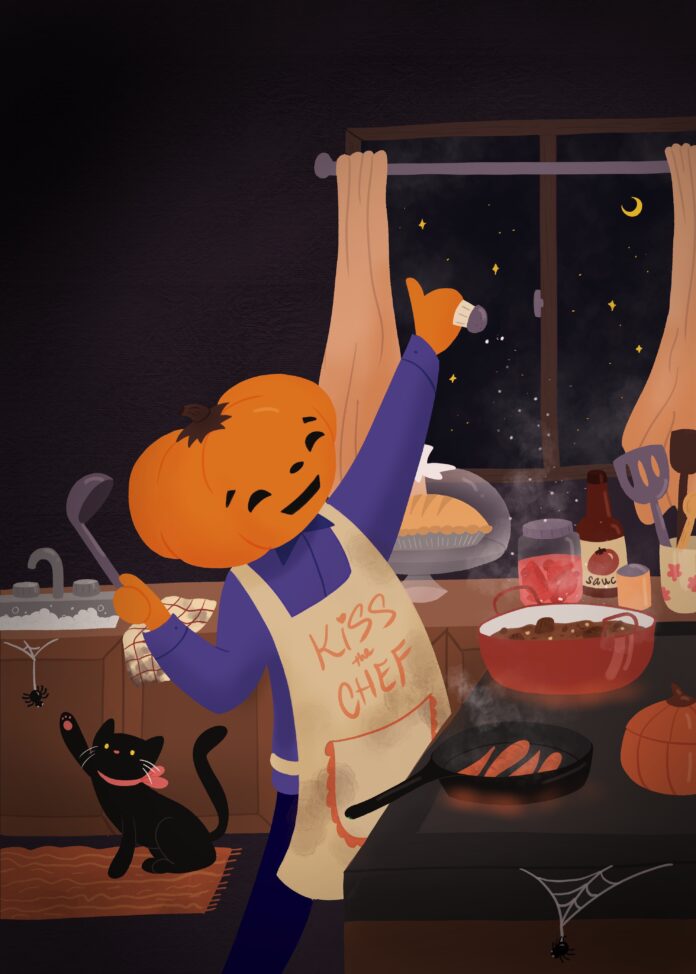
The scene is in a kitchen but it is spooky in a cute way. The background is purple and outside the window is a night sky. In the back left corner is a black cat swatting at a spider hanging off of a kitchen cabinet. In the centre of the picture is a person with a pumpkin head cooking something in the kitchen. They are reminiscent of that one dancing pumpkin gif that circulated a lot back in 2012 on Tumblr. The pumpkin is carved with a happy expression and they are wearing an apron that says “kiss the chef.”
Live your adventuring dreams with these five fantasy recipes. PHOTO: Maple Sukontasukkul / The Peak

I frequently fantasize about the types of foods my Dungeons and Dragons character eats: soups, loaves, and chunky legs of meat and vegetables laid out like a magnificent feast. And during the Halloween season, what better time to dress up as your favourite fantasy character and eat what they would eat? So here are five recipes to help you truly embrace the life of whoever (or whatever) fantastical creature you dress up as. 


Lembas bread for a day out in the woods

My current character is a young elf who loves snacking on buns with her brother. Also known as the elven bread in Lord of the Rings, this is the type of food I imagine she would bring with her. Supposedly eating lembas bread will sustain you for twelve days. While I’m not sure it will last you that long, this bread is an easy treat sure to satisfy your sweet tooth! 


Ingredients:

  • 1 cup butter
  • ½ cup brown sugar
  • 2 cups unbleached flour
  1. Preheat your oven to 325 degrees.
  2. Cream the butter and sugar together. Then, add flour and mix. Add some flour to a surface and begin kneading the dough for about five minutes.
  3. Roll the dough to ¼ inch thickness and cut into 3–4 inch squares. Score the squares with a knife diagonally. Place on a buttered baking sheet and bake for 20–25 minutes.

This recipe uses only three baking essentials you’ll easily find in your house: butter, brown sugar, and unbleached flour. It makes six servings, and you can wrap them up in banana leaves to really make them feel like the ones in Lord of the Rings.

I’d optionally pair this bread with jam or honey to sweeten the deal! 


Cream of mushroom soup to soothe the soul

A classic soup, Taste of Homes’ recipe for cream of mushroom tends to be rich and is perfect for a cozy night in. It’s essential to have some sort of soup or stew with your fantasy meal, because it’s easy to make in a large batch and it’s really filling. Soup is the perfect thing to perk up the soul of whatever weary adventurer you’re dressing as this Halloween.


Ingredients:

  • 2 tablespoons of butter
  • ½ pound sliced mushrooms
  • ¼ cup chopped onions
  • 6 tablespoons all-purpose flour
  • ½ teaspoon salt
  • ⅛ teaspoon pepper
  • 2 cans of chicken broth
  • 1 cup half-and-half cream
  • ½ cup of white wine 
  • Garlic powder (to taste)
  • Thyme (to taste)
  1. In a large pot, set to medium-high heat and saute mushrooms and onions. 
  2. Add half a cup of white wine to the mushroom and onion mixture. Stir in flour, salt, pepper, and 1 can of broth into the mixture. Bring to a boil.
  3. Cook and stir for two minutes, or until the mixture has thickened.
  4. Reduce heat, add cream.
  5. Simmer for about 15 minutes, stirring occasionally.

The acidity of the white wine really helps the soup pop. This recipe makes six servings.

Bonus: to go an extra step and have that rustic feel, serve the soup in bread bowls. Here’s a recipe for making your own. 


Gotcha Pork Roast from Food Wars

This dish is a genuine stunner: it looks like roast pork, but is actually just mashed potatoes wrapped in bacon. Based on the hilarious anime, Food Wars, where every episode brings new and explosive, crowd-pleasing recipes, your friends will adore this huge dish. After all, every feast needs something to look at, and this is one beautiful dish! 


Ingredients:

  • 6 white potatoes
  • 3 eringi mushrooms
  • 1 large white onion
  • 1 sprig of rosemary
  • 2 tablespoons of butter 
  • 2 packs of thick-cut bacon
  • 250 ml of red wine
  • ¼ cup of sweet sake
  • 2 tablespoons of soy sauce
  • 1 sprig of parsley
  • Salt (to taste)
  1. Set the oven to 375 degrees.
  2. Peel and slice the potatoes into quarter slices.
  3. Chop mushrooms and onions into small cubes.
  4. Steam the potatoes over medium heat for about 15–20 minutes.
  5. In a separate pot, add a tablespoon of butter. Set to medium heat, and pan fry onions and mushrooms until caramelized.
  6. Mash potatoes in a large bowl, and add onion and mushrooms until evenly mixed. Add some salt.
  7. Pick off rosemary and set aside.
  8. After five minutes or when the mixture is cool to the touch, begin forming the mashed potatoes into a log shape. 
  9. Set all the slices of bacon on a baking sheet. Then, taking the log-shaped potato mixture, place it in the centre of the slices of bacon. 
  10. Begin wrapping bacon around the potato mixture, making sure to cover as much of the surface as possible.
  11. Tie twine around the roast a few times. Add rosemary underneath the twine.
  12. Put the roast into the oven for 30–45 minutes. Turn the roast halfway through.
  13. Meanwhile, add the wine to the pot. Bring it to a boil. 
  14. Add butter and soy sauce, cook for 2–3 minutes. This will be your sauce.
  15. Remove the roast from the pot, removing the rosemary and twine. 
  16. Pour the sauce over the roast, add garnish, and serve.

My friends and I decided to make this dish on a whim after watching the first episode of Food Wars where this is featured. This is so good on a cold spooky Halloween night. This makes 6–8 servings. 


Quincy’s Caps ‘n Maggots (Chicken, mushroom, and rice pot)

This recipe comes from TikTok user Quincy who makes all sorts of recipes in their online tavern, Quincy’s! I’m sharing this recipe partially because their videos are so comforting, and capture the warmth you’re meant to feel in a tavern. This recipe is no exception. 

Based on a pirate’s feast from the game, Sea of Thieves, this protein-heavy dish is especially perfect if your friend group dresses up as a roving group of pirates (or hungry university students). The best part? This can all be made in one pot!


Ingredients:

  • 2 chicken breasts
  • ½ of a yellow onion
  • 6–8 small mushrooms
  • Salt (to taste)
  • Pepper (to taste)
  • 1 tablespoon of olive oil
  • 1 can of cream of chicken soup
  • 4 cups of chicken broth
  • 2 cups of rice
  1. Dice up onion and mushrooms.
  2. Dice up chicken breasts into cubes.
  3. Set heat to medium-high. Put oil in the pan, then saute chicken for about five minutes, or until thoroughly cooked.
  4. Remove the chicken, then pour onion and mushrooms into the pot. Saute for about two minutes, or until fragrant.
  5. Add cream of chicken, chicken broth, and rice. Cover and cook for 15–20 minutes, and stir occasionally.

This hearty recipe is quite creamy, with easy-to-obtain pantry ingredients! It makes four servings.


Mulled Cider to be merry

Finally, your drink of choice! There’s nothing quite like cider for a tavern table and it’s definitely less time consuming than making your own mead. The cinnamon and apple scents will really evoke autumnal coziness, and your kitchen will smell delicious for the Halloween party you’re throwing. 


Ingredients:

  • ½ gallon apple cider (non-alcoholic)
  • 1 orange
  • 12 whole cloves
  • 4 cinnamon sticks
  • 15 allspice berries
  • 2 tablespoons of unpacked brown sugar
  • 3 ½  tablespoons of cumin*
  • 3 ½ tablespoons of coriander*
  1. Set heat to medium-high. Pour apple cider into a pot, cover, and heat. 
  2. Slice orange into thin slices, and add to the pot. Then, add the rest of the ingredients into the pot.
  3. Reduce the heat to low, and simmer the mixture, covered, for about 20 minutes.
  4. Strain the mixture with a sieve into cups.

*The recipe recommends you use 7 pods of coriander pods, but in case you can’t find that in your supermarket, I’ve included this alternative, which should still give some earthy warmth to the drink!

If you’d like, you can add a bit of rum or bourbon to your drink to add some spice, but this drink will warm you up just fine without. The citrus and spices will definitely go down well with all the other foods on this list. This recipe makes eight servings.


 

Satanism and occult practices aren’t actually scary

0
A candle, tarot book, and black and purple stone jewelry laid on a table
I’ve learned different philosophies and met a supportive community of people. PHOTO: Dan Farrell / Unsplash

Every October I’m reminded when most people hear words like “Satanism,” “witchcraft,” and “the occult,” they imagine something dangerous, unethical, or don’t think people actually practice these things outside of movies. 

Popular horror movies like The Blair Witch Project and The Craft depict witches wrapped up in plots to kill. The Halloween franchise shows murderer Michael Myers as cursed by a druid cult, and suggests his violence comes from Pagan practices. However, the varying practices are not inherently dangerous or harmful. Just like any belief, Satanism has the potential to be a positive and deeply important part of someone’s life.

Normally when someone asks me about my religious beliefs, they aren’t expecting to hear I’m a Satanist or I practice witchcraft. I’m used to having to explain I don’t spend my free time drawing giant pentagrams on my floor and making animal sacrifices. Mostly, I just write for The Peak, read old books, and drink a lot of tea. 

Some common practices are atheistic (like secular witchcraft) while others can involve deities (like Luciferianism and Paganism). There are as many beliefs as there are believers, and practices vary from person to person, just like in any religion. Some people’s practices may also tie more specifically to family ancestry, like celebrating Celtic holidays or incorporating Norse Pagan traditions.

As a whole, Satanism and other occult practices do not promote violence. Further, none of these practices are actively used to recruit and convert people either. Instead, members tend to keep to themselves without a goal of bringing harm to or converting those outside their religion.

Personally, I was introduced to Satanism about seven years ago. After drifting between Satanic groups and, more recently, joining the Coven of Satan, I’ve found new ways to approach the world with kindness and thoughtfulness while prioritizing my own wellbeing. The Coven of Satan’s Ethos, the principles the Coven live by, advocates for things like “reason, science, and compassion in all things.” It reminds people that “a person is the final authority over themselves,” which led me to believe in fighting for personal autonomy and actively seeking knowledge about others’ lived experiences. 

Other principles from The Ethos, like recognizing your actions have consequences, taking responsibility for them and leaving “the world a better place than you found it” guide me in consistently working to be a better person. These ideas — in conjunction with the many lessons I’ve learned as a Satanic witch — influence my will to continue growing and making my life worth living. At no point have I, or anyone I’ve met, attempted to actively convert or harm anyone, despite what popular media may show.

I love a good horror movie and a fun costume as much as the next person celebrating Halloween or Samhain, but I wish the holiday celebrations would acknowledge that witchcraft, Satanism, and other related practices are real, aren’t malicious, and are happening around us. More importantly, I hope people can acknowledge their existence as just another religious or spiritual practice without fearing or judging it.

All your STI Questions — Answered!

0
It’s important to get an STI test before you have sex with anyone new. PHOTO: Gudrun Wai-Gunnarsson / The Peak

What is an STI? 

A sexually transmitted infection (STI) is an infection passed from person to person “during sex or intimate contact.” STIs can be transmitted via oral, vaginal, or anal sex, and sometimes during skin-to-skin contact. They can be symptomatic or asymptomatic (meaning you can carry an STI and not feel sick or uncomfortable). 

What should I do if I think I have an STI?

In an interview with The Peak, Nurse Barb said the first thing is to do is to stop having sex until you’ve been tested. She then said you can talk to her or the doctors at Health & Counselling. They are able to send a requisition email to LifeLabs and then you can go to your nearest one to get a gonorrhea and chlamydia test.

Students can begin this process by calling Health & Counselling or visiting in-person. There are some circumstances which require an in-person visit, like if a rash or sore needs to be checked out. If an STI test comes back positive, a health care professional can help you come up with a treatment plan, which may include medications to manage and treat the STI. You will also have to notify any recent sexual partners, so they can get tested as well.


What is it like to get tested for an STI?

Different STIs involve different tests — the test you do depends on what you’re concerned about. Tests include urine tests, blood tests, physical examinations, or taking samples from any sores or bumps. For example, if you are getting tested for chlamydia, your healthcare provider will often ask you to urinate in a cup, and your urine will be tested for chlamydia.


How can I keep myself and my partner(s) safe from STIs?

Nurse Barb urges students to focus on two things: prevention and testing. “Prevention is the best, wearing condoms, consider vaccines, barriers — that’s great prevention.” She added, “You can get tested throughout your lifetime, as many times as you want [ . . . ] If you’ve had any sexual contact, even skin-to-skin contact a year ago and you’re a little worried — come in, get tested.” 

Two vaccines students can consider are the Hepatitis B vaccine and the Human papillomavirus (HPV) vaccines. 


What sexual health services does SFU Health & Counselling offer students?

SFU students can call or visit Health & Counselling to book an appointment with a nurse or doctor, receive sexual health resources and information, update their vaccines, and more. 

Students can be prescribed pre-exposure prophylaxis (PrEP) and post-exposure prophylaxis (PEP) for free. PrEP and PEP are medications that prevent HIV, usually taken by those who are at risk of being exposed to the virus. PrEP is a daily medication someone can preemptively take, to reduce the risk of contracting HIV if exposed to it. PEP is an emergency treatment for someone who may have already been exposed to HIV, beginning within 72 hours of the potential exposure. It’s important to note anyone can contract HIV. 

Other services Health & Counselling offer include getting pap or smear tests done, exploring contraceptive options like IUDs, Nexplanon, oral contraceptives, pregnancy tests, and providing condoms, dental dams, and lube. Emergency contraceptives, like Plan B, and STI medications can also be found at Health & Counselling. 

“The STI meds are available, the emergency contraception is $15, and if someone needs it and they can’t afford it, we will just provide it, it’s not a big deal.” 


How does Health & Counselling support the sexual health of all SFU students?

“We, as a clinic, are inclusive to all populations and are working very hard to make that true with ongoing education,” said Nurse Barb. “We recognize diversity in our student body. The doctors, nurses, registered nurses, mental health nurses, and counsellors have all been taking courses, becoming educated, to support students [ . . . ] Our counselling team worked with Out on Campus to develop and present radical self-care groups a few summers ago.” 

Nurse Barb added she would love to hear from the SFU community on how Health & Counselling could better serve SFU students. In addition to the services and resources mentioned above, Health & Counselling also offers assistance with hormone therapy injections for transitioning students. Good resources outside of SFU include TransCare BC, the Health Initiative for Men (HIM), and Options for Sexual Health.


What is the most common STI?

Chlamydia is one of the most commonly reported STIs at SFU and in BC: in 2017, 15,426 cases of chlamydia were reported. HPV is also very common, with a 2004 study reporting 17% of BC women between 15 and 69 years old had it. When asked why chlamydia is so common, Nurse Barb noted it’s very easy to test for chlamydia and the tests are incredibly accurate. Additionally, chlamydia may be asymptomatic. Since the urine test is so easy, it is done very often. Nurse Barb explains, “If somebody is 25 and older, like females getting pap-tests, we’ll just do a chlamydia and gonorrhea test. Someone who comes in and has vague symptoms, we’ll do a chlamydia and gonorrhea test. Anybody starting a new relationship, we’ll do a chlamydia and gonorrhea test.”


I just got a cold sore for the first time — what do I do?

First, go to Health & Counselling to get it checked out and get tested. Nurse Barb encourages students who test positive for herpes to not panic. “I just like to reassure people that [ . . . ] if they have reoccurring outbreaks, it can be controlled. And over time, the virus weakens and outbreaks are less, and really, life does go on.” Additionally, there are prescription options to help treat outbreaks that doctors at Health & Counselling can prescribe. 


What’s the best way to talk to my partner about STIs?

It’s important to discuss factors like STI testing, condom use, birth control, vaccines, and COVID-19 with partners, for everyone’s safety. Nurse Barb stressed the importance of self-awareness and honesty. She said the important things are asking yourself whether you’re comfortable having sex, finding out more about contraception and STI prevention, and gauging whether you’re comfortable discussing these topics with your partner.

I’m curious about learning more. What can I do?

Nurse Barb is always happy to answer students’ questions about STIs and sexual health options, either in-person or via phone. Additionally, there are a number of good resources students can check out, including Health Initiatives for Men, Options for Sexual Health, and Smart Sex Resource.

Thank you to Nurse Barb Chick from Health & Counselling for sitting down with The Peak to discuss these topics, and for all the great resources provided! 

For more information on services Health & Counselling services, you can visit their website at https://www.sfu.ca/students/health/ or follow them on Instagram or Twitter @sfuhcs


True crime entertainment should be more ethical

0
A person watching a TV show in a dark room
Cruelty in entertainment forms is still cruelty. PHOTO: Nick Romanov / Unsplash

Content Warning: mentions of death, violence, and disappearances

When a true crime case becomes infamous on social media, there is a tendency for it to be turned into entertainment through popular media. As of 2020, true crime is the “third-most popular genre” in podcasts, as well as the largest and fastest growing documentary subgenre. These podcasts and documentaries often have gruesome depictions or descriptions of murder. The true crime genre, especially where death and disappearances are involved, needs to take a considerable step towards empathy. 

Think about how many Ted Bundy films have been released. Through these adaptations, the serial killer’s victims suffer again as audiences take in the details of their case, and his infamy grows. Why do we need to platform his horrific actions again and again, and why do we cast conventionally attractive men to play him when we do so? Honestly, we know the answer: it builds public perception of Bundy’s charm, and distracts from his monstrosity.

This is where the problem lies: turning these cases into entertainment boils real people down to mere characters for audiences. Adaptations like Bundy’s make a serial killer into a celebrity. This has ripple effects for how audiences come to treat these cases as they become intrigued by the shock value curated by these documentaries, movies, and other adaptations. Audiences get to speculate on the thoughts and decisions of the victim, the culprit, their whereabouts, and then create theories based on them. Audiences continuing to watch these movies also draws more money towards another popular Netflix documentary, and the cycle starts anew. 

This has become even more pressing with Gabby Petito’s case. Petito was a woman who disappeared between August 27 and 30, 2021, and was later found deceased on September 19. 

Millions of people have speculated about what happened to her. The hashtag #gabbypetito reached 1.3 billion views on TikTok. I could theorize the mass attention Gabby Petito’s disappearance has garnered put pressure on her case, which is good. However, with millions of videos under that hashtag, that is an immense pool of social media noise for investigators to look through in the hopes of finding some helpful information. What irks me about this case is how quickly people turn to consuming Petito’s case as though it were entertainment. Her case is being digested through aesthetic social media posts made in pastels and trending TikTok sounds. 

This is how people turn victims and culprits into caricatures for stories. Petito is a real person who is confirmed to be dead, and millions of people are pouring over her personal life to find details on her case as if they were sleuths themselves.

If, as a society, we are producing this kind of content in response to a tragedy, we must really be desensitized to death. This is something we need to confront. Petito is far from the only person whose death and identity have been used for entertainment.

The same has been done through I Am a Killer, a Netflix documentary centred on the case of Robert Mast, a man who was strangled in a Walmart parking lot. A Time article says family and friends of the victim “pleaded with producers to abandon the project” so they could grieve, but they were just ignored. The documentary decidedly portrays the victim’s murderer in a sympathetic light, and is set to renew for a third season. If we are concerned about the victims’ families (as we should ethically be), the consenting families should be at the forefront of these adaptations. 

There are many examples like I Am a Killer across true crime entertainment, where the victim’s family wishes are blatantly ignored. Instead, as these cases get retold, they get to relive this horrible moment again and again. 

Because people are consuming this content, producers will inevitably make more because it makes money, regardless of the wishes of the victims’ families. True crime should strive to be more ethical by emphasizing and working with the wishes of the victim’s family. We shouldn’t be trying to humanize culprits in serial killers, nor should we be only portraying people as victims. On a smaller scale, we can also be cautious of scrutinizing people’s lives and making trendy memes on social media in the case of Gabby Petito. She, and many true crime victims, deserve more than to be defined by their tragedies.

Delving into British Columbia: An Untold History with Naveen Girn

0
Photo courtesy of SFU University Communications

What does it mean to be a racialized immigrant in so-called BC? It usually means your history in this place isn’t told very often. The beginnings of BC have historically been painted as rough-and-tumble white explorers carving their way through the wilderness, bringing with them “civilization.” We now know, of course, this land has a rich, Indigenous history which predates settler colonialism by tens of thousands of years. Through a four part documentary series British Columbia: An Untold History, the Knowledge Network brings some of these stories to light. 

The show premiered October 12 and two episodes have already been released: Change + Resistance focuses on the Indigenous resistance to settler colonialism and Labour + Persistence covers the labour movement in BC. Upcoming episodes are Migration + Resilience and Nature + Co-Existence. The former covers the immigrant history of BC and the latter, the environmental history, including Indigenous stewardship of this land.

Migration + Resilience is set to air October 26 and it is worth the watch if you’re looking for an overview of the history of Chinese, Japanese, Punjabi, Black, and Doukhobor communities in BC. My experience with the way immigrant histories in BC have been traditionally told is they barely scratch the surface of Chinese and Japanese history, and usually omit any South Asian histories or the histories of other racialized communities. 


South Asian Roots

Watching the episode, I was struck by one of the speakers, SFU alum and cultural researcher and curator, Naveen Girn. His care with Sikh history was evident and — despite how packed the episode was — was able to drop tantalizing hints as to the complexity of tackling this history. I was fortunate enough to speak with him to delve deeper into the history of South Asians in BC. We both related to the experience of not having any South Asian history covered in high school. Being a first generation immigrant, for a long time I just assumed there wasn’t any. I’m Sri Lankan and our history here started later. However, as Girn, who has been dedicated to daylighting the history of the South Asian community “for over a decade” explained, the Sikh community has deep roots in BC. 

Many of the “early trading ships [ . . . ] had Hawaiian and Filipino and Chinese sailors working on board and there are some stories of South Asians from the Bengali area being on that as well,” he said. The first documented immigration of South Asians began in the 1890s and early 1900s. Girn spoke about a “Sikh regiment that was invited to the Jubilee of Queen Victoria.” He said they were “celebrated for being part of the Empire” and when they went home, they took with them stories of Canada’s beauty and opportunity, spurring an influx of Punjabi and Sikh immigration, along with a few Fijians and others. In fact, the first Sikh gurdwara (temple) opened in Golden, BC, likely in around 1905–06, and was converted from a barn.

Girn details the history of the Komagata Maru in the documentary. This was a ship commissioned by Gurdit Singh Sirhali, a Sikh from Punjab. Sirhali was responding to Canada’s amendment to the Immigration Act which refused passage to anyone who couldn’t make the journey in one continuous trip — a roundabout way of banning racialized immigrants, such as those from India. In April 1914, over 350 Indians (Sikhs, Muslims, and Hindus) made the journey from Hong Kong, but when they arrived, were not allowed to dock and were sent back on July 23, 1914. The episode goes into this event in greater detail, highlighting its importance.

In the episode, Girn points out the established South Asian community was able to raise $60,000 for the legal defense of the occupants of the ship, noting how difficult this was “when people are being paid less than a dollar a day.”


Cross-community collaboration

There is one picture Girn lingers on in the episode’s recounting of the 1907 anti-Asian riots — when white settlers made their way through Chinatown to Powell Street, smashing windows and assaulting residents. It’s a black and white image taken of a shop on Powell Street after the riot and in the corner are two Sikh men. The image compels him for what it represents: cross-community collaboration.

“These stories of community never take place in silos,” Girn said. “If you’re living in a place like Chinatown and you have Indigenous, Black, Chinese, South Asians all living close to each other, you’re bound to interact, you’re bound to build connections.”

He warned against overly romanticizing these connections, recognizing there were tensions, but highlights there was also friendship and connection. Looking at the histories of these communities, he said, might give us an “alternative idea of what Vancouver and British Columbia could be.” He goes on to discuss how that stands in direct opposition to the aim of government officials to make BC “white man’s country.”

Being in these close communities, Girn talked about the relationships that formed through marriage and religion. He gave the example of a marriage between Samuel Jagat Singh, an early convert to Christianity, and Alma Mae Stoner, a Black woman from St. Louis. 

He also explained, in Sikh gurdwaras, “you lay a blanket over the holy book,” and in one of the photos of the Vancouver gurdwara, “this blanket has dragons on it.” Dragons don’t exist in South Asian mythology so the blanket could have come from Singapore, Japan, or Chinatown. Girn said this shows how they were “connecting and using the materials and the community that was at hand to make services unique.”


“Imperialism is a two way street”

The series thoroughly refutes the idea BC was ever a white province, despite the attempt of white settlers to make it such. With the caveat that others have made this point before him, Girn said, “Imperialism is a two-way street.

“You can’t just go to a country and not expect that country to come to you in many different ways, whether it’s through culture, through language, through food, through people.”

India was part of the British Empire until 1947 (Sri Lanka until 1948 if anyone is curious) and, as subjects of the Empire, there was a lot of tension surrounding identity. Their position should have meant the same equalities as white members of the Empire but racism prevented that from being the case. The response from some meant working harder to be recognized by the British Empire and for others, it meant distancing themselves and fighting for autonomy. Indians, like any other group of people, are not a monolith and their actions demonstrated that. 

“There’s a lot of negotiation taking place in terms of how people want to situate themselves in proximity to power,” Girn said.

Some supported England in the war in 1914 and some on the Komagata Maru wore their regimental turbans to “show that affinity to England.” Other Sikhs, when asked to participate in a welcome procession for English royalty, “actually burned their medals and burned their uniforms and burned their certificates, just to show that protest and how they felt they’re being treated unjustly.

“There was a freedom movement based in North America [with] a strong chapter in Vancouver,” Girn explained. It was “heavily influenced by things like the French Revolution and American republicanism, and believed in the violent overthrow of the British.” He added they were “heavily influenced by Marxism and communism.”

Girn stressed this history is complicated.


“Small little vignettes”

This episode, and the series as a whole, provide “small little vignettes” that help viewers glimpse the real history of BC. As Girn put it, “No one can learn from history, no one can see the patterns that emerged, who actually isn’t honest enough and brave enough to tell the story in the first place. I think that’s what this documentary does.”

By focusing on the stories of marginalized communities, Girn said the documentary offers a “space for those voices to be heard.”


Telling untold histories

This episode provides not just a look into the South Asian community of BC, but also other marginalized communities. Though I knew most of the history covered in this episode, I still learned new details and this goes doubly for the previous episodes.

The episode does fall prey to treating communities as silos, with Girn one of the only speakers acknowledging the interrelated nature of communities. Another missed opportunity of the episode is to reckon (even in a small way) with the tension of being an immigrant from a marginalized community, while also understanding reconciliation is a responsibility of our presence here.

Of course, there’s only so much this documentary can do given its vast expanse so I don’t fault it too much, but hopefully it’ll open the doors for these stories to be told in greater depth and nuance.

This entire series provides a taste of the history in an accessible and engaging way and will hopefully urge viewers to dig deeper and learn more. At the very least, it will challenge assumptions that BC has not been a diverse place from the beginning.

British Columbia: An Untold History is playing on the Knowledge Network on Tuesdays at 9 p.m. It is also available to stream for free on www.knowledge.ca


Political Corner: Why it’s important to implement ecocide

0
A photo of a bunch of really tall trees. The camera is at a very low angle looking up so you can see the tops of the trees and the grey sky behind them.
Old-growth forests are an important part of the fight against the climate crisis. PHOTO: Arnaud Mesureur / Unsplash

In the last year alone, a BC town was burned down by raging forest fires, flooding in Germany and China killed hundreds, and the southwest United States faced its worst drought in a century. Climate change is accelerating and emissions continue to rise. Governments, international organizations, and corporations have willfully abused the environment in the name of profit and refuse to oppose climate change. 

This is why the introduction of “ecocide” as a law is more important than ever. 

In July 2021, a panel of 12 legal experts suggested the International Criminal Court (ICC) introduce the charge of “ecocide.” The law defines ecocide as unlawful acts committed by those who knowingly create long-lasting environmental harm. We need to internationally recognize this legal definition of ecocide. 

While the proposed charge deliberately shies away from specific cases, it’s broad enough to tackle oil spills, nuclear disasters, and climate change. The bill also shifts the onus onto the highest level of polluters — mostly big corporations — as opposed to individual consumers, who have so often been wrongfully blamed.

While some established international laws might be used to combat aspects of ecocide, making ecocide illegal recognizes perpetrators. Under the existing international human rights regime, a regime formed by the United Nations, the right to life may be violated by government inaction on emissions reduction. 

According to a review by West Coast Environmental Law, the Canadian government has the power to criminalize ecocide. An essential barrier to overcome is decoupling economic growth from ecocide. Alberta’s tar sands are considered one of the world’s foremost examples of ecocide — from the planet-warming emissions it produces to the destruction of land. Despite positive messaging on climate, Trudeau seems committed to the tar sands. 

Ecocide harms specific communities more than others which explains the general inaction on mitigating it. Working-class and lower-income communities, women, children, and racialized people are increasingly vulnerable to climate change and environmental destruction. It’s an issue that demands resolution as we begin to tackle the overwhelmingly industrialized, wealthy perpetrators of climate change. 

Adopting ecocide will only succeed if there’s a change in the political atmosphere. A fundamental change in our political atmosphere requires actions to include and address the needs of marginalized communities. It’s the only way we can mitigate and adapt to the climate catastrophe that’s before us. 

Though making ecocide illegal is a good first step in legitimizing climate justice and environmental protection, enforcement depends on significant political support. Actions you can take include calling, emailing or visiting your local Member of Parliament’s office to ask about their stance on the issue and articulate your position. Additionally, assembling a petition and presenting it to an elected official helps show there are real votes at stake in failing to address the crime of ecocide.

Accepting and moving past your emotionally abusive relationship

0
You shouldn’t have to convince someone to love you. PHOTO: Mediamodifier / Unsplash

Dear past self,

The first step in addressing your emotionally abusive relationship is accepting it for what it is: an emotionally abusive relationship. The words will sound harsh as they leave your mouth and you’ll come up with every excuse imaginable to rationalize it. But you should never have to question if you’re in an emotionally abusive relationship. Asking yourself if you are in one is probably a good indicator you might be. 

It will be easy to cling to the few happy memories. Picnics at the beach, visiting their grandparents, and movie nights under blankets. They will play through your head like a romantic comedy and make you miss your emotionally abusive partner. You’ll start to think you’re exaggerating, the relationship wasn’t that bad. But those few scraps of serotonin are nothing in comparison to the neglect and pain you felt every waking moment. You should feel safe and secure with a romantic partner, not anxious and fearful all the time. 

Emotional abuse will hide in the most innocent situations, and it will be difficult for you to see in the moment. It is a way to control you through emotions, shame, blame, and other manipulative tactics. It’s constant bullying that will wear down your self-esteem and ignore your mental health. 

Oh, and in regards to your mental health, your anxiety and depression are real. Just because they invalidated you and said were overreacting doesn’t mean they aren’t real. You know yourself better than anyone else. Trust your gut. 

It is not normal for people to threaten to leave you to make you do what they want. No successful relationship is built off of blackmail and manipulation. You should also not have to convince someone to love you. When your friends tell you your relationship isn’t healthy, listen to them. Don’t cut them off just because your partner told you to. This is a manipulation tactic to control and isolate you, making sure there are no outside voices of reason telling you you’re in an emotionally abusive relationship.

Try to grow your support group and have people outside of the relationship to rely on. Don’t worry, your friends will still be there for you even after you cut them off. They love you and will support you through thick and thin.

When your partner goes through all of your messages behind your back, leave. Don’t apologize. There was nothing to find, but they will still twist the situation to make themselves the victim. It’s not your fault. On the bright side, your passwords are now very secure. When you refuse to give them your password they’ll ask, “What are you hiding?” Even though you’re not hiding anything, you’re allowed to keep that password lock on your phone. 

This one may sound a bit obvious in hindsight but it is not normal for someone to tell you who you can hang out with, going through your texts behind your back, or accusing you of cheating and being extremely jealous of any person you talk to. You’ll wish you had realized this sooner, but it’s okay that you didn’t.

You’ll feel terrible for doing this, but establish boundaries. Firmly tell your emotionally abusive partner they cannot yell at you, call you names, insult you, and so on. This will result in your emotionally abusive partner yelling at you, calling you names, insulting you, and so on. This is the moment you’ll realize you’re in an emotionally abusive relationship, and you’ll hate yourself for not realizing it years earlier. 

When you finally break up with your emotionally abusive partner, you’ll feel relieved. In the movies, you see people absolutely devastated, crying in the pouring rain. But it will feel like a weight off of your chest and you’ll be able to breathe in your first anxiety-free breath of air in years. You’re not a terrible person for feeling this way. 

This is the most important part: don’t get back together with your emotionally abusive partner. In the moments by yourself, when you feel like you’re the most alone and you can only remember the good times, don’t ask them for a second chance. Don’t tell them you’ve changed and things will be different this time. You will keep blaming yourself, and while no one is perfect, I promise it wasn’t your fault. They should be the ones begging you for a second chance and apologizing, not the other way around. But even if your emotionally abusive partner does apologize and beg for a second chance, don’t go running back. 

Realize you cannot fix them, no matter how hard you might want to. 

Be prepared for your emotionally abusive partner to pop up in everyday life. They’ll send you innocuous texts at 2:00 a.m. just to “check in” and suddenly pop up at the grocery store you always shop at, despite them living an hour away. Your emotionally abusive partner will try to keep you under their thumb, blaming you for betraying them once you finally talk to the friends they asked you to cut off. 

Just because you’re a man does not make the relationship any less abusive, despite what people may tell you. The people who diminish your thoughts and tell you to “man up” are not ones worth keeping in your life. 

You may hate yourself right now, but I promise you’ll learn to like yourself again. When you finally leave your emotionally abusive relationship, not only will you feel better, but your body will readjust to its former self. Your skin will clear and you’ll finally have the energy to get out of bed in the morning. Despite what your emotionally abusive partner told you, you’re hot as hell. You’ll start to see it sooner or later, I promise. 

You deserve love, no matter what else you have been told. You deserve love not only from others but from yourself. There are so many people out there who love you. Unconditional love you weren’t able to see before. 

The last step in addressing your emotionally abusive relationship is accepting it for what it was: an emotionally abusive relationship. The words will sound harsh as they leave your mouth and you’ll come up with every excuse imaginable to rationalize what happened. But you know it’s the truth now. You now know you did the right thing. 

It will get better.

Sincerely,

Finn Martens


Police incident at SFU Burnaby campus on October 11, 2021

0
West Mall Parking lot
PHOTO: Gudrun Wai-Gunnarsson / The Peak

On October 11, 2021, SFU asked the community via Twitter to avoid the area surrounding the West Mall parkade at Burnaby campus, citing a police incident in progress. Roughly 45 minutes later, their subsequent tweet said “incident concluded and access to area now open.”

The Peak contacted Burnaby RCMP for more information. Corporal Mike Kalanj said, “Burnaby RCMP received a report of a man holding what was believed to be a firearm while driving in the area.” 

The Burnaby RCMP arrived on campus and arrested the man who Kalanj reported was in possession of an airsoft gun. 

According to the RCMP, airsoft guns — guns that expel pellets using compressed air — are powerful enough to classify as firearms and are regulated by the Firearms Act. If airsoft guns are used in a crime scenario, they are considered firearms under the Criminal Code. 

They are subject to the same licensing, registration, carrying laws, and transportation requirements as a standard firearm. 

The apprehended man at SFU Burnaby was released and is set to go before court in January 2022. Kalanj said “a weapons possession investigation is ongoing.”

SFU has outlined the appropriate steps for individuals on campus if there is an active threat. The procedure asks people to run and evacuate the area if they can see an armed intruder and if it is possible to safely exit. If escape is not possible, SFU recommends taking shelter, locking doors and windows, and turning off lights. 

SFU has workshops which can be requested via their website to learn more about active threat procedures and training. For individuals seeking emotional support SFU encourages them to visit Health and Counselling.

The Peak reached out to SFU about the incident but they declined to comment.

Important women of colour to celebrate this Women’s History Month

0
A purple background with the silhouette of 12 different women on the cover. I’ll be honest, they are supposed to resemble the 12 women we cover in this article but because they are silhouettes I have no idea who each one is so I cannot give you any names. The image is supposed to be reminiscent of the Avengers: End Game poster.
White women’s accomplishments often overshadow the accomplishments of women of colour. PHOTO: Siloam Yeung / The Peak

October isn’t just the start of fall, but it’s also Canada’s Women’s History Month. Every year I see lists of women celebrated throughout the month, and the lack of diversity in these lists is astounding to me. From critiquing the pay gap between sexes and talking about the same 10 women, we get the same content every year. It’s high time Women’s History Month in Canada generates more conversation around diversity and inclusivity. Here are some Canadian women of colour who deserve more recognition.


Dr. Maria Anderson

Dr. Anderson is the youngest Indigenous person to graduate from the faculty of medicine in Manitoba. Further, she is the youngest person to be the president of the Indigenous Physicians Association of Canada. Being Cree-Anishinaabe, Dr. Anderson has been a key figure in bringing to light the faults of the healthcare system and institutional racism towards Indigenous communities. She has been vocal about the significant impact of COVID-19 on Indigenous Peoples and the stigma around vaccines — which is drawn from trauma in the communities. Dr. Anderson currently serves as the executive director of Indigenous academic affairs at the Ongomiizwin Indigenous Institute of Health and Healing.


Kenojuak Ashevak

Ashevak is one of Canada’s most celebrated Inuit graphic artists. She was an ambassador for Inuit art on a global scale and is adorned with awards and achievements for her art. Her work gained immense popularity and The Enchanted Owl she made was even used on a Canadian postage stamp. In addition to her traditional artwork, she also made blankets and indulged in carving. Ashevank continued on to become a member of the Royal Canadian Academy of Art and was also appointed to the Order of Nunavut.


Jean Augustine

Augustine is the first Black woman to be elected to the Parliament of Canada and has been a social justice advocate and teacher. Born in Grenada, Augustine is an immigrant who has paved the way for women of colour — especially Black women — to enter into politics. She was also an active part of Toronto’s Caribbean communities as a teacher and an advocate for women’s rights. Augustine had a key role in establishing Black History Month in Canada on a federal level by bringing the motion forward to recognize February as Black History Month. She continues to advocate for education and women’s rights to this day.


Ruth Berhe

Ruth Berhe — more commonly known as Ruth B. — is a singer and songwriter from Alberta. Her single “Lost Boy” was an immense success in 2015, and she continues to make music that invokes tears from fans. Her music initially found fame through the app Vine, and she credits a major part of her success to social media. Ruth B. is the daughter of Ethiopian immigrants and the culture is ingrained in her music. The Black Lives Matters protests had a significant impact on Ruth, and she wrote the song “If I Have a Son” inspired by the struggle of Black people, particularly after the death of George Floyd. 


Viola Desmond

A civil rights activist and a Black businesswoman, Viola Desmond from Halifax has been an inspiration and a mentor to many Black Women. She tackled racial discrimination and fought for her rights as a Black woman. For challenging segregated seating in a movie theatre, she was arrested and convicted for a “tax offence.” Decades after her death, Desmond became the first Canadian woman to appear on the $10 note. During her life, she also opened a salon catered towards the Black community. Later, she would go to open a beauty school and create her own line of beauty products. 


Esi Edugyan

I am partial to Esi Edugyan because not only is she a woman of colour in literature who deserves more recognition, but also because I have read her novels and they give you all the feels. She currently resides in BC. As the daughter of an immigrant, Edugyan writes heart-wrenching stories that deal with identity, Black diaspora, and belonging. Her second novel, Half-Blood Blues is critically acclaimed and the winner of the Scotiabank Giller Prize. Her highly anticipated novel Washington Black also became a finalist for the Booker Prize. 


Uzma Jalaluddin

Jalaluddin is an author of South Asian origins who is also a culture and parenting writer for The Toronto Star. Being a second-generation Canadian, her famous debut novel Ayesha At Last attempts to break down stereotypical barriers and merges South Asian and Canadian cultures beautifully. Jalaluddin was inspired to write fiction by the lack of South Asian and Muslim representation in modern literature, and she hopes her readers will find familiarity with their culture in her work.


Haviah Mighty

A Toronto-born musician and rapper, Mighty is a performer whose style is self-defined as “profound introspection and incisive socio-political critique.” She was a part of the famous Canadian rap group The Sorority until 2019. Since then, Mighty has been producing her own music and has gained recognition for her music from publications such as Billboard and Pitchfork and The Rolling Stone. In 2019, she dropped her song “In Women Colour” for International Women’s Day, in which she touches on her identity as a Black woman. Mighty continues to be an advocate for “those who don’t fit the status quo.”


Baljit Sethi

Baljit Sethi is an advocate for refugee and immigrant rights in BC. As an immigrant herself, she has improved the lives of new immigrants and highly supports multiculturalism. Hailing from Punjab, India, she founded Immigrant and Multicultural Services of Prince George, which provides information about employment, immigration welfare, and other settlement services to new immigrants and refugees. 


Hide Hyodo Shimizu

Shimizu was an activist and an educator from Vancouver, BC. The daughter of Japanese immigrants, she taught Japanese Canadian children at a time when anti-Japanese sentiments were on the rise in Canada. She was also one of the first Japanese Canadian women to receive a teacher’s certificate. Her work later focused on teaching children in internment camps during World War II. Shimizu fought for the right to vote for Japanese Canadians and faced racism and discrimination head-on by recruiting many young Japanese Canadians who she trained to teach others. She truly carved the path for other women of colour to stand up for their rights.


Irene Ayako Uchida

Uchida was a pioneer for women in cytogenetics (the study of chromosomes) in Canada. She was accredited with the rapid screening of chromosomal abnormalities, which are abnormalities in genes caused by genetic mutations. After the death of her close friend in a car accident and her sister dying from tuberculosis, she decided to dedicate her life to helping others. She was the first Japanese Canadian to enroll at UBC and during her studies she worked to advance the rights of Japanese Canadians. 


Harsha Walia

Walia is a South Asian anti-colonial activist and author from Vancouver, BC who has been an active participant in anti-racist, Indigenous solidarity, and anti-capitalist movements. She is also the co-founder and active member of No One is Illegal, which is one of Vancouver’s most vocal migrant justice and immigrant groups. Walia has dedicated her life to activism in order to better the lives of the mistreated, and is the author of Undoing Border Imperialism where she discusses the brutal effects of capitalism, ableism, and Eurocentric Western feminism. Walia continues to fight for undocumented immigrants and those who have been deported.

SFU hosts discussion on Fairy Creek blockades and climate emergency

0
Old growth tree
PHOTO: Adam Jones / Wikimedia

On October 13, 2021, SFU Institute for the Humanities and Ricochet Media presented the “Fairy Creek and The Climate Emergency” panel discussion. The event aimed to address the complexities of the ongoing protest at Fairy Creek to protect old-growth trees, a natural climate change combatant. The protest is now the largest act of civil disobedience in Canadian history with over 1,000 arrests. 

Samir Gandesha, director of Institute for the Humanities opened the event. He said the renewal of the injunction by the BC Court of Appeal increased the urgency of the situation at Fairy Creek and the event was expedited to address this fact. On September 28, 2021, the BC Supreme Court decided to not renew the injunction to stop protestors from blocking access to logging grounds. On October 8, the BC Court of Appeals renewed the injunction.

Rita Wong, associate professor in critical and cultural studies at Emily Carr University started the discussion by providing an overview of her own experience protesting at Fairy Creek. 

“I have to say it’s been very distressing to see how the RCMP have been targeting BIPOC land defenders as well as media people with violence and intimidation tactics. Millions are being spent on three different police forces.”

Elder Bill Jones from the Pacheedaht Nation and leading member of the Rainforest Flying Squad was also present. 

“Most young people are coming up for two things: [dissatisfaction] with the political system and also the let down of spiritual guidance in the Western world [ . . . ] Both parts of our society have failed all people in all ways,” said Jones. “Because of the colonialist control of these two systems, we are now in the end game in the last struggle to save our old-growth.” 

The panelists spoke about what work still needs to be done and what the best outcome of this action would be. Rainbow Eyes (pseudonym), land defender at Fairy Creek and member of the Da’naxda’xw-Awaetlala First Nation, spoke about the urgency of this action.

“The trees always had this planned, the ancestors always had this planned. For us to go into the woods to find each other, to find ourselves, and save mother earth when the time came.

We’re in a code red. It’s scary. To have rainbow eyes, you have to go through the storm. You have to face the fact that we could be creating a living hell on earth.”

Aaron Neil Bourne is an Afro-Indo-Caribbean filmmaker working on a short film series about the Fairy Creek protests. Bourne said it’s important to protect BIPOC on the front lines and give them credit for the work they are doing for this movement.

“When we do acknowledge people’s work on defending this land, we cannot forget the matriarchs, considering this is a matriarch-led movement. We have countless LGBTQ2S+ people out here who have actually been throwing down and getting chewed up by this movement. A lot of Black women, historically and by this movement, have had their labour [ . . . ] not acknowledged,” said Bourne. 

“I really don’t like the narrative that all of a sudden the RCMP got more violent, it’s just now, all of a sudden, people started paying attention to the violence that [has] happened to all of these people we don’t ever hear from.”

Jerome Turner is a Gitxsan and Swedish journalist at Ricochet covering national and provincial issues with a focus on First Nations. Turner said he never wants to see the media exclusion lines he experienced at Fairy Creek happen again. Instead, he wants to see Pacheedaht and Ditidaht culture rise and reclaim their power in the Fairy Creek area.

“That law that permits people to be there, doing what they’re doing, is older than any nation that thinks that it has power here.”

This and other events by the Institute of the Humanities can be viewed on their Youtube account.