Home Blog Page 1123

Satellite Signals

0

WEB-woodward

Woodward’s

The Walrus Magazine held an event on Tuesday, March 25 in the Djavad Mowafaghian Cinema during which seven different speakers were given seven minutes each to discuss an issue surrounding sustainable renewable energy. Topics included First Nations rights in relation to resource extraction, the political climate surrounding the Northern Gateway and Kinder Morgan pipelines, and the role for young people in mitigating climate change.


vancouver

Harbour Centre

Each year, a public lecture is held in honour of the late SFU professor of communication, Dallas Smythe. This year’s memorial lecture, titled “Pulling Punches: Media Power, People Power,” was given on Monday, March 24 by Natalie Fenton, a communications professor from the University of London. Fenton discussed whether or not the media affects the practice of democracy in our society, and if so, which forms of media might have the most influence.

surrey

Surrey

Angelika Neuwirth, one of the world’s leading scholars of the Qur’an, spoke at SFU Surrey on Thursday, March 27 about “Reading the Qur’an as a Text of Late Antiquity.” Opening with a quote by Johann Wolfgang von Goethe about the Qur’an being the “book of books,” Neuwirth unpacked a weighty thesis on how the Qur’an can be read as a literary text in its own context. In her lecture last Thursday, she argued that the Qur’an deserves to be recognized for it’s “epistemic shift” towards morality for the sake of humanity, rather than as a mere continuation of the preceding Abrahamic texts.

SFU walks the catwalk

0

WEB-Fashion Show-Mark Burnham

When one thinks of fashion, SFU probably isn’t the first place that comes to mind. With NCAA sports teams, a world renowned co-op program, and notable academic achievements, fashion would seem to be the least of our concerns.

So it might’ve come as a surprise that SFU would be hosting its first ever Fashion Week, right here on Burnaby campus. As a school lacking in any sort of fashion design or marketing program, SFU seems like an odd locale for such an event.

According to SFU Fashion Week’s creative director Kayode Fatoba, this was exactly why the event was created: “The vision behind Fashion Week for us is to be able to represent a community that has more to offer than just academics.”

The SFU community has its own distinctive style, one that is, according to Viven Low, the event’s public relations and social media organizer, “based on the individuality of each person.” This individual style is what pushed organizers to bring SFU Fashion Week to life.

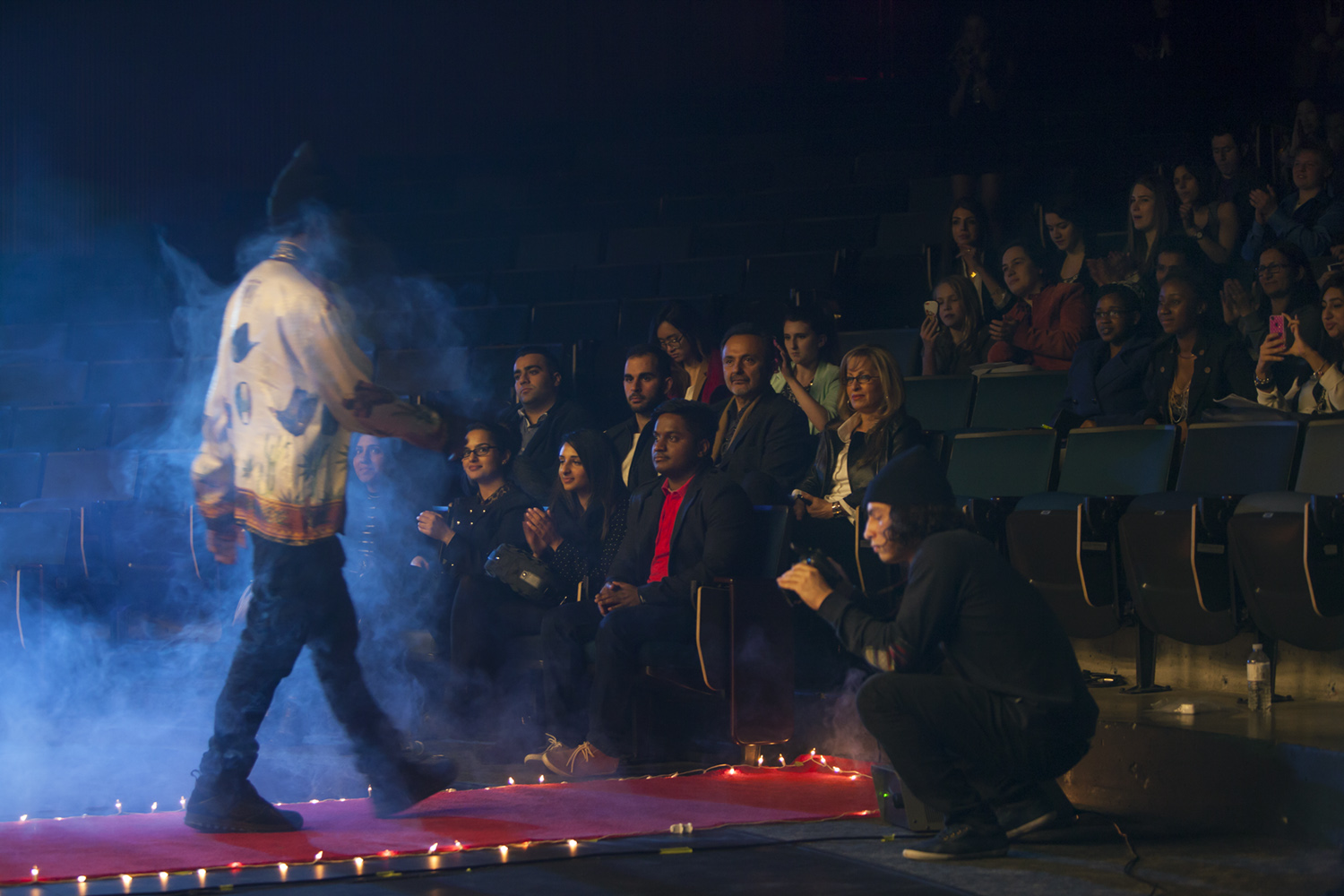
In order to exhibit SFU’s fashion community, organizers decided to set the stage for local designers to show off their collections. Showcasing brands such as Sleepless Nights, Dipt Vancity, Lavish Tee, Lily Rose, SFU Athletics, and the SFU bookstore, Fashion Week was able to bring forth this university’s hidden designing talent.

During the final show of the event, each brand displayed original designs on a runway; Sleepless Nights incorporated tribal prints with street wear through light-weight pants, eccentric hoodies, and loose shirts. The brand paired high-waisted slacks with simple t-shirts and beanies, with embellished bomber jackets paired with tribal-print harem pants.

“The vision behind Fashion Week for us is to be able to represent a community that has more to offer than just academics.”

Kayode Fatoba, creative director

Lavish Tee displayed everyday luxurious wear with an array of different prints, ranging from versatile t-shirts, tank tops, and sweaters, making the collection perfect for busy SFU students.

Lily Rose’s collection, on the other hand, used girly aspects to play up classic pieces, with floral-print dresses, bohemian bags, and blush-coloured skinny jeans, for an overarching feminine feel.

Dipt Vancity, a well-known brand throughout the city of Vancouver, displayed logo-clad hoodies, shirts, and snapbacks, representative of Vancouver’s ever-popular street style. Last of the independent designers, Chreetee displayed more exotic silhouettes with vibrant sequined maxi skirts paired with equally embellished crop tops.

It was inspiring to witness the artistic talent of the SFU and Vancouver communities, and to hear about the process behind getting into the fashion industry. At panel talks during Wednesday’s event, each designer spoke about breaking into the fashion world, showing how difficult yet rewarding the industry really is.

Along with networking and blogging, Sleepless Nights founder Jason Bempong says that it is important “to be brave enough to talk to people you don’t know and just put yourself out there.”

Though not necessarily a fashion capital, Vancouver’s fashion scene is increasingly making itself present on the global scale. If this fashion week proved anything, it is that fashion is present in this city and, as panelist Kevin Lalune stated, “Vancouver fashion is going to get big soon.”

I cannot wait to see SFU Fashion Week grow and expand in the future, and maybe even take on a more high-fashion and haute couture aspect. The fact that SFU hosted such an event just goes to show that there is a desire for fashion to be expressed in a more creative and impactful way on this campus.

Bringing together the community through the creative medium of fashion is not only inspirational, but it also presents a new platform for others to express their passions at future fashion weeks. As Fatoba put it, “While it is the first year of SFU Fashion Week, the journey of a thousand miles begins with one step.”

The return of Veronica Mars

0

veronica-mars-movie-2

Veronica Mars is an addict.

At least that’s the metaphor the new film plays with, poking fun at television’s favourite teen-girl detective and her inability to stay out of trouble. After years of retirement from the private-eye lifestyle, Veronica is drawn back to her hometown of Neptune, CA, where her old flame Logan has become the lead suspect in a very public murder.

Though she tries to keep out of the action, she is pulled headfirst into what she’s best at: wrangling her way into dangerous situations and solving crime, all served with her signature biting wit.

But our heroine isn’t the only one addicted — it would be foolish to review the Veronica Mars movie without acknowledging the events which allowed it to come together in the first place. Mars was one of many too-quickly cancelled television shows, beloved by dedicated fans who spent years creatively campaigning for its comeback in television or film.

This is the same group of fans who mailed thousands of Mars Bars and over 500 pounds of marshmallows to studio executives in protest of the cancellation.

Veronica Mars stood out for its clever lead female character, a teenage private eye who involves herself in the film noir dealings of a rich beach town constantly on the verge of class war and scandal. Campy it was not — the show was grounded in gritty crime and character driven plot.

This is the same group of fans who mailed thousands of Mars Bars and over 500 pounds of marshmallows to studio executives in protest of the cancellation.

When director Rob Thomas proposed his Kickstarter campaign to crowdsource the film through fans it, was met with a record-breaking response. It was fully funded in mere hours, and was sealed with a promise to make the best possible film for the deserving fans. So the question is: did it fulfill that promise?

The film opens with a snappy overview of the basic premise of the show for any of the uninitiated watching for the first time. Moving swiftly along, Mars retains its film noir tone and traditional use of snarky voice-over narration. Using the premise of a 10 year high school reunion in Mars’ hometown, the film easily draws together its core group of characters — and then some.

The film could drag through introductions but doesn’t, making the gathering of characters seem natural and allowing the plot to move on to the main mystery and action. The central crime results in tense conflict and a satisfying conclusion.

But does this work for both the hardcore fan and the casual viewer?

I would guess that first-time Veronica Mars viewers will enjoy the overall film, but miss many of the fan-heavy references that make the reunion of the characters so special. The film is balanced enough to be exciting for the general public but, true to intention, the most thrilled audience members will be the most dedicated backers.

After all, this film was made by the fans and it’s set up in a way to keep them coming back for more.

Distrikt Movement creates community

0

DSC_0393

If you live on the North Shore and have any interest in fitness, it’s likely you’ve heard of the new kid on the block, Distrikt Movement.

The studio, owned by established movement instructors and community leaders Alex Mazerolle and Jian Pablico, opened its doors the second week of January, bringing the ‘hood a new space to explore.

I first heard of Distrikt Movement through social media, and being an avid yogi and North Van lifer, I was immediately intrigued. I wondered, how would this one be different? In a city full of fitness centres and yoga studios, it was hard to imagine a newcomer offering up something truly original. Nonetheless, I decided to explore Distrikt Movement with an open mind and high hopes.

Before I even set foot in the studio, I was impressed by the variety of classes offered (yoga, dance, martial arts) and their refreshingly creative names (Core Mechanic, Ugly Sweaters). I chose a class entitled crush/hush for my first Distrikt adventure as it provided an appealing combination of fast-paced conditioning and plyometrics followed by a relaxing bout of yoga.

Since then I have taken a barre class, which combines pilates with ballet exercises — no experience necessary — as well as a classic vinyasa yoga class. Each of these selections offered an invigorating, unique workout led by energetic and knowledgeable instructors.

Chatting with Mazerolle about the studio, I learned that she and Pablico had first crossed paths through their collaborative work on various youth programs.

Both had founded successful youth initiatives (Girlvana and VARS/TY) independently, and soon realized a mutual vision of creating a fun and inclusive community hub that would provide a space for youth movement programs. From these beginnings Distrikt Movement was born: a multidisciplinary studio that welcomes all ages and abilities under one roof.

“[It’s] a fitness studio with heart. A place where you’re welcomed as you are and supported.”

Cassandra Van Dyck, SFU alumna

Community, creativity, and collaboration are the key values  at the heart of Distrikt Movement. Mazerolle discussed the importance of supporting local businesses and how this has shaped some of the studio’s offerings, including their partnership with Culver City Salads, a food truck that provides healthful lunches outside Distrikt every Friday.

Moving forward, Mazerolle and Pablico intend to build upon the foundation they have created by providing new leadership opportunities for youth and becoming more involved in the community.

When asked what it was like to start this business, Mazerolle confessed that it has been a tremendous amount of work. She recalled the long hours, learning curves, and continuous onslaught of obstacles that her and Pablico faced, both pre-and post-opening.

Yet even while discussing these challenges she conveyed a genuine sense of warmth and affection for all things Distrikt. In terms of advice for other young entrepreneurs Mazerolle remarked, without hesitation, “Just go for it.”

This week I asked other North Shore SFU students what their impressions of Distrikt Movement have been. One student described the space as having an unintimidating, relaxed atmosphere, while another characterized it as fun, friendly, and welcoming.

SFU alumna Cassandra Van Dyck said of Distrikt, “[It’s] a fitness studio with heart. A place where you’re welcomed as you are and supported. [ . . . ] You feel like you’re part of a community of people who care about being healthy, having fun, and feeling good about who you are.”

Distrikt Movement is not just a studio where people come to exercise; it is a community that offers a healthy dose of camaraderie — a space that strips away some of the seriousness of life in an honest and accessible way. To quote Mazerolle, when it comes down to it, it’s all about “people sweating and moving together.”

Distrikt Movement is located at 105-197 Forester Street in North Vancouver.

The Peak starts aNUW

0

As of a vote by our board of directors last week, The Peak has decided to leave the Canadian University Press (CUP) opting, instead, to join  the National University Wire (NUW).

If you haven’t been paying attention to the Canadian student newspaper world lately, let me tell you, things have been going on.

The Canadian University Press (CUP) is a non-profit, member owned and operated organization of Canadian student newspapers, and the oldest student newswire service in the world. In this capacity, CUP has provided services and support such as conferences and a national newswire to its members, including The Peak. All sounds good, right?

Right now, not so good. Currently, CUP is facing a financial crisis so bad that on Feb. 28 they launched a $50,000 Indiegogo fundraising campaign in an effort to keep themselves afloat, after facing their third consecutive deficit year. As of press time, they’ve raised a little over $7,000.

Over the past two years, we have repeatedly voiced our concerns, and CUP has not made serious moves to respond.

How did things get to this point, you ask? CUP depends on membership fees — calculated by the available finances of the individual paper — to operate. It’s a fine balance of providing services valuable to larger papers with plentiful resources, and to those with much less.

Unfortunately, a year ago, member papers started leaving, deciding that in the changing financial landscape of press that CUP fees were no longer worth the services they were receiving. CUP suddenly had a lot less money to keep up their national staff and expensive wire service.

The tensions arising from this financial state culminated in a plenary meeting at this year’s national conference in Edmonton, when a coalition of current and former members, including The Peak, tried to pass a new fee structure and online article plan to replace the current newswire. The proposal was rejected, with softer fee cuts chosen instead.

Over the past two years, The Peak has repeatedly voiced concerns about relevant services, asking for a more productive newswire service or an RSS feed that would allow papers to push content quickly and effectively, providing more diversity and choice for republishing. CUP has not made any serious moves to respond to these requests.

At this point, the mismanagement of the organization, the lack of response to our needs, and the resistance to decisive change have moved us to do something we have been discussing since I started at The Peak over two years ago: leave CUP.

If you need us, you can find us over at the National University Wire (NUW), which launched last Monday. NUW was founded out of collaboration between two former CUPpies, Geoff Lister of UBC’s The Ubyssey and Joshua Oliver of U of T’s The Varsity, in an effort to address the need that CUP has actively ignored. It’s the collaborative, user-generated feed we’ve always wanted.

And the company’s not bad either. Along with The Peak, members of NUW are student newspaper heavyweights, including The Gateway, The Ubyssey, The Martlet, and six others, all of which can be found on the site.

We are proud to be a part of a wire that is working towards creating a strong, collaborative, unified student press, which is the most valuable thing we could ever receive from an organization.

We hope CUP will be able to provide that again  one day. But for now, we’re trying something NUW.

Retired SFU professor rakes in literary award nods

0

David Stouck_credit Wayne Wiens

After 40 years of teaching in SFU’s English department and penning over a dozen books on Canadian literary authors, it seems an odd departure for David Stouck to write a book about an architect. But in fact, a book about Arthur Erickson is a serendipitous fit for a retired SFU professor, as Erickson designed the Burnaby campus.

Stouck actually wasn’t the one who came up with the idea for the book; it was Ethel Wilson’s niece, Mary Buckerfield White, whom he had interviewed during his research of Ethel Wilson. Mary contacted Stouck in 2004 and said no one was writing about her long-time friend, Arthur Erickson. Despite knowing next to nothing about architecture, and very little about Erikson, Stouck decided to take on the project.

“I thought it would make an interesting retirement project,” Stouck comments lightheartedly, “[but] I was skeptical, because I did not know the technical language of architecture.”

What he didn’t realize was the sheer amount of background research he would need to conduct — educating himself in everything from painting and philosophy to Japanese and Indonesian culture.

“It was a huge job,” states Stouck, “[Erickson] had a huge life.”

Stouck began research in 2005 and conducted nearly weekly interviews with Erikson, bringing archival material to Erickson’s house on the weekends to help jog his memory. He was surprised to learn about Erickson’s personal life, which became rather flamboyant when he moved to LA.

Stouck finished writing in 2011, two years after Erickson passed away. Then, after a small snag with the publisher, the book Arthur Erickson: An Architect’s Life was published in September 2013. The research process took Stouck and his wife traveling, as Erickson told him that to understand his influences, he would have to visit Florence in Italy, Kyoto in Japan, and the island of Bali in Indonesia.

Stouck began research in 2005 and conducted nearly weekly interviews with Erikson, bringing archival material to Erickson’s house on the weekends to help jog his memory.

“SFU is a good example of how Bali influenced him,” explains Stouck. “The landscaping of a mountain top in Bali, the buildings hug the landscape, and are very low.” All the other architects who put in proposals for SFU’s Burnaby campus had huge high rises as a central focus.

When Stouck and his wife visited Bali they saw terracing of the rice fields up and down the mountainside; those who are familiar with SFU Burnaby will understand how Erickson applied this concept.

“Japanese influence was really important too, both in landscaping and design. The idea that the building doesn’t rise up, but should be an intimate part of the landscape.”

Erickson also studied philosophy and believed in the creation of open, common areas for gathering and interdisciplinary mingling — which is reflected clearly in Convocation Mall and the AQ.

Arthur Erickson: An Architect’s Life has since been nominated for several awards, including the RBC Taylor Prize and two categories of the BC Book Prizes, for which the shortlist was announced on March 13.

Also on the BC Book Prize shortlist is Renée Sarojini Saklikar, graduate of the SFU Writer’s Studio and founder of Lunch Poems at SFU. Saklikar is nominated for her debut collection children of air india: un/authorized exhibits and interjections, reflecting on the Air India Flight 182 bombing in 1985.

The Dorothy Livesay Poetry Prize includes two other poets with SFU connections: Jordan Abel, shortlisted for his title The Place of Scraps, is an instructor in the Continuing Studies department. Russell Thornton’s book of poetry, Birds, Metals, Stones and Rain, was also shortlisted for the Governor General’s Award for Poetry in 2013; Thornton completed his MA at SFU.

On Thursday, April 3, there is a free soirée to celebrate the shortlisted authors at Joe’s Apartment at 6:00 p.m. The winner of the Lieutenant Governor’s Award for Literary Excellence, a lifetime achievement award, will also be announced at the event.

In mid-April, the BC Book Prizes On Tour will kick off, touring select authors (to be announced) around the province to visit schools, bookstores, and libraries in various communities. The winners of the BC Book Prizes will be announced May 3 at the Lieutenant Governor’s BC Book Prize Gala, an award celebration to be held this year at the Renaissance Vancouver Harbourside Hotel.


Manhattan and Monopoly: Creativity, copyright, and culture

0

“The artist’s job is not to succumb to despair, but to find an antidote for the emptiness of existence.”

For those who live by such words, today’s North American cultural industries have infinitely failed us. The corporate monopoly production of culture that comes out of Hollywood reflects capitalist values that individualize life’s miseries rather than provide a remedy.

But thanks to the sharing capacities of the Internet, not all North American art production has succumbed to this despair. In the last 10 years, the economy has become increasingly dependant on the generation of knowledge through creativity and innovation, otherwise known as the creative industries.

The rise of the creative industries has shifted cultural production away from corporations, and into the hands of the masses. This reduces the strength of cultural monopolies, and allows for meaningful artistic work that reflects the real values of middle class citizens living in North America.

Although the creative industries have changed the face of cultural production, there are barriers preventing the free flow of meaningful art. These barriers come in the form of intellectual property rights.

Sleeper 4

Take the example of the new-age digital music producer. This person takes sounds from other artists, remixes them, and puts them on top of various other tracks. The web presents an unlimited number of mediums to showcase and market this kind of work.

However, if a large record label owns the rights to a song, any reproduction of that song is strictly prohibited. If a new-age digital music artist uses only a few seconds of that song they could be heavily fined. The only way to legally produce a track that uses a protected song is to buy rights to it. Unfortunately, those don’t come cheap.

But even with strict intellectual property laws, the Internet and the creative industries have still revolutionized cultural production. There is now a population of creators who make a living in online video production, blogging, online graphic design, and a range of other practices made possible by the creative industries.

Copyright laws stifle the innovative practices the creative industries provide and restrict the free flow of meaningful cultural production. But, as Woody Allen tells us, “We should not succumb to despair.”

Although the commodification of art in the cultural industries has led to corporate monopolies on creativity, innovation, and the production of culture, the web has provided us with an arena for meaningful cultural production at our fingertips. The web may be limited by intensive copyright laws at this point in time, but it has increased artistic practices that better reflect the values of the majority of North American citizens.

Woohoo, boohoo

0

Woohoo: writing

As I come closer to completing my degree in English and become more interested in writing in general, writing is becoming the practice. The continuous mountain. The never-ending journey. I find little else as satisfying.

Handing in a completed essay feels fantastic. To have put together all the information from weeks of studying and research, to solve the puzzle of how to include as much info as possible from the semester into one complete package, I get a high.

The place of discovery that is writing also gets me stoned. Poetry specifically, but also prose and essay writing, allow the detachment of oneself from a written piece of work; the writing speaks for itself and can have unpredictable effects on a reader. Writing offers a means to create something new, and an opportunity to escape oneself in the process.

Cocaine? No, thanks. I get my high from the pencil and the pen. I get my dopamine from the keyboard.

Boohoo: getting started

Holy crap, am I ever terrified of starting to write.

I’m terrified of writing research papers, sifting through convoluted scholarly articles, potentially choosing the wrong ones, writing, editing, second-guessing, and nit-picking over every sentence.

I’m terrified of opening myself up to critiques. Especially when writing opinions, I really don’t want to take a hard stance for or against something, to invite a reaction, to potentially have to question my own beliefs.

I’m terrified of potentially having to defend an argument against anyone who might feel more educated (or, God forbid, more passionate) about a subject.

But I have to write like I have to speak. I have to express myself. I can’t live a life of fear, protected by the absence of rebuttals.

And I have to write essays. Because profs say so. But this semester, I’m gonna give myself at least a month to prepare each.

. . . Aaand the semester is over in a week. Well, I don’t really need sleep.

Clan finish second at Cal Baptist Invitational

0

The Clan men’s golf team continues to climb leaderboards ahead of April’s championship season.

Last week the men travelled south for the California Baptist Invitational where, after a very strong opening round that saw them take the lead, they finished in second place at tournament’s end. The SFU squad posted a team score of 875, only three strokes behind the winners and Great Northwest Athletic Conference (GNAC) rivals, Western Washington University.

Senior captain Mike Belle led the team through the three-round event, finishing in a tie for 10th position with rounds of 71-70-75 for a tournament total of 216. Belle’s was not the only quality performance, as four of the five men finished in the top 30 of the 96-player field.

Following his captain was John Mlikotic who finished in a tie for 14th with a total of 218 strokes and rounds of 70-73-75. Bret Thompson followed in 24th place after faltering in the latter rounds of the tournament. The sophomore’s opening round of 67 was five strokes below par,  but he couldn’t hang on, adding 77 and 78 in rounds two and three. Freshman Kevin Vigna finished in a tie for 29th place with scores of 78-72-73, improving significantly over the second two rounds and only one stroke behind Thompson. Their tournament totals were 222 and 223 respectively.

Rounding out the Clan side was freshman Craig Titterington, appearing in his first collegiate tournament where he opened with a very respectable round of 74. He stumbled in the later part of the tournament with rounds of 77-83, posting a three-round score of 234. The Clan men have one final tournament before they head to the GNAC Championships
in mid-April.

Boasting three of the top-10 scoring averages in the conference in Belle, Thompson and Vigna, the Clan have an excellent chance to win the title. Sitting at 19th in the NCAA Division II rankings, the Clan also hold the second best team scoring average in the GNAC with 298.6, just behind Montana State Billings with 298.1.

The men will be looking to advance to the West Region Championships for the first time since joining the NCAA in 2010, a chance they narrowly missed in 2013, when the Clan finished third at the conference event.

No UNSC nation should have veto power

0

Recently, members of the United Nations Security Council (UNSC) voted unanimously in favour of adopting a proposal to condemn the Crimean referendum as illegal, with two exceptions: China, who abstained, and Russia, who voted against the proposal.

In any other democratic forum, this would not matter, but Russia, as a permanent member of the UNSC, can veto any resolution that this organization attempts to pass. This veto power needs to be reformed.

When the United Nations was founded during World War II, it was decided that Great Britain, China, the Soviet Union, the US, and France would be the permanent members of this Security Council, and would have veto power in issues relating to threats to the peace and stability of the world. One reason for this power was to ensure the major powers act in concert, and to prohibit the UN from taking future actions against its principal founding members.

It’s a problem that there is nothing binding about the General Assembly overriding a Security Council veto.

In many ways, these five nations are the biggest threat to world peace. A report to the United States Congress on international arms sales found that these five nations together were responsible for 78 per cent of all arms deals to developing and industrialized countries from 2004 to 2011. Further, all five of these nations have been guilty of using the power of veto to block actions against their own countries.

These have included an attempt to condemn the American invasion of Panama, the Soviet invasion of Afghanistan, and the Suez Crisis. The veto has allowed these nations to act as they see fit without fear of condemnation by the UN.

Yet there does exist a process by which the United Nations can circumvent a veto or the threat of a veto; UN Resolution 377, known colloquially as “Uniting for Peace.” This resolution was adopted by the UN in 1950, allowing for the General Assembly to convene an emergency special session in the event that “the Security Council [ . . . ] fails to exercise [ . . . ] international peace and security in any case where there appears to be a threat to the peace, breach of the peace, or act of aggression.”

The problem with Resolution 377 is that it is more a tactic of putting pressure on belligerent nations than firm action. Unlike the veto system in the United States, where a presidential veto can be overridden with a two-thirds majority in each house, there is nothing binding about the General Assembly overriding a Security Council veto.

This is simply because the task of the Security Council is to enforce the peace, and any permanent member that does not agree with the resolution is likely to prevent the deployment of peacekeeping forces to a conflict zone.

So even if, for example, the UNGA was to initiate the process involved in invoking Resolution 377, it is entirely possible that Russia will simply ignore the action, much as they did in 1980 when the General Assembly protested the Soviet Union’s presence in Afghanistan.

What is needed here is reform, but it is difficult to see how this can be accomplished. The United Nations does not have any real power to enforce its will, and the will of the international community, on nations that choose to ignore it. For all of its accomplishments, this continual failure to protect the nations of the world from the will of the permanent members will be part of its legacy.