Home Blog Page 1108

Long live the lizard

0

Godzilla


He’s been stomping around pop-culture since 1954. While he may seem like just a giant lizard with atomic breath, Godzilla tells a story much closer to our own reality.

When the atomic bombs were dropped on Nagasaki and Hiroshima in 1945, an entire culture was beyond devastated. Many survivors had to live out the rest of their days with the constant reminder of massive keloid scarring on their bodies. Though Japan recovered, it has never forgotten. Nor should we. 

Emerging onto screen a few years after the bombing, Godzilla’s dark keloid-like skin is a reminder to the world that though Japan was horrifically scarred, it nonetheless rises. Godzilla was first introduced as just a monster rampaging  around Japan (as the violence of the bombing was still fresh in the country’s mind). 

But since then, the King of Monsters has shifted motives. He’s battled and saved us from threats of all kinds: many — like those in the newest installment — are the results of our own scientific arrogance. 

He’s the classic, but inadvertant movie monster. He destroys lives in his wake, but ultimately, he — along with all the other rampaging monsters behind him — is the punishment mankind deserves for our nuclear crimes against each other. This latest Godzilla incarnation definitely lives up to its hype.

The last time Godzilla was adapted into Western cinemas was in 1998, awkwardly starring Matthew Broderick. It was done in an archetypical “monster movie” fashion, with the beast rampaging through New York. To sugar coat it: the movie didn’t do so well.

Now, director Gareth Edwards recreates Godzilla in his largest physical rendering yet, definitely stomping out  the memory of its embarrassing predecessor. 

Even though a full hour passes before the King of Monsters shows more than his spiked back protruding from the ocean, the wait is definitely worth it. Godzilla is magnificently re-interpreted. Standing an impressive 350 feet (with thighs that look like he pushed himself to the max on an elliptical), his look is strikingly faithful to the globally recognized Japanese design. 

Put aside the mediocre story-telling, and just hear that iconic roar as if it were right outside the theatre. The scenes of giant monsters fighting are as eerily intriguing as witnessing unsettling footage on the evening news.

From the Philippines to Hawaii and Japan, then to Las Vegas, and ending in San Francisco, Edwards’ film is more global than the 1998 version, and it really resonates as a what if this really happened? kind of film.

The film is definitely a go-to summer movie (thus far) for stunning visuals. The first full body shot of Godzilla is sure to please your inner child. Don’t go for great storylines, however, as they unfortunately fall flat within the first hour after some emotional lypivotal events. Definitely go for the spectacular monster bashing, and Elizabeth Olsen’s surprisingly talented, but under-utilized acting skills.  

Calling home

0

My dad is from Pakistan. He moved to the United States for school when he was in his early 20s, met my mother — a country girl from Oklahoma — and never went back. I am American, through and through, raised Christian instead of Muslim, raised speaking English instead of Urdu; I’ve never been to Pakistan and I’ve never met my grandmother or my uncle or my cousin. My dad has returned home only a handful of times since I’ve been alive and rarely speaks to his family on the phone.

Unhappily, this communicative ineptitude, this bizarre phone phobia, is something I seem to have inherited.

Last year, my father’s father died. He was an old man, in his 80s, and had lived a full life. His body gave out peacefully as he slept in his chair, I was told. He was something of a legend to me: the soldier, the forest ranger, the stoic, white-haired man in a tunic and horn-rimmed glasses who stared out from the sepia-toned picture in our living room. He was a part of me, and though I’d never met him, I felt an overwhelming, profound ache when I heard of his passing.

News of my grandfather’s death didn’t reach my dad until a month after it had happened. Stay with me for a second and really think about that. My dad’s dad was gone for four whole weeks before he knew anything about it. When the phone call finally came, he was out of town for work and my mom picked up; she ended up having to break the news to my stunned father over the phone.

In pursuing adventure, exploration, and independence, I find myself losing track of the people who make me “me.”

My dad doesn’t talk about Pakistan easily; when I was little, I refused to go to bed until he told me a story from his childhood — my favourite involved him getting chased home by a pack of monkeys. He is the eldest son and he left, he married a white woman and raised his children in the West . . . I know my father’s relationship with his family is strained at best. But I never realised just how disconnected he was until this giant lapse in communication.

I always knew I would leave home and go far away. I grew up just outside Detroit, Michigan and after I graduated college, I immediately moved to Chicago. After two years there, I moved to Vancouver where I’ve been for just over a year. I suck at calling home. If a month goes by, my mom will send me a text which usually reads something like “Haven’t heard from you in a while. U alive?”

It’s not that I don’t love my family, I think about them often, and yet, something always seems to hold me back when I reach for the phone: it’s too late at night, I’m too tired to talk, it’s been so long since we last talked . . .

It’s scary when you find yourself replicating bad habits. I’m all for adventure, exploration and independence, but in pursuing those things, I find myself losing track of the people who make me “me.” It’s a sneaky sort of silence, an isolation that spirals out of control until a phone call to my brother seems like a truly daunting task.

Family is family, this is true, but even relationships bound by blood require maintenance. We are young and invincible and bright-eyed, but at some point, we will stumble, we will hurt, and we will fail. So pick up the phone, now. Keep the lines of communication open and remember how much we all really do need each other. ‘Cause no one wants to be in the dark when it counts.


Stealing your heart

0

CMYK-Art of Stealing Amber Funk Barton


How does a contemporary dance show inspire a Lululemon capsule collection? Amber Funk Barton is still surprised that she can now say she has her own clothing line, and she feels so grateful for the experience. “I feel that both organizations have truly had a collaboration and been inspired by each other,” she said. “They’ve been so supportive and respectful. It’s been a true artistic exchange.”  

This unlikely partnership all began when Barton was introduced to lead designer Jean Okada at the Lululemon Lab during a fit session where she gave feedback on some of their pieces. At that time she was halfway through producing her new dance work, The Art of Stealing, presented by her company, the response, and she was beginning to think about costuming. “I thought it would be so cool to work with Jean,” she said. 

Barton and Okada met for coffee, discussed costuming ideas for the show, and a short time later Okada suggested that they not only collaborate on the show’s costumes, but create a capsule collection inspired by it. “It was the most organic thing that happened. It was being introduced in the right way at the right time,” said Barton. Capsule collections are very small lines, in this case six pieces, inspired by groups in the Vancouver community. 

The right costumes can add so much to a dance. “Sometimes in contemporary dance we don’t put an emphasis on costumes,” explained Barton, saying that tight budgets often lead to hastily put together costumes bought at the mall. For this show she knew it had to be costumed with more thought. The aesthetic of Lululemon really suits this project, with black being the prominent colour.  

“We’ve been working so hard on creating a world that makes sense to us,” said Barton, explaining that each dancer has their own journey within the piece. One dancer said to Barton, after putting on the finished costumes: “Before I just felt like I was in a template, now I really feel like I’m in it.” 

Barton believes in the power of costumes to help transport the dancers to her fictional world: “You can suspend belief better in costume, you have your uniform,” she said. “For the dancers it really helps us forget that we’re dancers and be immersed.” The costume give them another piece of information about their role. 

Barton doesn’t like the word character to describe the different roles in her work. “I create avatars as opposed to characters,” she said, explaining that this leaves room for interpretation. The avatars in this show represent a post-apocalyptic gang of thieves, and there are some identifiable personalities: “There is a power struggle within the gang. There’s the leader, the rookie, the person who challenges authority, etc. It’s more an outline of a personality type.”

Influenced by comics and graphic novels, the loose narrative journey of the show could be described as a moving storyboard. The atmospheric, murky music adds a dark tone to the show and Barton says there’s a sense that “something eminently bad is going to happen.” 

This is Barton’s third full length show, and she explained that after her last work, Portraits and Scenes of Female Creatures, she learned a lot about knowing what needs to be fixed and how to fix it. “It’s just experience. You just have to keep making work and you come to terms with the fact that there’s no way you’ll ever make a perfect piece,” she said. “It’s all connected and every piece leads to the next piece. You don’t get a black belt in choreography,” she laughed. “It’s nice to still feel inspired.” 

The Art of Stealing will be presented at the Firehall Arts Centre May 28 to 31. For more information, visit responsedance.tumblr.com. 

Five surprising common misconceptions

1

Untitled-1

There are some things that everybody knows — call it common sense. Whether you heard them from your teacher, parent, friend, or one of those public Facebook posts, they’re the facts and figures we take for granted that make up our knowledge of the world around us. Turns out, a lot of the information we’ve gotten over the years may not be all that reliable.

Actually, many of our most taken for granted beliefs may be either partially untrue or total fabrications. Though there are too many to name, here are five of the most persistent myths and legends which still get passed around as indisputable facts.

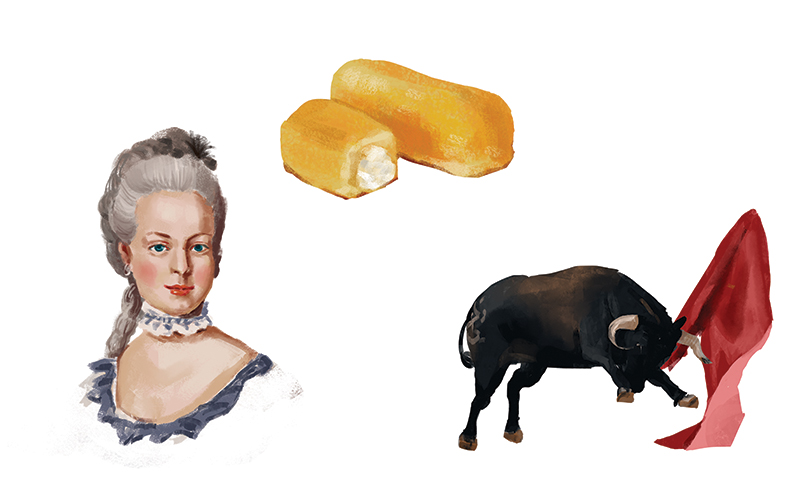
Marie Antoinette said “let them eat cake”

French queen consort Marie Antoinette’s famous quip is often credited as one of the best-known examples of rich people being, well, total dicks. Supposedly uttered at a time when the people of her nation were revolting due to a famine so devastating they could not even afford bread, the statement was used as a symbol of the selfishness and foolhardiness of the French nobility for years to come.

However, there’s no evidence Marie Antoinette actually said this at all. The statement first appeared in the autobiography of philosopher Jean-Jacques Rousseau, published when Marie Antoinette was only nine years old. In the work, Rousseau attributes the phrase to an unnamed princess, which was subsequently misattributed to Marie Antoinette.

There are many theories about how this phrase was attributed to her — most seem to believe it was the work of anti-royalists wanting to tarnish Marie Antoinette’s reputation at a time of extreme discontent with the French monarchy. In any case, Antoinette was known as one of the only members of the monarchy to actually care about the poor, making the statement pretty out of character.

Bulls are enraged by the colour red

This one is surprising. After all, we’ve all seen the absolute ferocity with which a bull rushes at a red cape waved by a matador, completely ignoring the matador himself — well, most of the time, anyway. Due to the popularization of bullfighting, the red of a matador’s cape has been seen as an aggressor to bulls for a very long time. However, not only is red itself not an aggressor for bulls, they can’t even see it.

Cattle, like most mammals, are dichromats, making them colour-blind. The actual reason bulls charge at red capes isn’t the red; it’s that the cape is in motion, which the bulls perceive as threatening. Why they chose to make the cape red instead of any other colour has a more morbid explanation: though modern bullfighting is not lethal to the bulls, historically, the red of the cape was chosen to mask the blood of the bull as it was injured and eventually died throughout the course of the bullfight. 

The Great Wall of China is visible from the moon 

Standing 8,850 km long and nine metres wide, the Great Wall of China is one of the most iconic structures ever built. The idea that this marvel is visible from the moon seems plausible, and has become ingrained in our cultural subconscious. However, this myth has been pretty thoroughly debunked.

The truth of the matter is, as Earth is 384,400 miles away from the moon, seeing the Great Wall of China from that distance would be equivalent to seeing a strand of hair from 20 miles away. Good luck with that. According to NASA, “No man-made object is visible at this scale.” Astronauts agree, and note that the Great Wall also blends in well with the surrounding landscape, making it even tougher to see from a distance.

Deoxygenated blood is blue

Turns out your 3rd grade teacher lied to you; blue veins don’t equal blue blood. In fact, blood is always red, regardless of oxygen content. The red blood cells in your blood contain hemoglobin, an iron-containing protein that aids in oxygen transport which our eyes see as red. Instead of blue, deoxygenated blood is a deeper red than the blood we’re used to seeing, closer to maroon.

This myth is a product of our veins appearing blue to us, which is due to a number of reasons, among them the way light scatters through your skin and the complexity of human colour perception — which you can read about at length in many a scientific paper. Suffice it to say that your blood ain’t blue.

Twinkies never expire

If you’ve ever seen Zombieland, you might hold out hope that in case there’s some kind of zombie apocalypse or nuclear war, as long as we can get to the Hostess warehouse and find the Twinkies, we’ll never go hungry. Why? Because Twinkies don’t expire, of course!

The idea of Twinkies as infinitely fresh arose from the seemingly perpetual sponginess and high volume of these little cakes in grocery stores. Eventually, rumours arose that Twinkies were purely artificial, made up entirely of chemicals which allowed them to stay fresh for years, or even decades, at a time.

Unfortunately, if you happen to open up a time capsule from 1995 and find a still-wrapped Twinkie inside, it would be a good idea to just throw it away. Officially, Twinkies have a shelf life of 25 days, and while this is longer than most cakes, it is nowhere near the multi-year expiration dates attributed to them. We can dream, though. 

The meaning of privilege

0

Screen Shot 2014-05-23 at 4.48.51 PM

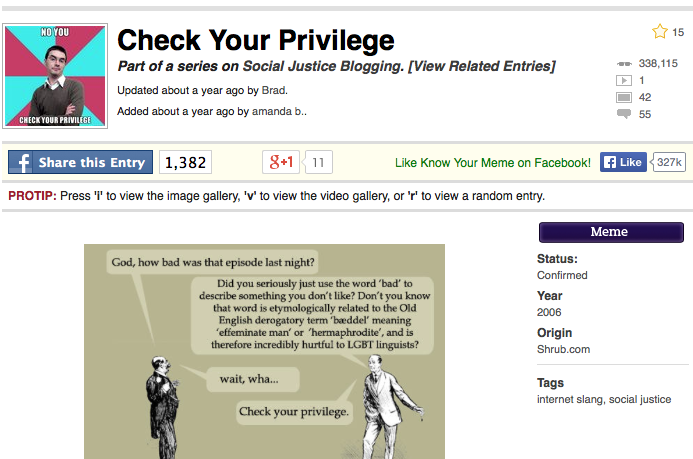
The “check your privilege” campaign is a social media movement that has been spreading among university campuses in the hopes that it will catalyze change and prevent discrimination. The campaign asks students to question their own privileges.

A lack of a privileged experience can result from discrimination based on race, sex, class, disability, sexual orientation, religious affiliation, age, and others. The generalized implications of the “check your privilege” campaign are brilliant because they cover all of these issues. The problem, though, is that this slogan is too broad to make the desired impact on its targeted audiences, which should include most of us to some degree.

It seems to me that despite the campaign’s attempt to increase the complexity of privilege, we still tend to drift towards the “I need this campaign because I am not a Caucasian, 30-year old, heterosexual, cis-male” argument. Surely, this demographic experiences a lot of privilege over other minority groups, and they need to be aware so that they can learn to mediate that issue. But there is more to understanding what privilege means in all of our lives than just this argument.

If we imagine a privileged experience of the world to be determined quantitatively through a checklist of how many privileges we have, then it is inevitable that there will be those who will score higher than others. However, are some privileges going to carry more weight than others? What score counts as being truly privileged? The issue is too complicated to be categorized into a pass/fail system.

There has been concern that the campaign could be used to silence Caucasian students. However, this shouldn’t be the case. Certain groups are going to feel targeted by the slogan but that is because of the negative perception we have of what privilege means.

 The issue of privilege is too complicated to be categorized into a pass/fail system.

This negative perception of privilege is unfortunate, as it tends to shut down meaningful conversation. We all need to understand that being privileged doesn’t make you a mean and selfish individual; it just means that you have some advantages that others do not experience.

The “check your privilege” campaign is easily interpreted as only targeting the obvious groups. But we have to remember that just because you are part of a minority group doesn’t mean you don’t experience some privilege.

There are wide ranges of contributing factors to privilege. If you step out of Canada and compare our rights and attitudes with different groups in other nations, this becomes immediately apparent.

Examine your own privileges before pointing out someone else’s. That is the only way that each of us can begin to listen to the issues of other groups and to become cognisant of the problems that we may not encounter because of the privileges that each of us possess.

Goodbye, Nintendo.

17

Nintendo Gameboy

It has been 31 years since the release of the Nintendo Entertainment System (NES), the system that revolutionized the world of videogames and helped create the now immensely influential modern video-gaming culture. But unfortunately, after seven home consoles, six handheld consoles, and a boatload of classic games, Nintendo has finally come to the end of its road.

The Guardian recently reported that Nintendo had slashed its Wii U yearly sales estimate from 9 million to 2.8 million. That’s less than one-third of the sales it predicted it would make the year before. What’s even worse is that Nintendo actually sold under its estimates, at 2.72 million consoles.

I’ve always been a fan of Nintendo more than of any other gaming console, mainly because I didn’t have the money to purchase an Xbox or Playstation. Growing up, my first console was the GameCube. Yes, I’ll admit I was a little late in joining the Nintendo crowd, as I was well aware of the explosive popularity brought about by the Nintendo 64, arguably the company’s peak-era.

Before I could finally convince my parents to invest in a Nintendo console, I’d lived the N64 experience through my friends’ consoles. By the time I’d gotten my hands on a GameCube, embellished with Zelda: The Windwaker and Madden 2002, I was well seasoned in the art of racing heavily pixelated Mario Karts, and busting out the jams on my ocarina.

But after the release of the Wii, it was evident to me that Nintendo’s popularity in the gaming community was starting to decline. Yes, the Wii introduced a change in gaming through motion-sensor technology, but as other consoles, like the Xbox and Playstation, were becoming increasingly popular with what were deemed more “hardcore” or mature games, in graphics and story lines, the Wii was struggling to adapt.

Only old crusties will hold on to Nintendo, clinging to childhood through our beloved Mario, Link, and StarFox.

Now, with the Wii U having made its less-than-glamorous debut, it is clear to me that the only thing keeping Nintendo barely running is the release of games with the classic characters that initially made it popular. In other words, Nintendo is running on nostalgic value.

I’ve accepted that, as a Nintendo fan, I have become an obsolete gamer, and have refrained from purchasing a Wii U console. But I will forever remain faithful to those games that played such an important role in childhood life.

However, The Guardian reported that while some analysts (like me) “have suggested that Nintendo may be ready to ditch its troubled machine,” Nintendo plans to “rejuvenate” the Wii U with the release of some new major titles and technologies.

While the company may feel its taking the right steps to boost its profits, I, unfortunately, feel otherwise. The stigma has been placed on Nintendo. With its failure to quickly branch out into modern hardcore graphic games, Nintendo will continue to lose copious amounts of money, and will eventually wither into nothing. Only the old crusties, such as myself, will hold on to it, trying desperately to cling to childhood through our beloved Mario, Link, and StarFox.

Goodbye, Nintendo. It was fun while it lasted. But now you must submit to your own demise in the face of high-definition blood and guts.


BESTiE delivers No Bad Days

0

CMYK-BESTiE - Garden - 2013 - 2.9MB


Imagine palm trees, warm beaches and piña coladas year round. Imagine the best of vibes and the best of friends. Imagine juicy fruit and nonstop sunshine; imagine no bad days. This is the feeling Vancouver-based tropic pop group BESTiE hits us with, again and again. 

Their infectious energy is compelling and uplifting, with each of their songs a bright burst of warmth more colourful than the last. BESTiE, who list “summer, ice cream, the beach, girls, floating down a river in an inner tube, high fives and heart break” as a few of their influences, have a warm, calypso-surf dream pop sound that catches the ear and the soul and brings you to a place of infinite joy. 

After scoring third place in the 2013 Peak Performance Project, the boys have only continued to impress. Their self-released first album, No Bad Days, came out on April 22, and they are currently grinding through their first cross-Canada tour. If it’s any sign of the spirit of BESTiE, they made time to chat with The Peak following an overnight prairie drive, in between their first gig on live TV, first thing in the morning, and their (much-anticipated) breakfast.

The band consists of Tristan Orchard (lead vocals), Andrew Janczewski (guitar), Rob Cameron (bass), and Daniel Ruiz (percussion). The four besties met at the Vancouver dive bar Funky Winker Beans in 2009, at a night Tristan had put together called No More Strangers. 

Their true collaboration, however, was birthed on a hot summer weekend at a jam space Tristan runs called Goodies. Tristan, Andrew and Rob stumbled into jamming together and were all really excited about the vibe that emerged, so they kept running with it. Daniel “found his way in” later, and the four of them have been seriously (but in a fun kind of way) creating their sound since 2012.

BESTiE’s diverse musical tapestry is characterized by the eclectic mix of the unique styles and influences of each member. Tristan has a DJ background and “likes eclectic mixes of sounds, and earnest pop music.” Andrew grew up listening to a lot of African music and early reggae and is, in Tristan’s words, “almost a historian.” 

Then we have Rob, the “guru of indie rock,” and Daniel, a Columbian native who contributes his Latin-inspired drumming style. The overall BESTiE sound we hear is a smooth blend of these diverse and sounds that compliment each other perfectly: breezy, upbeat, happy, and outrageously fun.

Interestingly so, the popular categorization of BESTiE’s sound as ultra optimistic was unintentional on their end. In fact, Tristan was in a low place at the time of the band’s formation, as his other band was dissolving. The collaboration with new to-be besties was exactly what he needed.

“Getting back into making music with other people was really exciting, we love playing music together. It’s really the best thing, so that joy manifests itself into the songs.” They also credit their geographical setting for their bright, positive sound. Tristan explains, “Being from Vancouver, where it’s dark out most of the time, you have a special fixation with the sun and the short summer.” For BESTiE, “it’s all about the vibe — born out of the mood we are in.”

The resources and experience BESTiE gained through the Peak Performance Project encouraged the release of their debut album, which they had been working on throughout 2013 and up until March 2014. A highlight of the process for the group was working with producer Howard Redekopp (Tegan & Sara, Mother Mother, The Zolas), which “was great, and definitely made us a better band.”

If the idea of summer condensed into an endlessly re-livable half hour sounds appealing, BESTiE’s No Bad Days is definitely an album for you. What’s perhaps the most amazing part of the music BESTiE has created is that when you listen to it, you can truly hear and feel that hot summer weekend that inspired the whole thing years ago. These self-described “young men that like to steer towards the light” are practically magicians, evoking the powerful feeling of joy they experience in doing what they love, a joy that many of us yearn for all year.

BESTiE will perform at Fortune Sound Club on May 30. For more information, visit bbbestie.com.

Off to see the wizard

0

Wicked Munchkinland Tour

 Are you good or evil? What does that even mean? Wicked explores the idea that none of us are really good nor evil, but a combination of both, and how we end up that way is more complex than we probably realize. Matt Shingledecker, who plays the witches’ love interest, Fiyero, explained that the idea of the show is to strip away the labels of good and evil to look deeper into individual character and motivations.

You may think you know the two witches from The Wizard of Oz: there’s Glinda, the sparkly, pure, good witch, and the Wicked Witch of the West who is sheer evil. But what were these two like before they became famous witches, and how did they go from being best friends to worst enemies? 

Wicked follows Elphaba (who would later become the Wicked Witch), and Glinda, through their college years and demonstrates how different societal influences come to shape them.

Shingledecker explained that the relationship between the witches is what people can relate to the most, “Their paths intertwine, they separate, and eventually come together. When Elphaba says ‘You’ve touched my life,’ everyone can relate to that.”

“It’s a different take on The Wizard of Oz, people learn something new,” he said, explaining that with this previous knowledge of the characters, “everyone feels like they’re in on it.”

The book that inspired the musical is quite different, said Shingledecker, but there is one part that stuck with him and seems to sum up the moral of the story: Boq, a munchkin who knew Elphaba as a child, says to her that you don’t have to be weary of people who call themselves evil, you have to be weary of people who call themselves good.

In Shingledecker’s favourite song of the show, “No Good Deed,” Elphaba’s character has a powerful moment when she struggles to figure out the difference between good and evil. “She sort of becomes her persona for a moment. It’s a moment of vulnerability.” 

Shingledecker’s character, Fiyero, is — according to him — best represented by the scene “thank goodness,” at the top of act two when he calls Glinda out. “You see where he’s come; how far he’s come,” he said.

“Every character has a specific arc change in the show. You see him change overnight. He goes from happy go lucky to deeply caring, more than anyone else.” Fiyero is put in a difficult position, caught in a love triangle with Elphaba and Glinda.

After over 100 shows in eight cities, Shingledecker is halfway through this North American tour, and he’s looking forward to stopping in Vancouver, as well as a few other Canadian cities that he has never visited. 

Apart from the magical story of these misunderstood witches, the impressive dancing, amazing music, and stunning sets keep audiences coming back for more Wicked fun.

Wicked will be presented by Broadway Across Canada at the Queen Elizabeth Theatre May 28 – June 29. For more information, visit Vancouver.broadway.com. For tickets, visit ticketmaster.ca.

Bhangra love takes over Vancouver

0

CMYK-City of Bhangra


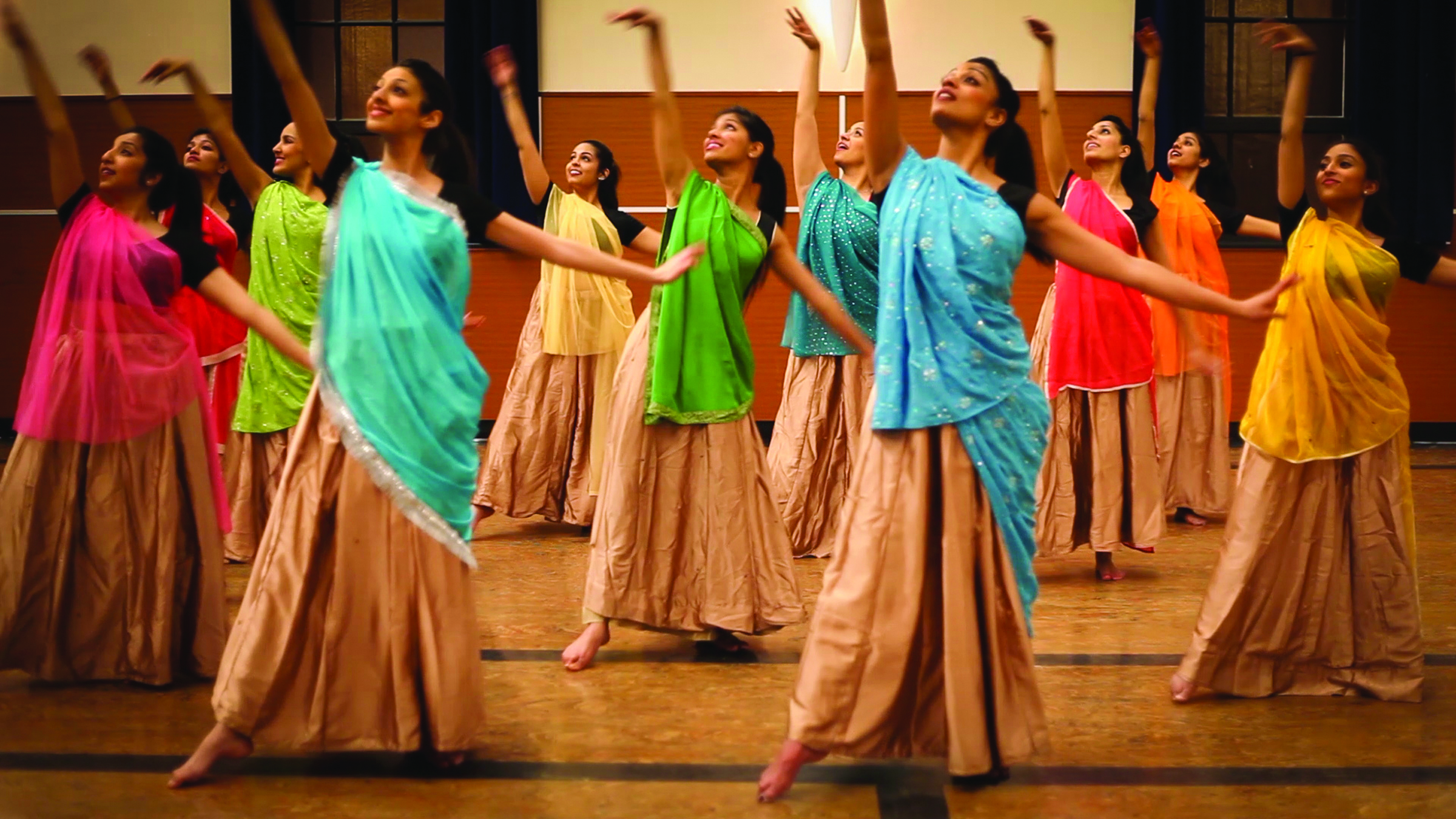
Vancouver, get ready to dance your heart out. The 10th annual Vancouver International Bhangra Celebration is a lively festival that will showcase music and dance from the Punjab region of India and Pakistan. Bhangra is a rhythmic folk dance that incorporates a blend of Punjabi music and Western influences. 

The aim of the event is to connect global communities as the performers each present a piece of their cultural heritage. Several local and international artists will be performing at places such as SFU Woodwards, Surrey City Hall, and the Vogue Theatre, to name a few. 

The festival kicks off with the Transfusion event and reception at SFU Woodwards on May 29. As the name suggests, the diverse range of performers at the event showcase a multitude of cultural and artistic boundaries. Among the performers are Now or Never, a hip hop breakdance crew; JCC Shalom Dancers, a dance group that celebrates Jewish heritage; and the Leela Dance Group which performs Indian classical and folk dance. 

Other performers include First Nations dance group Native Thunder and students from the Royal Academy of Bhangra. The Peak sat down with members of three of the crews to talk about their upcoming performances at the festival. 

The Now or Never crew was established in 1997 by a group of young people who shared the same interests in hip-hop dance. They have performed at a variety of venues ranging from South Asian weddings to the closing ceremony at the 2010 Winter Olympics. 

As for what they wish to take away from their upcoming performance at the Bhangra Festival, member Jhaymee Hizon says, “We are always open to learning and experiencing new things. We want to learn more about the South Asian culture and incorporate their [style of] dance into our show.”

The JCC Shalom Dancers have been going strong since 1981, dancing to showcase their Jewish culture and heritage. Member Marla Simcoff describes the group’s style as “a melting pot of styles. We do Eastern European and Turkish dance and incorporate it into a modern style of dance.” Since performing at the Yom Ha’azmaot (Israeli Independence Day) celebration in 1981, the group have become well known representatives of the Jewish community and history. As for the group dynamic, Simcoff says, “We are all in different stages of our lives. We have mothers, newlyweds, university students, and we are all united because we love to dance.” 

Leela Dance Group is an Indian dance group established by four choreographers who have been dancing together since they were kids. Incorporating a fusion of classical, structured Indian dance with the community oriented fun of folk dancing. Choreographer Monisha Manhas says of the group, “I enjoy the fusion of classical and folk dance as the classical style by itself can get lost on our younger generation.” 

The diverse showcase of cultures at this festival is truly something to celebrate; though the performers are from many different backgrounds, they are all united in their love of music and dance. Manhas characterizes this love well saying, “I think that people can create a deep emotional connection with music. Dance allows people to put a physical presence to that music. Even if people don’t understand the words, we can pull emotion from the music and put the emotions into our movement.”

Satellite Signals

0

WEB-woodward

Woodward’s

Thursday, May 22 to Sunday, May 25 was a busy weekend for SFU’s Arts campus, which hosted the second annual Spur festival. Founded by the Literary Review of Canada and Diaspora Dialogues, Spur offered solution-oriented presentations and debates on issues such as public transit, managing a public political persona, and maintaining a green city. Readings, literary cabarets, and film screenings were also offered.

surrey

Surrey

Surrey students looking to pad their resumes in the extracurricular sphere were in the right place last Thursday, May 22. Clubs Days was in full swing, offering a chance to sign up with groups such as the Aviation Club, BitCoin Club, Game Developers Clubs, and SFU’s Jazz band. Departmental student unions were also out in force, recruiting students to attend their upcoming meetings and functions.

vancouver

Harbour Centre

The unique literary wranglings of poets Phinder Dulai and Kim Minkus found the eager ears of Lunch Poems attendees at Harbour Centre’s Teck Gallery on Wednesday, May 21. The weekly poetry reading occurs at 1:00 p.m. and features Canadian word-smiths who entertain listeners free of charge.