Home Blog Page 1094

Board Shorts

0

Board extends application period for chairperson

The board voted to appoint Brandon Chapman as board chair for the remainder of the 2014 summer term.

The decision came after an extensive discussion, which concluded with the board going in-camera to discuss the merits of the potential candidates. Candidate profiles were presented by a task force, appointed on June 3, which was comprised of at-large representative Jeremy Pearce, VP student life Kayode Fatoba, president Chardaye Bueckert, and VP external relations Darwin Binesh.

Although the task force officially recommended Harp Palmer be appointed as the external chair, not all members of the task force were in agreement due to Palmer’s unavailability in August.

University Briefs

0

WEB-university briefs-ABCNews


UBC researchers conduct polls on driverless cars


PhD candidate AJung Moon is hoping to gauge public opinion on driverless vehicles through online polls as part of the Collaborative Advanced Robotics and Intelligent Systems (CARIS) lab at UBC.

The concept of driverless cars presents technical as well as moral dilemmas. One such question, presented in the latest polls and developed by philosophy PhD student Jason Millar, asks whether, in a scenario where an autonomous car is entering a tunnel and is about to hit a child, should it keep going, killing the child, or swerve into the wall, killing the passenger?

Since April, the group has been publishing a new poll every two weeks, allowing participants a chance to voice their opinions about the legislation and ethics of driverless cars.


With files from The Ubyssey


Acadia leads the charge against binge drinking


Acadia University has taken a leadership role in a collaborative effort made by institutions across the country to curb student drinking.

Since the alcohol-related death of first-year student Jonathan Andrew in 2011, the university has been on a mission to create awareness about binge drinking as a public health crisis. At a recent conference of the Canadian Association of College and University Student Services, keynote speaker and AU president Ray Ivany said that as a result of Andrew’s death, “Our campus changed forever.”

Ivany’s address called more to action, advocating systemic change as a solution to reduce the harms of high risk drinking. There are 30 post-secondary institutions involved in the collaborative so far.


With files from University Affairs
UofT student charged with high treason in Tajikistan


University of Toronto political science doctoral candidate Alexander Sodiqov is currently being held under arrest in his home country of Tajikistan for charges of high treason against the state.

Sodiqov was arrested on June 16 near the southern border shared with Afghanistan while he was interviewing Tajikistani activist Alim Sherzamonov for his project, “Rising Powers and Conflict Management in Central Asia,” which his supervisor, Edward Schatz, said aims to reduce violence in Tajikistan.

Schatz told The Varsity, “We hope that the professional, fair-minded individuals working in government structures in Tajikistan will recognize Alexander Sodiqov for who he is, which is a talented, young scholar.”


With files from The Varsity


Putting the pieces together with The Other Place

0

The Other Place cast

Like a good film full of plot twists and layered meaning, The Other Place is a play that will leave you wanting to see it again. As star Nick Hunnings explained, it will require another viewing to catch parts and clues you may have missed.

As the play develops, the audience begins to piece together the story. “There’s a moment when people will begin to piece it together,” he said, “but there will still be questions — provocative questions. You’ll have to retrace your steps. There will be moments you missed and clues in the script.”

Hunnings plays the male lead named Richard who is very close to the protagonist, Juliana (Chilton Crane). She is a researcher who is on the cusp of a breakthrough when her life takes a drastic turn. Hunnings said that his relationship with Juliana “explores the psychological landscape” and adds to the drama of the play.

Juliana is giving a lecture to colleagues at an exclusive Cape Cod resort when she sees something that sets her on a path to unravelling a mystery despite conflicting evidence, uncertainty and incomplete memories.

“When I first read the script I thought it was a psychological thriller with twists and turns and puzzle pieces that you have to put together,” said Hunnings.” He explained that the story is one that unfolds slowly.

“The first half of the play has a solid pace and envelops the audience in the story — you’re put on a train ride before you know it,” he explained, adding that the second act begins to weave together the story and the pace lightens a bit. This story requires that the audience pay close attention. “Audiences will have to piece it together,” he said. “It’s a really well told story and it will be different for everyone.”

Although this play is a drama, there’s a lot of humour and the script is very rich, said Hunnings. “There is every kind of moment — so it’s very authentic. The dialogue is very rich and little hints are dropped along the way,” he said. “Every character is driven to discover the driving force of the play, and it all revolves around a central driving problem,” explained Hunnings.

The characters are all trying to piece together their own lives as they also try to piece together this mystery of familial fallout. “There are elements of redemption, elements of closure, of wanting to discover truth. They’re all searching for answers,” said Hunnings, adding that there’s also suffering, relief, and old wounds as each of the characters navigates their own path while dealing with the circumstances. Without giving anything away, Hunnings said that central conflict of the play is something that is familiar for almost everybody.

This is the first time Hunnings has been involved with a play written by Sharr White, but he said that he loved the content and structure when he first read it. “The storytelling is so tight and authentic despite all the twists and turns,” he said. “This play forces the actor to do some work and it’s the work that the characters are doing.” The setting changes quite a bit throughout the play, explained Hunnings, saying that these changes mirror the landscape and arc of the story.

Sharr White’s The Other Place has impressed audiences on Broadway and the Vancouver production will be directed by Christy Webb. With so much drama, this play will keep you on the edge of your seat. “It’s really an adventure — a constant state of discovery, and new information always presents itself,” said Hunnings. “The audience will be affected, touched in a way that is not necessarily the heavy cathartic experience, but in a subtle, humane, authentic way. They will find themselves familiar with the people and the story.”

The Other Place will be presented from June 26 to 27 and July 1 to 5 at PAL Studio Theatre. For more information, visit theotherplacevancouver.ca.

Three draft picks the Canucks should choose

0

12112248755_b7fdc2753b_o

If there is one thing that can come out of last season’s dismal performance, it’s that the Canucks get the sixth overall pick at this year’s draft, and therefore a good chance to get a key piece for the future. It should be noted that any pick is a gamble and the further teams get from the top three prospects, the risk of a bust increases. Still, though, the Canucks have a good chance for a key guy.

Considering the Canucks’ offensive woes as of late, one would presume that they would be looking for someone to be a key offensive contributor, especially since last year’s ninth overall Bo Horvat is drawing questions about his offensive game, despite being great defensively.

Obviously, Sam Reinhart and Sam Bennett would be great additions, and will likely be the stars of their future team. However, it is unlikely they will drop past the third spot, and the price for trading up the draft (going from spot six to first overall for example) would be high, in my opinion. Probably too high.

With that being said, I would not be surprised to see the Canucks grab a few extra draft picks, namely in a possible Kesler trade. But I would think they would be later rather than earlier in the draft. That being said, here are some possible draft choices assuming the Canucks stay at sixth overall:

JAKE VIRTANEN – A 6’1” left winger for the Calgary Hitmen who is seventh overall on the International Scouting Services (ISS) Top 30 list of prospects. He is projected to be a power-forward and would bring both the toughness the Canucks want, and with 45 goals and a point per game pace in 71 games, the offensive production as well (at least in junior, which does not always translate, unfortunately.) A nice bonus is that he is from Abbotsford. However, on the negative, power-forwards often take a longer time to develop (see Kassian). He also recently suffered a shoulder injury that could hinder, or at least delay, development.

NICK RITCHIE – A 6’2” forward with the Peterborough Petes who is projected as tenth overall in the ISS rankings. He is also seen to be a tough power-forward in the making, with 39 goals over a point a game last season, and also notching 136 penalty minutes. He is bigger than Virtanen as well, lending well to the big, tough, but uptempo style the Canucks may try to build for. However, as with Virtanen, he may take longer to develop. TSN insider Bob McKenzie has noted that Ritchie has consistency issues, which could become a headache down the road.

NIKOLAJ EHLERS – A 5’11” Danish forward with the Halifax Mooseheads, who produced both the first and third overall picks last year, he is projected at eleventh overall by the ISS. Having scored 104 points and 49 goals in 63 games, Ehlers is equipped with great speed and hands. He would potentially have good chemistry with fellow Danish prospect Nicklas Jensen. However, his point totals may have been inflated by playing on a line with last year’s third overall Jonathan Drouin. As well, his 5’11” frame puts him on the small side, one reason last year’s Hunter Shinkaruk dropped to 24th overall.

In addition to these three, 5’11” center William Nylander Altelius provides a good option, as he will probably fall just outside of the first five picks, and many speculate that Michael Dal Colle, a 6’2” forward who the ISS has at third and generally agreed to be in the top five, may drop places in the draft.

Sustainable SFU launches premium harvest box program

0

This afternoon, Sustainable SFU launched its newest local food program, the FarmCity Co-Op’s Community Supported Agriculture (CSA) Box, at Cornerstone Town Square on Burnaby Mountain.

The initiative offers SFU community members the opportunity to subscribe to a weekly delivery of seasonal vegetables from a new cooperative of Metro Vancouver farmers.

The premium package, priced at $42 per week, will include a diverse mix of veggies direct from nine Metro Vancouver farms. The box will also include honey and fresh cut flowers; Sustainable SFU explained in a media release that, “bees and pollinators are a key component of healthy food systems.”

Several years ago, students and faculty came up with the idea to host a pocket market on Burnaby Campus, intending to bring local food up the mountain. However, as Mike Soron, executive director of Sustainable SFU, explained, “the market struggled to gain enough customers and vendors to really be successful, so we wanted to think of new ways of bringing local food to the mountain.”

With that in mind, Sustainable SFU began looking for a new partner and found their perfect match with the FarmCity Co-op. This community of small farms in southwestern British Columbia upholds the importance of “environmentally, socially, financially and ethically sustainable farming practices,” which fits within Sustainable SFU’s mandate to pursue a sustainable future at SFU campuses.

“Local food is healthy, it’s seasonal, it’s sustainable,” Soron said, whereas importing food from places such as New Zealand and California requires large amounts of water, fertilizers, and pesticides in production as well as fossil fuels and energy in transportation.

“By having [food] grown more locally at small farms, the ecological footprint in getting it to your table can often be much much smaller than having it be grown elsewhere,” Soron said.

Sustainable SFU already offers two similar harvest boxes: the Value Box and the Local Box. For $8.50 per week, students can receive at least seven varieties of fruits and vegetables, although they may be sourced from international producers. The Local Box, priced at $15.75 per week, also includes at least seven varieties of local of fruits and vegetables, but is sourced mostly from local producers in the Fraser Valley Region.

Although the FarmCity Co-Op CSA Box is significantly more expensive than previous options, Soron said that they wanted to present an option, “for someone who wanted to go the full mile and really commit to community supported agriculture, to sustainably grown produce by local farmers that they could email and talk to and really get to know.”

He continued, “The new box that we’re introducing this year is a little more costly than a full subscription, but really does offer that premium full experience of being involved with the local food economy.”

The CSA boxes will be available on Wednesday afternoons starting at 3:00 p.m. outside of Cornerstone and will continue to be available into October. Distributors will be joined by FarmCity’s “Fresh Cart” market stand, which will act as a “mini farmers’ market” and will sell the same produce available in the CSA boxes.

Professors Read Mean Reviews About Themselves

2

We caught up with a few SFU professors and engaged in some good old fashioned self-deprecation.

Professors Read Mean Reviews About Themselves

1

We caught up with a few SFU professors and engaged in some good old fashioned self-deprecation.

Contact [email protected] for inquiries.

Song: “Travelling Made-up Continents” by Gillicuddy (http://www.gillicuddy.com)

Toy Story

0


Dildo. A word I heard for the first time on a tire swing in grade two. It was used as a personal insult by one schoolboy to another: “Dude, you’re such a dildo!” The word itself fascinated me because it was such an effective gibe — its built-in alliteration, minimal syllables, and ability to conjure images of both Dilbert and a do-do bird simultaneously. In my eyes, this playground bully was a comic genius just waiting to be discovered.

It wasn’t until I started to use the word against my brother at daycare that it was explained to me that the term I found so hilarious actually describes a sexual object, and is generally considered an inappropriate conversation topic for an eight year-old.

Nowadays, living in the Internet Age, it’s increasingly rare to meet someone who doesn’t know the meaning of the word dildo. However, for those of you who would like to get better acquainted with the dildo — and its cousins, the vibrator, the butt plug, and the cock ring — here is a little Sex Toy 101 list of definitions.

There’s a sex toy out there for just about everyone.

Dildo: A phallic object usually made of silicone that is used for stimulation and/or penetration. It may be strapped on or double-ended, and is sometimes designed to resemble a more lifelike penis. This toy is manual, which means that it keeps going until your wrist gets sore.

Vibrator: A vibrating object used to stimulate nerves, usually in the clitoris but can also be used anally. Some plug into an electrical outlet, while others run on batteries and can be waterproof. They come in many different shapes and sizes and some also function as a dildo.

Butt Plug: Shorter than a dildo and with a flanged end, it is designed to be inserted into the rectum. Can be made of latex, silicone, or glass, and when paired with plenty of lube, can be moved in and out or left in for longer periods of time. 

Anal Beads: Not to be confused with a butt plug, anal beads consist of multiple balls strung together. The beads are inserted into the rectum then removed (typically upon orgasm) at various speeds to enhance pleasure.

Cock Ring: Typically worn around the base of the penis to slow blood flow to prolong an erection. Not to be confused with a Prince Albert piercing, cock rings can also be worn to restrain the testicles — some even include vibrators.

Penis Sleeve and Fleshlight: A cylindrical device used by inserting the penis into it. Often modelled in look and feel after vulvae or anuses, these penile toys replicate the sensation of intercourse.

Pumps: Used to temporarily enlarge and increase blood flow to any body part with erectile tissue, such as the penis, nipples, or clitoris. The pieces include the cylinder, the pump, and sometimes a hose or a sleeve.

Sex Machines or Sex Furniture: Chairs, stools, blocks, benches, blankets. Sex furniture makes sex easier for people with limited mobility, or who just want to get off the bed for a change. Made of material that’s easy to clean, some sex machines also hold dildos or vibrators that make for a hands-free fuck.

BDSM or bondage toys: BDSM, which stands for bondage and discipline (BD), dominance and submission (DS), and sadism and masochism (SM), can employ any number of toys for erotic pleasure. Some examples include restraints (belts, collars, cuffs), floggers and crops (used for whipping or spanking), nipple clamps, gags, and electro pads. No vanilla sex here, no sir.

DIY sex toys: Anything already at home used for pleasure! Some examples include a massaging showerhead, a vibrating toothbrush, cell phone, pillows, couch cushions, and fresh fruit. But please, for goodness’ sake, be careful and stay safe.

***

The history of the sex toy goes back a lot further than you might think. The oldest dildo discovered by modern humans is a 20 cm polished stone phallus excavated near Ulm, Germany. This toy is about 28,000 years old, which means it was likely used by people in the Ice Age to warm up — if you know what I mean.

In the Middle Ages, a plant called the Cantonese groin was soaked in water and used to imitate an erection, then used as a dildo. Other plants, such as bananas, were also used in Polynesian countries; the Kama Sutra, on the other hand, makes reference to dildos made of tubular stalks or reeds.

The word dildo actually comes from the italian word diletto, which means delight. This word is surprisingly in stark contrast with the word most historically associated with sex toys in the Western world: hysteria.

The first person to classify this epidemic was the ancient Greek physician and philosopher Hippocrates, as he and many of his contemporaries believed that women suffered from a condition known as hystera (later hysteria) — named after the Greek word for uterus. The ancient Greeks thought of the uterus as an animal that wandered around inside a woman’s body, causing illness: a “wandering womb,” as they called it, could cause serious mental and physical problems.

The cure? Women were given olisbos — a phallic object usually made of leather, wood or stone — to soothe the beast within.

For centuries, hysteria was considered a medical condition in need of professional treatment, lest women fall into the moral sin of masturbation. The Hippocratic symptoms associated with hysteria included difficulty breathing, swallowing, anxiety, and fits; these all stemmed from an affliction known as “suffocation of the womb.” Its cure? Pelvic massage. (Wink wink, nudge nudge, say no more.)

The result of the prescribed pelvic massages performed by doctors was a “hysterical paroxysm” — what you and I would recognize as an orgasm. You know: cumming, the big O, la petite mort. Since clitoral stimulation didn’t require intercourse, in those days, it wasn’t considered sexual; it was purely medical.

By the 1900s, hysteria had become one of the most commonly cited medical illnesses — people were complaining of hysteric symptoms about as often as they were fevers. Naturally, calls for increased medical treatment increased, and the sexually repressive Victorian era saw an incredible influx of women seeking medical treatment by paroxysm. This treatment became tiresome for the wrists and fingers of most practitioners, and so machines were built to accommodate.

“The Manipulator” was one of the first vibrating massagers, patented in 1869 by American physician George Taylor. This large, wooden table was equipped with a steam-powered vibrating sphere, which the patient would lay on. While it was apparently invented to treat pelvic disorders, Dr. Taylor did warn against “overindulgence,” and prescribed that patients be supervised during its use.

Just a little over a decade later, Dr. Joseph Mortimer Granville patented the first electromechanical vibrator. This machine had a 40 pound wet-cell battery, so while it was technically portable, there was still plenty of room for improvement.

At the 1900 Paris Exposition, many new types of portable medical massagers were introduced — not long afterwards, the vibrator began to move slowly from the doctor’s office to the bedroom. Did you know that the vibrator was the fifth widely available electric home appliance in North America? That’s right. Preceded only by the sewing machine, fan, kettle, and toaster, it’s clear that these buyers had their priorities straight.

In the first two decades after the turn of the century, vibrators were advertised and sold as essential home appliances, mostly to housewives. This period saw the advertisement of products such as Dr. Macaura’s Pulsocon Blood Circulator (hand crank), Vigor’s Horse-Action Saddle (vibrating chair), The American Vibrator (plugged into light bulb socket), and the White Cross Electric Vibrator (plugged into an electrical outlet, included with a myriad of applicators).

Advertisements of these products stressed their benefits without overtly mentioning anything sexual — but I’m sure any savvy reader knew what was up for grabs.

Whether it was society’s growing knowledge of female sexuality (and what those vibrators were actually being used for) or the appearance of vibrators in the stag (porn) films of the 1920s, advertisements for sex toys began to disappear from catalogues and magazines around 1930. But the toys themselves certainly didn’t go away.

The history of the sex toy between the 1930s and 1960s is pretty thin — people had learned to be discreet about their taboo bedroom habits — but sex toys maintained their popularity, leading to what is now a $15 billion industry. Among sex toy users, women are the biggest fans: in North America, 44 per cent of women between 18 and 60 have admitted to using a sex toy.

Sex toys have maintained their popularity, leading to what is now a $15 billion industry.

You may recognize some of the following products from snooping in your grandma’s room: the Miracle Ball-Grip Massager, the Wahl Hand-E Electric Vibrator, the Hollywood Vibra-Tone, or the Spot Reducer. There’s no way to know for sure, but come on; I’m pretty sure these were used for more than what was described on the box.

Predictably, the written history of the sex toy doesn’t pick up again until the sexual reawakening of the late 1960s and early 1970s. The electric vibrator wasn’t publicly reintroduced as a pleasure device until 1973 by Betty Dodson at a women’s sexuality conference. It was here that she promoted the use of the still-popular-today Hitachi Magic Wand — the vibrator to end all vibrators. 

Since that day, vibrators, dildos and everything in between have built up a large fanbase. Today, there are toys available that are more body-safe, versatile, waterproof, quiet, and effective than ever before; and, as it turns out, there’s a toy out there for just about everyone.

***

So what’s all the buzz about, anyways? Well, to start, orgasms have many health benefits: they’ve been known to suppress pain, relieve stress, and improve sleep. For folks who don’t have a significant other or fuck buddy on hand, a sex toy sure can come in hand-y.

Sex toys can also be adapted to meet a variety of their users’ needs — some toys can accommodate increased or decreased sensation, mobility and motor control issues, and fatigue, to name a few. 

Sex toys can also be crucial in defining a person’s sexuality, pleasure, and intimacy if they are living with a disability. For example, diseases such as multiple sclerosis can damage nerve pathways to sexual organs, and affect mobility and fatigue. Some vibrators which are inserted vaginally or anally — or worn as a ring around the penis — can be controlled with a remote, and some dildos can be fastened to harnesses or used with the help of a partner. Thanks to sex toys, people with physical disabilities can get off just as well as those without.

Speaking of sex toys in relationships, many of you may be wondering: why would you need one? Well, contrary to some beliefs that sex toys are only for lonely single folk, plenty of toys are used in couples because they provide different sensations than what another body part can. Why limit yourself, right?

As long as there is open communication, approaching your partner(s) about using a toy can be simple and fun. Some people with vulvae need clitoral stimulation in order to orgasm (hint: vibrator), and you’ll never know what a butt plug can do to spice up your sex (until you try it). There are also scores of sex toys that work better with two people than one (whips, cock rings with clitoral stimulators — the list goes on.

***

Hopefully I’ve piqued your interest as to what toys are available to you. The next step is to get out there and buy one already! For some expert advice on choosing a toy, I sat down with Brit Carpenter from Womyn’s Ware, Vancouver’s best sex-positive shop. What are they all about? “Helping people express themselves in healthy, positive ways,” says Carpenter. “We have everything out on display for people to feel and see if the controls work for them.”

When buying a toy, especially if it’s your first toy, it’s important to do your research. You should know what you’re looking for (BDSM toy, butt plug, cock ring, dildo, vibrator — pick your poison), as well as how much you’re willing to spend on it. If you’re shopping for a toy you plan to use with your partner(s), bring them along! “Come with enough time to really talk about it,” Carpenter suggests. “Do research and some self exploration and have an idea of what you’re after.”

Choosing a store to buy from is equally important. “Most of those XXX stores you walk into don’t have the research or education,” says Carpenter. “We do a lot of research to make sure that when an order comes in, it’s safe and it works and we can warrant it.” I recommend buying from a store that’s local, well-lit, clean, and where the staff is friendly and informed — it sure beats one of those dingy, windowless shops you tend to find in abandoned strip malls.

Of course, the most important thing to remember when buying a sex toy is that you are the expert on your own sexual health and pleasure. There are no wrong answers when it comes to picking the perfect sex toy for you; but that doesn’t mean there aren’t plenty of people and helpful resources that can help you on your way. Some of my favourite resources are local sex shop Womyn’s Ware; online toy retailer Come As You Are; webcomic Oh Joy! Sex Toy; and sexual health clinic Options, with locations across the Lower Mainland.

Well, what are you waiting for? Get out there and enjoy!

Study critiques Vancouver’s prostitution policies

0

Passed By

A recent study has concluded that the Nordic Model of prostitution laws could endanger sex trade workers even further and does not affect the demand for prostitution.

The Nordic Model, originating in Nordic nations such as Norway and Sweden, criminalizes the act of buying sex but not selling it — johns and pimps are prosecuted rather than sex trade workers themselves.

Conducted by UBC researchers and the Gender & Sexual Health Initiative (GHSI) of the BC Centre for Excellence in HIV/AIDS, the study found that the Vancouver Police Department’s (VPD) new policies — which focus on punishing clients — neither deterred prostitution nor increased the safety of sex trade workers.

Since the VPD’s policy shift, sex work related arrests have increased from 47 in 2012 to 71 in 2013, a 51 per cent increase. However, the report notes that there has been “no change in rates of work-related physical and sexual violence against sex workers” since the change in policy.

Andrea Krüsi, one of the authors of the report and a research assistant at GHSI, explained the results to The Peak: “In the context where clients are criminalized, it’s still in the shared interests of the client and the sex worker to be undetected by the police and so this led to women having to rush screening their clients [. . .] What they need to do is just hop into the car and hope for the best.”

The report states that the VPD’s new approach “severely limits street-based sex workers’ control over their health and safety due to [an] inability to screen clients or negotiate terms of transactions,” being forced to relocate to remote areas such as industrial areas, and an “inability to access police protection.”

In addition, due to the increased difficulty of targeting clients who are willing to risk potential criminal charges, many sex workers are forced to stay out longer, thus increasing their risk.

Krüsi added that, even though the police emphasized prioritizing the safety of sex workers, “sex workers were reluctant to report violence to police because they were worried that if they go to [the] police to report a violent client, that the police might use some of that information they give to refine their enforcement methods.”

“Our findings are very clear: that when clients are continued to be targets, the harms of criminalization are reproduced.”

Earlier this month, the federal government tabled new legislation on prostitution that would criminalize selling sex in areas where children under 18 are present. It would also criminalize advertisement of sex services, for which sex workers could face five years in prison. 

However, these new regulations would share the Nordic Model’s focus on clients by criminalizing the buying of sex, which was previously legal.

John Lowman, an SFU criminology professor, said that policies targeting just clients could be challenged as unconstitutional: “To have one party in what is a legally consenting adult relationship [. . .] held criminally responsible while the other party is not, is state-sponsored, institutionalized entrapment.”

Lowman expressed concern that new regulations designating areas where sex is criminalized could further endanger sex workers by forcing prostitution out of residential districts.

He explained that police enforced similar policies in the 1990s, and would not go after sex workers if they worked in places such as industrial districts. “That industrial area, which the police had turned into a red light district in the 1990s, became the killing field of Vancouver. That’s where Mr. Pickton picked up most of [his] victims,” said Lowman.

Both Lowman and the report state that decriminalization of sex work, with the potential for regulation and protection, is the best way to ensure the safety of sex workers, following the lead of countries such as New Zealand.

“[We should focus on] accepting that prostitution is a profession and is not inherently sexual abuse,” Krüsi told The Peak. “And therefore we should allow women, or sex workers in general to have working conditions that are conducive of safety and not make it harder to protect themselves.”

Japanese policies push young adults to procreate

1

CMYK-Japan wants baby-Pieterjan Vandaele-Flickr

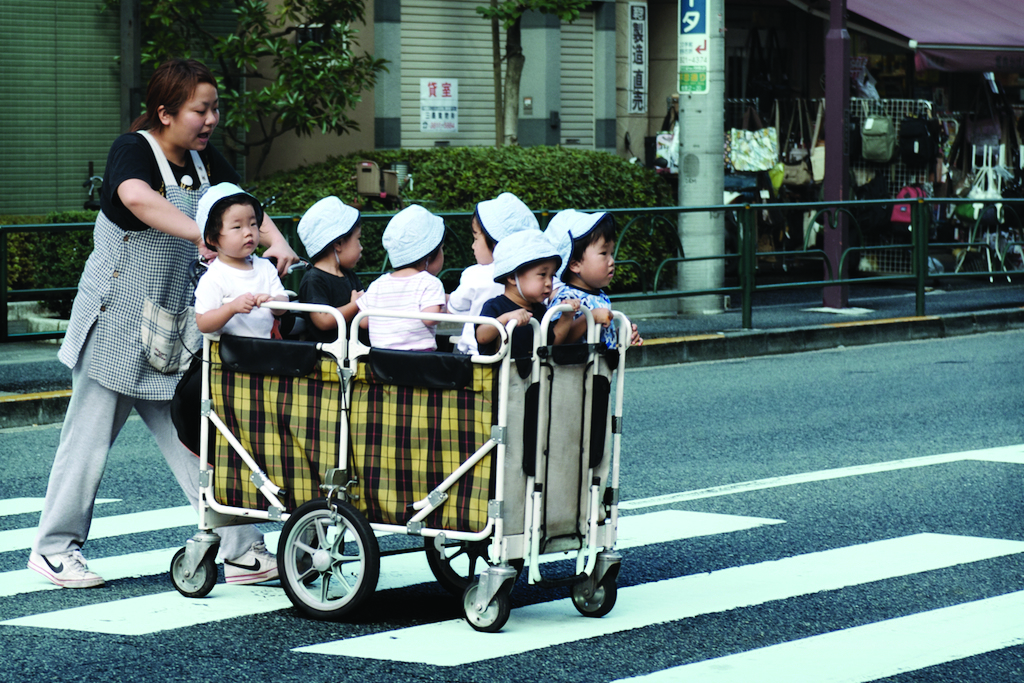
A Japanese member of parliament is taking the country’s population crisis into her own hands by promoting policies that would encourage Japan’s younger generations to get busy and start making babies.

By hosting national matchmaking parties and encouraging a return to old-style marriage introductions, Yuriko Koike hopes to increase the number of marriages in Japan from 600,000 in 2013 to one million by 2020. 

The government has put three billion yen towards this mission in a country that faces its lowest birth rate since 1899.

“Their problem is pretty serious,” professor of international studies Michael Howard told The Peak. “It’s not like they’re about to be hit by a tsunami or anything, but it’s looming pretty fast within the next decade, and the problem is that of course these things do take a long time to find solutions for.”

Shrinking by a record 244,000 people in 2013 alone, Japan’s population of 127 million is expected to fall to approximately 87 million by 2060, according to a recent analysis by government researchers.

Koike told The Telegraph that these policies are meant to revive the sort of old-school romance that gets lost in the midst of pursuing careers: “Younger generations, both men and women, complain that they have less opportunity to get to know each other. Japanese businessmen and women also work too long, normally until midnight, so there is no time to become acquainted with new people.”

Although these policies may seem unusual, other East Asian countries have pursued similar programs to combat falling population growth rates. In 2003, the Singapore government launched a “Love Boat” cruise service that offered couples a program of fertility seminars, massages, aphrodisiacs, and a night at a holiday resort — all designed to put couples in the mood.

“Singapore is a nice example of a country that has all these extreme policies to try to get people to have more children. [. . .] It doesn’t work very well,” said Howard. “They’ve tried everything you can with all the best frills in the world, but basically once you hit a certain level of development, you get women educated, and they’re just not going to have very many children.”

Japan’s current fertility rate is 1.4, which represents the average number of children a woman is expected to have over her lifetime. Koike explained that for Japanese women, it is often a choice between getting married and having children or having a career.

“To tell them to drop out of the workforce and produce 2.5 children or something like that, they’re not going to do it,” said Howard. “Outside of lining them up against a wall and threatening them to produce children I don’t know what’s going to work.”

One of the consequences of this decline in birth rates is a rapidly aging population. By 2055, international statistics organizations estimate that 38 per cent of the population will be over 65.

“Theoretically one could suppose that [Japan] could simply become a big retirement home,” said Howard.

Howard suggested that increased immigration may be the most effective solution to the population crisis. However, he said that Japan does “not have a history of being an immigrant-friendly country,” and this is therefore unlikely.

“These are things that are really tough to overcome [. . .] unless they can really come up with some policies that people are willing to agree with,” said Howard.

Until that happens, Howard said, “it’s just going to get worse.”