Home Blog Page 1086

What would Shakespeare do?

0

web-Equivocation

Bard on the Beach almost never presents plays that are not written by the Bard himself, but when they do, it is for good reason. Bill Cain’s tale of art and politics is a masterpiece of suspense and humour played by a cast of six talented actors. It is presented in partnership with the Belfry Theatre in Victoria, where it premiered this spring.

The story is set in Jacobean England in 1606 as Robert Cecil (Anousha Alamian), King James’ Prime Minister implores Shagspeare (Bob Frazer) to write a play titled The True Historie of the Gunpowder Plot. Shagspeare explains that he writes histories and plays based on events that happened in the past, but he does not do current events. 

The gunpowder plot was a terrorist plot led by Guy Fawkes to assassinate King James I and blow up Parliament, and Cecil is adamant that Shagspeare be the playwright to bring the story to life at the King’s request. Shagspeare has no choice but to agree and accepts Cecil’s payment. 

Under the direction of Richard Burbage (Gerry Mackay), Shagspeare and his Globe Theatre company (Anousha Alamian, Anton Lipovetsky, Shawn Macdonald) attempt to translate the story to the stage. As they delve further into the plot, they realize that the King’s version of the story might not be true, and they are forced to decide whether they can perform a story that they know to be false and damage their artistic integrity, or risk their lives by revealing the truth.

Bob Frazer is outstanding in the starring role of Shagspeare, and the relationship he has with his daughter Judith (Rachel Cairns) is so poignant. Judith has a beautiful soliloquy in which she laments about her disdain for soliloquies and plays in general, and I loved the moment when Shagspeare can finally look at Judith without grieving the loss of her twin, Hamnet. 

Anton Lipovetsky as a young King James, with his high-pitched voice as he called for his “Beagle” (Robert Cecil), was hilarious. Lipovetsky also played Sharpe, one of Shag’s actors who needs plenty of encouragement. Alamian as Cecil was also very impressive as he immediately switched from the limping, humpbacked Prime Minister to his other role as one of the actors.

Directed by Michael Shamata, Equivocation is full of references to the bard’s plays and humorous lines from Cecil about his work lasting at least 50 years. He also remarks that Shagspeare has the unique ability to make fun of a group of people during his plays, but have them laughing by the end. The construction of the play’s scenes is quite complex as they are interwoven and involve many quick character changes for the actors, but this cast seemed to pulled it off with ease and it was not difficult to follow. 

At its core, Equivocation is about posterity and how to tell the truth in difficult times, and it tackles these themes with intelligence, humour, and plenty of intrigue. According to Shagspeare, “We are all fools, we are all noble, we are all royal.” He tells his company of actors that they can play any role because they have it inside of them already. It was wonderful to get this glimpse of what it might have been like as Shakespeare directed his actors and dealt with the realities of being under the rule of the King. 

Equivocation runs from July 2 to September 19 at Bard on the Beach in Vanier Park. For more information, visit bardonthebeach.org.

Cymbeline is a modern drama

0

CMYK-Cymbeline

Late in his life, Shakespeare seemed to get a bit sentimental, writing plays that don’t fit neatly into one of his usual categories. Cymbeline is not exactly a tragedy, although it involves war; it’s not exactly a comedy, although it ends happily, and it’s not exactly a history, although it is about a king. The play is really a modern drama with elements of each and a happy Hollywood ending. 

Director Anita Rochon makes her Bard on the Beach debut with this small cast of seven who play multiple roles. The setting is ancient Britain where King Cymbeline (Gerry Mackay) is being threatened by the Romans. To Cymbeline’s dismay, his daughter, Imogen (Rachel Cairns), has married Posthumus (Anton Lipovetsky). Cymbeline had ordered her to marry his new wife’s son, Cloten (Lipovetsky), and he banishes Posthumus to Rome. In Rome, Posthumus meets the manipulative Iachimo (Bob Frazer), who makes a bet that he can seduce Imogen. 

Imogen is one of Shakespeare’s best female leads, and Cairns plays her with subtlety and elegance. Iachimo fails to seduce Imogen with his charms and resorts to hiding in a trunk to gain entry to her bedroom. Bob Frazer was perfectly cunning in this scene as he slinked out of the trunk and around Imogen’s bed. He takes a bracelet from her wrist that serves as evidence of Imogen’s infidelity, and Posthumus orders his servant, Pisanio (Anousha Alamian), to kill her. 

Pisanio leads Imogen into the mountains, but doesn’t plan to carry out his orders. Instead he tells her to go in search of Posthumus disguised as a boy named Fidele. She meets Belarius, a banished lord who has also disguised himself, and his two sons who are the King’s kidnapped sons. These three cave dwellers provide much of the comedy as they sing and go about their work.

Cloten, doting on Imogen and offended by her witty remarks, also provides many laughs. He disguises himself as Posthumus in order to try to win her affections, and seeing that Lipovetsky also played Posthumus, it was quite the feat to keep everything straight and make sure the audience wasn’t confused.

Along with Benjamin Elliott, Lipovetsky also played one of the King’s sons, and I lost track of how many times they ran across the stage to quickly throw on a costume piece and instantly assume their other identity. These rapid-fire costume and character changes added another level of humour that Cymbeline wouldn’t normally have.

Another added element to this production was the music by Benjamin Elliott. With a few instruments and relatively simple vocal harmonies all performed by the actors, this was the perfect final touch. 

Dealing with themes of forgiveness, hope, love, and the power to change, Cymbeline is a well-rounded story played by a small, talented cast. Although it is a lesser-known work of Shakespeare’s, I think it is among his best and deserves to be seen more often.     

Cymbeline runs from July 4 to September 17 at Bard on the Beach in Vanier Park. For more information, visit bardonthebeach.org.

SFU looks to the future with aboriginal academic summer camp

0

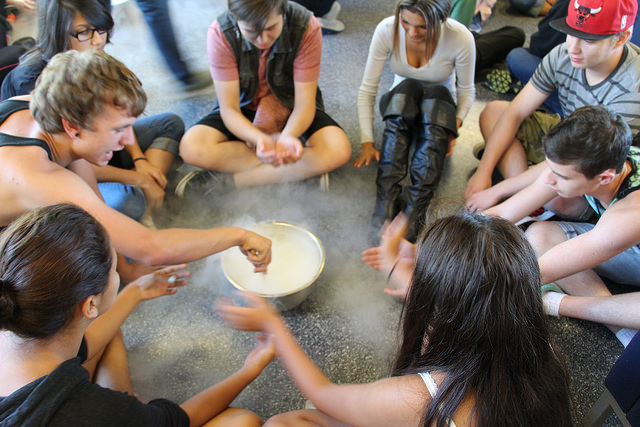
14604507894_1dcf82afce_zThis summer, SFU is offering its inaugural Academic Camp for Aboriginal Students from July 2to 31 at the Burnaby campus.

The camp’s attendees are aboriginal students from the Greater Vancouver area in grades eight to 11. The focus of the day-long sessions is math and english training, but they also expose the students to recreational activities, such as archery, as well as cultural activities that are organized by the Office for Aboriginal Peoples at SFU.

Some of the activities include meeting with elders, learning from Squamish performers how to dance and sing, and making dream catchers.

Veselin Jungic, an adjunct professor and associate chair in the math department, explained, “The purpose of the camp is to help aboriginal high school students in mathematics and English and to also introduce them to the academic environment [. . .] Most of the students are struggling with mathematics and they need another push to get the level of mathematics that will hopefully lead them to post-secondary education.”

Although the students are comprised of a mixture of different aboriginal ethnic backgrounds Jungic makes it clear that these differences do not affect the teaching method. He stated, “The students have an aboriginal background that we need to recognize and we need to support, but when it comes down to it, a math class is a math class and an English class is an English class.”

In BC, the aboriginal population represents 5.4 per cent of the total population. However, Jungic pointed out that at SFU, the aboriginal population represents just one per cent of the Faculty of Sciences and 0.8 per cent of the Faculty of Applied Sciences. This under representation of aboriginal students in applied sciences and sciences is one of many factors that led to the creation of this camp.

Jungic and the rest of the organizers of the Academic Camp for Aboriginal Students say their aim is not only to strengthen students’ understanding in math and English, but also to ignite a new interest in the students that will encourage them to continue into post-secondary education.

Jungic pointed out, “In my view it is not that aboriginal students should be enrolled in science, and applied science to be proportionately represented. It is a fact of life that without science and without applied science, you cannot become a doctor and you cannot become an accountant and you cannot become a lawyer, and that is why mathematics is so important.

“If the community is going to get these people involved in these careers than mathematics must be done.”


Apply!

0

fat-joe-money

Do you enjoy writing, getting your facts straight, and asking the hard questions? Or do you veer more towards graphic design, and creating beautiful layouts? How about creating high quality videos or photos?

Most importantly, would you like to be  paid to do those awesome things?

We’re currently accepting applicants for all of our Fall 2014 positions! The positions we’re hiring are:

To apply for a position, please send your resume and a cover letter to [email protected]. Please make clear in your cover letter which position(s) you are applying for. Inquiries about the positions and their qualifications can be sent to the same address.

The deadline to apply is August 1st.


Experimental Edge of Dance

0

MD The Three Cornered Hat photo Chris Randle

Another crop of contemporary dance works have graced Vancouver during the 26th annual Dancing on the Edge festival’s ten-day span. This year saw over 30 works, a strong partnership with the Scotiabank Dance Centre, many outdoor and site specific performances, and even a Family Dinner where the audiences were the guests at the table.

The mixed programs at Dancing on the Edge allow for a variety of choreographic styles in one evening, and the site specific works add another element of scenery, integrating the space into the work, but I opted to attend five of the full programs this year to see some full-length works by developed and emerging artists.

Ottawa Dance Directive presented three vastly different pieces and showed off a lot more than their choreographic skills. Their first piece, Fracture by Yvonne Coutts, was very funny and broke down the fourth wall before we even realized it. Riley Sims casually walked onstage eating a bag of nuts while talking directly to the audience and explaining nonchalantly that at first he wasn’t supposed to be in the piece, but then they were able to get more funding so he was included.

Sims spends much of the piece observing Jasmine Inns and Marilou Lepine dancing as he seems left out and eager to join them. The dynamic of the two girls dancing with Sims as an added afterthought worked well and Sims contributed plenty of humorous commentary. Out of the three works they presented, this was the most enjoyable.

Their second piece, Trembleherd Bells by Ted Robinson, had five dancers all in white garments and there were large bells placed around the stage. One of the dancers had a book and, at first, seemed to be in a position of authority as the others moved around in a trance, shaking and ringing the bells off and on. When all of the dancers picked up the bells and rang them vigorously, it felt like the whole theatre was one giant bell and we were the clapper swinging from side to side. It was quite the experience and left a lot to be interpreted.

For the final piece of the night, Noam Gagnon’s sho me wut u gut began with the same five dancers in sharp business attire as they romped around the stage and imitated a sort of animalistic need for sexual pleasure. They grabbed each other, rolled around, and generally got frisky. If you are uncomfortable watching other people be intimate, it probably would’ve been the least of your worries. They progressed to removing their clothes and continued to push and pull each other around the stage. There were some beautifully tender moments, but overall this piece wasn’t very pleasant.

Vanessa Goodman’s company, The Contingency Plan, presented What Belongs to You at the Scotiabank Dance Centre. The five dancers in this show are athletic and powerful, and they are full of subtle emotion that comes across through their movements. This work used balloons to create various costuming and scenic effects that I thought were very clever.

The dancers began with balloons covering their bodies as the music grew in volume and intensity and the dim lighting rose to reveal them. As they moved, the balloons slowly fell off one by one. The balloons were central to the work as fans blew them into a whirlwind centre stage and one of the dancers slowly moved in the middle of this balloon tornado. The work is described as being motivated by human desire and led by the senses, and I think that came across well as the dancers were propelled by one another’s energy and performed impressive lifts and moved in unison.

Mascall Dance’s The Three Cornered Hat was my first experience at the eclectic Chapel Arts venue. A few rows of chairs were arranged around a low stage, and this work immersed the audience in a few ways. Piles of red notebooks dominated the stage and served as many things throughout the show. There was a mop that had an open notebook as its base, a notebook on a fishing rod that they dropped onto a few laps to recite journal entries, and notebooks with lights instead of pages.

Before the show, Jennifer Mascall said that the show is like a book club where everyone is sharing their own story. With such a richly visualized concept and the wonderful use of these red notebooks, I loved the humour and intelligence of this piece.

That same evening at Chapel Arts Edmond Kilpatrick, another experienced choreographer, presented Four Intimate Pieces. Along with Ziyian Kwan and Anne Cooper he shared vulnerable moments of his life through narration and they translated these experiences into movement. One intense scene had Kilpatrick and Kwan in a heated couple’s argument followed by a physical exchange that was loving but coloured with anger. Allowing raw emotions to guide their movements, this sparse work took a while for me to get into. I think the opening section could have been shortened or benefited from some more narration to guide the audience.

The final night of Dancing on the Edge was Karen Jamieson’s. Her project, solo|soul, was the culmination of three years of research and danced conversations with other Vancouver dance artists. Through this work Jamieson wanted to explore the relationship between the inner meditative body and the outward focused, performative body that is used in dance.

The work felt as though I was observing one long meditation, and for an audience, it is difficult to feel as invested when the performer is not focused on their outward, performative side. Jamieson danced in the centre of a circle of lights, in front of blurry video projections adapted from her creative process with other dancers, and with John Korsrud playing trumpet around the outside of the circle. I think for the audience it was hard to grasp the concept that Jamieson was after, but it was a unique experience to watch a performer who is so connected to their inner world while on stage.

Celebrating 30 years of her company at this year’s festival, Karen Jamieson’s work was a fitting way to end a festival that supports emerging and established artists alike and allows for collaboration, diversity, and a forum for choreographers to show their works each year.

Something’s fishy at SFU’s reflection pond

0

CMYK-Koi-horizontal-Anderson Wang copy

Concerns regarding the dumping of unwanted pet fish into Burnaby lakes and ponds has been brought to public attention in a recent article published by Burnaby Now.

The article stated that a local pet shop has been misinforming customers, claiming that SFU’s Burnaby campus welcomes any unwanted koi fish in the university’s reflection pond.

Recalling the release of a predatory snakehead fish into Burnaby Lake in 2012, it is not news that invasive species may pose a detrimental threat to Burnaby’s natural habitat. However, many people still believe they are doing the ‘right thing’ by releasing their unwanted fish into the wild.

Stephanie Green, an SFU PhD graduate from the Department of Biological Sciences, told The Peak that although people believe they are doing the right thing, it only takes a few individuals to release invasive species into the wild before they can “spread out of control.”

Green explained that because of the interconnectivity of ponds, lakes and rivers, “once an introduced species takes hold, it is very difficult to eradicate completely because of how quickly they can spread.”

Green emphasized how important it is for pet owners to be conscious of the needs of a fish, as well as how large it gets and its dietary needs, before buying it in order to avoid the problem of individuals purchasing a fish that they are unable to care for.

The article in Burnaby Now revealed that staff at a Petsmart in Vancouver were implying that it was acceptable to dump unwanted fish into Coquitlam ponds as well as SFU’s reflection pond. In an attempt to clarify this issue, Keith Horne, superintendent for SFU Mechanical Services, informed The Peak that, “it is NOT permitted to dump fish in any pond at SFU.”

Not only is this illegal, with fines ranging from $2,500 to $250,000, but the introduction of new fish may alter a pond’s fragile ecosystem, leading to issues such as overpopulation or illness among the fish population.

During routine draining and cleaning of the reflection pool, the fish are captured and housed at SFU’s Alcan Aquatic Research Centre until the cleaning is complete.

Although it is unclear as to whether the fish population has altered due to the dumping of unwanted fish into the reflection pond or by naturally occurring reproduction, one thing is sure: the dumping of unfamiliar fish into the reflection pond poses a detrimental threat to the fish already living there.

Bruce Leighton, an associate member of SFU’s Department of Biological Sciences, said, “[The] dumping of fish in the pond at SFU brings a disease risk to the fish that live in the pond.” Leighton added that the reflection pond is “already at capacity [for fish]”, thus adding more could lead to overpopulation, resulting in death for some of its piscine residents.

So, if you find yourself developing animosity towards your fishy companion, think twice before discarding it in a local pond. Instead, “find a pet store that will take it in,” as Green suggests.

How to Save the CBC

0


Jian Ghomeshi has the perfect voice for broadcasting. His deep, smooth clarity that brims with authority makes speaking on radio seem effortless. “I’m not on the air simply advocating for my job right now, or even for my incredible team,” he articulates. “Rather, I believe in this institution. Plain and simple.”

These words aired April 11, 2014 on Q with Jian Ghomeshi, an arts and culture program featured on CBC Radio One, and the highest-rated show at its time-slot in CBC history. “I was a supporter of the CBC even before I worked here, and I will be long after I’m gone. That is, depending on what the CBC becomes down the road.” Ghomeshi was referring to the CBC’s abounding number of recent job cuts resulting from a dizzying spiral of economic and political hardships the broadcaster has faced.

The government’s recent drastic cuts in funding for the CBC have only increased the financial strain the corporation has been facing since 1985. Now, with its outright dismissal of 657 jobs and loss of hockey broadcasting rights to Rogers Communications, the extinction of the CBC has never been more probable.

The Clash of Funding and Interests

Known to many as the ‘Mother Corp,’ the Canadian Broadcasting Corporation was created in 1936 to model the BBC, the most prestigious broadcaster in the world. CBC was conceived to counter the influx of American programming that had been penetrating the airwaves across the border, to promote Canadian culture and national unity, and to reduce the growing tensions between Anglophone and Francophone citizens.

Today, the CBC operates with a level of complexity that is unprecedented. Across six time zones, it broadcasts 88 radio stations, 27 television stations, three all-digital services, and 16 specialty services in English, French and eight different Aboriginal languages. Being a public-service broadcaster, it seeks to enlighten, inform, and entertain Canadians from coast to coast, giving our culture a voice and providing us with a unique sense of Canada’s place in the world.

Unfortunately, the CBC’s ability to fulfill its mandate has been beclouded by government and corporate interests, the main obstacle being one of funding. CBC’s current annual budget is just over $1.5 billion. One billion of this is garnered from public appropriation and funding from the federal government, while the rest is brought in by commercial revenues.

On March 29, 2012, Ottawa announced a slew of financial cuts to the CBC, leaving the broadcaster with a loss of $115 million over the succeeding three years.
And the numbers worsen: On April 10, 2014, the CBC was forced to cut a further $130 million from its budget for the year. Consequently, the broadcaster was left with no choice but to eliminate 657 employees, a dramatic move that left all CBC supporters, myself included, alarmed and disheartened.

The CBC gives our culture a voice and provides us with a unique sense of Canada’s place in the world.

Linden MacIntyre, a CBC employee and public figure known for his 24-year run as host of television program The Fifth Estate, was so shaken that he announced his retirement from the CBC by the end of this summer. His aims are to save jobs for young employees, he told The Star on May 8.

“Even if you’ve never heard of most of the 657 jobs and people that are being cut, they’re all essential to this organization,” he states. “The energies, imagination and the future of an institution depends on the intake of young people [. . .] They will acquire everything I have acquired and more.”

Along with loss of government funding, the CBC has been battling steep declines in its commercial and ad revenues. On May 6, 2014, the broadcaster reported that its ad revenues had decreased by 11 per cent from the previous year, leaving its total at $331 million. As a new way of life approaches and advertising quickly treks into the digital realm, the CBC may have no choice but to follow in its footsteps.

Losing these funds will undoubtedly bring a plethora of changes to the broadcaster — in particular, to CBC Television. Among these changes will likely be the loss of original Canadian programs, the replacement of high-cost reality series with lower costing ones, and the cancellation of late night news in the north.

On June 26, 2014, CBC reported that because its priorities will shift from traditional broadcast to digital, a layoff of up to 1,500 employees will occur by 2020. Additionally, 90 minute evening newscasts will be stripped down to 30 minutes.

The CBC Says ‘Goodbye’ to Hockey

Perhaps the biggest blow yet to the CBC occurred just last year, on November 26, 2013.

This was the day that CBC said a tearful adios to its hockey broadcasting rights as they fell into the arms of Rogers Communications. The big league telecom company wrested control of NHL multimedia with a mammoth 12-year, $5.2 billion agreement that would re-brand and re-shape Hockey Night in Canada (HNIC).

For most Canadians, the sport of hockey flows through our cultural blood. Over time, the sport has connected us and defined us as the proud nation that we are. Over the past 78 years, HNIC has been the crown jewel of the CBC, beginning on radio in 1936, and seeing its first television broadcast in 1952. HNIC has built up a legion of dedicated fans, as well as part-time watchers.

To lose HNIC would not only be a blow to our cultural identity, but just may be the breaking point for CBC. Due to the abundance of ads displayed during game hours and the program’s high audience rates, HNIC has consistently delivered over half of the broadcaster’s ad revenue.

“Funding [for the CBC] needs to be separated from the whims of political interference.”– Dr. Kathleen Cross, professor of Communications at SFU

Furthermore, a CBC bereft of hockey leaves almost 400 hours of open TV time-slotting, and in order to fulfill the Canadian Radio-television and Telecommunications Commission (CRTC)’s minimum 60 per cent yearly Canadian content requirement, it will need to come up with a lot of original Canadian programming, and fast. This is programming that the CBC, sadly, does not have the money or time to produce with sufficient quality.

Losing hockey has proven to be much worse than recent federal cuts and will be a game changer (pun intended) for our broadcaster. Such occurrences are the duty of the Friends of Canadian Broadcasting Organization to monitor and make comment on.

Since 1985, Friends, based out of Toronto, has been a non-profit watchdog group for Canadian programming, with a mission to intervene, defend, and enhance the quality of Canadian content. Though many have called CBC’s loss of hockey the beginning of the end for the broadcaster, some at Friends feel differently.

Ian Morrison, a spokesperson for the organization, says the loss of hockey may be serendipitous, should CBC manage adequate funding. In a press release from October 2012, he stated that this loss could make the CBC less commercial, and “open new and exciting possibilities [for the CBC] to operate more like a public broadcaster in sharp distinction from its private sector competitors.” Without advertising to drive corporate interests, the broadcaster just might have the freedom to fulfill its mandate of enlightening the public with content fit to shape the citizens of a proper democracy.

Radio: Canada’s Surviving Medium

But what about CBC Radio? How is this medium holding up commercially? The reality that not many anticipated is that CBC Radio is flourishing remarkably compared to its TV sector.

Though heavily impacted by federal cuts, CBC Radio One has not been subject to ad revenue stress, as there are absolutely no advertisements on air. Along with being the most historical broadcast medium, Radio One has virtually no American competition, and produces an astonishingly high standard of Canadian-content programs, including news, politics, and culture.
Long-standing shows such as As It Happens, Quirks and Quarks, and The Current offer fresh voices on news and culture privy to being Canadian.

I’m quite accustomed to radio; for years, my household has awoken to the sound of the bubbling coffee maker and World Report emanating from the kitchen. I feel the programs I’ve listened to have both educated me and have given me a more distinct sense of my place as a Canadian. I can confidently state that CBC Radio has outlived the commercial hardships, while consistently producing content in sync with the CBC’s mandate.

CBC Online is also progressing fairly well. With its foot in the doorway to the digital age, it makes for a decent supplement to TV and radio broadcasting. Digital-savvy users are able to skim through content at their will, picking out the information that is most relevant to them. Even if CBC’s TV presence will wane, it seems that its radio and web presences will stay strong.

Public Broadcasting and True Quality

It’s clear that public broadcast TV has found itself in the tight clutches of commercialism, and has experienced far greater funding withdrawals than its sister media. Wade Rowland, author of Saving the CBC: Balancing Profit and Public Service, recognizes that commercial influence seems to have entranced the CBC with a fixation on ratings.
Commercial markets use ratings to measure program quality. The problem with this system, however, is that they only measure the number of heads; if a program receives a large number of views, then its marketers view this program as successful.

High ratings seem to be dependent on thrill and spectacle — how entertaining programs are. This has twisted recent news programs into what’s been termed as ‘infotainment,’ a style where settings are flashy, anchors are more photogenic than skilled, and the news is permeated with crime stories and fluff that otherwise have no significance to the viewer.

Of course, high ratings do not reflect the true quality of any program.

This is where public-service broadcasting steps in. Its aims are cultural rather than economic: to enhance public life and enrich all individual lives. According to Rowland, the true quality of a news program lies in leaving viewers as better, more informed and involved citizens.

Apart from exploring and criticizing society, true quality means that content must appeal to a broad range of tastes and interests. Public broadcasting can provide programs for particular ethnic, cultural, gender, and minority interests — those that are, for the most part, denied or ignored by corporate media.

Dr. Robert Hackett is a professor specializing in journalism and media studies at Simon Fraser University. He has completed several content analyses of CBC-TV News during his career, as well as a Newswatch Canada study comparing how the corporate press covers CBC versus commercial broadcasters.

“Public broadcasting is essential to simulating a public sphere,” Hackett says. “[It is] a space where different segments of society can engage in conversation on matters of common concern, in principle free from domination by powerful or wealthy private interests.”

Dr. Hackett goes on to cite the “strong correlation between robust public broadcasting in a media system, and the level of political information and engagement amongst the citizenry.”

Unfortunately, the current Canadian government has been less sympathetic to the concept of public broadcasting than any other government in Canadian history. It’s even more disheartening that, due to the American oversaturation of corporate media in Canada, many of my peers are confused or even clueless as to what public broadcasting even is, and what the political and cultural differences between Canada and the United States are.

What will we be as a country if CBC is no longer, and our culture becomes so integrated with America’s that we can’t distinguish it from our own? It’s a sad and frightening point, worsened by how close it has come to being a reality.

Is there any way to save the CBC?

The opposition facing our national broadcaster is so daunting, it seems difficult to think of any way to liberate the CBC from its mess. But apart from eliminating all of its commercial influences, there are still a few strategies left that could help rejuvenate the CBC, and our cultural identity along with it.

The first is to create a style of funding similar to that of the BBC. Britain’s public broadcaster is outstanding not only due to the quality of its programming, but because it is entirely publicly funded. While Canadians pay $29 each year for CBC, every Brit with a TV shells over about $270 CAD yearly. This is enough to make them choke on their biscuits and tea if their programming ever dipped below quality.

Do we want corporate media to define us, or would we rather define ourselves?

Dr. Kathleen Cross, a professor of communications at SFU with a research background in politics and news media, feels a different style of funding is the first and foremost priority for saving the broadcaster.

“Funding [for the CBC] needs to be separated from the whims of political interference,” she says. “CBC will always be vulnerable to punitive funding cuts, as we have seen for years, from a sitting government who doesn’t like to be held to account. The BBC model is a better model for funding.”

Kross also proposes another option. She states that “we need the appointment of CBC board members to be separate from political interference.” I wholeheartedly agree; the CBC president is currently appointed by the federal cabinet. Talk about political bias! For the past 50 years, these board members have all — I repeat, all — been men with interest in accounting and finance.

The CBC needs board members who are diverse in both interests and gender, ones who are at arm’s length from the government, who understand and are passionate about the values of public broadcasting.

I would also suggest that the CBC solicit proper funding to open its production studios to original programs once again. While shows such as Heartland, Republic of Doyle, and Murdoch Mysteries reflect Canadian settings and values, they are among a select few.

I’ll admit, I’m caught off guard when I see things that are distinctly Canadian in film and TV. I feel a twinge of renewed pride in my country; I feel a sense of belonging that’s previously been stifled. These are valuable feelings I wish would spread throughout Canada — they are long overdue!

Finally, in light of the digital age we live in, traditional broadcasting should expand and evolve with digital and social media. But as a digital deficit infiltrates our nation, we need to find inventive, low-cost ways to support our content creators.

Reilly Yeo is a community engagement specialist for OpenMedia.ca, based here in Vancouver. Apart from her previous work with Amnesty International and The Walrus magazine, Yeo directed the Reimagine CBC project in early 2012. Through a forum, Yeo and 10,940 other Canadians crafted a clear, low-cost proposal for CBC’s future in the digital age, which was subsequently reported to CBC President Hubert Lacroix.

“I believe that public institutions should follow the guidance of the public,” Yeo told The Peak. “[The CBC should] create participatory processes that can meaningfully empower the people who love CBC to defend and strengthen it.

“This is particularly important in the digital age, where we have new opportunities to connect people all across the country, [and] new challenges as old funding models — particularly investigative journalism — are breaking down.”

Yeo suggests that the CBC expand its digital services by creating more online participatory processes, to allow for active citizen engagement in accordance with its mandate.
The Reimagine CBC website also proposes the broadcaster should “enrich the digital ecosystem with the best content of CBC’s past and present, freeing the CBC archives and bringing television and radio online.” This could be accomplished by creating a no cost CBC-Netflix competitor, from which users could enjoy content from an archive of on-demand information, with legendary programs such as Canada, A People’s History.

A National Conversation: Who are we as Canadians?

While researching for this piece, I stumbled across a blog entitled CBC Exposed. The webpage, while haphazardly designed and littered with profanity, serves as a watchdog and collective of pro-privatization news stories on the CBC.

The site claims that CBC is an arrogant, wasteful operation that abuses Canadian citizens of our tax dollars which could instead be used for healthcare and education. That it plagues the media with a liberal bias and lack of transparency. That it is very clear — to them at least — that Canadians want the CBC privatized.

This is simply untrue. I am Canadian, and I’d like nothing other than for the CBC to remain public.

While I understand and respect the views of those against the CBC, I feel there’s a fundamental lack of understanding as to what the CBC is, and why it hasn’t clearly fulfilled its mandate recently. I’ll admit its quality has deteriorated, but this is chiefly due to government and commercial influence.

Yes, our tax dollars could be spent elsewhere. Yes, other public broadcasters could play the CBC’s role, though likely on a much smaller scale. But the CBC provides Canada with a single, central hub for democratic information and debate. It creates a public space for us to discuss national issues such as healthcare and education, so that we can decide, as a unified country, where our tax dollars should go.

It creates a national consciousness, and this is a public necessity.

If not for the CBC, who would serve language minorities and other communities to make them known throughout Canada? Who would ensure that Aboriginals remain intrinsic to our heritage? Privatized media certainly will not — they’ll ultimately look after their own interests, instead of the interests of the Canadian people.
I care about our broadcaster. I echo what CBC President Hubert Lacroix has proclaimed. If we care about the CBC, it’s time for us to embark on a national conversation about the future of our heritage, democracy, and our place in the media industry.

Who do we want to be as Canadians? Do we want corporate media to define us — and distort us in the process — or would we rather define ourselves? I sincerely hope you believe in the latter.

As Jian Ghomeshi brings his plea to a close, he leaves us with a profound message: “If you don’t believe in public broadcasting that’s a perfectly legitimate point of view. But, if you do, then maybe it’s time to assert yourselves, Canada; and frankly, maybe its time for those of us who work [at the CBC] to do so too.”


SFU scientists recognized as “World’s Most Influential Scientific Minds”

0


CMYK-The World’s Most Influential Scientific Minds- 2014-SFU

Three SFU scientists have made Thomson Reuter’s list of The World’s Most Influential Scientific Minds: 2014 (WMISM).

The three honourees — Marco Marra, Fiona Brinkman, and Steven Jones — are among 90 Canadians on the list of 3,215 researchers from around the world.

This list drew from 21 fields in the sciences and the social sciences, from space to psychology, and was created based on the number of citations each researcher’s papers received in their first year of publication. When a paper is cited, this means that another scientist is using it as a reference.

One of the three on the list, Fiona Brinkman, an SFU professor in the Department of Molecular Biology and Biochemistry, with cross appointments in the School of Computer Science and Faculty of Health Science, has been recognized for her contributions to computer science. 

A self-proclaimed “computer-geek,” growing up Brinkman felt that combining her interest in learning about life and using computers was the natural thing to do.

Her research focuses on developing more holistic and sustainable approaches to infectious disease control. This means that instead of only focusing on the disease-causing agent, her lab also looks at the host and disease causing factors in society and the environment. 

Brinkman’s research supports a trend of more specific treatment in medicine; instead of relying on the ‘shotgun approach’ to treating bacterial infections, which often results in antibiotic resistance, Brinkman wants to “put selective pressure on [bacteria] so that we can co-exist without them being able to make us ill.”

Her research also hopes to make the tracking and control of infections more efficient. This can have important implications not only for human disease, but also agriculture and aquaculture, and prevent negative economic impacts on affected areas.

Marra was the second most cited researcher in Canada in 2014.

Another recognized scientist, Steven Jones, is an SFU professor as well as a member of the bioinformatics group at Canada’s Michael Smith Genome Sciences Centre. Jones works alongside the third member of the trio, Marco Marra, researching malignancy in tumors using DNA sequencing and bioinformatics approaches.

Marra is an adjunct professor in SFU’s Department of Molecular Biology and Biochemistry; he was the second most cited researcher in Canada in 2014.

Using next-generation DNA sequencing technology, their research focuses on unraveling the mutational landscape of cancer. This is accomplished by analyzing the genetic code of tumors to understand the mutations that accumulate over time and result in the formation of cancer. 

Jones explained that “colon cancers from two different people might look identical under the microscope,” however they may not respond the same way to a treatment. By looking at the genetic code of the tumor he intends to learn why this may occur.

Marra added, “We are not going to sequence a cancer and know everything there is to know about all [of them].”

With better understanding of the genetic profile of a patient’s tumor, one can also avoid unnecessary treatments and ensure that the patient receives only the treatment they need, Jones explained.

This research supports a change in the way medical practitioners approach the treatment of cancer since there is now clear genetic evidence to suggest that no single treatment can serve as a cure for the disease.

Jones noted, “It’s nice that [Thomson Reuter’s list] is based on metric and not on opinions.” He added, “Many of the works that are being cited took many years of hard work.”

While Marra does not work specifically in drug development, some of his research has influenced the potential use of therapies that are currently being developed and tested.

Marra commented on what it means for him to be acknowledged on the Thomson Reuter’s list: “In some respects, it’s better than an award. It indicates that there is a general appreciation for the work my group publishes.

“It means we’ve had an impact, we’ve helped move science in some direction, and that’s to me really what science is all about. Sharing results, sharing information, and stimulating other work elsewhere, so I feel good about that.”

New anti-spam laws aren’t all they’re cracked up to be

3

CMYK-Spam-JerryGuo

For Canada Day, our country’s Parliament gave Canadians a birthday present: an anti-spam legislation that would ensure electronic users have the option to free themselves from the suffocation of Internet spam.

 The new legislation was praised by many as an important step for Canadians to control where their digital information goes. However, further research has me a little disheartened. This new law may not help un-clutter our inboxes at all.

 As of July 1, commercial businesses across the true north are now required to ask their customers for express (meaning deliberate or conscious) consent to recieve commercial messages via email, text, and social media, to provide clear identification of the company or individual sending the message, and to provide an obvious “unsubscribe” button should users want to cancel their torture.

This rather abrupt legislation has had companies shaking in their boots as they frantically fine-tune their spamming methods to avoid penalties that make the law one of the toughest to date — up to $1 million per violation for an individual, and $10 million per company.

But after Canada finally enacted the law, Canadians were given another unsuspecting birthday surprise: a hell of a lot more spam. Inboxes, including my own, began filling with relentless emails that begged and pleaded to be approved, emails from companies I didn’t even know I’d been involved with.

“Please!” Viagra sobbed. “Click ‘I agree’ so I can keep bombarding you with products you won’t need for another 40 years!”

Professional spammers will undoubtedly try to edge past the new system.

While some inboxes were flooded with hundreds of emails, other issues arose as well. Canada’s long-forgotten Personal Information Protection and Electronic Documents Act (PIPEDA) dragged itself feebly from beneath the mounds and reminded us that we already had an anti-spam law in place. PIPEDA then shook its head in defeat as Canadians realized the extent to which businesses had poorly adhered to its original privacy laws.

And while the new laws may benefit users in preventing large-scale companies from defecating in our computer screens, it unfortunately hinders small businesses from expanding and becoming successful. As one business owner told the CBC on June 24, “We find we can connect with like-minded customers [through social media. . .]  We would rather be spending our time with our customers than trying to figure out how to do this properly so we don’t get fined ridiculous fees.”

On another note, it shouldn’t come as a surprise that professional spammers will undoubtedly try to edge past the new system. Out-of-country spamming is an option which would not be subject to penalty. Spammers could also create more enticing mechanisms to capture and tempt those curious consumer eyes.

But what bothers me the most about this new legislation is that Canadians already had the tools to protect their privacy and prevent commercial annoyances. Most email accounts are equipped with a spam-sorter, where users can input those pesky addresses into the system and permanently block them. If, maybe, we had a little more patience, we could find the time to pluck the rotten from the ripe and save ourselves the future online hassles.

While this was an attempt to empower us with online privacy, I fear this new legislation will simply be useless. When the power of the human mind and the Internet’s precarious nature combine forces, our law-makers will realize they spent all that time and effort for nothing.

Album Review: Lana Del Rey – Ultraviolence

1

LanaDelRey-WKTDJ

When Lana Del Rey sings “Being a mistress on the side / It might not appeal to fools like you / We been around on the side / Wanna be somethin’ you would do” on “Sad Girl” and “Guns and summer time / Chica, cherry, cola, lime / Prison isn’t nothin’ to me / If you’ll be by my side” on “Florida Kilos,” it’s not immediately obvious what she’s saying, but the lyrics are pretty clear once spelled out. 

Listening to lyrics such as these off Del Rey’s newest album, Ultraviolence, her voice — that doesn’t enunciate 98 per cent of the time — shows how she continues to appeal to critics and fans with recycled material in a sultry voice, over slightly different melodies. Her third studio album provides the charm needed to win listeners over, but it’s nothing we haven’t heard (or could barely hear) from her before. 

Ultraviolence is hypnotic. Songs such as “Brooklyn Baby,” “Money Power Glory,” and the title track are sung in a passive voice, asking you to subconsciously tap a finger or start bobbing your head. It’s probably how she does it, actually: sneaks into your ears with that subtly sexy voice, accompanied by rhythmic snares and guitars. Yeah, you’re swaying, but you don’t know what the heck to. 

That’s what’s problematic about the album. Without paying attention to lyrics, or knowing which song is on exactly, you can’t differentiate when the album is on its next track. It essentially all sounds the same. As moments are repeated throughout the album, you can pick out sections that you could’ve sworn you’d heard before during a previous song. 

It’s not just melodies that are cut-and-pasted, but images as well. The image of an innocent girl falling apart appears in multiple forms, and the words “little,” “red,” “party,” and “dress” have been arranged into her past albums. Her repetitiveness shows the limits of her creativity. We get it, Lana, you’re a sad girl in a cute little dress. Can we see another party trick now?  

Yet, the album has been positively reviewed with comments such as Del Rey is growing more into her voice. And that’s probably the only thing we can unanimously agree on. Despite how boring and hauntingly monotonous her voice is, the girl’s got a set of golden, old Hollywood pipes on her. It’s a shame she may be getting too comfortable in this persona, instead of trying out new forms of singing and songwriting. 

I like to think the album is a success because it’s consistent with Del Rey’s work, which is why I can’t stop listening to it and trying to decipher what she’s saying. But I was expecting more from her — perhaps for her to dabble in different genres, or to hear a different vocal style. 

Then again, it’s only her third album so there’s not much to differentiate from. Ultraviolence has me torn, hoping to uncover another “Summertime Sadness” on the album. Maybe Lana just won’t be my summertime jam this year.