Home Blog Page 1078

Engineering grad lights up the night with Tron-inspired helmets

0

Movie magic from the Tron franchise has moved from the mainframe into the mainstream. Thanks to the efforts of SFU engineering graduate Thomas Plywaczewski, everyone can ride their motorcycles while donning helmets that glow in the dark — just like the ones in the movie Tron.

Inspired by the movie and his passion for motorcycles, Plywaczewski designed and developed his first LightMode helmet in 2013 to increase his own visibility while riding his 2003 Honda CBR 600RR. Plywaczewski is now taking orders for anyone who wishes to own one of these helmets.

With the help of his good friend Amanda Lee, an SFU business graduate, the small company is optimizing motorcycle helmet visibility by affixing them with electroluminescent materials that do not compromise the structural integrity of the helmet.

Plywaczewski explained that there’s hardly any additional weight to the helmet from the technology, and a single charge can last for months, depending on how often you ride at night. The lights turn on with the push of a button, and improve rider safety in a way that, until now, has never been released in the market.

Plywaczewski told The Peak that in its current capacity, the company provides either pre-wired helmets or a kit for consumers. “In the kit, I provide all the materials and instructions in a DVD format so people can just go step by step and make this themselves.”

The kits come with electroluminescent material and a battery-powered controller. With simple step-by-step instructions, customers will have their helmet in minutes, illuminating the night streets of Vancouver much like the characters in the movie.

The company is optimizing motorcycle helmet visibility with electroluminescent materials.

Through a Kickstarter campaign, the startup hoped to achieve their funding goals by the end of August 2014. At time of press, the campaign has raised $15,002 — a number significantly higher than their original $2,400 goal, which was reached in just seven and a half hours. The team plans to put the money to good use, covering all the materials, shipping costs, and website fees, as well as marketing to satisfy the growing number of orders.

The product has already surpassed domestic demand, as suppliers in the United States, Australia, Japan, Russia and India have contacted Plywaczewski to order large quantities for their own customers looking to buy the helmets.

“I’m hoping [. . .] to ship everything out by the end of September,” he said. “All those hiccups and things like that, I going to try to minimize as best I can.”

In the next few years the company hopes to move away from the do-it-yourself kits and start manufacturing the helmets in the thousands.
CMYK-Tron-1-Anderson Wang

The Mariners are actually pretty good this year

0
Mariners pitcher Felix Hernandez.

For the first time since 2001, the Seattle Mariners could have a playoff run. It’s good to see our MLB home team do well after so many years of struggling and mediocrity.

In prior years, in every Mariners game that I watched, the hits were few. If they did win, it was likely because of pitching, with a maximum score of three runs. I even have a Mariners program from last year that admits to their mediocrity, and at least implies an unwillingness to spend money. When your own team-made program questions the team, you know that you’ve got problems.

This year, however, something’s different. The team can hit, as evidenced in games such as the Mariners’ thumping of the Toronto Blue Jays 11-1. They have also shown remarkable resilience — in one game, the Boston Red Sox were up 3-0 in the ninth inning, yet the Mariners fought back scoring five runs, with the majority of them coming after two outs.

They probably have the best pitcher in the league with Felix Hernandez.

To be honest, I don’t know what it is. Truthfully, I don’t watch baseball to see what happens every single night, but I do know that the turnaround is amazing. Maybe it’s the fact that the Mariners did spend some big money with Robinson Cano, plying him from the Yankees, or perhaps it’s the new manager.

It should be noted, with pitching as one of the few bright spots of the Mariners of old, well, they have still got it. They have probably have the best pitcher in the league with Felix Hernandez, and the other pitchers are not slouches either.

This year looks like it could be a great year for the Mariners.Wouldn’t that be something,  a Super Bowl and a World Series in the same year?

But I shouldn’t get too ahead of myself. For one, they still have to make the playoffs, which is far from a given in the MLB where only ten of the teams make the playoffs. And two, I probably just jinxed them. Oh well, I guess.

(A)side jab: It is also nice to see the Toronto Blue Jays slumping. Initially when the Mariners met the Jays in early August they were neck and neck in the playoff race. However, now the Jays are a pretty significant six and a half games back (as of Tuesday, August 26).

It’s always nice to see a Toronto team fall, whether it be the Maple Leafs or the Blue Jays. And for those of you who want to say that the Jays are our home team, well, Seattle’s a lot closer than Toronto, and in my books, the real home team.

Third generation Italian-Canadians return to their roots

0
This research may provide insight into the relationships inside other diaspora groups.

Using an online survey entitled “Being Ethnic: Third Generation Italian Identity in Vancouver,” SFU research associate, Eva Sajoo, has moved one step closer to understanding the implications of being a third generation Italian immigrant in Canada.

Sponsored by the Institute for Diaspora Research & Engagement and the Centre for the Comparative Study of Muslim Societies and Cultures, the research project conducted various interviews with Italian-Canadians in order to better understand how they describe their identity and sense of community.

Sajoo’s preliminary results indicate that third generation immigrants may have an increased interest in their lineage than prior generations, who often distance themselves from what they see as their parents’ old country.

Sajoo initially observed her brothers showing an increased interest in personal roots, and after expanding into other ethnic groups, began to see a trend. When she spoke with Mauro Vescera, the director of the Italian Cultural Centre (Il Centro), he noted the same phenomenon in Italian immigrants, which sparked a collaboration on the study.

Sajoo told The Peak that the study involves a brief online survey. “We are asking third generation Italians — anyone whose grandparents came to Canada from Italy — what Italian identity means to them,” she said.

Sajoo continued, “The most important question is how they describe themselves. Do they think of themselves as primarily Italian, Italian-Canadian, Canadian, or something else?  We are trying to understand what factors affect how a person relates to their family history in constructing their own sense of identity.”

Prior generations often distance themselves from what they see as their parents’ old country.

She also noted the variety in immigrant communities across the country, saying that “this study attempts to provide some insight into how identity evolves over time in one community.”

The Italian Cultural Centre will use the research to adapt to the changing needs of their community. Sajoo said, “Ultimately, the results will not only tell us something about Italian-Canadian youth in Vancouver, but will be a point of comparison for future studies of other communities.”

She concluded, “The research is important because we live in an increasingly mobile, globalized world. Diaspora groups — communities which live in one country but retain some kind of connection to their country of origin — are going to be increasingly common.

“As a result, understanding how individuals preserve parts of one identity while also participating and belonging to their local community is going to be of ongoing interest.”

The online survey will be open until the end of September, with results likely published by the end of the year.

SFSS club raises Greek life question

3
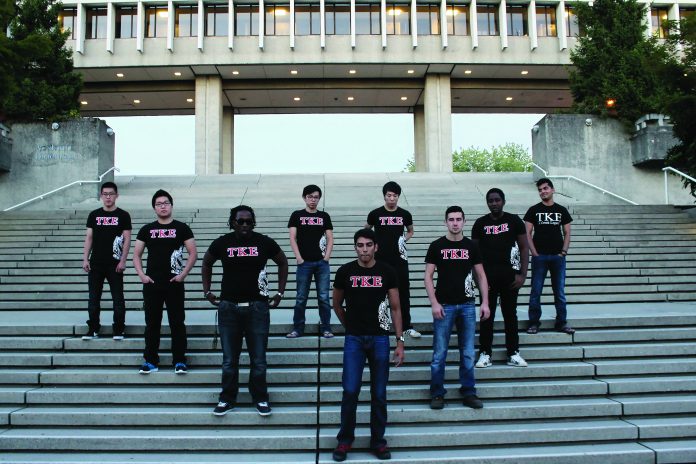
The SFU chapter of Tau Kappa Epsilon is working with the SFSS to get Greek life recognized on campus.

The status of Greek life at SFU has once again been called into question, as the SFSS board of directors recently brought the discussion to the table.

The issue concerns Grid Representation and Interest Development (GRID), the club through which fraternities and sororities are able to function on campus. While taking no official stance on Greek life as a society, the board moved last Tuesday to grant GRID temporary registration for one more year, during which they will assist GRID in approaching SFU for recognition.

While the group is a ‘friend’ of the SFSS, neither it nor its subsequent Greek societies have ever been recognized by the university.

GRID has expressed to the SFSS that they would like assistance in lifting the ban on fraternities and sororities.

The motion carried by board allows GRID to continue being registered until September 1, 2015, but only in accordance with a letter of agreement (LOA), which outlines some guidelines for operation. After this date, GRID will no longer operate as a club. The motion also tasked members of the board to assist the group in seeking recognition from the university.

SFSS president Chardaye Bueckert spoke to the purpose of the LOA, saying, “There were concerns about behaviours that the Greek societies were engaging in.” These behaviours could potentially pose a liability issue for the society.

In the past, fraternities and sororities on campus have violated various SFSS bylaws. At-large representative Rebecca Langmead explained, “Previously, our issues [have come up because] our bylaws clearly state that there should be no gender divisions [in clubs], that they’re all inclusive for all members, and this does not seem to be the way that these sororities and these fraternities are running.”

She continued, “[These policies ensure] that the SFSS is an LGBTQ+ space and our understanding is that GRID itself does not violate those concerns, but the fraternities and sororities that GRID represents do.”

Addressing the board, Bueckert said, “If we sign this, it’s a win-win-win with the understanding that the student society has not taken a position. We obviously can do so, if there is desire from the membership and from our board.”

“There were concerns about behaviours that the Greek societies were engaging in.”

Chardaye Bueckert, SFSS president

While the SFSS currently has no formal position on Greek life at SFU, the university administration has not changed its official stance since SFU opened its doors. The SFU council — a body whose activities now fall to senate — reported in 1966 that “fraternities and sororities are not desirable on this university campus. This is also the view of the majority of the Simon Fraser students who turned out to vote on a referendum concerning this issue on March 22, 1966.”

Since 1966, however, there has been a shift in attitude, with more student groups showing an interest in adopting Greek life at SFU. In 2008, the SFSS held a non-binding plebiscite purely to gauge student interest in having the ban on fraternities and sororities lifted. The SFSS reported that the referendum “passed in favour of fraternities and sororities by a narrow margin.”

SFU’s associate vice-president, students, Tim Rahilly, informed The Peak that, in recent years, SFU has not been approached by any Greek societies to form a formal relationship.

He expressed that if the university did receive such a request, it would warrant reopening the discussion: “[The year] 1966 was a long time ago, and I’d hazard to guess that there aren’t many people part of that dialogue today who were also part of it back then.”

He spoke to some of the potential merits of Greek societies, such as community building, though maintained that there are many alternate ways to achieve the same things: “Some of the goals that these organizations talk about in terms of student involvement are things that I personally agree with. I think that might be great.”

Nevertheless, Rahilly anticipates that there might be opposition to what some view as Greek life culture. “I think the concern that many people have is what comes along with this kind of traditional view of fraternities and sororities. There’s a lot of collateral damage that seems to come with it,” he said.

The SFSS will continue to work with GRID in pursuit of recognition from SFU, as long as they honour the statutes of the LOA. “We would like to work with the university to accomplish that,” stated Langmead.

A new coach, a new hope

0
Chapdelaine’s praise of the players’ work ethic makes one optimistic for the new season.

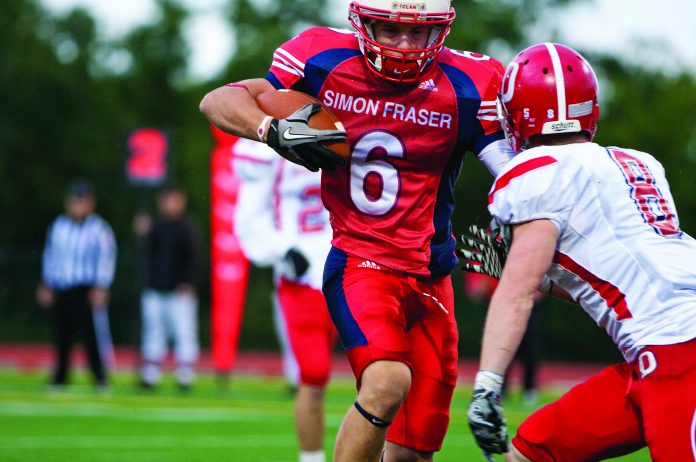
SFU football has yet to post a winning season since joining the NCAA. However, with new head coach Jacques Chapdelaine, the team looks to change that this season.

Chapdelaine, who was most recently the offensive coordinator for the BC Lions, a position he held from 2010 to 2013, and previously 2005 to 2006, hopes to use his experience to make the Clan a stronger offensive team.

“Offensively, I think we’ll probably have more formations and probably a greater variety of patterns to associate with that using quite a bit of pocket movement so the quarterback is in the same spot, which should help also with the protection schemes,” said the coach.

However, Chapdelaine’s new systems are not just limited to offense. He also intends to bring in a safer, more reliable defense.

“I think we’re moving forward. They’ve [. . .] really turned it into a positive experience.”

“We’ll probably be relying more on the front four on defense to put pressure on the quarterback as opposed to having a pretty steady stream of blitz pressure like they did last year, leaving the coverage more vulnerable when they did that.”

SFU has good reason to put their trust in coach Chapdelaine. In his first head coaching job with Laval University, he won the team their first Vanier Cup, the CIS championship, in 1999. He has also won two Grey Cups as an offensive coordinator and has been on the coaching staff for three Grey Cup victories.

Ultimately, it comes down to the players, and although having five Clan members drafted by the CFL looks good on the program, it also means losing some key players. Despite this, Chapdelaine is convinced that the team is up to the challenge.

“The biggest change on our team from last year would be the veterans moving on, [. . . as there are] some spots we need to fill,” he added. “But at the same time, we’ve had some guys who have stepped up and really done a good job.”

In particular, he mentioned Quinn Courtney and Michael Couture as quality candidates to fill in the holes on the offensive line. The coach, however, wants to credit the whole team for their work ethic and ability to adapt to his new systems.

“I think we’re moving forward. They’ve picked up the challenges of having a new system and [they’ve] really turned it into a positive experience.”

For a winning season to occur, though, Chapdelaine says that the team needs to work on its consistency.  “At this point in time, because these are new schemes for them, they need to develop consistency through repetition. Repetition will be crucial in order to have a successful season.”

Chapdelaine’s praise of his team’s hard work indicates a bright future. The games have yet to be played, and until then it will be hard to judge the Clan, but for now it seems like this could be their season.

The Clan play their first home game against the Menlo College Oaks on Saturday, September 6 at 12:00 p.m.

Volleyball team poised to take next step

0
With much of the team returning, there is no need to worry about chemistry.

Last season, the Clan volleyball saw marked improvement, posting a 6-12 record in the GNAC. Although it wasn’t a winning record, it certainly beat the previous two seasons which had just one win each.

Now, they must look to improve on that record with the help of head coach Gina Schmidt, now in her second year. Schmidt was brought in to right the ship after three seasons with only six conference wins.

This task should be made easier by the fact that the majority of team is returning this season, as opposed to the high amount of turnover in some years.

“Being able to have a similar core group of players from one season to the next will be huge.”

“We do have a lot of returners, so that’s helped definitely in some respects as we have a lot of veterans on the team, [. . .] so we’re going to rely on their experience for sure,” Schmidt said.

She elaborated, explaining the significance of returners in certain positions, “Previous to this season, some of our older players have had a different setter every year. This is the first time they have had the same setter for two consecutive seasons and that’s kind of like having a quarterback that changes every year.

“That continuity, being able to have a similar core group of players from one season to the next will be huge. There’s a lot of team chemistry in volleyball, so the more you can get that team to be cohesive in the court, [. . .] that’s all going to definitely help.”

One of the areas that Schmidt believes the team needs to work on is offense. She explained, “We’ve spent a big part of our spring training increasing our offensive efficiency, so just creating more kills for ourselves, reducing our errors, and increasing our team hitting percentage.

“On the defensive side of the ball [we are working on] trying to control more digs which allow us to create more kills [. . .] out of our defense.”

In a GNAC coaches poll, the Clan were picked to finish seventh in the conference (out of ten), matching the place they achieved last season. For good or bad, this is by no means a given — the Clan could certainly move in either direction, whether up or down.

The volleyball team has an opportunity to take that next step, continuing their progress from a struggling team to a true contender. Whether they take that next step has yet to be seen, but the ball is in their court.

The Clan play their first home game against the Columbia Bible College Bearcats on Thursday, September 4 at 7 p.m.

Clan set to continue domination

0
The Clan look for a fifth straight GNAC title.

When it comes to SFU men’s soccer, the question isn’t about if the team will have success, it’s about how much success.

Even before they hit the pitch, the Clan succeeded in claiming the top spot of the Great Northwest Athletic Conference (GNAC) coaches’ poll for the fourth consecutive year. This is the fruit of what was a considerably staggering season of success last year, during when the team led the nation in points (211) and broke a GNAC goal scoring record with a tally of 77.

Now, after the first week of training, the squad has hit the ground running with wins in all three pre-season matches. After just their first day of training, the Clan battled well in their early test against Kwantlen the following day, notching five goals and successfully maintaining a shutout.

“We are always glad when we win, [. . .] but there are times that show we have work to do.”

The Clan continued on the right foot with two more victories against University of Saskatchewan, the first a 4-1 result at home before battling to a 1-0 result two days later versus the Huskies. For head coach Alan Koch, it remains business as usual, as he is both modest and hopeful for a repeat of seasons past.

“We are always glad when we win, but you can tell it’s still early days because we’ve showed some good glimpses of what we can do, but there are times that show we have work to do.”

The repeat Coach of the Year hopes to quickly gel together a new look squad, which will include the return of eight starters from last season. Returning are GNAC Defender of the Year Alex Rowley, GNAC Newcomer of the Year Magnus Kristensen, and a trio of captains in midfielder Jovan Blagojevic, defender Alex Kleefeldt, and goalkeeper Brandon Watson.

“This year we have less holes to fill, but more depth in the quality of the recruited class coming in,” said Koch. “All three of our captains played major minutes and major roles last year. All are different personas in separate positions so they compliment each other very well and it’s great to have leaders in different positions.”

A formidable set of newcomers will grace the field for SFU this season, and the competition for spots will be a great fuel for success. Pascal Schmidt joins the team after playing at home in Germany for the VFB Stuttgart youth team; fellow countryman Kleefeldt will surely be a great mentor as the two players take hold in defence.

The local talents of goalkeeper Christian Zimmerman (Delta) and striker Michael North (Coquitlam) will further reinforce the side. Both players come from Mountain United FC, where Zimmerman starred for the U-18 squad, and North scored 17 goals in 15 appearances for the U-17 team.

The Clan will aim for a third consecutive NCAA final four appearance and a fifth straight GNAC title this season, as they hope to continue their dominance in the NCAA.

The Clan play their first home game against the Sonoma State Seawolves on Thursday, September 4 at 7:30 p.m.

Mistreated Native women: the government must take action

0

As Canadians become increasingly aware of the disproportionate amount of violence that Aboriginal women and girls across the country face, support for a federal inquiry into the issue has gained momentum. However, the federal government’s inaction serves as a reminder that Aboriginal women continue to face various race-related hurdles when it comes to receiving both the respect and services they are entitled to.

While Aboriginal women make up just 4.3 per cent of the female population, they account for roughly 16 per cent of all female homicide victims. Over 1,000 Aboriginal women were confirmed missing or murdered between 1980 and 2012. As of 2006, 36 per cent of Aboriginal women were living in poverty, with many in isolated communities or communities with few relevant resources. They were also less likely than non-Aboriginal women to have completed high school or post-secondary education, making it more difficult to break the cycle.

Combine these factors with a political system and society that continues to discriminate against them, and their disproportionate victimization no longer seems like such a mystery.

Unfortunately, the federal government continues to pretend that the institutionalized factors contributing to this over-representation are not relevant. Stephen Harper made this very clear by stating, “We should not view this as a sociological phenomenon. We should view this as crime.”

This plays into the rosy Canadian belief that we are a harmonious, peaceful nation that was horribly racist — but only in the past! The attitude that people should just ‘get over’ traumatizing practices that persisted well into the 20th century (such as the residential schools), is unrealistic, unhealthy and incredibly insensitive.

Aboriginal women account for roughly 16 per cent of all female homicide victims.

Harper has apparently failed to realize that crime and sociological phenomena are not mutually exclusive. To approach these tragedies as isolated events may lead to justice for individual families, but will do nothing to prevent these tragedies from recurring.

To make matters worse, there are hundreds of authoritative examples that do not take suffering Native communities seriously. These range from mishandling domestic abuse cases to ignoring signs of a serial killer preying on the vulnerable.

Even when reported, missing Aboriginal women receive 27 times less media coverage than white women, a phenomenon called ‘Missing White Woman Syndrome.’ Along the now infamous Highway of Tears, Aboriginal women had been disappearing for almost 30 years before the disappearance of a young white woman brought serious media and law enforcement attention to the area.

While there are arguably more effective alternatives to a national inquiry, there is no excuse for doing nothing. Considering the range of factors that contribute to these tragedies, the question should be where to start, not whether anything should be done at all.

In his statement, Harper tried to justify this inaction saying, “We brought in laws across this country that I think are having more effect in terms of crimes of violence against not just Aboriginal women, but women and persons more generally.” This is inaccurate; while the number of female non-Aboriginal homicide victims has dropped, the percentage of female Aboriginal victims increased from nine per cent in 1980 to 23 per cent in 2012.

The federal government continues to send the message that Canada does not value young Aboriginal people and that they are not worthy of resources. Tina Fontaine, and all those who suffered before her, deserved more than to be filed away under ‘helpless Aboriginal victim,’ and the government must take appropriate action so that this ongoing tragedy comes to an end.

The United Players get Scandalous

0

Promising to be “a glimpse into a part of our history,” The United Players production of the classic School for Scandal will open on September 5. Written in 1777 by Richard Brinsley Sheridan, this play takes the intrigue of creating and avoiding gossip in London to the stage.

Director and set designer Matthew Bissett spoke of his excitement to be working with The United Players on their 55th anniversary. Bissett is known for his work with the Ensemble Theatre Company on their production of The Farmsworth Invention, an engrossing play that comments on the invention of the television. As an ex-opera director, his eye for classic works has lent itself splendidly to School for Scandal.

The play itself is a wonderful union of the past and present in a most unreal way. Bissett describes the work as an “artificial play, [where] people [. . .] pose like paintings. The language is complicated and beautiful.” The set, instead of focusing on realism, highlights the artistry of the language.

Consisting of a series of empty picture frames, according to Bissett, the set allows the actors to step out of the action and play with the audience. Elaborate costumes and acting add a sumptuous tone to the whole production.

The play follows various storylines, and explores many topics, such as those of greed and love. “There’s an old, rich man who has married a country girl,” Bissett says, explaining that the man thinks his wife will stay a country girl forever, but things quickly change when he brings her into the hustle and bustle of London. In another storyline, a man returns from his travels with great riches, and must decide to give his fortune to one of his two nephews. Drama and hilarity ensue.

Bissett describes the play as highly comedic, filled with misunderstandings and wild chaos, saying, “There is a reason it’s been done for so long.” School for Scandal was a huge hit in its time, and has been consistently revamped over the last 200 years. “It has never gone out of style,” says Bissett, “the writing is very clever, and it’s fun for everyone.”

In The United Players’ production, there is an attempt at modernity and uniqueness in how the play is performed. “This helps to express the universality of the message,” says Bissett, and it allows the audience to identify with the story. He says that people being recognizable is extremely important, as it allows the play to talk to a modern audience.

School for Scandal promises to be an enlightening work, full of large skirts, and larger laughs. The universal message, speaking on the human obsession over gossip “hints at [us] not having changed” as a society after all these years, says Bissett. Made for “people who love words,” this play entertains and teaches lessons about the marriage of media and gossip.

The United Player’s cast of 15 will soon take to the stage, asking the viewer to question the role and scope of media interaction in our lives. Truly a treat to see, The United Players will bring a sleek and modern twist to a timeless classic.

School for Scandal will be presented by The United Players at the Jericho Arts Centre from September 5 to 28. For more information, visit unitedplayers.com.


SUB project enters Working Drawings Phase

0
Unlike blueprints, the working drawings allow for more design elements in the plans.

Having translated the space program into physical drawings of the SFSS Student Union Building (SUB) and determined all design decisions for construction, the Build SFU SUB project will move into the final stage of the architectural design development phase this fall.

Beginning in September and set to finish by Spring 2015, Build SFU’s Working Drawings Phase will see the creation of documents that include the detailed requirements for construction. These will consist of all the architectural drawings and specifications necessary to complete the project.

“We’re about halfway through the design phase right now,” said Marc Fontaine, general manager of Build SFU. “So far the project is moving exactly as scheduled which is quite good for major projects like this.”

Fontaine explained exactly what the Working Drawings Phase entails: “Right now these are designs but they’re not blueprints [. . .] A lot of it is basically the architects taking these plans and refining them, planning out where absolutely everything will be for the SUB, such as wires for electricity, or plumbing [and] pipes, so they understand how to build the SUB.”

Feedback from the students during workshops and consultations has given the architects the information they need to begin designing the building on a more detailed level.  Fontaine suspects this is largely due to the project remaining consistent in its direction and sticking to decisions made based on student feedback. 

“I’m quite excited about the progress that’s happened over the summer,” said Fontaine.  “It seems to me that the architects have really captured what students have said [. . .] and they’ve been able to incorporate all of those requests into this building.”

The interior spaces of the building were finalized in February of this year, and aside from the addition of the respite room — also known as the ‘napping’ room — there haven’t been any significant changes to the program since.

The SUB project, which began in Spring 2012, aims to provide students with a space that is comfortable and inviting, essentially providing that “home away from home” feel, and hopefully becoming the “central hub of connectivity.”

According to Fontaine, the next six months will not be as visible or as active as the previous year due to the nature of this phase. However, Build SFU will continue to provide updates for students and there will be opportunities for more workshops and consultations in the future. 

“It seems to me that the architects have really captured what students have said.”

Marc Fontaine, Build SFU general manager

A street team is currently undergoing training to provide information about the building to students. Their duties will include showing a fly-through video with rendered images of the possible spaces in the SUB and essentially thanking the students for all the feedback they have given for this project. 

In addition, Build SFU will propose a special resolution in the upcoming SFSS Annual General Meeting (AGM) in October, asking undergraduate students whether they will allow the SFSS to take on a loan to pay for the project. More information will be provided closer to the date.

Build SFU continues to welcome feedback and encourages students to send their suggestions on what they see. Fontaine suggests submitting feedback through the feedback form found on the website, via social media, by heading to the Think Tank to talk to a Build SFU member, or even by leaving a comment on the whiteboard wall.

“At the moment, we still have time to make some adjustments to the furniture or to the colour scheme of the building,” says Fontaine.

Fontaine hopes that these finishing touches will foster a comfortable, homey environment on campus: “We’re building a building we hope will feel inviting and welcoming to students [coming] from many [different] angles and approaches on campus.”