Home Blog Page 1051

Homelessness does not have a quick fix solution

0
Without permanent housing and a basic standard of living for subsistence, policies are simply maintaining the status quo.

Last week, a BC Supreme Court judge granted the City of Vancouver an injunction to evict all people living in the recently erected tent city at Oppenheimer Park in the Downtown Eastside. This legal battle is a decent indicator of everything that it is wrong with how our society advocates for the rights of the homeless.

The policies implemented by the city do nothing to improve the condition of the homeless, and perpetuate a disturbing pattern of behaviour which treats the homeless as intruders on land that ought to belong to them.

The logic behind the court’s decision is dubious. While acknowledging that the reality of a tent city poses many unique safety concerns such as drug use, open flames, low sanitation standards, and frequent incidents of violence, the court has failed to recognize that these concerns are not resolved simply through eviction, but rather are everyday realities of being homeless.

Similar to city police ushering homeless youth from the downtown prior to the 2010 Winter Olympics, the injunction was less about the welfare of homeless populations and more about removing the ‘social nuisance’ that the city and our society seem to see homelessness as.

We generally implement programs for the homeless that push their problems out of our field of vision. This happens so that we can proceed with our lives without the residual guilt that accompanies being a ‘winner’ in an economic system that favours the lottery of birth, and a political system that has left Aboriginal peoples — who are disproportionately represented in the homeless population — far worse off in society.

City policies treat the homeless as intruders on land that ought to belong to them.

These policies are ineffectual and harm society as a whole. The Canadian Homeless Research Network cites a report estimating that “between 1993 and 2004, Canadian taxpayers spent an estimated $49.5 billion maintaining the status quo on the homeless problem.” The status quo is that the homeless population has a far greater level of mental health problems, and institutionalization in both jails and hospitals.

According to the CBC, current prison costs are at an all-time high. Meanwhile, providing social housing for a basic standard of living costs approximately $200 a month. This research empirically shows that policies to combat the homeless, as opposed to combating homelessness, have little more practical consequence than producing exorbitant costs for society at large.

This is not to say that the court’s decision is without merit. Proponents of the eviction might argue that indoor shelters and increased oversight might substantially improve the welfare of the residents, while others may argue that the shelters will be uncomfortable, dirty, and overcrowded. However, both situations share a glaring commonality.

Both are temporary and thus fail to solve an intrinsic problem in the lives of the homeless: a lack of permanence. Without permanent housing and a basic standard of living for subsistence, these policies are simply maintaining the status quo. Permanence provides an individual with the security and basic conditions necessary to escape a cycle of poverty.

Is Oppenheimer Park a superior option to the city’s proposed temporary shelters? I would argue that it does not matter. The very fact that the issue has devolved to quick-fix solutions for a systemic problem proves that our society has failed in its duty to protect the most vulnerable and at risk.

Anti-christian bigotry is misguided

0
Canada is becoming increasingly intolerant to the two-thirds of the population that claim Christianity as their religion.

Trinity Western University is once again in the news, and for once, they’re not under attack. A graduate from the university was recently denied a job on the basis of her faith.

While the organization, Amaruk Wilderness Corp., claims that the student’s application was denied because she failed to meet the minimum requirements for the position, the e-mails that followed display an extreme anti-Christian bias, to the point where the company’s hiring manager, Olaf Amundsen, stated that if he “was to meet [God], [he] would fuck him.” Though it has since been revealed that Amaruk is not a real company, the e-mails and the discrimination are very real.

Sadly, this kind of anti-Christian bigotry is rapidly becoming the norm. Back in July, I wrote an article about the Nanaimo city council and their near-unanimous decision to ban a church group from using a public facility to simulcast a leadership conference, while equating the group with both organized crime and terrorism.

In both these cases, the reasoning behind the anti-Christian bias was based off of wrongs committed in the past; in Amaruk’s case, centuries in the past, as the e-mails reference the forced conversion of the Norse peoples to Christianity, which occurred around the 11th century. Both of these cases are clear violations of the Charter of Rights and Freedoms, which, ironically enough, are founded on the dual principles of “the supremacy of God and the rule of law,” in a country whose head of state is titled “defender of the Faith.”

Christians are often labelled as gay-bashing, hypocritical folks who favour faith over science.

In the name of tolerance and inclusiveness, Canada is becoming increasingly intolerant to the nearly two-thirds of the population who claim Christianity as their religion. While it would be foolish to claim that all members of this group are innocent of the alleged homophobia used by the Nanaimo city council to justify its ban, it is equally erroneous to state that all Christians are guilty.

Unfortunately, there are many people who paint all Christians with the same brush, immediately labelling all of us as gay-bashing, hypocritical, judgemental folks who deny science in favour of faith. This is despite the fact that Canadians seem to be able to separate the good from the bad in other religions, as very few people believe that all Muslims are terrorists.

But when the Prime Minister is accused of being a fundamentalist — those evangelical Christians characterized by their militarism, separatism and biblical literalism — for his private beliefs, while Justin Trudeau can visit a mosque with links to al-Qaeda and not have the media comment on it, we have a problem.

Canadians seem to be unable to accept the fact that there are Christians who follow Christ to the best of their ability — displaying the compassion of Jesus — while others fall short of the mark. Which makes a lot of sense, as conversion to the Christian faith does not automatically mean that one becomes perfect; mistakes will always be made in how faith is expressed.

We are not perfect people, nor should we claim to be. Have Christians made mistakes in the past? Of course. We are only human, and are no better or worse than anyone else. To my fellow Christians, I ask that we learn to be better representatives of the Christ we claim to follow, emphasizing compassion and grace. To the rest of our readers, I ask for your forgiveness for the wrongs mistakenly committed in His Name, and also for a chance to prove that we are not the people that the media portrays us to be.

Food bank program expands to satellite campuses

0
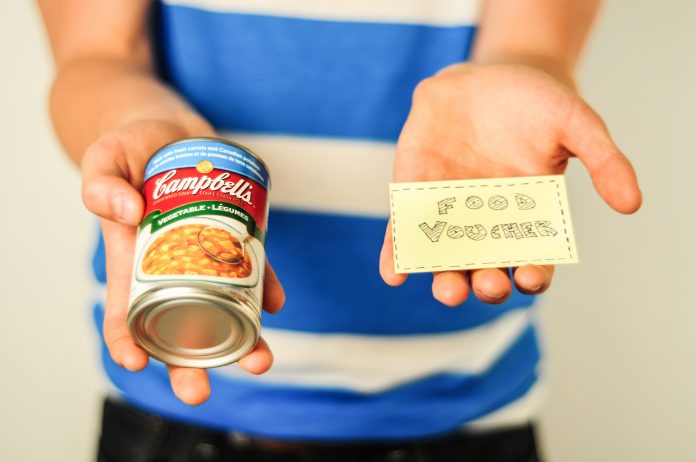
The downtown site will now offer food vouchers, redeemable at Nester's.

The Simon Fraser Student Society (SFSS) food bank has officially expanded its reach to the Vancouver campus at Woodwards, and plans to expand to SFU’s Surrey campus in the near future.

According to the SFSS board of directors, $500 has been allocated for 100 Dining Hall vouchers for Burnaby, $1,875 for 75 Safeway vouchers for SFU Surrey, and $2,000 for 80 Nester’s Market vouchers at the Burnaby or Vancouver locations.

Vouchers are now available at the SFSS general office or at Nester’s Market opposite Woodwards.

The SFSS took over responsibility for the program on October 1, 2013 after Student Services withdrew its support.

According to SFSS president Chardaye Bueckert, the SFSS was “committed to making sure that students could access needs based food support on campus.” This led to the aforementioned voucher system that is currently in place at SFU campuses.

In an interview with The Peak, Bueckert and Faculty of Communications, Art and Technology representative Shirin Escarcha explained the role of the SFSS in the food bank program and its expansion to Vancouver.

The SFSS’ Food Bank Working Group, which is spearheading the project, wanted to explore the possibility of “serv[ing] the students who are primarily based in downtown campuses, not only in Woodwards but at Harbour Centre as well,” Escarcha explained.

The two lauded the voucher system, which offers redeemable coupons worth $25 at a time, broken down into two $10 vouchers and one $5 voucher. The vouchers can be used to purchase any food product in Nester’s Market. Bueckert commented, “Instead of just having canned, non-perishable foods, they [students] can access produce and dairy and people with dietary restrictions have a larger variety of options.”

The receipts that are given to students are copied and returned to the SFSS, who then reimburse Nester’s Market for items purchased with the vouchers. Statistics compiled by the board from these vouchers show that 63.63 per cent of all food purchased between January and March 2014 was perishable. Of this percentage, nine per cent was junk food and 2.89 per cent was frozen food.

Bueckert explained these findings: “Clearly people are using [the voucher system] for healthy food, they are making good use of it [. . .] I feel like this program has a real advantage over a traditional food bank model.”

Students using the vouchers can also pick up granola bars, donated by Nester’s Market Nester’s Market also encourages customers to contribute their Nester’s Points to the SFU Food Bank program.

The Food Bank Working Group is working to establish ties with other stores around the Surrey campus in order to launch the program there sometime over the next few months.

Escarcha remarked, “At the end of the day, it’s about erasing stigma for students, and so we want to ensure that everybody from all campuses has the most convenient access to this program.”

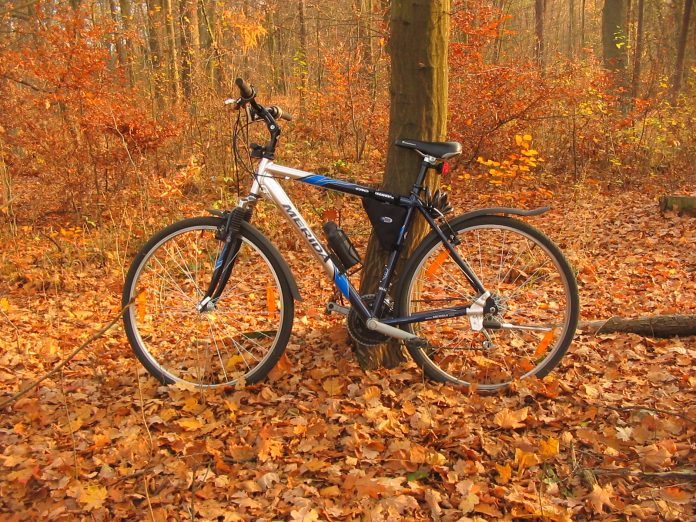
Ditch the treadmill and bike to work

0

Most doctors recommend that people engage in aerobic exercise for 30 to 60 minutes, three to five days a week, in order to maintain a sufficient level of overall health. For many people, this means cramming a run or a visit to the gym into your busy schedule, but as it turns out, this may not be your best option.

The belief that going to the gym and jogging on a treadmill are effective workouts is wrong; not only do these inflict stress on our hip, knee, and ankle joints, but they are time-consuming activities that burn fewer calories than other forms of outdoor exercise. What if I told you about an aerobic exercise that could improve your fitness, while also saving you time and money?

Cycling is one of the best aerobic exercises for losing weight, shaping your figure, and enhancing the strength of your lower body. According to a study conducted by the National Forum for Coronary Heart Disease Foundation, cycling regularly can take you to the fitness level of someone 10 years younger, and dramatically reduces the risk of heart diseases.

What about that beer belly you’ve been trying to get rid of? According to research conducted by the Harvard School of Public Health in Boston, those who bike as few as five minutes a day lose significantly more weight than those who do not.

The benefits don’t stop there. Unlike running and other high impact activities, biking strengthens your hips and knees without stressing your joints. It is unlikely to lead to knee complications such as arthritis and other orthopaedic problems. Cycling could significantly benefit people who have difficulties with mobility, not just those who are overweight or inactive.

Those who bike as few as five minutes a day also lose significantly more weight than those who do not.

Visiting the gym is a time consuming activity — it’s a luxury that can be difficult to fit into a busy day. However, something as simple as biking to work will save you time and money. Not only will you liberate yourself from the gym, but your commute may be faster, not to mention more enjoyable.

Depending on the geographic features of your daily commute, cycling to work could be significantly beneficial in saving you transit time. Even if it doesn’t, the added time would likely be offset by covering your exercise component for the day.

If you need further convincing to embrace your two-wheeled companion, talk with Louis Goddyn, a veteran Burnaby Mountain cyclist. Louis believes that his annual savings from cycling to work total $6,150. That’s a lot of coffee (or paid-off student debt).

But don’t just do it for yourself, do it for the rest of us as well. By doing something as simple as running an errand by biking, we can realize significant savings to our health care system. The more we cycle, the better the infrastructure becomes. The better the infrastructure, the more people cycle. It’s a wonderful positive feedback loop.

If you’d like to live an active lifestyle that saves you time and money, take the plunge and embrace your two wheels.

Shakeout BC hits SFU

0
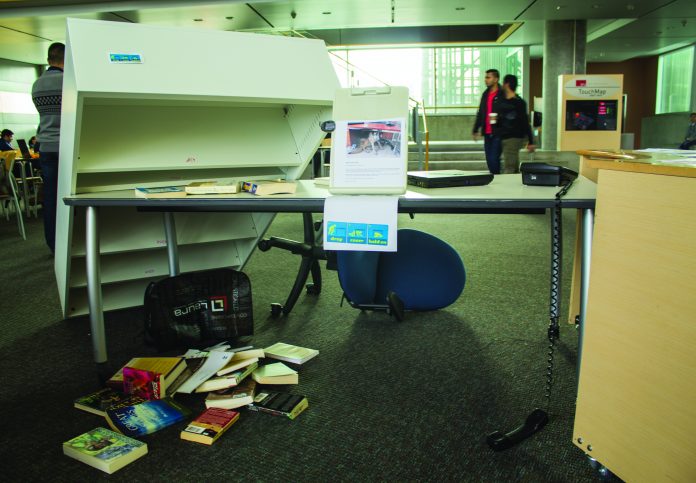
The mock-up of a post-disaster zone demonstrated the importance of securing your space.

Members of the SFU community were encouraged to “drop, cover, and hold on” last Thursday, October 16, as the university participated in Shakeout BC.

Shakeout BC is an annual event that involves people not only in BC, but all over the world, performing the same earthquake drill. This year’s drill took place at 10:16 a.m. and approximately 73,000 people participated in BC alone.

The event was held at all three SFU campuses from 9:30 a.m. to noon. SFU’s Safety and Risk Services (SRS) set up information booths and displays in order to educate passersby about earthquake preparedness, and even practise the drill with people walking by.

The day held a particular relevance for the SFU community, as the university is located in the Lower Mainland of BC, one of the most seismically active regions in Canada.

The main goal of the organizers was to stress the importance of being familiar with the internationally recognized safety procedure, “drop, cover, and hold on.”

“A lot of people are unsure of what to do if they felt an earthquake,” said Miranda Myles, emergency and continuity planner for SRS. She explained that a surprising number of people who came up to the booths were unfamiliar with the procedure.

There was also a session on earthquake safety hosted by ResLife staff in the Dining Hall the night before.

For the event, SRS staged a mock-up of a post-earthquake scene. The rooms demonstrated how an office might look if none of its furniture had been secured prior to the earthquake.

Myles explained this was “to show the importance of securing your space and making sure the things around you are secure.” This could mean fixing furniture in place or removing heavy items from high places.

Last year, SRS published a video in which McFogg the Dog demonstrates how to respond to an earthquake in various campus settings.

“You do the same thing no matter where you are,” said Myles. “Drop to the ground. If you don’t have a table to get under, you still cover your head with your hands, and try to tuck up against something like a wall, something sturdy that you can brace yourself against.”

She continued, “After the shaking stops, you should stay wherever you are for about a minute just to let things settle, and to take a minute to look around. Then proceed outside. We want to encourage people to stay away from buildings and move into more open areas like parking lots and the field.”

The video also includes some advice from SFU president Andrew Petter on how to prepare for an earthquake. “Prepare an emergency kit with items like food, water, a flashlight,” he said. “And any other essential items,” he added, as he put a stuffed bear into his go bag.

Satellite Signals

0

Woodward’s

The Vancouver Polish Film Festival came to SFU Woodward’s over the weekend of Oct. 17-19. The festival featured screenings of 12 different noteworthy Polish films.

The three-day event showed films of various genres, including documentaries, dramas, thrillers, and comedies.

Harbour Centre

This month’s Lunch Poems brought poets Tim Bowling and Donato Mancini to SFU’s Harbour Centre campus last Wednesday, Oct. 15.

The event occurs at noon on the third Wednesday of each month and includes readings from the featured writers. Participants are encouraged to bring their lunch and enjoy a “unique vibrant exchange of poetic ideas.”


Surrey

SFU’s World Literature Program presented An Evening with Anosh Irani in the Westminster Savings Theatre last Thursday evening. Irani, a novelist and playwright, spoke to the role of literature in addressing social issues such as terrorism.

In his talk, “The Discomfort Zone: Why Literature Should Unsettle Us,” he discussed how literature helps us to understand absurd social phenomena, as well as the inspiration for his own works.

Restaurants should incorporate a no-tip policy

0
Many customers feel entitled and inherently deserving of impeccable service.

Our society accepts the restaurant industry’s hyper-sexualized, customer-driven culture as normal. Many customers feel highly entitled and inherently deserving of impeccable service, regardless of their behaviour toward restaurant staff catering to their every whim. Unfortunately, this entitlement often turns into verbal and sexual harassment.

According to a report from the New York Observer regarding sexual harassment within the service industry, 90 per cent of female restaurant workers have been verbally and sexually harassed at work. This may be due to the current cultural structures that surround the service industry, as they perpetuate certain attitudes that enable harassment.

Not only can customers be culprits, but many servers have accepted this system as a fixed set of cultural norms. Having worked in the service industry for a number of years, I’ve often felt pressured to cozy up to my customers to get to know them on a more personal level. I understand the rationale behind this — it encourages customers to return and ultimately fills a server’s pocket with more change. Often, though, the fine line between ‘friendly’ and ‘too friendly’ is crossed in order to make that 20 per cent tip.

Tipping culture puts servers in unsafe positions.

To change this established dynamic between customers and servers, a shift in power must be employed, and my solution would be to introducwe a ‘no tip’ policy. While restaurants rely on customers to subsidize servers’ wages, they could instead mark up their menu prices by a certain percentage, and pay their servers a living wage. To revoke a customer’s tipping option changes the dynamic between the customer and server by creating a level playing field — one in which servers no longer feel obligated to tolerate inappropriate customers.

While this model provides a straightforward solution in theory, it has faced some resistance. The Smoke ‘N’ Water restaurant in Nanoose Bay initially began business with a no-tip policy, though it recently switched back to the classic tipping-system due to customer preferences. Owner David Jones believes that his restaurant was slightly ahead of the curve — despite popularity with the staff, customers were unhappy with the policy, as many of them believed that tipping promotes good service.

The reality is that tipping culture creates an environment where customers are ‘always right’ and servers are placed in vulnerable positions. Rather than encouraging impeccable service, tipping fosters a work environment that encourages servers to humour or tolerate inappropriate customers who enjoy pushing boundaries. Servers should not have to throw away their dignity in exchange for a 20 per cent gratuity.

Transitioning to a ‘no-tip’ policy will not happen easily, as it always takes time to shift a cultural paradigm. However, despite the skepticism, I believe this model would change the restaurant industry for the better; without it, servers will continue to accept different forms of harassment as part of their job description.

International study to address climate change in the workplace

0
The project’s aim is to investigate green options in the workplace.

An SFU professor has joined a newly formed international research project to assess the impact of the workplace on climate change, and to make recommendations as to how certain sectors can improve their carbon footprints.

John Calvert, an SFU adjunct professor of political science and an associate professor of health sciences, is part of the team which has been awarded a Social Sciences and Humanities Research Council (SSHRC) grant to pursue their research.

The team’s project, called Adapting Canadian Work and Workplaces to Respond to Climate Change (ACW), will investigate how Canadian workplaces can be modified to minimize greenhouse gas emissions. Furthermore, ACW will examine what changes should be made in law and policy in order for businesses and workplaces to be as green as possible.

Over $2.5 million dollars has been given to the York University-led project. The SSHRC team is a collaboration of 36 participants from 17 organizations in Canada, the US, and the UK. Team members represent a range of 20 different disciplines, professions, and trades.

Project members will conduct their work in six stages, and in four groups. As an associate director of the Built Environment group — which will consider human-made surroundings that provide the setting for human activity — Calvert will have a leading role.

Although Calvert acknowledges that changing law, policy, and getting the government on board will be a challenge, the aim of ACW is to transition Canada into a lower-carbon economy. The industries that the ACW project will look into are construction, energy, manufacturing, and public and private services.

Calvert emphasized that action will be needed with or without the full support of the government. “Regardless of what party is in office, we will need to develop the skills, knowledge base and best practices in order to address climate change in the workplace,” he said.

Calvert already has some experience creating policies for the BC government, as well as with policies concerning monitoring, training, equity, and employment related to the Vancouver Island Highway project. With regards to the SSHRC project, Calvert told The Peak that he will apply this experience, with a more pronounced green focus, to his research.

Specifically, Calvert will be examining the construction industry; his knowledge of policy related to construction projects in BC provides him with suitable insight into the inner workings of the industry’s workplaces.

“My focus is the impact on work in the construction industry and the extent to which ‘green’ working practices are being integrated into the training and skills development of building workers,” he said.

According to Calvert, conducting research in climate change, investigating new laws and policies, and developing new strategies for greener work environments will allow ACW project to anticipate the jobs and workplaces of the future.

CLIVE takes People’s Choice Award at MIT contest

0
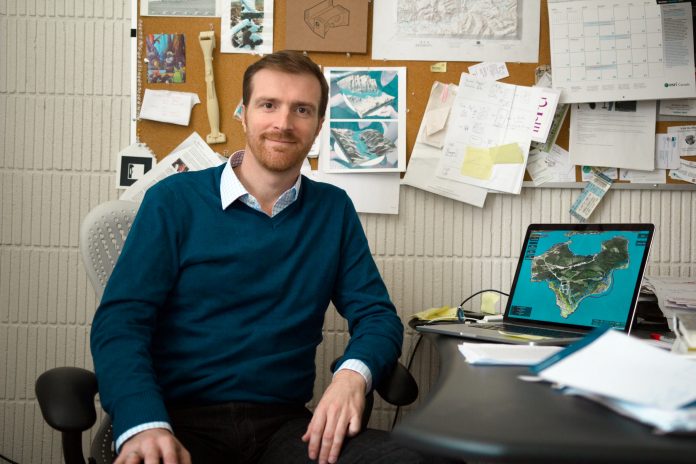
Nicholas Hedley, director of SIRL, and a SFU professor of geography is one of the co-creators of CLIVE.

CLIVE (Coastal Impact Visualization Environment) is a project co-directed by an SFU professor. The project won the People’s Choice Award at a major MIT-sponsored contest that concluded in early October.

The contest, entitled ‘Communicating Coastal Risk and Resiliency,’ focused on identifying projects that facilitate the communication of climate change data to the public, while also providing a system from which real solutions can be identified.

CLIVE is the product of a cross-country collaboration between SFU’s Spatial Interface Research Lab (SIRL) and the University of Prince Edward Island’s (UPEI) Climate Research Lab. This technology combines sea level rise and coastal erosion predictions with complex spatial data from PEI, and runs this data through a 3D game engine.

Operating as a computer program, it is controlled with either a keyboard or a game controller. The user is able to navigate within a virtual representation of PEI and trigger visual projections of sea level rise and coastal erosion for a given year (ranging from 1968 to 2100) to see how the land is impacted.

“The dialogue it has stimulated is one of our greatest success stories. It has brought science, our best science, into the public realm,” said Nicholas Hedley, director of SIRL, and a SFU professor of geography. Hedley is one of the co-creators of CLIVE, and brought his extensive background in 3D geovisual analytics to the team.

Hedley continued, “People are no longer relying upon abstract names of government science projects, wondering what it means to them. CLIVE allows them to see what it means to them, what the implications will be.”

Although the program is focused on PEI — a region identified as particularly susceptible to sea level rise and the accompanying consequences — Hedley explained the broader applications available: “One of the greatest accomplishments with this is not just with what we’ve built, but having created a workflow that is scalable and can be applied anywhere.

“We’ve had interest from countries in Europe, the Caribbean, down in the States; some are small communities [. . .] but some are whole municipalities, cities, and a couple of international governments,” added Hedley.

Hedley spoke to the real world implications of the data offered by CLIVE: “It is about designing ways to deliver data to citizens and stakeholders of all kinds, giving people infomocracy — democratic access to spatial information.

“If we’re going to make decisions about big serious problems, whether they have to do with health, environment, quality of life, every taxpayer is entitled to the information on which decisions will be made.”

Commemorative plaque returns to Freedom Square

1
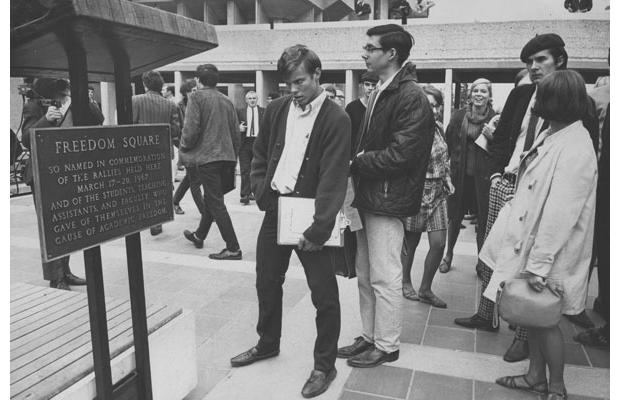
The original Freedom Square podium installed in 1968. Photo courtesy of SFU archives.

The Freedom Square plaque has been returned to SFU’s Burnaby campus after appearing and disappearing multiple times since its installation 47 years ago.

The Simon Fraser Student Society (SFSS) finally managed to track down this elusive piece of SFU history after beginning the search last year. It was restored to Freedom Square earlier this October.

The uncovered area east of Convocation Mall was given the name Freedom Square for its history of student political action.

In 1967, 2,500 students and faculty engaged in a sit-down protest in the area to demonstrate their opposition to the firing of five teaching assistants. The staff were reinstated as a result of the demonstration.

The plaque was installed the following year in commemoration of that protest and to recognize the spot as an important place for student activism, but has since spent more time away from SFU than at its home in Freedom Square.

UBC engineering students stole the plaque shortly after its installation in 1968, replacing it with an antagonizing ‘Fool’s Square’ plaque.

The plaque went on to reside in a UBC fraternity house for many years and eventually served as a TV stand for the UBC alumnus who returned it to SFU in 1990.

After its return, the Freedom Square plaque was rededicated in fall of 2000, only to disappear soon after.

The SFSS recently discovered that the plaque made its way into a storage space under a staircase in Convocation Mall. Facilities services told the SFSS that it was there for at least 10 years.

The plaque spent some years as a TV stand before being returned.

“It was a bit of a challenge to get it remounted, because nobody actually knew where it went,” explained SFSS president Chardaye Bueckert.

She also commented on the SFSS connection to the plaque: “It’s actually kind of cool. [The group that installed the plaque] was the equivalent then of the SFSS. They called themselves the SFU Student Council, but it was actually the student union who paid for it and mounted it in the first place.”