

By: Niveja Assalaarachchi, News Writer
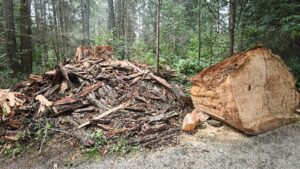
In early September, a 400-year-old Douglas fir tree was found cut down in Stanley Park. The tree, measuring 38 meters tall and 30 centimetres wide, caused “significant damage to an adjacent riparian area” when it was chopped down.
The Stanley Park Preservation Society raised concerns about the felling of the tree. Founded in 2024, the non-profit’s mandate is to preserve the park’s natural environment and advocate for the scientific assessment of its flora and fauna. They alleged that multiple levels of government have failed to take the proper precautions to conduct tree risk assessments, which are needed for a tree to be felled.
The organization launched an independent inspection of the Douglas fir by sending two independent risk assessors. The assessors found that the stump of the tree was sound, and the “natural decay” at the top of the tree posed no threat.
The City of Vancouver informed the preservation society the tree had died during a rainstorm in August and had overhanging bark, posing a risk to public safety. The risk assessors disagreed. In their report, they documented that the felled tree was “5.5 meters from the trail with no lean,” making the possibility of the tree having overhanging bark unrealistic.
Douglas firs are among a handful of conifer tree species that are found throughout Stanley Park. Some, like the felled tree, are a part of a collection of old-growth trees seen in the park. Old-growth trees “provide unique habitats, structures, and ecological functions not available in younger stands,” and they’re “very important to First Nations and the public, whether for biological, spiritual, aesthetic, economic, or cultural values,” according to the provincial government. The trees “are highly effective at trapping climate-warming greenhouse gases like carbon dioxide from the atmosphere,” and also “act as a water treatment network” to “clean our water and air.” The trees are also difficult to replace, given that they take hundreds of years to grow.
However, they are being placed under threat due to increases in private logging and mandated felling by the municipal government. The City of Vancouver has stated that trees are only removed from city parks if they pose a major threat to public well-being.
The Peak spoke with Jillan Maguire, a director of the preservation society, for her thoughts on the felling of the Douglas fir.
“It’s really symptomatic of the City of Vancouver’s lack of proper process in cutting these trees down”
— Jillan Maguire, director at Stanley Park Preservation Society
Maguire spoke about poor communication between the City and her organization, saying, “We started communicating with the City through email and would go to the Park Board meetings and talk to them about this. But we really weren’t getting anywhere.
“We weren’t getting any response from the urban parks department or the parks and recreation. Nobody seemed to give us any satisfactory answers,” she continued.
“Stanley Park is world famous for its semi-wild environment. You can just walk down if you live in the city [ . . . ] and you can be in old growth forests,” said Maguire.
“It’s a real wonder, and we feel we have to do everything possible to protect what’s left.”