

By: Lucaiah Smith-Miodownik, News Writer
The year 1965 saw the development of the modern Canadian flag, the first spacewalk, Malcolm X’s assassination, and other notable events. It was amid the backdrop of these events that The Peak, SFU’s independent student newspaper, was born. 60 years later, The Peak continues to publish issues weekly.
To celebrate this anniversary, the paper contacted editors from The Peak’s founding era as well as more recent times to explore how the publication has changed, and what impact its work has had on those involved.
The publication as it exists today is the result of the dissolution of two preceding rival papers, The Tartan and S. F. View. In his essay shared with The Peak titled “Peak Beginnings,” founding member Rick McGrath explained the series of events that led to its creation. The story involves former student Don Pulsford, who recruited McGrath and others to start SFView in an effort to take down The Tartan.
Dubbed “SFU’s surprisingly instant student newspaper,” The Tartan was founded by Lorne Mallin, who transferred from UBC in hopes of starting a paper where he could be editor. To some students’ displeasure, Lorne was running the publication in an “autocratic” fashion, according to McGrath. In the end, S. F. View was successful — both papers dissolved and staff from each respective publication agreed to merge into one. On October 20, 1965, The Peak published its first issue.
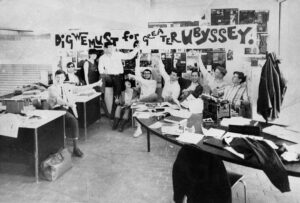
“The Peak office was basically our campus hangout,” said Rick McGrath, founding member and also the first sports editor for the paper. “It was great because I got access to a typewriter for essays,” he added. “Every week, there was a big story. There was so much happening on campus at that time.”
“It was chaotic, wonderful, and endlessly ongoing.” — Rick McGrath, founding member of The Peak
“Everything was sort of being figured out and argued about and demonstrated against.”
In an essay shared with The Peak, McGrath recalled that in 1965, students gathered to protest SFU’s decision to provide Shell Canada with the rights to a campus gas station “in return for financing the new men’s residence.” The following years brought more student activism, including the 1968 student occupation of an administration building, which resulted in 114 arrests.
While still at SFU, McGrath “edited Canadian University Press news releases” before landing a job at The Georgia Straight after his time at The Peak. He then went on to work for the now-defunct publications Terminal City Express and Richmond Review, eventually becoming assistant editor. McGrath’s career path ultimately led him to advertising, where he co-founded his own company (McGrath Dunn Advertising) in 1978.
The Peak’s role in reporting on social issues has extended beyond campus through the years as well. Former editor-in-chief Kelly Chia explained what working at the publication from 2019 to 2024 meant to her. “At The Peak, something we were keenly aware of is that objective news reporting necessarily has to include the communities we cover in an equitable way, especially if they’ve had damaging narratives surrounding them perpetuated by news media,” Chia wrote.
“2020 was a year where we had a lot of responsibility as a platform to educate readers on how BIPOC are overpoliced and discriminated against, and to proactively reach out to work in collaboration with BIPOC and 2SLGBTQIA+ writers, leaders, creatives,” she said. The Peak also reached out to Ian Rocksborough-Smith, features editor in 2002 and 2003, for insight into the publication’s middle years, but could not interview him by the publication deadline. The Peak also reached out to Gabrielle McLaren, who served as editor-in-chief from 2021 to 2020, but did not receive a response by the publication deadline.
These “damaging narratives” are “something I’ve experienced personally when wrapping my own mind on the sharp rise of anti-Asian hate crimes in 2020 as a Malaysian-Chinese citizen, a piece I wrote with other members of the Asian diaspora in response to news coverage around the Atlanta shooting in 2021,” she explained.
Chia also discussed the impact the onset of the COVID-19 pandemic had on the publication. “We shifted wholly to online production of the paper,” she said. “A lot of news interviews and events were done online. Often these events were transcribed online on Zoom, so that made it easier for news writers to transcribe for their pieces.”
“As students ourselves trying to adapt to this period of isolation, I think we tried to connect with each other as best as we could,” Chia added. She explained how, when she was a staff writer, then Editor-in-Chief Marco Ovies “would do weekly movie nights remotely, which was a nice way to connect.”
Shifting to online “also made it a lot easier for our news writers and the student community to join in for SFSS meetings, which were also held remotely,” Chia said. “We found it easier to have writers cover SFSS meetings and agendas, given their mixed schedules. I think in general we also were able to document more student engagement,” she said, giving the example of students joining an SFSS meeting over Zoom “to express their dissent and concern to the councillors directly” about a policy.
Here’s to 60 years of The Peak, and more to come!
Those interested in browsing past articles can do so through The Peak’s archives