

By: Maya Barillas Mohan, Staff Writer
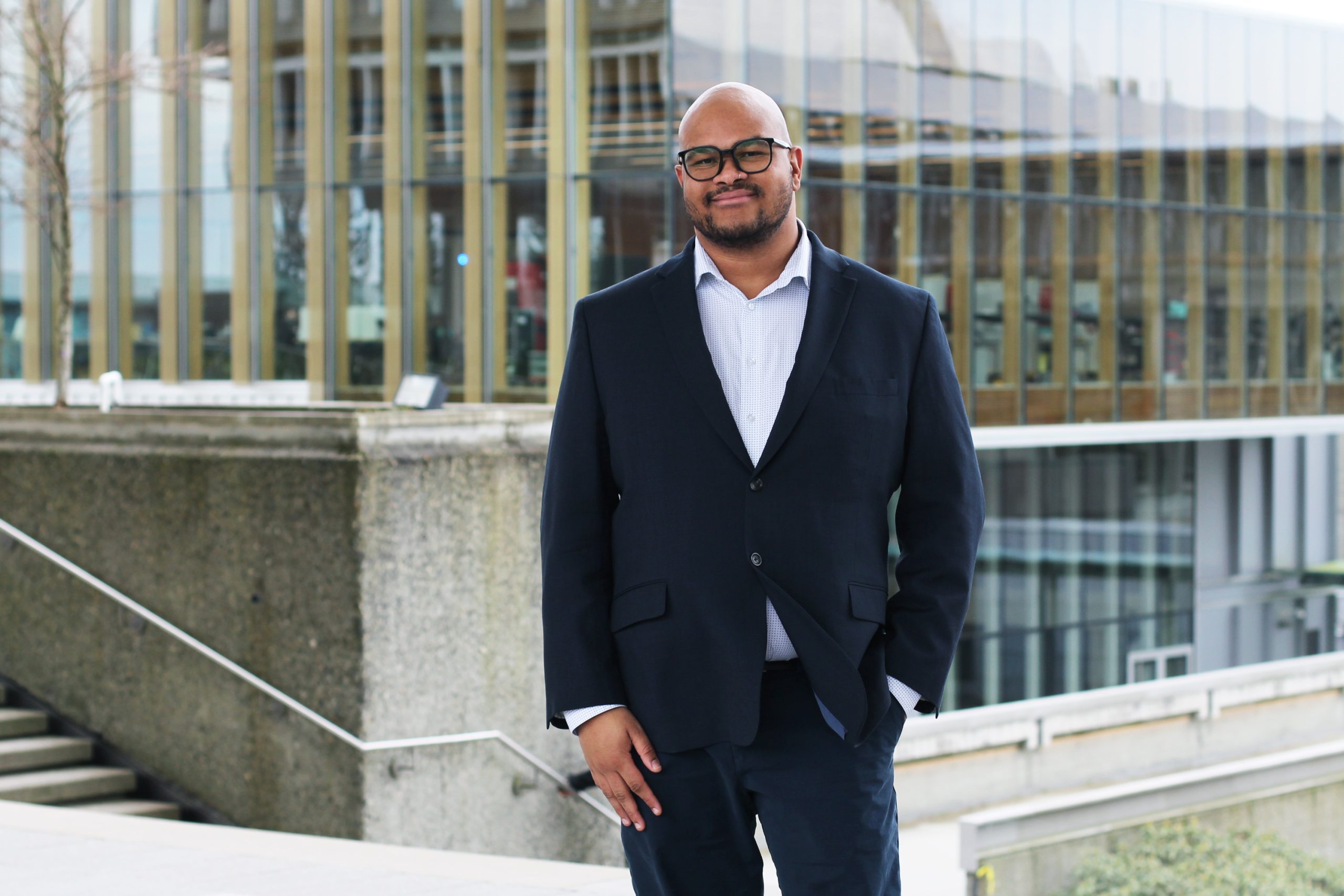
Dr. Cornel Bogle is an assistant professor in the English department currently teaching ENGL 361, “Diaspora Literatures” and ENGL 852, “Studies in Gender, Sexuality, and Literature.” He leads both undergraduate and master’s classes, writes poetry, and enjoys watching cricket in his leisure time. Fondness for the sport is informed by time spent in Jamaica; so, too, are his studies.
In describing his work, Bogle tells The Peak he prefers the term Caribbean studies over Black diaspora literature because the Caribbean is a region “of multiplicity. It was one of complex simultaneous experiences that are both different but inseparable.” He adds,
“When I say Caribbean, it’s like, ‘yes, Black and.’ Yes, I do Black, but I also think about the ways in which Blackness is not a singular thing. It’s multiple and it’s experienced in multiple ways, depending on where you are in the world.”
“And so that’s the kind of approach I take to thinking about and that’s very much informed by my own background.” Bogle’s mother is Afro-Jamaican and his father is “mixed with Afro-Scottish, European, and other forms of ethnicities.”
Reflecting on how the Caribbean has been essentialized by the tourism industry as paradise in the 20th century and as the birthplace of the fastest man alive in the 2000s, Bogle says,
“I was always interested in how people from the Caribbean get caught into certain narratives, particularly as they migrate, because migration is such a key part of Caribbean experience.”
Expanding on identity as multi-faceted, he says diaspora life “resists an easy narrative; it’s complex, fraught, and littered with multiple affects, emotions, and experiences.” Bogle told The Peak he thinks about how Black experience is often “reified into something singular” and added, “I think about queerness as a queer person as well as neurodivergence.”
As a self-described “younger racialized faculty,” Bogle says academia is only one of many pathways, but Bogle pledges to be candid about the challenges that exist in academia and guide students through the invisible curriculum. “There’s a way in which those whose families have gone to universities generationally pass on knowledge about what it means to be a university student, whether or not it’s consciously or unconsciously. If you’re raised in that kind of family where your parents went to university, your grandparents went to university, there’s something about the culture of a university that you’re raised with.” This unspoken culture is unknown to those who may be the first in their families to attend university. Bogle explains that understanding university structures, like knowing “who the provost or chancellor are” is part of that necessary cultural education. Building community and connecting with other Black scholars is valuable in this context. Bogle does just that as a founding member of the Institute of Black and African and African-diaspora Research and Engagement Steering Committee at SFU. The committee helps “bring together scholars, students, and communities to explore the rich histories, cultures, and contributions of Black and African peoples globally, while addressing the pressing challenges they face.”
Passionate about the process of hands-on learning, Bogle shared his approach to teaching u. The flipped classroom model lets students reach their own conclusions by encouraging them to collaborate with him and each other. Discovery is not about outcome, but rather the “knowledge encountered during the process of creating.” Besides, Bogle continues, “I never want to tell people the answer. The answer is never one thing.” Learning is active and ongoing, and Bogle shares that he finds being a “facilitator of conversations” rewarding.
Bogle’s dedication to research-creation as a method transmits naturally to his poetry. Last term, he invited students directly into his revision process. He started a poem from scratch, editing the poem through a trail of iterations. Titled “Queer Use,” it began from a moment of observation out in the community: “A disco ball glimmers / under a salmon door, / half-open while
rain needles the frame.” Bogle tells The Peak he was captivated by a salmon-coloured store filled with beautiful, delicate things that reject a primary practical purpose. He describes the items for sale, like tiny cups, as a queer aesthetic and acknowledges the privilege present in access to spaces engendered by beauty and craft instead of utility. Bogle thoughtfully concludes that “limits of certain things don’t have to negate the beauty of a space.”