

By: Lucaiah Smith-Miodownik, News Writer
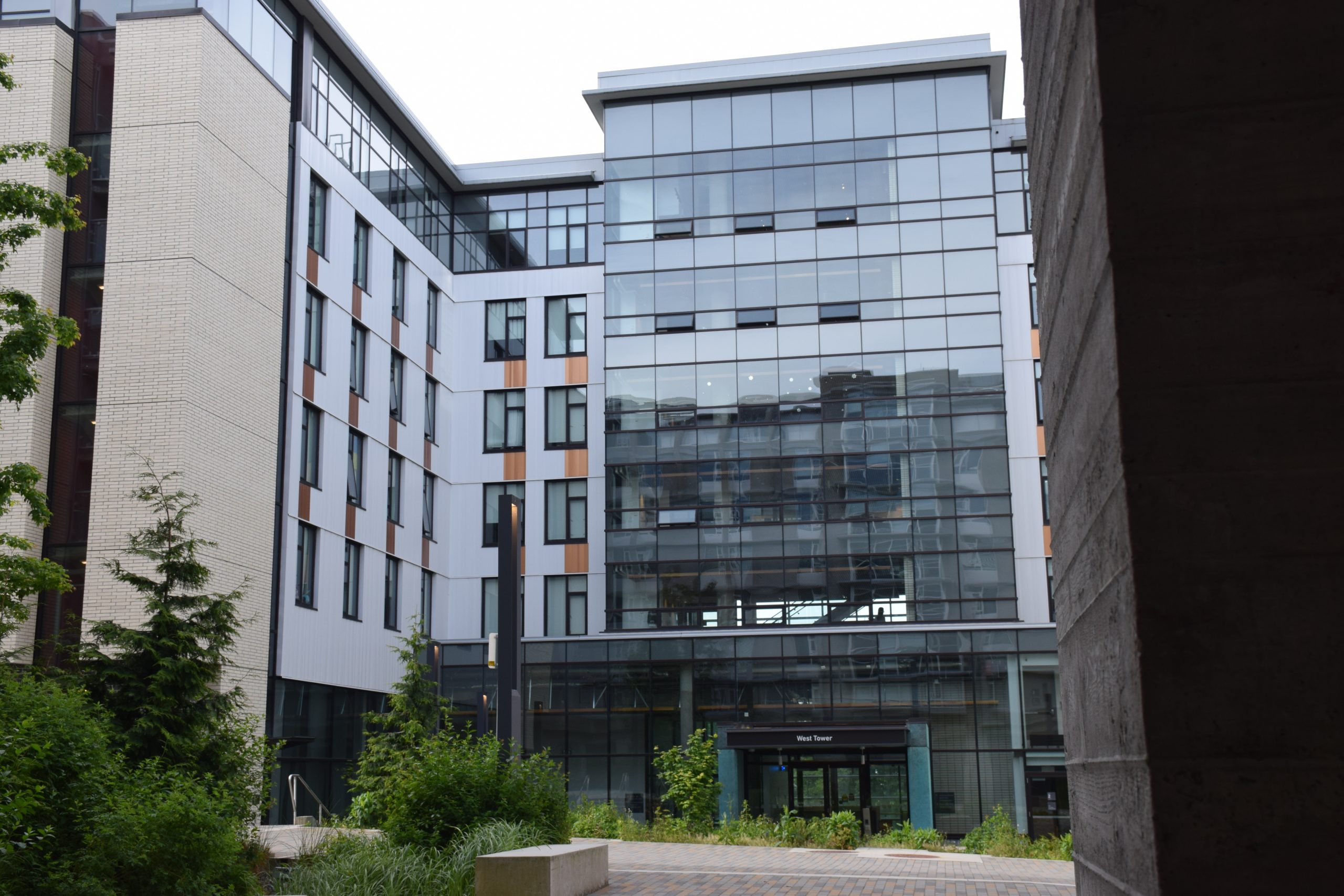
Securing housing can be a serious struggle for university students, and those at SFU are no exception. SFU recently broke ground on a new residence building, with the additional 445 beds increasing the university’s housing capacity to around 8% of the student population. The project represents phase three of the university’s Residence and Housing Master Plan, with more housing construction in phases four and five to follow.
Still, SFU continues to seek opportunities to expand student residence. Recently, a proposal from Forum Asset Management, an “investor, developer, and asset manager,” represented such a possibility. The Toronto-based company sought to build a privately owned residential complex off campus at the base of Burnaby Mountain, at 9809–9998 Rathburn Drive. SFU said “the university has no affiliation with the recent application” and “has not endorsed individual projects.” However, “it remains supportive of off-campus student housing developments and recognizes the housing challenges faced by students.”
However, the project was denied primarily due to environmental concerns, among other issues.
On October 28, Burnaby city council voted “against authorizing city staff to continue working with Forum on preparation of a development plan.” The new development would have included “950 dedicated purpose-built student housing units and 450 secured purpose-built rental housing units for general rental uses,” reported Daily Hive. The student housing would be intended for those in the “latter stage post-secondary” category, since “the availability of on-campus student dormitory accommodation is significantly limited for these students.”
The land Forum Asset Management hoped to use currently comprises 16 single-family homes, and would require rezoning as part of its transformation.
While all members of city council, except Pietro Calendino, voted no on exploring the proposal further, general city staff felt differently. The group, separate from city council, put out a report supporting the “continuation of work with the applicant on the development concept,” reported the Daily Hive. The report acknowledged “the need for additional student housing options in the area,” and “the contribution purpose-built student housing has on overall housing affordability.”
The Peak corresponded with city councillor Alison Gu for more information on the decision to deny the proposal.
“I have concerns that are related to wildfire risk and flooding in this area, which a budgeted-for but not yet completed hazards mapping strategy is supposed to provide recommendations on — this was a motion that was passed in January of 2025,” she said. The proposed area is next to Stoney Creek, which contains some endangered fish species and has already suffered “ecological damage from increased sediment caused by nearby building construction,” reported the Daily Hive.
“I am all for student housing and density in transit-oriented areas, but we need to have certainty that the people who move there are not then put at risk of flooding and fire.”
— Alison Gu, Burnaby city councillor
“Not only could those who move there then be put at risk of these hazards that are increasingly likely due to climate change, they can also create an additional risk of wildfire, as the vast majority of wildfires are started by human activity. With drier forests and hotter summers, these risks are substantially elevated, even if their starts are accidental.
“The recommendation we voted on was to provide staff authority to work on advancing an application, not to approve a rezoning application outright,” Gu clarified. “There was no finalized rezoning application put in place. At this time, given the early stages of the project, my vote was a direct reflection of not wanting to presuppose any outcomes of the hazard mapping or grandfather in applications that may not ultimately are not in the best interest of the community or the future residents who will live there.
“I do not operate with a black/white approach to housing, as I believe that the nuances and details matter. As such, all my decisions are measured carefully, with considerations for economics, affordability, tenure, unit distribution, environment, and more,” she added.