

By: Lucaiah Smith-Miodownik, News Writer
Content warning: mentions of systemic violence, overdose, and death
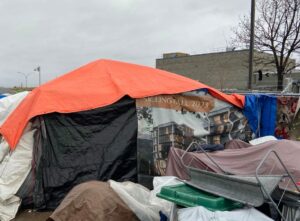
From Vancouver to Kelowna, community members are uniting in solidarity for those affected by ongoing tent city policies. In late March, residents along the Okanagan rail trail were forced to leave as officials capped the number of tents at 60. Additionally, some areas of the encampment are now reserved for overnight use only.
For some, the procedure is all too familiar. “It’s a coordinated strategy that cities are using. It’s intentional and thought out, and the rhetoric is identical,” advocate Fiona York told the Unhoused Solidarity Collective Okanagan (USCO), which focuses on elevating unhoused voices. The collective noted that officials used similar language in the case of CRAB Park in Vancouver, where a “clean-up” last March ultimately led to a forced closure in November.
The Peak corresponded with USCO and spoke with two community members who have spent time living in encampments about their experiences, their solidarity with those in similar situations, and what they would like to see change.
“One of my best friends actually died because of them cleaning up all the stores, or all the camps that were on Hastings Street. There was nobody on Hastings that night, and he overdosed right on the corner,” Kirstine Fuhrman said, herself also having experienced street sweeps. “If they hadn’t done that, then he’d still be alive,” she said. Using substances alone increases the risk of overdose, as no one is available to help during an emergency. A recent study also indicated that street sweeps “negatively affected respondents’ access to services,” like supervised consumption sites.
USCO reported that in Kelowna, “deaths among the unhoused have spiked since the City’s recent violent decampment of tent city.”
Despite the reduction in its size, the encampment “remains only 75% full.” The shortfall stems from the fact that the “vast majority” of residents refuse to sign a required Good Neighbour Agreement to stay.
One unhoused Kelowna community member, Timothy Freeman, explained to USCO that the agreement forces residents to surrender privacy and control over their own homes. The agreement also prohibits residents from having visitors. Bylaw officers can visit the site, but must do so on a set schedule to avoid any surprise inspections or confiscations.
The alternative, Fuhrman explained, isn’t always sufficient either. “They don’t want to offer you any actual housing; they just want to offer you things that are inadequate,” she said.
“I’d like to see some of these politicians actually stay in some of these places they’re offering us.” — Kirstine Fuhrman, unhoused community member
“It’s sad, it’s disheartening that they’re still getting away with these things against people, and it shouldn’t be happening,” said Athena Pranteau, a community advocate who spent time living in CRAB Park. Pranteau shared that she has been unhoused on two separate occasions, both “due to clerical issues from BC housing staff.” She may face the prospect of being unhoused with her two kids again, expressing a sense of “impending doom.”
USCO hopes to “gain some momentum with regards to resources for the unhoused that will significantly impact the ability for people to gain shelter and income in a way that’s sustainable,” the organization told The Peak. “How can any government make improvements without hearing from the very people they’re claiming to be helping? USCO wants to bridge the current disconnect and hopefully gain some community understanding during the process.”